Bombay Natural History Society (BNHS): India’s Oldest Conservation NGO
BNHS is India's oldest scientific conservation NGO, founded in 1883. Birds, vultures, Important Bird Areas, Salim Ali, publications, and UPSC pointers.
In a small office in colonial Bombay in 1883, eight British naturalists and Indian sportsmen gathered to share notes on birds, mammals, and insects they had observed across the subcontinent. Their record-keeping habit grew into one of the most consequential scientific NGOs in modern India. The Bombay Natural History Society, almost always abbreviated to BNHS, predates the Indian National Congress, the Forest Research Institute at Dehradun, and indeed the modern conservation movement worldwide. For 142 years it has documented Indian biodiversity, trained a generation of field biologists, and shaped the policy infrastructure that protects the country’s wildlife.
The Society’s logo is the Great Hornbill, a massive forest bird that itself represents the link between scientific curiosity and conservation urgency. Its global standing comes not from government backing but from sustained scholarly output: peer-reviewed journals, multi-decade bird surveys, captive-breeding programmes for critically endangered vultures, and the steady identification of Important Bird and Biodiversity Areas that now form the analytical backbone of conservation planning across India and South Asia.
For UPSC, BNHS is a tier-one institution in environment and ecology. It is named directly in question stems, recognised through its scientific outputs, and tied to figures such as Salim Ali whose work has framed Indian ornithology since the 1930s. This guide walks through what BNHS is, how it grew, what it does, why its work matters for policy, and what every aspirant must know for prelims and mains.
Quick Facts
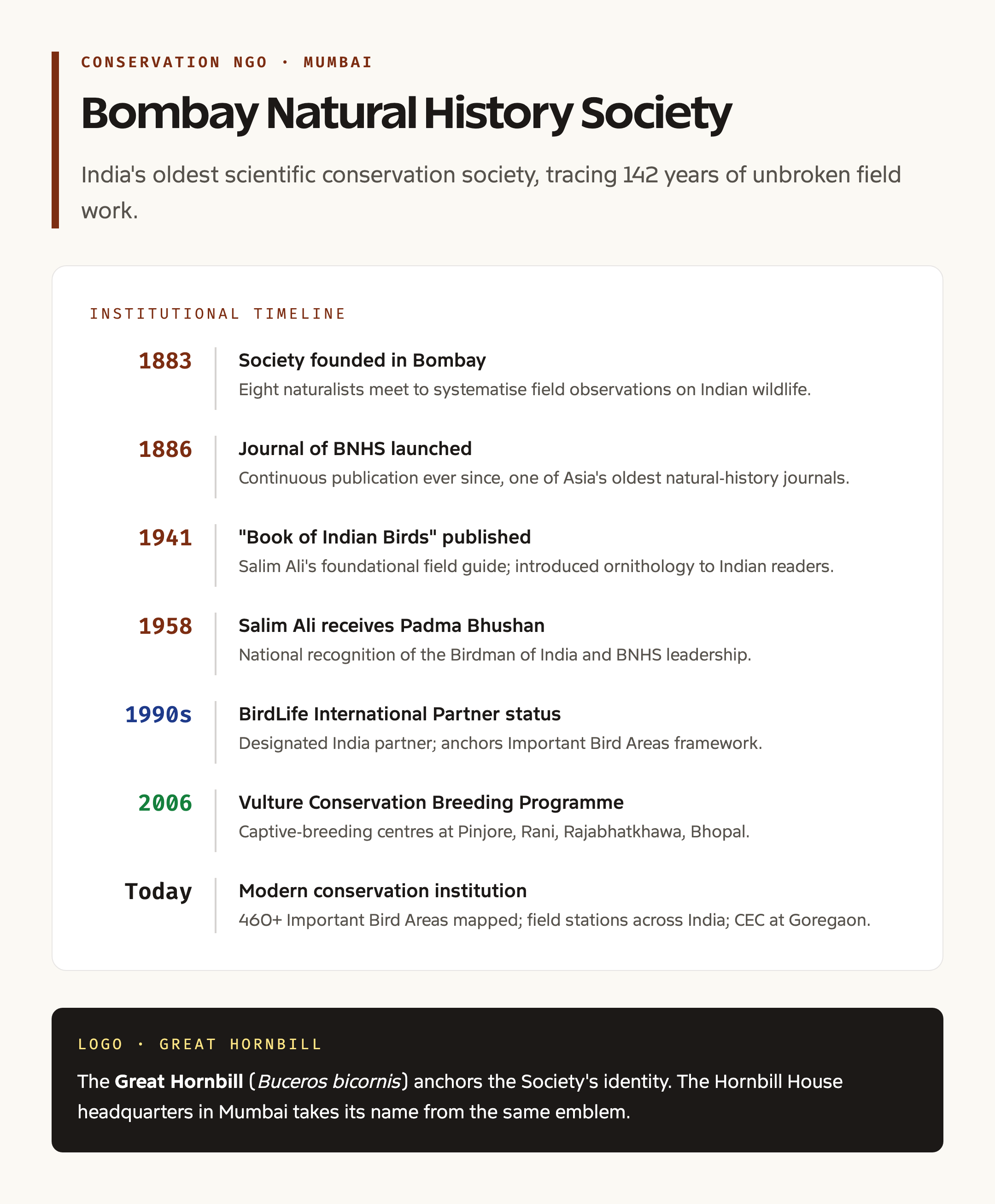
- Founded: 15 September 1883
- Headquarters: Hornbill House, Mumbai (Maharashtra)
- Status: Non-governmental, non-profit, scientific membership society
- Registration: Section 8 company under the Companies Act
- Logo: The Great Hornbill (Buceros bicornis)
- Motto: Conservation through research, education, and public awareness
- BirdLife International: Designated Partner in India
- Flagship publication: Journal of the Bombay Natural History Society (since 1886)
- Iconic books: The Book of Indian Birds, Handbook of the Birds of India and Pakistan
- Key programmes: Important Bird Areas, Vulture Conservation Breeding, Climate Change and Avian Studies
- Most famous member: Dr Salim Ali, the “Birdman of India”
- Padma Bhushan recipients: Salim Ali (1958), J C Daniel, others
- International funding: Darwin Initiative, MacArthur Foundation, RSPB
- Field stations: Bharatpur (Rajasthan), Pirotan (Gujarat), Point Calimere (Tamil Nadu)
What Is the Bombay Natural History Society
The Bombay Natural History Society is a scientific membership organisation that conducts research on wildlife, edits and publishes peer-reviewed scholarship, and advises government on conservation policy. It is constituted as a non-profit, runs largely on grants, membership fees, donations, and consulting income, and operates with full institutional independence from any ministry of government.
What sets BNHS apart from younger conservation NGOs is the depth of its archival and field record. The Society holds one of the most important natural-history collections in Asia, including specimens collected during expeditions led by Salim Ali, Humayun Abdulali, and S H Prater. Its library houses correspondence with Charles Darwin, William Hornaday, and the Bombay Presidency naturalists. These collections are not museum curios. They are working datasets that allow researchers to compare current species ranges and population trends against baselines from a hundred years ago.
The Society’s three core functions are scientific research, conservation action, and public education. Scientific research includes long-term bird ringing, wetland monitoring, and species recovery work. Conservation action takes the form of captive breeding for vultures, Important Bird Area mapping, and policy submissions to ministries. Public education runs through nature trails, camps, the Conservation Education Centre at Goregaon, and public lectures that have introduced generations of urban Indians to the natural world.
Background and Historical Context
The founding moment was modest. On a September evening in 1883, eight men met to formalise a society that would catalogue the birds, mammals, reptiles, insects, and plants they had been observing on shooting trips, jungle marches, and railway journeys. The early membership reflected the colonial era. British civil servants, military officers, and Indian sportsmen formed the initial roster. By the 1890s the Society had expanded to include planters, educators, and Indian princes who funded its expeditions and museum.
The first volume of the Journal of the Bombay Natural History Society appeared in 1886. It set a model that has continued for over a century. Each issue carries original research, field notes, miscellaneous observations, and book reviews. Some of the most valuable scientific data on Indian wildlife exists only in JBNHS pages, particularly distribution records of species that have since vanished from large parts of their historic range.
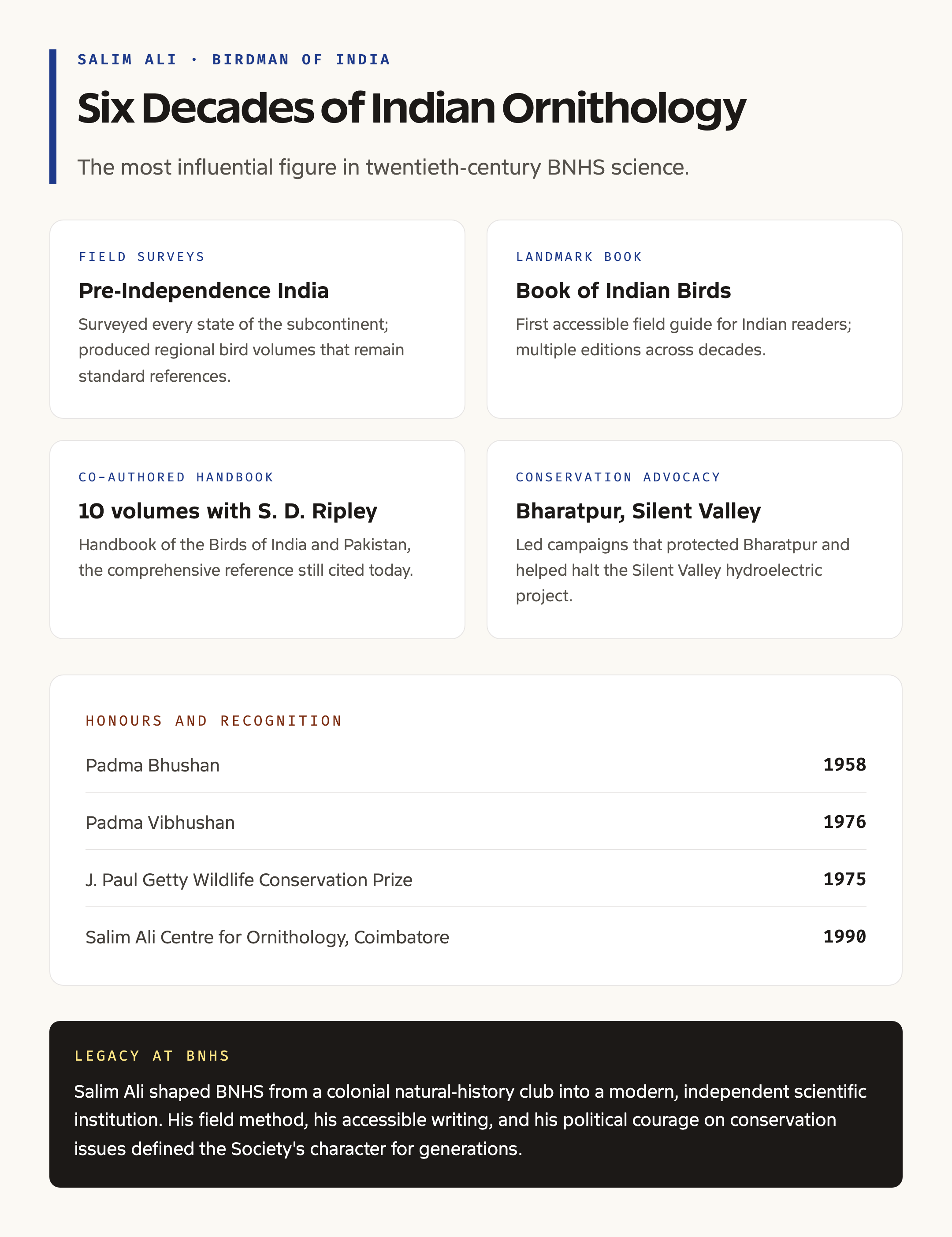
The Society’s transformation from a colonial natural-history club to a modern conservation institution accelerated under the leadership of Salim Ali in the mid-twentieth century. Ali’s surveys covered every state of pre-Independence India and produced the regional bird volumes that remain the standard reference. By the 1970s BNHS had emerged as the scientific partner of choice for the new generation of environmental laws in India, feeding evidence into the Wildlife Protection Act, 1972 and Project Tiger.
The institutional structure also evolved. BNHS designation as the Indian partner of BirdLife International gave it formal responsibility for global bird-monitoring frameworks within India. Field stations at Bharatpur, Point Calimere, and Pirotan extended its reach beyond Mumbai. The Conservation Education Centre at Goregaon, opened in the late 1990s, gave it a public-facing campus in the city.
Key Programmes and Provisions
Important Bird and Biodiversity Areas
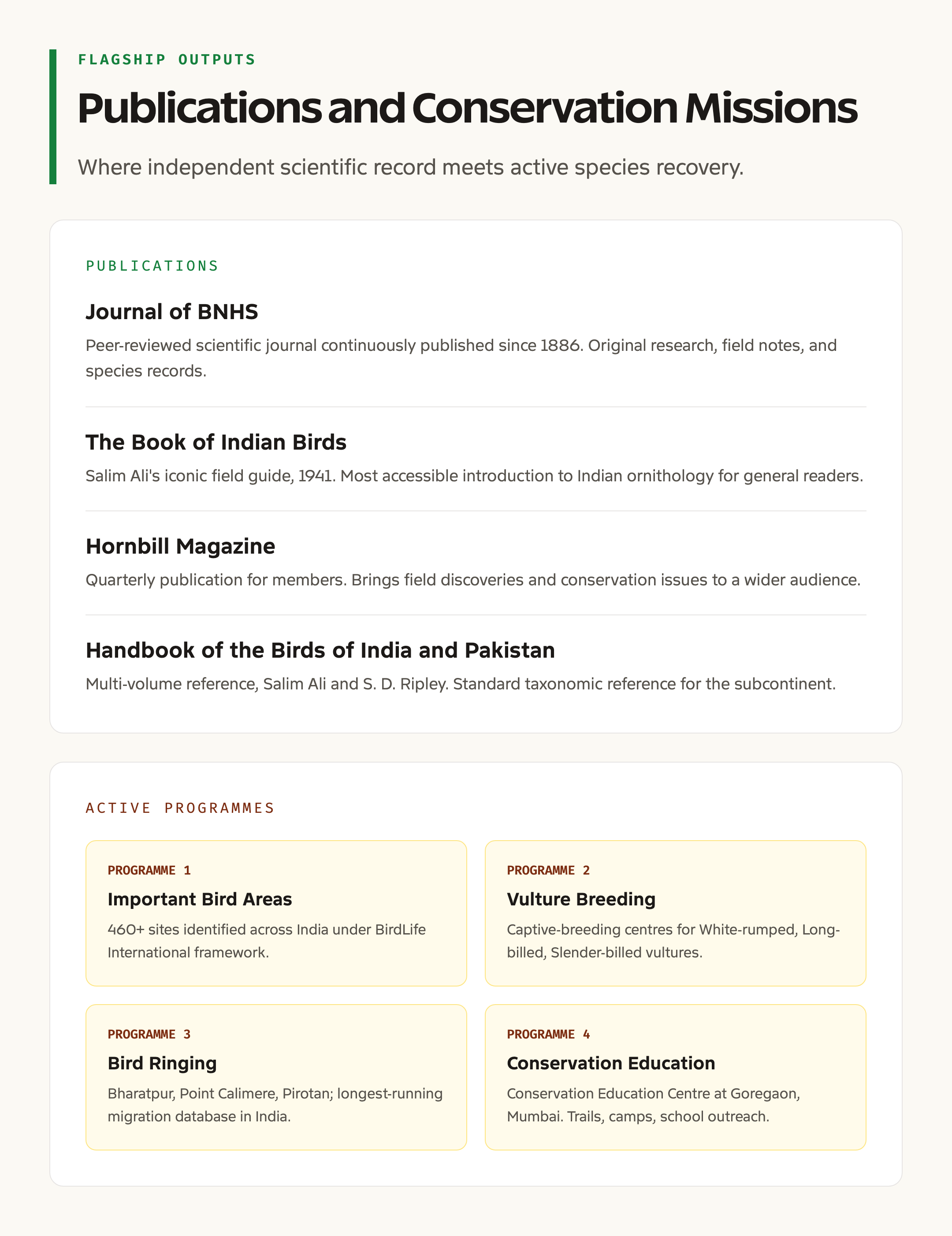
The Important Bird and Biodiversity Areas programme is BNHS’s most influential analytical product. Working with BirdLife International, BNHS identifies sites in India that meet specified criteria for globally threatened species, restricted-range species, biome-restricted species, or large congregations. These sites form a science-based shortlist that planners, courts, and the central government can use to prioritise conservation. As of recent counts, India has more than 460 Important Bird Areas, ranging from Himalayan high-altitude lakes to coastal wetlands and Western Ghats forest patches.
Vulture Conservation Breeding Programme
Indian vulture populations crashed by more than 95 percent between the 1990s and the early 2000s, primarily because of diclofenac residues in livestock carcasses. BNHS led the scientific work that identified diclofenac as the cause and partnered with the Haryana, West Bengal, Madhya Pradesh, and Assam forest departments to set up captive-breeding centres. The programme breeds the White-rumped, Long-billed, and Slender-billed vultures and runs a structured release framework in vulture-safe zones.
Bird Ringing and Migration Studies
BNHS runs the longest continuously operating bird ringing programme in India, particularly at Bharatpur, Point Calimere, and the wetlands of Gujarat. Migration data feed into global flyway analyses and help track the impact of climate change on arrival and departure dates.
Conservation Education Centre
The CEC at Goregaon, near Sanjay Gandhi National Park in Mumbai, is one of the most influential public conservation education campuses in urban India. It runs nature trails, school programmes, residential camps, and citizen-science workshops.
Why It Matters
BNHS matters for three reasons. First, it provides the long-term scientific record without which modern Indian conservation cannot make defensible decisions. When a Supreme Court bench, a National Green Tribunal hearing, or a state forest department needs to know whether a particular wetland is genuinely critical or whether a species is genuinely declining, BNHS data, peer-reviewed in JBNHS, often forms the evidentiary backbone.
Second, it functions as an independent voice that can disagree with government when needed. As a non-government scientific body, BNHS has consistently published findings that complicated official narratives, including on the diclofenac vulture crisis, the water-bird declines at Bharatpur, and the implications of wetland reclamation for migratory birds. This independence is rare in the Indian conservation ecosystem and adds genuine value to public debate.
Third, BNHS performs convening functions that no single government agency can. As the BirdLife partner in India, it links domestic conservation to global flyway monitoring, IUCN red-listing processes, and international bird-conservation funding. As a teaching institution, it has produced generations of field ornithologists who now staff state forest departments, central institutions, and other NGOs.
Detailed Analysis
A closer look at BNHS reveals a model that combines voluntary science, professional management, and policy engagement in an unusual blend. Its founding membership model survives. Members receive the Hornbill quarterly, voting rights, and access to programmes. This base provides both income and legitimacy. Around this membership core sits a professional research staff funded through grants, project income, and endowments.
The Society’s research output is concentrated in birds but extends to mammals, reptiles, amphibians, butterflies, and freshwater ecosystems. Long-term bird-ringing has produced species-specific datasets on body condition, moult timing, and survival probabilities that inform climate-change studies globally. The vulture programme is internationally cited as a model of in-situ ex-situ integration: captive breeding combined with veterinary advocacy to remove the underlying threat.
Policy engagement runs through formal channels. BNHS scientists serve on standing committees of the Ministry of Environment, Forest and Climate Change, on the National Board for Wildlife in observer or invited capacity, and on technical committees for Ramsar implementation, biosphere reserves in India, and tiger reserve management plans. Submissions on Coastal Regulation Zone notifications, eco-sensitive zones, and infrastructure clearances are an ongoing part of the Society’s policy footprint.
Funding structure is diversified. International donors such as the Royal Society for the Protection of Birds, the MacArthur Foundation, the Darwin Initiative, and CEPF fund specific programmes. Indian corporate CSR contributions support education and species-recovery work. Government project income comes from research and survey contracts. Membership and endowment income provide continuity.
Comparative Perspective
BNHS sits in a small global club of long-running natural-history societies. The Royal Society for the Protection of Birds in the United Kingdom (1889) and the Audubon Society in the United States (1905) are roughly comparable in age and mission. BNHS is older than both. The British Trust for Ornithology (1933) is closer to BNHS in its emphasis on scientific bird-monitoring through volunteers.
Within India, BNHS is one of several institutional pillars of conservation science. The Wildlife Institute of India at Dehradun (1982) is the central government scientific institution focused on protected-area management and species recovery. The Salim Ali Centre for Ornithology and Natural History at Coimbatore (1990), named after BNHS’s most famous member, is an autonomous body of MoEFCC. The Zoological Survey of India is the official taxonomic authority. BNHS predates all of these and complements them as an independent NGO with comparable scientific credibility.
What distinguishes BNHS from younger Indian conservation NGOs is the depth of its scientific publication record and the breadth of its policy reach. The Wildlife Trust of India and ATREE Bengaluru are excellent younger institutions. BNHS still anchors them through training, journal publication, and historical datasets.
Challenges
The Society faces real institutional challenges. Funding for long-term monitoring is harder to secure than for fashionable single-species campaigns. The 2010s saw international funding constraints under the FCRA framework that affected many Indian NGOs, and BNHS had to rebalance its donor base. Generational succession in leadership, away from the giants of the Salim Ali and J C Daniel era, has required deliberate institution-building.
Scientific challenges are also growing. Climate change is altering bird distributions in ways that long-term datasets are uniquely positioned to detect, but only if monitoring continues with adequate funding. The vulture programme, though successful in breeding, faces the wider task of removing veterinary toxins such as ketoprofen, nimesulide, and aceclofenac that pose risks similar to diclofenac.
Public engagement competes for attention with social media wildlife content that often lacks scientific accuracy. BNHS investments in the Conservation Education Centre, citizen-science platforms such as MigrantWatch, and public lectures address this challenge but require continuous renewal.
Prelims Pointers
- BNHS was founded in 1883 in Bombay, headquartered at Hornbill House, Mumbai
- Logo is the Great Hornbill, a Western Ghats and Northeast forest bird
- Designated as the BirdLife International Partner in India
- Identifies and maintains the network of Important Bird and Biodiversity Areas
- Runs the Vulture Conservation Breeding Programme with state forest departments
- Publishes the Journal of the Bombay Natural History Society since 1886
- Salim Ali, the “Birdman of India”, was a leading BNHS member; Padma Bhushan in 1958
- The Book of Indian Birds by Salim Ali was published under the BNHS banner
- BNHS is not an autonomous body of the Ministry of Environment, Forest and Climate Change. It is a registered non-profit, fully independent of government.
- Conducts nature trails, camps, citizen-science programmes, and policy submissions
Mains Practice Questions
- Examine the role of independent scientific NGOs such as the Bombay Natural History Society in shaping environmental governance in India. Illustrate with at least three programmes.
- The vulture population crash in India is one of the most dramatic ecological collapses of the past century. Discuss the causes, the response led by BNHS, and the policy lessons for managing veterinary pharmaceuticals.
- What are Important Bird and Biodiversity Areas? How does the BNHS framework feed into India’s broader biodiversity in India policy architecture?
- Compare the institutional model of BNHS with that of the Wildlife Institute of India. What complementarities and tensions arise between independent scientific societies and statutory research institutions?
Way Forward
Three priorities define the coming decade for BNHS. First, sustain and expand long-term ecological monitoring. India’s commitments to global biodiversity frameworks, including the Kunming-Montreal Global Biodiversity Framework targets, depend on credible national datasets. BNHS programmes at Bharatpur, Point Calimere, the Western Ghats hill stations, and Northeast forest patches provide irreplaceable continuity that needs stable funding.
Second, deepen the diclofenac-style scientific advocacy on emerging environmental threats. Veterinary pharmaceuticals, neonicotinoid pesticides, microplastics in freshwater, and renewable-energy infrastructure siting all pose questions where independent scientific synthesis is needed. BNHS is well placed to lead on these issues if it can secure dedicated programme funding.
Third, modernise public engagement without losing scientific rigour. Citizen-science platforms, mobile applications, and open datasets can multiply the Society’s reach while keeping data quality standards intact. Partnerships with eBird India, the Indian Bird Conservation Network, and university ornithology programmes are natural extensions.
For the conservation movement at large, the message is that long-running scientific institutions are infrastructure. They cannot be built quickly when needed. India’s good fortune in having BNHS for 142 years should translate into deliberate public, philanthropic, and corporate support for the next generation of its work.
Frequently Asked Questions
Is the Bombay Natural History Society a government body?
No. BNHS is a non-governmental, non-profit scientific membership society. It is independent of any ministry of government, though it advises the Ministry of Environment, Forest and Climate Change and other agencies through technical committees and policy submissions.
When and where was BNHS founded?
BNHS was founded on 15 September 1883 in Bombay, now Mumbai, by a small group of British and Indian naturalists who wanted to systematise their natural-history observations. Its headquarters at Hornbill House sits in the Fort area of South Mumbai.
Who was Salim Ali and what was his connection to BNHS?
Salim Ali, often called the u0022Birdman of Indiau0022, was the most influential Indian ornithologist of the twentieth century. He led BNHS surveys across pre-Independence India, authored The Book of Indian Birds and the multi-volume Handbook of the Birds of India and Pakistan with S Dillon Ripley, and shaped the Society’s research direction for more than four decades. He received the Padma Bhushan in 1958.
What is the BNHS logo and why was it chosen?
The BNHS logo is the Great Hornbill, Buceros bicornis. The bird represents the linkage between forest ecology, charismatic species conservation, and the Society’s commitment to documenting India’s natural heritage. The Hornbill House headquarters takes its name from the same emblem.
What are Important Bird Areas and what role does BNHS play?
Important Bird and Biodiversity Areas are sites identified through standardised global criteria for their importance to bird conservation. As the BirdLife International Partner in India, BNHS identifies, monitors, and advocates for these areas, of which India has more than 460. The IBA framework feeds directly into national protected-area planning and litigation in environmental forums.
What is the BNHS Vulture Conservation Breeding Programme?
The programme breeds critically endangered Indian vultures, including the White-rumped, Long-billed, and Slender-billed vultures, in centres at Pinjore in Haryana, Rani in Assam, Rajabhatkhawa in West Bengal, and Bhopal in Madhya Pradesh. It also advocates for the removal of toxic veterinary drugs and the creation of vulture-safe zones for releases. BNHS leads the scientific component in partnership with state forest departments.
Does BNHS run public nature trails and camps?
Yes. BNHS organises nature trails, residential camps, school programmes, and citizen-science workshops, particularly through the Conservation Education Centre at Goregaon, Mumbai, and through field-station outreach at Bharatpur and Point Calimere.
Which scientific journal does BNHS publish?
BNHS publishes the Journal of the Bombay Natural History Society, in continuous publication since 1886. JBNHS is one of the oldest natural-history journals in Asia and a primary publication venue for original Indian wildlife research.
Is BNHS connected to international conservation networks?
Yes. BNHS is the BirdLife International Partner in India, collaborates with the Royal Society for the Protection of Birds, the MacArthur Foundation, the Wildlife Conservation Society, and the Convention on Migratory Species. It contributes to IUCN Red List assessments and international flyway initiatives.
Where can a UPSC aspirant find authoritative information about BNHS for prelims?
The Society’s own publications, the JBNHS abstracts, and India Year Book entries are reliable. For prelims revision, focus on founding year (1883), logo (Great Hornbill), BirdLife partnership status, key programmes (Important Bird Areas, Vulture Conservation Breeding), and the Salim Ali association.