A bird with a body the size of a turkey, a wingspan close to five feet, a yellow casque sitting on top of its bill like a second forehead, and a wing-flap so powerful that you hear it before you see it. The Great Hornbill, Buceros bicornis, is one of the most distinctive birds of South Asian forests. It is a flagship species for the wet evergreen tropics of the Western Ghats and the eastern Himalayan foothills. It is the state bird of Kerala and Arunachal Pradesh. It is on Schedule I of the Wildlife Protection Act and Appendix I of CITES. And it is, for many forest-dependent communities of the North-East, an animal of cultural and spiritual significance second only to the elephant.
The Great Hornbill’s biology is a study in evolutionary specialisation. The casque, the canopy-dwelling habit, the extreme nesting behaviour, and the seed-dispersal role have all attracted decades of scientific attention. Long-term work by the Nature Conservation Foundation in the Western Ghats and by the Wildlife Institute of India in the North-East has produced one of the more detailed life-history pictures of any large South Asian bird.
For UPSC, the Great Hornbill comes up frequently in prelims through location-based stems on the Western Ghats and North-East species, and in mains through the broader question of forest ecology and seed dispersal. This guide walks through the species, its biology, its conservation status, and what an aspirant must know.
Quick Facts
- Scientific name: Buceros bicornis
- Family: Bucerotidae (hornbills)
- Common names: Great Hornbill, Great Indian Hornbill
- Range in India: Western Ghats, North-East states, parts of Uttarakhand
- Range outside India: Bhutan, Nepal, Myanmar, Thailand, Laos, Vietnam, Indonesia, Malaysia
- Habitat: Tropical and subtropical evergreen and semi-evergreen forests
- Body length: 95 to 130 cm
- Weight: 2.1 to 4 kg (males larger than females)
- Wingspan: 152 cm or more
- Distinctive feature: Large yellow and black casque on top of the upper mandible
- Diet: Frugivorous (fig genus Ficus especially), supplemented by small vertebrates
- Nesting: Female seals herself inside a tree cavity for several weeks
- Ecological role: Major seed disperser, called the “Guardian of the Forest”
- State bird of: Kerala, Arunachal Pradesh
- IUCN Red List: Vulnerable (VU)
- Wildlife Protection Act, 1972: Schedule I
- CITES: Appendix I
What Is the Great Hornbill
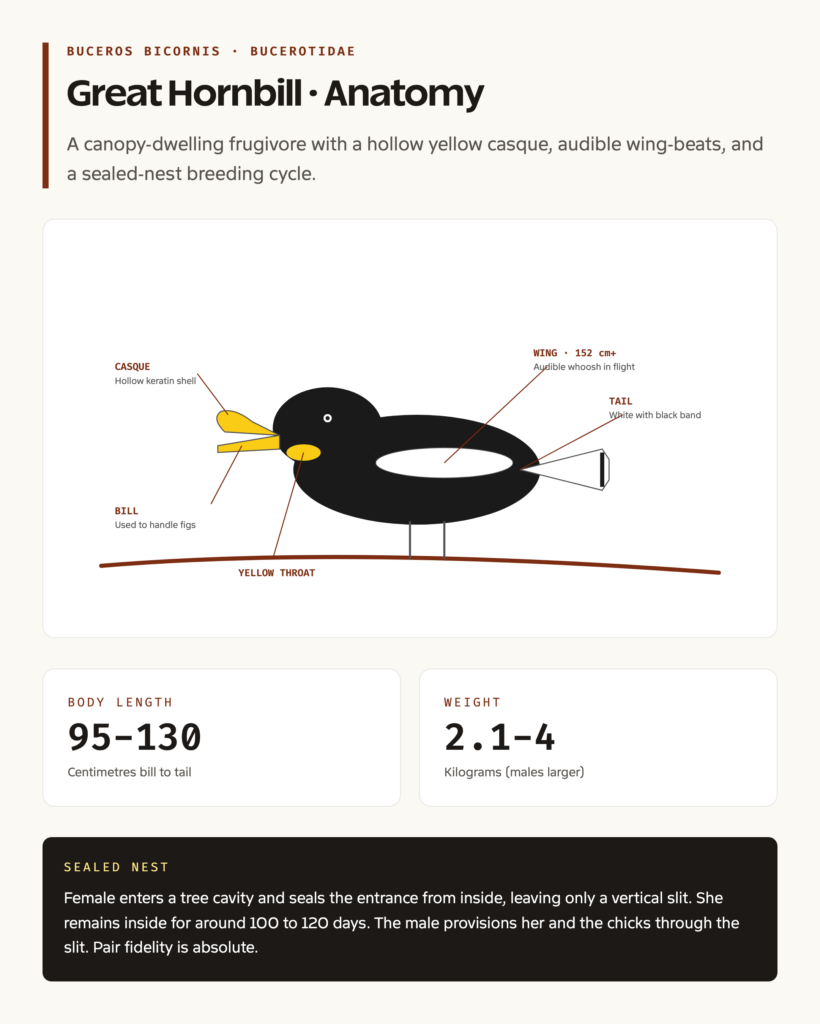
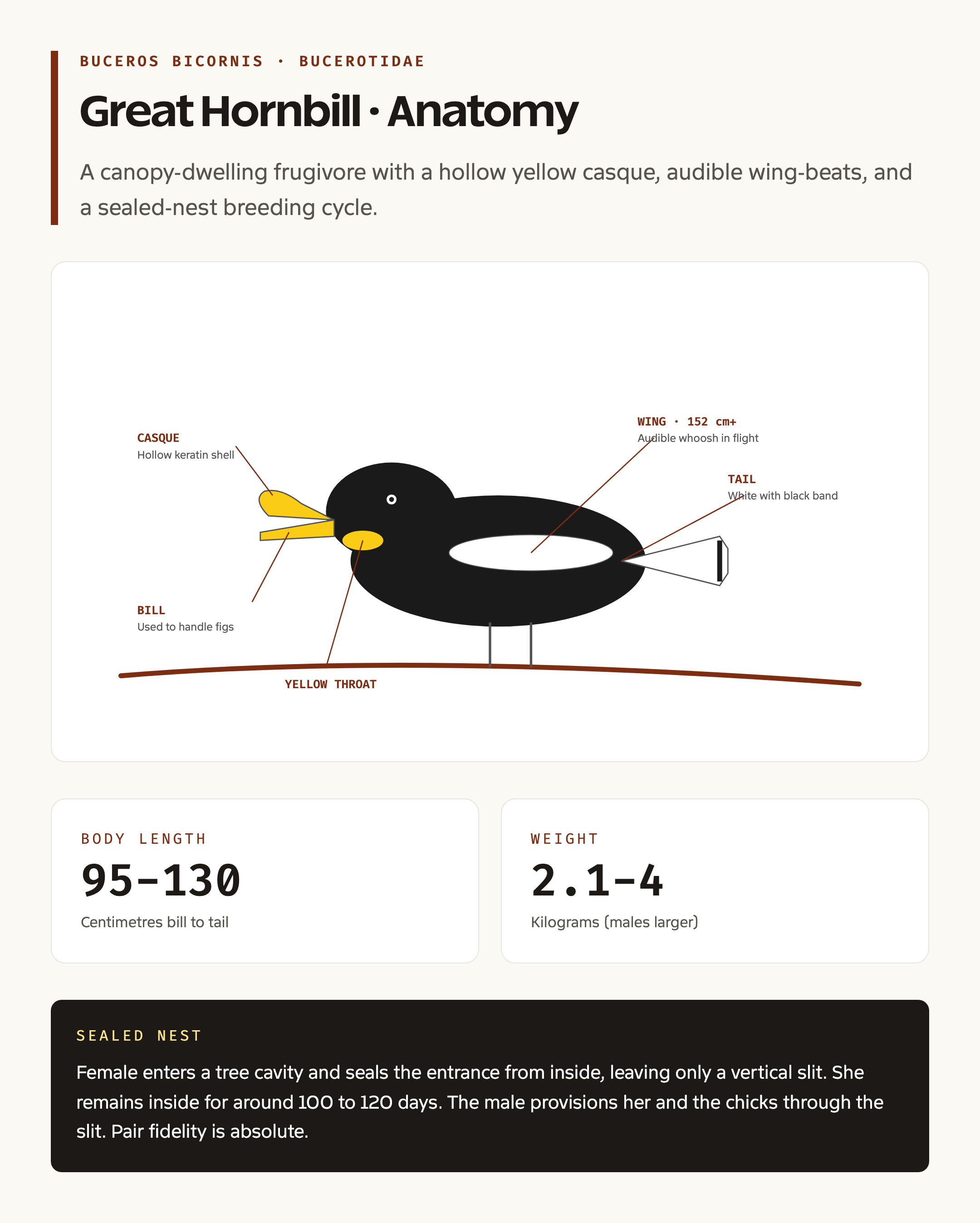
The Great Hornbill is the largest hornbill of the Indian subcontinent and one of the largest hornbills in the world. The body is black and white, with a yellow throat patch, white wing-bars and tail, and a large bill topped by a hollow, yellow casque. Both sexes carry the casque, although the male’s is generally larger and more pigmented. The colours of the casque, bill, and bare skin around the eye are maintained through preen-oil from the uropygial gland, which gives the species an unusual amount of cosmetic ornamentation.
The casque itself is a striking structure. It is not a solid bony growth but a hollow, keratinous shell built over a thin bony framework, with internal struts that distribute weight. Its function has been the subject of long debate. The current consensus is that it serves a combination of acoustic resonance for the species’s loud calls, structural support for the bill during fruit handling, and a sex-display function in courtship. It is not used for digging or fighting in any significant way.
The species is canopy-resident in tall evergreen forests. It rarely descends to the ground except to drink at forest pools or to inspect fallen fruit. Its flight is heavy, the wing-beats deliberate and audible from several hundred metres away. The “whoosh-whoosh” of a hornbill flight is one of the more recognisable sounds of South Asian wet forests.
Background and Historical Context
The Great Hornbill has been part of South Asian human consciousness for centuries. In Naga, Mizo, and Khasi cultures of north-east India, the bird’s feathers and casques have featured in ceremonial headdresses, and the species figures prominently in folklore. The state of Nagaland’s Hornbill Festival, named after the bird, is one of the most prominent cultural events of the North-East.
Western scientific description came through Carl Linnaeus’s Systema Naturae in 1758, who named the species Buceros bicornis on the basis of museum specimens reaching Europe through colonial trade. Through the nineteenth century, Indian ornithologists, including the Bombay Natural History Society’s pioneers, documented the species’s range, breeding behaviour, and feeding ecology.
The twentieth century brought sustained pressure on the species. Hunting for the casque, which was carved into ornaments and ceremonial objects, became significant during the early colonial period. Habitat loss followed in the post-independence decades, with logging and clearance for plantations cutting into the prime evergreen forests of the Western Ghats and the North-East. By the 1970s, the species had retreated to a fraction of its original range.
The Wildlife Protection Act, 1972, placed the Great Hornbill on Schedule I, the highest protection level. CITES added the species to Appendix I, prohibiting commercial international trade. Sustained scientific research from the 1980s onward, particularly by the Nature Conservation Foundation under researchers like Aparajita Datta, has documented the species’s biology and reinforced its position as a flagship for forest conservation. The bird’s recent inclusion in biodiversity in India priority lists reflects this continuing focus.
Anatomy, Behaviour, and the Sealed Nest
The Great Hornbill’s nesting behaviour is among the most extreme adaptations in the avian world. The female enters a natural tree cavity, typically high up in a large emergent tree such as Tetrameles nudiflora, Dipterocarpus, or Canarium, and seals the entrance from inside, leaving only a narrow vertical slit. The sealing material is a paste of mud, droppings, and food fragments. The male, who never enters the cavity, supplies the female and, eventually, the chicks with food through the slit.
The seclusion lasts for around 100 to 120 days for the female and somewhat less for the chicks, who emerge after the female has broken out partway through the nestling period. During the seclusion, the female undergoes a moult and is essentially flightless. The system has evolved as a defence against predation by snakes, monitor lizards, and arboreal mammals such as civets and martens. It demands strict pair fidelity and an extraordinary parental investment from the male, who forages over many square kilometres to provision the family.
The species is overwhelmingly frugivorous. Figs, especially the Ficus genus, are the dominant food. Seasonal availability of figs structures the species’s movement patterns, and large fig fruiting events draw aggregations of multiple birds. Small vertebrates, including lizards, frogs, and occasionally bird eggs, supplement the diet during the nesting season when protein demand peaks.
Why the Great Hornbill Matters
The case for the Great Hornbill operates at three levels. Ecologically, the species is a “Guardian of the Forest”, a long-distance seed disperser for several large-seeded tropical trees that no other animal can effectively disperse. Studies in the Western Ghats and the North-East show that the species can move seeds over distances of several kilometres, maintaining genetic exchange between forest fragments and supporting the recruitment of dipterocarp and Polyalthia species in particular.
Culturally, the bird is woven into the identity of forest peoples across South and South-East Asia. It is the state bird of Kerala and Arunachal Pradesh in India. The Hornbill Festival in Nagaland, although named after the closely related Indian pied hornbill and the Great Hornbill, has become one of the principal cultural showcases of the North-East. In Naga and Mizo cultures, the casque and feathers continue to carry ceremonial meaning, and conservation organisations have worked with communities to develop alternatives such as fibreglass casques for ceremonial use.
Symbolically, the species is one of the flagships of South Asian forest conservation. Its size, charisma, and distinctive shape make it a recognisable indicator of healthy old-growth forest. Its presence is a fast diagnostic for ecologists assessing the integrity of an evergreen forest patch.
Detailed Analysis: Range and Population
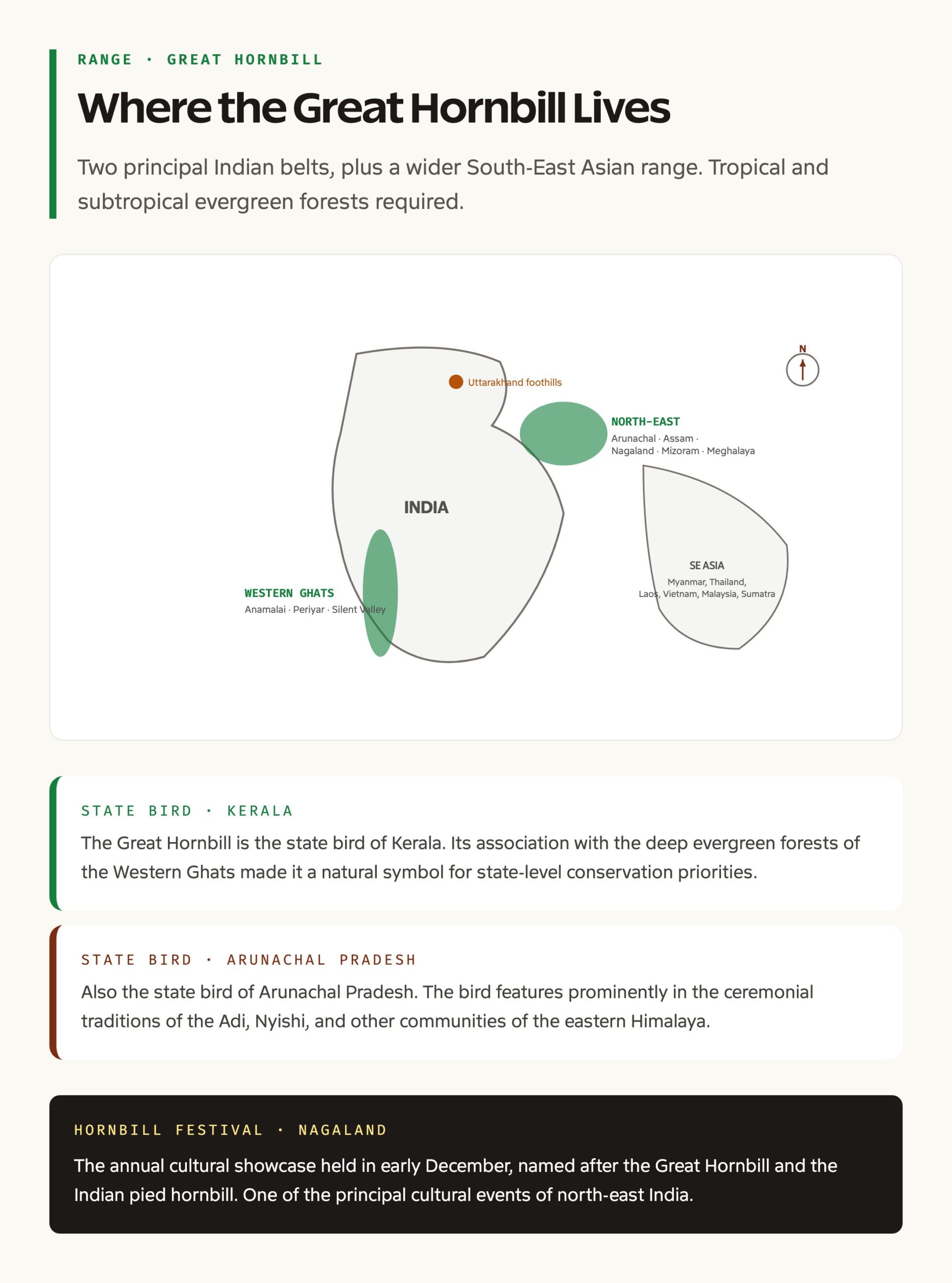
In India, the Great Hornbill occurs in two main belts. The first is the Western Ghats, from southern Maharashtra through Karnataka, Kerala, and Tamil Nadu, with strongholds in the Anamalai Hills, the Periyar landscape, and the Silent Valley. The second is the eastern Himalayan and North-East belt, covering Arunachal Pradesh, Assam, Nagaland, Manipur, Mizoram, Meghalaya, and parts of north Bengal. Smaller populations occur in Uttarakhand and historically in the Himalayan foothills further west.
Outside India, the species ranges across Bhutan, Nepal, Myanmar, Thailand, Laos, Vietnam, Cambodia, peninsular Malaysia, Sumatra, and historically further into Indonesia. The South-East Asian populations have come under heavier pressure from forest loss and hunting, and the species is treated as Vulnerable globally.
Population estimates are difficult because the species is canopy-resident and moves long distances seasonally. Indian estimates suggest a few thousand individuals across the two belts, with the Western Ghats stronghold somewhat better documented than the North-East. The pair-bonded breeding system means that effective population size is significantly smaller than the count of individuals.
Comparative Perspective
The Great Hornbill is one of nine hornbill species recorded in India. Others include the Indian Grey Hornbill (a peninsular generalist), the Malabar Pied Hornbill (Western Ghats and Sri Lanka), the Wreathed Hornbill (North-East), the Rufous-necked Hornbill (eastern Himalaya), and the smaller Oriental Pied Hornbill. Of these, the Great Hornbill and the Rufous-necked are the most threatened, with the latter classified as Vulnerable and restricted to a smaller range.
Among large flagship birds of South Asian forests, the Great Hornbill compares with the Sarus Crane, the Great Indian Bustard, and the Black-necked Crane. Each occupies a different biome and faces different pressures. The hornbill’s reliance on tall, intact, fruit-rich forest places it in a different conservation policy frame than grassland birds like the bustard.
Internationally, the Great Hornbill is the closest analogue of the African Trumpeter Hornbill and the South American toucans in its forest-canopy seed-dispersal role, although neither group of birds matches the size or the casque structure of Buceros.
Challenges and Issues
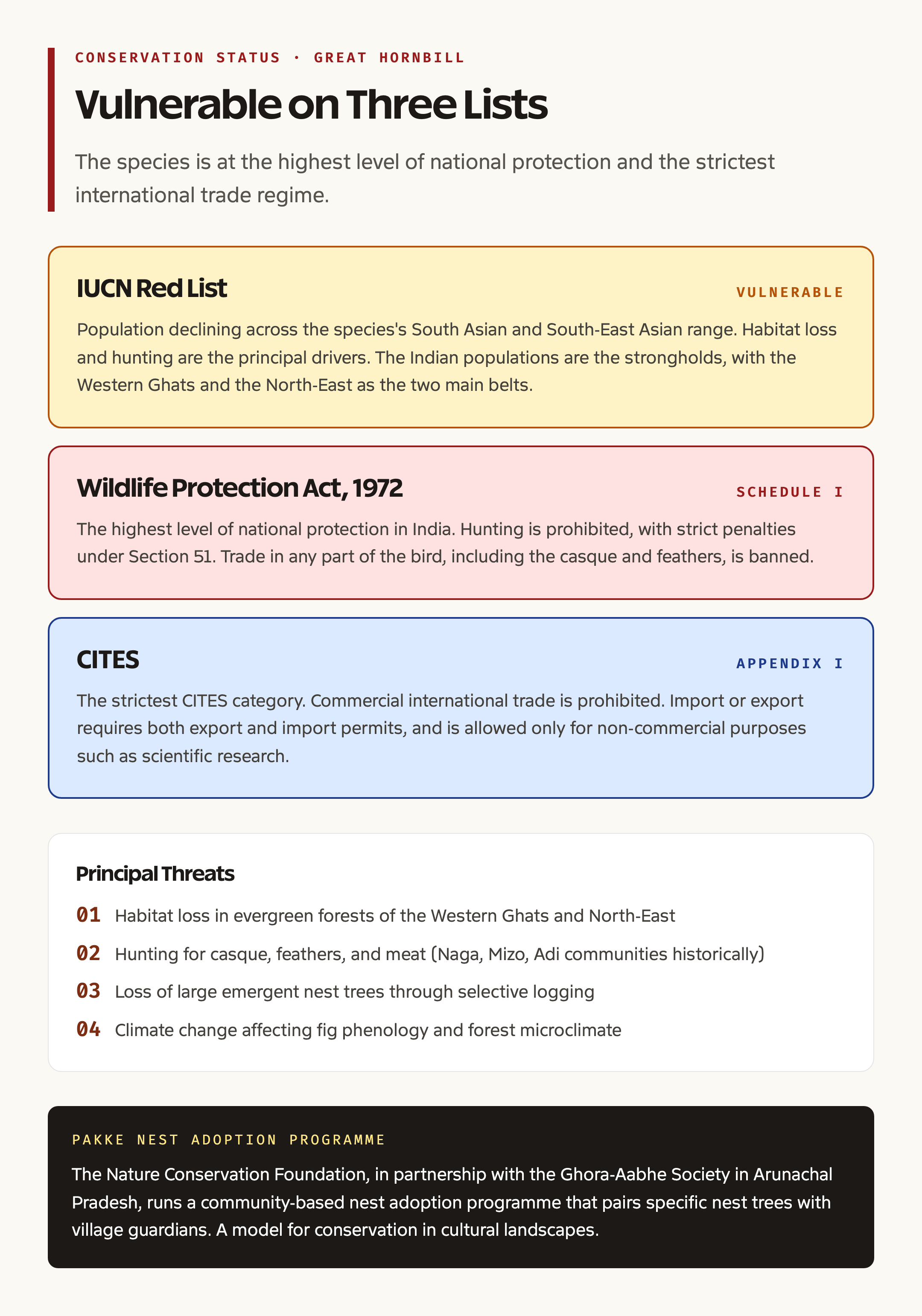
The Great Hornbill faces a clutch of pressures. Habitat loss is the dominant driver. The species depends on tall, intact, fruit-rich evergreen forest. Conversion to plantations, hydropower reservoir flooding, and infrastructure expansion in the Western Ghats and the North-East have cut into the bird’s range over decades.
Hunting for the casque, feathers, and meat persists in parts of the North-East despite Schedule I status. Conservation organisations have worked with Naga, Mizo, and Adi communities to reduce hunting pressure and to develop alternatives for ceremonial use. Progress has been real but uneven.
Nest-tree availability is a specific constraint. The species needs cavities in very large emergent trees. Such trees take centuries to develop, and selective logging of large trees, even in otherwise standing forest, can render an area unsuitable for breeding. Programmes that protect identified nest trees and offer compensation to landowners have shown encouraging results.
Climate change is a slower-moving pressure. Shifts in fig phenology, monsoon timing, and forest microclimate have potential downstream effects on the species’s breeding success and dispersal patterns. Long-term monitoring data from the Anamalai Hills and Pakke Tiger Reserve in Arunachal Pradesh are beginning to track these effects.
Prelims Pointers
- Scientific name: Buceros bicornis.
- Family: Bucerotidae.
- Range in India: Western Ghats, North-East, Uttarakhand foothills.
- Habitat: Tropical and subtropical evergreen forests.
- Body length: 95-130 cm. Wingspan: 152 cm or more.
- Diet: Frugivorous, fig-dominated; small vertebrates supplement.
- Nesting: Female seals herself in tree cavity for ~100-120 days.
- Ecological role: Long-distance seed disperser (“Guardian of the Forest”).
- State bird of: Kerala, Arunachal Pradesh.
- IUCN Red List: Vulnerable.
- WPA, 1972: Schedule I.
- CITES: Appendix I.
- Casque: Hollow keratin and bone, yellow, on top of upper mandible.
- Cultural significance: Naga, Mizo, Adi ceremonial use; Hornbill Festival.
Probable Mains Questions
- The Great Hornbill is described as the “Guardian of the Forest”. Discuss the species’s ecological role in tropical evergreen forests with reference to seed dispersal. (250 words)
- Examine the conservation challenges facing the Great Hornbill in India, with specific attention to habitat loss, hunting, and nest-tree availability. (250 words)
- Discuss the cultural significance of the hornbill in north-east Indian communities and the conservation responses that have engaged this cultural dimension. (150 words)
Way Forward
The Great Hornbill needs interventions across the species’s range. Old-growth retention is the foundational requirement. Forest management plans in the Western Ghats and the North-East must explicitly protect very large emergent trees, with mapped nest-tree registries and buffer protections.
Community partnership in the North-East has shown that hunting pressure can be reduced when conservation organisations work alongside village councils, customary law institutions, and traditional headmen. The Pakke Hornbill Nest Adoption Programme in Arunachal Pradesh, run by the Nature Conservation Foundation in partnership with Ghora-Aabhe Society, is a model that can be scaled.
Monitoring through citizen-science platforms and forest-department surveys should be expanded. The species’s canopy habit makes detection difficult, and standardised survey protocols would improve population assessment. The BirdLife International network and the BNHS provide infrastructure that can support such efforts.
Cultural alternatives for ceremonial use of casques and feathers should be developed with community input. Fibreglass casques have been adopted in parts of Nagaland and Mizoram. Wider acceptance requires sustained engagement and design work that respects cultural meaning.
Landscape connectivity across the Western Ghats, including corridors between protected areas like Anamalai, Periyar, and Silent Valley, must be reinforced through compatible land use in the buffer zones. The bird needs more than the protected-area islands.
Frequently Asked Questions
Where is the Great Hornbill found in India?
The Great Hornbill occurs in two main belts. The first is the Western Ghats, from southern Maharashtra through Karnataka, Kerala, and Tamil Nadu, with strongholds in the Anamalai Hills, Periyar landscape, and Silent Valley. The second is the eastern Himalayan and North-East belt, covering Arunachal Pradesh, Assam, Nagaland, Manipur, Mizoram, Meghalaya, and parts of north Bengal.
What is the casque on a hornbill, and what does it do?
The casque is a hollow, keratinous structure built on a thin bony framework on top of the upper mandible. Its functions include acoustic resonance for the species’s loud calls, structural support for the bill during fruit handling, and sex-display during courtship. It is not used for digging or fighting.
Why is the Great Hornbill called the Guardian of the Forest?
The Great Hornbill is a long-distance seed disperser for many large-seeded tropical trees. By moving seeds over kilometres of forest, the bird maintains the genetic and structural diversity of evergreen forests. The u0022Guardianu0022 name reflects this ecological role.
What is the IUCN status of the Great Hornbill?
The Great Hornbill is classified as Vulnerable on the IUCN Red List. It is also on Schedule I of the Wildlife Protection Act, 1972, and Appendix I of CITES, which prohibits commercial international trade.
Why does the female hornbill seal herself inside a tree cavity?
The sealing behaviour is an adaptation against predation by snakes, monitor lizards, and arboreal mammals. The female enters a tree cavity, seals it from inside leaving only a narrow slit, and remains there for around 100 to 120 days. The male provides all food through the slit. The system requires extreme pair fidelity and parental investment.
What does the Great Hornbill eat?
The Great Hornbill is overwhelmingly frugivorous. Figs of the Ficus genus are the dominant food. The species also takes small vertebrates such as lizards, frogs, and occasionally bird eggs, especially during the breeding season when protein demand is high.
Which states have the Great Hornbill as their state bird?
The Great Hornbill is the state bird of Kerala and of Arunachal Pradesh. Its presence in the deep evergreen forests of both states made it a natural symbol for state-level conservation priorities.
What is the connection between the Great Hornbill and the Hornbill Festival?
The Hornbill Festival is an annual cultural showcase held in Nagaland in early December. It is named after the Great Hornbill and the Indian pied hornbill, both of which feature in Naga ceremonial traditions. The festival brings together the cultural traditions of Nagaland’s Naga tribes and is one of the principal cultural events of north-east India.
Has the Great Hornbill ever appeared in UPSC prelims questions?
Yes. The species has featured in prelims through location-based stems, most directly in a question asking where the Great Indian Hornbill is most likely to be encountered in its natural habitat. The correct answer in such questions has been the Western Ghats, with the North-East as the alternative natural habitat.
What can be done to protect Great Hornbill nesting trees?
Protection of nest trees requires identification, mapping, and formal registration with the forest department; landowner compensation where the trees occur on private land; programmes such as the Pakke Hornbill Nest Adoption Programme that pair specific nest trees with community guardians; and forest management rules that explicitly protect very large emergent trees.
Tell Google you want more of this.
Add Anantam IAS as a preferred sourceOne tap, and this site shows up more often in your own Top Stories, AI Overviews and AI Mode. Remove it any time.