Introduction
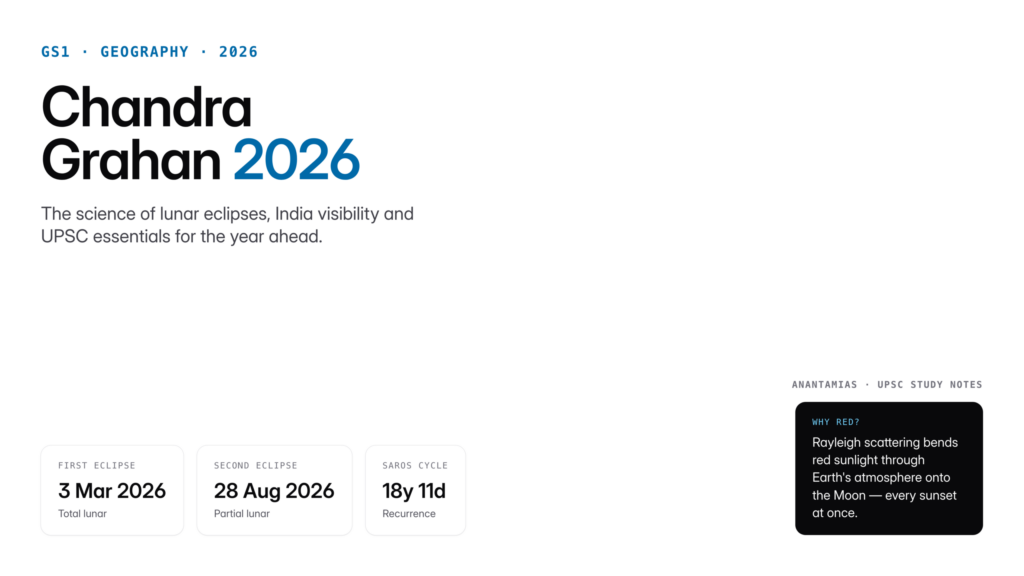
Every time the Moon slips quietly into the shadow of the Earth, millions across India pause to watch the sky, whisper mantras, or simply pull out their phones to capture the reddish glow. The event is called Chandra Grahan, the Sanskrit name for a lunar eclipse, and in 2026 the phenomenon returns with two distinct episodes that curious students, amateur astronomers, and UPSC aspirants will all want to track. Beyond the folklore, a lunar eclipse is a precise astronomical alignment that reveals how the Earth, Moon and Sun move in measurable, predictable orbits.
For an aspirant preparing for General Studies Paper 1, Chandra Grahan is not just a mythic moment. It is a window into celestial mechanics, the geometry of the Earth-Moon-Sun system, the composition of the Earth’s atmosphere, and the cultural history of astronomy in the Indian subcontinent. This guide explains the science, the 2026 dates, visibility across India, cultural practices, and the exam-relevant angles you must memorise before Prelims.
Quick Facts at a Glance
| Attribute | Detail |
|---|---|
| Event name (Sanskrit) | Chandra Grahan |
| English term | Lunar eclipse |
| Types | Total, Partial, Penumbral |
| Occurs during | Full Moon (Purnima) only |
| Alignment required | Sun, Earth, Moon in near-straight line (syzygy) |
| First 2026 eclipse | 3 March 2026 (Total lunar eclipse) |
| Second 2026 eclipse | 28 August 2026 (Partial lunar eclipse) |
| Visibility in India (Mar 2026) | Not visible (peak during Indian daytime) |
| Safety | Naked-eye safe, unlike solar eclipse |
| Maximum duration of totality | Up to 1 hour 47 minutes (theoretical) |
Background and Historical Context
Chandra Grahan has been observed and recorded across Indian civilisation for more than three thousand years. Vedanga Jyotisha, the oldest surviving Indian astronomical text associated with the Vedas, already discusses eclipse cycles. Later classical astronomers, most notably Aryabhata in the 5th century CE, rejected the mythological explanation of Rahu swallowing the Moon and proposed the physically accurate model that an eclipse is caused by the Earth’s shadow falling on the Moon. Aryabhata’s Aryabhatiya computed eclipse timings with remarkable accuracy for its era.
Brahmagupta, Varahamihira, and Bhaskara II refined the predictive models, while observatories such as the Jantar Mantars of Jaipur and Delhi, built in the 18th century under Sawai Jai Singh II, continued the tradition of precise eclipse forecasting. The Greek astronomer Hipparchus and later Ptolemy used lunar eclipse observations to estimate the distance to the Moon, illustrating how eclipses became a scientific tool worldwide.
Culturally, Chandra Grahan is tied to the Samudra Manthan legend in which the demon Svarbhanu, later split into Rahu and Ketu, consumes the luminaries as cosmic revenge. Rituals such as fasting during the sutak period, bathing in rivers after the eclipse, and avoiding cooked food are observed in many households even today. These practices coexist with a modern scientific literacy campaign pushed by bodies such as the Indian Institute of Astrophysics and the Department of Science and Technology.
Key Features
Geometry of a Lunar Eclipse
A lunar eclipse occurs only at Full Moon, when the Earth sits directly between the Sun and the Moon. Because the Moon’s orbit is tilted about 5 degrees to the ecliptic, the three bodies line up only when the Full Moon is near a lunar node. This is why eclipses do not happen every month.
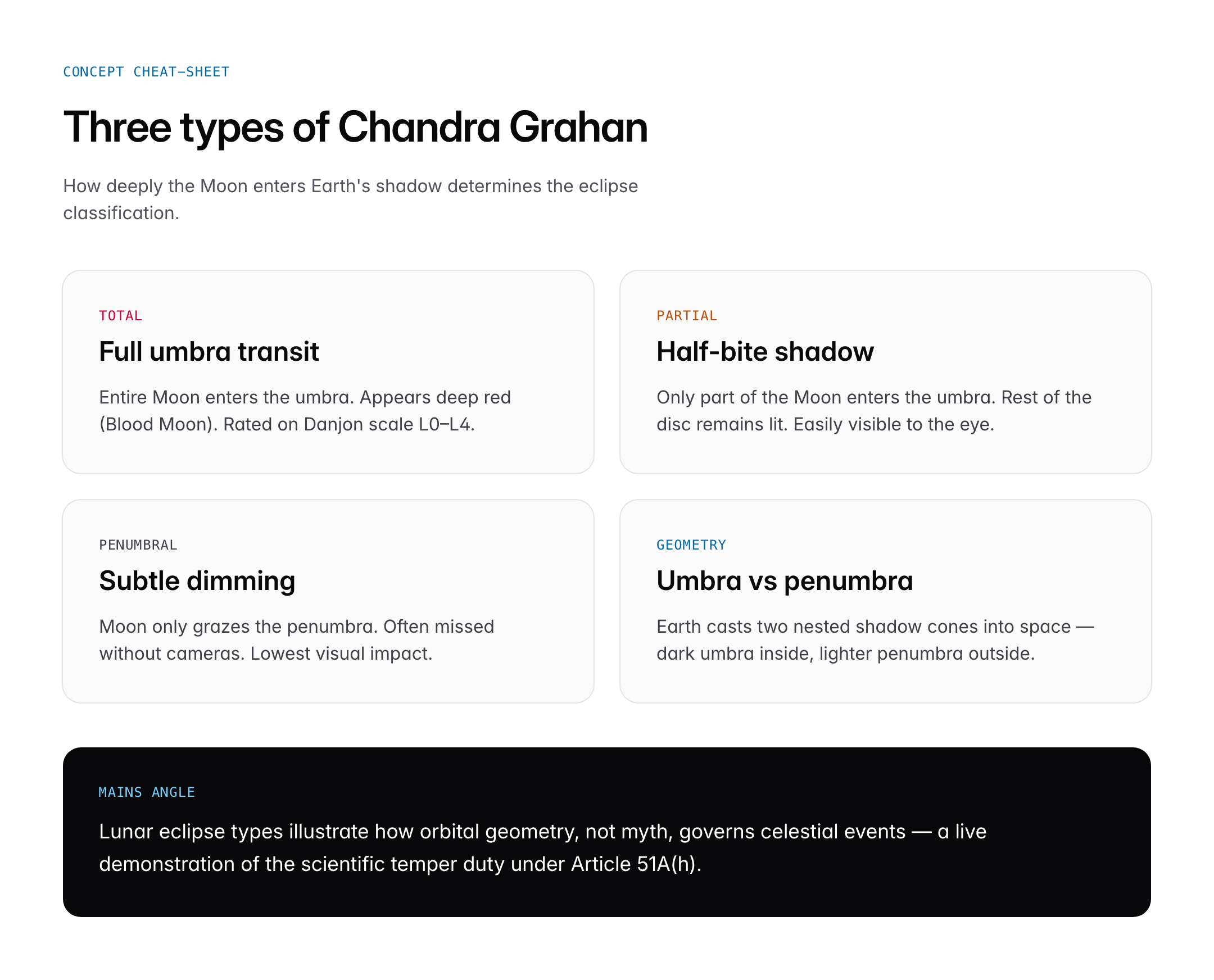
The Earth casts two shadow cones into space. The umbra is the dark central cone where the Sun is fully blocked. The penumbra is the lighter outer cone where the Sun is only partially blocked.
Types of Chandra Grahan
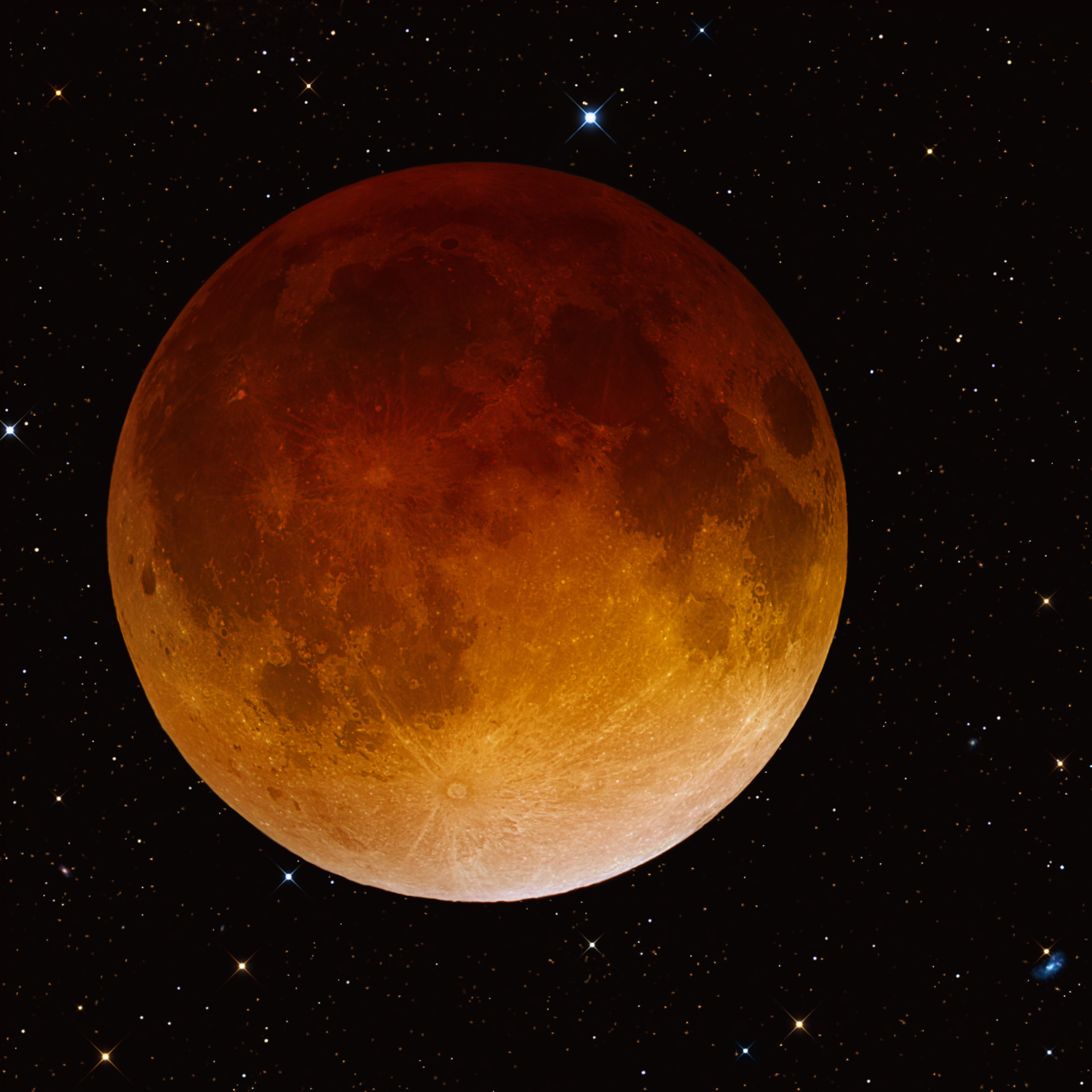
- Total lunar eclipse — the entire Moon passes through the umbra. The Moon often glows deep red, earning the popular name Blood Moon.
- Partial lunar eclipse — only a portion of the Moon enters the umbra, leaving a visible dark bite.
- Penumbral lunar eclipse — the Moon only grazes the penumbra. The dimming is subtle and often missed without instruments.
The Blood Moon Effect
During totality, the Moon does not disappear. Sunlight refracts through the Earth’s atmosphere, and shorter blue wavelengths scatter out via Rayleigh scattering, leaving the longer red and orange wavelengths to bend inward and illuminate the lunar surface. In effect, every sunrise and sunset on Earth is projected onto the Moon at once. The depth of redness depends on atmospheric dust, volcanic ash, and cloud cover, captured by the Danjon scale from L0 (very dark) to L4 (bright copper).
Eclipse Cycles
The Saros cycle of 18 years 11 days 8 hours produces nearly identical eclipses because the Earth-Moon-Sun geometry repeats. The Metonic cycle of 19 years is also relevant for calendars. These cycles let astronomers predict eclipses centuries in advance.
2026 Eclipse Calendar
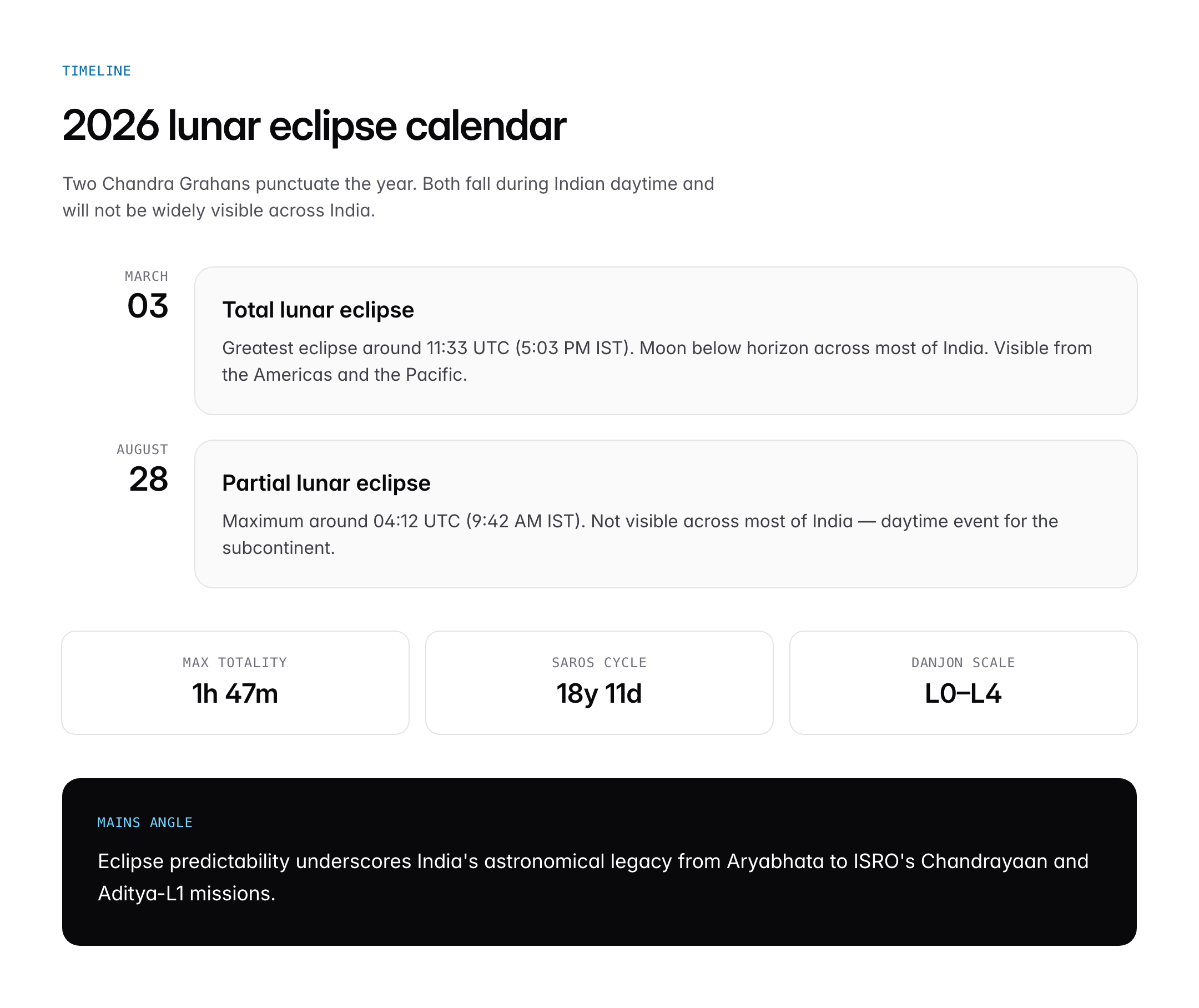
- 3 March 2026 — Total lunar eclipse, with greatest eclipse around 11:33 UTC (approximately 5:03 PM IST). In India, the Moon is still below the horizon during totality, so the event is largely not visible from the subcontinent.
- 28 August 2026 — Partial lunar eclipse, with maximum around 04:12 UTC (approximately 9:42 AM IST). Again, not visible from most of India because it occurs in daytime.
Significance for UPSC and General Knowledge
- Tests understanding of celestial mechanics relevant to GS1 geography and the Earth-Moon-Sun system
- Links to Indian scientific heritage — Aryabhata, Varahamihira, Bhaskara, Jantar Mantar
- Connects to atmospheric science through Rayleigh scattering and the Danjon scale
- Provides factual Prelims fodder on types, cycles, and visibility
- Anchors Mains discussion on scientific temper under Article 51A (h) versus traditional beliefs
- Ties to disaster myth debunking and public science communication missions
Detailed Analysis: Science, Culture and Policy
The scientific value of lunar eclipses is often underappreciated. Because the Moon is a passive screen, changes in the Earth’s atmosphere directly shape eclipse colour. After major volcanic eruptions such as Mount Pinatubo (1991) or Krakatoa (1883), subsequent total eclipses were notably darker because stratospheric sulphate aerosols absorbed more light. NASA and the European Space Agency still use eclipse photometry to track atmospheric optical depth and validate climate models.
Culturally, India presents a striking paradox. On the one hand, the country has produced world-class astronomical missions — Chandrayaan-1, Chandrayaan-2, Chandrayaan-3, and the Aditya-L1 solar observatory — that demonstrate deep scientific capability. On the other hand, persistent beliefs around sutak, eclipse-time food contamination, and restrictions on pregnant women continue to circulate. The Indian Medical Association and the Indian Council of Medical Research have repeatedly clarified that no evidence supports eclipse-related health harm.
The Department of Science and Technology and the Vigyan Prasar initiative have used each eclipse as a public outreach opportunity, distributing safe observation material, coordinating with planetaria such as Nehru Planetarium Delhi and Birla Planetarium Kolkata, and broadcasting live feeds. The policy question for UPSC Mains is how a constitutional duty to develop scientific temper, enshrined in Article 51A(h), can be balanced with respect for cultural heritage without amplifying misinformation.
Economically, eclipse tourism is a small but growing segment. States along favourable viewing paths for future total solar eclipses, notably the 2034 total solar eclipse that will touch Jammu and Kashmir, Himachal Pradesh and Uttarakhand, are already being studied by the Ministry of Tourism as niche astro-tourism destinations.
Comparative Perspective
| Feature | Lunar Eclipse (Chandra Grahan) | Solar Eclipse (Surya Grahan) |
|---|---|---|
| Occurs at | Full Moon | New Moon |
| Alignment | Sun-Earth-Moon | Sun-Moon-Earth |
| Safe to view | Yes, with naked eye | No, requires certified filters |
| Duration | Up to 1 hr 47 min totality | Up to 7 min 32 sec totality |
| Frequency per year | 2 to 5 globally | 2 to 5 globally |
| Visibility | Entire night side of Earth | Narrow path only |
| Shadow cast on | The Moon | The Earth |
Lunar eclipses are more democratic than solar eclipses. While a total solar eclipse draws a path of totality only a few hundred kilometres wide, a total lunar eclipse is visible to every observer on the night side of Earth simultaneously. This is why, over a human lifetime, you will typically witness far more lunar eclipses than total solar ones from any single location.
Controversies and Debates
Chandra Grahan sits at a familiar fault line between faith and science. The sutak period, traditionally nine hours before a lunar eclipse, prescribes fasting, shutting temples, and discarding cooked food. Advocacy groups argue that these practices are culturally significant and harmless, while rationalist organisations such as the Federation of Indian Rationalist Associations contend that they reinforce unscientific thinking, particularly when directed at pregnant women through taboos about scissors, knives, or stepping outside.
There is also a climate-denial adjacent controversy. Some online commentators misuse historical eclipse records to argue that atmospheric changes are cyclic and not human-caused. Mainstream science rejects this conflation. Eclipse photometry confirms a net increase in stratospheric dimming correlated with specific volcanic or industrial events, not with general climate trends.
Finally, the commercial dimension invites debate. Paid puja packages, eclipse-specific amulets, and social media astrologers exploit anxiety for profit. Consumer protection agencies and science communication platforms continue to flag misleading claims without restricting legitimate religious practice.
Prelims Pointers
- Chandra Grahan always occurs on Purnima (Full Moon), never on Amavasya
- The Moon’s orbital tilt of about 5 degrees to the ecliptic is why eclipses are not monthly
- Umbra is the dark inner shadow, penumbra the lighter outer shadow
- Three types: total, partial, penumbral
- Blood Moon colour is caused by Rayleigh scattering through Earth’s atmosphere
- Danjon scale (L0 to L4) measures the brightness of a total lunar eclipse
- Saros cycle is 18 years 11 days 8 hours
- 3 March 2026 is a total lunar eclipse, largely not visible in India
- 28 August 2026 is a partial lunar eclipse, also not visible across most of India
- Aryabhata’s Aryabhatiya scientifically explained eclipses in the 5th century CE
- Jantar Mantar observatories were commissioned by Sawai Jai Singh II
- Lunar eclipses are safe to view with the naked eye, unlike solar eclipses
Mains Practice Questions
Q1. Examine the scientific basis of a lunar eclipse and discuss how Indian classical astronomers contributed to its understanding. (250 words)
- Explain geometry, umbra, penumbra and types
- Trace Aryabhata, Varahamihira, Brahmagupta contributions and Jantar Mantar legacy
- Contrast scientific models with mythological accounts and note the importance of scientific temper
Q2. “Article 51A(h) places a duty on citizens to develop a scientific temper.” In the context of eclipse-related beliefs, critically discuss the role of public institutions in promoting rational thinking. (250 words)
- Outline the Article 51A(h) fundamental duty
- Evaluate DST, Vigyan Prasar, planetaria and ISRO outreach
- Suggest policy measures balancing cultural respect with misinformation control
Conclusion
Chandra Grahan is a rare reminder that the sky obeys mathematics. Every reddened Moon is a live demonstration of orbital geometry, atmospheric optics, and the patient cycles first decoded by Indian and Greek astronomers more than fifteen centuries ago. The 2026 pair of eclipses, on 3 March and 28 August, may not be spectacular from Indian skies, but they are valuable teaching moments for aspirants and citizens alike.
For UPSC preparation, Chandra Grahan is a compact topic that spans geography, science and technology, Indian culture, and governance. Understanding the mechanics, remembering the dates, recognising the cultural context, and engaging with the policy debate on scientific temper together produce a well rounded answer that can anchor Prelims MCQs and Mains essays alike.
Frequently Asked Questions
What is Chandra Grahan?
Chandra Grahan is the Sanskrit name for a lunar eclipse. It occurs on a Full Moon night when the Sun, Earth and Moon align so that the Earth’s shadow falls on the Moon. Depending on how deeply the Moon enters the shadow, the eclipse is classified as total, partial or penumbral, each with its own visual signature.
Why is Chandra Grahan important for UPSC?
Chandra Grahan is relevant across GS1 geography, science and technology, Indian culture and governance. It tests knowledge of celestial mechanics, the Earth-Moon-Sun system, Indian astronomical heritage, and the constitutional duty to develop scientific temper under Article 51A(h). It frequently appears in Prelims MCQs and as Mains issues on rationality and tradition.
How is Chandra Grahan related to Surya Grahan?
Both are eclipses caused by shadows in the Earth-Moon-Sun system, but they differ in geometry. Surya Grahan happens at New Moon when the Moon blocks the Sun. Chandra Grahan happens at Full Moon when the Earth blocks sunlight from reaching the Moon. Solar eclipses require eye protection, while lunar eclipses are naked-eye safe.
When will Chandra Grahan occur in 2026?
There are two lunar eclipses in 2026. A total lunar eclipse takes place on 3 March 2026, and a partial lunar eclipse follows on 28 August 2026. However, both events occur largely during Indian daytime, so most of India will not see them directly. Live streams from global observatories offer an alternative.
Why does the Moon turn red during a total lunar eclipse?
During totality, sunlight passes through Earth’s atmosphere before reaching the Moon. Shorter blue wavelengths scatter out via Rayleigh scattering, while longer red wavelengths bend inward and illuminate the lunar surface. In effect, every sunrise and sunset on Earth is projected onto the Moon simultaneously, producing the Blood Moon colour.
Is it safe to watch Chandra Grahan?
Yes. Unlike a solar eclipse, a lunar eclipse can be observed directly with the naked eye, binoculars or a telescope without any filters. The only light reaching Earth is reflected moonlight, which is always safe. Cultural practices such as sutak are not based on scientific evidence of physical harm.
What is the Saros cycle?
The Saros is an eclipse cycle of approximately 18 years 11 days 8 hours. After one Saros, the Sun, Earth and Moon return to nearly the same relative geometry, producing a similar eclipse. Astronomers use Saros series to predict eclipses centuries in advance and to track families of recurring solar and lunar eclipses.
What contribution did Aryabhata make to eclipse science?
Aryabhata, in his 5th century CE work Aryabhatiya, rejected the mythological Rahu-Ketu explanation and correctly stated that lunar eclipses occur when the Moon enters the Earth’s shadow, while solar eclipses occur when the Moon blocks the Sun. He also computed eclipse timings and used a spherical Earth model, laying the foundation for later Indian astronomy.
Tell Google you want more of this.
Add Anantam IAS as a preferred sourceOne tap, and this site shows up more often in your own Top Stories, AI Overviews and AI Mode. Remove it any time.