Cheetah vs Leopard: Anatomy, Behaviour, and India’s Reintroduction Story
Cheetah vs leopard explained: solid spots vs rosettes, sprinter vs ambusher, semi-retractable vs retractable claws, India's Kuno reintroduction, and UPSC pointers.
The cheetah and the leopard look similar from a distance. Both are spotted, sand-coloured cats roughly the size of a Labrador, both stalk through grasslands at dusk, and both have made the cover of National Geographic more times than anyone can count. Up close, however, they are two completely different animals with separate evolutionary lineages, distinct hunting tactics, and very different fates in modern India. Mistaking one for the other is one of the easiest ways to lose marks in the UPSC Prelims environment section.
This guide pulls together the anatomical, behavioural, and conservation differences between the two cats. It uses the canonical comparison taught in NCERT and recent Project Cheetah reports, then layers on context that the Mains paper looks for: the IUCN status, the Indian distribution, and the policy story behind India’s cheetah reintroduction at Kuno National Park. By the end you should be able to identify either cat from a photograph, place each in the right ecosystem, and answer either factual or analytical questions on big cats in India.
We will start with a quick comparison snapshot, then peel back each feature with explanation and examples.
Quick Facts
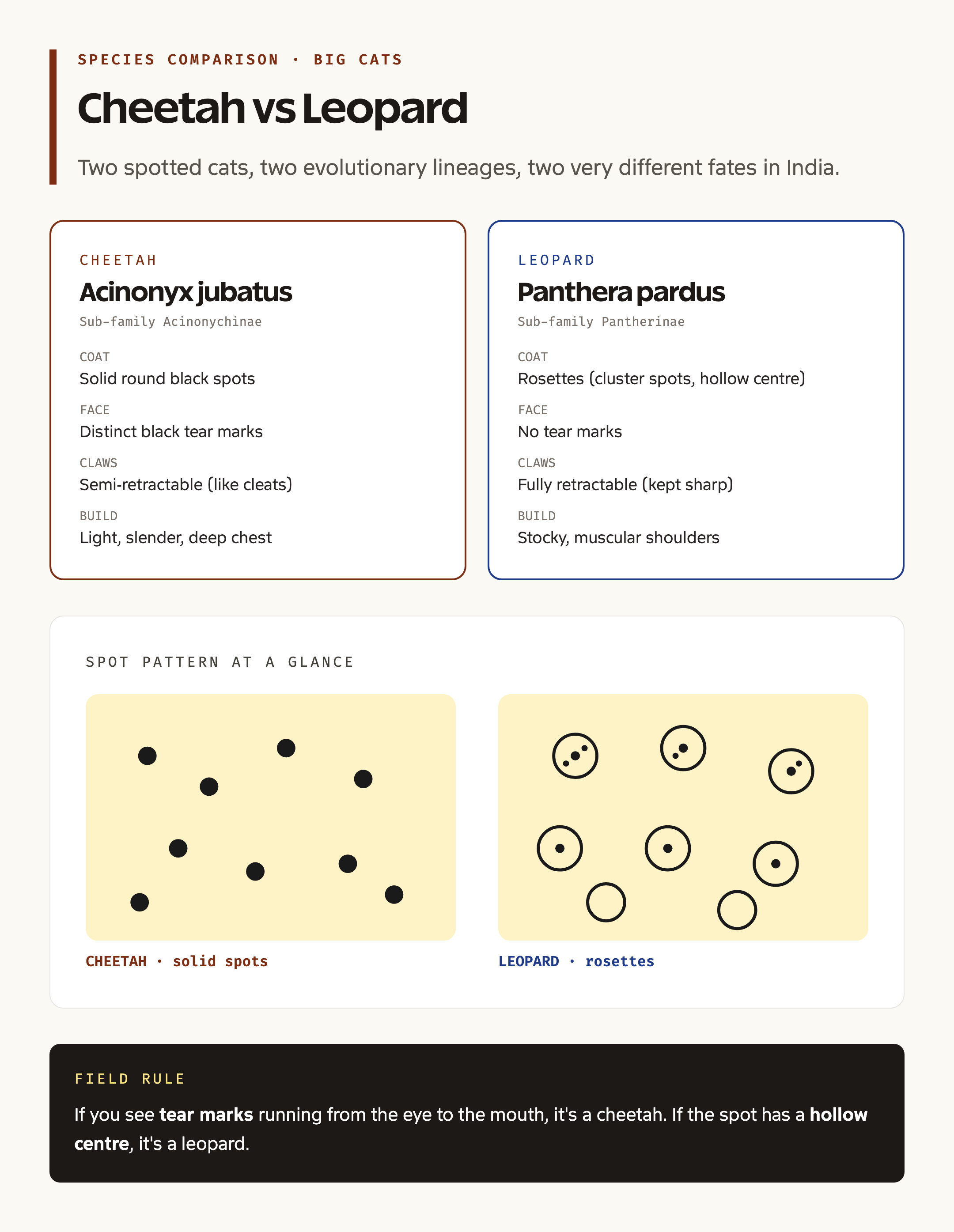
- Cheetah scientific name: Acinonyx jubatus
- Leopard scientific name: Panthera pardus
- Cheetah top speed: 110 to 120 km per hour, fastest land animal
- Leopard top speed: 58 km per hour
- Cheetah hunting style: Open-ground sprinter
- Leopard hunting style: Stealth ambusher and tree climber
- Cheetah claws: Semi-retractable (provide running traction)
- Leopard claws: Fully retractable (kept sharp for climbing)
- Cheetah coat: Solid round black spots
- Leopard coat: Rosettes (clusters of spots forming a flower shape)
- Cheetah in India: Asiatic cheetah declared extinct in 1952; African cheetahs reintroduced at Kuno from 2022
- Leopard in India: Around 13,874 individuals (Status of Leopards 2022 estimate)
What These Two Cats Are
Cheetah and leopard belong to the same family, Felidae, but to two different sub-families. The cheetah sits in Acinonychinae as the only living member of the genus Acinonyx. The leopard is a true big cat under Pantherinae, sharing the genus Panthera with the lion, tiger, jaguar, and snow leopard. The split happened roughly 8 to 10 million years ago, which explains why the cheetah lacks features common to other big cats such as the ability to roar and fully retractable claws.
The cheetah is built for one thing: speed in open country. Its body is light, its chest is deep, its legs are long, its claws are semi-retractable like running spikes, and its non-retractable dewclaws are used to hook prey at full sprint. The leopard is built for power and versatility. It is heavy in the shoulders, can drag a 70 kg carcass up a tree, climbs vertically, swims well, and hunts equally happily in dense forest, mountain rocky terrain, or arid scrub.
Geographically, leopards remain the most widely distributed big cat after the domestic cat, found across Africa and most of Asia. Cheetahs in the wild now exist in only a handful of African countries and a tiny relict population in Iran. India lost its native Asiatic cheetah subspecies in 1952 when the last three were shot in Madhya Pradesh.
Background and Historical Context
The cheetah’s relationship with India is millennia long. Mughal emperors used trained cheetahs for hunting blackbuck, with Akbar reportedly maintaining a stable of around 1,000 cheetahs at the height of his rule. The word “cheetah” itself comes from the Sanskrit chitraka, meaning “the spotted one,” and the same root gives us the word “chital” for spotted deer.
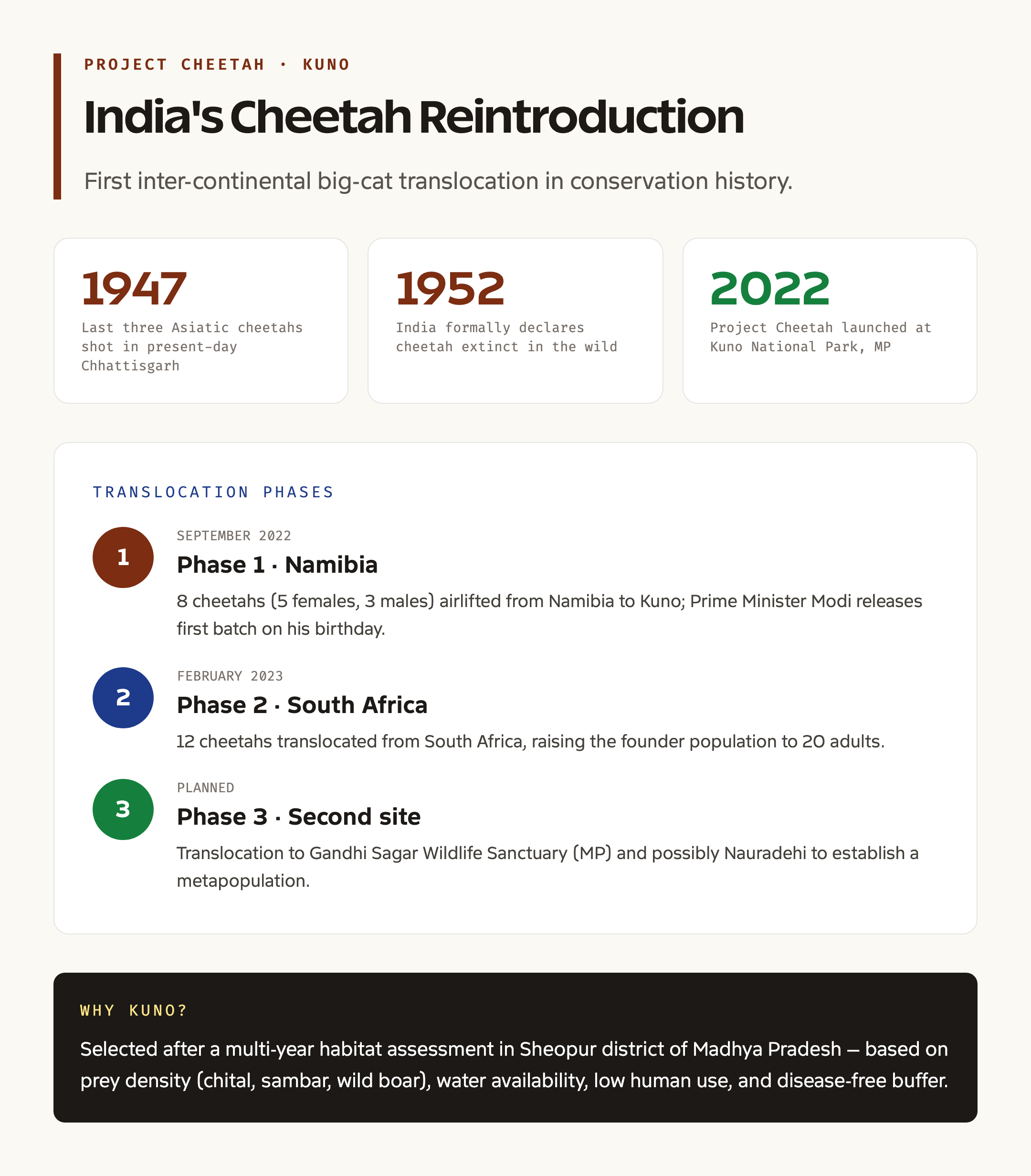
By the early twentieth century, hunting pressure, habitat loss, and the conversion of grasslands to agriculture had reduced the Asiatic cheetah population to a handful of individuals. The Maharaja of Korea (now in Chhattisgarh) shot the last three confirmed Asiatic cheetahs in 1947 in his hunting estate. In 1952, the Indian government formally declared the cheetah extinct in the wild.
Project Cheetah, launched in September 2022, is the world’s first inter-continental big-cat reintroduction. Eight cheetahs from Namibia, followed by twelve from South Africa, were released into Kuno National Park in Madhya Pradesh. The project’s stated aim is to restore the cheetah as a functional ecological actor in Indian grasslands and as a flagship for the recovery of open-ecosystem biodiversity. The conservation logic ties into broader frameworks already covered in our Project Tiger explainer, though cheetahs target prey and habitats that tigers do not.
The leopard story in India runs in the opposite direction. Despite intense persecution, prey loss, and conflict with humans, the leopard has held on across an extraordinary range of habitats. The 2022 Status of Leopards in India report counted 13,874 individuals across the tiger states, an increase of around eight percent over the previous count.
Key Differences: Feature by Feature
Coat Pattern
The cheetah carries solid, round, black spots scattered evenly across a tawny coat. Each spot is a single mark with no inner space. The leopard carries rosettes, which are clusters of smaller spots arranged like a flower or a rose, with a hollow tan centre. If you can see a hollow inside the spot, it is a leopard. The Asian and African leopard subspecies show slightly different rosette densities, but the rosette form is constant.
Tear Marks
The cheetah has two distinct black tear lines running from the inner corner of each eye down to the corner of the mouth. These are thought to reduce sun glare during high-speed chases under bright sunlight, much like the eye black athletes wear. The leopard has no tear lines at all. This is the single fastest field identification trick.
Claws
A cheetah’s claws are semi-retractable. They are visible even when relaxed and act as cleats during a sprint, providing grip on hard ground. The leopard has fully retractable claws like a domestic cat. They stay sheathed during walking, which keeps them sharp for climbing trees and gripping prey.
Hunting Style
The cheetah is a daytime sprinter. It stalks to within 50 to 100 metres, then explodes into a chase that lasts no more than 30 seconds and rarely covers more than 600 metres. Cheetah hunts succeed about 50 percent of the time but are extremely energy-intensive. After a kill, the cheetah needs 15 to 20 minutes to recover before it can eat.
The leopard is an ambusher. It stalks within striking distance through dense cover, pounces, and dispatches prey with a throat or neck bite. Leopards then haul carcasses up trees, sometimes weighing twice their body weight, to keep them away from lions and hyenas.
Activity Pattern
Cheetahs are diurnal, hunting in the cooler hours of morning and late afternoon. This is partly because they need to see prey at distance for high-speed chases, and partly because they avoid competition with bigger nocturnal predators. Leopards are largely nocturnal and crepuscular, hunting at dusk, dawn, and through the night. In areas with high human activity, leopards become almost entirely nocturnal.
Habitat
Cheetahs need open grasslands, savannahs, and lightly wooded scrub where there is room to run. Dense forest blocks their hunting strategy entirely. Leopards are the most habitat-flexible big cat on earth, found in dense rainforest, dry deciduous forest, mountainous terrain up to 5,200 metres in the Himalayas, semi-arid scrub, mangroves, and even on the outskirts of mega-cities such as Mumbai’s Sanjay Gandhi National Park.
Vocalisation and Roaring
Cheetahs cannot roar. They chirp like a bird, purr loudly, hiss, and growl. Leopards can roar, though their roar is a hoarse “sawing” sound rather than the deep boom of a lion or a tiger. The ability to roar in Panthera species comes from a specialised, partially ossified hyoid bone that is absent in the cheetah.
Climbing
Cheetahs are poor climbers. Their semi-retractable claws cannot grip bark well, and they are too lightly built to haul prey vertically. Leopards are expert climbers. A leopard hauling an antelope up a 12 metre acacia is one of the iconic images of African wildlife.
IUCN Status
The cheetah as a global species is listed as Vulnerable by IUCN, but the Asiatic cheetah subspecies (Acinonyx jubatus venaticus) is Critically Endangered with fewer than 50 individuals left, all in Iran. The leopard is Vulnerable globally, with regional populations such as the Persian leopard and Sri Lankan leopard listed separately. The Indian leopard subspecies (Panthera pardus fusca) is also Vulnerable.
Conservation Status in India
The Asiatic cheetah was declared extinct in India in 1952. Today, the only cheetahs in India are reintroduced African cats at Kuno. The leopard is widespread across India with a population of approximately 13,874 individuals as per the 2022 census, present in nearly every state except the highest Himalayan zones, building on the broader picture of Indian wildlife covered in our biological diversity act, 2002 primer.
Detailed Comparison Table
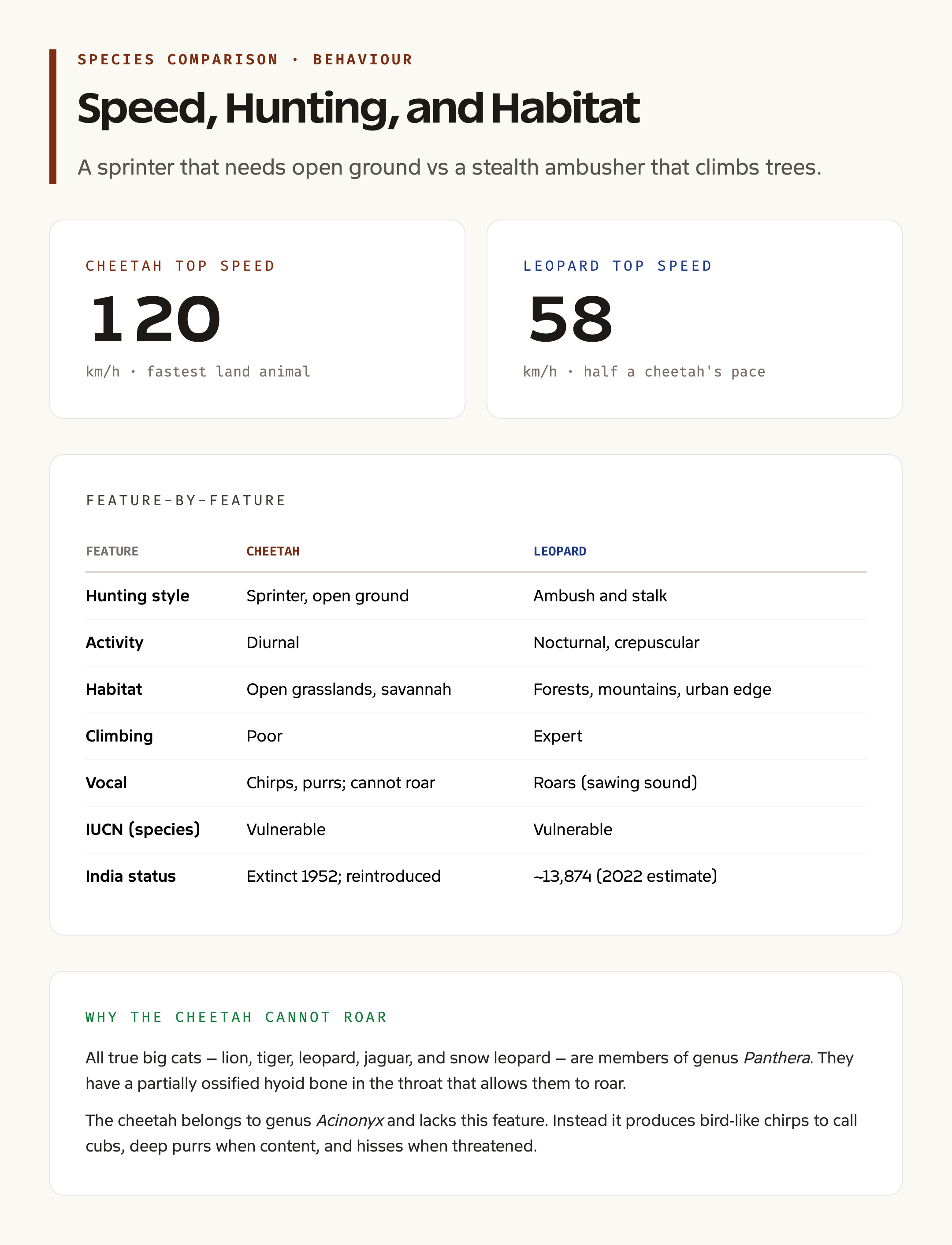
| Feature | Cheetah (Acinonyx jubatus) | Leopard (Panthera pardus) |
|---|---|---|
| Family / Genus | Felidae / Acinonyx | Felidae / Panthera |
| Coat pattern | Solid round black spots | Rosettes (cluster spots with hollow centre) |
| Face | Distinct black tear marks | No tear marks |
| Claws | Semi-retractable | Fully retractable |
| Body build | Light, slender, deep chest | Stocky, muscular shoulders |
| Top speed | 110 to 120 km per hour | Around 58 km per hour |
| Hunting style | Open-ground sprint | Ambush and stalk |
| Activity pattern | Diurnal | Nocturnal and crepuscular |
| Habitat | Open grasslands and savannahs | Forests, mountains, scrub, urban edges |
| Vocalisation | Chirps, purrs, hisses; cannot roar | Roars (sawing sound) |
| Climbing ability | Poor | Expert |
| IUCN (species) | Vulnerable | Vulnerable |
| Asiatic / Indian subspecies status | Critically Endangered (extinct in India) | Vulnerable, ~13,874 in India |
| Indian range | Reintroduced at Kuno (Madhya Pradesh) | Almost all states |
India’s Cheetah Reintroduction at Kuno
Project Cheetah was approved by the Supreme Court in 2020 after a long legal battle. The project involves three phases.
- Phase 1 (2022): Eight Namibian cheetahs (5 females, 3 males) released at Kuno National Park
- Phase 2 (2023): Twelve South African cheetahs added
- Phase 3 (planned): Translocation to Gandhi Sagar Wildlife Sanctuary and possibly Nauradehi
Kuno was selected after a multi-year habitat assessment looked at prey density, water availability, area size, human use, and disease risk. The site sits in Sheopur district of Madhya Pradesh and was originally identified as a possible second home for the Asiatic lion.
The project has had setbacks. Several cheetahs and cubs have died, raising debates over habitat suitability, monsoon humidity, and management protocols. Supporters argue the early mortalities are within expected ranges for translocation projects. Critics argue Kuno is too small and too humid for cheetahs and that the project displaces the long-pending Gir lion translocation. Either way, the project has restored cheetah-shaped paw prints to Indian soil for the first time in 70 years.
Why It Matters
Ecological role: Both cats are apex predators that regulate herbivore populations and the cascading effects on vegetation. Cheetahs target medium-sized antelope and gazelle, leopards target a wider prey spectrum from small rodents to full-grown sambar.
Flagship status: Both species pull conservation funding, tourism revenue, and political attention to wider ecosystems. Saving cheetah grasslands also saves bustards and blackbuck. Saving leopard forests also saves langurs, peafowl, and forest hydrology.
Human-wildlife conflict: The leopard is involved in more conflict incidents in India than any other big cat because of its overlap with rural and peri-urban areas. The cheetah is at the opposite end of the spectrum because there are simply not enough of them in India to generate conflict yet.
Challenges
For cheetahs: Tiny global wild population (around 7,100), narrow genetic diversity, dependence on open grasslands that are being converted to agriculture and renewable energy projects, and high cub mortality from lions and hyenas in Africa.
For leopards in India: Habitat fragmentation from highways and railways, retaliatory killings after conflict, illegal trade in skins and bones, and road kills which have risen sharply in the past decade. Many leopard deaths are also linked to electrocution from low-hanging power lines, an issue covered in detail in our eco-sensitive zones primer.
Prelims Pointers
- Cheetah scientific name: Acinonyx jubatus; leopard: Panthera pardus
- Cheetah is the only living member of genus Acinonyx
- Cheetah has solid spots and tear marks; leopard has rosettes and no tear marks
- Cheetah has semi-retractable claws; leopard has fully retractable claws
- Cheetah cannot roar; leopard can roar
- Cheetah top speed: 110 to 120 km per hour, fastest land animal
- Asiatic cheetah declared extinct in India in 1952
- Project Cheetah started in September 2022 at Kuno National Park, Madhya Pradesh
- Cheetahs introduced from Namibia (2022) and South Africa (2023)
- Indian leopard population (2022 estimate): approximately 13,874
- Cheetah IUCN status: Vulnerable; leopard: Vulnerable
Mains Practice Questions
- Critically evaluate Project Cheetah as an exercise in ecological restoration. Should India prioritise the reintroduction of an extinct subspecies or the recovery of existing endangered native species first? (250 words)
- The leopard is one of India’s most adaptable predators yet faces sustained human-wildlife conflict. Examine the policy interventions needed to reduce leopard-human conflict in peri-urban India. (150 words)
- Compare the ecological roles of the cheetah and the leopard, highlighting how each contributes differently to ecosystem balance in Indian conditions. (150 words)
Way Forward
For the cheetah, India needs to think beyond Kuno. A self-sustaining metapopulation requires at least three to four release sites with corridors, robust prey bases, and tight co-management with surrounding communities. The captive component of Project Cheetah should be expanded to insure against catastrophic losses, and learning should flow back into bustard and blackbuck programmes that share the same grassland landscape. For the leopard, the priority is not population recovery but conflict management. Quick payment of crop and livestock compensation, strict regulation of garbage dumps that attract leopards into towns, dedicated wildlife rescue teams, and underground power lines along forest fringes will reduce the trickle of leopard deaths that, in aggregate, take a heavy toll. Both species teach the same lesson: India’s predators need landscapes, not just protected fragments.
Frequently Asked Questions
What is the main difference between a cheetah and a leopard?
The simplest field difference is the spots. A cheetah has solid round black spots and two tear lines running down from its eyes. A leopard has rosettes, which look like clusters of smaller spots forming a flower with a hollow tan centre, and has no tear lines.
Which is faster, a cheetah or a leopard?
The cheetah is far faster. It can sprint at 110 to 120 km per hour over short distances and is the fastest land animal on earth. A leopard’s top speed is roughly 58 km per hour.
Are cheetahs and leopards in the same family?
Both belong to the family Felidae, but to different sub-families and genera. The cheetah is the only living species in the genus Acinonyx. The leopard is in the genus Panthera alongside lions, tigers, jaguars, and snow leopards.
Why was the cheetah declared extinct in India?
By the mid-twentieth century, intensive hunting, the conversion of grasslands to agriculture, and the loss of prey species had reduced the Asiatic cheetah to a handful of individuals. The last three were shot in 1947 in present-day Chhattisgarh, and the species was formally declared extinct in 1952.
What is Project Cheetah?
Project Cheetah is India’s plan to reintroduce the cheetah after a 70-year absence. It started in September 2022 with the release of eight Namibian cheetahs at Kuno National Park in Madhya Pradesh, followed by twelve South African cheetahs in 2023. It is the world’s first inter-continental big-cat translocation.
Can a leopard roar?
Yes, but the leopard’s roar sounds like rough, repeated sawing rather than the deep boom of a lion. The ability to roar comes from a specially structured hyoid bone in the throat, which the cheetah does not have.
Why do cheetahs have tear marks?
The two black lines running from the eyes to the mouth probably reduce sun glare during daytime hunts and may also help in directing prey vision and communication between cheetahs. They are absent in leopards.
Which big cat is more widespread in India?
The leopard. According to the Status of Leopards in India 2022 report, India has approximately 13,874 leopards spread across nearly every state. The cheetah exists only at Kuno and adjoining areas as part of the reintroduction.
Can cheetahs climb trees like leopards?
Cheetahs are poor climbers. Their semi-retractable claws give grip during running but cannot hook into bark. Leopards are expert climbers and routinely haul prey heavier than themselves up into trees to keep it safe from lions and hyenas.
Are reintroduced African cheetahs the same as the Asiatic cheetah?
No. The reintroduced cheetahs at Kuno belong to the African subspecies Acinonyx jubatus jubatus. The Asiatic cheetah (Acinonyx jubatus venaticus) survives only in Iran and is genetically distinct, though closely related.