Introduction
The Classical Language tag in India is a formal recognition granted by the Union Government on the recommendation of the Linguistic Experts Committee constituted by the Ministry of Culture. It confers scholarly prestige, Central funding for Centres of Excellence, and Presidential awards for eminent scholars. As of 2026, eleven languages hold classical status, up from the original six recognised between 2004 and 2014, following a significant expansion in October 2024 when five additional languages were added in a single Cabinet decision.
For the UPSC aspirant, the list is a high-probability Prelims question because it sits at the intersection of culture, federalism and language policy. It also anchors Mains answers in GS1 on Indian culture and in GS2 on Eighth Schedule politics. This article offers the consolidated 2026 list, the evolution of the recognition criteria, state-wise politics behind demands, and the institutional architecture supporting classical languages.
Quick Facts at a Glance
| Attribute | Detail |
|---|---|
| Total classical languages (2026) | 11 |
| First language recognised | Tamil, 2004 |
| Most recent additions | Marathi, Pali, Prakrit, Assamese, Bengali in October 2024 |
| Nodal ministry | Ministry of Culture |
| Advisory body | Linguistic Experts Committee under Sahitya Akademi |
| Constitutional provision | Article 351 (not direct), Eighth Schedule (separate) |
| Benefits | Centres of Excellence, Presidents Awards, two international awards |
| Not in Eighth Schedule | Pali, Prakrit |
Background and Historical Context
India has no single official definition of a classical language in its Constitution. The concept emerged in the early 2000s as a policy innovation to honour ancient literary heritage distinct from the Eighth Schedule list, which primarily recognises languages for administrative and educational use. The demand for special classical status first crystallised in Tamil Nadu during the late 1990s, with Dravidian political parties pressing the Union Government to acknowledge Tamils 2,000-plus year literary antiquity.
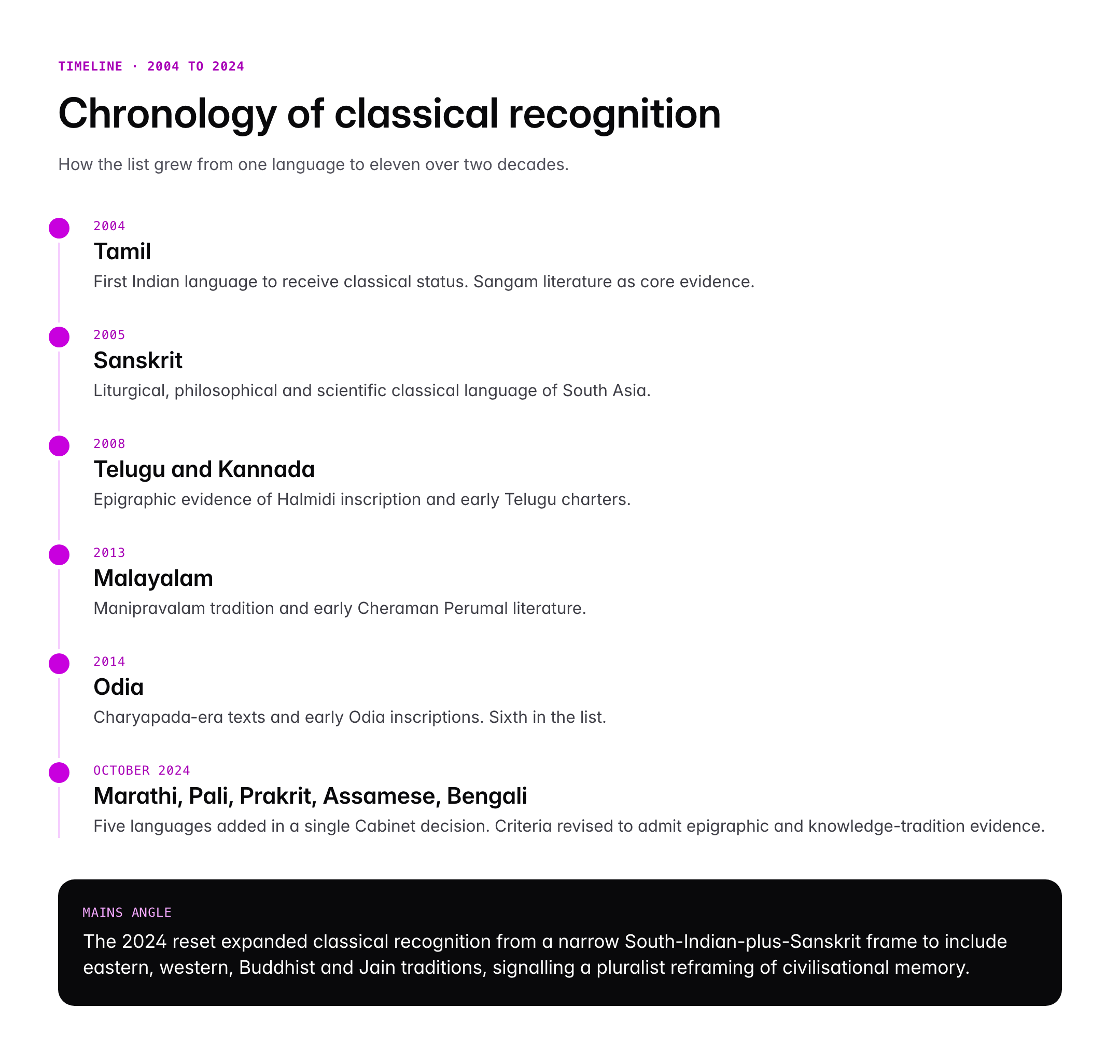
The Vajpayee government in 2004 formally created the classical language category and granted it to Tamil. Sanskrit followed in 2005 under the Manmohan Singh government. Responding to demands from other regions, an expert committee under the Sahitya Akademi was constituted in 2004 to develop objective criteria. Between 2008 and 2014, Telugu, Kannada, Malayalam and Odia were added, taking the tally to six. For a decade afterwards the list froze, even as demands piled up from Maharashtra, Assam, West Bengal and Buddhist monastic circles.
The 2024 Cabinet decision marked a reset. Five languages were added together: Marathi, Pali, Prakrit, Assamese and Bengali. The government simultaneously revised the antiquity threshold from 1,500 years to 1,500 to 2,000 years depending on literary evidence, and added explicit recognition of knowledge texts and epigraphy alongside pure literature. This was the most significant shift in classical language policy since the tags inception.
Key Features
The 2026 list in chronological order
- Tamil – recognised 2004, antiquity traced to Sangam literature.
- Sanskrit – recognised 2005, the classical liturgical and philosophical language of South Asia.
- Telugu – recognised 2008, with epigraphic attestation from the 6th century.
- Kannada – recognised 2008, Halmidi inscription of 450 CE as base evidence.
- Malayalam – recognised 2013, distinct literary tradition from Manipravalam onwards.
- Odia – recognised 2014, Charyapada and early Odia inscriptions.
- Marathi – recognised 2024, with Satavahana Prakrit roots and Dnyaneshwari of 1290 CE.
- Pali – recognised 2024, canonical language of Theravada Buddhism.
- Prakrit – recognised 2024, umbrella for Ardhamagadhi and Jain canonical texts.
- Assamese – recognised 2024, with Charyapada, Buranji chronicles and Sankardev heritage.
- Bengali – recognised 2024, with Charyapada and medieval Vaishnava literature.
The revised criteria
The Linguistic Experts Committee in 2024 consolidated four criteria:
- High antiquity of early texts, 1,500 to 2,000 years minimum.
- An ancient literature or body of texts considered a valuable heritage by generations of speakers.
- A knowledge tradition in the language, including grammar, philosophy, sciences or epigraphy.
- The classical form may be distinct or may have branched off into modern descendants, and epigraphic or oral attestation is admissible.
Institutional architecture
Each classical language is eligible for a Centre of Excellence for Studies funded by the Ministry of Culture, two international awards for scholars, chairs in universities, and financial assistance to institutions working on preservation.
Significance for UPSC and General Knowledge
- The exact count 11 and the 2024 additions are prime Prelims territory.
- Links to Eighth Schedule politics for GS2 federalism and language rights questions.
- Relevant to Mains GS1 questions on Indian heritage, literary traditions and syncretic culture.
- Tests understanding of Article 29 cultural rights and Article 351 Hindi-promotion distinction.
- Backgrounds current affairs such as Sahitya Akademi debates and university chair appointments.
- Aligns with India G20 emphasis on civilisational continuity and indigenous knowledge systems.
Detailed Analysis: Political Economy of Classical Status
The classical language tag has become a serious instrument of cultural federalism. Four dynamics stand out. First, state government lobbying: Maharashtra passed assembly resolutions demanding classical status for Marathi between 2013 and 2022 before the 2024 grant. West Bengal and Assam pressed through Ministry of Culture submissions backed by manuscript evidence from Asiatic Society archives. Second, scholarly curation: the Linguistic Experts Committee, comprising Sahitya Akademi nominees and independent linguists, vets submissions. The 2024 committee included specialists in Indo-Aryan philology, Dravidian linguistics, and Pali-Prakrit studies.
Third, fiscal commitments: each Centre of Excellence receives recurring grants that currently average Rs 10 to 15 crore over a five-year project cycle. The Central Institute of Indian Languages (CIIL) at Mysuru acts as the apex coordination body, with separate Centres for Tamil at Chennai, Telugu at Hyderabad, and Kannada at Mysuru. Additional centres for the 2024 entrants are under establishment. Fourth, award regime: the government funds two international annual awards per classical language, recognising scholars based inside and outside India.
Controversies persist. Critics allege politicisation: some linguists argue that classical status should be linked more tightly to peer-reviewed antiquity claims rather than state political pressure. Others note that the 2024 expansion was timed close to the Maharashtra assembly election cycle and Bihar political manoeuvring around Pali and Prakrit for Buddhist-Jain constituency signalling. Defenders counter that federal language recognition has always been political and that broadening the tent strengthens civilisational narratives.
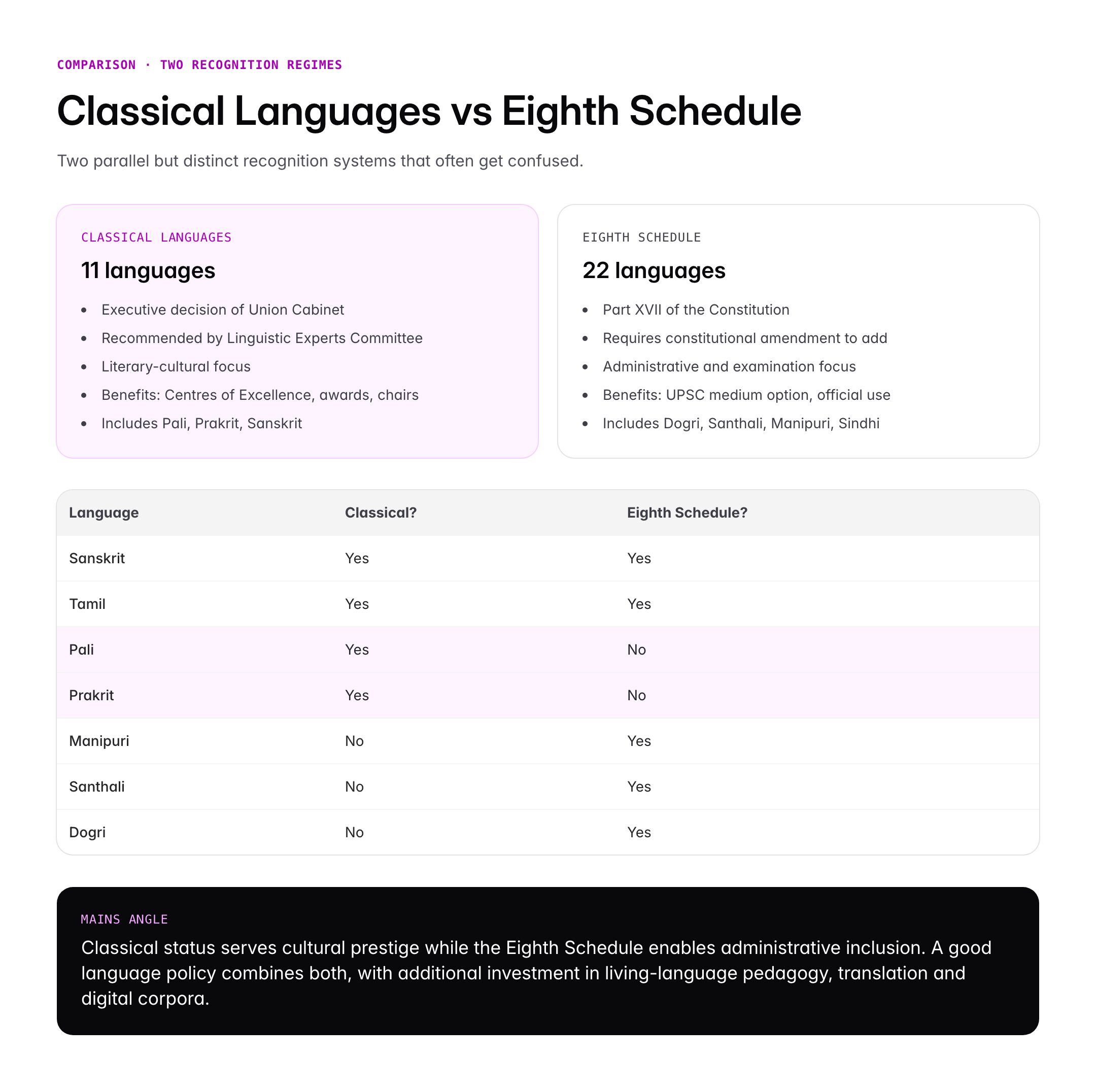
A further structural issue is the asymmetry between classical language recognition and Eighth Schedule inclusion. Pali and Prakrit are classical but not in the Eighth Schedule; Manipuri is in the Eighth Schedule but not classical despite literary traditions dating to the 17th century Cheitharol Kumbaba. Demands for Manipuri, Dogri, Maithili, Nepali and other Eighth Schedule languages are now active.
Comparative Perspective
| Feature | Classical Languages | Eighth Schedule |
|---|---|---|
| Count (2026) | 11 | 22 |
| Constitutional basis | Executive decision of Union Cabinet | Part XVII, Eighth Schedule |
| Primary purpose | Literary-cultural recognition, scholarship | Representation in administration, exams, states |
| Example exclusive to list | Pali, Prakrit, Sanskrit | Dogri, Santhali, Manipuri, Sindhi |
| Financial benefit | Centres of Excellence, awards | UPSC exam medium option, official use |
| Grant mechanism | Ministry of Culture | Constitutional amendment process |
Unlike UNESCO Masterpieces of Oral Heritage listings, the Indian classical language tag is a sovereign national recognition tied to cultural policy. It parallels Chinas scheme for classical language promotion and Greeces dedicated classical studies funding, but without comparable linkage to school curricula.
Controversies and Debates
The 2024 expansion triggered lively debate. Tamil scholars and some Dravidian commentators argued that adding five languages simultaneously diluted the rigour that had underpinned earlier grants. Scholars from north-eastern states welcomed Assamese inclusion but flagged that Manipuri and Khasi traditions remain unrecognised. There has also been pushback on criteria transparency: the exact reports of the Linguistic Experts Committee are not always placed in the public domain, fuelling allegations of opacity.
Another strand of debate concerns the instrumental use of classical status. State governments have occasionally redirected Centre of Excellence funds toward tourism-themed projects rather than manuscriptology, raising audit concerns. There is also tension between living language communities and classical status: younger speakers of Odia or Kannada sometimes feel that classical grandeur is privileged over contemporary pedagogy, digital tools and translation infrastructure. A balanced policy design would couple classical recognition with corpus building, OCR of palm-leaf manuscripts and teacher training in modern descendants.
Prelims Pointers
- Total classical languages of India in 2026: 11.
- First classical language: Tamil, 2004.
- Sanskrit recognised: 2005.
- Languages added in 2024: Marathi, Pali, Prakrit, Assamese, Bengali.
- Two classical languages not in the Eighth Schedule: Pali and Prakrit.
- Recommending body: Linguistic Experts Committee under Sahitya Akademi.
- Nodal ministry: Ministry of Culture.
- Antiquity threshold: 1,500 to 2,000 years.
- Apex coordination body: Central Institute of Indian Languages, Mysuru.
- Year Telugu and Kannada got classical status: 2008.
- Eighth Schedule count: 22 languages.
- Classical languages from South India: Tamil, Telugu, Kannada, Malayalam.
Mains Practice Questions
- Evaluate the criteria and process by which the Union Government grants Classical Language status, with reference to the 2024 additions. (250 words)
- Original 2004 criteria and the 2024 revision.
- Role of Linguistic Experts Committee and Sahitya Akademi.
- Political economy and transparency concerns.
- Differentiate between classical language recognition and Eighth Schedule inclusion. Which is more consequential for language preservation? (150 words)
- Constitutional vs executive basis.
- Administrative vs cultural significance.
- Argue with examples: Pali, Manipuri, Santhali.
Conclusion
The Classical Languages of India framework has matured from a 2004 experiment into a robust arm of national cultural policy. With 11 languages now recognised, including long-awaited entries for Marathi, Pali, Prakrit, Assamese and Bengali, the schema reflects both civilisational depth and contemporary federal pressures. It complements rather than substitutes the Eighth Schedule and rewards literary, epigraphic and knowledge traditions through Centres of Excellence, scholar awards and chairs.
For UPSC aspirants, mastering this topic means three things: memorise the exact 2026 count and chronology, understand the four revised criteria, and be ready to argue the GS2 dimensions about transparency, federalism and the balance between cultural prestige and living language pedagogy. The classical language story is an object lesson in how India negotiates plural pasts through institutional design.
Frequently Asked Questions
What are the Classical Languages of India?
Classical Languages of India are those formally recognised by the Union Government for their antiquity, independent literary tradition and knowledge heritage. The tag is conferred by the Ministry of Culture on the recommendation of the Linguistic Experts Committee under the Sahitya Akademi. As of 2026 there are eleven classical languages starting with Tamil in 2004.
How many classical languages are there in India in 2026?
India currently recognises 11 classical languages: Tamil, Sanskrit, Telugu, Kannada, Malayalam, Odia, Marathi, Pali, Prakrit, Assamese and Bengali. The first six were granted between 2004 and 2014, while Marathi, Pali, Prakrit, Assamese and Bengali were added together by the Union Cabinet in October 2024, taking the total to eleven.
Why is the classical language list important for UPSC?
It is important because the exact count, year of recognition and criteria appear frequently in Prelims. For Mains it links to GS1 Indian heritage, GS2 federalism and Eighth Schedule politics, and Article 29 cultural rights. The 2024 additions of Marathi, Pali, Prakrit, Assamese and Bengali are especially testable as current affairs.
How is the Classical Language tag related to the Eighth Schedule?
They are distinct. The Eighth Schedule is a constitutional list of 22 languages under Part XVII, guiding administrative and examination use. Classical status is a non-constitutional executive recognition focused on literary and cultural heritage. Pali and Prakrit are classical but not in the Eighth Schedule, while Manipuri is in the Eighth Schedule but not classical, showing the two lists can diverge.
What are the criteria for classical language status?
The revised 2024 criteria are: high antiquity of early texts roughly 1,500 to 2,000 years, a valuable body of ancient literature, an original knowledge tradition including grammar, philosophy or epigraphy, and the classical form may be distinct from or parent to modern descendants. Epigraphic and oral evidence are admissible alongside written literature.
Which was the first language to get classical status in India?
Tamil was the first Indian language to receive classical status, in 2004, under the Vajpayee government. The decision recognised the Sangam literary corpus dated to roughly 300 BCE to 300 CE, grammatical treatises such as the Tolkappiyam, and inscriptional evidence. Sanskrit was the second, recognised in 2005 by the Manmohan Singh government.
What benefits flow from classical language recognition?
Each classical language receives central funding for a Centre of Excellence for Studies, two annual international awards for eminent scholars, university chairs, and financial assistance to institutions working on manuscripts, corpora and teacher training. The Central Institute of Indian Languages at Mysuru coordinates many of these schemes alongside the Ministry of Culture.
Why were five languages added together in 2024?
The 2024 expansion responded to long-pending demands from Maharashtra, Assam, West Bengal and Buddhist-Jain scholarly communities. The Linguistic Experts Committee revised its criteria to admit epigraphic and knowledge-tradition evidence, enabling the simultaneous inclusion of Marathi, Pali, Prakrit, Assamese and Bengali. The move was framed as a reset of classical language policy after a decade-long freeze.