Introduction
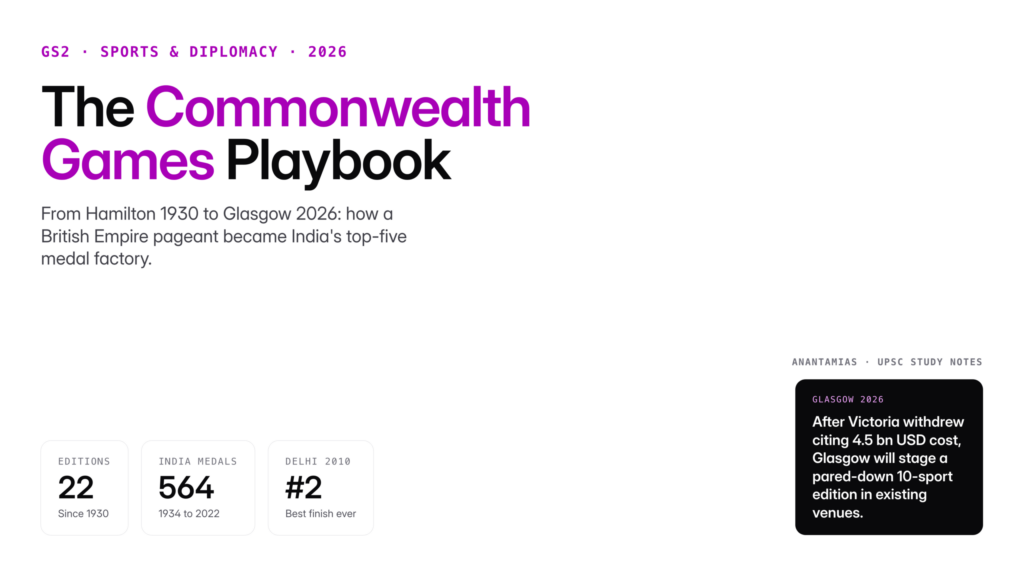
The Commonwealth Games are a quadrennial multi-sport festival that brings together athletes from the 56 member states of the Commonwealth of Nations, most of them former territories of the British Empire. Held every four years since 1930, the Games are the world’s third-largest multi-sport event after the Summer Olympics and the Asian Games, and they remain one of the few international competitions where India has consistently finished inside the top five.
For the UPSC aspirant, the Commonwealth Games straddle several syllabus zones. They appear in Prelims current affairs tables about hosts and medal tallies. They appear in GS Paper 2 discussions of multilateral groupings and the role of the Commonwealth. They also turn up in GS Paper 1 sports and culture questions, and in Essay prompts on soft power and diplomacy. A well-organised set of facts about the Games, India’s record in them and the institutional framework around them is therefore a useful investment.
Quick Facts at a Glance
| Feature | Detail |
|---|---|
| Official name | Commonwealth Games |
| First edition | 1930, Hamilton, Canada (then British Empire Games) |
| Frequency | Every four years |
| Governing body | Commonwealth Games Federation (CGF) |
| Member nations | 56 Commonwealth member states, 72 teams (crown dependencies, territories included) |
| India’s first participation | 1934, London |
| India’s best finish | 2nd place, 2010 Delhi (101 medals) |
| Next edition | 2026 Glasgow (scaled down, 10 sports) |
Background and Historical Context
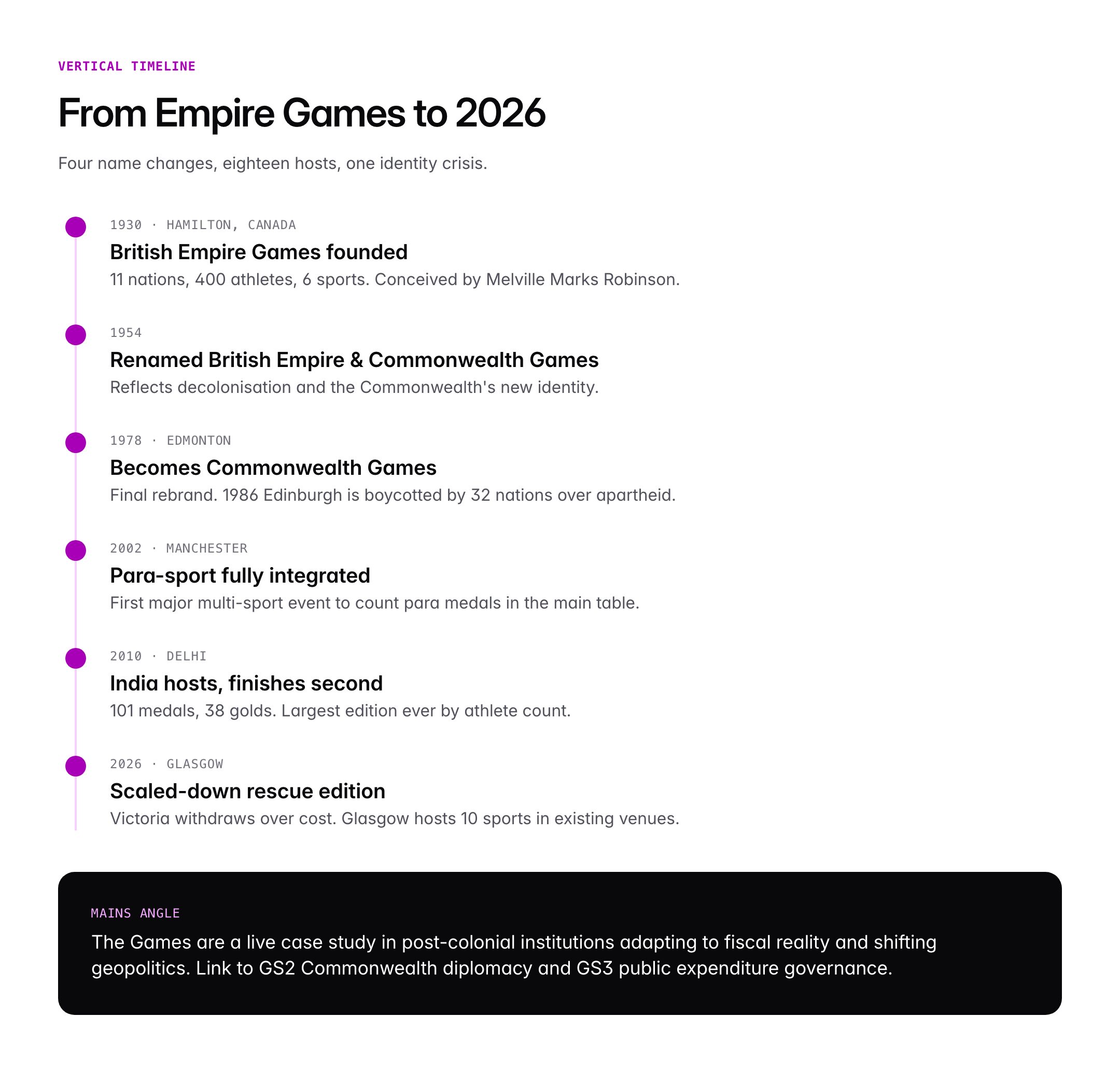
The idea of a sporting festival among British Empire nations was first floated in 1891 by Reverend J. Astley Cooper, who wrote in The Times of London about a “Pan-Britannic” gathering to reinforce imperial bonds. A small pilot, the Inter-Empire Championships, was held alongside the Festival of Empire in London in 1911. But the Games as we know them were organised only in 1930, when Canadian sports administrator Melville Marks Robinson persuaded eleven nations to send 400 athletes to Hamilton, Ontario. That edition was called the British Empire Games.
The name has evolved with the political geography of the Commonwealth. The event became the British Empire and Commonwealth Games in 1954, the British Commonwealth Games in 1970 and finally the Commonwealth Games from 1978 onward. The 1986 Edinburgh edition was shadowed by an African-Asian-Caribbean boycott over the United Kingdom’s refusal to sanction apartheid-era South Africa, a reminder that the Games are never insulated from world politics.
The Games have been hosted eighteen times, by eight countries. Australia leads with five editions, followed by Canada with four. Scotland, New Zealand and England have each hosted three. India hosted the 2010 edition in Delhi, which remains the largest Games in history by athlete count and one of the largest live sports events held on Indian soil. Jamaica, Malaysia and the Bahamas complete the list of host nations when territories are included.
The Commonwealth Games Federation, founded in 1932 as the British Empire Games Federation, governs the event. It sets the sport programme, selects hosts and adjudicates anti-doping violations. Unlike the International Olympic Committee, the CGF is a smaller, more federated body that relies heavily on the host city organising committee.
Key Features
Sport Programme
The Commonwealth Games have a core of ten compulsory sports that every edition must stage. These include athletics, aquatics (swimming and diving), lawn bowls, netball, rugby sevens, hockey, squash, weightlifting, boxing and badminton. Each host has the flexibility to add optional sports from an approved list. Shooting, wrestling, cycling, table tennis and gymnastics have frequently featured as options, which has benefited India’s medal count given the country’s strength in these disciplines.
Participating Teams
Although the Commonwealth has 56 member nations, the Games field 72 teams. This is because home nations of the United Kingdom compete separately as England, Scotland, Wales and Northern Ireland, and British Crown Dependencies such as the Isle of Man, Jersey and Guernsey also send their own teams. British Overseas Territories like Bermuda, Gibraltar and the Falkland Islands also participate independently. This unusual arrangement is a legacy of the Empire’s constitutional patchwork.
Symbols and Traditions
The Games open with a Queen’s Baton Relay, modelled on the Olympic torch relay but carrying a message from the British monarch to the opening ceremony. The first relay was held in 1958 for the Cardiff Games. The CGF uses a stylised letter “C” with a human figure as its logo. Anti-doping, gender parity and disability-sport integration are now explicit CGF priorities, and the Games were the first major multi-sport event to include para-sport events fully integrated into the medal table, starting in Manchester 2002.
Financing and Scale
A typical edition features 4,500 to 6,600 athletes competing in roughly 250 events across about 20 sports. Budgets have ranged from 1 billion US dollars for Glasgow 2014 to more than 4 billion US dollars for Delhi 2010 once infrastructure is included. Questions of cost have become acute. Victoria, Australia, withdrew from hosting the 2026 Games in 2023 after estimates ballooned past 4.5 billion US dollars, forcing Glasgow to step in with a pared-down programme.
Significance for UPSC and General Knowledge
- The Games are a live example of soft power diplomacy, knitting 2.5 billion people across 56 nations through a shared sporting calendar.
- They intersect with GS Paper 2 topics on Commonwealth groupings, post-colonial institutions and India’s multilateral posture.
- India’s 2010 hosting ties into GS Paper 3 discussions on public expenditure, infrastructure delivery and the CAG’s role in scrutinising Games contracts.
- Recurring questions on hosts, mascots and India’s medal finishes appear in Prelims and in competitive exams such as SSC and State PSCs.
- The Games illustrate how sporting boycotts, like the 1986 anti-apartheid walkout, have been used as tools of moral pressure.
- They offer Mains essay material on the ethics of mega-events, cost-benefit analysis and legacy utilisation of stadia.
Detailed Analysis: India’s Performance Across Editions
India first sent a team to the 1934 British Empire Games in London, where wrestler Rashid Anwar won a bronze, the country’s first Commonwealth Games medal. India skipped the 1950 and 1962 editions and was a consistent but middling performer through the 1970s and 1980s, winning five to fifteen medals per edition.
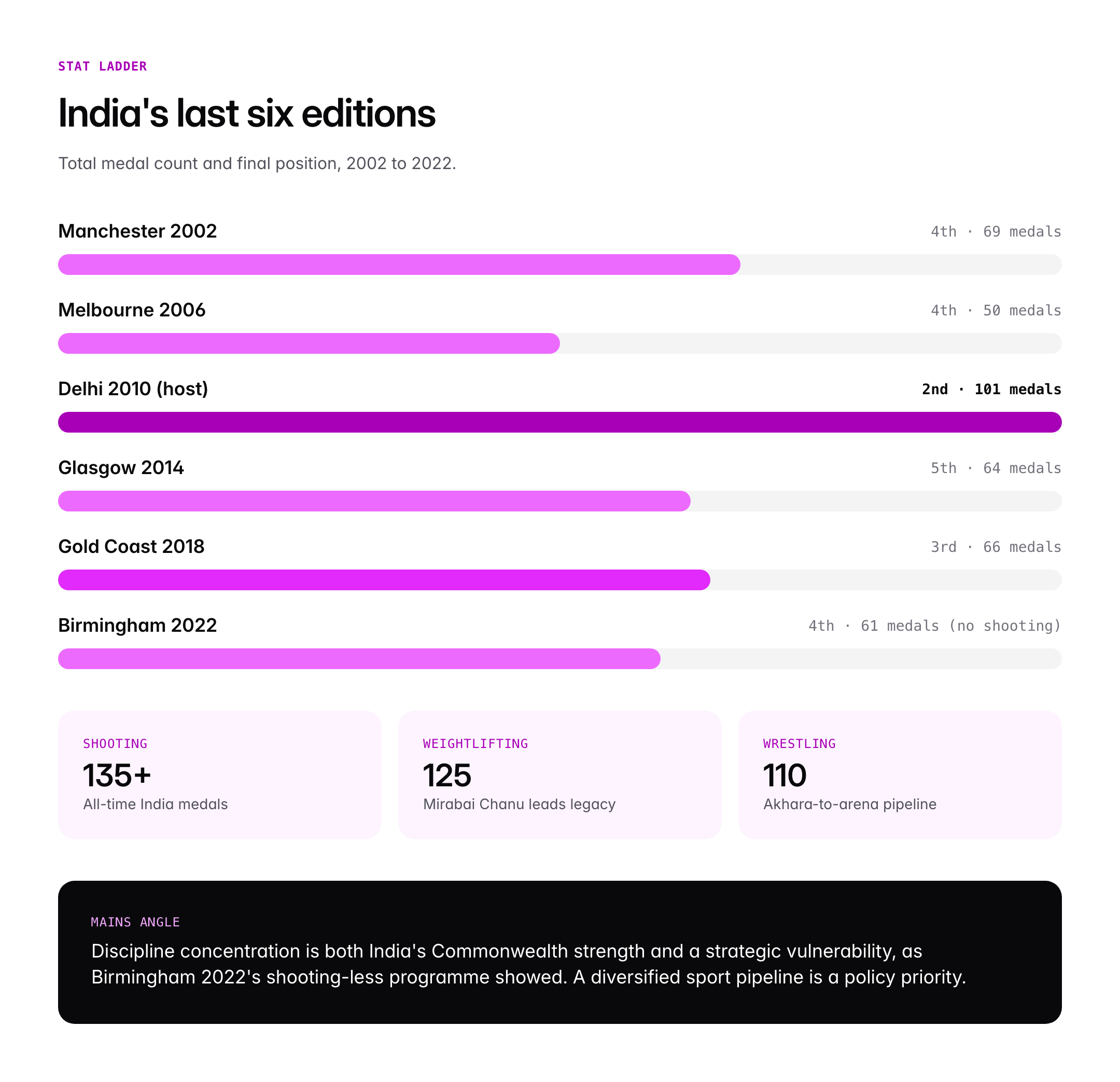
The transformation began with Manchester 2002, where India finished fourth with 69 medals, driven by shooting and weightlifting. At Melbourne 2006, India held fourth place with 50 medals, Abhinav Bindra and Samresh Jung starring in shooting. The high point came at Delhi 2010, where India finished second behind only Australia with 38 golds and 101 medals overall, the best-ever performance by the host. Discus thrower Krishna Poonia won India’s first women’s athletics gold in 52 years, and the shooting team collected 30 medals.
The trend continued. Glasgow 2014 yielded 64 medals (fifth place), Gold Coast 2018 66 medals (third place) and Birmingham 2022 61 medals (fourth place). The Birmingham total was notable because it was earned despite the absence of shooting, historically India’s most productive sport. Wrestling, weightlifting, boxing, badminton and table tennis carried the load, with Saikhom Mirabai Chanu winning a dramatic weightlifting gold and Achanta Sharath Kamal collecting four medals in table tennis.
As of 2026, India has won 564 Commonwealth Games medals across 18 editions, making it one of the most successful teams historically. Shooting accounts for over 135 of those medals, wrestling for about 110 and weightlifting for roughly 125. The discipline-specific concentration is a strategic vulnerability, as the Glasgow 2026 programme illustrates.
Comparative Perspective
| Event | Nations | Athletes | Frequency | India’s typical finish |
|---|---|---|---|---|
| Summer Olympics | 206 | ~11,000 | Every 4 years | 25th–70th |
| Asian Games | 45 | ~12,000 | Every 4 years | 4th–5th |
| Commonwealth Games | 56 (72 teams) | ~5,000 | Every 4 years | 2nd–5th |
| SAF Games | 8 | ~2,500 | Variable | 1st |
The Commonwealth Games sit in a sweet spot for India. The pool of competition is smaller than the Olympics, particularly because sporting superpowers such as the United States, China, Russia, Germany and Japan are absent. But the field is stronger than the regional Asian or South Asian Games, and many Commonwealth members including Australia, Canada, England and Kenya are elite in specific disciplines. That explains why Commonwealth medals are meaningful without being as prestigious as Olympic ones. For Indian policy-makers, the Games have served as a mid-cycle barometer for Olympic preparation.
Challenges and Criticisms
The Commonwealth Games face an existential identity crisis. Hosting costs have spiralled, television audiences have shrunk, and several former members including Zimbabwe, the Maldives and the Gambia have at times distanced themselves from the Commonwealth itself. Victoria’s 2023 withdrawal from the 2026 hosting forced the CGF into an emergency scale-down, with Glasgow agreeing to run a ten-sport programme in existing venues. Critics argue the Games are a colonial relic in search of a purpose and that resources might be better deployed in sport-for-development.
Defenders reply that the Games promote para-athletics integration, female participation and small-island-state representation in ways that the Olympic movement does not. Samoa, Kiribati and Saint Lucia rarely feature in global sport, but they consistently send teams to the Commonwealth. For India specifically, the Games offer a high-return venue for building grassroots pipelines in shooting, wrestling and badminton. The cost-benefit calculus therefore cuts both ways. India hosted 2010 at a reported cost of over 70,000 crore rupees according to a CAG estimate that included collateral infrastructure, triggering corruption enquiries that dragged on for years.
Prelims Pointers
- The first Commonwealth Games were held in Hamilton, Canada in 1930.
- They were then called the British Empire Games.
- The Commonwealth Games Federation (CGF) governs the event.
- The Queen’s Baton Relay precedes each Games.
- India’s first CG medal was won by Rashid Anwar (wrestling) in 1934.
- Delhi 2010 was the only edition hosted by India.
- India finished second at Delhi 2010 with 101 medals.
- Birmingham 2022 saw India finish fourth with 61 medals.
- Australia has hosted the most editions (5).
- Core compulsory sports include athletics, aquatics, hockey and lawn bowls.
- Para-sport events are fully integrated into the medal table since Manchester 2002.
- Glasgow will host the 2026 Games with a reduced 10-sport programme.
The 2026 Glasgow and 2030 Ahmedabad (Centenary) Editions
After Victoria’s withdrawal, Glasgow stepped in to stage a pared-down 2026 edition built around ten core sports, keeping the four-year cycle intact while the movement rethinks its cost model. The bigger landmark comes in 2030, when Ahmedabad is set to host an edition officially styled the “Centenary Games” because it falls exactly a hundred years after the first edition at Hamilton, Canada, in 1930. For India this is a homecoming of sorts, only the second time the country will host after Delhi 2010, and it places a Gujarat city at the heart of a global multi-sport calendar.
It is worth being precise about who actually competes. The Commonwealth Games are contested only by member nations and territories of the Commonwealth, which is why sporting heavyweights such as China, the United States and Russia never appear on the start line. The medal table is therefore led by Commonwealth powers, with Australia the long-standing front-runner and England, Canada and India close behind. India has steadily climbed this order, peaking at Delhi 2010 with 38 golds and 101 medals to finish second overall, and it remains a consistent top-five force across shooting, wrestling, weightlifting and badminton.
Mains Practice Questions
- “The Commonwealth Games have lost much of their original purpose but retain a specific utility for emerging sporting nations like India.” Critically examine.
- Outline original imperial-bonding purpose and how it eroded post-decolonisation
- Explain India’s medal-pipeline, para-sport integration and women’s participation gains
- Balance with cost overruns, shrinking viewership and the Victoria 2026 withdrawal
- Discuss the lessons from the Delhi 2010 Commonwealth Games for hosting global sporting events in India.
- Infrastructure legacy and urban upgrades in Delhi
- Governance failures documented by the CAG and Shunglu Committee
- Policy reforms in public procurement, PPP accountability and Games-time security
Conclusion
The Commonwealth Games remain an imperfect but enduring instrument of sporting diplomacy. For India, they are a mid-tier international stage where the country is already a top-five force and can showcase depth in disciplines that still struggle for Olympic visibility. The 2026 Glasgow edition, pared down after Victoria’s withdrawal, will test whether the CGF can reinvent the Games for a post-colonial, fiscally conscious era.
For the UPSC aspirant, the Games offer a rare intersection of history, sport, diplomacy and public expenditure. Tracking host cities, medal leaders and governance debates around the CGF equips one to tackle both factual Prelims questions and analytical Mains answers. They are also a reminder that sport, like any public institution, is never neutral: it reflects the politics, economics and aspirations of the society that funds it.
Frequently Asked Questions
What are the Commonwealth Games?
The Commonwealth Games are a quadrennial multi-sport event bringing together athletes from the 56 member nations of the Commonwealth of Nations. First held in 1930 as the British Empire Games, they are governed by the Commonwealth Games Federation and rank as the third-largest multi-sport event after the Olympics and Asian Games, featuring around 5,000 athletes across about 20 sports.
Why are the Commonwealth Games important for UPSC?
The Games appear across GS Paper 1 (sports and culture), GS Paper 2 (Commonwealth groupings and multilateral diplomacy) and GS Paper 3 (public expenditure, as seen in the Delhi 2010 CAG report). Prelims questions regularly ask about hosts, India’s medal finishes, founding year and governing body, making them a reliable factual cluster worth memorising.
How is the Commonwealth Games related to the Olympics?
Both are quadrennial multi-sport events inspired by the modern Olympic movement, but the Commonwealth Games involve only 56 Commonwealth member nations while the Olympics include 206 National Olympic Committees. The CG programme is smaller, hosting costs are lower, and the absence of sporting superpowers like the US, China and Russia makes medals more attainable for mid-tier nations such as India.
When was the first Commonwealth Games held?
The first edition was held in Hamilton, Canada, from 16 to 23 August 1930. Eleven nations sent 400 athletes to compete in six sports. The event was called the British Empire Games at the time and was the brainchild of Canadian administrator Melville Marks Robinson. The name evolved to Commonwealth Games in 1978.
What is India’s best performance at the Commonwealth Games?
India’s best finish was second place at the 2010 Delhi Games, where the country won 38 golds, 27 silvers and 36 bronzes for a total of 101 medals. This was also India’s only hosting of the event. Delhi 2010 remains one of the largest editions ever staged by athlete count and propelled investment in Indian sport.
Which sports are compulsory at the Commonwealth Games?
The Commonwealth Games Federation mandates ten core sports: athletics, aquatics (swimming and diving), lawn bowls, netball, rugby sevens, hockey, squash, weightlifting, boxing and badminton. Hosts may add optional sports from an approved list, which has historically included shooting, wrestling, cycling and table tennis, all strong disciplines for India.
Why was the 2026 Commonwealth Games moved to Glasgow?
Victoria, Australia, withdrew as host in July 2023 citing cost overruns projected above 4.5 billion US dollars. After a scramble, the Commonwealth Games Federation awarded Glasgow the 2026 edition on the condition that it run a scaled-down ten-sport programme using existing venues. Glasgow had previously hosted the 2014 Games successfully.
How many medals has India won at the Commonwealth Games?
India has won approximately 564 medals across its eighteen Commonwealth Games appearances from 1934 to 2022. Shooting accounts for the largest share with more than 135 medals, followed by weightlifting with about 125 and wrestling with around 110. India has finished in the top five at every edition since 2002, peaking at second place at Delhi 2010.
Tell Google you want more of this.
Add Anantam IAS as a preferred sourceOne tap, and this site shows up more often in your own Top Stories, AI Overviews and AI Mode. Remove it any time.