Constitutional Bodies in India: Complete List
Complete list of constitutional bodies in India — UPSC, ECI, CAG, Finance Commission, and more with articles, functions, and comparison with statutory bodies.
Constitutional Bodies in India: Complete List
Constitutional bodies are institutions established directly by the Indian Constitution. Unlike statutory bodies (created by Acts of Parliament), constitutional bodies derive their authority, composition, and powers from specific constitutional articles. This distinction matters for UPSC — questions frequently test the difference between constitutional and statutory bodies, their functions, and the specific articles that establish them.
What Makes a Body “Constitutional”?
A constitutional body has three defining features:
- Created by the Constitution itself — not by an Act of Parliament
- Cannot be abolished without a constitutional amendment
- Powers and composition are defined in the Constitution
This gives constitutional bodies a higher status and greater independence compared to statutory bodies, which Parliament can modify or abolish through ordinary legislation.
Complete List of Constitutional Bodies
Major Constitutional Bodies at a Glance
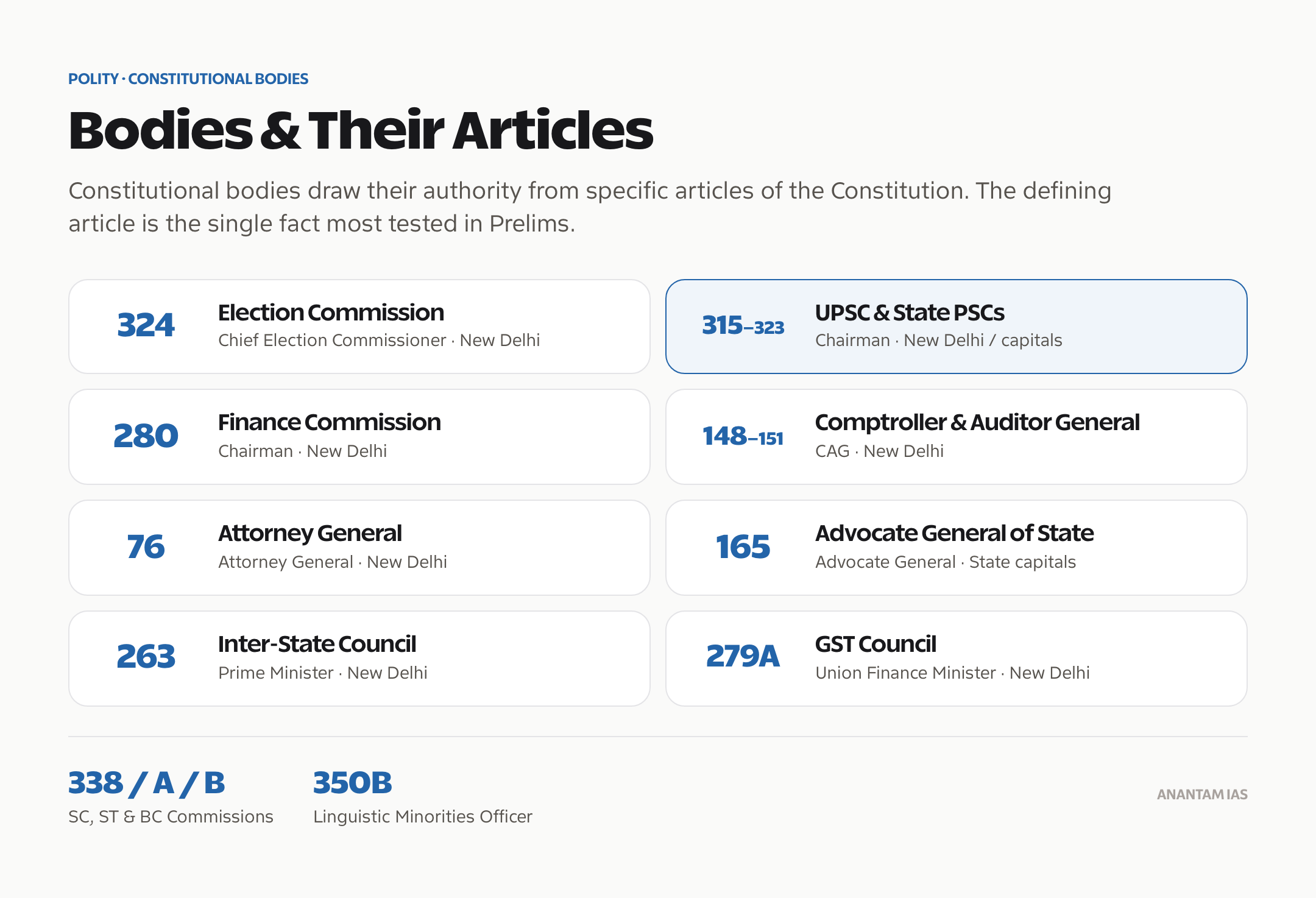
| Constitutional Body | Article(s) | Head/Chairman | Headquarters |
|---|---|---|---|
| Election Commission of India | 324 | Chief Election Commissioner | New Delhi |
| Union Public Service Commission | 315–323 | Chairman, UPSC | New Delhi |
| State Public Service Commissions | 315–323 | Chairman, respective SPSC | State capitals |
| Finance Commission | 280 | Chairman | New Delhi |
| Comptroller and Auditor General | 148–151 | CAG | New Delhi |
| Attorney General of India | 76 | Attorney General | New Delhi |
| Advocate General of State | 165 | Advocate General | State capitals |
| National Commission for SCs | 338 | Chairperson | New Delhi |
| National Commission for STs | 338A | Chairperson | New Delhi |
| National Commission for BCs | 338B | Chairperson | New Delhi |
| Special Officer for Linguistic Minorities | 350B | Commissioner | New Delhi |
| Inter-State Council | 263 | Prime Minister | New Delhi |
| GST Council | 279A | Union Finance Minister | New Delhi |
Detailed Analysis of Each Constitutional Body
1. Election Commission of India (Article 324)
The Election Commission of India supervises, directs, and controls the conduct of elections to Parliament, state legislatures, and the offices of President and Vice President.
| Feature | Detail |
|---|---|
| Article | 324 |
| Composition | CEC + Election Commissioners (currently 3-member body) |
| Appointment | By the President of India |
| Tenure | 6 years or until age 65, whichever is earlier |
| Removal | CEC — same as Supreme Court judge (Parliamentary process) |
| Key Function | Conducting free and fair elections |
The CEC can only be removed through impeachment-like proceedings in Parliament — the same process used for Supreme Court judges. Other Election Commissioners, however, can only be removed on the CEC’s recommendation.
Election Commission of India: Complete Guide
2. Union Public Service Commission (Articles 315–323)
UPSC conducts the Civil Services Examination, Engineering Services, Combined Medical Services, and other all-India competitive examinations.
| Feature | Detail |
|---|---|
| Articles | 315–323 |
| Composition | Chairman + members (max 10, currently varies) |
| Appointment | By the President |
| Tenure | 6 years or age 65, whichever is earlier |
| Removal | By the President on Supreme Court inquiry (Article 317) |
| Key Functions | Recruitment, advising on service matters |
3. Finance Commission (Article 280)
The Finance Commission recommends the distribution of tax revenues between the Centre and states, and among the states themselves.
| Feature | Detail |
|---|---|
| Article | 280 |
| Constituted | Every 5 years by the President |
| Current | 16th Finance Commission (2024–2029) |
| Chairman | Appointed by the President |
| Key Function | Tax devolution, grants-in-aid recommendations |
The Finance Commission plays a crucial role in fiscal federalism. Its recommendations on vertical devolution (Centre-state share) and horizontal devolution (distribution among states) directly impact state finances.
Finance Commission: Complete Guide
4. Comptroller and Auditor General (Articles 148–151)
The CAG audits all receipts and expenditure of the Government of India and state governments.
| Feature | Detail |
|---|---|
| Articles | 148–151 |
| Appointment | By the President |
| Tenure | 6 years or age 65, whichever is earlier |
| Removal | Same as Supreme Court judge |
| Key Function | Auditing government accounts |
| Reports To | President (Centre), Governor (State) |
The CAG is often called the “Guardian of the Public Purse.” CAG reports are examined by the Public Accounts Committee (PAC) of Parliament — a critical accountability mechanism.
5. Attorney General of India (Article 76)
The Attorney General is the highest law officer of India, appointed by the President on the advice of the government.
| Feature | Detail |
|---|---|
| Article | 76 |
| Appointment | By the President |
| Qualification | Eligible to be appointed as Supreme Court judge |
| Tenure | During the pleasure of the President |
| Key Function | Legal advisor to Government of India |
| Special Rights | Right to speak in both Houses of Parliament |
The AG can participate in parliamentary proceedings but cannot vote. There’s no fixed tenure — the AG holds office during the President’s pleasure, which effectively means the government’s pleasure.
Attorney General of India: Complete Guide
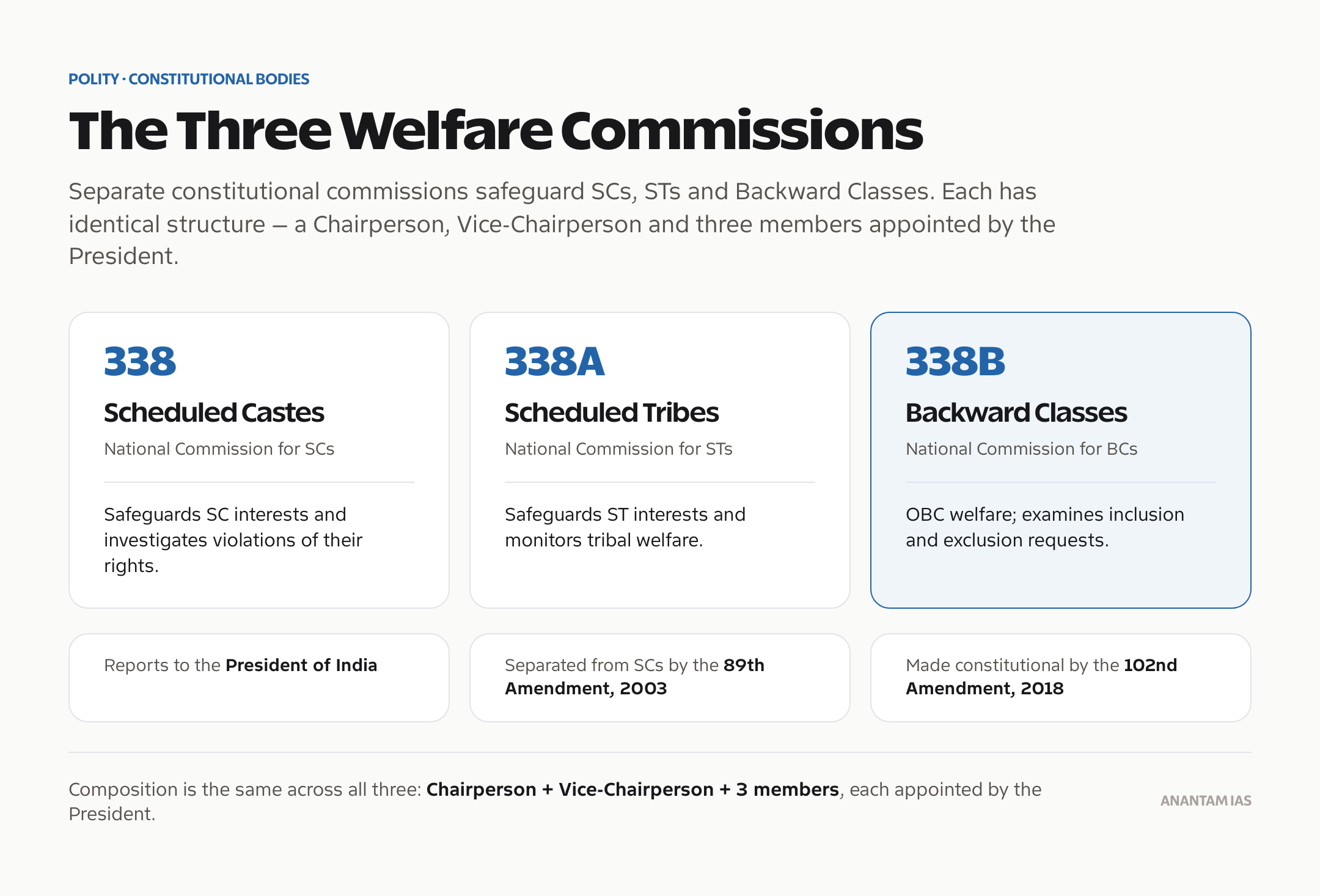
6. National Commission for Scheduled Castes (Article 338)
| Feature | Detail |
|---|---|
| Article | 338 |
| Composition | Chairperson + Vice-Chairperson + 3 members |
| Appointment | By the President |
| Key Function | Safeguarding SC interests, investigating violations |
| Reports To | President of India |
7. National Commission for Scheduled Tribes (Article 338A)
| Feature | Detail |
|---|---|
| Article | 338A (inserted by 89th Amendment, 2003) |
| Composition | Chairperson + Vice-Chairperson + 3 members |
| Appointment | By the President |
| Key Function | Safeguarding ST interests, monitoring tribal welfare |
Originally, a single commission covered both SCs and STs. The 89th Constitutional Amendment (2003) created a separate commission for STs.
8. National Commission for Backward Classes (Article 338B)
| Feature | Detail |
|---|---|
| Article | 338B (inserted by 102nd Amendment, 2018) |
| Composition | Chairperson + Vice-Chairperson + 3 members |
| Key Function | OBC welfare, examining inclusion/exclusion requests |
The 102nd Constitutional Amendment elevated the NCBC from a statutory body to a constitutional body, giving it the same status as the SC and ST commissions.
9. GST Council (Article 279A)
| Feature | Detail |
|---|---|
| Article | 279A (inserted by 101st Amendment, 2016) |
| Chairperson | Union Finance Minister |
| Members | Union MoS Finance + Finance Ministers of all states/UTs |
| Key Function | GST rate recommendations, exemptions, dispute resolution |
The GST Council is the newest constitutional body, created through the 101st Amendment that introduced the Goods and Services Tax. Its decisions are made by three-fourths majority, with the Centre having one-third weightage and all states together having two-thirds weightage.
Constitutional vs Statutory Bodies: Key Differences
| Parameter | Constitutional Body | Statutory Body |
|---|---|---|
| Creation | By the Constitution | By an Act of Parliament |
| Legal Basis | Constitutional articles | Parliamentary legislation |
| Abolition | Requires constitutional amendment | Parliament can dissolve |
| Independence | Higher | Relatively lower |
| Examples | UPSC, ECI, CAG, Finance Commission | NHRC, CBI, NITI Aayog, NCW |
| Status | Supreme (after Constitution) | Below constitutional bodies |
| Modification | Amendment needed | Ordinary legislation sufficient |
Important Statutory Bodies (Often Confused as Constitutional)
| Statutory Body | Established By | Often Confused Because |
|---|---|---|
| NHRC | Protection of Human Rights Act, 1993 | High visibility, quasi-judicial powers |
| NITI Aayog | Cabinet Resolution, 2015 | Replaced constitutional Planning Commission |
| CBI | Delhi Special Police Establishment Act, 1946 | Central investigating agency |
| National Commission for Women | NCW Act, 1990 | Similar structure to constitutional commissions |
| National Green Tribunal | NGT Act, 2010 | Significant judicial powers |
| Lokpal | Lokpal and Lokayuktas Act, 2013 | Anti-corruption mandate |
NHRC: National Human Rights Commission NITI Aayog: Complete Guide Lokpal and Lokayukta: Complete Guide
Articles to Remember: Quick Reference
| Article | Body/Provision |
|---|---|
| 76 | Attorney General of India |
| 148–151 | Comptroller and Auditor General |
| 165 | Advocate General of State |
| 263 | Inter-State Council |
| 279A | GST Council |
| 280 | Finance Commission |
| 315–323 | UPSC and State PSCs |
| 324 | Election Commission |
| 338 | National Commission for SCs |
| 338A | National Commission for STs |
| 338B | National Commission for BCs |
| 350B | Special Officer for Linguistic Minorities |
UPSC Question Trends
Constitutional bodies appear in UPSC Prelims as direct factual questions (“Which article establishes…”) and in Mains as analytical questions about institutional independence, reform proposals, and comparative analysis. Key themes include:
- Independence and accountability of constitutional bodies
- Appointment and removal processes
- Comparison between constitutional and statutory bodies
- Reform of Election Commission, UPSC, and Finance Commission
- Role of CAG in financial accountability
- GST Council’s functioning and cooperative federalism
Frequently Asked Questions
How many constitutional bodies are there in India?
India has approximately 12–14 constitutional bodies, depending on how bodies like the Inter-State Council and Advocate General are classified. The exact count varies because some scholars include bodies mentioned in the Constitution but not traditionally listed as u0022constitutional bodies.u0022 The undisputed ones include ECI, UPSC, CAG, Finance Commission, Attorney General, and the three national commissions.
Can Parliament abolish a constitutional body?
No, Parliament cannot abolish a constitutional body through ordinary legislation. Since these bodies are created by the Constitution itself, removing them requires a constitutional amendment — which needs a special majority in both Houses of Parliament and, in some cases, ratification by half the state legislatures.
What is the difference between NITI Aayog and Planning Commission?
The Planning Commission was established by a Cabinet Resolution in 1950 and was technically not a constitutional or statutory body. NITI Aayog replaced it in 2015, also through a Cabinet Resolution. Neither is a constitutional body, though many aspirants confuse the Planning Commission’s long history with constitutional status.
Why is the NHRC not a constitutional body?
The NHRC was created by the Protection of Human Rights Act, 1993 — an Act of Parliament. Despite its important quasi-judicial functions and high visibility, it remains a statutory body. Parliament could theoretically modify or abolish it through ordinary legislation, unlike constitutional bodies that require amendments.
Which is the newest constitutional body in India?
The GST Council, established under Article 279A through the 101st Constitutional Amendment (2016), is the newest constitutional body. Before that, the National Commission for Backward Classes became a constitutional body through the 102nd Amendment in 2018 (though the GST Council amendment came first chronologically).