Attorney General of India: Role, Duties & Powers
The Attorney General of India is the government’s chief legal adviser and the first Law Officer of the country. Appointed by the President under Article 76, the AG represents the Union of India in the Supreme Court and provides legal opinions on constitutional and complex legal matters. For UPSC, the AG is a favourite topic in Polity — both Prelims and Mains Paper 2.
Constitutional Basis: Article 76
Article 76 of the Indian Constitution establishes the office of the Attorney General of India. It falls under Part V (The Union), alongside other constitutional offices like the President, Vice-President, and CAG.
Article 76 has four clauses:
- The President shall appoint a person qualified to be a judge of the Supreme Court as AG
- The AG’s duty is to give legal advice to the Government of India on matters referred by the President
- The AG shall perform other duties of a legal character assigned by the President
- The AG shall have the right of audience in all courts in India
This right of audience across all courts — from district courts to the Supreme Court — is a defining feature that distinguishes the AG from ordinary legal practitioners.
Placement in the Constitutional Scheme
| Office | Article | Appointed By |
|---|---|---|
| Attorney General of India | Art 76 | President |
| Comptroller & Auditor General | Art 148 | President |
| Election Commission | Art 324 | President |
| Advocate General of State | Art 165 | Governor |
The Attorney General is a constitutional functionary, not a civil servant. This distinction matters — the AG isn’t part of the permanent executive and doesn’t hold a government job in the traditional sense.
Qualifications for Attorney General of India
The AG must be qualified to be appointed as a judge of the Supreme Court. This means, under Article 124(3):
- Must be a citizen of India
- Has been a judge of a High Court for at least 5 years, OR
- Has been an advocate of a High Court for at least 10 years, OR
- Is a distinguished jurist in the President’s opinion
In practice, the AG is almost always an eminent advocate — not a former judge. Senior Advocates with strong Supreme Court practice are the typical choice.
Appointment and Tenure of the Attorney General
The President appoints the AG on the advice of the Council of Ministers. There’s no fixed tenure specified in the Constitution. The AG holds office during the pleasure of the President — meaning the President (effectively the cabinet) can remove the AG any time.
Conventionally, when a new government comes to power, the AG resigns or is replaced because the role is political in nature. The AG represents the government of the day, not an abstract idea of the Indian state.
There’s no procedure for removal specified in the Constitution. Unlike the CAG or a Supreme Court judge, the AG can simply be asked to leave or may resign.
Duties and Functions of the Attorney General
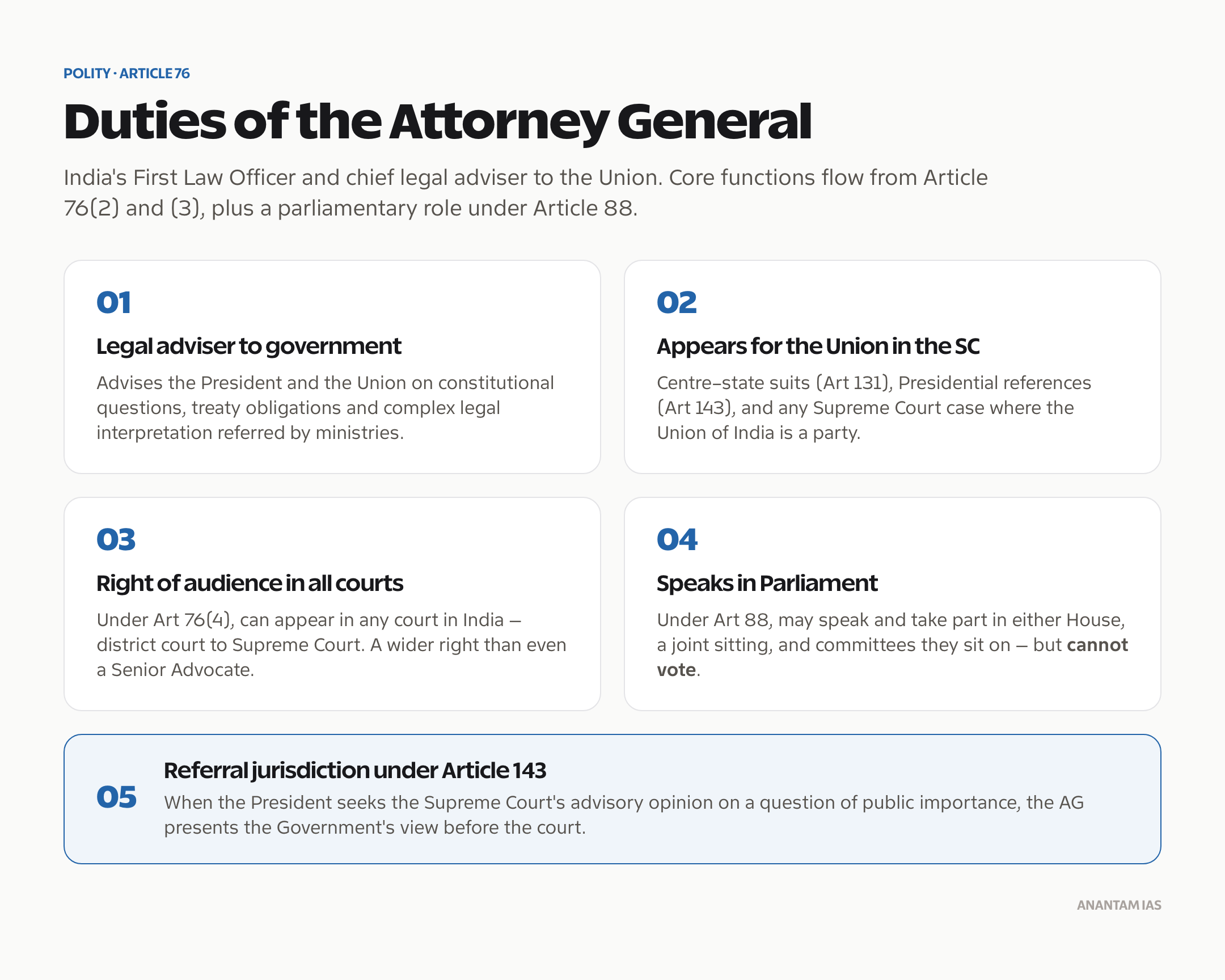
The AG’s core functions flow from Article 76(2) and (3):
1. Legal Adviser to the Government
The AG gives legal advice to the President and the Government of India on constitutional questions, treaty obligations, and other matters requiring legal interpretation. This is perhaps the most significant day-to-day function — ministries refer complex legal questions to the AG’s office.
2. Appearance Before the Supreme Court
The AG appears on behalf of the Union of India in:
- Original suits between states or between states and the Centre (Art 131)
- Cases referred to the Supreme Court by the President under Art 143 (advisory jurisdiction)
- Any Supreme Court case where the Union of India is a party
- Cases of constitutional importance where the Centre has a stake
3. Appearance Before Any Court in India
Under Article 76(4), the AG has the right of audience in all courts across India. This is a wider right than even a Senior Advocate. The AG can appear in any High Court or district court whenever needed.
4. Functions Under Parliamentary Procedures
The AG has the right to speak and take part in proceedings of both Houses of Parliament and of any joint sitting, as well as any Parliamentary Committee of which they may be named a member — but without the right to vote (Art 88). This is a critical exam point.
The AG can also be a member of any Parliamentary Committee. But voting — in committees or in the House — is not permitted.
5. Referral Jurisdiction Under Article 143
When the President seeks the Supreme Court’s opinion on a legal question of public importance (Art 143 — advisory jurisdiction), the AG typically presents the Government’s view before the court.
Rights and Privileges of the Attorney General
The AG enjoys several privileges and rights:
- Right of audience in all courts in India (Art 76(4)) — unique constitutional guarantee
- Right to speak in Parliament but not to vote (Art 88)
- Entitled to all privileges and immunities available to a Member of Parliament in connection with Parliamentary proceedings
- Can take up private legal practice — the AG is not barred from private practice (unlike the US Attorney General who must give up private work). But the AG cannot advise or hold briefs against the Government of India.
The ability to maintain private practice makes the Indian AG’s role fundamentally different from, say, a Cabinet Minister or a full-time civil servant.
Restrictions on the Attorney General
The AG faces certain restrictions:
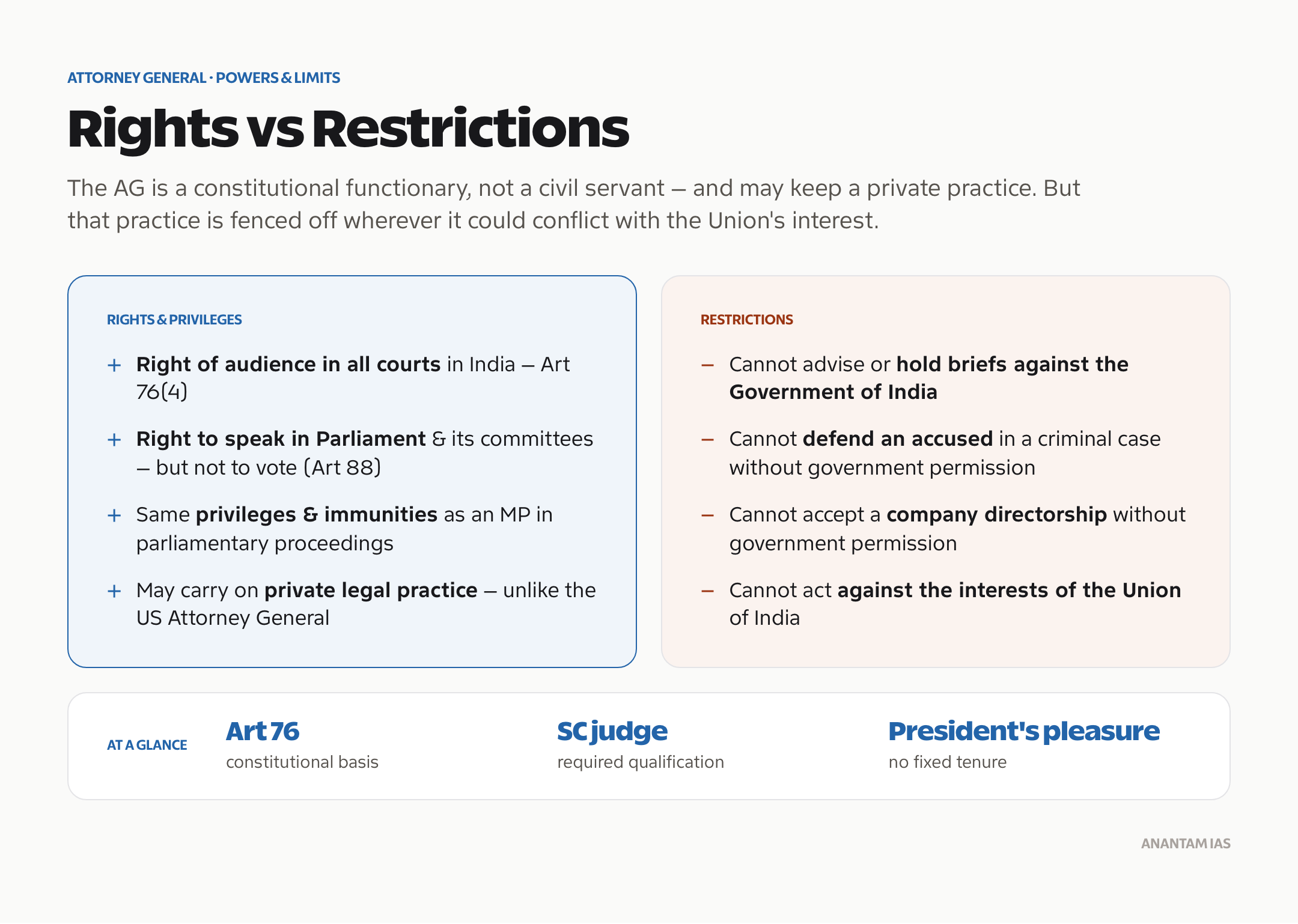
- Cannot advise or hold briefs against the Government of India
- Cannot defend an accused in a criminal case without the government’s permission
- Cannot accept appointment as a director of any company or corporation without the government’s permission
- Cannot act against the interests of the Union of India
These restrictions exist because the AG’s core loyalty is to the Union. Taking up cases against the government would create an obvious conflict of interest.
Attorney General vs Solicitor General of India
This comparison appears frequently in exams.
| Feature | Attorney General | Solicitor General |
|---|---|---|
| Constitutional basis | Article 76 | Statutory (no specific article) |
| Rank | First Law Officer | Second Law Officer |
| Appointed by | President | President (on cabinet advice) |
| Tenure | Pleasure of President | Pleasure of President |
| Parliament rights | Can speak (not vote) | No independent right |
| Right of audience | All courts (Art 76(4)) | Appears in SC primarily |
The Solicitor General and Additional Solicitor Generals assist the AG. There are typically 4 Additional Solicitor Generals of India. They are not constitutional offices — they exist by statute and convention, not by constitutional mandate.
Attorney General vs Advocate General of State
| Feature | Attorney General of India | Advocate General of State |
|---|---|---|
| Constitutional Article | Art 76 | Art 165 |
| Appointed by | President | Governor |
| Scope | Union of India | State Government |
| Parliament rights | Can speak (not vote) | No such right |
| State legislature | No right | Can speak in state legislature |
The Advocate General is the state’s equivalent of the AG — first law officer of the state government.
The AG Has No Voting Right in Parliament: Why It Matters
Article 88 is the key provision here. Both the Attorney General and the Solicitor General can be summoned to Parliament to assist in legal matters. They can speak in committees and in the Houses. But they can’t vote on legislation.
This is constitutionally logical — the AG is not elected. Giving voting rights to an unelected appointee would compromise the democratic character of Parliament. The right to speak is a functional necessity; the absence of voting rights preserves democratic integrity.
Comptroller and Auditor General of India
Current Attorney General of India
R. Venkataramani is the current Attorney General of India, appointed in October 2022. He’s an eminent constitutional lawyer with decades of Supreme Court practice.
Previous AGs include luminaries like:
- M.C. Setalvad (first AG, longest serving)
- C.K. Daphtary
- Soli Sorabjee (two tenures)
- Mukul Rohatgi
- K.K. Venugopal (longest-serving in recent times)
UPSC Exam Focus Points
Key facts you should know cold:
- AG is established by Article 76 — Part V of the Constitution
- Qualifications = qualified to be a SC judge
- Right of audience in all courts in India — constitutional right under Art 76(4)
- Can speak in Parliament but cannot vote — Art 88
- No fixed tenure — holds office during President’s pleasure
- Can practice privately but not against the Union of India
- Not a civil servant — a constitutional functionary
- Solicitor General is the second law officer — not a constitutional office
Frequently Asked Questions
What is the role of the Attorney General of India?
The Attorney General is the chief legal adviser to the Government of India, appointed under Article 76. The AG gives legal opinions to the President and ministries, appears for the Union of India before the Supreme Court and all courts in India, and can speak (but not vote) in both Houses of Parliament. The AG is the first Law Officer of the country.
Can the Attorney General of India vote in Parliament?
No. Under Article 88, the Attorney General has the right to speak and participate in proceedings of both Houses and parliamentary committees, but does not have the right to vote. The AG is not an elected representative — granting voting rights to an appointed official would compromise Parliament’s democratic character.
What is the difference between the Attorney General and Solicitor General?
The Attorney General is the first Law Officer of India, a constitutional office under Article 76, with a guaranteed right of audience in all courts and a right to speak in Parliament. The Solicitor General is the second Law Officer, assisting the AG, with no separate constitutional provision — the position exists by statute and convention. The AG outranks the Solicitor General.
How is the Attorney General of India removed?
The Constitution specifies no formal removal procedure for the AG. The AG holds office during the pleasure of the President, meaning the appointment can be terminated at any time. In practice, AGs conventionally resign when a new government takes charge, since the role requires representing the government of the day and political alignment matters.
Does the Attorney General have the right to private practice?
Yes. Unlike ministers or civil servants, the AG can maintain private legal practice. The only restriction is that the AG cannot advise or hold briefs against the Government of India or appear for the accused in a criminal case without permission. This is a key difference from the American AG, who must give up private practice upon appointment.
Tell Google you want more of this.
Add Anantam IAS as a preferred sourceOne tap, and this site shows up more often in your own Top Stories, AI Overviews and AI Mode. Remove it any time.