Daily Digest
UPSC · Civil Services Examination
Current Affairs · Thursday, 10 September 2026
Current affairs curated and edited by Anantam IAS faculty — pulled from The Hindu, PIB, IDSA, Foreign Affairs and the ministries. Read, annotate, revise.
Old Rajinder Nagar · Delhi 110005 · anantamias.com
FIU Notices to Crypto Platforms: Activity-Based AML Obligations
Why in News?
On 9 September 2026, FIU-IND announced non-compliance notices to 15 virtual digital asset service providers, highlighting activity-based anti-money-laundering obligations for platforms operating in India.
- FIU-IND issued the notices under Section 13 of the PMLA; this announcement concerns compliance action against the named service providers.
- The Director also issued notices to take down applications and URLs associated with these entities; the release does not establish that every address became inaccessible.
- The government reiterated that onshore and offshore providers undertaking covered activities in India must register with FIU-IND and meet reporting and record-keeping obligations.
- Digital delivery can separate a firm’s headquarters from its users; compliance based on activity addresses that geographical gap.
- Financial-integrity supervision and investor protection answer different questions, making registration claims an important exam trap.
UPSC Relevance
Prelims Relevance
- FIU-IND and reporting entities
- Prevention of Money Laundering Act
- AML/CFT framework
- Activity-based obligations
- Offshore VDA service providers
Mains Relevance
GS Paper 3
- Preventing misuse of digital financial services for money laundering and terror financing
- Cross-border enforcement and the limits of registration-based consumer reassurance
GS Paper 2
- Distinguishing compliance proceedings, access restrictions and final findings
Essay
- Digital markets require institutions that follow activities across borders.
Background and Context
What makes the obligations activity-based?
The relevant test concerns covered services operating in India; a provider’s overseas address does not, by itself, remove the stated compliance requirement.
- VDA service providers entered the AML/CFT framework in March 2023. The framework addresses misuse of financial activity for money laundering and terrorism financing, rather than certifying whether an investment will retain its value.
- Exchange services connecting virtual digital assets with fiat currencies are among the covered activities identified in the release. The important relationship is between the service performed and the compliance duties attached to it.
- Transfer services are also identified as covered activity. A platform need not resemble a conventional bank for its handling of virtual assets to raise financial-integrity concerns under the framework described by the government.
- Safekeeping and administration cover services involving virtual assets or instruments enabling control over them. This widens the focus beyond buying and selling to the functions through which users hold or control their assets.
- Offshore status is not an automatic exemption for providers operating in India. In an exam scenario, examine the activity and Indian operational connection before assuming that the absence of local premises settles compliance.
How reporting-entity compliance works
Registration places a provider within a compliance relationship; ongoing reporting and record keeping remain distinct responsibilities under the framework described in the release.
- FIU-IND registration is a stated requirement for the covered service providers as reporting entities. Treat it as an entry into the compliance framework, rather than proof that every subsequent transaction satisfies the rules.
- Record keeping preserves information about financial activity for later examination. Its practical value is traceability: an inquiry needs usable records, not merely the knowledge that a platform or customer account once existed online.
- Reporting obligations require covered providers to supply information under the applicable framework. The release names reporting and record keeping together because information must both be retained and made available through the prescribed process.
- Compliance assessment concerns whether the provider meets its obligations, including registration. A platform’s popularity, overseas incorporation or technical sophistication cannot substitute for evidence that it meets the requirements applicable to its covered activities.
- AML registration does not establish product approval or guaranteed returns. The same government release warns that crypto products and NFTs are unregulated and highly risky, with potentially no regulatory recourse for transaction losses.
What the notices establish, and what they do not
Read the announcement as a specific compliance action; avoid converting a procedural development into a broader claim about guilt or successful access restriction.
- Non-compliance notices identify the action announced by FIU-IND against the listed providers. They should not be rewritten as criminal convictions or as proof that every user transaction on those platforms involved money laundering.
- Takedown notices concern public access to associated applications and URLs. Their issuance is a verifiable official action; successful removal across every app store, network or address would require separate evidence of implementation.
- Provider obligations and user losses are separate analytical questions. Even effective enforcement of reporting duties would not, by itself, remove volatility, guarantee custody safety or establish compensation for a failed crypto investment.
- Cross-border enforcement faces a practical gap between stating a duty and securing compliance. For analysis, distinguish the government’s activity-based rule from the operational challenge of obtaining cooperation from services with overseas organisational structures.
- Precise answer writing follows the evidence: name the authority, identify the compliance action, explain the covered activity and state the limit. Avoid presenting all crypto activity as either fully approved or universally prohibited.
Way Forward
Make compliance claims verifiable
- Supervisory communication should separate registration status, alleged failures, final findings and implemented access restrictions so readers can understand exactly what each announcement establishes.
- Platform disclosures should explain the scope of FIU registration without implying investment approval, guaranteed safety or compensation protection.
- Enforcement assessment should track usable records and compliance responses alongside access restrictions, because removing a URL alone does not establish financial traceability.
Conclusion
- Activity-based regulation follows covered services operating in India across organisational borders. The durable lesson is to test what a provider does before treating its physical location as decisive for its compliance obligations.
- Registration, enforcement and investor safety remain separate questions. Use this case to show why a sound regulatory answer must identify both the reach of an obligation and the limits of the evidence available.
UPSC Practice Questions
Prelims MCQ 1
With reference to VDA service providers operating in India, consider the following statements:
- Their AML/CFT obligations are activity-based.
- An offshore location automatically exempts them from FIU-IND registration requirements.
- The government’s release identifies safekeeping or administration of VDAs among covered activities.
How many of the above statements are correct?
(a) Only one (b) Only two (c) All three (d) None
Answer: (b) Only two
Explanation:
Statements 1 and 3 are correct. The release expressly includes offshore providers operating in India and says obligations do not depend on physical presence.
Prelims MCQ 2
Which conclusion is supported by the September 2026 FIU-IND announcement?
(a) Every listed platform has been criminally convicted. (b) FIU registration guarantees returns on crypto products. (c) Non-compliance notices and application/URL takedown notices were issued. (d) Every listed application is confirmed inaccessible everywhere.
Answer: (c) Non-compliance notices and application/URL takedown notices were issued.
Explanation:
The release establishes issuance of notices. It does not establish convictions, guaranteed returns or completed blocking of every application and URL.
UPSC Mains Questions
- Explain how activity-based AML/CFT obligations address offshore virtual digital asset service providers operating in India. What enforcement challenges remain?
- Distinguish reporting-entity registration from product approval and investor protection, using the FIU-IND notices to VDA platforms as an example.
Source: PIB, Ministry of Finance.
Frequently Asked Questions
Why did FIU-IND issue notices to crypto platforms?
FIU-IND announced non-compliance notices to 15 virtual digital asset service providers under the PMLA. The action concerns their compliance obligations and should not be described as a criminal conviction.
Can an offshore crypto platform avoid these obligations?
The release states that covered providers operating in India must comply whether onshore or offshore. Obligations are activity-based and do not depend on the entity having a physical presence in India.
Does FIU registration mean crypto products are approved?
No. Registration concerns the provider’s reporting-entity obligations. The government separately warns that crypto products and NFTs are unregulated and highly risky, and transaction losses may have no regulatory recourse.
Were all the named websites confirmed blocked?
The release reports notices seeking takedown of associated applications and URLs. Issuing those notices does not itself prove that every listed service became inaccessible; implementation needs separate evidence.
Which VDA activities does the release identify?
It identifies exchange between VDAs and fiat currencies, VDA transfers, and safekeeping or administration of VDAs or instruments enabling control over them. These illustrate why supervision focuses on functions performed.
Source: https://anantamias.com/current-affairs/fiu-vda-notices-activity-based-aml/
Aadhaar Face SDK: Single-App Authentication and Safer Testing
Why in News?
UIDAI launched the Aadhaar Face Authentication SDK and a testing sandbox at Global Fintech Fest on 9 September 2026, enabling partners to integrate facial authentication into their applications.
- The software development kit supports native Android and iOS integration, reducing dependence on a separate FaceRD application.
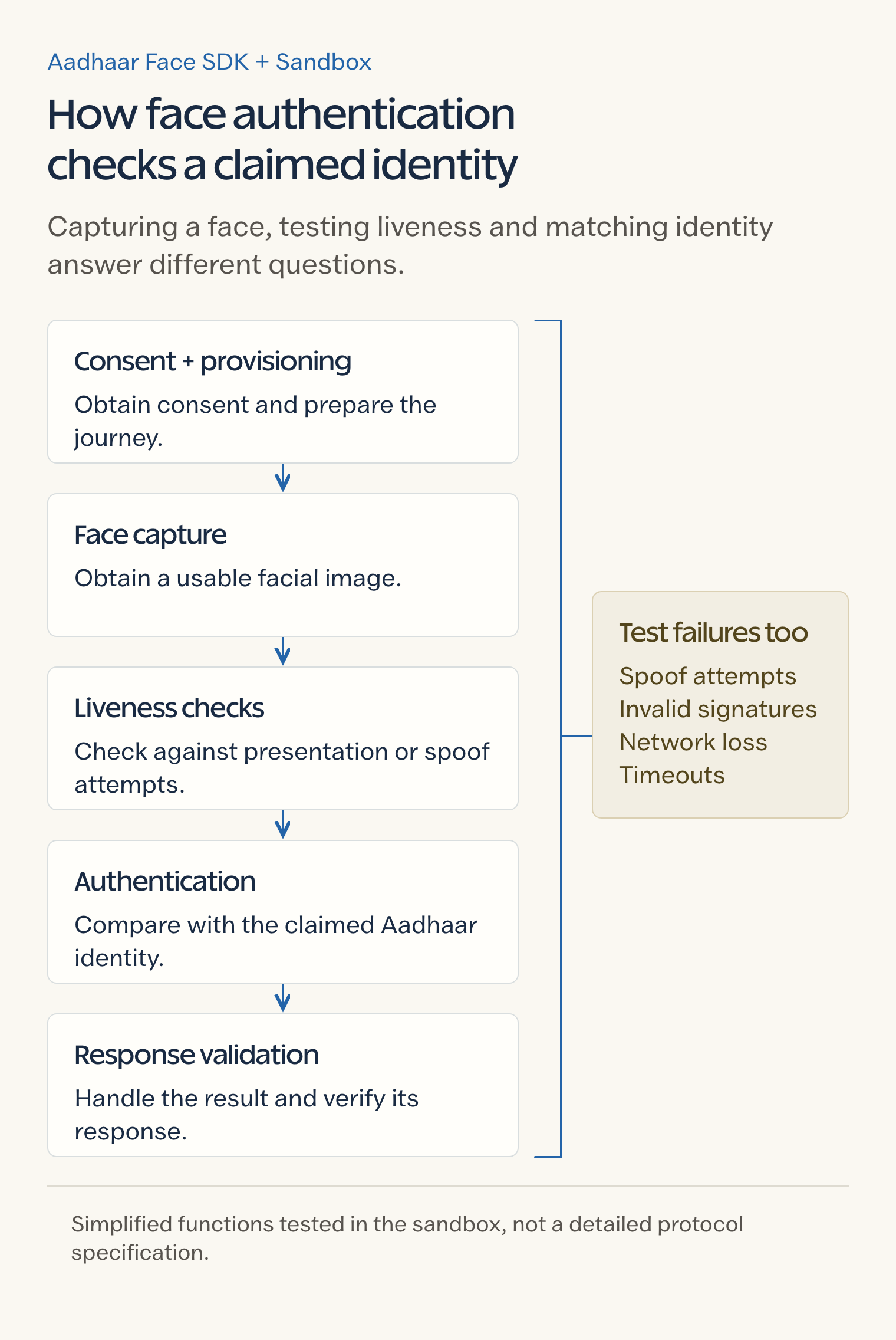
- The sandbox tests consent, capture, liveness, authentication and response handling before production onboarding.
- Failure tests include invalid digital signatures, network interruptions, timeouts and spoofing attempts.
- The launch improves an available authentication capability; it does not announce compulsory facial authentication across all services.
- Fewer application switches can reduce onboarding friction, but the service must still handle interrupted or unsuccessful authentication.
- Digital inclusion depends on usable recovery paths as well as successful identity checks.
UPSC Relevance
Prelims Relevance
- SDK: reusable software components integrated into a partner application.
- Sandbox: controlled environment for testing before production onboarding.
- Liveness: checks aimed at detecting presentation or spoofing attempts.
- Face authentication: verification of a claimed identity against its Aadhaar record.
- Consent: a distinct stage, not a consequence of merely opening a camera.
Mains Relevance
GS Paper 2
- E-governance: reducing onboarding friction without increasing exclusion.
- Accountability: meaningful consent, recovery and grievance handling.
GS Paper 3
- Cybersecurity: liveness checks, encryption and testing of failure scenarios.
Essay
- Digital trust is tested when a system fails, not only when it works.
Background and Context
What changes when authentication moves inside an app?
The SDK changes how organisations embed an existing identity service; it does not create a new identity database or make every service biometric.
- An SDK packages reusable software for an application’s developers. Here, UIDAI’s face capability can operate within a bank or other partner’s native application, making the authentication journey easier to integrate and maintain.
- Previously, a comparable journey depended on the separate FaceRD app being present. The new integration reduces this dependency and application switching; it does not establish that every existing service has already migrated.
- The SDK incorporates AI/ML-based liveness and anti-spoofing, alongside secure handling and encryption of authentication data. These are safeguards within a larger service, not proof that the entire partner application is risk-free.
- Designed for consumer smartphones, the capability can support government and financial services without an external biometric reader. Actual usability still needs testing across devices and conditions before an organisation treats integration as complete.
- Keep this distinct from the citizen-facing Aadhaar app: the new SDK is for partner applications. A developer integration tool, a resident’s app and an authentication modality are different layers of the system.

Consent, liveness and authentication answer different questions
A successful face capture is only one step: authorisation, anti-spoofing and identity matching each solve a different problem in the authentication journey.
- Consent concerns the user’s agreement to authentication. Opening a camera or obtaining a usable photograph should not be treated as a substitute for explaining the request and capturing the person’s agreement first.
- Face capture provides an image for the process, while liveness checks assess whether a presentation may be an attempted spoof. Capturing an image alone does not demonstrate either identity confirmation or a completed transaction.
- Face authentication checks a claimed identity through matching with the corresponding Aadhaar record. UIDAI describes this as one-to-one verification; it differs from searching a crowd to discover the identity of an unknown person.
- Response validation is another explicit sandbox stage. An application needs to interpret the returned outcome correctly rather than display success merely because the camera worked or the request was sent without a visible error.
- For digital financial inclusion, distinguish identity verification from service eligibility. A successful identity check cannot by itself establish loan eligibility, determine a welfare entitlement or replace the other checks that the service requires.
Why failure testing matters as much as a successful demo
The sandbox is a controlled rehearsal of the complete journey, including failures that can otherwise leave users stranded or applications misreading an outcome.
- The sandbox permits integration and validation before production onboarding. Developers and quality-assurance teams can test provisioning, consent, capture and later stages together, rather than assume that separately working components guarantee a reliable end-to-end journey.
- Testing an invalid digital signature examines how the application responds to a failed authenticity or integrity check. The useful operational question is whether the failure is handled safely instead of being mistaken for success.
- A network interruption or timeout is different from a confirmed identity mismatch. Service design should distinguish those outcomes, explain the next step and avoid labelling a person ineligible simply because a technical request failed.
- A spoofing attempt tests the defensive pathway rather than ordinary convenience. The announcement does not provide an independent accuracy benchmark, so the presence of anti-spoofing tools cannot support a claim that impersonation is impossible.
- Production readiness also requires accessible recovery, assistance and monitoring after deployment. These are governance recommendations, not benefits automatically delivered by downloading the SDK; faster onboarding must be assessed alongside people who cannot finish the journey.
Way Forward
Measure recovery alongside convenience
- Test interrupted journeys and explain whether users should retry, wait or seek assistance.
- Make consent prompts clear and specific to authentication, with language and accessibility support.
- Monitor unsuccessful attempts and recovery across devices; a successful demonstration is insufficient evidence of inclusive deployment.
- Keep service eligibility decisions separate from technical authentication errors and provide accountable grievance handling.
Conclusion
- The Aadhaar Face SDK simplifies integration, while the sandbox exposes weaknesses before deployment. Their value lies in a complete, understandable journey, including consent and failed attempts, rather than biometric convenience alone.
- In an answer, connect security with inclusion: liveness addresses spoofing, authentication verifies a claimed identity, and recovery prevents technical failures becoming service barriers. The launch itself establishes no universal requirement to use face authentication.
UPSC Practice Questions
Prelims MCQ 1
With reference to the Aadhaar Face Authentication SDK and Sandbox, consider the following statements:
- The SDK enables integration within native Android and iOS partner applications.
- The sandbox can test network interruptions and invalid digital signatures.
- The launch makes face authentication compulsory for every digital service.
How many of the above statements are correct?
(a) Only one (b) Only two (c) All three (d) None
Answer: (b) Only two
Explanation:
The first two statements reflect UIDAI’s announcement. The launch introduces integration and testing tools; it does not impose universal compulsory face authentication.
Prelims MCQ 2
Which distinction best explains liveness checks in a face-authentication journey?
(a) They determine eligibility for a welfare scheme. (b) They replace the user’s consent. (c) They address spoofing or presentation attempts, while identity matching verifies a claimed identity. (d) They certify that network interruptions cannot occur.
Answer: (c) They address spoofing or presentation attempts, while identity matching verifies a claimed identity.
Explanation:
Liveness and identity matching address separate questions. Neither establishes scheme eligibility, replaces consent nor prevents every technical failure.
UPSC Mains Questions
- Explain how embedding biometric authentication within service applications can improve convenience while creating new responsibilities for inclusion and accountability. (150 words)
- Why should digital identity systems test failure scenarios before deployment? Discuss with reference to consent, liveness and response handling. (150 words)
Sources: PIB, Ministry of Electronics & IT and UIDAI, Unlocking Face Authentication playbook.
Frequently Asked Questions
What is the Aadhaar Face Authentication SDK?
It is a software development kit that lets partners integrate UIDAI’s face-authentication capability within native Android and iOS applications, reducing reliance on switching to or installing a separate supporting app.
What does the Aadhaar face sandbox test?
It tests the journey before production onboarding, including consent, capture, liveness, authentication and responses. Failure scenarios include invalid signatures, network interruptions, timeouts and spoofing attempts, helping developers check how their applications react.
Does liveness prove a person’s identity?
Liveness addresses whether a presentation may be a spoof. Identity matching is a separate part of authentication. A captured image, or a completed liveness stage, should not be confused with the entire transaction succeeding.
Is face authentication now compulsory everywhere?
The SDK and sandbox announcement does not make it universally compulsory. It supplies integration and testing tools. Requirements for a particular service must be assessed separately instead of inferred from this technology launch.
Source: https://anantamias.com/current-affairs/aadhaar-face-sdk-sandbox-authentication/
NHAI Plantation Rules: Linking Completion and Payments to Survival
Why in News?
On 9 September 2026, NHAI announced plantation compliance guidelines linking provisional highway completion and subsequent maintenance payments to verified planting coverage and sapling survival.
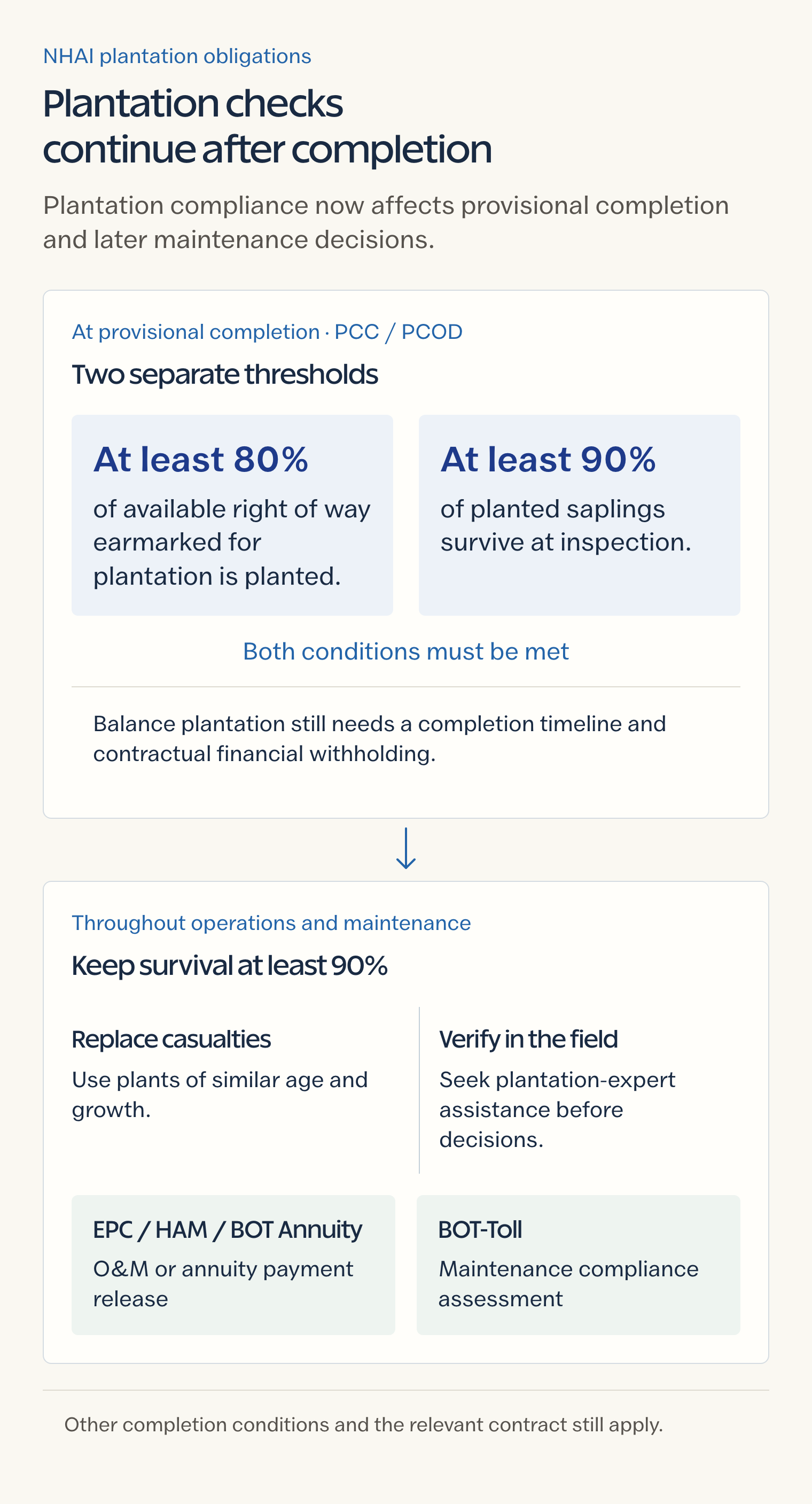
- Provisional completion requires plantation on at least 80% of available Right of Way earmarked for plantation.
- Sapling survival must reach at least 90% at inspection; this is a separate condition from the land-coverage threshold.
- Maintenance compliance carries the survival requirement into the operating period, with payment consequences under the applicable project arrangement.
- Dead plants must be replaced promptly with plants of similar age and growth.
- NHAI’s identified problem: plantation was already contractual, but received insufficient attention when provisional completion was certified.
- Policy significance: environmental obligations now face checks at project completion and during maintenance, rather than relying only on initial planting.
UPSC Relevance
Prelims Relevance
- Right of Way earmarked for plantation
- Provisional Certificate of Completion and Provisional Commercial Operation Date
- Plantation coverage versus sapling survival
- Operations and Maintenance obligations
- EPC, HAM, BOT-Annuity and BOT-Toll distinctions
Mains Relevance
GS Paper 3
- Environmental conditions in infrastructure contracts
- Performance-linked maintenance and durable public assets
GS Paper 2
- Field verification and accountability in contract implementation
Essay
- Public investment succeeds when assets remain useful after construction.
Background and Context
What the plantation thresholds actually measure
Coverage and survival answer different questions: where planting has happened, and whether planted saplings remain alive when officials inspect the work.
- Coverage concerns the available Right of Way specifically earmarked for plantation. It does not mean that trees must occupy the same share of every carriageway, shoulder or other land within a highway corridor.
- Survival concerns the planted saplings, rather than the proportion of highway land planted. A project can cover enough eligible land yet fail the separate survival test because too many of those saplings died.
- Median and avenue planting must follow the relevant contract or concession agreement and prescribed guidelines. The announcement treats landscaping and plantation as components of highway development, rather than optional additions after engineering works finish.
- Green Highways Policy, 2015 is an identified policy reference. The new directions strengthen compliance with planting obligations; they do not establish that every corridor already satisfies those obligations or has achieved lasting ecological benefits.
- Trees outside forests provide a wider conceptual link: roadside planting belongs in discussions beyond notified forests. Read the forest-inventory note separately; counting trees and enforcing their contractual maintenance address different governance problems.

How provisional completion becomes an enforcement point
The completion check joins two conditions, while financial withholding keeps the unfinished plantation obligation alive after that initial threshold is crossed.
- PCC means Provisional Certificate of Completion; PCOD means Provisional Commercial Operation Date. The plantation test applies at these provisional milestones, making environmental compliance relevant when officials assess whether the project can pass this stage.
- Both conditions must hold: plantation must cover at least 80% of the eligible available area, and saplings must show at least 90% survival at inspection. Neither condition can substitute for the other one.
- Remaining plantation must be identified with specific completion timelines. Crossing the provisional threshold does not cancel the balance of the prescribed planting target or convert that remaining obligation into work the contractor may ignore.
- Financial withholdings follow the relevant contract or concession agreement and continue until the balance plantation is completed and the prescribed target achieved. The release does not announce one uniform monetary deduction for every project.
- Field inspection makes the distinction operational: officials need evidence of eligible planted area and living saplings. Treating a planting invoice or a total sapling purchase count as proof would miss the survival condition.
Why survival remains linked to maintenance payments
The maintenance stage tests continuity, so a satisfactory inspection at provisional completion cannot settle the plantation obligation for the rest of the operating period.
- Ongoing survival must meet the minimum standard throughout Operations and Maintenance. This shifts the contractor’s incentive toward keeping plants alive after planting, instead of treating the completion inspection as the final environmental checkpoint.
- EPC, HAM and BOT-Annuity projects face the condition when O&M or annuity payments are released. In BOT-Toll projects it governs maintenance-compliance assessment; the release distinguishes these routes rather than describing identical payments everywhere.
- Replacement plants must have similar age and growth to casualties. Simply inserting very small saplings where established plants died would not satisfy the stated objective of maintaining plantation density, uniformity and corridor continuity.
- Environment and plantation expertise must support field-level verification before payment processing or maintenance certification. This adds a technical check to the administrative decision, rather than leaving compliance to unsupported claims about work performed.
- Payment design links obligations to an enforceable decision point. The railway hybrid-annuity note explains a separate financing application; it should not be used to assume these highway plantation directions automatically govern railway contracts.
Way Forward
Make each compliance decision auditable
- Record denominators: distinguish eligible available planting area, area actually planted and saplings inspected so coverage cannot conceal poor survival.
- Track the remaining obligation: connect shortfalls, completion timelines and contractual withholdings in the same inspection record.
- Verify continuity: document casualties and comparable replacements before processing maintenance payments or certification, rather than relying on completion-stage photographs.
Conclusion
- The central distinction is coverage versus survival: one measures planting across eligible land, while the other checks living saplings. The guidelines combine these measures at provisional completion and retain survival as an operating obligation.
- For a governance answer, trace the enforcement chain: define the obligation, inspect the result, identify unfinished work and connect compliance to certification or money. The announcement establishes this mechanism; successful implementation still requires credible field evidence.
UPSC Practice Questions
Prelims MCQ 1
With reference to NHAI’s new plantation compliance guidelines, consider the following statements:
- Coverage is calculated against available Right of Way earmarked for plantation.
- Meeting the provisional coverage threshold extinguishes the remaining plantation obligation.
- The prescribed survival standard continues throughout the Operations and Maintenance period.
How many of the above statements are correct?
(a) Only one (b) Only two (c) All three (d) None
Answer: (b) Only two
Explanation:
Statements 1 and 3 are correct. The remaining plantation must have completion timelines, with financial withholdings under the relevant agreement until the prescribed target is achieved.
Prelims MCQ 2
Which statement correctly describes the guidelines’ treatment of BOT-Toll projects?
(a) Plantation survival is irrelevant after provisional completion. (b) All toll revenue must be transferred to a plantation fund. (c) Survival compliance forms part of maintenance-compliance assessment. (d) Only the number of saplings purchased is inspected.
Answer: (c) Survival compliance forms part of maintenance-compliance assessment.
Explanation:
The release links BOT-Toll projects to assessment of maintenance compliance, while separately describing release of O&M or annuity payments in EPC, HAM and BOT-Annuity projects.
UPSC Mains Questions
- Explain how linking plantation compliance to provisional completion and maintenance payments can strengthen environmental accountability in highway development.
- Why should infrastructure contracts distinguish work completion from continuing asset performance? Discuss using NHAI’s plantation coverage and survival requirements.
Source: PIB, Ministry of Road Transport & Highways.
Frequently Asked Questions
What is the coverage requirement for provisional completion?
Plantation must cover at least 80% of the available Right of Way earmarked for planting. This denominator is the eligible planting area, not the entire land area of the highway corridor.
How is the survival requirement different?
A minimum 90% of planted saplings must survive at inspection. Coverage measures where planting occurred; survival measures whether the planted saplings are alive. Both conditions are needed for provisional plantation compliance.
Does provisional completion remove the remaining planting obligation?
No. Remaining plantation must be identified with completion timelines. Financial withholdings under the relevant contract or concession agreement apply until the balance plantation is completed and the prescribed target is achieved.
How do maintenance payments enter the mechanism?
O&M or annuity payments in EPC, HAM and BOT-Annuity projects depend on maintaining the survival standard. BOT-Toll projects face maintenance-compliance assessment, supported by expert verification of field conditions before certification.
What does NHAI require when plants die?
Casualties must be replaced promptly with plants of similar age and growth. The requirement aims to preserve plantation density, uniformity and continuity along the highway rather than allowing repeated loss of established planting.
Source: https://anantamias.com/current-affairs/nhai-plantation-completion-survival-payments/
India’s 6G Call to Action: Security, Standards and Policy Autonomy
Why in News?
On 9 September 2026, the Ministry of Communications reported India’s endorsement of the Call to Action for 6G Leadership and Security, announced alongside the G20 Innovation Ministerial held earlier that month.
- The Department of Telecommunications will coordinate India’s engagement with government agencies, industry, academia and other stakeholders.
- The initiative promotes open, interoperable, secure and resilient networks, alongside resource efficiency and innovation-led competition.
- Its graduated cooperation programme covers expert contacts, sector consultations, supply-chain strategy and progress review.
- Participation preserves independent national positions in industry-driven standards bodies; endorsement does not announce operational 6G services.
- The policy question is how international coordination can reduce network risks while allowing India to retain independent technology and standards positions.
- Separate governance cooperation from laboratory demonstrations, commercial deployment and final technical standards; these are different developments.
UPSC Relevance
Prelims Relevance
- Department of Telecommunications: Indian coordinating agency
- 6G: sixth generation of wireless communications
- Interoperability and network resilience
- Industry-led standards development
- National autonomy within voluntary cooperation
Mains Relevance
GS Paper 3
- Cybersecurity and telecommunications supply chains
- Domestic research capacity and participation in global standards
GS Paper 2
- International technology cooperation and strategic autonomy
Essay
- Technological interdependence and national autonomy
Background and Context
Why network security extends beyond the radio tower
The initiative treats future telecommunications as shared critical infrastructure whose security depends on equipment, connected systems and the firms supplying them.
- Interoperability means systems can work together. For an aspirant, distinguish this objective from unrestricted trust: equipment that exchanges information successfully still needs scrutiny for security weaknesses and dependable operation throughout its working life.
- Resilience concerns continuity when networks face disruption. The Call links it with security because critical services increasingly depend on communications; preventing every incident and maintaining service through an incident are related but different tasks.
- Supply-chain transparency means understanding developments and vulnerabilities among suppliers. The initiative proposes sharing such information because telecom risks can originate beyond the operator, including within equipment, software and other components of interconnected systems.
- Cybersecurity assessment is an identified cooperation area for telecommunications investments. The exam takeaway is to examine technical weaknesses alongside strategic dependence, rather than treating a network investment only as a question of speed or price.
- Resource efficiency and competition sit alongside security in the initiative. An analytical answer should assess whether network choices support dependable services and innovation without assuming that any single supplier arrangement automatically satisfies all these objectives.

How the graduated cooperation programme works
The sequence moves from identifying responsible people to examining industry barriers, planning supply chains and reviewing progress with participating stakeholders.
- Within one month, participants are to nominate expert 6G contacts, designate a coordinating agency and prepare an initial stakeholder list. This establishes responsibility before substantive joint work with industry and academia moves forward.
- Within three months, governments are to consult the telecom sector, map the emerging landscape, identify leadership barriers and discuss findings. They also begin identifying resources that could support competitiveness rather than announcing completed networks.
- Within six months, expert discussions turn to secure, resilient, sustainable and innovative supply chains. Participants also consider how leadership and security should enter national or regional strategies, connecting external dialogue with domestic policy planning.
- Within twelve months, an in-person review is envisaged to compare progress, exchange lessons and set subsequent priorities with industry. This is a cooperation review milestone, not a promised deadline for commercial 6G deployment.
- The Department of Telecommunications leads India’s follow-up across relevant institutions. Its coordinating role matters because research priorities, investment risks and standardisation proposals require inputs from several actors rather than a decision by one laboratory.
What endorsement changes, and what it does not
The Call creates a framework for coordinated preparation; it explicitly preserves independent positioning and avoids duplicating technical work in existing standardisation forums.
- Policy autonomy remains explicit: participation does not bind or limit a government’s independent position in industry-driven standards bodies. Cooperation on shared risks should not be interpreted as surrendering national choices about future technical proposals.
- National circumstances shape implementation. The release says next steps vary with priorities, resources and capabilities; common objectives do not mean every participant undertakes identical actions, allocates equal funding or reaches the same readiness simultaneously.
- Industry-led standardisation remains the technical channel. Governments propose working with industry on global standards, including security standards, while avoiding duplicate technical work; endorsement itself does not settle the final specifications of a future network.
- Domestic capability provides the Indian foundation: the release cites Bharat 6G Vision, Bharat 6G Alliance and indigenous telecom technology work. These support participation but should not be presented as proof that commercial 6G already exists.
- Existing 5G systems also feature in the cooperation agenda, including their industrial and security applications. This matters because preparation for a future generation can accompany improvements to present networks without implying an immediate technology replacement.
Way Forward
Convert cooperation into demonstrable capability
- Connect industry and academic consultations to specific security problems and standards proposals, so participation produces technical contributions rather than only statements of intent.
- Assess supply-chain vulnerabilities alongside interoperability and resource efficiency; avoid treating procurement cost or claimed speed as a sufficient measure of network quality.
- Preserve independent standards positions while sharing evidence on common risks; distinguish research results, proposed standards and deployment readiness in public communication.
Conclusion
- 6G cooperation is about shaping future networks through security, supply-chain planning and industry engagement. The announcement concerns coordinated preparation, so answers should not convert an endorsement into a claim of completed technology or commercial rollout.
- Use this development to explain strategic autonomy through participation: India can work with partners on shared infrastructure risks while retaining independent positions. Judge success by technical contributions and credible follow-up, rather than the endorsement alone.
UPSC Practice Questions
Prelims MCQ 1
With reference to the Call to Action for 6G Leadership and Security, consider the following statements:
- The Department of Telecommunications coordinates India’s engagement.
- Participation removes governments’ independent positions in industry-driven standards bodies.
- The initiative cautions against duplicating technical work in industry-led standardisation forums.
How many of the above statements are correct?
(a) Only one (b) Only two (c) All three (d) None
Answer: (b) Only two
Explanation:
Statements 1 and 3 are correct. The Call explicitly preserves independent governmental positioning and autonomy in industry-driven standards bodies.
Prelims MCQ 2
Which description best captures India’s endorsement of the 6G Call to Action?
(a) A commercial launch of operational 6G networks (b) Adoption of final technical specifications for all participating countries (c) Graduated cooperation on future network security, competitiveness and supply chains (d) A requirement to replace existing 5G networks immediately
Answer: (c) Graduated cooperation on future network security, competitiveness and supply chains
Explanation:
The initiative sets out staged contacts, consultations, strategy and review. It does not announce commercial deployment, final standards or compulsory replacement of 5G.
UPSC Mains Questions
- Explain how international cooperation on future telecommunications networks can strengthen security without undermining India’s policy autonomy.
- Why should telecommunications policy examine interoperability, supply-chain vulnerabilities and resilience together? Discuss with reference to India’s 6G Call to Action endorsement.
Source: PIB, Ministry of Communications.
Frequently Asked Questions
What is the 6G Call to Action?
It is a cooperation initiative for open, interoperable, secure and resilient next-generation networks. Participating governments plan expert contacts, industry consultations, supply-chain discussions and progress reviews with relevant stakeholders.
Has India launched commercial 6G through this endorsement?
No. The announcement concerns cooperation and preparation for future networks. It does not establish operational commercial 6G services or announce that final technical standards have been adopted.
Does participation restrict India’s policy autonomy?
The Call expressly preserves independent governmental positioning in industry-driven standards bodies. Participants’ next steps vary according to national priorities, resources and capabilities, rather than requiring identical national choices.
Who coordinates India’s participation?
The Department of Telecommunications coordinates India’s engagement and follow-up with relevant government agencies, industry, academia and other stakeholders. The role connects domestic institutions with the cooperation programme.
Why are supply chains part of telecom security?
Telecom services depend on equipment, software and their suppliers. Sharing information about supply-chain developments and vulnerabilities can inform risk assessment, alongside efforts to strengthen network security, resilience and interoperability.
Source: https://anantamias.com/current-affairs/india-6g-call-action-security-standards/
DILRMP 3.0: The Proposed Shift From Digital Records to a Land Stack
Why in News?
On 9 September 2026, the Department of Land Resources announced that DILRMP 3.0 operational guidelines would be launched on 10 September at 6:30 PM, outlining a proposed integrated Land Stack.
- DILRMP 3.0 is presented as a Central Sector Scheme; its scheduled evening launch remains upcoming at morning publication.
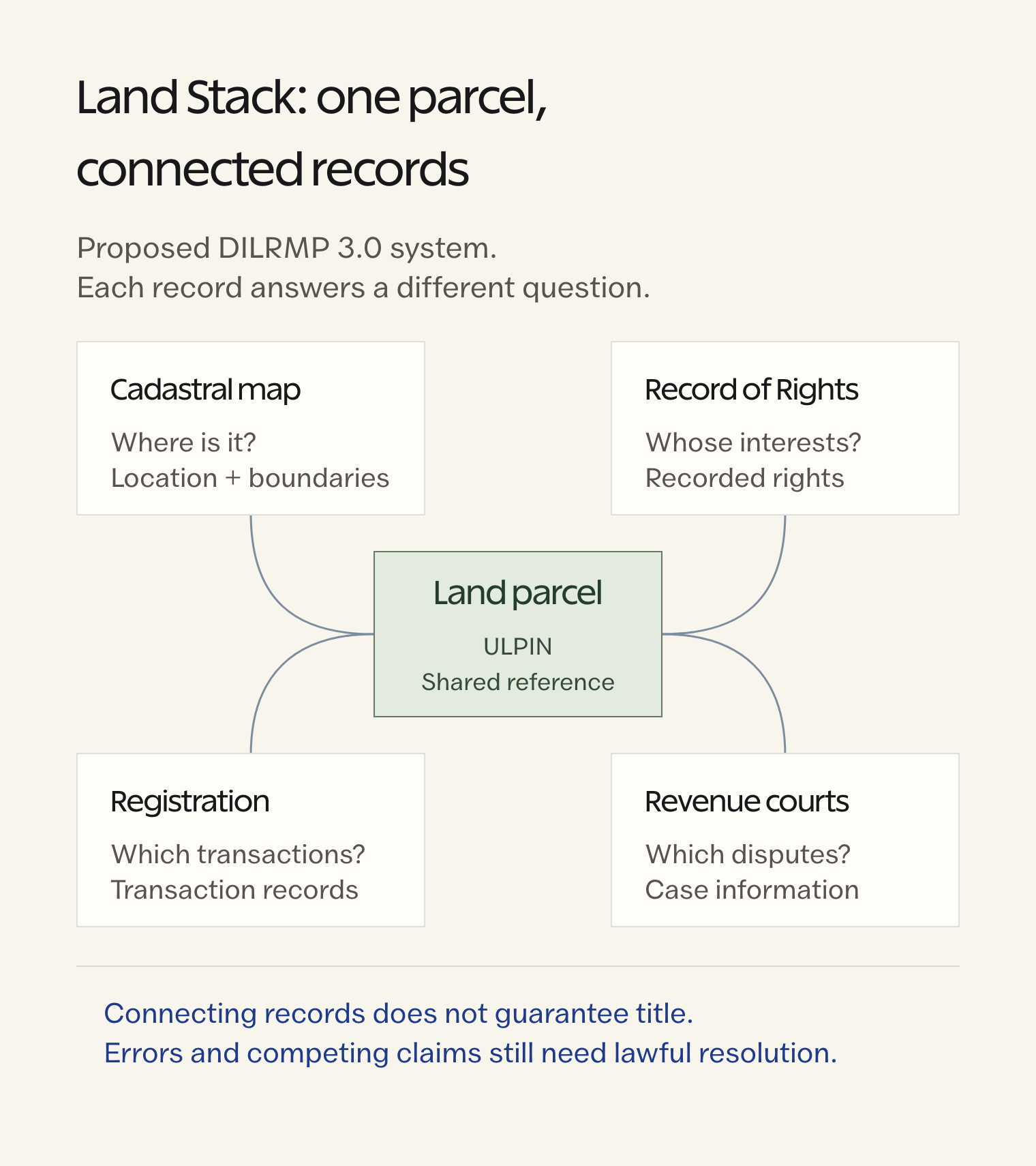
- The proposed GIS-enabled Land Stack would connect maps, ownership details, property registration and court cases.
- Bhu-Aadhaar or ULPIN would identify land parcels through a 14-digit identifier; it is a parcel reference, not an ownership guarantee.
- Planned interventions include georeferenced cadastral maps, paperless registration and integrated revenue court case management.
- Fragmented records can make citizens reconcile different descriptions of the same property across offices.
- Land governance depends on matching a physical parcel with recorded rights, transactions and disputes, while preserving correction and hearing procedures.
UPSC Relevance
Prelims Relevance
- DILRMP: Digital India Land Records Modernization Programme.
- DoLR: Department of Land Resources, Ministry of Rural Development.
- Cadastral map: a map showing individual land parcels and their boundaries.
- ULPIN: Unique Land Parcel Identification Number, also called Bhu-Aadhaar.
- RCCMS: Revenue Court Case Management System.
Mains Relevance
GS Paper 2
- Governance: coordinated land services, accessible corrections and accountable information sharing.
GS Paper 3
- Land reforms: reliable parcel information, transaction costs and protection against disputed claims.
Essay
- Trust in public records requires both accurate information and a fair opportunity to contest it.
Background and Context
Start with the parcel, not the screen
A Land Stack becomes useful when different records reliably refer to the same piece of land, despite describing different aspects of it.
- A physical parcel is a bounded piece of land. Field bunds are visible features, but they alone cannot establish the surveyed boundary, recorded owner or legal title.
- A cadastral map describes parcel boundaries and location relative to neighbouring parcels. Georeferencing connects that mapped space to geographic coordinates, helping officials compare the map with land on the ground.
- A Record of Rights supplies textual information about recorded interests in land. Its entries and the parcel map must correspond; a digitised name without the correct spatial reference can misidentify the property.
- The proposed ULPIN provides a shared reference for a parcel across connected systems. Identification helps link information, but does not independently verify every entry attached to that reference or settle competing ownership claims.
- GIS enables spatial information to be examined alongside associated records. The key administrative gain is locating which parcel a transaction or dispute concerns, rather than merely displaying another scanned document online.

Connect maps, transactions and disputes
The proposed architecture links complementary records around a parcel; it does not turn every record into the same kind of evidence.
- The registration system holds records of registered transactions. Linking these with land records can help officials identify relevant changes, while recognising that registration information and the updated revenue entry serve different purposes.
- Revenue records and survey information answer different questions about a property. Integration should expose discrepancies between a parcel description and its recorded interests instead of silently treating one database as universally correct.
- An integrated revenue court case system could show whether a linked parcel is involved in recorded proceedings. Case visibility supports informed decisions; it cannot itself decide the merits of the dispute.
- The Department of Land Resources describes court linkage as providing authentic first-hand land and registration information. Its value lies in supporting judicial examination, while the competent court still evaluates the evidence.
- Secure APIs would allow authorised systems to exchange information. A sound design should retain the responsible office, update time and source record, allowing a user to trace why a parcel entry changed.
Digital identity is not guaranteed title
The most important exam distinction is between improving access to evidence and changing the legal certainty that the evidence provides.
- India’s land-record modernisation seeks to move towards conclusive titling. That policy objective must not be confused with a completed legal transition merely because a parcel acquires a digital identifier or online record.
- Revenue entries do not by themselves confer title, as the Supreme Court has reiterated. A computerised entry cannot gain stronger legal force simply through scanning, database linkage or display on an official portal.
- Legacy errors can spread when connected systems reuse an incorrect boundary or name. A useful safeguard is a documented correction process that checks supporting records and identifies which office must resolve the inconsistency.
- Exclusion risks arise if people cannot inspect entries, submit objections or obtain assisted service. Digitisation should make such remedies easier to use, especially where literacy, connectivity or documentation gaps obstruct access.
- The announcement establishes proposed interventions, not demonstrated nationwide outcomes. Evaluate implementation through accurate parcel matching, completed corrections and accessible dispute information; fewer visits or faster disposal remain expected benefits until supported by evidence.
Way Forward
Make every linked entry contestable
- Reconcile before linking: compare parcel maps, textual records and registration descriptions; flag mismatches for accountable review.
- Preserve due process: provide notice, accessible objections and assisted correction channels before disputed changes become widely reused.
- Measure service quality: track correction completion and retrieval of relevant case information, alongside digitisation progress.
- Limit access: use permissions and audit trails to protect personal information while enabling legitimate public services.
Conclusion
- DILRMP 3.0 proposes a move from separate digital documents towards connected parcel information. Its distinctive promise is making maps, recorded interests, transactions and disputes intelligible together for citizens and institutions.
- Use this distinction in answers: interoperability improves access to evidence; reliable title also requires lawful records and dispute resolution. Judge the reform by the accuracy and contestability of the information it connects.
UPSC Practice Questions
Prelims MCQ 1
With reference to the proposed Land Stack, consider the following statements:
- ULPIN identifies a land parcel.
- Georeferencing connects mapped land information to geographic coordinates.
- An integrated case-management system automatically adjudicates disputes over title.
How many of the above statements are correct?
(a) Only one (b) Only two (c) All three (d) None
Answer: (b) Only two
Explanation:
The first two statements are correct. Case management links proceedings and information; adjudication remains with the competent authority.
Prelims MCQ 2
Which distinction best explains the purpose of connecting land records with registration and court information?
(a) All connected records become conclusive title certificates. (b) Physical boundaries become irrelevant once records are online. (c) Different records provide complementary information about the same parcel. (d) A pending court case automatically cancels every registered transaction.
Answer: (c) Different records provide complementary information about the same parcel.
Explanation:
Maps, textual records, registered transactions and court proceedings describe different aspects of a parcel. Integration supports examination without making their legal roles identical.
UPSC Mains Questions
- Explain how a parcel-centred Land Stack could improve land governance. What safeguards are necessary to prevent digitisation from reproducing errors?
- Distinguish digital land-record integration from conclusive titling. Discuss why access to remedies remains essential in land administration.
Sources: PIB, Ministry of Rural Development and Department of Land Resources.
Frequently Asked Questions
What is the proposed DILRMP 3.0 Land Stack?
It is a proposed interoperable land-information system connecting maps, recorded ownership details, registration information and court cases. The aim is to make information about the same parcel easier to retrieve and compare.
Had the DILRMP 3.0 guidelines been launched at this note’s publication?
No. The 9 September announcement scheduled the launch for 6:30 PM on 10 September 2026. This morning note explains announced proposals and does not claim their rollout or implementation.
Does ULPIN prove ownership?
No. ULPIN identifies a parcel so connected systems can refer to the same land. Identification does not itself establish title, validate all associated entries or resolve a dispute between competing claimants.
Why connect court cases with land records?
Linkage can help courts and users find relevant records and the recorded dispute status of a property. It improves access to information while leaving examination of evidence and adjudication to competent authorities.
What is georeferencing in land administration?
Georeferencing links mapped information to geographic coordinates. For cadastral maps, it helps relate the depicted parcel to its ground location; it does not independently determine who legally owns that parcel.
Source: https://anantamias.com/current-affairs/dilrmp-three-land-stack-guidelines-announced/
Organic Photocatalysts: How Self-Assembly Improves Charge Separation
Why in News?
On 9 September 2026, the Ministry of Science and Technology reported that CeNS researchers developed self-assembled organic photocatalyst nanosheets with improved photocurrent during solar-driven water splitting.
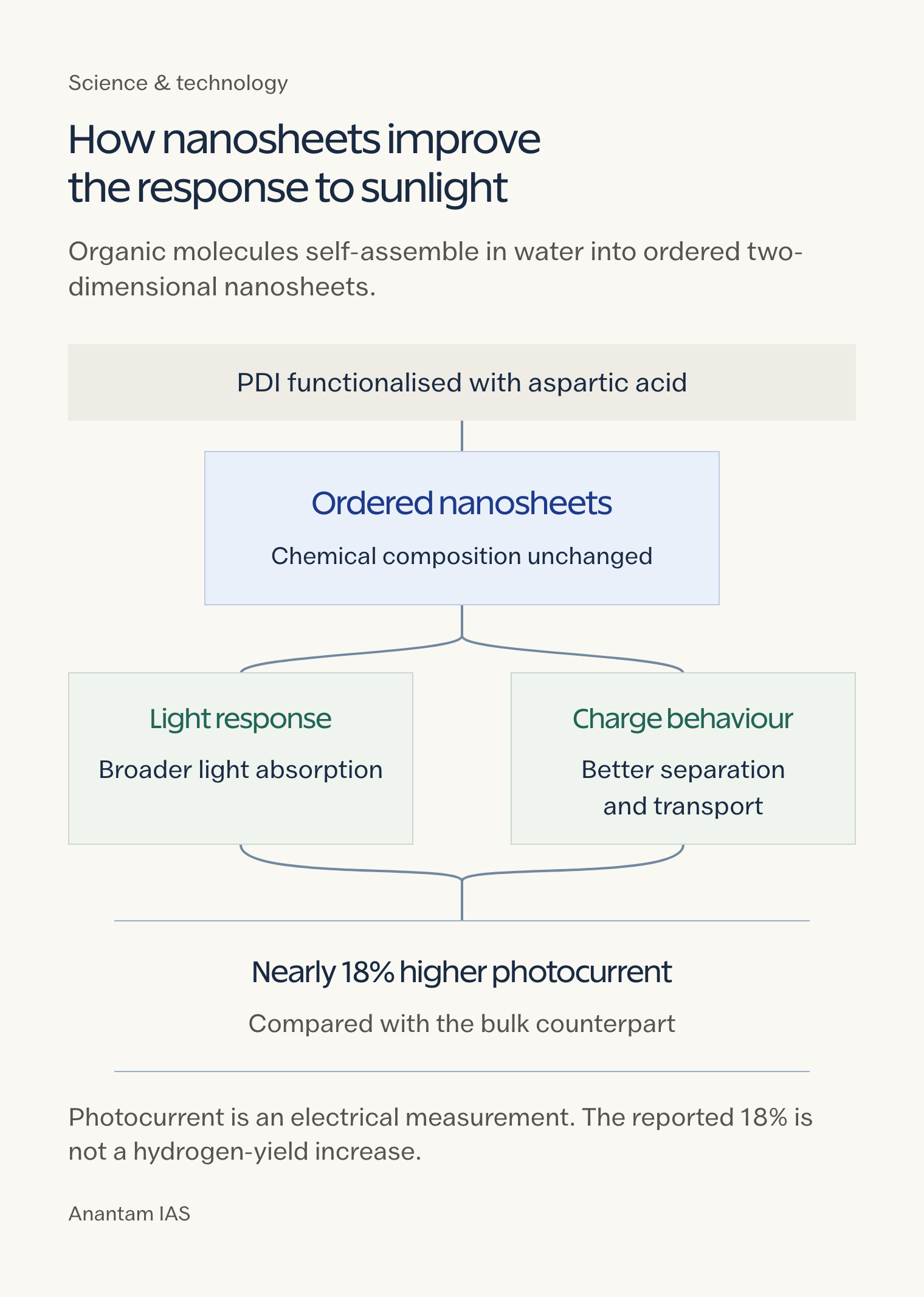
- Researchers combined perylene diimide (PDI), a light-absorbing organic molecule, with the naturally occurring amino acid aspartic acid.
- The molecules organised themselves in water into two-dimensional nanosheets through supramolecular self-assembly.
- The assembled material produced nearly 18% higher photocurrent than its bulk counterpart; this is not a reported increase in hydrogen yield.
- The work comes from the Centre for Nano and Soft Matter Sciences, Bengaluru, an autonomous institution under DST.
- Molecular organisation can change material performance without changing the chemical composition of the assembled molecule.
- Metal-free photocatalysts offer a research route for reducing reliance on costly or scarce catalytic metals; commercial suitability still requires evidence.
UPSC Relevance
Prelims Relevance
- Photocatalysis: light-assisted catalytic reactions.
- PDI: the light-absorbing organic component in this study.
- Aspartic acid: an amino acid promoting hydrogen-bonded organisation.
- Self-assembly: spontaneous organisation into larger ordered structures.
- Photocurrent: a light-induced electrical response, distinct from hydrogen yield.
Mains Relevance
GS Paper 3
- Materials design for renewable energy and solar-fuel research.
- Distinguishing laboratory performance indicators from commercial technology readiness.
Essay
- How the organisation of familiar building blocks can create new functionality.
Background and Context
What self-assembly changes
The useful innovation is an ordered arrangement of organic molecules, rather than the addition of a precious metal to the catalyst.
- Supramolecular self-assembly means individual molecules organise into a larger structure through interactions between them. Here, the functionalised PDI molecules spontaneously formed ordered sheets in water, giving the researchers a different material architecture to study.
- Aspartic acid promotes extended hydrogen bonding between the molecules. It acts as an organiser within the material, rather than merely appearing as an additional ingredient in a mixture of unrelated components.
- PDI contributes light absorption and stacking between its aromatic molecular regions, described as π–π stacking. This works together with hydrogen bonding to influence the arrangement and functional properties of the resulting material.
- Two-dimensional nanosheets describe the assembled structure, not a new chemical formula. The reported improvement followed molecular reorganisation without changing the chemical composition of the molecule being compared with its unassembled bulk counterpart.
- Structure and composition answer different questions: composition identifies the chemical building blocks, while structure describes their organisation. This distinction explains why using the same molecule need not produce the same performance in different material forms.

From sunlight to useful charge
A photocatalyst must do more than absorb sunlight: the resulting charges must separate and move efficiently enough to contribute to a reaction.
- Broader light absorption was one reported consequence of nanosheet formation. The important mechanism is an altered response to incident light, not a claim that the material captures every wavelength or absorbs all incoming solar energy.
- Charge separation keeps photo-generated charges available for the reactions they help drive. The researchers reported improved separation and reduced energy losses after self-assembly, connecting the material arrangement with its measured electrochemical behaviour.
- Charge transport concerns movement through the material after charges are generated. Electrochemical measurements and density functional theory calculations supported more efficient transport, while the amino acid increased molecular polarity and helped separate photo-generated charges.
- Accessible surface area also increased with the assembled structure, providing more exposed area for catalytic reactions. Absorption, separation, transport and surface access are complementary features; one favourable property alone does not establish a complete working technology.
- Hydrogen evolution is the reaction that the separated charges help drive in this research. The study links molecular design to solar-energy conversion, while the official account identifies photocurrent as the quantified comparison with bulk material.
Read the result without overstating it
The reported comparison is encouraging laboratory evidence, but the measured quantity and the stage of development must remain clear in an examination answer.
- Nearly 18% higher photocurrent compares the self-assembled material with its bulk counterpart. It must not be rewritten as 18% greater hydrogen production, an 18% conversion efficiency, or a reduction of that size in production costs.
- Photocurrent and hydrogen yield describe different outputs. An electrical response can support an interpretation of improved charge behaviour; a claim about the amount of hydrogen produced requires measurements of hydrogen itself under specified experimental conditions.
- Laboratory research is the demonstrated stage described in the release. It does not establish a commercially deployed reactor, industrial production capacity, operating lifetime, or an economically competitive replacement for existing hydrogen production systems.
- Metal-free material design addresses dependence on catalytic metals in this research. It does not, by itself, prove that the entire production system has negligible environmental impact or that all manufacturing and operating inputs are sustainable.
- Technology assessment should ask for stability, reproducibility, measured hydrogen output and performance beyond laboratory conditions. These are evaluation needs, not results already established by the reported photocurrent improvement or by the proposed future applications.
Way Forward
Measure the complete performance chain
- Report hydrogen output alongside photocurrent and experimental conditions so that electrical improvement is not mistaken for a quantified fuel-production gain.
- Test durability and repeatability before drawing conclusions about dependable operation over time.
- Evaluate manufacturing, resource inputs and system costs before describing the material as commercially sustainable.
Conclusion
- Self-assembly shows how organising organic molecules can improve light absorption and charge behaviour without changing the assembled molecule’s chemical composition. The central lesson is to connect material structure with function, rather than memorise an isolated percentage.
- Use the correct evidence boundary: the news reports higher photocurrent in laboratory research relevant to solar hydrogen. A claim of more hydrogen, lower costs or commercial readiness needs separate supporting measurements and validation.
UPSC Practice Questions
Prelims MCQ 1
With reference to the reported CeNS organic photocatalyst research, consider the following statements:
- Aspartic acid helps promote hydrogen-bonded molecular organisation.
- Self-assembly produced ordered two-dimensional nanosheets in water.
- The reported nearly 18% improvement measures hydrogen yield.
How many of the above statements are correct?
(a) Only one (b) Only two (c) All three (d) None
Answer: (b) Only two
Explanation:
The first two statements are correct. The reported improvement concerns photocurrent compared with the bulk counterpart, not hydrogen yield.
Prelims MCQ 2
Which feature best describes supramolecular self-assembly in this study?
(a) Replacement of the organic molecule with a precious metal (b) Spontaneous organisation of molecules into ordered structures (c) Industrial compression of hydrogen into transport cylinders (d) Measurement of commercial hydrogen production costs
Answer: (b) Spontaneous organisation of molecules into ordered structures
Explanation:
Interactions including hydrogen bonding and π–π stacking help organise the functionalised molecules into ordered nanosheets.
UPSC Mains Questions
- Explain how supramolecular self-assembly can improve the performance of organic photocatalysts. Distinguish material design from changes in chemical composition.
- Why should an improvement in laboratory photocurrent not be equated with commercial readiness for green hydrogen production? Discuss the additional evidence required.
Source: PIB, Ministry of Science & Technology.
Frequently Asked Questions
What did the CeNS photocatalyst study achieve?
Researchers organised aspartic acid-functionalised PDI molecules into nanosheets in water. The self-assembled material produced nearly 18% higher photocurrent than its bulk counterpart during solar-driven water splitting.
What role does aspartic acid play?
Aspartic acid promotes extended hydrogen bonding and helps regulate molecular organisation. The study also links it with increased molecular dipole moment, supporting separation of charges generated when the material absorbs light.
Does higher photocurrent mean 18% more hydrogen?
No. Photocurrent is an electrical response, while hydrogen yield measures the amount of hydrogen produced. The official release quantifies the photocurrent improvement and does not establish an equivalent percentage increase in hydrogen output.
Is this a commercially deployed hydrogen technology?
The release describes laboratory research and possible future applications. It does not establish commercial deployment, industrial production capacity, long-term operating stability or competitiveness with existing hydrogen production systems.
Source: https://anantamias.com/current-affairs/self-assembled-organic-photocatalyst-hydrogen/
3D-Printed Bone Grafts: Patient-Specific Bioceramics Move Toward Commercialisation
Why in News?
On 9 September 2026, the Technology Development Board announced financial support for Ceramat’s project to commercialise 3D-printed bone grafts using indigenous calcium-phosphate materials and patient-specific digital designs.
- TDB, under the Department of Science & Technology, supports the commercialisation project at Ceramat in Palghar, Maharashtra.
- The project combines Digital Light Processing and extrusion-based printing for standard and patient-specific grafts.
- The announcement concerns financial assistance and planned manufacturing; it does not establish clinical approval, patient outcomes or general availability.
- Domestic biomaterials and advanced manufacturing can address import dependence, but patient access also depends on reliable production and demonstrated clinical suitability.
- The case connects science policy with health governance: support for innovation must be assessed separately from evidence supporting medical use.
UPSC Relevance
Prelims Relevance
- TDB: Technology Development Board under DST.
- Bioceramics: ceramic materials developed for biological or medical applications.
- Hydroxyapatite and beta-tricalcium phosphate: calcium-phosphate biomaterials.
- Additive manufacturing: forming a designed object by adding material in successive layers.
- Patient-specific: matched to individual anatomy; not equivalent to printing living tissue.
Mains Relevance
GS Paper 3
- Indigenous medical technology and commercialisation of research.
- Advanced manufacturing, quality assurance and domestic supply chains.
GS Paper 2
- Evidence-based adoption of health technologies and affordable access.
Essay
- Innovation earns public trust when scientific ambition is matched by evidence.
Background and Context
What is a bioceramic bone graft?
A ceramic graft addresses a material and structural requirement; understanding natural bone prevents confusing that manufactured object with a complete living replacement.
- Bioceramics are ceramic materials intended for biological applications. This project uses calcium-phosphate materials, including hydroxyapatite and beta-tricalcium phosphate, whose relevance comes from their similarity to the mineral component of natural bone.
- Natural bone is living tissue containing cells and a collagen-based framework with mineral deposits. NIAMS explains that it constantly remodels; a calcium-phosphate structure alone does not reproduce this entire biological system.
- A graft provides material for a bone-repair application. Its composition, shape and intended use matter together: chemical resemblance to bone mineral cannot by itself establish suitability for every defect or surgical requirement.
- Patient-specific describes anatomical matching. FDA explains that medical imaging can guide designs fitted to an individual; matching shape answers a design problem but does not independently establish how well a product performs clinically.
- The announced project concerns ceramic manufacture, not deposition of living cells into a functioning bone. Keep the distinction explicit when interpreting the phrase “3D-printed bone”: the printed object here is a graft material.

How digital design becomes a printed graft
Additive manufacturing connects a digital shape to a physical object through controlled layers, while the chosen printing method determines how each layer is formed.
- Digital design establishes the desired geometry before manufacture. Patient-matched models can use anatomical information, while standard models serve predefined designs; both routes still require checking that the finished object corresponds to its intended specifications.
- Digital Light Processing uses projected light to selectively cure a light-sensitive formulation, layer by layer. In ceramic printing, ceramic particles are carried in that formulation; light does not directly turn calcium phosphate into living tissue.
- Extrusion-based printing deposits material through a nozzle along a programmed path. Successive tracks build the structure; the material must flow during deposition while retaining enough shape for the intended geometry to form.
- Post-processing can alter a ceramic part after printing. NIST identifies sintering and dimensional accuracy as manufacturing concerns; checking only the digital file misses changes that occur while producing the finished ceramic object.
- The important distinction is light-controlled curing versus nozzle-controlled deposition. These are manufacturing approaches rather than competing medical diagnoses; the release identifies both without proving that either universally delivers better clinical outcomes for patients.
Commercialisation support is not clinical proof
The policy opportunity is domestic capability, but responsible assessment separates a supported project, a consistently manufactured product and evidence for its intended medical use.
- TDB support helps move a proposed technology toward commercial application. The announcement is evidence of that support and project direction; it should not be presented as a completed clinical trial or regulatory authorisation.
- Import substitution involves more than owning a printer. Domestic capability must cover suitable raw materials, repeatable fabrication, testing and dependable supply; weaknesses in any link can limit the value of a locally manufactured product.
- Quality control must follow the finished device. FDA’s process guidance distinguishes design, material controls, post-processing and testing, illustrating why an attractive printed shape is only one part of evaluating an additive-manufactured medical product.
- Affordability remains a question to investigate, not an outcome demonstrated by this announcement. A policy evaluation should examine total treatment costs and access alongside manufacturing capability before claiming that localisation has benefited patients.
- Evidence gaps include product-specific clinical results and verified availability in this release. Naming these gaps keeps an answer balanced: technological promise supports further development, while patient-use claims require evidence beyond financial assistance.
Way Forward
Tie support to verifiable development milestones
- Require manufacturing evidence on dimensional consistency, material properties and finished-product quality for each intended application.
- Assess clinical suitability through the applicable evidence and regulatory pathway before describing a supported project as a proven treatment.
- Track patient access through availability and total treatment costs, rather than treating domestic production alone as proof of affordability.
Conclusion
- Patient-specific bioceramics bring materials science and digital manufacturing together, but a graft’s anatomical fit, manufacturing quality and clinical suitability remain separate questions that must be answered with appropriate evidence.
- Use this case to explain innovation governance: public support can strengthen domestic capability, while transparent evaluation must establish what a finished medical product can safely and effectively do for its intended patients.
UPSC Practice Questions
Prelims MCQ 1
With reference to patient-specific bioceramic grafts, consider the following statements:
- Hydroxyapatite is a calcium-phosphate biomaterial.
- Patient-specific manufacturing necessarily involves printing living bone cells.
- Financial support for commercialisation establishes that a product has proven clinical effectiveness.
How many of the above statements are correct?
(a) Only one (b) Only two (c) All three (d) None
Answer: (a) Only one
Explanation:
Only statement 1 is correct. Patient-specific describes anatomical matching, and commercialisation support does not establish clinical effectiveness.
Prelims MCQ 2
Which pairing correctly distinguishes the printing approaches in this project?
(a) DLP: projected-light curing; extrusion: nozzle-based deposition (b) DLP: living-cell division; extrusion: X-ray imaging (c) DLP: nozzle-based deposition; extrusion: projected-light curing (d) Both methods directly grow a complete living bone
Answer: (a) DLP: projected-light curing; extrusion: nozzle-based deposition
Explanation:
DLP selectively cures a light-sensitive formulation using projected light. Extrusion deposits material along a controlled path through a nozzle.
UPSC Mains Questions
- Explain how patient-specific additive manufacturing can strengthen India’s medical-technology capability. Distinguish manufacturing potential from clinical evidence. (150 words)
- Import substitution in medical devices requires more than domestic production. Discuss with reference to bioceramic bone grafts and patient access. (250 words)
Sources: PIB, Ministry of Science & Technology and FDA: Medical Applications of 3D Printing.
Frequently Asked Questions
What are 3D-printed bioceramic bone grafts?
They are graft structures manufactured using ceramic biomaterials and additive techniques. The supported project uses calcium-phosphate materials to develop standard and anatomically customised products; it does not claim to print complete living bones.
What makes a graft patient-specific?
Its design is matched to an individual’s anatomical features, potentially using medical imaging. This describes how the product is shaped; clinical suitability and manufacturing quality still need separate evaluation.
Are calcium-phosphate ceramics the same as natural bone?
No. Calcium phosphate resembles bone’s mineral component, while natural bone is living tissue with cells and a collagen-based framework. A ceramic structure does not reproduce that complete biological system.
Does TDB support mean the grafts are clinically approved?
No. The announcement establishes financial assistance for a commercialisation project. It does not provide product-specific clinical outcomes or establish regulatory approval, so those claims cannot be inferred from this release.
Source: https://anantamias.com/current-affairs/patient-specific-bioceramic-3d-bone-grafts/
ORV Sagar Manthan: From Ship Launch to Ocean Research
Why in News?
ORV Sagar Manthan was launched at Kolkata on September 9, 2026, beginning another construction phase before its scheduled delivery for commissioning in 2028.
- GRSE is building the ocean research vessel for the National Centre for Polar and Ocean Research, under the Ministry of Earth Sciences.
- Superstructure erection, system integration and sea trials remain after launch; the ship has not entered operational research service.
- The vessel supports the Deep Ocean Mission, with planned seabed surveys, water-column studies and environmental observations.
- Ocean observations help connect underwater geology, water properties and atmospheric conditions, giving researchers evidence that a surface view cannot supply.
- Scientific capability depends on working instruments, trained teams and usable observations, alongside the physical research platform.
UPSC Relevance
Prelims Relevance
- ORV: Ocean Research Vessel.
- NCPOR: an institution under the Ministry of Earth Sciences.
- Bathymetry: underwater depth and seabed topography.
- CTD: conductivity, temperature and depth profiling.
- Sub-bottom profiling: imaging structures beneath the seabed.
Mains Relevance
GS Paper 3
- Domestic scientific infrastructure and ocean technology.
- Resource exploration, environmental baselines and evidence-based ocean management.
GS Paper 1
- Ocean-floor relief and the physical properties of ocean water.
Essay
- Scientific self-reliance requires dependable knowledge production, alongside domestic manufacturing.
Background and Context
What the launch does, and what remains
The launch marks progress in construction; readiness for scientific cruises requires further work on the ship and its integrated systems.
- Launch means the vessel entered the water for its next construction phase. The official account records a transfer between docks, not the departure of a fully equipped ship on an ocean expedition.
- Superstructure erection remains on the project schedule. This makes the unfinished ship an especially useful example of why a floating hull should not be confused with a completed oceanographic platform ready for service.
- System integration brings the vessel and its equipment together. For research, the practical question is whether ship operations and scientific instruments can function reliably as a combined platform during planned work at sea.
- Sea trials must precede final delivery for commissioning, scheduled for 2028. The announcement supplies a future milestone rather than evidence that every performance requirement has already been demonstrated in actual ocean conditions.
- NCPOR is the intended scientific recipient under the Earth Sciences Ministry. Construction by a defence public sector shipyard does not change the stated ocean-research purpose into a naval combat or submarine-rescue role.

Match the instrument to the research question
Different instruments observe different parts of the ocean; combining their findings is more useful than treating every survey as the same measurement.
- Multibeam bathymetry maps seabed depth across a swath by timing returning sound pulses. It answers where underwater ridges and depressions lie; a depth map alone does not identify commercially recoverable mineral deposits.
- CTD profiling records conductivity and temperature with depth in the water column. Conductivity helps derive salinity, allowing scientists to examine changing water properties rather than merely produce another outline of the ocean floor.
- Sub-bottom profiling uses sound to investigate sediment structures beneath the seabed. Its target differs from bathymetry: the question concerns buried layers, not simply how deep the seabed lies beneath the research vessel.
- Multichannel seismic systems record reflected signals through multiple receivers to study subsurface structure. Such profiles require geological interpretation; recording reflections is not equivalent to directly seeing or extracting an underground mineral resource.
- Complementary observations improve measurement quality as well as coverage. NOAA explains that CTD information supports sound-speed profiles for accurate sonar bathymetry, showing how water-column measurements can help correct a map of the seabed.
How exploration becomes useful public knowledge
The proposed research programme links geological exploration with environmental observations; the value comes from interpreting both together rather than counting equipment installed.
- Mid-ocean-ridge exploration is part of the planned programme, including identification of multi-metal hydrothermal sulphide mineralisation. An exploration objective describes what researchers intend to investigate, not a confirmed inventory of economically recoverable resources.
- Environmental baselines establish reference conditions for interpreting later observations. They help separate an existing ecosystem condition from a subsequent change, but a baseline survey itself cannot establish that a future intervention is harmless.
- Water-column sampling and atmospheric observations widen the research beyond minerals. Studying the ocean together with conditions above it supports multidisciplinary questions; no single new ship can independently deliver an entire forecasting or warning system.
- ROV and AUV deployment facilities are planned aboard the vessel. These extend the range of research operations, but the provision of deployment infrastructure is not evidence that a particular underwater vehicle mission has occurred.
- Domestic construction can strengthen experience with complex scientific platforms. The longer-term test should be dependable research operations and useful observations, rather than treating the launch ceremony as proof that scientific independence is already complete.
Way Forward
Track readiness and research quality
- Publish clear integration and trial milestones, distinguishing completed work from delivery targets.
- Prepare scientific teams, calibration procedures and maintenance support alongside the remaining construction work.
- Plan environmental baseline observations with geological surveys, so resource assessment does not proceed without ecological context.
- Make validated research data and methods accessible where appropriate, with uncertainty and sampling limitations clearly explained.
Conclusion
- ORV Sagar Manthan illustrates the chain from shipbuilding to scientific capability: launch enables further work, trials test readiness, and research operations eventually produce evidence. Each stage deserves a separate assessment.
- For ocean policy, connect measurement, interpretation and responsible use. Bathymetry, water-column profiles and subsurface surveys answer different questions; their combined value depends on reliable equipment, competent teams and careful treatment of uncertainty.
UPSC Practice Questions
Prelims MCQ 1
With reference to ORV Sagar Manthan, consider the following statements:
- Its September 2026 launch marked its commissioning into operational research service.
- It is being built for NCPOR under the Ministry of Earth Sciences.
- Multibeam bathymetry and CTD profiling measure different aspects of the ocean.
How many of the above statements are correct?
(a) Only one (b) Only two (c) All three (d) None
Answer: (b) Only two
Explanation:
Statements 2 and 3 are correct. Launch preceded remaining construction, integration and sea trials; delivery for commissioning is scheduled for 2028.
Prelims MCQ 2
Which instrument is most directly suited to examining how conductivity and temperature vary with depth in seawater?
(a) Weather radar (b) Multichannel seismic system (c) CTD profiler (d) Sub-bottom profiler
Answer: (c) CTD profiler
Explanation:
CTD stands for conductivity, temperature and depth. It profiles water-column properties, while sub-bottom and seismic methods investigate structures beneath the seabed.
UPSC Mains Questions
- Explain how complementary oceanographic instruments improve understanding of the ocean. Distinguish bathymetry, CTD profiling and subsurface surveys. (150 words)
- Domestic construction of a research vessel is a foundation for scientific self-reliance, but not its final measure. Discuss with reference to ORV Sagar Manthan. (250 words)
Sources: PIB, Ministry of Earth Sciences and NOAA Ocean Exploration; US Geological Survey.
Frequently Asked Questions
Has ORV Sagar Manthan been commissioned?
No. It was launched on September 9, 2026. Superstructure erection, system integration and sea trials remain, with final delivery for commissioning to NCPOR and the Earth Sciences Ministry scheduled for 2028.
Is ORV Sagar Manthan a warship?
The announced platform is an ocean research vessel being built for NCPOR under the Ministry of Earth Sciences. Its construction by GRSE, a defence public sector shipyard, does not make its stated mission naval combat.
How does bathymetry differ from CTD profiling?
Bathymetry measures underwater depth and maps seabed relief. CTD profiling examines conductivity and temperature through the water column, helping derive salinity and understand how water properties change with depth.
Does mineral exploration mean seabed mining has started?
No. Investigating mineralisation is an exploration objective. It does not establish commercially recoverable deposits, demonstrate that extraction is environmentally acceptable, or show that mining operations have started at a surveyed location.
Source: https://anantamias.com/current-affairs/orv-sagar-manthan-launch-ocean-research/
US-Iran Conflict: Widening Threat to Regional Stability, Global Energy and Trade
Why in News?
Renewed U.S.-Iran attacks on tankers and military installations, alongside Houthi attacks on Saudi Arabia, have widened the conflict across West Asia. The simultaneous threats to Hormuz and Red Sea shipping are increasing energy prices and exposing the region’s economic and security vulnerabilities.
Brent crude futures crossed $100 per barrel on September 9, 2026, for the first time since July 2026,
| UPSC Relevance: GS-2 International Relations: West Asia; Locations in News Prelims: Locations of: Strait of Hormuz, Bab-el-Mandeb Mains: US-Iran conflict: Wider implications on the Gulf region & beyond. |
Location and geographical importance of Hormuz:
- Location: The strait lies between Iran to the north and Oman’s Musandam Peninsula to the south; the UAE lies nearby on its southern approaches.
- Connectivity: It connects the Persian Gulf with the Gulf of Oman, which opens into the Arabian Sea.
- Narrow passage: It is approximately 33-34 km wide at its narrowest point. Commercial traffic uses considerably narrower designated shipping lanes, increasing vulnerability to disruption.
Why is Hormuz difficult to replace in global energy trade?
- Large oil flows: In the first half of 2025, approximately 20.9 million barrels per day passed through Hormuz, around 20% of global petroleum-liquids consumption and one-quarter of global seaborne oil trade.
- Critical LNG route: Over 20% of global LNG trade, primarily from Qatar, passed through it during the same period.
- High Asian exposure: About 89% of crude oil and condensate flows through Hormuz went to Asian markets; China, India, Japan and South Korea together accounted for 74%.
- Limited bypass capacity: Saudi Arabia and the UAE possess major bypass pipelines. Iran also has the Goreh-Jask route, but with limited effective capacity. These alternatives cannot replace all flows through Hormuz.

What is happening in the Strait?
The latest escalation has opened a new maritime front in the U.S.-Iran confrontation.
- The United States has struck Iranian oil tankers, claiming that the action was in response to attacks on U.S. naval assets.
- Iran has responded by targeting vessels attempting to transit the Strait and declaring additional maritime areas as restricted or prohibited zones.
- Iran’s actions are aimed partly at challenging the U.S. naval blockade and restrictions on Iranian oil exports.
- The confrontation has therefore moved beyond attacks on military targets to include commercial shipping and energy infrastructure, increasing the risk of wider regional escalation.
Why is this particularly dangerous?
- Spillover into Neighbouring states: Iranian attacks on a U.S. base in Jordan demonstrate how countries hosting foreign military installations can become exposed.
- Renewed Saudi-Houthi hostilities: Houthi missile and drone attacks have struck Saudi energy and economic facilities, while fighting has intensified along Yemen’s western coast. Saudi authorities reported 73 injuries in the recent attacks.
The conflict is no longer confined to one theatre. The involvement of Jordan, Saudi Arabia, Yemen and the Red Sea creates the possibility of horizontal escalation across multiple maritime and land fronts.
The simultaneous vulnerability of Hormuz and the Red Sea-Bab el-Mandeb corridor could disrupt both Gulf energy supplies and the Europe-Asia trade route.

What are the wider regional implications?
- Pressure on two strategic maritime passages: Hormuz insecurity affects access to the Persian Gulf, while Houthi operations threaten the Bab-el-Mandeb-Red Sea route. Houthi advances towards Mocha and nearby coastal areas could strengthen their ability to disrupt shipping.
- A security dilemma for Gulf monarchies: Gulf states must protect infrastructure and maintain defence partnerships while avoiding deeper involvement in the war. Foreign military presence may strengthen deterrence but also create potential targets, complicating efforts to remain outside hostilities.
- Threat to economic diversification: Tourism, aviation, logistics, financial services and major investment projects depend on confidence and predictability. Prolonged insecurity can raise financing costs, delay investment and undermine plans such as Saudi Vision 2030.
- Renewed instability in Yemen: Escalating Saudi-Houthi confrontation threatens the gains from earlier de-escalation and aggravates displacement, food insecurity and pressure on humanitarian services. Yemen’s conflict is increasingly intertwined with regional maritime competition.
- Food, water and electricity insecurity: Gulf economies depend heavily on maritime imports and interconnected energy infrastructure. Disruption can affect food availability, fuel supplies and essential services. Damage to power or desalination systems would have particularly serious civilian consequences.
- Strain on regional diplomacy: Retaliatory attacks can weaken confidence-building between Iran and Arab neighbours. Mediators face the difficult task of separating immediate navigation and humanitarian agreements from larger disputes over sanctions, military presence and regional influence.
- Greater influence of armed non-state actors: Relatively inexpensive missiles and drones can impose substantial costs on shipping and infrastructure. This gives groups such as the Houthis leverage beyond their economic size and complicates conventional deterrence.
- Environmental and coastal damage: Tanker attacks create risks of oil spills, toxic smoke and damage to fisheries, mangroves and coastal livelihoods. Pollution may also threaten seawater intakes serving desalination facilities.
The widening conflict shows that maritime security, regional prosperity and civilian welfare are closely connected. Restoring dependable navigation and preventing further spillover are essential to both regional stability and global economic security.
Mains Practice Question:
Q. “The widening U.S.-Iran conflict demonstrates the interdependence of maritime security, regional stability and economic development.” Discuss its implications for West Asia and India.
Onus on legislature to make Marital Rape punishable: SC
Why in News?
Recently, the Supreme Court questioned whether a husband could face rape prosecution while the statutory marital rape exception remains operative. Exception 2 to Section 63 of the Bharatiya Nyaya Sanhita (BNS) states that “sexual intercourse or sexual acts by a man with his own wife, the wife not being under 15 years of age, is not rape”.
The SC stated that it recognises the individual autonomy of married women, but the Bharatiya Nyaya Sanhita exempts marital rape from being considered a crime. The onus is on the legislature to make Marital Rape punishable.
| UPSC Relevance: GS-2 Polity and Governance: Fundamental Rights; Judicial Review; GS-2 Social Justice: Vulnerable Sections Prelims: IPC Section 375 (Section 63 Bharatiya Nyaya Sanhita) Mains: Legal status of Marital Rape |
What is the existing legal position?
Marital rape means sexual intercourse or sexual acts imposed on a spouse without consent. Indian law recognises sexual abuse within marriage, but retains a significant exception from prosecution for rape.
- Adult wives: Exception 2 to Section 63, Bharatiya Nyaya Sanhita (BNS), corresponding to IPC Section 375, excludes sexual intercourse or sexual acts by a man with his wife, aged 18 or above, from rape.
- Separated wives: Section 67 BNS, corresponding to IPC Section 376B, separately criminalises non-consensual intercourse during separation, whether under a judicial decree or otherwise. Punishment is two to seven years’ imprisonment and a fine.
- Other criminal provisions: Sections 85-86 BNS address cruelty by husbands or their relatives; provisions concerning hurt and intimidation may apply when their ingredients are established. These do not provide equivalent recognition of rape.
- Domestic violence remedies: The Protection of Women from Domestic Violence Act, 2005 includes sexual abuse and provides protection, residence, monetary and compensation remedies. These remedies do not themselves abolish the rape exception.
Why does the issue demand attention?
- Substantial domestic violence burden: NFHS-5 (2019-21) recorded that 29.3% of ever-married women aged 18-49 had experienced spousal violence, compared with 31.2% in NFHS-4.
- Sexual violence frequently occurs within intimate relationships: Among ever-married women aged 18-49 who reported ever experiencing sexual violence, NFHS-5 found 82% identified their current husband and 14% a former husband as perpetrators. These percentages concern survivors reporting sexual violence, not all married women.
- Economic and social barriers impede reporting: A 2025 analysis of NFHS-5 identified associations between sexual violence and factors including economic dependence, lower education and limited decision-making autonomy. Such associations support interventions beyond criminal law alone.
Arguments for removing the Marital Rape Exception:
(i) Equal protection should survive marriage:
- The constitutional argument under Articles 14 and 15 is that marital status should not determine whether a woman receives protection against non-consensual sexual penetration.
- The separated-wife provision (BNS) further raises the question: why should living arrangements determine the degree of protection for bodily autonomy?
(ii) Marriage cannot extinguish dignity and sexual autonomy:
- Article 21 protects personal liberty and dignity. In Joseph Shine v. Union of India (2018), the Supreme Court struck down adultery criminalisation and rejected the conception of a wife as subordinate to her husband.
- This reasoning supports the argument that marriage cannot create permanent sexual entitlement, although that judgment did not itself invalidate the marital rape exception.
(iii) Consent must relate to the particular sexual act:
- Section 63 BNS defines consent as voluntary agreement to a specific sexual act by words, gestures or any form of verbal or non-verbal communication. Absence of physical resistance alone does not establish consent. The reform argument is that this principle should apply consistently within marriage.
(iv) Sexual violence causes serious health consequences regardless of the relationship:
- WHO associates intimate-partner and sexual violence with injuries, unintended pregnancies, sexually transmitted infections, depression and post-traumatic stress. These consequences establish a public-health rationale for prevention, accountability and accessible treatment.
(v) Existing reproductive-rights jurisprudence already recognises marital sexual violence:
- In X v. Principal Secretary, Health and Family Welfare Department (2022), the Supreme Court included marital rape within “rape” for purposes of the Medical Termination of Pregnancy (MTP) framework.
- It expressly clarified that this did not strike down the IPC exception. The decision nevertheless demonstrates that forced sex within marriage can have legally recognised consequences for reproductive autonomy.
(vi) Expert recommendations and comparative experience support reform:
- The Justice J.S. Verma Committee (2013) recommended removing the IPC (BNS) exception and rejected marriage as irrevocable consent.
Arguments against criminalising Marital Rape:
- Separation of Powers: Removing the marital exception would substantially alter criminal law and create new criminal liability. Critics, including Justice C. Hari Shankar in the 2022 Delhi High Court split verdict, argue that Parliament should make such a change with clear definitions, punishments, and safeguards.
- Need for proportionate punishment: The ordinary rape provision under the BNS carries a minimum 10-year sentence. The Centre has argued that mechanically applying the same framework within marriage may be disproportionate and that a differentiated offence and sentencing framework may be more appropriate.
- Evidentiary challenges: In marital relationships, the fact of intercourse may be undisputed, while the key question is whether consent was absent on a particular occasion. DNA evidence can establish sexual contact but not the absence of consent. Hence, clear evidentiary and procedural safeguards are necessary.
- Existing legal remedies: Cruelty provisions, the Domestic Violence Act and the offence relating to sexual intercourse by a husband with a wife living separately already provide certain protections. Critics favour strengthening and integrating these mechanisms rather than simply extending the conventional rape law to marriage.
- Risk of socio-economic consequences: Arrest or imprisonment of the earning spouse may affect maintenance, housing and childcare, particularly where women are economically dependent. Criminalisation should therefore be accompanied by financial assistance, shelter and child-support mechanisms.
- Institutional capacity: Without gender-sensitive policing, trained investigators, confidential procedures, survivor protection and speedy trials, criminalisation may produce limited practical protection and expose survivors to further trauma.
Way Forward:
- Remove the adult-wife exception through clear legal reform, with consent as the governing principle and explicit treatment of temporal application.
- Review the separate treatment of separated wives, ensuring that differences in protection have a constitutionally defensible basis.
- Combine accountability with immediate support: accessible protection orders, safe accommodation, financial relief, legal assistance and reproductive and mental-health care.
- Improve investigation and adjudication: train police, prosecutors, doctors and judges to recognise coercion within intimate relationships while protecting fair-trial rights.
- Strengthen women’s economic agency: employment opportunities, access to assets and social protection can reduce dependence that obstructs reporting or exit.
- Improve measurement: distinguish spousal sexual violence, physical violence, help-seeking and case outcomes; avoid treating registered crimes as a complete measure of prevalence.
- Address wider sexual-offence gaps while preserving the decriminalisation of consensual adult intimacy.
Marriage should preserve each partner’s dignity and freedom to consent. A credible reform must translate that principle into clear criminal law, fair procedure and practical support for survivors.
Mains practice question:
Q. “Marriage does not extinguish individual autonomy, but reform of penal law must also respect constitutional legality.” Examine in the context of India’s marital rape exception.
Source: https://anantamias.com/current-affairs/onus-on-legislature-to-make-marital-rape-punishable-sc/
Trade between BRICS countries shows marked increase
Why in News?
India will host the 18th BRICS Summit in New Delhi on September 12-13, 2026, with financial cooperation, cross-border payments and expansion of intra-BRICS trade among the key areas of discussion. This has renewed the debate over greater use of national currencies and reducing excessive dependence on the U.S. dollar.
| UPSC Relevance: GS-2 International Relations: International Organisations, South-South Cooperation Mains: BRICS as a platform for South-South Cooperation, growing intra-BRICS trade; Challenges within BRICS. |

About BRICS:
- BRICS is an informal intergovernmental grouping of major emerging economies and developing countries that seeks to strengthen economic cooperation, reform global governance and enhance the voice of the Global South.
- 11 Members: Brazil, Russia, India, China, South Africa, Egypt, Ethiopia, Iran, the UAE, Saudi Arabia and Indonesia.
- BRICS is neither a treaty-based organisation nor a formal economic or military alliance. It has no permanent secretariat, common market or common economic policy. Cooperation takes place through annual summits, ministerial meetings and specialised working groups.
- BRICS has no free-trade agreement or customs union, and intra-BRICS trade remains significantly influenced by China’s large economic weight.

Growing Economic and Trade Significance
- Large economic footprint: India’s official BRICS 2026 platform estimates that the grouping accounts for around 49.5% of the global population, 40% of global GDP in PPP terms and 26% of global trade.
- Growing intra-BRICS trade: UNCTAD data show that intra-BRICS merchandise trade increased more than thirteenfold, from about $84 billion in 2003 to $1.17 trillion in 2024.
- Rising share of global exports: The BRICS economies together account for roughly one-fourth of global merchandise exports, highlighting their growing weight in world trade.
- Complementary economic structures: BRICS brings together major energy producers such as Russia, Iran and the Gulf economies; large energy consumers such as India and China; agricultural exporters such as Brazil; and major manufacturing and mineral economies.
- Uneven interdependence: Growth of intra-BRICS trade does not imply equal dependence among members. Countries differ considerably in their reliance on BRICS markets, while China’s highly diversified global export base gives it relatively lower dependence on intra-BRICS markets.

Why greater use of National Currencies?
Growing intra-BRICS trade creates a need for efficient and affordable cross-border payments.
Currently, international payments often pass through correspondent banks and intermediary institutions. Where direct banking relationships are absent, transactions may involve conversion through a major international currency such as the dollar.
This can lead to:
- Higher transaction costs due to intermediary fees and foreign-exchange margins.
- Longer settlement times because payments pass through multiple institutions.
- Exchange-rate risk for businesses dealing in foreign currencies.
- Greater vulnerability to financial restrictions, particularly when transactions depend on financial infrastructure outside the participating countries.
Greater use of national currencies and interoperable payment systems can therefore reduce transaction costs and diversify financial channels.
Russia as a Catalyst:
- Russia’s experience following the 2022 Ukraine conflict highlighted the geopolitical vulnerability associated with dependence on existing international financial channels.
- Restrictions on Russian banks and their access to international financial messaging and payment networks encouraged Russia and other BRICS members to explore alternative mechanisms.
However, BRICS’ objective should not be equated with an immediate replacement of the dollar. The more realistic goal is payment and currency diversification.
Emerging BRICS Initiatives:
- BRICS Cross-Border Payments Initiative: The BRICS Cross-Border Payments Initiative (BCBPI) seeks to make cross-border payments faster, cheaper, more accessible, efficient, transparent and secure. BRICS countries are examining greater interoperability among their payment systems. It remains an ongoing cooperation framework rather than a fully operational common BRICS payment network.
- Rupee-based International Trade Settlement: India has promoted international use of the rupee through Special Rupee Vostro Accounts (SRVAs). They allow authorised banks in partner countries to maintain rupee accounts with Indian banks for settling international trade. This can facilitate direct rupee-based settlement and reduce dependence on third-country currencies, where commercially viable.
- India-UAE Cooperation: India and the UAE have developed mechanisms for rupee-dirham trade settlement and cooperation on payment and messaging systems, providing a practical example of bilateral financial connectivity.
- New Development Bank: The New Development Bank (NDB) provides BRICS with an important avenue for development financing. Its strategy has encouraged greater local-currency financing, which can reduce currency mismatch for developing countries borrowing for domestic infrastructure projects.
Why is Replacing the Dollar Difficult?
Despite BRICS’ growing economic weight, creating a genuine alternative to the dollar faces major challenges.
- Economic and political diversity: BRICS members have different economic structures, monetary policies, exchange-rate regimes and geopolitical interests, making common financial policies difficult.
- China’s dominance: A substantial proportion of intra-BRICS trade involves China. Excessive reliance on the renminbi could merely replace dependence on one dominant currency with dependence on another.
- Limited currency convertibility and liquidity: Most BRICS currencies do not possess the global liquidity, convertibility and deep financial markets associated with the dollar.
- Absence of common economic institutions: BRICS lacks a customs union, common market and common monetary policy, making deeper financial integration difficult.
- Trust and interoperability: Cross-border payment systems require common standards for KYC, AML/CFT, cybersecurity, data protection and settlement.
- Structural strength of the dollar: Dollar dominance is supported by the size and liquidity of U.S. financial markets, its widespread use in trade and finance, and strong network effects. An alternative payment mechanism alone cannot displace these structural advantages.
Way Forward:
India should pursue pragmatic financial diversification rather than an ideological campaign against the dollar.
- BRICS should develop interoperable payment systems with common standards for cybersecurity, KYC and AML/CFT.
- India should expand rupee-based trade settlement where market conditions make it economically viable.
- BRICS should strengthen local-currency financing through the NDB.
- The grouping should create multiple bilateral and multilateral payment corridors, rather than becoming dependent on any single member’s financial system.
- Greater financial integration should be accompanied by trade facilitation and reduction of non-tariff barriers.
- India should maintain access to the existing dollar-based global financial system while simultaneously developing alternative channels, consistent with its policy of strategic autonomy.
The rise in intra-BRICS trade creates a strong economic rationale for cheaper, faster and more resilient cross-border payment mechanisms. However, the economic size of BRICS alone cannot displace dollar dominance, which rests on deep financial markets, liquidity, convertibility and global confidence.
The more realistic near-term outcome is therefore selective de-dollarisation and greater currency diversification, rather than the emergence of a single BRICS currency or an immediate replacement of the dollar.
Mains Practice Question:
Q. “Growing intra-BRICS trade creates opportunities for local-currency settlement, but economic size alone cannot displace dollar dominance.” Discuss, highlighting India’s interests.
Source: https://anantamias.com/current-affairs/trade-between-brics-countries-shows-marked-increase/
Pollution from Open Waste Burning triples in cities during winter: study
Why in News?
According to recent report by the World Resources Institute (WRI) India, open waste burning in the surveyed Indian cities increases sharply during winter, with burning incidence, waste quantities and associated emissions reaching up to three times their summer levels.
| UPSC Relevance: GS-3 Environment and Biodiversity: Environmental Pollution and Degradation, Solid Waste Management Mains: Solid Waste Management and Open Waste Burning. |
What does the study show?
Based on the reported field surveys conducted during 2019-2026 across 11 polluted cities:
- Seasonal increase: Winter recorded substantially greater burning activity and emissions than summer.
- Highest quantity: Tier 2 cities (having populations of 5-50 lakh) recorded the largest quantities of waste burned.
- Highest frequency: Winter incidence averaged 49.6 incidents/km²/day in Tier 3 cities, which had the highest frequency compared to Tier 2 and Tier 1.
- Socio-economic inequality: Poorer neighbourhoods and low-income areas experienced more burning.
- Local exposure concern: Burning contributed less than 1% of estimated citywide PM2.5 and PM10 emissions in the assessed cities, yet could cause substantial short-term exposure near homes, streets and dumps.
What is Open Waste Burning?
- It is the uncontrolled burning of discarded materials such as leaves, paper, plastics, textiles and mixed household waste in streets, vacant plots, neighbourhood dumps or disposal sites. Unlike a regulated treatment facility, it lacks controlled combustion conditions and emission-treatment systems.
- WHO identifies it as a source of pollutants harmful to both health and climate. Depending on the waste composition, it can release:
- PM2.5 and PM10, which penetrate deep into the respiratory system.
- Carbon monoxide (CO) and volatile organic compounds.
- Black carbon and other short-lived climate pollutants.
- Toxic organic compounds, particularly when plastics and other synthetic materials are burned.
- Persistent organic pollutants such as dioxins and furans, which are highly toxic and can have long-term health effects.
The problem becomes particularly serious when mixed waste containing plastics, synthetic materials or other hazardous components is burned.
Why does the problem intensify during winter?
Two processes operate together: more pollution may be emitted, while the atmosphere becomes less effective at dispersing it.
- Burning for warmth: People without affordable heating, including outdoor workers and homeless residents, may burn available waste. A January 2026 CAQM inspection found biomass/MSW burning at 18 of 54 inspected locations in Delhi’s NDMC area, with heating identified as a major purpose of biomass burning.
- Persistent waste accumulation: Irregular door-to-door collection can encourage households, street vendors and sanitation workers to burn accumulated waste. In areas lacking adequate waste infrastructure, burning becomes a low-cost method of reducing waste volume.
- Temperature inversion: On many winter nights, the ground cools rapidly, leaving colder air below warmer air. This suppresses vertical mixing and traps pollutants near the surface.
- Weak winds: Weak winds (stagnant conditions reduce horizontal dispersal) and stable atmospheric layers during winter can trap pollutants closer to the ground. Pollutants become concentrated within a shallower atmospheric layer.
- Moisture and temperature: Damp waste and cooler conditions can make disposal and decomposition more difficult, encouraging burning as a quick disposal method.
What is India’s Policy Framework?
- Solid Waste Management Rules, 2026: Effective from April 1, 2026, these supersede the 2016 rules. They mandate segregation into wet, dry, sanitary and special-care waste, introduce Extended Bulk Waste Generator Responsibility, provide for digital tracking and strengthen legacy-waste remediation and environmental compensation.
- Responsibilities of generators and local bodies: The rules prohibit generators from burning waste in streets and specified public spaces. Urban local bodies must prepare waste-management plans incorporating ward-level collection, infrastructure and garbage hotspots.
- Swachh Bharat Mission-Urban 2.0: Its objectives include source segregation, door-to-door collection and scientific management of all waste fractions—services essential to preventing burning.
- National Clean Air Programme: CPCB’s PRANA monitoring framework includes waste and biomass dumping and burning, providing a basis for integrating waste services with clean-air planning.
Open waste burning is an avoidable source of exposure rooted in everyday service failures. Sending all mixed waste to incinerators is not a universal solution. Waste reduction and material recovery should come first. Sites that use thermal treatment should have suitable feedstock, strict emission controls and safe residue management.
UPSC PYQ 2014
Q. Which of the following are some important pollutants released by the steel industry in India?
1. Oxides of sulphur
2. Oxides of nitrogen
3. Carbon monoxide
4. Carbon dioxide
Select the correct answer using the code given below.
(a) 1, 3 and 4 only
(b) 2 and 3 only
(c) 1 and 4 only
(d) 1, 2, 3 and 4
Answer: (d)
Centre against English being ‘native’ language
Why in News?
The Central government has opposed treating English as a “native” Indian language in litigation concerning CBSE’s three-language scheme.
However, the proceedings are ongoing and do not amount to a final judgment on English’s classification or a confirmed exemption.
| UPSC Relevance: GS-2 Social Justice: Education, Language Policy in Education Prelims: Constitutional language provisions, Eighth Schedule, minority rights and NEP 2020. |
What does the three-language formula envisage?
Under NEP 2020:
- Students should learn three languages, with at least two native to India.
- Language choices should reflect the preferences of States, regions and students.
- The policy provides flexibility and states that no language should be imposed on any State.
- It promotes multilingualism and greater use of Indian languages in education.
The formula does not itself prescribe Hindi as compulsory nationwide. Also, learning a language as a subject is different from using it as the medium of instruction.
CBSE’s 2026 implementation measures introduce the third language, or R3, in Class 6 under the revised scheme of studies.
Why does the classification of English matter?
- The requirement of two languages native to India affects the combinations students can choose. For example, English, French and one Indian language would not fulfil that requirement if English is excluded from the native-language category.
What is English’s constitutional and legal position?

A sound language policy should expand students’ capabilities while respecting India’s linguistic diversity. Its success will depend on genuine choice, qualified teachers and a fair transition.
Prelims Practice MCQ:
Q. Consider the following statements:
- English is included in the Eighth Schedule.
- Article 350A concerns mother-tongue instruction at the primary stage for linguistic-minority children.
- NEP 2020 requires at least two of the three languages learned to be native to India.
Which of the statements given above is/are correct?
(a) 1 and 2 only
(b) 2 only
(c) 1 and 3 only
(d) 2 and 3 only
Answer: (d)
Source: https://anantamias.com/current-affairs/centre-against-english-being-native-language/
