Daily Digest
UPSC · Civil Services Examination
Current Affairs · Thursday, 11 September 2025
Current affairs curated and edited by Anantam IAS faculty — pulled from The Hindu, PIB, IDSA, Foreign Affairs and the ministries. Read, annotate, revise.
Old Rajinder Nagar · Delhi 110005 · anantamias.com
Bandipur Tiger Reserve

Why in news:
An elephant was electrocuted in Bandipur Tiger Reserve, Karnataka, after it came in contact with an illegally drawn live electric fence around farmland. The fence was reportedly set up by villagers to protect crops from wild animal raids.
UPSC PYQ 2020:
With reference to India’s Desert National Park, which of the following statements are correct?
- It is spread over two districts.
- There is no human habitation inside the Park.
- It is one of the natural habitats of the Great Indian Bustard.
Select the correct answer using the code given below:
(a) 1 and 2 only
(b) 2 and 3 only
(c) 1 and 3 only
(d) 1, 2 and 3
About Bandipur Tiger Reserve:
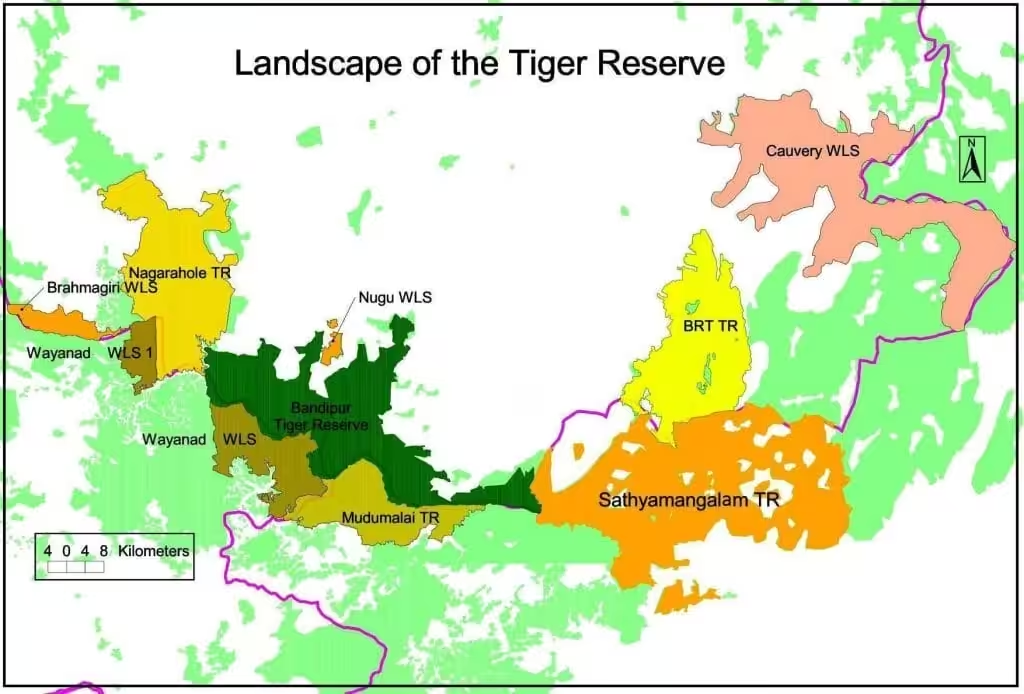
- The Bandipur Tiger Reserve is situated in the Mysore and Chamarajanagar revenue districts of southern Karnataka.
- Geographically, it is an “ecological confluence” as the western and Eastern Ghats meet and constitute this area as distinctive and extraordinary from the point of its fauna and flora.
Habitat attributes:
Flora and Fauna:
- The scrub jungle towards the eastern limits of the Park consists of stunted trees, interspersed with bushes and open grassy patches. Towards its northwestern fringes, there is a gradual shift in the vegetation from open dry deciduous forest to tropical mixed deciduous forests.
- Even during the summer, when dryness prevails over most parts of Bandipur, the backwaters of the Kabini Reservoir in the northwestern portion of the Park host huge congregations of large mammals, especially the elephant and the gaur. This unique feature makes a breathtaking spectacle, and is almost the only one of its kind in Asia.
Tiger Status:
The Bandipur tiger reserve has a high density of tiger in the Western ghats landscape, bounded by other important tiger habitats, namely Mudumalai, Waynad, Nagarahole and BRT. As per the 2010 tiger assessment, the tiger density is 11 per 100 sq.km.
Corridor
- The reserve has contiguous corridor linkages within the State with Nagarahole and BRT. Besides, it is also contiguous with tiger habitats of Kerala (Wayanad) and Tamil Nadu (Sathyamangalam, buffer areas of Mudumalai). These areas require monitoring and protection, besides fostering ecologically sustainable land uses.
Human-Animal Conflict:

- Between 2019 and 2023, elephant attacks caused nearly 2,800 deaths. In Kerala alone, between 2021 and 2024, conflicts with wildlife claimed 316 lives and injured 3,700 people. During the same period, human-tiger conflicts resulted in nearly 300 deaths, while 75 tigers died due to poaching, seizures, and other unnatural causes.
- Electrocution killed the maximum number of elephants, with Karnataka and Tamil Nadu recording the maximum deaths.
Govt. Initiatives:
- Elephant Corridors in India: 88 corridors were identified jointly by the Ministry of Environment, Forests and Climate Change and Wildlife Trust of India (WTI), and published in 2005.
- Project Elephant was launched in 1992 by the Government of India for the protection of elephants, their habitats and corridors.
Source: https://anantamias.com/current-affairs/bandipur-tiger-reserve/
SSLV Technology


Why in news:
ISRO has signed a formal agreement with Hindustan Aeronautics Limited (HAL) for the transfer of technology of Small Satellite Launch Vehicle (SSLV). This marks the 100th transfer of technology agreement facilitated by IN-SPACe (Indian National Space Promotion and Authorization Centre).
UPSC Relevance:
Achievements of Indians in science & technology
UPSC PYQ:
Q. With reference to India’s satellite launch vehicles, consider the following statements:
- PSLVs launch the satellites useful for Earth resources monitoring whereas GSLVs are designed mainly to launch communication satellites.
- Satellites launched by PSLV appear to remain permanently fixed in the same position in the sky, as viewed from a particular location on Earth.
- GSLV Mk III is a four-staged launch vehicle with the first and third stages using solid rocket motors; and the second and fourth stages using liquid rocket engines.
Which of the statements given above is/are correct?
q) 1 only
b) 3 only
c) 2 and 3
d) 1 and 2
About SSLV:
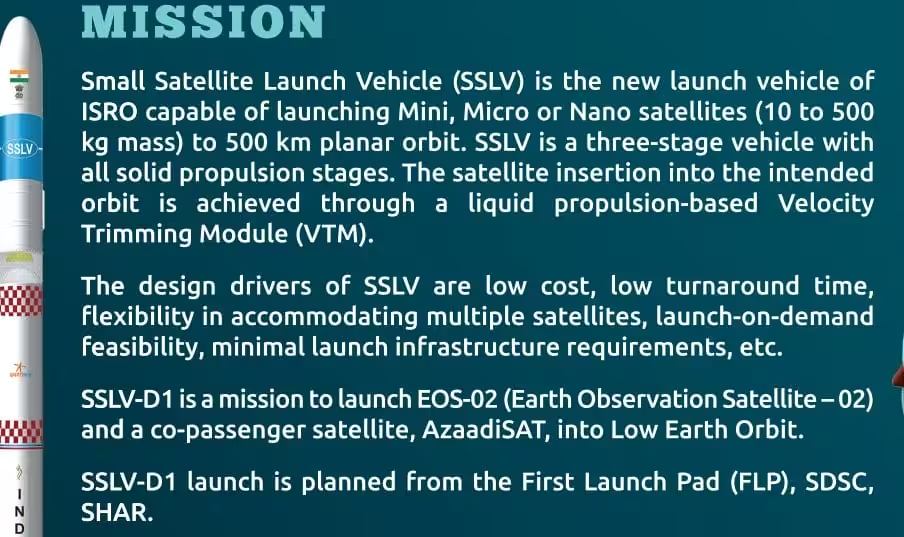
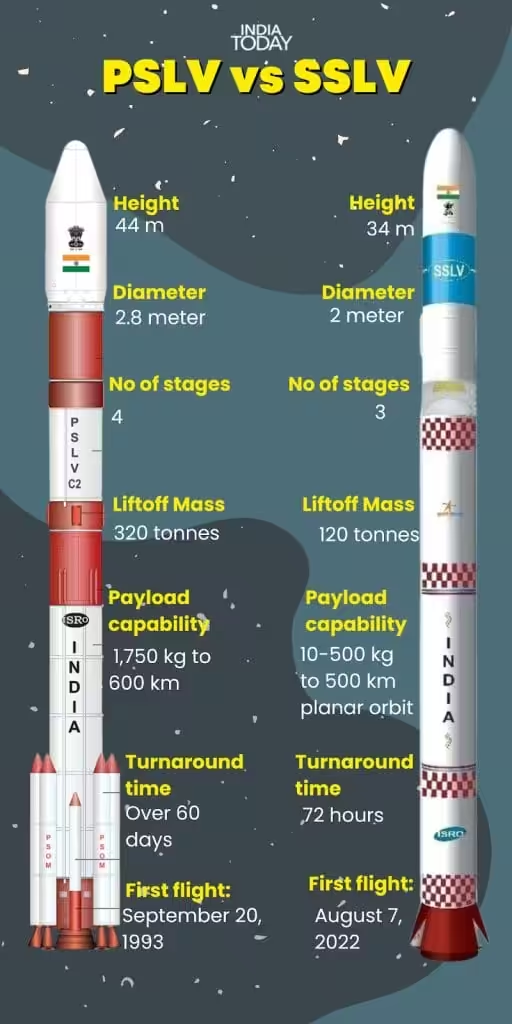
- Small Satellite Launch Vehicle (SSLV) is a 3 stage Launch Vehicle configured with three Solid Propulsion Stages and liquid propulsion based Velocity Trimming Module (VTM) as a terminal stage.
- SSLV is 2m in diameter and 34m in length with lift off weight of ~120 tonnes.
- SSLV is capable of launching ~500kg satellite in 500km planar orbit.
- The key features of SSLV are Low cost, with low turn-around time, flexibility in accommodating multiple satellites, Launch on demand feasibility, minimal launch infrastructure requirements, etc.
Terminal stage: the final engine stage that precisely maneuvers the satellite into its designated orbit after the main propulsion stages have been jettisoned.
Velocity Trimming Module (VTM):
It is the liquid-propulsion terminal stage of India’s Small Satellite Launch Vehicle (SSLV) that precisely adjusts the rocket’s velocity to accurately place a satellite into its intended orbit.
Importance :
By allowing HAL to take charge of SSLV, India is aiming to:
- Increase launch frequency and serve more customers.
- Attract international clients who need budget-friendly launches.
- Strengthen India’s position as a trusted space partner worldwide.
- ISRO can now focus more on deep space missions and new research.
- HAL will handle commercial launches and create new opportunities for private companies.
- Startups in India will benefit as they will have faster and cheaper launch options.
- This kind of industry-led growth is what makes India stand out in the global space economy.
Source: https://anantamias.com/current-affairs/sslv-technology/
India Shipbuilding by 2047

Why in news:
The Government of India has announced that with less than 1% share in global shipbuilding at present, India is aiming to be among the top 5 shipbuilding nations by 2047.
UPSC Relevance:
Infrastructure: Energy, Ports, Roads, Airports, Railways et. and Shipping Industry
UPSC PYQ 2017:
Examine the developments of Airports in India through Joint Ventures under Public-Private Partnership (PPP) model. What are the challenges faced by the authorities in this regard.
India’s maritime legacy is as vast and dynamic as its 11098-kilometer coastline, which anchors 12 major ports and over 200 minor ones. Positioned along the world’s busiest shipping routes, India is not just a key trading hub but a rising global power. In 2023, the nation contributed 16 percent of global growth, and according to some estimates, it is on course to become the third-largest economy within the next three years. As India ascends the global stage, its maritime sector emerges as a linchpin for commerce, connectivity, and international cooperation.
Industry Overview:
- Around 95% of India’s trading by volume and 70% by value is done through maritime transport. In November 2020, Hon’ble Prime Minister renamed the Ministry of Shipping as the Ministry of Ports, Shipping and Waterways.
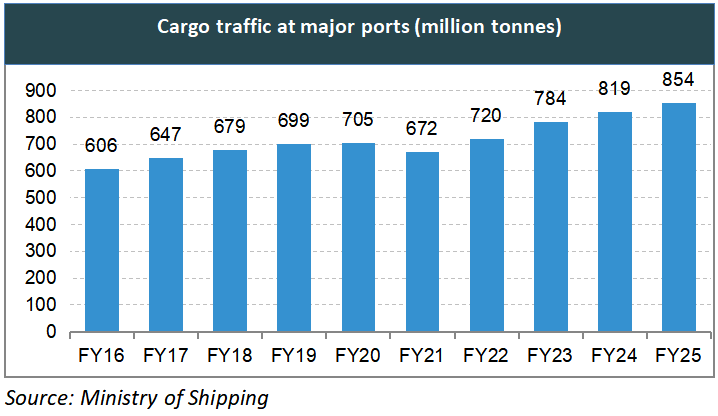
- During FY25, all key ports in India handled 853.56 million tonnes (MT) of cargo traffic compared to 819 MMT handled during FY24. Merchandise exports reached Rs. 37,34,255 crore (US$ 437.42 billion) in FY25.
- India has less than 1% share in global shipbuilding at present.
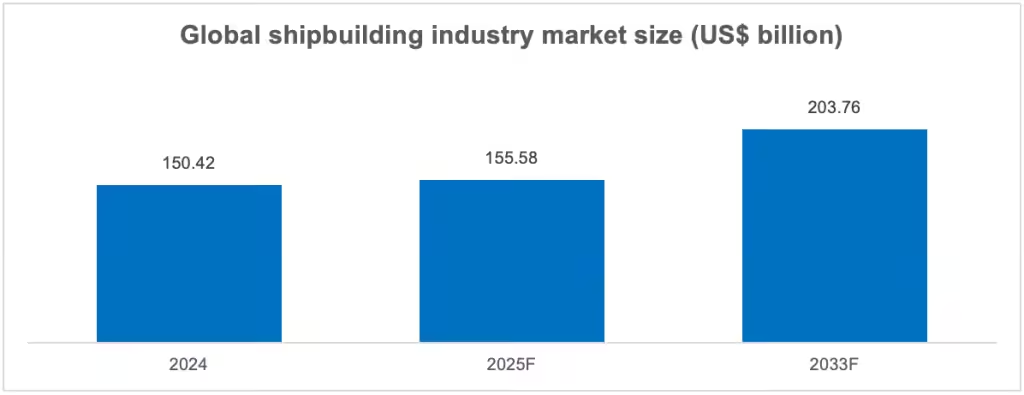
- The value of the global shipbuilding market was estimated at US$ 150.42 billion in 2024 and is projected to increase at a compound annual growth rate (CAGR) of 3.43% from US$ 155.58 billion in 2025 to US$ 203.76 billion in 2033.
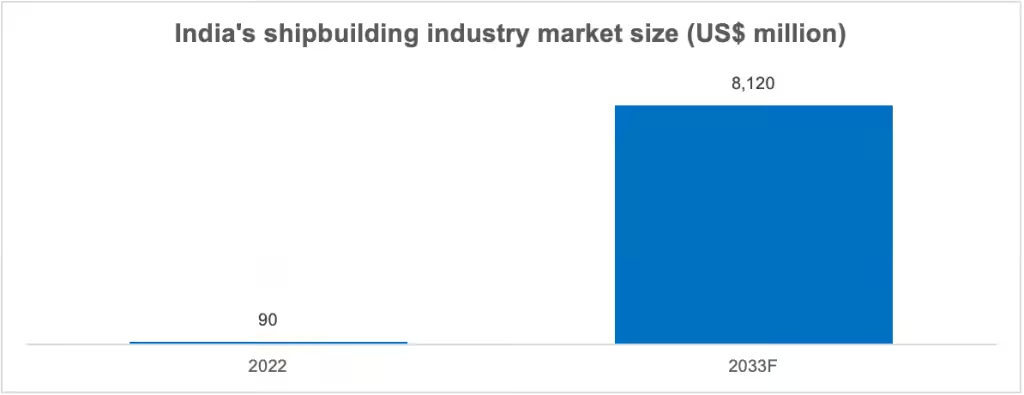
Indian Shipbuilding Market Size:
Public sector shipyards
- Cochin Shipyard Limited (CSL):India’s largest shipyard, known for building commercial vessels, defence ships, and the INS Vikrant, India’s first indigenous aircraft carrier.
- Mazagaon Dock Shipbuilders Limited (MDL): Specialises in constructing submarines, warships, and offshore patrol vessels for the Indian Navy.
- Garden Reach Shipbuilders & Engineers (GRSE): Focuses on frigates, corvettes, and patrol vessels, and has also built export ships for international clients.
- Goa Shipyard Limited (GSL): Primarily constructs offshore patrol vessels (OPVs), fast patrol boats, and interceptor boats for defence forces.
- Hindustan Shipyard Limited (HSL): Handles naval support vessels, submarines, and ship repair services.
Private sector shipyards
Shoft Shipyard and ABG Shipyard: Focus on small vessels, tugboats and support ships.
Larsen & Toubro (L&T Shipbuilding): Specialises in high-speed interceptors, defence vessels, and offshore support ships.
Reliance Naval and Engineering Limited (RNEL): Engages in naval and commercial shipbuilding, although financial issues have impacted operations.
Govt. Initiatives:
New targets set by the Govt.:
- Expand Indian seafarers’ share of the global workforce from 12% to 25%.
- Rank among the top 10 maritime nations by 2030.
- Rank among the top 5 by 2047.
- Raise maritime sector’s contribution from 4% to 12% of GDP.
- Advance from 16th position globally to 5th by 2047.
Maritime India Vision, 2030:
(i) Ministry has amended the Shipbuilding Financial Assistance Policy (SBFAP) guidelines on 29.01.2025 to encourage more participation in the shipbuilding activities.
(ii) The Government, in November, 2021, has released Standard Tug Designs of five variants for use by Major Ports for procurement of tugs to be built in Indian Shipyards.
(iii) To promote indigenous shipbuilding, the Ministry of Ports, Shipping and Waterways on 20.09.2023 has revised the hierarchy of Right of First Refusal (RoFR) to be followed in any kind of charter of a vessel which is undertaken through a tender process.
v) Government has launched the Harit Nauka guidelines for inland vessels which aim to promote the adoption of greener technologies in inland waterway vessels.
Shipbreaking Credit Note Scheme:
- Offers 40% credit on the scrap value of old ships, usable for purchasing new ‘Made in India’ vessels.
Maritime Development Fund
- Rs 25,000 crore fund created (49% government-funded), to provide long-term, low-cost financing for shipbuilding, ship repair, and infrastructure.
Source: https://anantamias.com/current-affairs/india-shipbuilding-by-2047/