Why in news:
ISRO has signed a formal agreement with Hindustan Aeronautics Limited (HAL) for the transfer of technology of Small Satellite Launch Vehicle (SSLV). This marks the 100th transfer of technology agreement facilitated by IN-SPACe (Indian National Space Promotion and Authorization Centre).
UPSC Relevance:
Achievements of Indians in science & technology
UPSC PYQ:
Q. With reference to India’s satellite launch vehicles, consider the following statements:
- PSLVs launch the satellites useful for Earth resources monitoring whereas GSLVs are designed mainly to launch communication satellites.
- Satellites launched by PSLV appear to remain permanently fixed in the same position in the sky, as viewed from a particular location on Earth.
- GSLV Mk III is a four-staged launch vehicle with the first and third stages using solid rocket motors; and the second and fourth stages using liquid rocket engines.
Which of the statements given above is/are correct?
q) 1 only
b) 3 only
c) 2 and 3
d) 1 and 2
About SSLV:
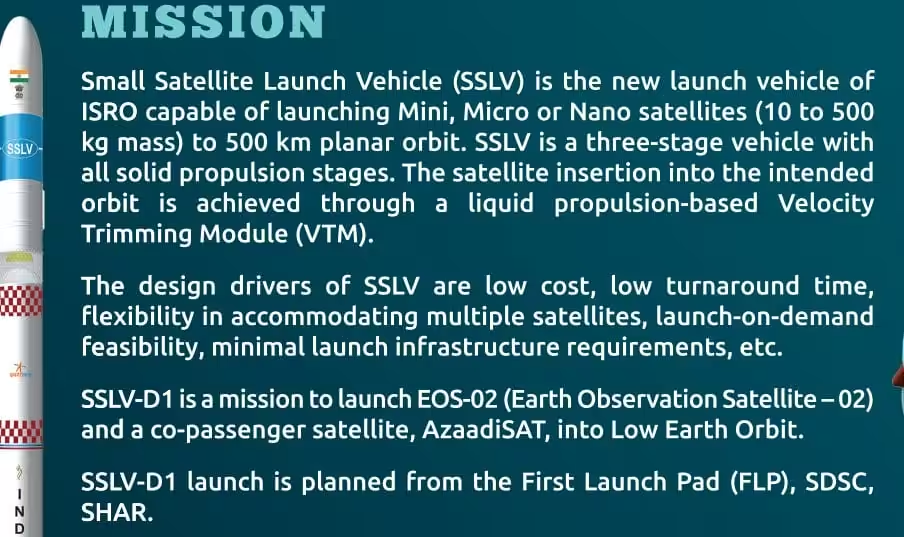
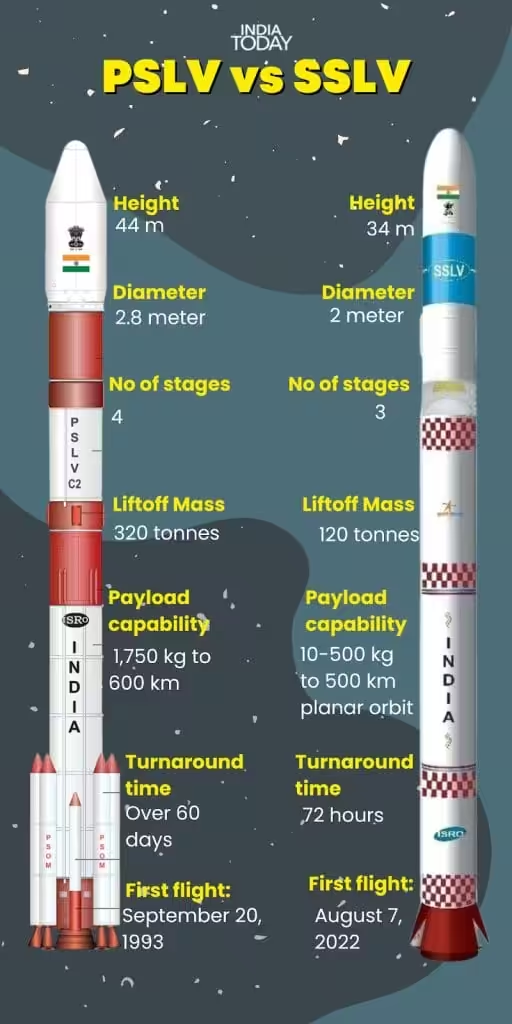
- Small Satellite Launch Vehicle (SSLV) is a 3 stage Launch Vehicle configured with three Solid Propulsion Stages and liquid propulsion based Velocity Trimming Module (VTM) as a terminal stage.
- SSLV is 2m in diameter and 34m in length with lift off weight of ~120 tonnes.
- SSLV is capable of launching ~500kg satellite in 500km planar orbit.
- The key features of SSLV are Low cost, with low turn-around time, flexibility in accommodating multiple satellites, Launch on demand feasibility, minimal launch infrastructure requirements, etc.
Terminal stage: the final engine stage that precisely maneuvers the satellite into its designated orbit after the main propulsion stages have been jettisoned.
Velocity Trimming Module (VTM):
It is the liquid-propulsion terminal stage of India’s Small Satellite Launch Vehicle (SSLV) that precisely adjusts the rocket’s velocity to accurately place a satellite into its intended orbit.
Importance :
By allowing HAL to take charge of SSLV, India is aiming to:
- Increase launch frequency and serve more customers.
- Attract international clients who need budget-friendly launches.
- Strengthen India’s position as a trusted space partner worldwide.
- ISRO can now focus more on deep space missions and new research.
- HAL will handle commercial launches and create new opportunities for private companies.
- Startups in India will benefit as they will have faster and cheaper launch options.
- This kind of industry-led growth is what makes India stand out in the global space economy.
Tell Google you want more of this.
Add Anantam IAS as a preferred sourceOne tap, and this site shows up more often in your own Top Stories, AI Overviews and AI Mode. Remove it any time.