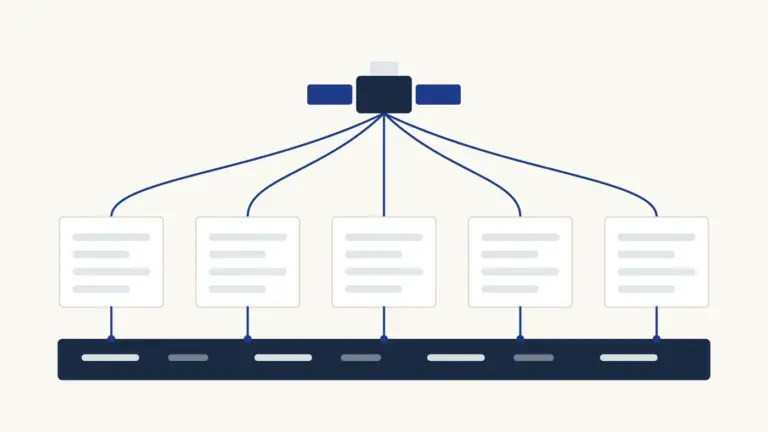
The Small Satellite Launch Vehicle (SSLV) is ISRO's newest rocket — a 34-metre, three-stage solid-propulsion launcher with a liquid Velocity Trimming Module (VTM), designed to put up to 500 kg into Low Earth Orbit (LEO). SSLV is ISRO's answer to the small-satellite constellation boom — a rocket that can be assembled in days rather than months, and launched "on demand" from lean infrastructure. For UPSC, SSLV is a GS Paper III topic on Science & Technology and the Space Economy.
Why a small-satellite launcher?
The satellite industry has shifted from a few big, exquisite birds to constellations of small satellites (100-500 kg) for earth observation, IoT, and communications.
- Starlink — 6,000+ satellites (2025).
- OneWeb — 600+ satellites.
- Amazon Kuiper — first satellites launched 2024.
- Planet Labs, BlackSky, Iceye, Spire — daily-refresh earth observation.
- Indian private — Pixxel, Digantara, GalaxEye, Dhruva Space.
For these customers, PSLV is "too big"; they need dedicated rides to targeted orbits — that is SSLV's niche.
SSLV design
| Parameter | Value |
|---|---|
| Height | 34 m |
| Diameter | 2 m |
| Lift-off mass | ~120 t |
| Payload to LEO (500 km) | 500 kg |
| Payload to Sun-Synchronous Orbit (SSO) | ~300 kg |
| Stages | 3 solid + liquid VTM |
| Fairing diameter | 2 m |
| Integration time | 72 hours (target) |
| Launch turnaround | 7-10 days |
| Manpower | ~6-person team vs ~60 for PSLV |
| Cost per launch | ~Rs 30-40 crore |
Stages
- SS1 — first stage; 87 t HTPB solid propellant.
- SS2 — second stage; 7.7 t solid.
- SS3 — third stage; 4.5 t solid.
- VTM (Velocity Trimming Module) — liquid, for precise orbit insertion.
Development timeline
- Concept approval — early 2018.
- Development cost — Rs 169 crore.
- SSLV-D1 (Aug 2022) — EOS-02 + AzaadiSAT. Payload failed to reach stable orbit due to accelerometer anomaly.
- SSLV-D2 (Feb 2023) — successful; EOS-07, Janus-1 (USA), AzaadiSAT-2 placed in LEO.
- SSLV-D3 (Aug 2024) — successful; EOS-08 placed in 475 km circular SSO.
- SSLV declared "operational" post SSLV-D3.
Commercial transfer to industry
A landmark in India's space privatisation.
- IN-SPACe and NSIL ran a transparent Technology Transfer process.
- In 2024, IN-SPACe shortlisted three consortia; in mid-2025 the selected lead integrator will produce SSLVs end-to-end under NSIL's contracts.
- ISRO retains technology IP; industry owns production.
This is conceptually similar to the US transition from Atlas/Delta government launches to SpaceX Falcon-9 commercial services — but adapted to Indian conditions.
Comparison with other small launchers
| Launcher | Payload to SSO | Status |
|---|---|---|
| SSLV (India) | 300 kg | Operational 2024 |
| Electron (Rocket Lab, USA) | 200 kg | ~40+ flights |
| LauncherOne (Virgin Orbit) | 300 kg | Retired |
| Astra Rocket | ~150 kg | Restructuring |
| Vega-C (ESA) | ~1,500 kg (LEO) | Large smallsat class |
| Firefly Alpha | 600 kg LEO | Limited flights |
| Kairos (Space One, Japan) | 150 kg LEO | 2024 failure |
| Zhuque-2 (China, LandSpace) | 4,000 kg LEO | 2023 first success |
Indian private launchers on the way:
- Skyroot Vikram-I (~480 kg SSO) — Vikram-S suborbital flown (Nov 2022).
- Agnikul Agnibaan SOrTeD — world's first single-piece 3-D printed engine, flown suborbitally May 2024.
- Bellatrix — high-specific-impulse thrusters for small satellites.
- Pixxel, Digantara, GalaxEye — payload customers.
India's space economy
- Space Policy 2023 — private end-to-end activity permitted.
- FDI liberalised (2024) — 100% in satellite manufacturing via automatic route, 74% automatic in launch vehicles.
- ~200+ Indian space startups; ~Rs 2,200 crore raised in 2023-24.
- Space economy target: USD 8 bn today → USD 44 bn by 2033 (~8% of global).
SSLV use-cases
- Earth observation constellations — daily-refresh imagery.
- IoT constellations — low-bandwidth asset tracking.
- Tech demonstration missions — university cubesats.
- Replacement satellites for LEO constellations.
- Defence smallsat launches — Defence Space Agency.
Advantages
| Advantage | Impact |
|---|---|
| Low cost | ~Rs 30-40 crore per launch |
| Rapid integration | 72 hours vs weeks |
| Launch on demand | Responsive constellations |
| Small team | Democratises launch operations |
| Export potential | Price-competitive |
| Resilience | Multiple launch sites (SDSC, new Kulasekarapattinam spaceport) feasible |
Challenges
| Challenge | Detail |
|---|---|
| Payload ceiling (500 kg) | Some constellations require more |
| Competition | SpaceX rideshare prices as low as $5,000/kg |
| Production scale-up | Private consortium must ramp to 6-10 SSLVs/year |
| Quality assurance | Solid motor variability |
| Kulasekarapattinam spaceport | Ready by 2027 |
Latest developments (2024-26)
- SSLV-D3 success (Aug 2024) — EOS-08 into 475 km SSO; flight declared fully operational.
- IN-SPACe shortlisting (2024) — consortia for SSLV production transfer; lead integrator selected 2025.
- Kulasekarapattinam (Tamil Nadu) spaceport construction (2024-27) — dedicated SSLV spaceport.
- Pixxel's Firefly commercial hyperspectral constellation launches (2024-25) booked on SSLV.
- Dhruva Space satellite platforms for SSLV.
- AI Action Summit, Paris (Feb 2025) — ISRO pitched AI-enabled earth observation leveraging smallsats.
- India Semiconductor Mission — rad-hard chips for LEO constellations.
- DeepTech Policy 2024 — space launch start-ups supported.
- National Quantum Mission (2024) — satellite QKD to ride smallsats (SSLV).
- Chandrayaan-4 plan and Gaganyaan progress — PSLV/LVM3 remain the workhorses for deep-space; SSLV focuses on LEO.
UPSC Relevance
GS Paper III — Science & Technology
- SSLV design, stages, commercial transfer.
GS Paper III — Economy
- Space start-up economy, FDI reforms, PLI-equivalent mechanisms.
GS Paper II — Governance
- IN-SPACe, NSIL, Space Policy 2023.
GS Paper III — Internal Security
- Defence smallsats; surveillance constellations.
Prelims pointers — SSLV payload (500 kg LEO), SSLV-D1 (2022 partial failure), SSLV-D2 (2023 success), SSLV-D3 (Aug 2024 success), Kulasekarapattinam, IN-SPACe, Skyroot Vikram, Agnikul Agnibaan.
Interview probes — SSLV vs global rivals; private launch ecosystem; regulatory liberalisation; launch-on-demand strategic relevance.
SSLV marks India's shift from a state-run space programme to a platform state for a private space economy. Its success is a pre-condition for the India-44 billion-dollar space dream of 2033.
Tell Google you want more of this.
Add Anantam IAS as a preferred sourceOne tap, and this site shows up more often in your own Top Stories, AI Overviews and AI Mode. Remove it any time.