Daily Digest
UPSC · Civil Services Examination
Current Affairs · Monday, 14 September 2026
Current affairs curated and edited by Anantam IAS faculty — pulled from The Hindu, PIB, IDSA, Foreign Affairs and the ministries. Read, annotate, revise.
Old Rajinder Nagar · Delhi 110005 · anantamias.com
RBI Money-Mule Draft: Temporary Debit Holds and Customer Safeguards
Why in News?
The Reserve Bank of India released its money-mule draft on September 11, 2026, proposing time-bound bank debit holds alongside safeguards for genuine account holders.
- The proposal remains a public-consultation draft; the RBI has invited comments until October 2, 2026.
- April 1, 2027 is the proposed implementation date, with earlier adoption allowed under the draft; it is not a claim that final directions already operate.
- The draft covers commercial banks and urban cooperative banks, including payments banks, small finance banks and regional rural banks.
- It follows a Supreme Court direction asking the RBI to circulate a standard operating procedure for temporary debit holds linked to money-mule activity and cyber-enabled fraud.
- A rapid debit hold can interrupt onward movement of suspected fraud proceeds, but mistaken restrictions can also interrupt legitimate payments.
- The policy question is how to combine fraud containment with reasons, review deadlines and a route for genuine customers to obtain release.
UPSC Relevance
Prelims Relevance
- Money mule account: an account used knowingly or unknowingly to receive, layer or transfer cyber-fraud proceeds for another person.
- Temporary debit hold: a restriction on outgoing use of suspected amounts or an account, pending verification.
- NCRP-CFCFRMS: the National Cybercrime Reporting Portal’s Citizen Financial Cyber Fraud Reporting and Management System.
- FIU-IND: receives suspicious transaction reports; the draft does not replace existing reporting obligations.
Mains Relevance
GS Paper 3
- Cybersecurity: disrupting financial-fraud chains through bank transaction monitoring.
- Financial inclusion: limiting collateral harm when genuine accounts trigger fraud alerts.
GS Paper 2
- Procedural safeguards: reasoned decisions, accessible complaints and time-bound coordination between banks and police.
Essay
- Accountable automation: technological suspicion should trigger review, not become a substitute for judgment.
Background and Context
What a money-mule debit hold actually does
The draft separates an account’s possible role in moving fraud proceeds from the account holder’s guilt, making verification central to the proposed restriction.
- A money mule account channels proceeds for another person, sometimes without its holder understanding the fraud. Receiving, layering and transferring describe different roles in moving money; suspicion alone does not establish knowing participation.
- A temporary debit hold restricts outgoing use while the bank verifies suspected activity. Its purpose is to interrupt movement of suspect funds, rather than to declare a criminal conviction or promise repayment to victims.
- Under the draft, the bank’s internal policy must distinguish amount-level restrictions from whole-account holds. Restricting the entire account is an exceptional last resort, helping preserve access to unrelated funds where a narrower hold suffices.
- The proposed procedure concerns holds initiated by banks themselves. A restriction placed or continued under a specific law-enforcement instruction follows that instruction; the bank-initiated timetable cannot be treated as overriding every lawful investigative direction.
- The draft excludes special-purpose accounts, including nodal, pool and escrow accounts, from this SOP. That exclusion is about this procedure’s scope; it does not establish a general exemption from anti-money-laundering or banking obligations.
How the customer and police-referral clocks work
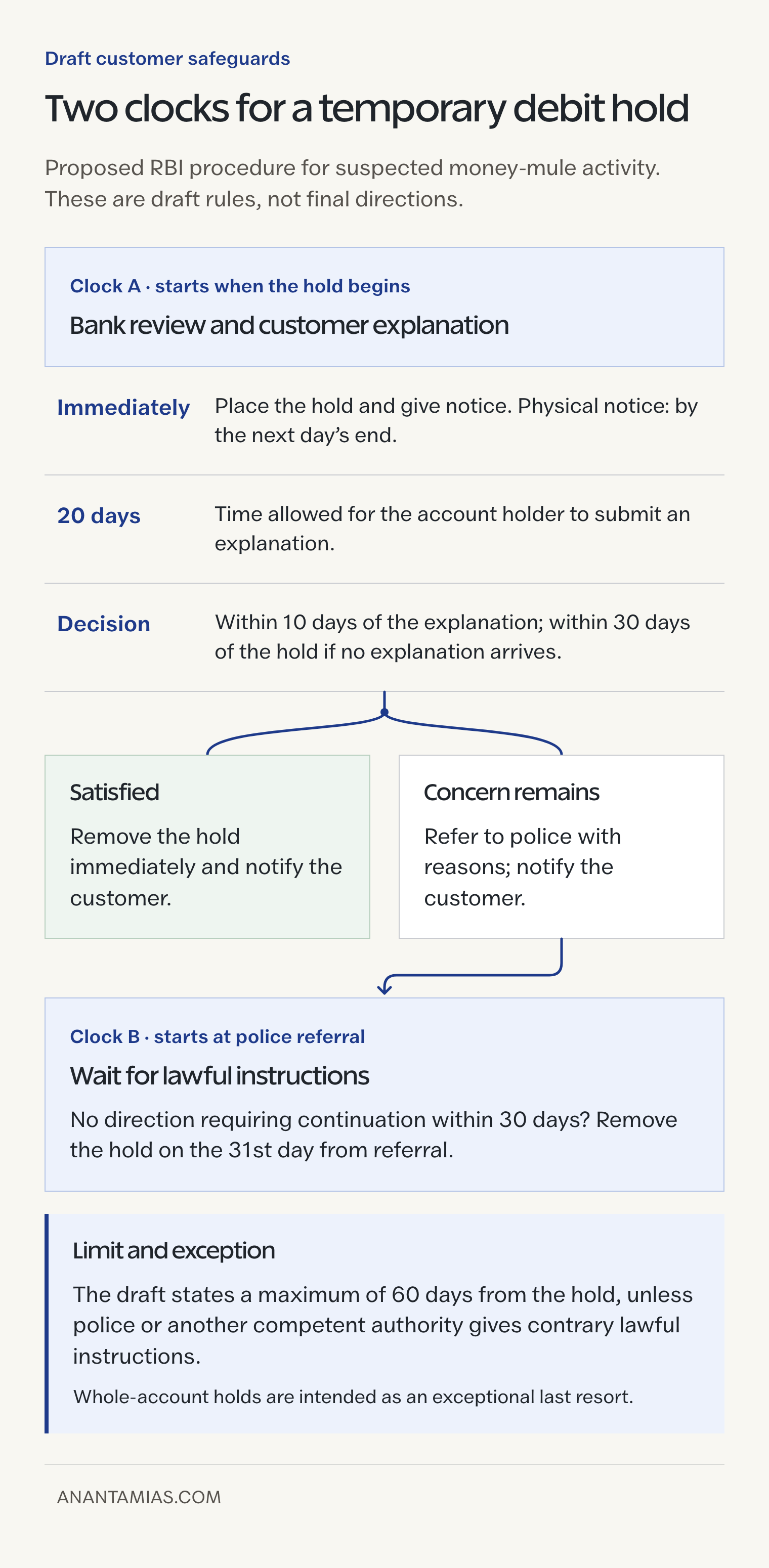
Two linked clocks begin at different events: the original hold starts customer review, while a police referral starts the period for receiving lawful instructions.
- When imposing a hold, the bank would communicate reasons, removal steps and officer contacts. Digital notice is immediate; other notice is due by the next day’s end, giving the customer a practical response route.
- The customer would receive 20 calendar days from the hold to explain the transaction or account. The bank must decide within ten days of receiving that explanation, allowing earlier resolution when a response arrives promptly.
- Without an explanation, the bank would still conduct due diligence and decide within 30 days of the hold. Silence does not authorise an indefinite restriction; satisfaction requires immediate removal and notice to the customer.
- If concerns persist, the bank would continue the hold and refer reasons to the jurisdictional police through NCRP-CFCFRMS. That referral starts a further 30-day window for a direction backed by appropriate statutory provisions.
- Without a lawful continuation direction, removal is due on the 31st day after referral. Separately, the draft states a maximum of 60 days from the initial hold absent contrary instructions; both formulations require careful implementation.
Safeguards against mistaken or indefinite restrictions
The proposal’s value depends on disciplined decisions and records, especially when automated alerts confuse unusual but legitimate activity with suspected movement of fraud proceeds.
- Banks would analyse flagged transactions using objective parameters aimed at reducing false positives. A transaction-monitoring alert starts scrutiny; treating the alert as conclusive would defeat the draft’s own requirement for explanations and due diligence.
- A central management information system would record hold dates, reasons, customer correspondence, referrals, directions and release or continuation. These linked records make it possible to check whether each deadline and decision actually occurred.
- Designated nodal officers would handle coordination and complaints, with contact details displayed on bank websites and at branches. Accessible contact information matters because a customer cannot challenge a restriction effectively without knowing who handles it.
- Existing suspicious transaction reporting to FIU-IND would continue alongside this SOP. Reporting a suspicion and deciding whether a bank-initiated hold should continue are related tasks, but neither substitutes for completing the other required process.
- The distinction is temporary containment versus final adjudication. A hold may protect an investigation, while release under the timetable prevents unsupported continuation; neither outcome alone proves guilt, innocence or recovery of every victim’s money.
Way Forward
Make time limits operational
- Configure separate hold-date and referral-date alerts so staff can distinguish the customer-review deadline from the period for lawful police instructions.
- Require a recorded justification for whole-account restrictions, including why an amount-level hold cannot adequately address the suspected activity.
- Test customer notices for usable instructions: reasons, submission channels, responsible officers and the next review step should be clear.
- Resolve the interaction between the 31st-day release wording and 60-day ceiling in final directions and implementation guidance, preventing inconsistent deadline calculations.
Conclusion
- The RBI money-mule draft offers a framework for rapid fraud containment with review, notice and limits. Its significance lies in making the bank explain and revisit a restriction rather than allowing suspicion to sustain it indefinitely.
- In an answer, evaluate proportionality and accountability together: restrict only what the risk requires, preserve a customer response route and track police directions. Keep the proposal’s consultation status separate from any claim about final enforceable rules.
UPSC Practice Questions
Prelims MCQ 1
With reference to the RBI’s draft money-mule SOP, consider the following statements:
- A money mule account may be used without its holder knowingly participating in fraud.
- Whole-account holds are proposed as the routine first response to every suspicious transaction.
- Existing suspicious transaction reporting obligations to FIU-IND would continue.
How many of the above statements are correct?
(a) Only one (b) Only two (c) All three (d) None
Answer: (b) Only two
Explanation:
Statements 1 and 3 are correct. The draft defines knowing or unknowing use and preserves reporting obligations. Whole-account holds are an exceptional last resort.
Prelims MCQ 2
Under the draft SOP, which event begins the further 30-day window for receiving lawful instructions before release is required?
(a) Publication of the RBI consultation (b) The account holder opening the account (c) Referral to the jurisdictional police authority (d) Submission of the bank’s annual report
Answer: (c) Referral to the jurisdictional police authority
Explanation:
The draft measures this further window from the date of reference to the police. It separately states a 60-day maximum from the initial hold absent contrary instructions.
UPSC Mains Questions
- How can temporary debit holds disrupt cyber-enabled financial fraud without disproportionately harming genuine customers? Discuss using the RBI’s draft safeguards.
- Examine the importance of reasoned decisions, time limits and inter-agency records in regulating automated fraud-detection systems.
Sources: Reserve Bank of India and RBI draft SOP.
Frequently Asked Questions
Is the RBI money-mule SOP already a final rule?
No. The RBI released draft amendments for public consultation on September 11, 2026. Comments are invited until October 2, 2026; April 1, 2027 is the proposed implementation date.
Does a money mule account always involve a willing participant?
No. The draft definition includes accounts used knowingly or unknowingly to receive, layer or transfer cyber-fraud proceeds for another person. A suspected transaction still requires scrutiny and appropriate verification.
Can the bank restrict the entire account?
The draft allows account-level restrictions, but requires the internal policy to make them an exceptional last resort. It distinguishes those restrictions from holding only the suspected amount pending verification.
Does the draft guarantee release after 60 days in every case?
No. Its stated 60-day maximum applies in the absence of contrary instructions from law enforcement or a competent authority. Lawful directions requiring continuation must be considered under the relevant statutory provisions.
Does lifting a temporary hold guarantee that a fraud victim recovers money?
No. Removing a temporary restriction and recovering fraud proceeds are different outcomes. The proposed SOP governs bank holds and review procedures; it does not promise recovery of every victim’s money.
Source: https://anantamias.com/current-affairs/rbi-money-mule-debit-hold-draft-safeguards/
Gujarat Bustard Recovery: Habitat, Egg Substitution and Soft Release
Why in News?
The Gujarat bustard recovery action plan, released at Bhuj on 13 September 2026, connects habitat restoration, breeding support and preparation for conditional future releases.
- The Wildlife Institute of India and Gujarat Forest Department prepared the plan for the small, isolated Great Indian Bustard population in Kachchh.
- The minister reported that a chick from egg substitution had survived beyond its first three months in the wild.
- A Soft Release Centre near Naliya has been developed for future acclimatisation of captive-bred birds from Rajasthan; eventual release requires appropriate protocols and habitat conditions.
- Breeding support can address reproductive constraints, but birds still need safe, functioning habitat after hatching or release.
- Recovery assessment must distinguish an announced plan, a reported individual survival result and a future release pathway.
UPSC Relevance
Prelims Relevance
- Great Indian Bustard: a Critically Endangered bird associated with open natural ecosystems.
- Kachchh: Gujarat landscape supporting a small, isolated population.
- In-situ conservation: protection within natural habitat.
- Ex-situ conservation: conservation outside natural habitat, including managed breeding.
- Soft release: acclimatisation before a managed return to the wild.
Mains Relevance
GS Paper 3
- Link species recovery to habitat quality, ecological connectivity and infrastructure threats.
- Evaluate assisted breeding using survival and subsequent reproduction, rather than intervention counts alone.
Essay
- Scientific intervention succeeds when the receiving ecosystem can sustain its result.
Background and Context
Why the open landscape comes first
The Great Indian Bustard needs a functioning open ecosystem; protecting a bird while degrading its surroundings leaves the underlying recovery problem unresolved.
- In-situ conservation protects the species where it naturally lives. In Gujarat, the action plan connects bustard recovery to safe, contiguous habitat rather than treating breeding facilities as a complete substitute for landscape protection.
- Kachchh’s population is described as small and isolated. This makes survival of individual birds consequential, while also showing why an encouraging chick record cannot establish that the population has become secure or self-sustaining.
- Habitat restoration includes removing invasive vegetation and managing grazing. The ecological objective is suitable open habitat, not simply a larger tree count; our grasslands guide explains this distinction for ecosystem management and restoration.
- Infrastructure-related threats and nest predators feature in the announced interventions. Recovery planning must address these pressures alongside breeding support, because increasing the supply of birds does not itself make their receiving landscape safer.
- Community participation is part of the landscape approach described in the review. The practical challenge is to align habitat management with local land use, rather than assume a breeding programme alone resolves competing demands.

Two recovery routes with different starting points
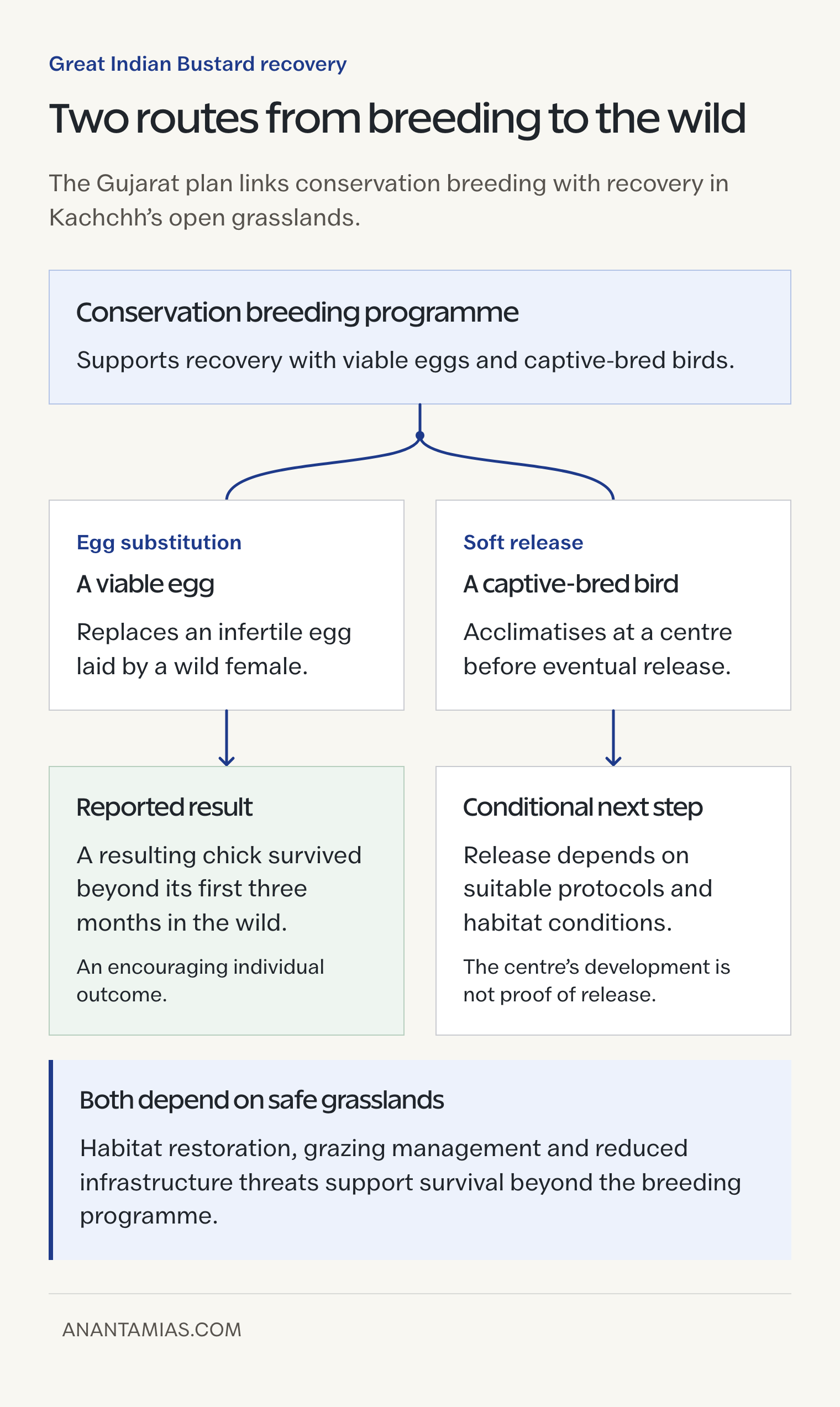
Egg substitution starts with a wild nest, whereas soft release prepares a captive-bred bird for eventual release; the distinction matters for interpreting progress.
- Egg substitution replaces an infertile egg laid by a wild female with a viable egg from the conservation breeding programme. It supports reproduction through an existing wild nesting situation rather than releasing a captive-bred adult.
- The reported outcome is a chick from the second such attempt surviving beyond three months in the wild. This is an attributed ministerial account of individual survival, not evidence of a recovered population.
- Conservation breeding supplies viable eggs for that intervention and captive-bred birds for a separate pathway. These roles connect managed breeding with wild recovery, but they should not be described as the same conservation procedure.
- Soft release introduces an acclimatisation stage before eventual release. The centre near Naliya is intended to house birds from Rajasthan, allowing preparation between captive breeding and entry into the receiving landscape under appropriate protocols.
- Current status matters: the centre has been developed, but housing, acclimatisation and eventual release are described prospectively. The announcement does not establish that captive-bred birds have already been released successfully into Gujarat’s wild population.
What would count as durable recovery?
A recovery programme needs evidence across successive stages, with habitat readiness checked before releases and population outcomes assessed beyond the first encouraging survival milestone.
- Individual survival is an early outcome, not the final conservation endpoint. Continued survival, later breeding and sustained recruitment would provide stronger evidence that assisted reproduction is contributing to a population able to persist.
- Release readiness depends on appropriate protocols and habitat conditions, according to the announcement. A completed facility demonstrates preparedness, but it cannot by itself establish that releasing birds is ecologically justified or immediately safe.
- Connected habitat is a functional requirement, not merely an area entry in a plan. The Tadoba-Indravati corridor debate similarly illustrates why conservation decisions must examine relationships across a landscape, while involving a different species.
- Monitoring should separate eggs transferred, chicks surviving, birds acclimatised and birds subsequently breeding in the wild. Combining these stages into a single success claim would hide where the programme works and where losses occur.
- The policy test is whether assisted recovery and threat reduction reinforce each other. Breeding assistance without safer habitat risks repeated losses; habitat restoration without addressing reproductive constraints may leave a small population unable to recover.
Way Forward
Match interventions to evidence
- Confirm habitat readiness and release protocols before moving from facility preparation to bird release.
- Track successive outcomes from hatching through survival and reproduction; publish stage-specific results rather than a single undifferentiated success claim.
- Coordinate landscape management with local communities, invasive-species control and infrastructure-risk reduction.
Conclusion
- Gujarat bustard recovery illustrates how in-situ habitat protection and ex-situ breeding can complement each other. Their connection is a managed conservation pathway, not a guarantee that additional eggs or captive birds will create a secure wild population.
- For an analytical answer, distinguish the released action plan, the reported chick survival and the conditional future soft-release pathway. Judge long-term success through population persistence and reproduction within habitat that remains suitable and safe.
UPSC Practice Questions
Prelims MCQ 1
With reference to Gujarat’s Great Indian Bustard recovery measures, consider the following statements:
- Egg substitution uses a viable breeding-programme egg to replace an infertile egg laid by a wild female.
- A completed soft-release centre proves that captive-bred birds have already been released into the wild.
- Safe habitat remains necessary for both egg-substitution and soft-release pathways.
How many of the above statements are correct?
(a) Only one (b) Only two (c) All three (d) None
Answer: (b) Only two
Explanation:
Statements 1 and 3 are correct. The centre prepares for future acclimatisation and conditional release; its development does not prove that release has occurred.
Prelims MCQ 2
Which outcome offers the strongest evidence of durable species recovery?
(a) Construction of a breeding facility (b) Announcement of an action plan (c) Sustained survival and reproduction in suitable wild habitat (d) Transfer of viable eggs alone
Answer: (c) Sustained survival and reproduction in suitable wild habitat
Explanation:
Facilities, plans and transfers are inputs or intermediate steps. Persistence and reproduction in the wild are stronger population-level outcomes.
UPSC Mains Questions
- Explain how in-situ and ex-situ conservation complement each other in the Great Indian Bustard recovery programme.
- Why should conservation programmes distinguish infrastructure readiness, individual survival and population recovery? Discuss with reference to Gujarat’s bustard action plan.
Source: PIB, Ministry of Environment, Forest and Climate Change.
Frequently Asked Questions
What is the Gujarat bustard recovery action plan?
It is a conservation roadmap prepared by the Wildlife Institute of India and Gujarat Forest Department. Released at Bhuj, it connects habitat restoration and threat management with breeding support for the isolated Kachchh population.
How does egg substitution help the Great Indian Bustard?
An infertile egg laid by a wild female is replaced with a viable egg from the conservation breeding programme. The intervention supports hatching in the wild; subsequent survival still depends on suitable conditions.
Have captive-bred bustards already been released from Naliya?
The announcement does not establish that releases have occurred. It says the developed centre will house and acclimatise captive-bred birds from Rajasthan, with eventual release dependent on appropriate protocols and habitat conditions.
Does one surviving chick prove population recovery?
No. A chick surviving beyond three months is an encouraging individual result. Durable recovery requires evidence of continued survival, reproduction and recruitment within habitat that can sustain the population over time.
Source: https://anantamias.com/current-affairs/gujarat-bustard-recovery-habitat-soft-release/
Moth Bean Resilience: Developmental Plasticity Under Moisture Stress
Why in News?
On 13 September 2026, ICAR-CAZRI reported that its moth bean varieties maintained growth and pod development during an approximately 35-day dry spell in Kharif 2026.
- CAZRI Moth-4, Moth-5, Moth-6 and Moth-7 were released during the preceding three years; the fresh development is their reported field performance.
- The moisture deficit overlapped with flowering and pod formation, making continued reproductive development the significant observation.
- The report also records scattered light rainfall; a prolonged dry spell should not be described as complete absence of rain.
- Rainfed farming depends on rainfall timing and stored soil moisture, not merely the seasonal rainfall total.
- Variety selection and crop management must work together if promising breeding traits are to support dependable farm production.
UPSC Relevance
Prelims Relevance
- Moth bean: a pulse crop of the hot arid regions of western Rajasthan.
- ICAR-CAZRI: Central Arid Zone Research Institute, Jodhpur.
- Developmental plasticity: flexibility in growth and maturity in response to available soil moisture.
- Subsurface soil moisture: water below the surface layer that can continue contributing to crop requirements.
- Field resilience: continued growth under stress does not by itself establish a comparative harvested-yield advantage.
Mains Relevance
GS Paper 3
- Climate-resilient agriculture: combine locally suited varieties with moisture conservation.
- Research extension: distinguish promising crop observations from demonstrated farm-level productivity gains.
Essay
- Adaptation: resilience emerges from living systems and practical management working together.
Background and Context
Why moth bean matters in arid farming
Moth bean illustrates how a locally suited pulse can remain productive in principle when rainfall is uncertain, provided usable moisture remains available.
- Moth bean is an important pulse of western Rajasthan. Its agricultural relevance comes from cultivation under hot, arid conditions where uncertain rainfall and limited soil moisture constrain the crop throughout its growth.
- ICAR-CAZRI, Jodhpur developed the reported varieties through a breeding and genetic improvement programme focused on adaptation. The September announcement concerns their recent performance, rather than the immediate release of a new cultivar.
- The central observation was continued vegetative growth and pod development during moisture stress. This is more informative than green appearance alone because it also describes progress through reproductive stages of the crop.
- The reported dry spell lasted around 35 days, with small scattered rainfall events. Use that description carefully: low rainfall, moisture stress and a completely rainless period are not interchangeable claims about field conditions.
- The crop established with early-season rainfall before the prolonged deficit. Its later performance must be understood against that starting condition; the account does not describe seed germination and growth without any available water.
How developmental plasticity and stored moisture interact
Developmental plasticity describes flexible growth timing; stored soil moisture supplies the water that allows that flexibility to remain useful under stress.
- Developmental plasticity means the varieties can adjust growth and maturity according to soil moisture availability. The useful trait is flexibility in development as conditions change, rather than one fixed growth schedule regardless of stress.
- The report describes early reproductive development alongside continued vegetative growth. Moving towards flowering while moisture remains usable can offer an adaptation advantage, but it does not remove the crop’s continuing physiological requirement for water.
- Surface soil became drier during the prolonged deficit, while moisture below it continued contributing to crop requirements. A dry-looking surface alone cannot reveal the full amount of water still available within the soil profile.
- Early canopy development, soil binding and moisture retention around the roots supported establishment. The observed response belongs to a crop growing within a managed soil environment, rather than to an isolated genetic trait.
- Rainfall distribution matters because establishment and reproductive development occur at different times. An agricultural assessment should ask when water was available and which growth stages faced shortage, alongside considering the rainfall received overall.
What management adds, and what the evidence cannot prove
The field report supports a promising adaptation example, while leaving comparative yield performance and wider farm reliability open to further testing.
- Timely sowing with monsoon onset helped establishment while moisture was available. The practical lesson is to match the sowing opportunity to local rainfall and recommended practice, rather than prescribe one calendar date everywhere.
- Weed management, suitable plant arrangement and interculture operations formed part of the reported management package. These practices belong in the explanation of field performance, rather than treating seed choice as a complete farming solution.
- The report records poor soil fertility alongside prolonged moisture stress. That context strengthens the interest in the observation, but it does not establish that every farmer’s field will reproduce the same crop response.
- Maintained pods are not the same measurement as harvested grain yield. The release supplies no randomized comparative yield results establishing the size of an advantage over other varieties under otherwise matched growing conditions.
- Drought resilience remains conditional on stress intensity, timing, soil and management. Evidence from this field setting should inform further evaluation; it cannot justify claims of drought immunity or guaranteed harvests across different agroecological conditions.
Way Forward
Test the package under farmer conditions
- Compare harvested yield and yield stability across seasons and locations, using appropriate comparator varieties and recorded soil moisture conditions.
- Pair seed delivery with locally tested sowing, weed-control and moisture-conservation advice, so adoption includes the supporting practices.
- Track farmer performance and costs before recommending large-scale expansion; distinguish seed-production intentions from demonstrated adoption or income gains.
Conclusion
- Moth bean resilience offers a useful example of developmental flexibility supported by stored soil moisture and crop management. Its value lies in showing how these factors interact under an actual reported stress period.
- In an answer on climate-resilient agriculture, connect breeding with agronomy and evidence quality: continued growth is encouraging, while dependable yield gains still require comparative measurement across relevant farming conditions.
UPSC Practice Questions
Prelims MCQ 1
With reference to the reported CAZRI moth bean performance, consider the following statements:
- Developmental plasticity involves adjustment of growth and maturity to soil moisture availability.
- Stored subsurface moisture can contribute to crop water requirements during a dry spell.
- Continued pod development by itself proves a comparative harvested-yield advantage over other varieties.
How many of the above statements are correct?
(a) Only one (b) Only two (c) All three (d) None
Answer: (b) Only two
Explanation:
The first two statements describe the reported mechanisms. Pod development is a field observation, not a substitute for comparative harvested-yield evidence.
Prelims MCQ 2
Which interpretation best reflects the reported moth bean resilience?
(a) The crop can complete its life cycle without water. (b) Genetic traits make crop management unnecessary. (c) Developmental flexibility, stored soil moisture and management jointly supported the observed response. (d) A prolonged dry spell necessarily means no rainfall at all.
Answer: (c) Developmental flexibility, stored soil moisture and management jointly supported the observed response.
Explanation:
The report links developmental plasticity with available soil moisture and management practices, and records scattered light rainfall during the prolonged dry spell.
UPSC Mains Questions
- Explain how developmental plasticity, soil moisture and crop management interact in building resilience in rainfed agriculture. Use the reported moth bean performance as an example. (150 words)
- Why should field observations of crop resilience be distinguished from proof of comparative yield gains? Suggest an evaluation approach for climate-resilient varieties. (250 words)
Source: PIB, Ministry of Agriculture and Farmers Welfare.
Frequently Asked Questions
What is developmental plasticity in moth bean?
Developmental plasticity is the ability to adjust growth and maturity according to available soil moisture. It helps explain adaptation to uncertain rainfall, while the crop still requires usable water for growth.
Were these CAZRI varieties newly released in September 2026?
No. The official report says CAZRI Moth-4 to Moth-7 were released during the preceding three years. The September update describes their field performance under moisture stress during Kharif 2026.
Did the moth bean crop experience absolutely no rain?
The report describes an approximately 35-day dry spell but also records scattered light rainfall. The careful description is a prolonged period without substantial rainfall, rather than a completely rainless period.
Does continued pod development prove higher yield?
No. Continued pod development indicates reproductive activity under stress. Establishing higher harvested yield requires suitable comparisons and measurements; the release does not provide randomized comparative yield evidence for that conclusion.
Why does crop management matter for drought resilience?
Timely sowing, appropriate plant arrangement, weed management and moisture conservation supported the reported response. The variety’s potential depends partly on growing conditions, so seed selection cannot replace the supporting management package.
Source: https://anantamias.com/current-affairs/cazri-moth-bean-developmental-plasticity-drought/
Philippines and CDRI: Disaster Resilience Through Infrastructure Cooperation
Why in News?
India welcomed the Philippines’ decision to join CDRI during a bilateral meeting in New Delhi on 13 September 2026, linking cooperation with disaster-resilient infrastructure.
- CDRI stands for the Coalition for Disaster Resilient Infrastructure.
- The Prime Minister’s Office reported the Philippines’ decision to join; the release does not establish completed accession formalities or a funded construction project.
- The meeting placed cooperation within the India-Philippines Strategic Partnership, established in August 2025.
- Infrastructure resilience concerns whether essential services can withstand disruption and recover, not simply how much new construction is undertaken.
- International cooperation can improve technical knowledge and risk governance, while implementation still requires decisions by infrastructure owners and public authorities.
UPSC Relevance
Prelims Relevance
- CDRI: Coalition for Disaster Resilient Infrastructure.
- Scope: resilience of infrastructure systems to climate and disaster risks.
- Participation: governments, international institutions, financing bodies, businesses and knowledge institutions.
- Service continuity: maintaining or restoring essential functions during disruption.
- Cascading failure: disruption spreading through connected infrastructure systems.
Mains Relevance
GS Paper 2
- Assess practical cooperation under the India-Philippines Strategic Partnership.
- Distinguish a coalition-participation announcement from binding project commitments.
GS Paper 3
- Explain infrastructure interdependence, maintenance and disaster-risk reduction.
Essay
- Resilience is measured by services that continue when normal conditions fail.
Background and Context
What CDRI cooperation can contribute
CDRI brings infrastructure and disaster risk into the same policy conversation, creating opportunities for learning before damaged assets interrupt essential services during an emergency.
- The coalition connects national governments with international organisations, financing institutions, businesses and knowledge institutions. Its infrastructure focus gives different participants a common problem: reducing vulnerability across systems that societies depend on for everyday services.
- Knowledge cooperation can help authorities compare risk-assessment methods, design choices and maintenance practices. The useful output is an improvement in decisions about real assets, rather than participation being treated as sufficient proof of resilience.
- Capacity building matters because a technical recommendation must be understood by planners, engineers and operators before it can change practice. Cooperation becomes useful when institutions can apply shared knowledge to their own infrastructure constraints.
- Risk governance connects technical evidence with responsibilities and decisions. A hypothetical exposed bridge needs an accountable owner, inspection arrangements and a repair strategy; exchanging engineering knowledge does not remove these domestic implementation requirements.
- The announcement is a decision to join CDRI, welcomed by India. It should not be rewritten as proof of completed accession, a new construction contract or automatic financing for a particular Philippine infrastructure project.
Why service continuity is the real test
A road, power line or hospital matters because of the service it enables; resilience asks what happens to that service when a hazard disrupts operations.
- Consider a coastal road: it may connect settlements with hospitals, markets and evacuation routes. Its resilience depends on whether those connections remain usable or can be restored, not only whether the road surface survives.
- Interdependence changes the analysis. In an illustrative storm scenario, a hospital building may remain intact while damaged access roads delay supplies and electricity failure disrupts equipment; strengthening one asset alone leaves other service dependencies exposed.
- Redundancy means providing a workable alternative when a component fails. An alternate access route or backup electricity can support continuity, but its usefulness depends on capacity, availability and whether the same hazard disables it.
- Maintenance and recovery planning should accompany construction. A drainage channel that is blocked, or backup equipment that cannot operate, can undermine an apparently sound design; operating arrangements need scrutiny alongside the physical structure itself.
- Health infrastructure illustrates this systems approach particularly clearly: beds require power, water, supplies and staff access. Our PM-ABHIM explainer discusses the linked institutional and service requirements behind functioning public-health capacity rather than treating buildings as outcomes.

Resilience, relief and diplomacy are different claims
The new cooperation hook concerns infrastructure resilience; keeping it distinct from disaster relief and defence avoids overstating what the bilateral announcement actually establishes.
- Emergency relief addresses urgent needs during and after a disaster. Infrastructure resilience also concerns decisions made beforehand, including where assets are placed, how they are maintained and how essential functions can continue under stress.
- Preparedness learning can connect the two: disruptions reveal weak links that future investment should address. The NIDM disaster-review approach explains how lessons from actual incidents can inform readiness, rather than remain isolated reports after an emergency.
- Defence cooperation appeared elsewhere in the bilateral discussion, but that does not make CDRI a military alliance. Each initiative should be interpreted through its stated purpose instead of transferring claims between separate parts of diplomacy.
- Project delivery would require further evidence of what is planned, who is responsible and how it is financed. The current statement establishes the participation decision; it does not identify a funded project or construction schedule.
- Policy evaluation should follow the chain from shared knowledge to implemented changes and more reliable services. Fewer disruptions or faster restoration would be more meaningful outcomes than the number of meetings or cooperation announcements alone.
Way Forward
Turn cooperation into operational improvements
- Map service dependencies before selecting projects, including transport, electricity, water and communications links.
- Assign operating responsibilities alongside engineering upgrades, with maintenance funding and workable restoration arrangements.
- Track service outcomes such as interruption and restoration, while distinguishing proposed cooperation from approved and implemented projects.
Conclusion
- The Philippines’ CDRI decision gives India-Philippines cooperation a practical infrastructure-resilience dimension. Its value will depend on whether technical exchange helps authorities and operators protect essential services against disruption and restore them effectively when failures occur.
- For an analytical answer, move from the physical asset to the service it supports, then identify connected systems and implementation responsibilities. Preserve the distinction between a decision to join, a financed project and demonstrated resilience.
UPSC Practice Questions
Prelims MCQ 1
With reference to disaster-resilient infrastructure, consider the following statements:
- Service continuity depends only on whether the main physical structure survives.
- Failure of one infrastructure system can disrupt another dependent system.
- CDRI cooperation is concerned with climate and disaster risks to infrastructure.
How many of the above statements are correct?
(a) Only one (b) Only two (c) All three (d) None
Answer: (b) Only two
Explanation:
Statements 2 and 3 are correct. Services also depend on access, supplies, utilities, operators and other connected systems.
Prelims MCQ 2
What does the September 2026 bilateral statement establish about the Philippines and CDRI?
(a) A funded coastal-bridge construction contract (b) Completed construction of a new emergency network (c) India welcomed the Philippines’ decision to join CDRI (d) A new military mutual-defence obligation
Answer: (c) India welcomed the Philippines' decision to join CDRI
Explanation:
The official statement reports the decision to join. It does not establish the other commitments or outcomes.
UPSC Mains Questions
- Explain why service continuity is a better test of infrastructure resilience than the survival of an individual asset.
- Discuss how India-Philippines cooperation through CDRI can support disaster-risk reduction. Distinguish institutional cooperation from project delivery.
Sources: PIB, Prime Minister's Office and Coalition for Disaster Resilient Infrastructure.
Frequently Asked Questions
What is CDRI?
CDRI is the Coalition for Disaster Resilient Infrastructure, a partnership focused on infrastructure resilience to climate and disaster risks. Its work brings together technical knowledge, capacity building and risk-governance approaches.
What did the Philippines announce about CDRI?
The bilateral statement says India welcomed the Philippines’ decision to join CDRI. It does not establish completed accession formalities, a funded construction contract or an operational infrastructure project resulting from that decision.
How is infrastructure resilience different from emergency relief?
Emergency relief addresses immediate needs during or after a disaster. Infrastructure resilience also involves advance planning, design, maintenance and recovery arrangements that help essential services withstand disruption and resume functioning.
Why can an undamaged hospital still stop functioning?
A hospital depends on electricity, water, equipment, supplies, communications and access for staff and patients. Failure in these connected systems can interrupt healthcare even if the hospital building itself remains intact.
Source: https://anantamias.com/current-affairs/philippines-cdri-disaster-resilient-infrastructure/
US Hydraulic-Cylinder Probes: Dumping, Subsidies and Injury Tests
Why in News?
US hydraulic-cylinder investigations involving India appear in official notices filed for public inspection on September 11, 2026, with Federal Register publication scheduled for September 14.
- Both notices state an applicable date of September 8, 2026; filing for public inspection and scheduled publication are separate events.
- The antidumping investigation covers the specified products from Canada, China, India, the Republic of Korea and Mexico.
- The parallel countervailing-duty investigation covers China, India and Mexico; Canada and Korea appear only in the antidumping notice.
- These are initiation notices, not final dumping, subsidy or injury determinations and not final duty orders.
- For Indian manufacturers, a product-specific investigation can create evidence and compliance demands even before any final remedy is decided.
- The distinction between pricing, government support and injury prevents a trade investigation from being misread as a blanket tariff on all exports from a country.
UPSC Relevance
Prelims Relevance
- Antidumping: examines sales at less than fair value through the relevant price comparison.
- Countervailing duty: concerns imports benefiting from countervailable subsidies.
- US Department of Commerce: investigates dumping and countervailable subsidies.
- US International Trade Commission: examines material injury or its threat to the domestic industry.
- Product scope: the written description determines which goods the investigation covers.
Mains Relevance
GS Paper 3
- External trade: export competitiveness and evidence-based responses to trade-remedy proceedings.
- Industrial policy: distinguish allegations about government support from established countervailable subsidies.
GS Paper 2
- International economic relations: specialised administrative investigations alongside wider bilateral trade relations.
Essay
- Fair competition: a credible remedy needs a defined harm and an evidentiary process.
Background and Context
The product and the boundaries of the investigation
A hydraulic cylinder is a linear actuator using pressurised fluid to move a piston and rod; the notice covers only a defined product category.
- The covered category is certain linear hydraulic cylinders and parts, including specified steel barrels and piston rods. The wording matters: this proceeding concerns defined industrial goods, not every hydraulic component or every Indian engineering export.
- The scope can include a cylinder attached to machinery, but the notice specifies that only the cylinder is covered in that situation. Inclusion of one component does not automatically bring the entire machine within scope.
- The notices list customs tariff classifications for convenience, while making the written product description decisive. Matching a code alone is an incomplete coverage test; physical characteristics and the stated inclusions and exclusions must also be checked.
- Commerce flags an unresolved question about the administrability of some steel-barrel scope language. It adopted that wording for initiation while inviting comments and allowing possible clarification, showing that coverage details remain open to examination.
- A country-and-product-specific probe differs from an across-the-board tariff announcement. These notices identify particular merchandise and origins, so their existence cannot support a claim that every import from India faces a new duty.

Dumping, subsidies and injury ask different questions
The US system divides the investigation between Commerce and the International Trade Commission, preventing different legal questions from being compressed into one accusation.
- For antidumping, Commerce examines whether goods are sold in the United States at less than fair value. The notice compares export price with normal value, using adjustments and product comparisons rather than a cheapness test.
- For India, the petition’s normal-value allegation uses home-market pricing information from market research. Those inputs support initiation; they are not a final verified dumping finding or a duty rate that exporters must already pay.
- The countervailing-duty inquiry examines whether the covered imports benefit from countervailable government subsidies. It asks a different question from the price comparison, so starting both proceedings does not merge their evidence or establish either allegation.
- The US International Trade Commission examines whether the imports materially injure, or threaten material injury to, the US industry. Its injury assessment is separate from Commerce’s dumping or subsidy inquiry and concerns the relevant domestic industry.
- The petitions cite lost sales, price pressure and weaker performance as evidence of alleged harm. These remain allegations here; checking their link to the investigated imports matters, rather than assuming every business loss proves injury.
Why initiation is an intermediate procedural step
Accepting a petition for investigation means the initiating requirements were met, while the contested economic claims still require examination through the relevant proceedings.
- Commerce assessed domestic-industry support before initiating these investigations, including polling producers. Establishing adequate support answers who may bring the petition; it does not independently prove dumping, a countervailable subsidy or injury from the imports.
- The notices describe preliminary determinations as subsequent stages in the investigations. Initiation begins a process with evidence gathering and responses; it should not be reported as the completed assessment or the imposition of a final remedy.
- A negative preliminary injury determination for a country would terminate the relevant investigation for that country, according to the notices. This illustrates why the injury inquiry is an operative safeguard rather than merely a procedural formality.
- Interested parties can address product coverage and factual evidence through the prescribed proceedings. Commerce requires accuracy and completeness certifications for factual submissions, making a documented record more useful than a general assertion that exports are competitive.
- The response is case-specific preparation: identify covered products and preserve usable transaction and support records. The notices do not establish a final cost increase for buyers, an export collapse or a proven violation by India.
Way Forward
Prepare evidence before drawing conclusions
- Map the written product scope against actual goods and components, including any machinery attachments, before estimating commercial exposure.
- Keep pricing and government-support records distinct because antidumping and countervailing inquiries ask different questions.
- Follow the Commerce and USITC proceedings separately, identifying which issue each determination actually resolves.
- Use verified procedural status in public communication: allegation, initiation, preliminary determination and final order are not interchangeable descriptions.
Conclusion
- The hydraulic-cylinder investigations offer a concrete way to distinguish price discrimination, countervailable government support and domestic-industry injury. India’s inclusion in both proceedings identifies exposure to scrutiny, while leaving the contested findings to the investigation process.
- For an exam answer, connect trade defence with evidentiary discipline: define the product, identify the investigating authority and separate each legal test. Avoid treating an initiation notice as proof of wrongdoing or as an already imposed final tariff.
UPSC Practice Questions
Prelims MCQ 1
With reference to the US hydraulic-cylinder initiation notices, consider the following statements:
- India is included in both the antidumping and countervailing-duty investigations.
- Canada and the Republic of Korea are included in both investigations.
- The notices themselves constitute final duty orders.
How many of the above statements are correct?
(a) Only one (b) Only two (c) All three (d) None
Answer: (a) Only one
Explanation:
Only statement 1 is correct. Canada and Korea appear in the antidumping notice, not the parallel countervailing-duty notice. Initiation is not a final duty order.
Prelims MCQ 2
Which institution examines material injury or threat of material injury to the domestic US industry in these proceedings?
(a) Reserve Bank of India (b) US International Trade Commission (c) International Monetary Fund (d) UN Conference on Trade and Development
Answer: (b) US International Trade Commission
Explanation:
The USITC examines domestic-industry injury. Commerce separately investigates sales at less than fair value and countervailable subsidies.
UPSC Mains Questions
- Distinguish antidumping and countervailing-duty investigations. Why is a separate assessment of domestic-industry injury important?
- How should Indian engineering exporters respond to product-specific trade-remedy investigations without assuming that initiation is a final adverse determination?
Sources: US Department of Commerce, antidumping initiation notice and US Department of Commerce, countervailing-duty initiation notice.
Frequently Asked Questions
Have these notices imposed final duties on Indian hydraulic cylinders?
No. The notices initiate investigations; they are not final duty orders. They identify allegations for examination and outline subsequent stages, rather than establishing final dumping, subsidy or injury findings.
How is antidumping different from a countervailing-duty investigation?
Antidumping examines sales at less than fair value through a price comparison. A countervailing-duty investigation examines whether covered imports benefit from countervailable government subsidies. The two inquiries require different evidence.
Are all hydraulic products from India covered?
No. The investigations concern certain linear hydraulic cylinders and specified parts. Their written product descriptions contain relevant inclusions and exclusions; the notices do not announce a remedy against every hydraulic or engineering product.
Does Commerce decide the injury question as well?
The US International Trade Commission separately examines material injury or its threat to the domestic industry. Commerce’s dumping and subsidy investigations do not replace that assessment in these proceedings.
What is the correct date sequence for these notices?
Both state September 8, 2026 as the applicable date. They were filed for public inspection on September 11, with Federal Register publication scheduled for September 14; these are distinct procedural dates.
Source: https://anantamias.com/current-affairs/hydraulic-cylinder-us-trade-remedy-investigations/
Charged Water Droplets: How Electrical Breakdown Damages Coatings
Why in News?
An 11 September 2026 Max Planck Society release highlighted research showing that charged water droplets can electrically damage protective coatings and enable corrosion of underlying metal.
- The study by Ni and colleagues appeared online in Nature on 26 August; the September research release explains the findings to a wider audience.
- In the reported comparison, 3,000 charged-droplet impacts produced visible microscopic changes, while the same number of uncharged impacts left the test coating apparently unchanged.
- The work identifies an electrical failure mechanism; it does not announce a commercially available coating that prevents it.
- Protective coatings shield metals from their surroundings, so microscopic defects can matter even before damage becomes obvious to the eye.
- Understanding how a barrier fails helps researchers design relevant durability tests instead of checking only resistance to abrasion or chemical attack.
UPSC Relevance
Prelims Relevance
- Contact electrification: charge separation associated with contact between materials.
- Sliding electrification: water droplets can acquire charge while moving over insulating surfaces.
- Dielectric breakdown: an insulating material locally fails under a sufficiently strong electric field.
- Corrosion: material degradation; metal corrosion can follow loss of a protective barrier.
- Experimental control: the uncharged-droplet comparison helps distinguish charge-related damage from impact alone.
Mains Relevance
GS Paper 3
- Materials research: improve the durability of protective coatings through mechanism-based testing.
- Technology assessment: distinguish controlled laboratory findings from established effects on infrastructure in service.
Essay
- Invisible causes, visible consequences: careful experiments can reveal overlooked sources of material failure.
Background and Context
What the researchers compared
The decisive comparison separated ordinary droplet impact from impact after the droplet had acquired electrical charge by sliding across another surface.
- Protective coatings act as barriers between metal and the external environment. Familiar explanations for their deterioration include mechanical wear from moving droplets and chemical degradation caused by substances carried within the water.
- The researchers examined Teflon-coated copper as a test system. Choosing a chemically robust coating helped investigate whether a different route to damage could operate, rather than assuming chemical resistance guarantees protection against every stress.
- Uncharged droplets fell directly onto the coated sample. After 3,000 impacts, microscopy showed no notable change in surface morphology, providing a reference against which to examine the effect of charged drops.
- Other droplets first slid over surfaces including a plant leaf and plastics, acquired charge and then struck the coating. The researchers observed microscopic damage in the coating and underlying metal after the repeated impacts.
- The primary evidence concerns controlled laboratory samples and observed damage. It supports an additional mechanism of coating failure, rather than establishing that a particular bridge, vehicle or household object has already failed this way.

From sliding electrification to barrier failure
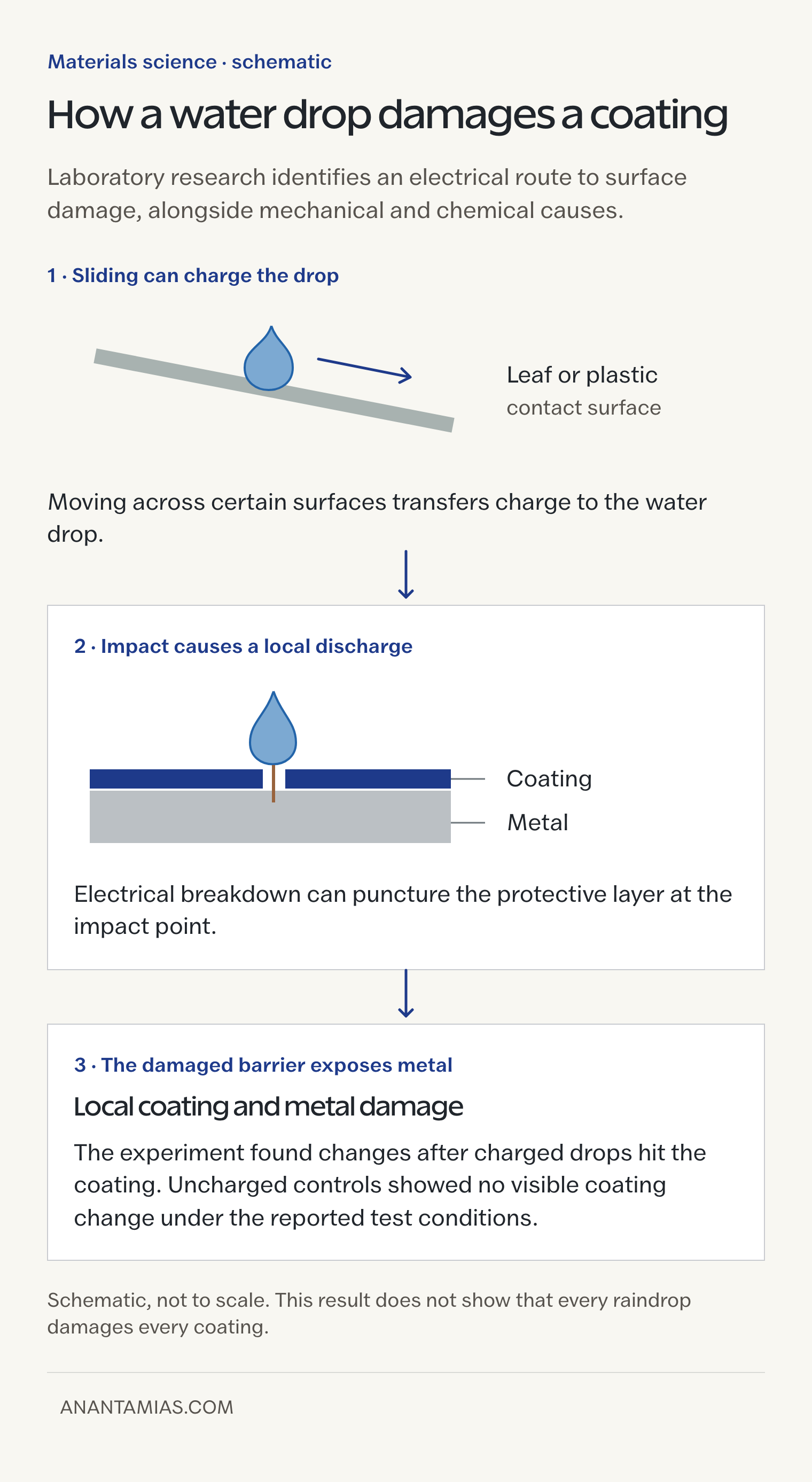
An electrically insulating coating can resist some chemical attack yet still fail locally when the electric field generated by a charged droplet becomes sufficiently strong.
- Sliding electrification occurs as water moves over a surface and charge separates between them. The droplet can leave carrying electrical charge; the amount acquired depends on the material and the conditions of contact.
- When that charged droplet approaches coated metal, its charge creates a local electric field. The study connects sufficiently strong fields with failure of the insulating layer, rather than treating water impact as purely mechanical.
- Dielectric breakdown means the insulating barrier locally loses its ability to withstand the field. Electrical discharge can puncture the coating at small sites, creating defects that compromise its original protective function.
- Once the barrier is breached, the underlying metal can become exposed to the water and its dissolved substances. The experiment links damage to the coating with subsequent corrosion of the metal beneath it.
- The causal sequence is charge acquisition, local breakdown and barrier damage. Its significance is that an electrical event can initiate failure; it does not imply that ordinary chemical or mechanical corrosion pathways cease to matter.
What the finding changes, and what remains uncertain
The result widens the questions asked during coating design, while practical significance still depends on the material system and its exposure conditions.
- The uncharged control matters because both comparisons involve water contacting a coated surface. The difference in observed damage makes electrical charging relevant to the explanation, instead of attributing every defect simply to repeated wetting.
- Coating properties and droplet charge influence electrical stress and breakdown. A result on specified laboratory materials cannot be treated as a universal rule that every raindrop penetrates every outdoor coating upon contact.
- The researchers identify possible relevance to buildings, vehicles and other exposed metal components. These are potential application areas for further investigation, not measured estimates of damage or replacement costs in those sectors.
- Stronger anticorrosion strategies may need to consider resistance to charge-induced damage alongside established stresses. The paper provides a research direction; it does not demonstrate a finished protective product ready for general deployment.
- The use of Teflon in an experiment specifies the tested coating, not a finding about consumer health. These results do not establish food contamination, human exposure or health outcomes associated with household cookware.
Way Forward
Translate the mechanism into relevant durability tests
- Test commercially relevant coatings under controlled charged and uncharged exposure while recording material properties, coating thickness and water composition.
- Combine laboratory work with field measurements to determine where naturally charged droplets materially contribute to damage during actual service.
- Assess proposed solutions against electrical, chemical and mechanical stresses before claiming improved lifetime or reduced maintenance requirements.
Conclusion
- Charged water droplets add an electrical route to the explanation of coating failure: sliding can charge the drop, local breakdown can puncture the barrier, and exposed metal can subsequently corrode under the tested conditions.
- For a science answer, connect the mechanism with the control experiment, then state its limit. Laboratory evidence establishes a credible pathway, while the scale of its contribution to real-world deterioration requires further investigation.
UPSC Practice Questions
Prelims MCQ 1
With reference to charged water droplets and protective coatings, consider the following statements:
- A water droplet can acquire charge while sliding across an insulating surface.
- Dielectric breakdown can create defects in an electrically insulating coating.
- The study establishes that every raindrop destroys every protective coating.
How many of the above statements are correct?
(a) Only one (b) Only two (c) All three (d) None
Answer: (b) Only two
Explanation:
The first two describe the reported mechanism. Breakdown depends on the experimental material system and electrical conditions; the universal claim in the third statement is unsupported.
Prelims MCQ 2
What is the main purpose of comparing charged droplets with uncharged droplets in this study?
(a) To prove that all forms of corrosion are electrical. (b) To distinguish charge-related coating damage from the effect of water impact alone. (c) To establish the health effects of cookware. (d) To show that insulating materials never conduct under any circumstances.
Answer: (b) To distinguish charge-related coating damage from the effect of water impact alone.
Explanation:
The uncharged-droplet comparison provides a reference for interpreting damage after charged-droplet impacts. It supports examining electrical charge as a relevant cause under the test conditions.
UPSC Mains Questions
- Explain how sliding electrification of water droplets can contribute to coating failure and metal corrosion. Why is the control experiment important? (150 words)
- Discuss how an improved understanding of material failure mechanisms can inform infrastructure durability. Distinguish laboratory evidence from field-level validation. (250 words)
Sources: Max Planck Society and Nature, Ni et al..
Frequently Asked Questions
How do water droplets become electrically charged?
Water droplets can acquire charge while sliding across surfaces such as leaves and plastics. This contact or sliding electrification separates charge, and the amount acquired depends on the particular surface and conditions.
What is dielectric breakdown of a coating?
Dielectric breakdown occurs when an insulating coating can no longer withstand a sufficiently strong electric field at a location. Local damage can create a defect through which the barrier loses its protective function.
What did the uncharged-droplet comparison show?
Under the reported test conditions, the coating showed no notable microscopic surface change after 3,000 uncharged impacts. Charged impacts produced damage, supporting investigation of electrical charging as a cause rather than impact alone.
Does this prove that rain rapidly destroys bridges?
No. The study demonstrates a mechanism in controlled experiments and identifies possible relevance to exposed metal structures. Its contribution to the deterioration of actual bridges requires field evidence under relevant conditions.
Has the research produced a new commercial anticorrosion coating?
The reported work identifies a previously overlooked mechanism and suggests directions for improved protection. It does not announce a commercially available coating proven to prevent this form of damage in general use.
Source: https://anantamias.com/current-affairs/charged-water-droplets-coating-corrosion/
AI in Mathematics: Proof Verification, Understanding and Research Ethics
Why in News?
On 11 September 2026, Fields medallists issued a joint declaration warning that benchmark-driven AI in mathematics could undermine conceptual understanding, scholarly attribution and the training of researchers.
- Published on Terence Tao’s blog, the declaration argues that solving famous problems should advance understanding rather than become the discipline’s overriding objective.
- The signatories also recognise AI’s potential to accelerate mathematical study; their concern focuses on incentives and the human decisions shaping its use.
- An Indian Express explainer places the declaration alongside debates about proof verification, researchers’ data and credit; disputed allegations do not establish misconduct.
- Correctness and understanding answer different questions: whether an argument follows, and what it explains or enables others to learn.
- Research ethics includes permission to use material, acknowledgement of contributions and accountability for claims, alongside protection of personal identifiers.
UPSC Relevance
Prelims Relevance
- Formal verification: checking a formal argument against specified assumptions and inference rules.
- Proof assistant: software used to express and check mathematical arguments, with Lean as an example.
- Conceptual understanding: explaining why a result holds and connecting its methods to other questions.
- De-identification: removal or alteration of identifying information, distinct from permission or scholarly credit.
- Research attribution: acknowledgement of relevant prior work and intellectual contributions.
Mains Relevance
GS Paper 4
- Integrity and fairness: credit, informed consent and responsibility in AI-assisted research.
- Conflicting incentives: performance metrics can pull institutions away from their stated purpose.
GS Paper 3
- Scientific innovation: combine computational assistance with verification, explanation and researcher development.
Essay
- The purpose of knowledge: producing an answer and learning to ask better questions are connected but distinct achievements.
Background and Context
Why the declaration questions research incentives
The signatories frame mathematical research as a shared effort to build understanding, with solved problems serving as evidence of progress rather than its sole purpose.
- The declaration argues that mathematical ideas develop through explanation: researchers discuss results, simplify arguments and connect methods to earlier work. A final answer gains wider value when others can study and use its reasoning.
- Famous problems can guide research towards new methods and insights. The signatories warn that treating solved-problem counts mainly as AI performance benchmarks could weaken the link between a visible achievement and the understanding it advances.
- Their concern extends to student development. Working through problems can train judgement and the ability to formulate new questions; obtaining a finished solution does not automatically provide the same intellectual practice or learning experience.
- The declaration raises attribution concerns when results are announced before careful writeups and engagement with previous scholarship. This is an ethical critique of publication incentives, not evidence that every AI-assisted result involves plagiarism.
- The signatories acknowledge beneficial AI assistance and call for human choices that support mathematical study. Their statement is an attributed position about risks and priorities, rather than a controlled study proving universal harm from AI.
Proof checking, correct assumptions and understanding
A checked argument can establish a precise logical result while leaving further work to explain its meaning, relevance and relationship to the original research question.
- Formal verification checks whether a conclusion follows from a formally expressed set of assumptions and rules. A proof assistant such as Lean helps inspect the logical argument, rather than accepting a convincing-looking explanation alone.
- Correct specification remains essential: the formal statement must represent the intended question. If an assumption changes the problem, checking a proof of that altered statement does not by itself settle the original research question.
- Conceptual understanding asks why the proof works, which ideas matter and where those ideas may apply next. Logical correctness is valuable, but it does not automatically produce a clear explanation suitable for another researcher or student.
- A formal proof object can also support understanding by being examined, reorganised or simplified. Verification and explanation can reinforce each other; the useful distinction is between their functions, rather than assuming they must compete.
- Expert scrutiny must examine definitions, assumptions, significance and the communication of results. A claim that software checked an argument should be assessed with its precise scope, rather than presented as automatic acceptance of every accompanying announcement.
Consent, credit and human accountability
Questions about how research material was used remain separate from questions about whether the resulting mathematical argument is valid.
- De-identification concerns information that identifies a person. Removing identifiers from a conversation does not necessarily remove its intellectual content, establish permission for every subsequent use, or resolve how relevant contributions should be acknowledged.
- Consent and attribution address different responsibilities: permission concerns authorised use, while credit concerns recognition of contributions. An ethical research workflow should consider both rather than assume that meeting one obligation automatically satisfies the other.
- Indian Express reports disputed concerns about researchers’ data alongside company denials about accessing specific user data. These accounts justify careful questions and evidence gathering, not an assertion that private research was stolen or improperly used.
- Proof verification examines the argument produced; it does not reconstruct the route by which a model generated it. Questions about data provenance, earlier ideas and credit require relevant records and inquiry beyond checking logical steps.
- Human accountability remains central when people choose research objectives, decide what to publish and assess significance. Institutions should identify who can explain and defend each claim instead of allowing an AI system’s involvement to obscure responsibility.
Way Forward
Reward evidence, explanation and responsible practice
- Require precise statements and inspectable proof material, together with explanations that clarify assumptions, scope and the ideas behind a result.
- Publish clear research-data policies covering permitted uses, training choices and acknowledgement; make these understandable before researchers submit unpublished work.
- Evaluate research quality and student learning alongside output speed, and assign human responsibility for verification, attribution and corrections.
Conclusion
- The declaration asks whether AI research incentives serve the deeper purpose of mathematics. Assess that concern through the quality of understanding, the development of researchers and the treatment of prior contributions, not output speed alone.
- For an ethics answer, separate logical validity, intellectual understanding and responsible conduct. A trustworthy research process needs attention to all three; success at checking a proof does not automatically resolve consent, credit or accountability.
UPSC Practice Questions
Prelims MCQ 1
With reference to AI-assisted mathematical research, consider the following statements:
- Formal verification checks an argument relative to its formal assumptions and rules.
- Removing personal identifiers automatically establishes consent for every use of the underlying research ideas.
- A formally checked proof can still require explanation and scrutiny of whether it addresses the intended question.
How many of the above statements are correct?
(a) Only one (b) Only two (c) All three (d) None
Answer: (b) Only two
Explanation:
Statements 1 and 3 are correct. De-identification addresses identifying information; it does not automatically establish permission for all uses or settle attribution.
Prelims MCQ 2
Which response best addresses the concern expressed in the mathematicians’ declaration?
(a) Evaluate research solely by how many famous problems are reported solved. (b) Treat all AI-assisted proofs as invalid without examining them. (c) Combine proof scrutiny with explanation, appropriate credit and researcher development. (d) Replace human responsibility with reliance on a model’s self-assessment.
Answer: (c) Combine proof scrutiny with explanation, appropriate credit and researcher development.
Explanation:
The declaration recognises AI’s potential while warning that benchmark incentives can displace understanding and the human processes through which research develops.
UPSC Mains Questions
- Distinguish formal correctness from conceptual understanding in AI-assisted research. How can scientific institutions promote both? (150 words)
- De-identification, informed consent and attribution address different ethical concerns. Discuss their relevance to researchers’ use of AI tools, including the need for human accountability. (250 words)
Sources: Terence Tao, joint declaration and Indian Express Explained.
Frequently Asked Questions
What is the main concern in the mathematicians’ declaration?
The signatories argue that using solved problems primarily as AI benchmarks can displace mathematics’ deeper goals of understanding, new ideas and researcher development. They also acknowledge the potential benefits of AI assistance.
Does formal verification guarantee that the original research problem is solved?
Formal verification checks an argument within a specified formal setting. Researchers must also examine whether its definitions and assumptions represent the intended question, and whether the scope of the announced claim matches the checked result.
Can a checked proof help researchers understand a result?
Yes. Researchers can inspect, simplify and reorganise a formal proof to extract useful ideas. That work connects logical verification with explanation, but clear conceptual understanding does not arise automatically from a successful check.
Is de-identification the same as consent or attribution?
No. De-identification concerns identifying information; consent concerns permission for use, and attribution concerns acknowledgement of contributions. Removing identifiers does not automatically resolve the other responsibilities associated with research material or ideas.
Why is human accountability needed in AI-assisted research?
People and institutions set objectives, publish claims and decide how evidence should be interpreted. They must remain responsible for the scope, explanation and provenance of results, as well as correcting errors and acknowledging contributions.
Source: https://anantamias.com/current-affairs/ai-mathematics-proof-understanding-research-ethics/
BRICS Traditional Medicine Proposal: Evidence, Safety and Regulation
Why in News?
An Ayush release on 13 September 2026 highlighted BRICS support for a proposed traditional medicine expert group, with cooperation centred on research, evidence and regulatory approaches.
- The declaration welcomed the proposed establishment of a BRICS Expert Working Group on Traditional, Complementary and Integrative Medicine under the Health Track.
- A Chandigarh meeting on 21 July 2026 had reached consensus on the proposed group’s Terms of Reference.
- The cooperation agenda includes medicinal plants, herbal preparations, pharmacopoeial knowledge and evidence-informed quality, safety and efficacy assessment.
- The release does not demonstrate an operational working group, common binding regulations or approval of a particular treatment.
- Traditional use can identify research questions, but cannot alone establish whether a preparation produces a particular health benefit.
- Integration into healthcare requires evidence and appropriate regulation; international recognition is not a substitute for evaluating products and practices.
UPSC Relevance
Prelims Relevance
- TCIM: Traditional, Complementary and Integrative Medicine.
- Efficacy: whether an intervention produces the intended benefit under defined conditions.
- Safety: assessment of possible harms and risks.
- Quality: identity, purity and consistency of a product or preparation.
- Pharmacopoeial standards: specifications and methods supporting medicine quality assessment.
Mains Relevance
GS Paper 2
- Examine evidence-informed integration and regulation within health systems.
- Assess international research cooperation without conflating it with regulatory approval.
GS Paper 3
- Distinguish traditional knowledge, product standardisation and evidence of clinical benefit.
Essay
- Respect for inherited knowledge and rigorous scientific scrutiny can reinforce each other.
Background and Context
What the proposed group would do
The proposal creates a possible channel for research and technical exchange; its current status must remain distinct from an operational institution or a medicine-approval decision.
- The proposed expert group is envisaged as a platform for dialogue and collaboration among BRICS members. Its purpose is to bring researchers, experts and policymakers into sustained engagement on traditional, complementary and integrative medicine.
- Terms of Reference describe the intended framework for a group’s work. Consensus on that framework and political support for establishment are meaningful steps, but neither proves that meetings, programmes or technical outputs are already operational.
- National regulatory contexts remain explicit in the release. Countries may exchange approaches to evidence and quality without immediately adopting identical laws, sharing product approvals or accepting every therapeutic claim made in another member state.
- India’s opportunity lies in research cooperation, quality assurance and scientific validation through its Ayush ecosystem. The analytical question is what evidence and standards emerge, rather than whether diplomatic recognition alone validates a whole medical tradition.
- The broader declaration supplies the political setting, covered in our BRICS declaration explainer. This health proposal has a separate practical test: whether structured cooperation improves research methods and regulatory decisions about specific products and practices.
Efficacy, safety and quality answer different questions
A preparation can meet a quality specification without proving a health benefit; keeping these questions separate prevents technical standards from becoming exaggerated therapeutic claims.
- Efficacy asks whether an intervention produces its intended benefit in defined conditions. Research must specify the preparation, claimed outcome and population; evidence about one formulation cannot automatically validate every product carrying a similar traditional name.
- Safety asks what harms may occur and under what circumstances. A long history of use is relevant context, but it does not remove the need to examine adverse effects, interactions and risks in different users.
- Quality concerns what a product contains and whether its identity, purity and consistency meet appropriate specifications. A well-characterised preparation allows more meaningful testing, but consistent manufacture does not by itself establish that a treatment works.
- Pharmacopoeial standards support this quality function through agreed specifications and testing methods. The enoxaparin reference-standard example illustrates the separate role of reliable measurement; its specific tests should not be transferred uncritically to unrelated herbal preparations.
- Medicinal-plant research needs documentation of the material and preparation being studied. Without that foundation, apparently similar samples may not support meaningful comparison, making it harder to interpret whether different research findings address the same intervention.

From traditional knowledge to evidence-informed care
Traditional knowledge can guide investigation, while scientific evaluation determines what particular claims are supported and whether a health system should incorporate a product or practice.
- Research begins with a question, not an assumed cure. A record of traditional use may suggest what to investigate; the next task is to test a clearly defined claim with methods appropriate to that question.
- Laboratory findings can help identify mechanisms or properties worth investigating. A result in a laboratory system is not automatically evidence of benefit in patients, whose relevant outcomes and potential harms require separate clinical evaluation.
- Evidence synthesis should assess the strengths and limitations of the available studies. Repeating favourable conclusions across documents does not make the underlying evidence stronger if methods are weak or results cannot be independently scrutinised.
- WHO’s approach supports evidence, safety, quality and appropriate integration, as its traditional-medicine guidance explains. International cooperation can strengthen this evaluation process, but it should not be presented as universal endorsement of all therapies or preparations.
- Health-system integration requires an assessment of evidence and national circumstances. The proposal creates space to exchange research and regulatory experience; it does not establish that a particular product is effective, approved or ready for routine care.
Way Forward
Make the cooperation evidence-led
- Define research questions around identified preparations and meaningful outcomes, with methods and limitations open to scrutiny.
- Keep assessments separate: report quality testing, safety findings and evidence of benefit without allowing one category to stand in for another.
- Track institutional progress through actual mandates, programmes and outputs before calling the proposed expert group operational.
Conclusion
- The BRICS traditional medicine proposal offers a route to better research and regulatory exchange. Its value should be judged by the evidence and quality practices it strengthens, rather than by interpreting diplomatic support as proof of therapeutic efficacy.
- For a balanced answer, distinguish respect for traditional knowledge from acceptance of untested claims, and separate quality, safety and efficacy. A proposal for cooperation becomes useful when it improves decisions about specific products, practices and health outcomes.
UPSC Practice Questions
Prelims MCQ 1
With reference to traditional medicine assessment, consider the following statements:
- Meeting a quality specification automatically proves therapeutic efficacy.
- Safety and efficacy assessment address different questions.
- Traditional use can provide a starting point for research without proving a particular clinical claim.
How many of the above statements are correct?
(a) Only one (b) Only two (c) All three (d) None
Answer: (b) Only two
Explanation:
Statements 2 and 3 are correct. Quality concerns characteristics such as identity and consistency; efficacy requires evidence of the intended benefit.
Prelims MCQ 2
Which description most accurately reflects the announced BRICS TCIM mechanism?
(a) A proposed expert group welcomed for research and cooperation (b) A regulator issuing binding medicine approvals across every BRICS member (c) A completed clinical trial proving all herbal products effective (d) A common law replacing national medicine regulation
Answer: (a) A proposed expert group welcomed for research and cooperation
Explanation:
The release describes proposed establishment and consensus on Terms of Reference, not operational regulatory harmonisation or approval of therapies.
UPSC Mains Questions
- Distinguish quality, safety and efficacy in the evaluation of traditional medicine. Why must health policy assess each separately?
- Evaluate the opportunities and limits of the proposed BRICS expert group on traditional, complementary and integrative medicine.
Sources: PIB, Ministry of Ayush and World Health Organization.
Frequently Asked Questions
What is the proposed BRICS TCIM expert group?
It is a proposed platform under the BRICS Health Track for dialogue, research and technical cooperation on traditional, complementary and integrative medicine. The announcement does not establish that it is already operational.
Does traditional use prove that a medicine works?
No. Traditional use can identify promising research questions and provide context. A specific claim still requires suitable evidence about the preparation, intended benefit and relevant users, together with assessment of potential harms.
How does quality differ from efficacy?
Quality concerns characteristics such as identity, purity and consistency. Efficacy concerns whether the intended benefit occurs under defined conditions. A consistently manufactured preparation can meet quality requirements without having established therapeutic efficacy.
Will the proposal create one binding BRICS medicine regulator?
The release does not establish a common regulator or binding harmonised rules. It describes cooperation and evidence-informed regulatory approaches in accordance with national contexts, leaving individual product approvals and legal arrangements unproven.
Source: https://anantamias.com/current-affairs/brics-traditional-medicine-evidence-working-group/