Daily Digest
UPSC · Civil Services Examination
Current Affairs · Tuesday, 18 August 2026
Current affairs curated and edited by Anantam IAS faculty — pulled from The Hindu, PIB, IDSA, Foreign Affairs and the ministries. Read, annotate, revise.
Old Rajinder Nagar · Delhi 110005 · anantamias.com
Sixth Positive Indigenisation List: 405 Defence Items Reserved for Indian Industry
Why in News?
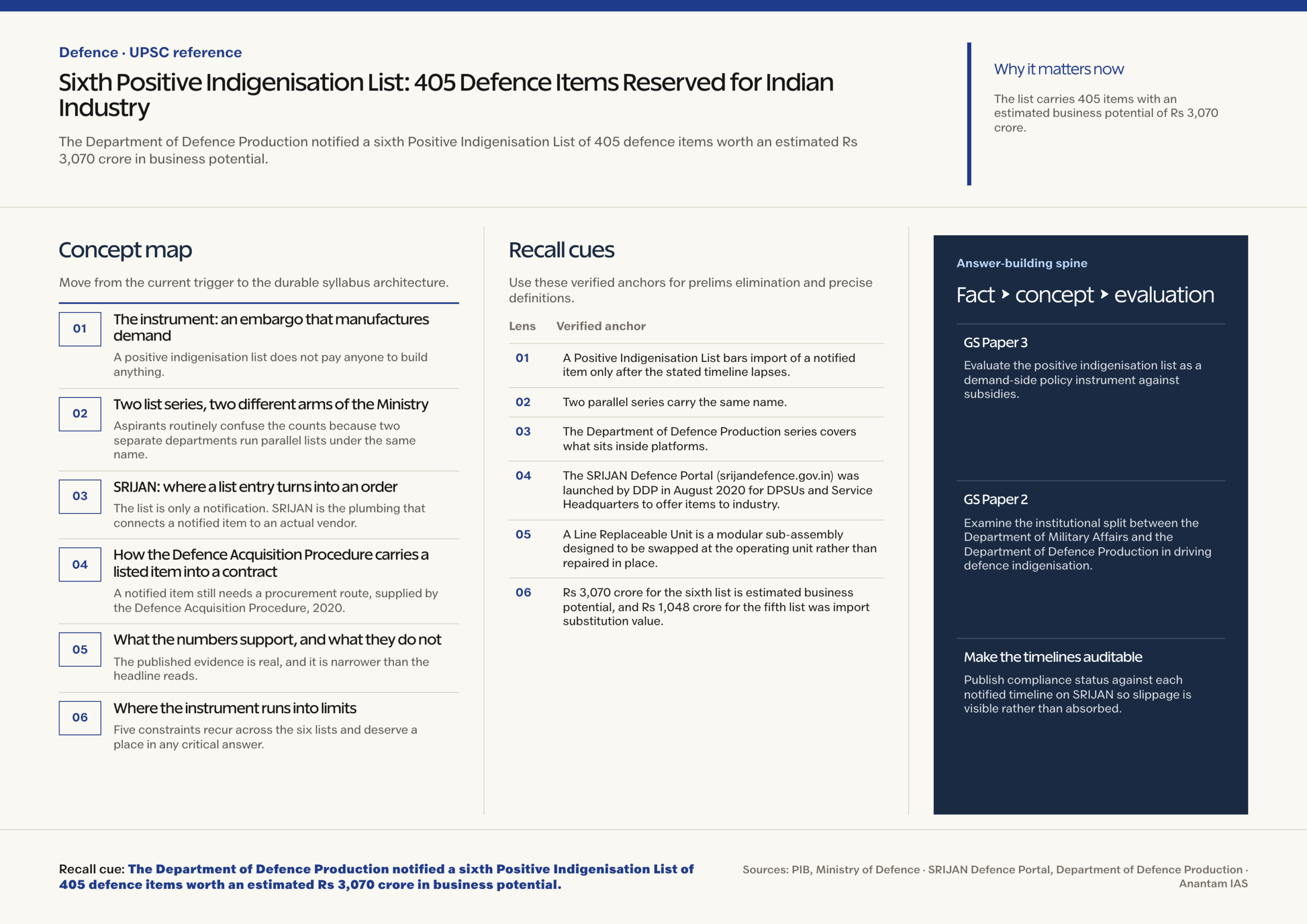
The Department of Defence Production notified the sixth Positive Indigenisation List on 18 August 2026, covering 405 defence items.
- The list is a dated import embargo for named items, not an immediate ban from the gazette date.
- It covers 389 DPSU items and 16 Indian Coast Guard items, mostly Line Replaceable Units, spares and components.
- Estimated business potential is Rs 3,070 crore. That is possible domestic orders, not contracts already awarded.
- Each item has an indicative timeline on the SRIJAN portal. Successful development precedes Indian procurement.
- The instrument creates a market by rule: after the date, that item should not be imported.
- Two series share the name. DMA lists complex systems; DDP lists what sits inside platforms.
- Item counts are a weak scoreboard for design authority.
UPSC Relevance
Prelims Relevance
- A Positive Indigenisation List bars import only after the stated timeline lapses.
- The Department of Military Affairs and the Department of Defence Production notify separate series.
- This sixth list is a DDP list.
- The SRIJAN portal (srijandefence.gov.in) was launched by DDP in August 2020.
- A Line Replaceable Unit is a modular sub-assembly swapped at the unit, not repaired in place.
- The Indian Coast Guard sits under the Ministry of Defence, which is why its items appear here.
Mains Relevance
GS Paper 3
- Evaluate a positive list as a demand-side tool against subsidies and production-linked incentives.
- Distinguish component substitution from platform-level design autonomy.
Essay
- Self-reliance is built in components before it is won in platforms.
Background and Context
What the instrument actually does
The list is a rule about future imports, not a catalogue of things India already makes.
- After the indicative date, the services and DPSUs are not supposed to import that item.
- Until development succeeds and a source is qualified, the item is notified for indigenisation, not already made here.
- Coverage here is insides: LRUs, sub-systems, spares, components and some raw materials.
- Named platforms in the release are the hosts of those insides, not newly banned aircraft or tanks.
- Business potential is a projection. Do not write it as if the order book already exists.
DMA lists and DDP lists are not the same
Same name, different layer of the machine, different department.
- DMA lists have focused on complex systems, weapons, sensors and ammunition.
- DDP lists focus on what DPSUs and the Coast Guard buy to keep platforms running.
- SRIJAN is the shop window where those items are offered to industry.
- Make-I, Make-II and Make-III under DAP 2020 are the development routes, not the embargo itself.
- Aspirants lose easy marks by treating every positive list as if it were one series.
What the instrument cannot do
An embargo on a spare does not create design authority over the platform.
- Timelines are indicative. Slipping one is easier than missing a contracted delivery.
- Making an LRU for a Su-30MKI or T-90 still leaves the airframe or hull imported.
- A single official buyer sets terms, which is hard on MSMEs if orders are lumpy.
- Item counts can rise while critical subsystems stay foreign.
- The honest test is whether Indian firms can design, qualify, support and export, not only replace a spare.
How to write the number without fooling yourself
The release invites a rupee headline. The better sentence is about the rule.
- Say what was notified, by whom, and that the embargo is dated rather than immediate.
- Keep DMA system lists and DDP component lists in different sentences.
- Call business potential a projection. Never call it an order book.
- If you mention SRIJAN, say it is an offer portal, not a regulator.
- End on the limit: insides can be reserved while the platform itself stays imported.
Way Forward
Audit the date, then move up the stack
- Publish which embargo dates were met and which items were still imported after the date.
- Score the programme on qualified domestic sources, not only on items notified.
- Use the same instrument, later, on design-critical subsystems rather than only consumables.
- Keep SRIJAN offers matched to real order visibility so firms can fund development.
Conclusion
- The sixth list is a routine notification doing a narrow job: reserve 405 insides for Indian industry after a stated date.
- It is not, by itself, platform self-reliance. Write the dated embargo, then write that limit, and stop.
- If the scoreboard is only item counts, the programme can look finished while design stays imported.
UPSC Practice Questions
Prelims MCQ 1
With reference to Positive Indigenisation Lists in India’s defence sector, consider the following statements:
- Both the Department of Military Affairs and the Department of Defence Production have notified such lists.
- An item placed on a list cannot be imported with immediate effect from the date of notification.
- The SRIJAN Defence Portal is the platform on which DPSUs and Service Headquarters offer items to industry.
How many of the above statements are correct?
(a) Only one (b) Only two (c) All three (d) None
Answer: (b) Only two
Explanation:
Statements 1 and 3 are correct. Import is barred after the stated timeline, not from the gazette date.
Prelims MCQ 2
The SRIJAN Defence Portal is best described as:
(a) A Ministry of External Affairs export-promotion window (b) A Department of Defence Production platform for offering defence items to industry for indigenous development (c) A statutory regulator of offset contracts (d) The Indian Navy’s logistics command system
Answer: (b) A Department of Defence Production platform for offering defence items to industry for indigenous development
Explanation:
SRIJAN was launched by DDP in 2020 as the offer-and-match portal for indigenisation.
UPSC Mains Questions
- Positive indigenisation lists create a market by rule rather than by subsidy. Evaluate this instrument. (250 words)
- India can substitute components faster than it acquires platform design authority. Examine the distinction. (150 words)
Sources: PIB, Ministry of Defence and SRIJAN Defence Portal, Department of Defence Production.
Frequently Asked Questions
What is a Positive Indigenisation List?
A notification that named defence items should not be imported after an indicative date, so Indian firms can develop and supply them.
Who notified the sixth list?
The Department of Defence Production in the Ministry of Defence, on 18 August 2026, covering 405 items.
Does Rs 3,070 crore mean contracts of that size exist?
No. It is estimated business potential if the items are successfully indigenised and then bought at home.
Are the 405 items already made in India?
Not by virtue of the list. They are reserved for future indigenous supply after development against a timeline.
Source: https://anantamias.com/current-affairs/sixth-positive-indigenisation-list-405-defence-items/
PLFS July 2026: Labour Force Participation Rises as Unemployment Eases
Why in News?
The Ministry of Statistics and Programme Implementation released the Periodic Labour Force Survey monthly bulletin for July 2026 on 17 August 2026.
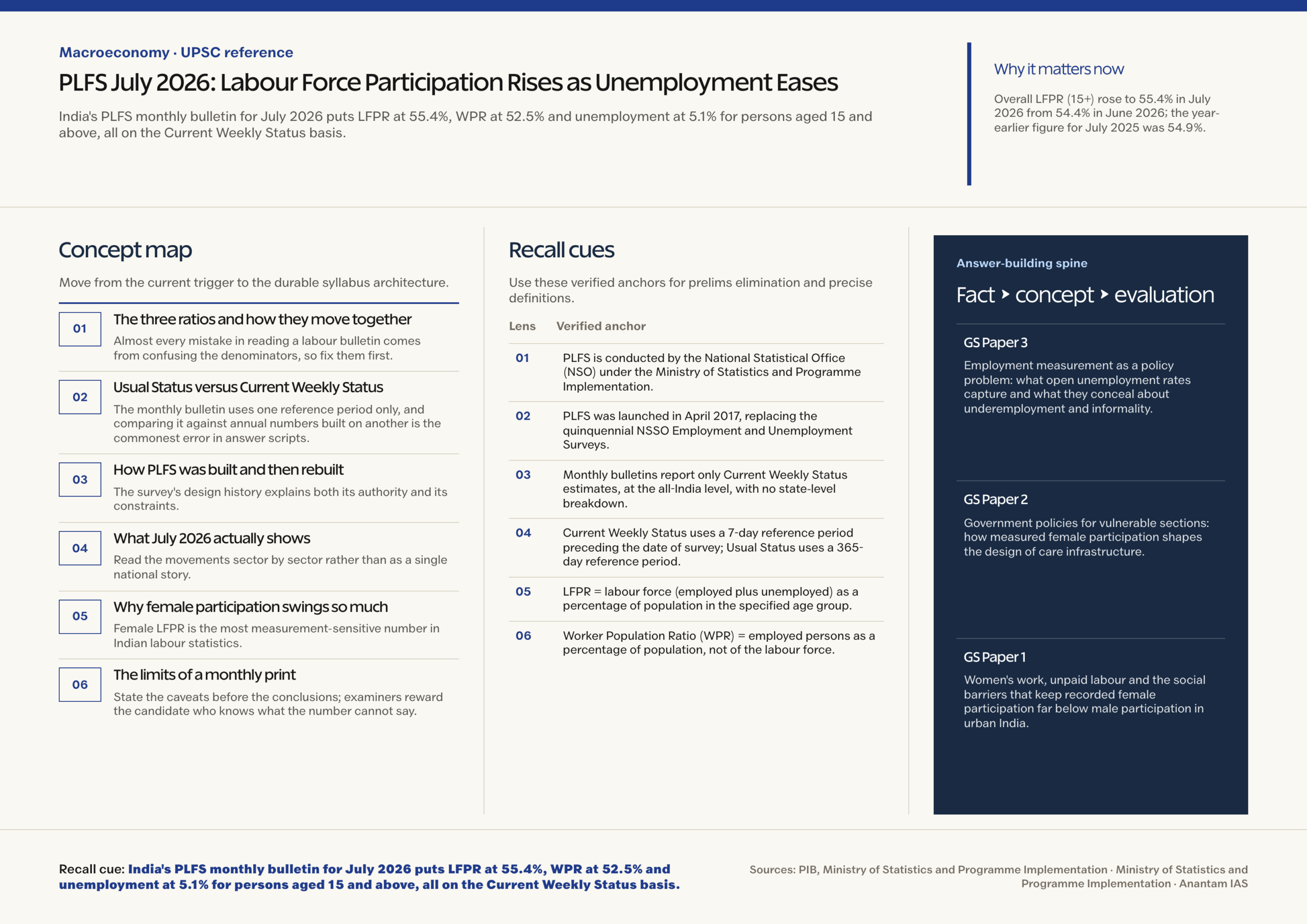
- Overall LFPR for persons aged 15+ rose to 55.4% in July 2026 from 54.4% in June, on Current Weekly Status.
- Worker Population Ratio rose to 52.5% and the Unemployment Rate eased to 5.1% over the same month.
- Monthly PLFS prints are all-India only. They cannot be used to rank states.
- The gain is a one-month reading, not a trend, and the bulletin is not seasonally adjusted.
- PLFS is India’s official employment series, so its definitions decide what counts as a job.
- A falling unemployment rate with rising participation is not a paradox once the three ratios are clear.
- Female participation is the volatile part of the headline, especially in a monsoon month.
UPSC Relevance
Prelims Relevance
- PLFS is conducted by the National Statistical Office under MoSPI.
- It was launched in April 2017, replacing quinquennial NSSO employment surveys.
- Monthly bulletins report only Current Weekly Status, at the all-India level.
- CWS uses a 7-day reference period; Usual Status uses 365 days.
- LFPR is labour force as a share of population; UR is unemployed as a share of the labour force.
- WPR = LFPR × (1 − UR) by construction.
Mains Relevance
GS Paper 3
- What an open unemployment rate captures, and what it conceals about underemployment and informality.
- Why a high-frequency labour print is infrastructure, not a victory headline.
GS Paper 1
- Women’s work, unpaid family labour, and why recorded urban female participation stays far below the male rate.
Essay
- What we count decides what we value: statistics as public purpose.
Background and Context
The three ratios and how they move together
Almost every mistake comes from mixing the denominators of LFPR, WPR and unemployment.
- The labour force is the employed plus the unemployed who were seeking or available for work.
- LFPR divides that labour force by the age-group population.
- WPR divides only the employed by the same population.
- UR divides the unemployed by the labour force, so its denominator moves with participation.
- The identity WPR = LFPR × (1 − UR) is why the July pair is internally consistent.
Usual Status versus Current Weekly Status
The monthly bulletin uses one reference period only. Do not mix it with annual usual-status rates.
- Current Weekly Status classifies a person by the seven days before the survey, treating even an hour of work as employment.
- Usual Status uses 365 days, with a majority-time rule for principal status.
- A week catches short spells of joblessness that a year averages away, so CWS unemployment is usually higher.
- Monthly PLFS bulletins publish CWS only. Annual reports publish both. They are not one series.
- State the status basis and age group in the same sentence as the number.
What a July print cannot say
State the caveats before the conclusions. Examiners reward knowing what the number cannot do.
- There is no seasonal adjustment, so a monsoon rise in rural work is not a structural turn.
- The unemployment rate measures open unemployment. It is silent on underemployment and job quality.
- Rising rural self-employment can be distress absorption. The headline ratios cannot tell the two apart.
- The monthly bulletin reports no earnings, so it says nothing about real wages.
- For the previous month’s reading, see our note on the June 2026 PLFS bulletin.
Why the rural monsoon move is easy to over-read
Most of a July improvement can be farm work that a seven-day window is built to catch.
- Rural women often enter the count as unpaid family helpers on household farms.
- Transplanting weeks pull that work into the reference week, then the next month can drop it.
- Urban female participation is less seasonal and much lower, so the national swing is usually rural.
- None of that is a reason to ignore the print. It is a reason not to call it structural.
- The safe sentence is: participation rose on CWS in a monsoon month, mainly where farm work is seasonal.
Way Forward
Read the architecture, not the print
- Publish confidence intervals with monthly ratios so users can tell signal from noise.
- Keep CWS and Usual Status on separate lines in every answer and briefing.
- Pair participation data with earnings and time-use before claiming a labour-market recovery.
- Treat one monsoon month as a reading, then wait for the next two prints.
Conclusion
- July 2026 is a better month on the official CWS print: participation up, unemployment down.
- The exam-durable takeaway is the architecture: the three ratios, the two status bases, and what a monthly bulletin cannot measure.
UPSC Practice Questions
Prelims MCQ 1
With reference to the Periodic Labour Force Survey (PLFS) monthly bulletin, consider the following statements:
- Monthly bulletins publish Current Weekly Status estimates at the all-India level.
- Current Weekly Status uses a 365-day reference period.
- The Unemployment Rate is unemployed persons as a percentage of the labour force, not of the population.
How many of the above statements are correct?
(a) Only one (b) Only two (c) All three (d) None
Answer: (b) Only two
Explanation:
Statements 1 and 3 are correct. CWS uses a 7-day reference period, not 365 days, so statement 2 is wrong.
Prelims MCQ 2
In official Indian labour statistics, Worker Population Ratio is best described as:
(a) Employed persons as a percentage of the labour force (b) Employed persons as a percentage of the population in the specified age group (c) Unemployed persons as a percentage of the labour force (d) Labour force as a percentage of the working-age population only in urban areas
Answer: (b) Employed persons as a percentage of the population in the specified age group
Explanation:
WPR uses population as the denominator. Unemployed as a share of the labour force is the unemployment rate.
UPSC Mains Questions
- A falling unemployment rate alongside a rising labour force participation rate is often misread as a contradiction. Explain why it is not, using the official Indian definitions. (150 words)
- Monthly PLFS bulletins have improved the frequency of Indian labour data. Examine what they still cannot tell a policymaker. (250 words)
Sources: PIB, Ministry of Statistics and Programme Implementation and Ministry of Statistics and Programme Implementation (MoSPI).
Frequently Asked Questions
What is the headline PLFS July 2026 set?
For persons aged 15 and above on Current Weekly Status, LFPR is 55.4%, WPR is 52.5% and the unemployment rate is 5.1%. Always state the age group and the status basis with the number.
Who conducts PLFS?
The National Statistical Office under the Ministry of Statistics and Programme Implementation. The survey began in April 2017 and replaced the older quinquennial NSSO employment surveys.
Why can monthly PLFS figures not be compared with annual usual-status rates?
Monthly bulletins use Current Weekly Status and a seven-day window. Annual reports also publish Usual Status on a 365-day rule. Mixing the two is a category error.
Does a one-month rise in LFPR mean the labour market has turned?
No. The series is not seasonally adjusted, is all-India only, and says nothing about wages or job quality. One monsoon month is a reading, not a trend.
Source: https://anantamias.com/current-affairs/plfs-july-2026-labour-force-participation-rate/
Grasslands Guide at UNCCD COP17: Valuing India’s Open Natural Ecosystems
Why in News?
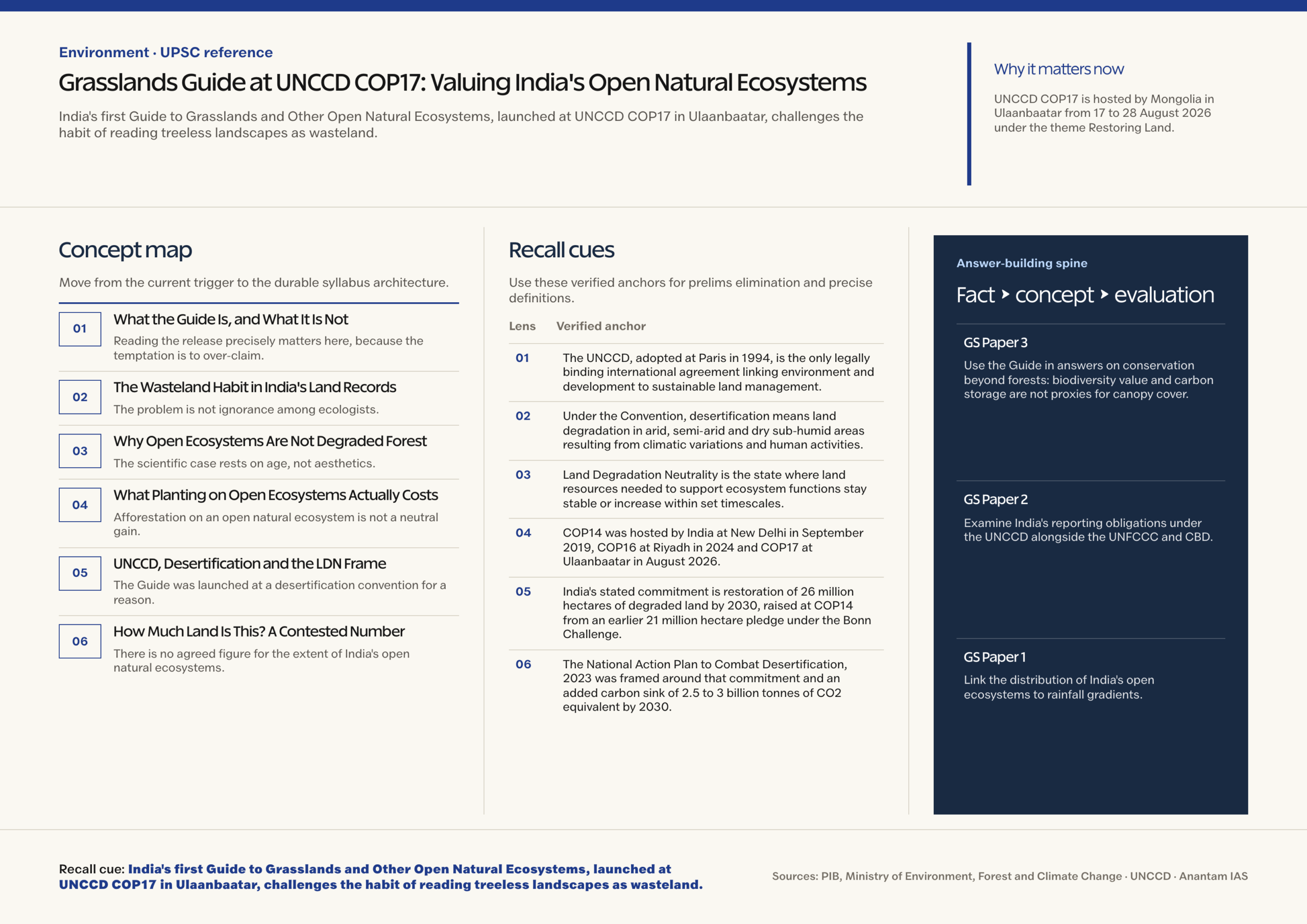
India launched its first Guide to Grasslands and Other Open Natural Ecosystems at a UNCCD COP17 side event in Ulaanbaatar on 17 August 2026.
- The Guide is a reference document, not a law, scheme, or COP decision.
- It argues that savannas, scrublands, ravines and deserts are ecosystems, not failed forest.
- UNCCD COP17 runs in Mongolia from 17 to 28 August 2026.
- The launch sits under the Ministry of Environment, Forest and Climate Change and India’s Land Degradation Neutrality talk.
- Indian land policy has long treated tree cover as the proof of ecological value.
- That habit turns naturally open land into ‘wasteland’ ready for plantation or solar parks.
- Aspirants need the category, not the partner list at the side event.
UPSC Relevance
Prelims Relevance
- The UNCCD is one of the three Rio Conventions, with UNFCCC and CBD.
- India hosted UNCCD COP14 in New Delhi in September 2019.
- COP17 is at Ulaanbaatar, Mongolia. COP16 was at Riyadh in 2024.
- The Guide creates no new protected-area category and reclassifies no wasteland.
- Open Natural Ecosystems are kept open by climate, soil, fire and grazing, not only by cutting.
- Land Degradation Neutrality is anchored in SDG 15.3.
Mains Relevance
GS Paper 3
- Why equating ecological value with tree cover harms grasslands and pastoral commons.
- How Land Degradation Neutrality goes wrong if the baseline treats naturally open land as degraded.
Essay
- Not every empty-looking landscape is empty.
Background and Context
What the Guide is, and what it is not
Read the release precisely. The temptation is to over-claim a book into a statute.
- The Guide compiles geography, ecology, biodiversity and associated communities of India’s open ecosystems.
- It notifies no land, assigns no budget, and sets no legal restoration target.
- Revenue wasteland categories remain as they are until a later instrument changes them.
- Its use is a shared official description that later maps and appraisals can be held against.
- For the convention itself, see our explainer on the UNCCD.
The wasteland habit
The problem is a classification inherited from revenue administration, not a gap in ecology.
- Colonial forest and revenue systems sorted land by timber and crop. What yielded neither became waste.
- That label still steers compensatory afforestation, solar siting and ‘green’ plantation drives.
- Planting trees on a grassland can be recorded as restored land and still erase bustard or blackbuck habitat.
- Pastoral use looks like residual livelihood in this vocabulary, not as a land-management system.
- The Guide’s claim is modest: stop starting the description from what the landscape lacks.
Why this belongs in a UNCCD week
Land Degradation Neutrality is only as honest as the baseline it uses.
- If naturally open ecosystems are coded as degraded, planting them ‘restores’ them on paper.
- India’s restoration pledge then collides with the very landscapes the Guide asks us to keep open.
- Fire ecology and grazing are processes in these systems, not automatically damage.
- The exam trap is to treat every COP product as binding. This one is a side-event guide.
- The live policy test is whether later atlases stop calling these tracts wasteland.
Pastoralism is land management, not leftover livelihood
If the Guide is only read as a wildlife note, its most political claim is missed.
- Grazing and mobility keep many open ecosystems open. Closing them ‘for greening’ can degrade them.
- Commons that look empty on a satellite product are often working rangeland.
- Fire, used with knowledge, is a process in savanna systems rather than a simple crime.
- A restoration target that plants over a grazing tract can impoverish the people who kept it open.
- The Guide’s sections on pastoralism are the part that belongs in a GS1 society answer as well as GS3.
Way Forward
Change the category, then the map
- Keep open ecosystems as their own conservation class, including community-managed options.
- Make solar, corridor and plantation appraisals count open-ecosystem loss explicitly.
- Separate tree-cover targets from grassland and savanna outcomes in official accounts.
- Treat pastoral access as a design constraint, not an afterthought.
Conclusion
- The Guide protects not a single hectare. It puts an official name on landscapes that policy still calls waste.
- It will matter only if maps, restoration ledgers and project siting start using that name.
UPSC Practice Questions
Prelims MCQ 1
With reference to the United Nations Convention to Combat Desertification (UNCCD), consider the following statements:
- It is counted as one of the three Rio Conventions, along with the UNFCCC and the Convention on Biological Diversity.
- India has hosted a session of its Conference of the Parties.
- Its 17th session of the Conference of the Parties was held in Riyadh, Saudi Arabia.
How many of the above statements are correct?
(a) Only one (b) Only two (c) All three (d) None
Answer: (b) Only two
Explanation:
Statements 1 and 2 are correct. India hosted COP14 in New Delhi in 2019. COP17 is at Ulaanbaatar; Riyadh hosted COP16.
Prelims MCQ 2
The Guide to Grasslands and Other Open Natural Ecosystems of India, launched in August 2026, is best described as:
(a) A reference document launched at a UNCCD COP17 side event (b) A statutory reclassification of wastelands under the Indian Forest Act, 1927 (c) A legally binding grassland restoration target for 2030 (d) A formal decision of the Conference of the Parties to the UNCCD
Answer: (a) A reference document launched at a UNCCD COP17 side event
Explanation:
PIB records a side-event launch of a guidance document. It notifies nothing and is not a COP decision.
UPSC Mains Questions
- Indian land policy has long equated ecological value with tree cover. Examine how this has shaped the treatment of grasslands and other open natural ecosystems. (250 words)
- Land Degradation Neutrality requires a baseline that distinguishes degraded land from naturally open ecosystems. Discuss. (150 words)
Sources: PIB, Ministry of Environment, Forest and Climate Change and UNCCD.
Frequently Asked Questions
What are Open Natural Ecosystems?
Naturally treeless or sparsely wooded landscapes such as grasslands, savannas, scrub, ravines and deserts, kept open by climate, soil, fire and grazing rather than by recent destruction.
Did the Guide change any land category?
No. It is guidance, not a notification. Wasteland labels in revenue and remote-sensing products stay until a later instrument changes them.
Why is planting trees on a grassland a problem?
It closes habitat that open-country species need, can cut pastoral access, and still gets counted as restored tree cover in official accounts.
What is Land Degradation Neutrality?
Keeping the amount and quality of productive land stable or improving, anchored in SDG 15.3. The baseline must not treat naturally open land as already degraded.
Where is UNCCD COP17 being held?
Ulaanbaatar, Mongolia, from 17 to 28 August 2026. India hosted COP14 in New Delhi in 2019.
Source: https://anantamias.com/current-affairs/grasslands-open-natural-ecosystems-guide-unccd-cop17/
Iran-US Memorandum Expires: Strait of Hormuz Risk and India’s Exposure
Why in News?
The 60-day Iran-US memorandum meant to pause the West Asia war lapsed on 17 August 2026, and neither capital announced a public extension.
- The Indian Express describes a 14-point memorandum whose closing promise was a final deal within 60 days.
- Crossings through the Strait of Hormuz remain in single digits against a pre-war norm above 130 a day.
- UKMTO reported an outbound vessel struck by an unknown projectile on 18 August. No attacker has been named.
- Almost every diplomatic clause is an attributed claim. The durable material is geography, energy and passage law.
- A chokepoint does not have to close to hurt. Thin traffic and war-risk premia already raise landed costs.
- India imports close to 88% of the crude it refines, and much of that basket loads inside the Persian Gulf.
- Indian seafarers carry physical risk on foreign-flagged ships even when no Indian cargo is named.
UPSC Relevance
Prelims Relevance
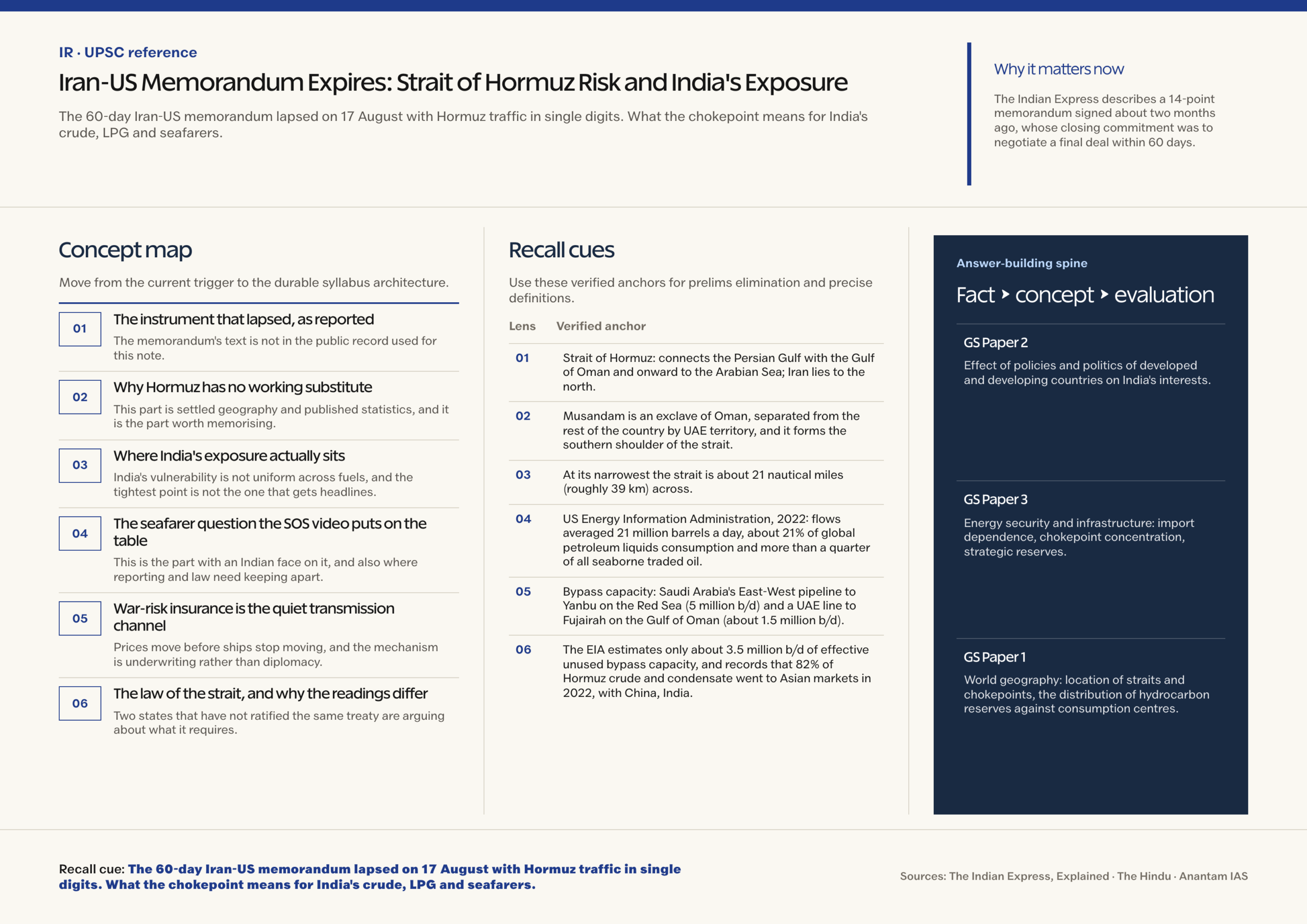
- The Strait of Hormuz joins the Persian Gulf to the Gulf of Oman; Iran north, Oman’s Musandam and the UAE south.
- At its narrowest it is about 21 nautical miles, so it sits inside territorial seas.
- UNCLOS Part III creates non-suspendable transit passage through international straits.
- Iran signed but did not ratify UNCLOS. The United States also has not ratified it.
- UKMTO is a reporting and advisory point, not an investigating authority.
- India’s ISPRL Phase I caverns are at Visakhapatnam, Mangaluru and Padur.
Mains Relevance
GS Paper 2
- How a bargain between two third countries reshapes India’s energy and shipping risk.
- UNCLOS transit passage versus innocent passage, and why the readings differ.
GS Paper 3
- Energy security at a chokepoint: crude, LPG, freight, insurance and thin strategic reserves.
Essay
- Agreements that pause a war are not agreements that end one.
Background and Context
Why Hormuz has no working substitute
This part is settled geography. It is the part worth keeping.
- The strait is the only sea exit from the Persian Gulf to the Arabian Sea.
- The US EIA put 2022 flows at about 21 million barrels a day of petroleum liquids.
- A large share of seaborne oil and a large share of LNG, especially Qatari cargoes, use this lane.
- Bypass lines to Yanbu and Fujairah exist, but spare capacity is thin against normal Gulf loadings.
- Iraq and Kuwait have no pipeline escape from the Gulf at all.
Where India's exposure sits
India’s vulnerability is not uniform across fuels. The tightest point is not always crude.
- Most Indian crude still loads inside the Gulf, so freight and insurance move before shortages do.
- LPG dependence on Gulf suppliers is tighter, and the demand is household cooking.
- Strategic reserves buy days, not months. Phase I of ISPRL is a thin buffer.
- Indian crew on foreign flags fall first under the flag state, not under DG Shipping.
- Earlier notes on the memorandum as reported at signing cover the same geography.
The law of the strait
Two states that never ratified the same treaty are arguing about what it requires.
- Because the strait is narrower than two 12-nautical-mile seas, every ship enters a territorial sea.
- UNCLOS transit passage is continuous, expeditious, and may not be suspended.
- Iran offers innocent passage instead, which is suspendable.
- The United States treats transit passage as customary law even without ratification.
- UKMTO recorded an unknown projectile. An answer that names the attacker is guessing.
Insurance and crew move before cargo disappears
Prices and refusals arrive first. Physical shortage, if it comes, arrives later.
- Additional war-risk premium is charged on hull value for each listed-area transit and can reprice overnight.
- The Lloyd’s Joint War Committee listing is an underwriting judgement, not a government advisory.
- Seafarers under International Bargaining Forum contracts may decline warlike transits and claim a bonus.
- A Marshall Islands flag puts primary enforcement on that flag state, not on India.
- One public Indian-crew refusal is evidence of risk, not yet evidence of an Indian energy shortage.
Way Forward
Harden the import route and the crew rule
- Raise the share of barrels liftable outside the Gulf and treat LPG storage as the binding constraint.
- Make DG Shipping advisories operational: when Indian crew may decline a listed high-risk transit.
- Keep naval mission-based presence and maritime domain awareness sized to actual traffic.
- Test any Hormuz management scheme against UNCLOS through the IMO, not only through two capitals.
Conclusion
- The lapse of a 60-day paper is a small headline on a large fact: Hormuz traffic is still not normal.
- Keep contested diplomacy separate from geography, UNCLOS passage law and seafarer protection, which will not move with the next statement.
- If you cannot name the attacker or the cargo, do not invent either.
UPSC Practice Questions
Prelims MCQ 1
With reference to the Strait of Hormuz, consider the following statements:
- It connects the Persian Gulf with the Gulf of Oman.
- Oman’s Musandam exclave forms part of its southern shore.
- At its narrowest it is wider than 50 nautical miles, so it lies entirely in the high seas.
How many of the above statements are correct?
(a) Only one (b) Only two (c) All three (d) None
Answer: (b) Only two
Explanation:
Statements 1 and 2 are correct. The strait is about 21 nautical miles at its narrowest and sits inside territorial seas.
Prelims MCQ 2
Transit passage under UNCLOS is best described as:
(a) A suspendable right, identical to innocent passage (b) Continuous and expeditious passage through a strait used for international navigation, which bordering states may not suspend (c) A right available only to states that have ratified UNCLOS (d) A coastal-state licensing regime for tankers
Answer: (b) Continuous and expeditious passage through a strait used for international navigation, which bordering states may not suspend
Explanation:
That is the Part III rule. Innocent passage is the suspendable regime, and the US treats transit passage as customary law.
UPSC Mains Questions
- The Strait of Hormuz does not have to close to raise India’s energy bill. Examine the transmission channels. (250 words)
- Distinguish transit passage from innocent passage and explain why the distinction matters at Hormuz. (150 words)
Sources: The Indian Express, Explained and The Hindu.
Frequently Asked Questions
What lapsed on 17 August 2026?
A reported 60-day Iran-US memorandum that was meant to pause the war and lead to a final deal. No public extension was announced.
Why does the Strait of Hormuz matter to India?
A large share of India’s crude and LPG loadings sit inside the Persian Gulf. Thin traffic and war-risk insurance raise landed costs even without a formal closure.
What is transit passage?
Under UNCLOS Part III, ships have a right of continuous, expeditious passage through an international strait. Bordering states may not suspend it.
Did anyone claim the 18 August strike?
No. UKMTO recorded an unknown projectile, engine-room damage and one casualty. Attribution is not established.
Source: https://anantamias.com/current-affairs/iran-us-mou-expiry-strait-of-hormuz-shipping-risk/
Ken-Betwa River Link: Displacement, Forests and the Interlinking Question
Why in News?
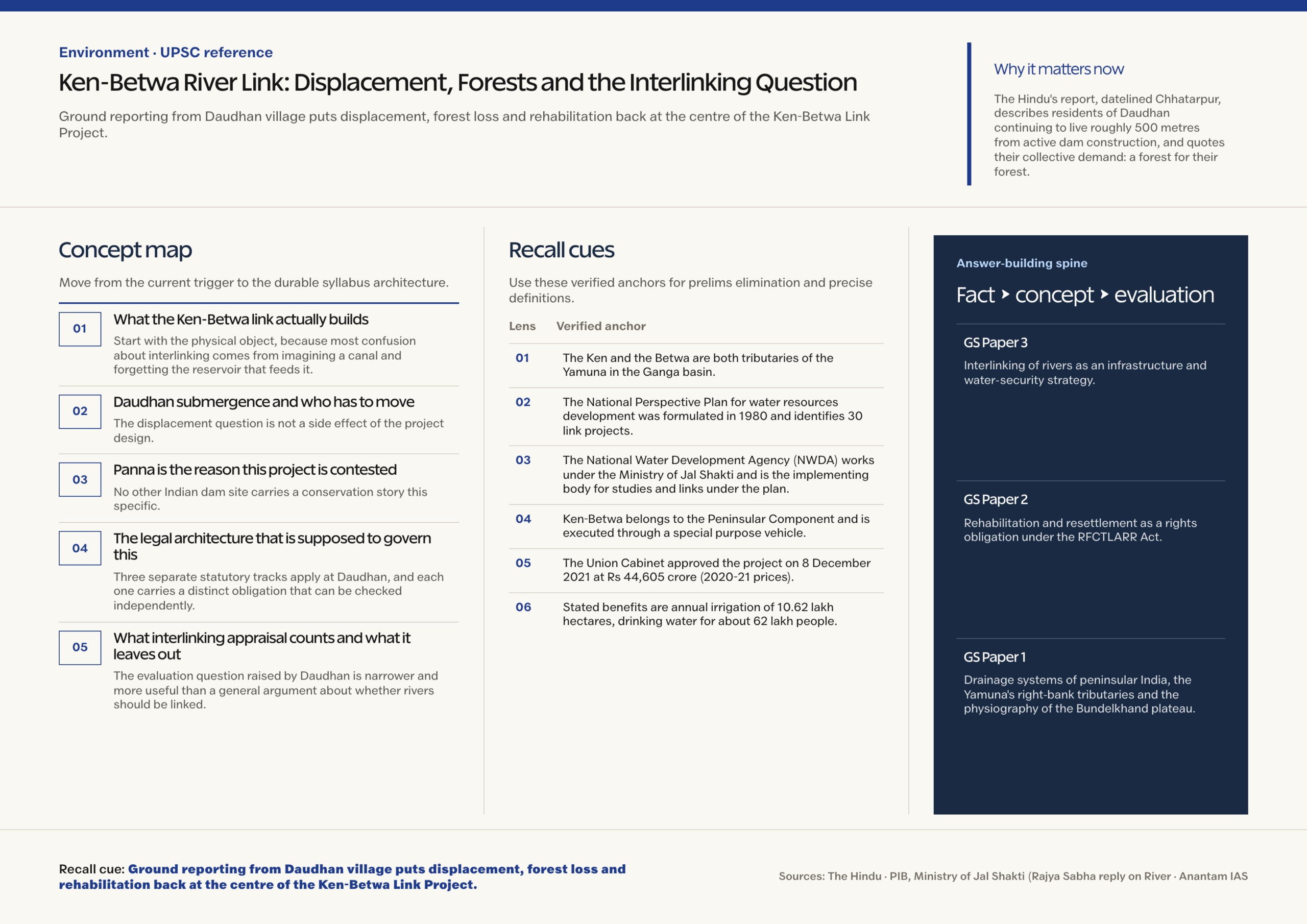
The Hindu reported on 18 August 2026 from Daudhan village that Adivasi families beside the dam works are resisting relocation as Ken-Betwa construction advances.
- The Daudhan dam on the Ken is the core of the Ken-Betwa Link Project, the first National Perspective Plan link under construction.
- Parliament was told of about 7,193 project-affected families at the Section 11 notification stage.
- The reservoir submergence includes part of the Panna Tiger Reserve core and buffer.
- A ministry line that ‘no protest was reported’ sits beside a year of published protest reporting.
- Bundelkhand’s drought and distress migration make the water case real, not invented.
- Panna is also a celebrated tiger reintroduction landscape, so two public successes collide.
- How rights and forests are handled here becomes the template for later links.
UPSC Relevance
Prelims Relevance
- The Ken and the Betwa are Yamuna tributaries in the Ganga basin.
- The National Perspective Plan (1980) lists 30 links: 14 Himalayan and 16 Peninsular.
- Ken-Betwa is a Peninsular link, executed through the KBLPA under NWDA and Jal Shakti.
- The Union Cabinet approved it on 8 December 2021 at Rs 44,605 crore (2020-21 prices).
- Land acquisition runs under the RFCTLARR Act, 2013.
- Panna became a tiger reserve in 1994, lost its tigers by 2009, and was rebuilt by reintroduction.
Mains Relevance
GS Paper 3
- Interlinking as a surplus-to-deficit idea, tested against a real reservoir and a tiger reserve.
- What environmental, forest and wildlife clearances did and did not filter at Ken-Betwa.
GS Paper 2
- Rehabilitation as a rights duty under the 2013 Act, not a discretionary payout.
Essay
- The cost of a dam is easy to count and hard to measure.
Background and Context
What the link actually builds
Most confusion comes from imagining a canal and forgetting the reservoir that feeds it.
- Phase I is the Daudhan dam on the Ken, upstream of the Gangau weir.
- Water is meant to move to the Betwa basin through a long link canal, with later Phase II storages.
- Stated benefits are irrigation and drinking water in Bundelkhand districts of Madhya Pradesh and Uttar Pradesh.
- NWDA and the Ken-Betwa Link Project Authority are the official machinery.
- Completion has been spoken of for 2030. Construction and relocation are already running together.
Displacement is not a side effect
Who must move is a direct consequence of where the reservoir sits.
- The environmental assessment put Daudhan submergence at about 9,000 hectares, including Panna core and buffer.
- The Hindu’s Daudhan reporting describes families still living beside active works and asking land for land.
- The 2013 Act requires a social impact assessment, a Section 11 notification, and Second Schedule entitlements.
- Forest-rights settlement is supposed to precede eviction on forest land.
- A cash package is not automatically a replacement for a forest-edge livelihood.
Panna is why the project is contested
No other Indian dam site carries a conservation story this specific.
- Panna’s tigers were lost by 2009 and rebuilt from Bandhavgarh and Kanha.
- The Supreme Court’s Central Empowered Committee in 2019 called the harm irreversible. The court never finally decided that report.
- Downstream, the Ken Gharial Sanctuary depends on monsoon flow and silt.
- A landscape management plan is a future administrative promise. Submergence is immediate.
- The wider interlinking debate is set out in our note on the river interlinking project.
Three legal tracks, three different duties
Each statute at Daudhan can be checked on its own. Do not mash them into one clearance.
- Land and rehabilitation run under the RFCTLARR Act, 2013, including the social impact assessment.
- Forest diversion needs staged clearance under the Van Adhiniyam, 1980.
- Use of a national park or sanctuary needs the Standing Committee of the National Board for Wildlife.
- The Forest Rights Act, 2006 bars eviction until claims are settled.
- An undecided adverse committee report is not the same thing as a cleared project.
Way Forward
Make rehabilitation verifiable
- Publish the social impact assessment and village-wise award, disbursal and resettlement records.
- Finish Forest Rights Act claims before further clearing of the submergence zone.
- Put measurable wildlife outcomes on a public clock, not only in a management annexure.
- Complete rights settlement before heavy construction on any later National Perspective Plan link.
Conclusion
- Ken-Betwa is the first river link India has actually started building, and Daudhan is the household-scale bill.
- Judge it on whether rights settlement and clearances preceded submergence, not on a general yes or no to interlinking.
- The later twenty-nine links will be graded on the same paper.
UPSC Practice Questions
Prelims MCQ 1
With reference to the Ken-Betwa Link Project, consider the following statements:
- Its main component, the Daudhan dam, is being built across the Ken river in Madhya Pradesh.
- It is the first National Perspective Plan link to enter implementation.
- The submergence area of the Daudhan reservoir lies entirely outside the Panna Tiger Reserve.
How many of the above statements are correct?
(a) Only one (b) Only two (c) All three (d) None
Answer: (b) Only two
Explanation:
Statements 1 and 2 are correct. Submergence includes Panna core and buffer, so statement 3 is wrong.
Prelims MCQ 2
With reference to the National Perspective Plan for interlinking of rivers, which one of the following statements is correct?
(a) It was formulated in 1980 and identifies 30 link projects, 14 Himalayan and 16 Peninsular. (b) The National Water Development Agency functions under the Ministry of Environment, Forest and Climate Change. (c) Detailed Project Reports have been completed for all 30 identified links. (d) The Ken-Betwa link falls under the Himalayan Component.
Answer: (a) It was formulated in 1980 and identifies 30 link projects, 14 Himalayan and 16 Peninsular.
Explanation:
NWDA is under Jal Shakti, DPRs are not complete for all 30 links, and Ken-Betwa is Peninsular.
UPSC Mains Questions
- Ken-Betwa is the first National Perspective Plan link under construction. Examine the displacement and wildlife questions that a surplus-deficit model does not price. (250 words)
- Rehabilitation under the RFCTLARR Act, 2013 is a rights process. Discuss with reference to dam-affected communities. (150 words)
Sources: The Hindu and PIB, Ministry of Jal Shakti (Rajya Sabha reply on River Interlinking Projects).
Frequently Asked Questions
What is the Ken-Betwa Link Project?
A Peninsular Component river link that would store Ken water at Daudhan and move some of it toward the Betwa basin for irrigation and drinking water in Bundelkhand.
Why is Panna involved?
Part of the planned reservoir submergence lies inside the Panna Tiger Reserve. The reserve lost its tigers by 2009 and was later rebuilt by reintroduction.
Is this the first river-link project?
It is the first National Perspective Plan link to reach construction. The 1980 plan lists 30 links; the others are not at this stage.
Which law governs rehabilitation?
The Right to Fair Compensation and Transparency in Land Acquisition, Rehabilitation and Resettlement Act, 2013, plus forest and wildlife clearances where those lands are involved.
Source: https://anantamias.com/current-affairs/ken-betwa-river-link-daudhan-dam-displacement/
Electronics Components Manufacturing Scheme: Building the Missing Value Chain
Why in News?
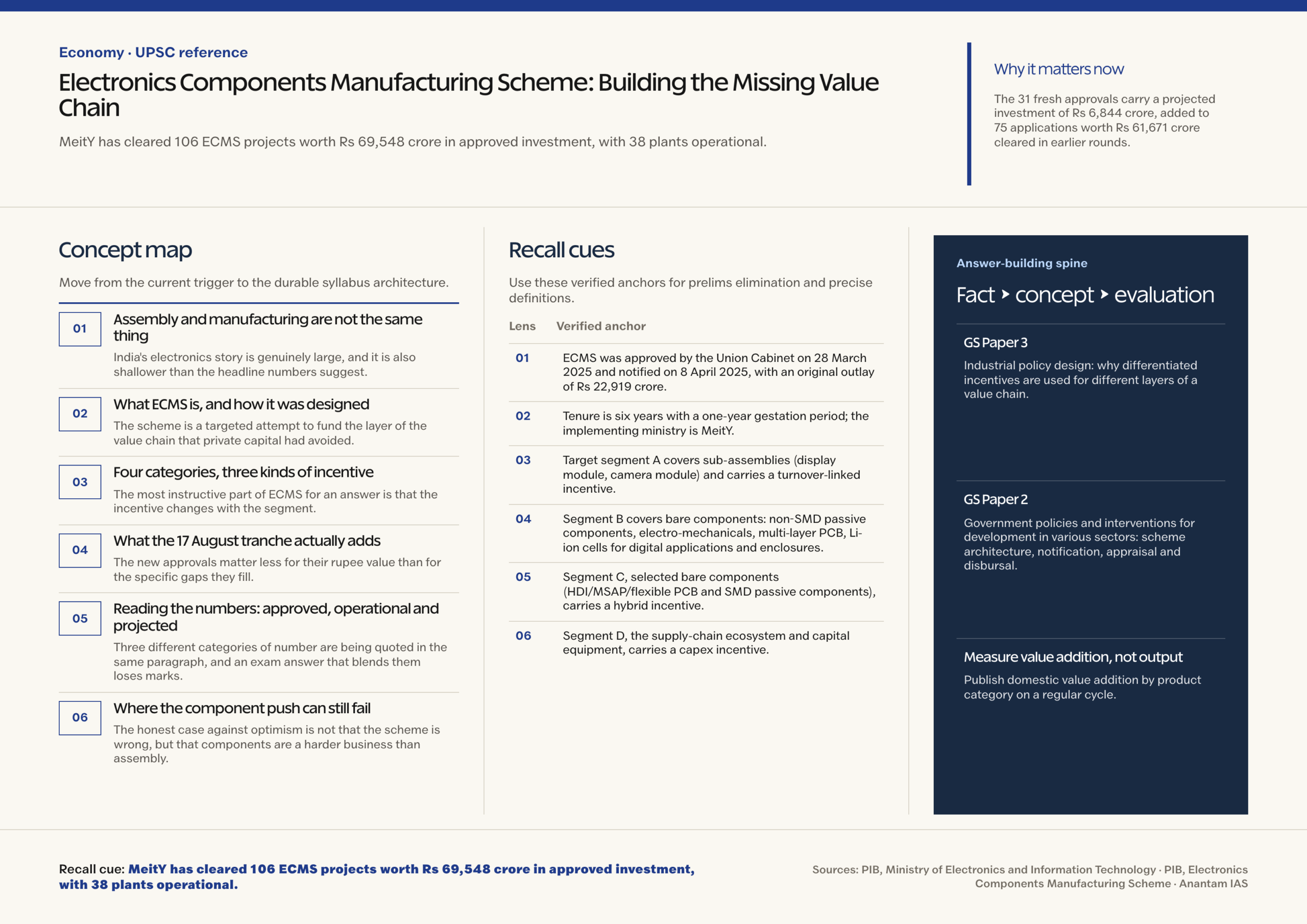
The Ministry of Electronics and Information Technology approved 31 more proposals under the Electronics Components Manufacturing Scheme at an industry event in New Delhi on 17 August 2026.
- The tranche takes the scheme to 106 approved projects, with 38 plants already manufacturing.
- Approved investment now stands at Rs 69,548 crore. That is committed spend, not money already on the ground.
- The scheme targets the missing middle of the value chain: sub-assemblies, bare components and capital goods, not finished phones.
- Employment and production figures in the release are forecasts, not outcomes.
- India scaled electronics assembly far faster than it built a component base, so Domestic Value Addition stayed thin.
- Components are a harder business than assembly: low margins, high yield discipline, and long qualification cycles.
- ECMS is the instrument aimed at that gap. It is not the India Semiconductor Mission.
UPSC Relevance
Prelims Relevance
- ECMS is implemented by MeitY, not the Ministry of Heavy Industries.
- The Union Cabinet approved it on 28 March 2025; MeitY notified it on 8 April 2025.
- Incentives are turnover-linked, capex, or hybrid, depending on the target segment.
- Part of the payout is linked to employment targets.
- Capital goods used to make components sit in the scheme, not only the components themselves.
- Approved investment and operational plants are different numbers. Do not blend them.
Mains Relevance
GS Paper 3
- Why component manufacturing, not final assembly, decides Domestic Value Addition in electronics.
- Differentiated incentives: why turnover-linked, capex and hybrid tools fit different market failures.
Essay
- A large factory that imports its insides is still an assembly line.
Background and Context
Assembly is not manufacturing
India’s electronics story is large, and it is shallower than the headline output suggests.
- Phones and other finished goods can be assembled at scale while the bill of materials stays imported.
- Value addition lives in displays, camera modules, passives, enclosures and capital goods.
- Private capital avoided that layer because yields are hard and buyers qualify slowly.
- ECMS exists to fund that avoided layer, not to add another assembly incentive.
- See the broader industrial context in our note on production-linked incentives.
How the scheme is built
The exam-useful design point is that the incentive changes with the segment.
- The Cabinet approved ECMS on 28 March 2025 with an outlay of Rs 22,919 crore.
- It runs six years with a one-year gestation, aimed at Domestic Value Addition and Global Value Chains.
- Sub-assemblies get a turnover-linked incentive on incremental sales.
- Bare components and some supply-chain items get capex or hybrid support.
- That split is the answer, not the list of every product in the gazette.
How to read the 17 August numbers
Three kinds of number are being quoted together. An answer that blends them loses marks.
- Approved means 106 projects and committed investment. It is a promise after clearance.
- Operational means 38 plants have started manufacturing. That is the physical fact.
- Jobs and output in the release are projected. Treat them as forecasts.
- Capacity claims that ‘meet full domestic demand’ are ministry statements about approved capacity, not current market share.
- The scheme can still fail on yield, upstream inputs, and export-market qualification.
Where a component push still fails
The honest caution is not that the scheme is pointed at the wrong layer.
- Passive components are high-volume and low-margin. Yield, not capacity announcements, decides who wins.
- Localising a part does not localise its inputs. Anode material and electrolyte chemicals sit further upstream.
- Export buyers qualify slowly. A domestic line can run for years before it enters a global bill of materials.
- Assembly PLI and component support must be scored separately, or one hides the other.
- A first-ever domestic line is a start. It is not import independence.
Way Forward
Measure value addition, not output
- Score ECMS on Domestic Value Addition and operational plants, not on approved investment.
- Keep semiconductor, display and component schemes on separate ledgers so one does not hide the other.
- Publish yield and qualification progress, because that is where component firms actually compete.
- Do not treat a first domestic line as import independence.
Conclusion
- ECMS is aimed at the right layer: the components and capital goods that assembly never built.
- Judge it by plants actually running and by Domestic Value Addition, not by the rupee value of approvals.
- Keep semiconductor, display and component schemes in separate sentences so one does not hide the other.
UPSC Practice Questions
Prelims MCQ 1
With reference to the Electronics Components Manufacturing Scheme (ECMS), consider the following statements:
- It is implemented by the Ministry of Heavy Industries.
- It offers turnover-linked, capital expenditure and hybrid incentives depending on the target segment.
- A part of the incentive payout is linked to the achievement of employment targets.
How many of the above statements are correct?
(a) Only one (b) Only two (c) All three (d) None
Answer: (b) Only two
Explanation:
Statements 2 and 3 are correct. MeitY implements ECMS, not Heavy Industries, so statement 1 is wrong.
Prelims MCQ 2
Under the Electronics Components Manufacturing Scheme, capital goods used in electronics manufacturing typically receive which form of support?
(a) Only a tariff exemption (b) Only a production-linked incentive on finished phones (c) A capital expenditure incentive (d) A statutory preference in all government procurement
Answer: (c) A capital expenditure incentive
Explanation:
Capital goods and related parts sit in the capex-linked part of ECMS, not in a phone-assembly PLI.
UPSC Mains Questions
- India became a large assembler of mobile phones without a matching component base. Examine why that gap matters for industrial policy. (250 words)
- Differentiated incentives are the defining feature of ECMS. Discuss the rationale for turnover-linked, capex and hybrid tools. (150 words)
Sources: PIB, Ministry of Electronics and Information Technology and PIB, Electronics Components Manufacturing Scheme backgrounder.
Frequently Asked Questions
What is the Electronics Components Manufacturing Scheme?
A MeitY scheme, approved in March 2025, that subsidises domestic making of electronic sub-assemblies, bare components, supply-chain materials and capital goods rather than finished devices.
How many ECMS projects are approved, and how many plants are running?
As of the 17 August 2026 tranche, 106 projects are approved and 38 plants have started manufacturing. Those are different facts.
Are the advertised jobs already created?
No. Direct and indirect job numbers in the release are projections attached to approved projects, not verified hires.
How is ECMS different from the India Semiconductor Mission?
ECMS funds components and capital goods for electronics. The semiconductor mission funds fabs, display fabs and related chip ecosystem bets. Do not merge them.
Source: https://anantamias.com/current-affairs/ecms-electronics-components-manufacturing-scheme-projects/
RTI Second Appeals: The Central Information Commission Rebuilds Its Case System
Why in News?
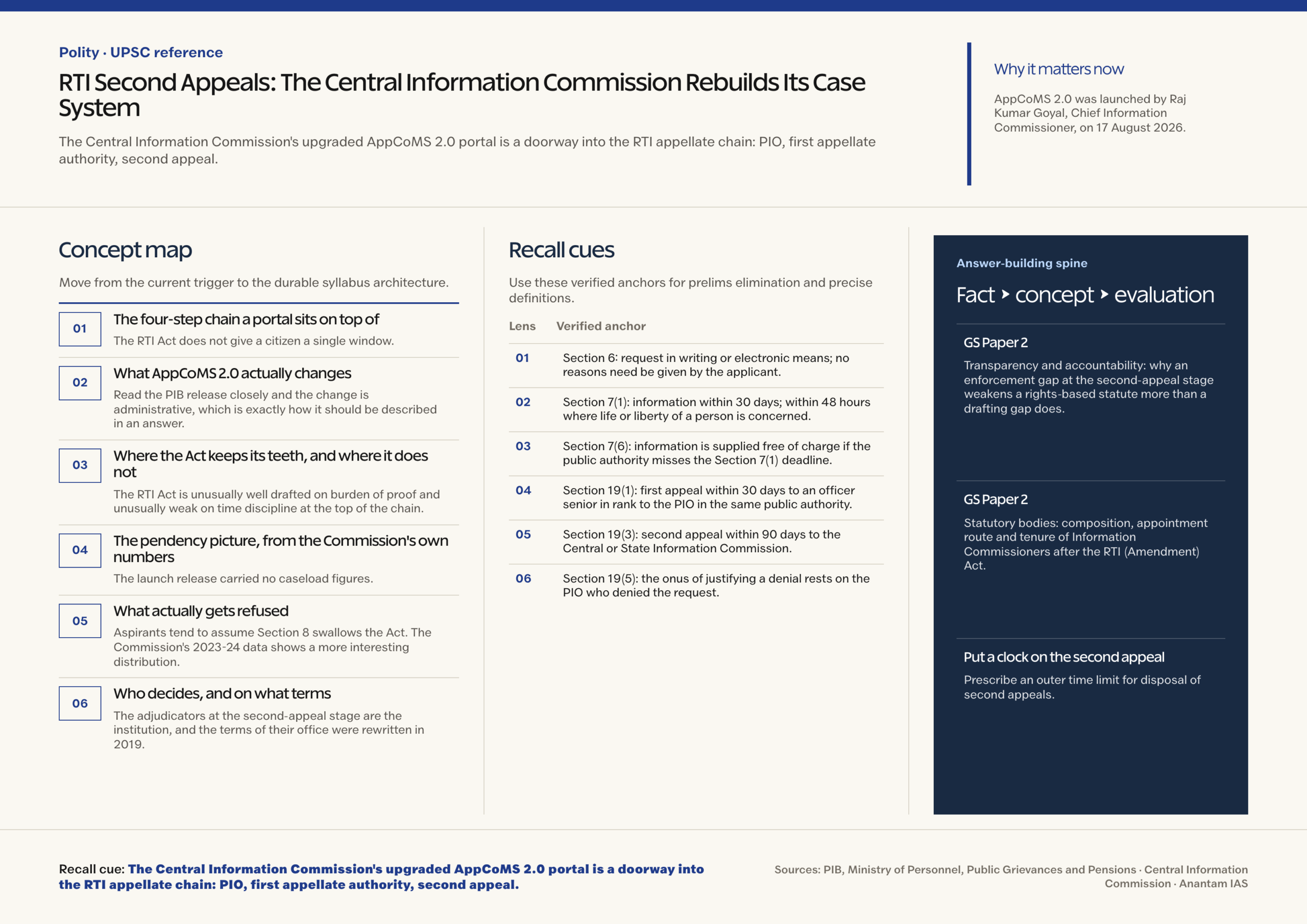
The Central Information Commission launched an upgraded Appeal and Complaint Management System, AppCoMS 2.0, on 17 August 2026.
- The original AppCoMS, from September 2016, already handled online second appeals and complaints.
- Version 2.0 adds user accounts, visible timelines, and digitally signed notices and orders.
- It creates no new right, changes no limitation period, and adds no disposal deadline.
- The useful syllabus object is the second-appeal stage of the RTI Act, 2005.
- The Act works through a chain, not a single counter. A portal at the top cannot repair the tiers below.
- The second appeal is the stage with enforcement power and no statutory outer clock.
- GS2 will ask about transparency and capacity, not about a software build.
UPSC Relevance
Prelims Relevance
- Section 6: request in writing or electronic form; the applicant need give no reasons.
- Section 7(1): 30 days, or 48 hours where life or liberty is at stake.
- Section 19(1): first appeal within 30 days to an officer senior to the PIO.
- Section 19(3): second appeal to the Information Commission within 90 days.
- Section 19(5): the PIO who denied the request bears the burden of justifying the denial.
- Section 20(1): penalty of Rs 250 a day, capped at Rs 25,000.
Mains Relevance
GS Paper 2
- Why an enforcement gap at the second appeal weakens a rights statute more than a drafting gap does.
- What a case-management platform can fix, and what only a statutory deadline can fix.
Essay
- A right without a deadline is a queue.
Background and Context
The four-step chain under the portal
The RTI Act gives a sequence. Each step has its own officer, clock and failure mode.
- Section 6: apply to the PIO. No reasons required.
- Section 7: the PIO must give or refuse information in 30 days. Silence is a deemed refusal.
- Section 19(1): first appeal inside the same public authority, to a senior officer, with a 30-to-45 day clock.
- Section 19(3): second appeal to the Central or State Information Commission within 90 days.
- Section 18 is a parallel complaint track. AppCoMS handles both. See our RTI Act explainer.
What AppCoMS 2.0 actually changes
The change is administrative. Describe it that way in an answer.
- Applicants get accounts, timelines, and downloads of notices and orders.
- The Commission can issue digitally signed notices, shortening the postal lag.
- CPIOs get accounts to file the official record, which citizen portals often omit.
- Limitation periods, exemptions and the Commission’s powers stay exactly where the Act left them.
- A cleaner queue is still a queue if nobody has to decide by a date.
Where the Act has teeth, and where it does not
The statute is strong on burden of proof and weak on time at the top of the chain.
- Section 19(5) reverses the ordinary burden: the refusing PIO must justify the refusal.
- The Commission’s decision is binding, and it can order disclosure, compensation and penalties.
- Sections 7 and 19(6) bind the PIO and the first appellate authority to deadlines.
- Section 19 sets no outer time limit for the Commission to decide a second appeal.
- That asymmetry is the exam point, not the name of the new portal.
Independence after the 2019 rewrite
Who sits on the Commission, and on what terms, is the other half of the second-appeal story.
- The CIC is a Chief Information Commissioner plus not more than ten Information Commissioners.
- The RTI (Amendment) Act, 2019 moved tenure and salary from the statute to central rules.
- The RTI Rules, 2019 prescribe a three-year term, with the age cap of 65 years kept.
- Critics read that as weaker independence. The official defence is alignment with other statutory bodies.
- A full-strength Commission still cannot outrun a stage that has no disposal clock.
Way Forward
Put a clock on the second appeal
- Prescribe an outer disposal limit for second appeals, matching the first-appeal discipline.
- Publish ageing of pending cases, not only opening and closing counts.
- Make first appellate authorities a named, reported role so fewer cases reach the Commission.
- Keep offline and assisted filing, so an account-based portal does not become the only door.
Conclusion
- A better CIC portal is worth having. It shortens the distance between a decision and the citizen waiting for it.
- It is not the missing reform. Until the second appeal has a deadline, the right still arrives late.
UPSC Practice Questions
Prelims MCQ 1
With reference to the appellate mechanism under the Right to Information Act, 2005, consider the following statements:
- A first appeal lies to an officer senior in rank to the Public Information Officer within the same public authority.
- A second appeal to the Information Commission must ordinarily be filed within ninety days.
- In appeal proceedings, the onus to prove that a denial was justified lies on the appellant.
How many of the above statements are correct?
(a) Only one (b) Only two (c) All three (d) None
Answer: (b) Only two
Explanation:
Statements 1 and 2 are correct. Section 19(5) puts the burden on the PIO, so statement 3 is wrong.
Prelims MCQ 2
AppCoMS 2.0, seen in the news, is best described as:
(a) A new statutory right of third appeal under the RTI Act (b) The Central Information Commission’s upgraded system for second appeals and complaints (c) A replacement of Section 8 exemptions (d) A time limit of 30 days imposed on the Central Information Commission
Answer: (b) The Central Information Commission's upgraded system for second appeals and complaints
Explanation:
It is case-management software. It does not create a new appeal, rewrite exemptions, or add a CIC deadline.
UPSC Mains Questions
- The RTI Act binds the PIO and the first appellate authority to time, then falls silent at the Commission. Examine the consequences. (250 words)
- Digitising a queue is not the same as enforcing a right. Discuss with reference to the Central Information Commission. (150 words)
Sources: PIB, Ministry of Personnel, Public Grievances and Pensions and Central Information Commission.
Frequently Asked Questions
What is AppCoMS 2.0?
The CIC’s upgraded online system for filing and processing second appeals and complaints. It adds accounts, timelines and digital signatures. It does not change the Act.
What is a second appeal under RTI?
An appeal to the Central or State Information Commission under Section 19(3), ordinarily within 90 days of the first-appeal decision or non-decision.
Who must prove that a denial was lawful?
The PIO who refused, under Section 19(5). The appellant does not carry that burden.
Is there a deadline for the Information Commission?
The Act sets none for deciding a second appeal. That is the structural gap a portal cannot close.
What penalty can the Commission impose?
Rs 250 per day of default, capped at Rs 25,000, after a hearing, and it may also recommend disciplinary action.
Source: https://anantamias.com/current-affairs/rti-second-appeals-central-information-commission-appcoms/
UDISE+ 2025-26: What India’s School Education Data Actually Shows
Why in News?
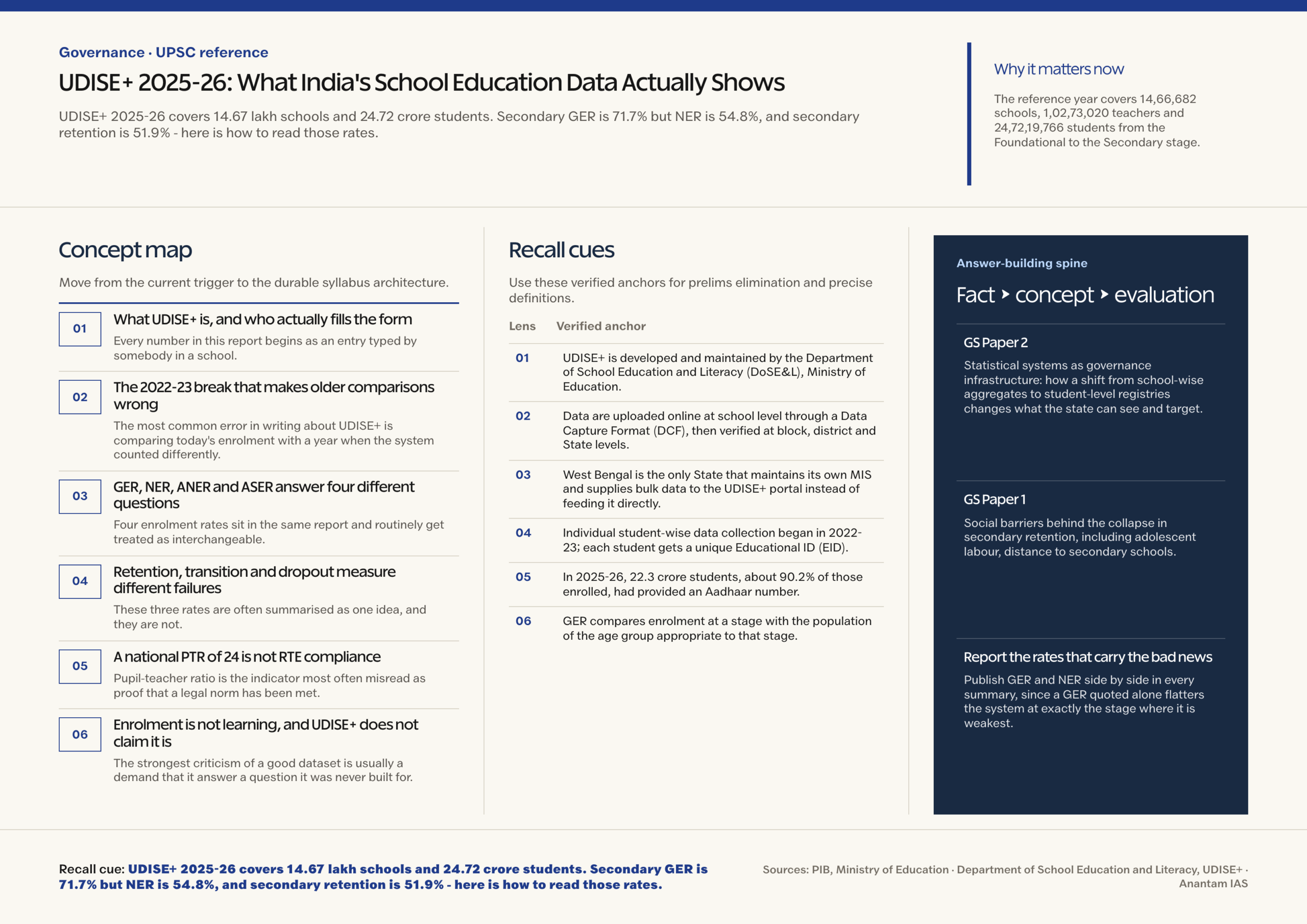
A PIB backgrounder on 17 August 2026 returned attention to the UDISE+ 2025-26 school education report released by the Ministry of Education.
- This is the first edition reported entirely in the NEP 5+3+3+4 structure.
- Secondary GER is 71.7%. Secondary NER is 54.8%.
- Secondary retention is 51.9%, still the weakest link in the chain.
- UDISE+ measures participation, staff and facilities. It does not measure learning.
- Almost every official claim about NEP implementation now leans on this dataset.
- The useful skill is knowing which rate answers which question.
- Comparing today’s enrolment with pre-2022-23 totals is usually wrong.
UPSC Relevance
Prelims Relevance
- UDISE+ is run by the Department of School Education and Literacy since 2018-19.
- From 2022-23 it collects individual student records, not only school-wise totals.
- GER can exceed 100% because over-age and under-age children are in the numerator.
- NER counts only children of the official age group for that stage.
- A national pupil-teacher ratio is not proof of RTE Schedule compliance in every school.
- Learning is assessed separately, including by PARAKH, not by UDISE+.
Mains Relevance
GS Paper 2
- How an administrative data system shapes the school problems a government can see.
- Why GER, NER and retention can improve together and still describe different failures.
Essay
- Enrolment is not learning, and a good dataset should not be asked to pretend it is.
Background and Context
What UDISE+ is
Every number begins as an entry typed in a school. That is the most useful fact about it.
- UDISE+ is the Union online school-statistics platform, replacing older paper DISE.
- Schools upload through a Data Capture Format against an active UDISE+ code.
- From 2022-23, unique student records cut duplicate and ghost entries.
- That break means headline enrolment is not strictly comparable with earlier years.
- The 2025-26 edition also recasts stages as Foundational, Preparatory, Middle and Secondary.
GER, NER and retention are not one idea
Four rates sit in the same report and get treated as interchangeable. That is where analysis fails.
- GER divides all students at a stage, of any age, by the official age-group population.
- NER keeps only the official age group in the numerator, so it is the tighter participation measure.
- A high GER with a much lower NER means many enrolled children are off-age, or many age-right children are out.
- Retention asks who stayed through the stage. Secondary at 51.9% is the system’s leak.
- Dropout, transition and retention measure different failures. Do not summarise them as one number.
What the report cannot answer
The strongest criticism of a good dataset is usually a demand it was never built to meet.
- UDISE+ does not test reading, arithmetic or science. That is not a defect. It is the design.
- A national pupil-teacher ratio can look fine while single-teacher schools still exist.
- RTE norms are school-level legal standards, not national averages.
- Pair this report with a learning assessment before claiming NEP success.
- For the older architecture of the system, see our note on UDISE.
Averages hide the school that is failing the law
National pupil-teacher ratios are the most misread comfort statistic in the report.
- A countrywide ratio can look better than the RTE Schedule while single-teacher schools remain.
- The RTE norms are school-level duties: thirty to one in primary, thirty-five in upper primary.
- NEP 2020 talks of thirty to one at all levels. That is a recommendation, not the RTE Schedule.
- Zero-enrolment and single-teacher counts are the flags that the average conceals.
- Write the national average only if you also write the tail the average conceals.
Way Forward
Report the rate that carries the bad news
- Lead with secondary NER and retention, not only with GER.
- Publish school-level teacher and enrolment flags, not only national averages.
- Stop comparing post-2022-23 student-wise totals with older school-wise totals.
- Read UDISE+ beside PARAKH before writing a learning claim.
Conclusion
- UDISE+ 2025-26 is a better instrument, and some participation numbers have improved.
- The exam skill is matching the rate to the question: GER is not NER, and neither is learning.
- A national average that looks fine is not proof that the school in front of you meets the law.
UPSC Practice Questions
Prelims MCQ 1
With reference to the UDISE+ system and the UDISE+ 2025-26 report, consider the following statements:
- The Gross Enrolment Ratio at a stage can exceed 100 per cent because of over-age and under-age children.
- UDISE+ 2025-26 indicators are strictly comparable with reports up to 2021-22.
- UDISE+ now collects individual student-wise data with a unique educational ID.
How many of the above statements are correct?
(a) Only one (b) Only two (c) All three (d) None
Answer: (b) Only two
Explanation:
Statements 1 and 3 are correct. The 2022-23 shift to student-wise records breaks strict comparability, so statement 2 is wrong.
Prelims MCQ 2
As per the UDISE+ 2025-26 report, the all-India Gross Enrolment Ratio at the Secondary stage was:
(a) 54.8 per cent (b) 71.7 per cent (c) 89.6 per cent (d) 51.9 per cent
Answer: (b) 71.7 per cent
Explanation:
Secondary GER is 71.7%. 54.8% is secondary NER and 51.9% is secondary retention.
UPSC Mains Questions
- UDISE+ 2025-26 reports a secondary GER of 71.7% alongside an NER of 54.8% and retention of 51.9%. Explain what each rate is measuring. (250 words)
- A favourable national pupil-teacher ratio is not evidence of RTE compliance. Discuss. (150 words)
Sources: PIB, Ministry of Education and Department of School Education and Literacy, UDISE+ 2025-26 Report.
Frequently Asked Questions
What is UDISE+?
The Union government’s online school-statistics system, run by the Department of School Education and Literacy, covering schools, teachers, enrolment and facilities.
Why can GER exceed 100%?
The numerator includes every child in that stage, including over-age and under-age students. The denominator is only the official age-group population.
How is NER different from GER?
NER counts only children of the official age for that stage. It is the tighter measure of whether the right-age cohort is actually in school.
Why should older UDISE+ totals not be compared directly?
From 2022-23 the system is student-wise and de-duplicates records, so a fall in headline enrolment can be cleaner counting rather than children leaving.
Source: https://anantamias.com/current-affairs/udise-plus-2025-26-school-education-data/