Why in News?
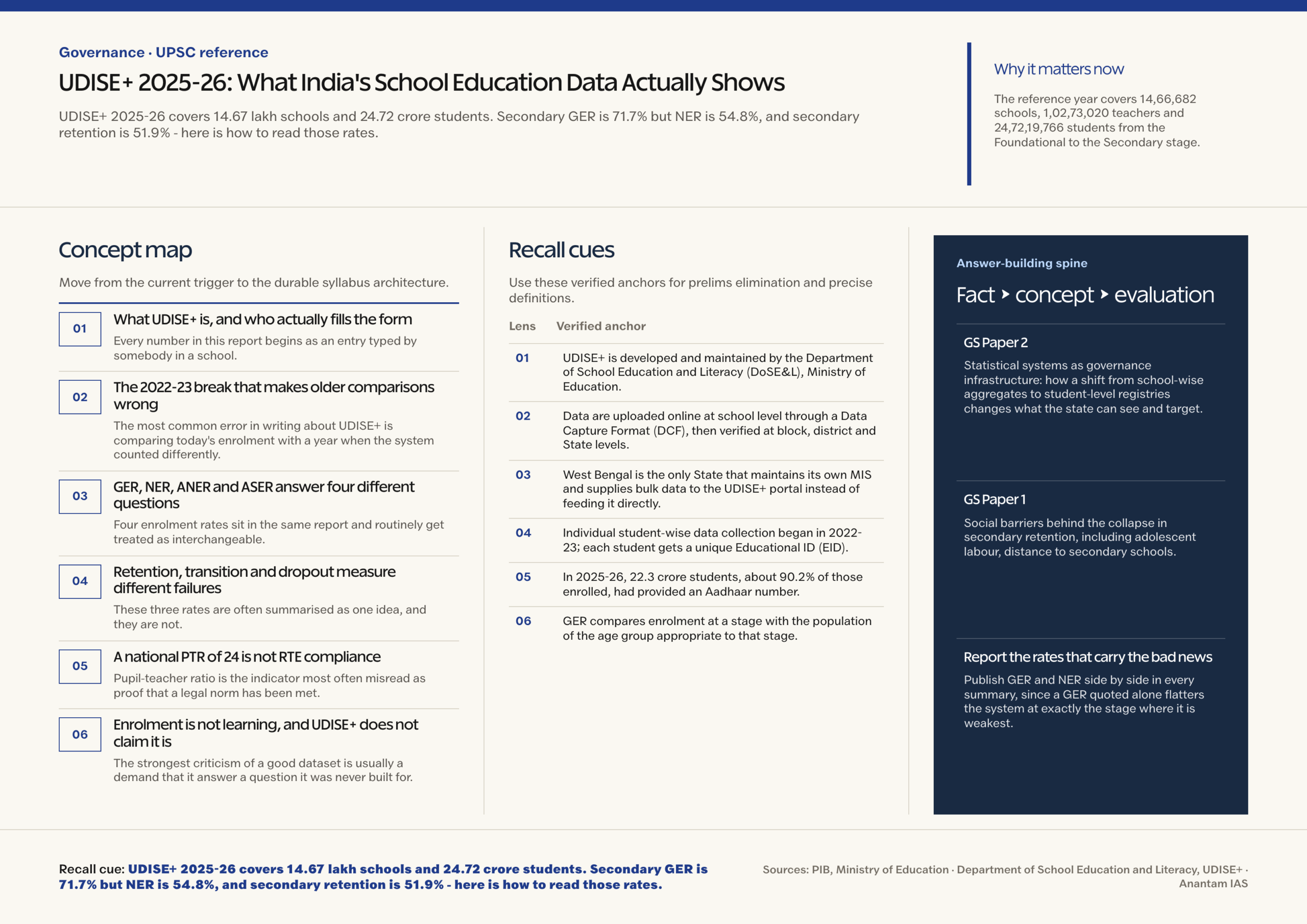
A PIB backgrounder on 17 August 2026 returned attention to the UDISE+ 2025-26 school education report released by the Ministry of Education.
- This is the first edition reported entirely in the NEP 5+3+3+4 structure.
- Secondary GER is 71.7%. Secondary NER is 54.8%.
- Secondary retention is 51.9%, still the weakest link in the chain.
- UDISE+ measures participation, staff and facilities. It does not measure learning.
- Almost every official claim about NEP implementation now leans on this dataset.
- The useful skill is knowing which rate answers which question.
- Comparing today’s enrolment with pre-2022-23 totals is usually wrong.
UPSC Relevance
Prelims Relevance
- UDISE+ is run by the Department of School Education and Literacy since 2018-19.
- From 2022-23 it collects individual student records, not only school-wise totals.
- GER can exceed 100% because over-age and under-age children are in the numerator.
- NER counts only children of the official age group for that stage.
- A national pupil-teacher ratio is not proof of RTE Schedule compliance in every school.
- Learning is assessed separately, including by PARAKH, not by UDISE+.
Mains Relevance
GS Paper 2
- How an administrative data system shapes the school problems a government can see.
- Why GER, NER and retention can improve together and still describe different failures.
Essay
- Enrolment is not learning, and a good dataset should not be asked to pretend it is.
Background and Context
What UDISE+ is
Every number begins as an entry typed in a school. That is the most useful fact about it.
- UDISE+ is the Union online school-statistics platform, replacing older paper DISE.
- Schools upload through a Data Capture Format against an active UDISE+ code.
- From 2022-23, unique student records cut duplicate and ghost entries.
- That break means headline enrolment is not strictly comparable with earlier years.
- The 2025-26 edition also recasts stages as Foundational, Preparatory, Middle and Secondary.
GER, NER and retention are not one idea
Four rates sit in the same report and get treated as interchangeable. That is where analysis fails.
- GER divides all students at a stage, of any age, by the official age-group population.
- NER keeps only the official age group in the numerator, so it is the tighter participation measure.
- A high GER with a much lower NER means many enrolled children are off-age, or many age-right children are out.
- Retention asks who stayed through the stage. Secondary at 51.9% is the system’s leak.
- Dropout, transition and retention measure different failures. Do not summarise them as one number.
What the report cannot answer
The strongest criticism of a good dataset is usually a demand it was never built to meet.
- UDISE+ does not test reading, arithmetic or science. That is not a defect. It is the design.
- A national pupil-teacher ratio can look fine while single-teacher schools still exist.
- RTE norms are school-level legal standards, not national averages.
- Pair this report with a learning assessment before claiming NEP success.
- For the older architecture of the system, see our note on UDISE.
Averages hide the school that is failing the law
National pupil-teacher ratios are the most misread comfort statistic in the report.
- A countrywide ratio can look better than the RTE Schedule while single-teacher schools remain.
- The RTE norms are school-level duties: thirty to one in primary, thirty-five in upper primary.
- NEP 2020 talks of thirty to one at all levels. That is a recommendation, not the RTE Schedule.
- Zero-enrolment and single-teacher counts are the flags that the average conceals.
- Write the national average only if you also write the tail the average conceals.
Way Forward
Report the rate that carries the bad news
- Lead with secondary NER and retention, not only with GER.
- Publish school-level teacher and enrolment flags, not only national averages.
- Stop comparing post-2022-23 student-wise totals with older school-wise totals.
- Read UDISE+ beside PARAKH before writing a learning claim.
Conclusion
- UDISE+ 2025-26 is a better instrument, and some participation numbers have improved.
- The exam skill is matching the rate to the question: GER is not NER, and neither is learning.
- A national average that looks fine is not proof that the school in front of you meets the law.
UPSC Practice Questions
Prelims MCQ 1
With reference to the UDISE+ system and the UDISE+ 2025-26 report, consider the following statements:
- The Gross Enrolment Ratio at a stage can exceed 100 per cent because of over-age and under-age children.
- UDISE+ 2025-26 indicators are strictly comparable with reports up to 2021-22.
- UDISE+ now collects individual student-wise data with a unique educational ID.
How many of the above statements are correct?
(a) Only one (b) Only two (c) All three (d) None
Answer: (b) Only two
Explanation:
Statements 1 and 3 are correct. The 2022-23 shift to student-wise records breaks strict comparability, so statement 2 is wrong.
Prelims MCQ 2
As per the UDISE+ 2025-26 report, the all-India Gross Enrolment Ratio at the Secondary stage was:
(a) 54.8 per cent (b) 71.7 per cent (c) 89.6 per cent (d) 51.9 per cent
Answer: (b) 71.7 per cent
Explanation:
Secondary GER is 71.7%. 54.8% is secondary NER and 51.9% is secondary retention.
UPSC Mains Questions
- UDISE+ 2025-26 reports a secondary GER of 71.7% alongside an NER of 54.8% and retention of 51.9%. Explain what each rate is measuring. (250 words)
- A favourable national pupil-teacher ratio is not evidence of RTE compliance. Discuss. (150 words)
Sources: PIB, Ministry of Education and Department of School Education and Literacy, UDISE+ 2025-26 Report.
Frequently Asked Questions
What is UDISE+?
The Union government’s online school-statistics system, run by the Department of School Education and Literacy, covering schools, teachers, enrolment and facilities.
Why can GER exceed 100%?
The numerator includes every child in that stage, including over-age and under-age students. The denominator is only the official age-group population.
How is NER different from GER?
NER counts only children of the official age for that stage. It is the tighter measure of whether the right-age cohort is actually in school.
Why should older UDISE+ totals not be compared directly?
From 2022-23 the system is student-wise and de-duplicates records, so a fall in headline enrolment can be cleaner counting rather than children leaving.
Tell Google you want more of this.
Add Anantam IAS as a preferred sourceOne tap, and this site shows up more often in your own Top Stories, AI Overviews and AI Mode. Remove it any time.