Daily Digest
UPSC · Civil Services Examination
Current Affairs · Thursday, 18 December 2025
Current affairs curated and edited by Anantam IAS faculty — pulled from The Hindu, PIB, IDSA, Foreign Affairs and the ministries. Read, annotate, revise.
Old Rajinder Nagar · Delhi 110005 · anantamias.com
Aravalli Issue


Context:
In June 2025, the Supreme Court of India issued important directions on the protection and uniform definition of the Aravalli hills and ranges, covering Delhi, Haryana, Rajasthan and Gujarat.
UPSC Relevance:
Environment
UPSC PYQ:
What is oil pollution? What are its impacts on the marine ecosystem? In what way is oil pollution particularly harmful for a country like India?
Background:
Issues relating to definition of Aravali Hills and Ranges (2025)
- A Supreme Court ruling adopts a narrow new definition of the Aravalli hills based on a 100-metre elevation threshold.
- The move will exclude over 90% of the range from protection, enabling large-scale mining.
- Further destruction could accelerate desertification from the Thar desert into Delhi-NCR and beyond.
- Vast tracts in Haryana, Rajasthan and Gujarat already show severe ecological degradation from mining and stone-crushing.
The new definition of ‘Aravalli Hills’ in the 692 kilometre range spread across north-west India is ‘any landform located in the Aravalli districts, having an elevation of 100 metres or more from the local relief’.
Issue in uniform definition,
The acceptance of the above “uniform definition of the Aravalli Hills” by the bench will be catastrophic for this already beleaguered landscape, as it will exclude more than 90 per cent of the Aravallis, including vast stretches of low-lying scrub hills, grasslands and ridges, for the purpose of mining.

Why are the Aravallis important?
Physical & Ecological Significance
- One of the world’s oldest fold mountains (Pre-Cambrian origin).
- Acts as a natural barrier against the eastward spread of the Thar Desert.
- Influences monsoon circulation and local rainfall patterns.
- Crucial for groundwater recharge → fractured quartzite and weathered rock systems store aquifers.
- Supports dry deciduous forests, wildlife corridors (leopards, hyenas, birds).
Human & Environmental Services
- Prevents desertification of the Indo-Gangetic Plain.
- Regulates micro-climate of NCR, Rajasthan and Haryana.
- Acts as a carbon sink and dust-storm barrier.
- Historical mining (quartzite, marble, limestone) → irreversible ecological damage.
Challenges with Aravallis?
Shrinking Hill Area:
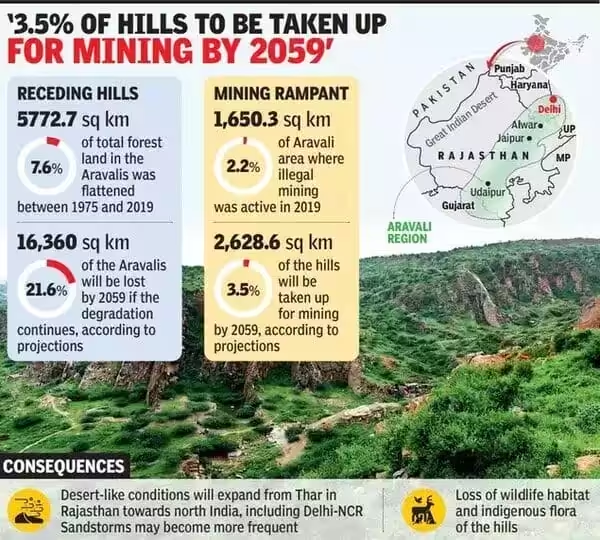
- Between 1975 and 2019, approximately 8% of the Aravalli hill system (about 5,770 sq km) was lost.
- Nearly 5% of this area turned into barren land, while around 1% was absorbed by expanding human settlements.
- The degradation of the Aravallis has weakened their role as a natural barrier, allowing the Thar Desert to advance towards the National Capital Region (NCR).
- This has intensified desertification, worsened air pollution, and contributed to irregular climatic patterns in north-west India.
Expansion of Mining Activities:
- Land under mining increased from 1.8% in 1975 to 2.2% in 2019.
- Rapid urban growth combined with poorly regulated mining has been a major driver of ecological damage.
- More than one-fourth of the Aravalli region and 31 hill ranges in Rajasthan have reportedly disappeared due to illegal quarrying.
- Mining dust is a significant source of respirable particulate matter (RPM), contributing heavily to air pollution in the NCR.
Growth of Human Settlements:
- Built-up areas expanded sharply from 4.5% in 1975 to 13.3% in 2019.
- This expansion has resulted in habitat fragmentation and increased pressure on fragile ecosystems.
Decline in Forest Cover:
- In the central Aravalli range, forest cover declined by nearly 32% between 1975 and 2019, largely due to conversion into agricultural land.
- Between 1999 and 2019, forest area reduced by around 0.9% of the total landscape.
- The average annual deforestation rate during this period stood at approximately 0.57%, indicating persistent ecological stress.
Impact on Water Resources:
- Water bodies initially expanded from 1.7% in 1975 to 1.9% in 1989, but have declined steadily thereafter.
- Deep and unscientific mining has breached underground aquifers, disrupting natural water flows.
- This has led to the drying up of lakes and streams, while abandoned mining pits have created artificial water depressions, altering local hydrology.
Role of Protected Areas:
- Wildlife sanctuaries such as Todgarh–Raoli and Kumbhalgarh in the central Aravalli range have played a protective role.
- These areas recorded comparatively lower forest loss, highlighting the effectiveness of eco-sensitive zone protection.
Vegetation Health Indicators:
- The Enhanced Vegetation Index (EVI) shows values between 0 and –0.2 in parts of the upper central Aravalli region, particularly Nagaur district, indicating poor and stressed vegetation cover.
Future Projections:
- By 2059, total degradation of the Aravalli landscape is projected to reach around 22% (over 16,000 sq km).
- Nearly 3.5% of the total area (about 2,630 sq km) is expected to be brought under mining if current trends continue.
Other Major Ecological Challenges:
- Loss of natural forest cover has intensified human–wildlife conflicts, especially near expanding settlements.
- There has been a sharp decline in biodiversity, including species such as leopards, striped hyenas, golden jackals, and other wildlife.
- Several rivers originating from the Aravallis, including Banas, Luni, Sahibi and Sakhi, have either dried up or become seasonal.
Central Empowered Committee Recommendations:
- The Central Empowered Committee proposed a science-based, multi-layered strategy for protecting the Aravalli’s. Key recommendations included:
- Comprehensive scientific mapping of the Aravalli range across all States.
- Macro-level environmental impact assessment of mining activities.
- Strict prohibition of mining in ecologically sensitive zones such as wildlife corridors, aquifer recharge areas, water bodies, and protected habitats.
- No new mining leases or renewals until proper mapping and assessments are completed.
- Tight regulation of stone-crushing units contributing to air pollution.
Why was a uniform definition of Aravallis needed?
Problem Earlier
- States used narrow, selective definitions to permit mining.
- Forest classification excluded many degraded or low-height hills.
- Result: Legalised ecological destruction
Supreme Court’s Direction
- Use scientific, geomorphological criteria, not administrative convenience.
- Hills to be identified using natural formations, not revenue records alone.
Is mining completely banned in the Aravallis?
No complete blanket ban
- Existing legal mines may continue under strict regulation.
- New mining → severely restricted / prohibited in ecologically sensitive zones.
Court’s calibrated approach
- Balance between:
- Environmental protection
- Existing legal rights
- Economic considerations
Mining allowed only if:
- Strictly monitored
- Environmentally justified
- Scientifically assessed
New Government Initiative: “Green Wall Project”
Key Features:
- Launched June 2025.
- Aim: Restore 26 million hectares of degraded land by 2030.
- Aravallis identified as priority ecological zone.
- Focus on:
- Afforestation
- Landscape restoration
- Desertification control
International Link:
Aligns with UN Convention to Combat Desertification (UNCCD) commitments.
Source: https://anantamias.com/current-affairs/aravalli-issue/
About Ethanol Issue

Context:
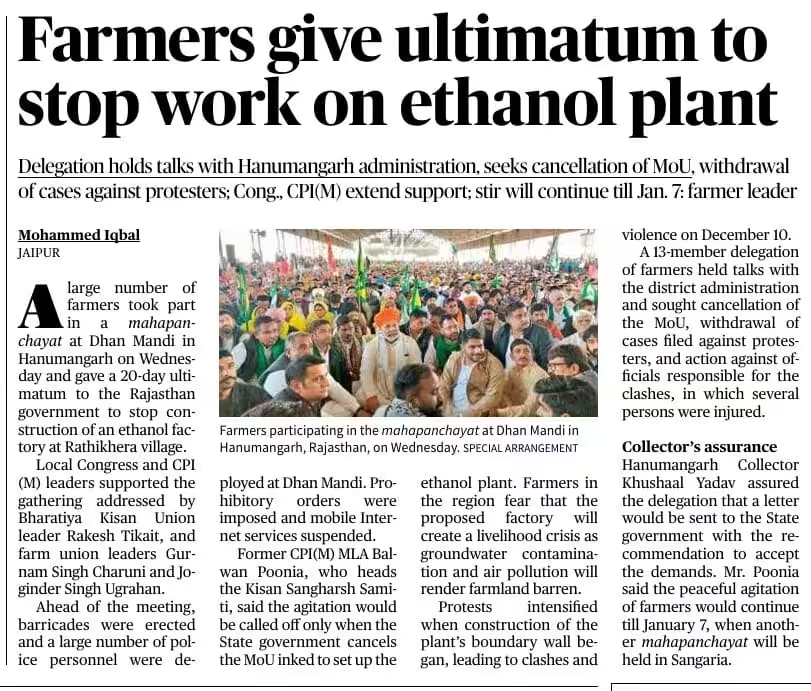
Farmers in Hanumangarh district, Rajasthan, have issued a 20-day ultimatum to the State government to halt construction of an ethanol plant at Rathikhera village. They are demanding cancellation of the MoU, withdrawal of cases against protesters, and action against officials involved in clashes.
UPSC Relevance:
Environment
UPSC PYQ:
Q. According to India’s National Policy on Biofuels, which of the following can be used as raw materials for the production of biofuels? (2020)
- Cassava
- Damaged wheat grains
- Groundnut seeds
- Horse gram
- Rotten potatoes
- Sugar beet
Select the correct answer using the code given below:
(a) 1, 2, 5 and 6 only
(b) 1, 3, 4 and 6 only
(c) 2, 3, 4 and 5 only
(d) 1, 2, 3, 4, 5 and 6
About Ethanol Issue:
The ethanol plant, part of India’s Ethanol Blended Petrol (EBP) Programme, is being opposed due to fears of:
- Long-term land degradation
- Groundwater depletion
- Water contamination
- Air pollution
Farmers’ Concerns:
Environmental & Resource Concerns
- Groundwater stress in an already semi-arid region like Hanumangarh.
- Risk of industrial effluents contaminating aquifers.
- Fear that pollution will render farmland unproductive.
Livelihood Concerns
- Agriculture is the primary economic activity in the region.
- Farmers argue that industrial activity may create short-term jobs but cause long-term agrarian distress.
- Loss of soil fertility threatens food security and rural income.
Procedural Concerns
- Demand for withdrawal of police cases and accountability for clashes.
- Alleged lack of prior consultation with local communities.
- Opposition to MoU being signed without adequate social and environmental impact assessment.
Government’s Position:
- The district administration has assured that:
- Prohibitory orders and internet shutdowns indicate law and order sensitivity of the issue.
- Farmers’ demands will be forwarded to the State government.
- No immediate cancellation, but continued dialogue.
Case Study: Andhra Pradesh
Buoyed by the encouraging results of the Ethanol Blended Petrol (EBP) programme, which was introduced in India as a pilot project in 2001, the Central government in 2020 decided to advance the target of 20% ethanol blending in petrol from 2030 to 2025 as the way towards a greener future. As of 2024, the blend percentage was 15% in the country. To meet the required target of 20% ethanol in petrol by 2025-26, 1,016 crore litres of ethanol would be required. All ethanol production plants and distilleries fall under the ‘red category’, which means that they have a pollution score of 60 or more, as per Central government norms. Farmers also fear that the water-guzzling factories will leave them with no water for their crops. A grain-based ethanol factory requires 8-12 litres of water per litre of ethanol. Ethanol Blended Petrol (EBP) programme refuse to die down in Andhra Pradesh, with scientists and farmers saying water resources are depleting and emissions from factories are polluting the air, water, and soil.
Source: https://anantamias.com/current-affairs/about-ethanol-issue/
Government tables Bill to replace MGNREGA amid protests

Why in News:
The government on Tuesday (December 16, 2025) introduced the Viksit Bharat Guarantee for Rozgar and Ajeevika Mission (Gramin) (VB-G RAM G) Bill, 2025, which seeks to replace the two-decade-old Mahatma Gandhi National Rural Employment Guarantee Act (MGNREGA).
UPSC Relevance: GS II & GS III
- rights-based welfare, Welfare state vs minimum government debate
- Employment generation and rural distress
- Fiscal federalism and decentralisation
Background and Context
- The Union government has introduced the Viksit Bharat Guarantee for Rozgar and Ajeevika Mission (Gramin) (VB-G RAM G) Bill, 2025.
- The Bill proposes to replace the Mahatma Gandhi National Rural Employment Guarantee Act (MGNREGA), 2005, which has been in force for about 20 years.
- MGNREGA is one of India’s most significant rights-based welfare legislations, guaranteeing 100 days of wage employment to rural households.
Key Features of MGNREGA:
- Legal right to work: Employment must be provided on demand.
- Anchored in Directive Principles of State Policy, especially Articles 39, 41 and 43.
- Demand-driven: Work is generated when people demand it, not capped by budgets.
- Unemployment allowance if work is not provided.
- Centre–State funding pattern: Around 90% Centre share for wages.
- Decentralised implementation through Gram Panchayats.
Government’s Rationale for the New Bill:
Statements by the Government
- Union Rural Development Minister Shivraj Singh Chouhan argued that:
- The government has done more for rural development than previous regimes.The new law aligns with Gandhian philosophy and seeks to build “Ram Rajya” in villages.
- Emphasis is on:
- Holistic village developmentBalance between agriculture and labour
- Livelihoods (Ajeevika) rather than only wage employment
- The government maintains that the Bill reflects the ideals of Mahatma Gandhi, even though his name has been removed from the Act.
Major Changes Proposed under VB-G RAM G (as alleged by Opposition)
Shift from demand-driven to budget-driven model:
- Erosion of the “Right to Work” (Demand-Driven vs. Supply-Driven):
- MGNREGA is a rights-based law where the legal right to work is triggered by the worker’s demand, and failure to provide work results in a mandatory unemployment allowance.
- Critics argue the shift to Normative Allocation and central control makes the scheme supply-driven and budget-capped. If the state exhausts its “normative allocation,” the legal guarantee is effectively dissolved, weakening the statutory right.
- Reduction in Centre’s funding share from 90% to 60%
- Centre:State split is 60:40 for most states. (90:10 for North-East/Himalayan states).
- Greater centralisation of decision-making
- Replacement of a statutory right with a government “guarantee”
- Promise of 125 days of work, but without clarity on enforceability
| Feature | MGNREGA (2005) | VB-G RAM G Bill (2025) | Significance/Impact |
| Name | Mahatma Gandhi National Rural Employment Guarantee Act | Viksit Bharat Guarantee for Rozgar and Ajeevika Mission (Gramin) | Ideological/Political: Removal of Mahatma Gandhi’s name is a major point of contention. |
| Guarantee | 100 days of wage employment per household. | 125 days of wage employment per household. | Positive: Increases guaranteed work days, theoretically providing more income security. |
| Funding Pattern (General States) | Centre pays 100% of unskilled wage cost. (Effective Centre:State approx 90:10) | Centre:State split is 60:40 for most states. (90:10 for North-East/Himalayan states). | Fiscal Federalism: Shifts a major financial burden onto State governments. |
| Budgeting Model | Demand-Driven (Open-ended entitlement—budget follows demand/need). | Normative Allocation (Top-down, fixed, budget-capped allocation set by the Centre). | Dismantles “Right to Work”: Replaces an open-ended right with a budget-constrained, supply-driven scheme. |
| Work Availability | Guaranteed year-round employment (income shock absorber). | 60-day pause during peak agricultural seasons (sowing/harvesting). | Controversial: Aims to resolve farm labour shortages but denies work when rural distress is often highest. |
| Planning Mechanism | Labour Budget based on local demand (bottom-up). | Viksit Gram Panchayat Plans aggregated into a National Rural Infrastructure Stack. | Centralization vs. Decentralization: Integrates planning with national infra goals (PM Gati Shakti) but centralizes control over work and funds. |
| Focus Areas | Broad range of works, including individual-beneficiary assets. | Narrowed to four thematic domains: Water security, Core rural infrastructure, Livelihood infrastructure, and Climate resilience. | Asset Quality: Prioritizes durable, large-scale, and strategic infrastructure. |
Opposition’s Criticisms:
Weakening of Employment Rights
- Opposition leaders termed MGNREGA a “revolutionary and unanimously passed Act”.
- Allegation that:
- The new Bill dilutes the right-based framework
- Removes legal accountability of the State
- Converts welfare from rights to charity
Federalism Concerns
- Reduction in Centre’s funding share will:
- Increase financial burden on States
- Hurt States already affected by GST compensation delays
- Seen as a violation of fiscal federalism
Centralisation vs Decentralisation
- Decision-making powers allegedly shifted away from:
- Gram Panchayats
- State governments
- Opposed as being against the spirit of 73rd Constitutional Amendment
Symbolism and Legacy
- Removal of Gandhi’s name viewed as:
- An attack on moral and historical legitimacy
- Undermining Gandhian philosophy of dignity of labour
- Opposition leaders accused the government of “ridiculing” the Father of the Nation.
Constitutional and Governance Issues Involved:
Rights-based Welfare vs Executive Discretion
- MGNREGA created a justiciable entitlement
- VB-G RAM G is seen as shifting towards policy-based welfare, weakening accountability
Directive Principles of State Policy
- Article 41: Right to work
- Article 39: Livelihood and economic justice
- Dilution of MGNREGA may weaken DPSP implementation
Cooperative Federalism
- Funding pattern change raises concerns about:
- Fiscal autonomy of States
- Vertical imbalance in Centre–State relations
Democratic Process
- Introduction of a major welfare reform without:
- Wider consultation
- Committee scrutiny
- Raises questions on legislative due process
Conclusion
The VB-G RAM G Bill, 2025 marks a major shift in India’s rural employment policy. While the government projects it as a reform aligned with Gandhian ideals and village development, the Opposition views it as a rollback of constitutional, legal and federal safeguards embedded in MGNREGA. The debate reflects a broader ideological contest between rights-based welfare and centrally controlled guarantees.
Source: https://anantamias.com/current-affairs/government-tables-bill-to-replace-mgnrega-amid-protests/