Context:
In June 2025, the Supreme Court of India issued important directions on the protection and uniform definition of the Aravalli hills and ranges, covering Delhi, Haryana, Rajasthan and Gujarat.
UPSC Relevance:
Environment
UPSC PYQ:
What is oil pollution? What are its impacts on the marine ecosystem? In what way is oil pollution particularly harmful for a country like India?
Background:
Issues relating to definition of Aravali Hills and Ranges (2025)
- A Supreme Court ruling adopts a narrow new definition of the Aravalli hills based on a 100-metre elevation threshold.
- The move will exclude over 90% of the range from protection, enabling large-scale mining.
- Further destruction could accelerate desertification from the Thar desert into Delhi-NCR and beyond.
- Vast tracts in Haryana, Rajasthan and Gujarat already show severe ecological degradation from mining and stone-crushing.
The new definition of ‘Aravalli Hills’ in the 692 kilometre range spread across north-west India is ‘any landform located in the Aravalli districts, having an elevation of 100 metres or more from the local relief’.
Issue in uniform definition,
The acceptance of the above “uniform definition of the Aravalli Hills” by the bench will be catastrophic for this already beleaguered landscape, as it will exclude more than 90 per cent of the Aravallis, including vast stretches of low-lying scrub hills, grasslands and ridges, for the purpose of mining.

Why are the Aravallis important?
Physical & Ecological Significance
- One of the world’s oldest fold mountains (Pre-Cambrian origin).
- Acts as a natural barrier against the eastward spread of the Thar Desert.
- Influences monsoon circulation and local rainfall patterns.
- Crucial for groundwater recharge → fractured quartzite and weathered rock systems store aquifers.
- Supports dry deciduous forests, wildlife corridors (leopards, hyenas, birds).
Human & Environmental Services
- Prevents desertification of the Indo-Gangetic Plain.
- Regulates micro-climate of NCR, Rajasthan and Haryana.
- Acts as a carbon sink and dust-storm barrier.
- Historical mining (quartzite, marble, limestone) → irreversible ecological damage.
Challenges with Aravallis?
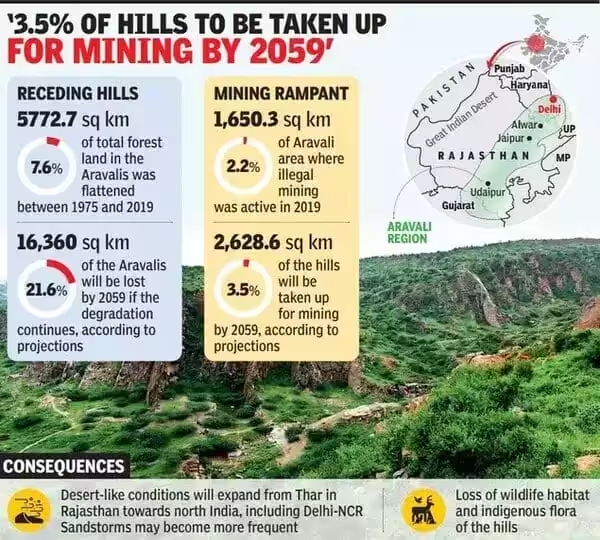
Shrinking Hill Area:
- Between 1975 and 2019, approximately 8% of the Aravalli hill system (about 5,770 sq km) was lost.
- Nearly 5% of this area turned into barren land, while around 1% was absorbed by expanding human settlements.
- The degradation of the Aravallis has weakened their role as a natural barrier, allowing the Thar Desert to advance towards the National Capital Region (NCR).
- This has intensified desertification, worsened air pollution, and contributed to irregular climatic patterns in north-west India.
Expansion of Mining Activities:
- Land under mining increased from 1.8% in 1975 to 2.2% in 2019.
- Rapid urban growth combined with poorly regulated mining has been a major driver of ecological damage.
- More than one-fourth of the Aravalli region and 31 hill ranges in Rajasthan have reportedly disappeared due to illegal quarrying.
- Mining dust is a significant source of respirable particulate matter (RPM), contributing heavily to air pollution in the NCR.
Growth of Human Settlements:
- Built-up areas expanded sharply from 4.5% in 1975 to 13.3% in 2019.
- This expansion has resulted in habitat fragmentation and increased pressure on fragile ecosystems.
Decline in Forest Cover:
- In the central Aravalli range, forest cover declined by nearly 32% between 1975 and 2019, largely due to conversion into agricultural land.
- Between 1999 and 2019, forest area reduced by around 0.9% of the total landscape.
- The average annual deforestation rate during this period stood at approximately 0.57%, indicating persistent ecological stress.
Impact on Water Resources:
- Water bodies initially expanded from 1.7% in 1975 to 1.9% in 1989, but have declined steadily thereafter.
- Deep and unscientific mining has breached underground aquifers, disrupting natural water flows.
- This has led to the drying up of lakes and streams, while abandoned mining pits have created artificial water depressions, altering local hydrology.
Role of Protected Areas:
- Wildlife sanctuaries such as Todgarh–Raoli and Kumbhalgarh in the central Aravalli range have played a protective role.
- These areas recorded comparatively lower forest loss, highlighting the effectiveness of eco-sensitive zone protection.
Vegetation Health Indicators:
- The Enhanced Vegetation Index (EVI) shows values between 0 and –0.2 in parts of the upper central Aravalli region, particularly Nagaur district, indicating poor and stressed vegetation cover.
Future Projections:
- By 2059, total degradation of the Aravalli landscape is projected to reach around 22% (over 16,000 sq km).
- Nearly 3.5% of the total area (about 2,630 sq km) is expected to be brought under mining if current trends continue.
Other Major Ecological Challenges:
- Loss of natural forest cover has intensified human–wildlife conflicts, especially near expanding settlements.
- There has been a sharp decline in biodiversity, including species such as leopards, striped hyenas, golden jackals, and other wildlife.
- Several rivers originating from the Aravallis, including Banas, Luni, Sahibi and Sakhi, have either dried up or become seasonal.
Central Empowered Committee Recommendations:
- The Central Empowered Committee proposed a science-based, multi-layered strategy for protecting the Aravalli’s. Key recommendations included:
- Comprehensive scientific mapping of the Aravalli range across all States.
- Macro-level environmental impact assessment of mining activities.
- Strict prohibition of mining in ecologically sensitive zones such as wildlife corridors, aquifer recharge areas, water bodies, and protected habitats.
- No new mining leases or renewals until proper mapping and assessments are completed.
- Tight regulation of stone-crushing units contributing to air pollution.
Why was a uniform definition of Aravallis needed?
Problem Earlier
- States used narrow, selective definitions to permit mining.
- Forest classification excluded many degraded or low-height hills.
- Result: Legalised ecological destruction
Supreme Court’s Direction
- Use scientific, geomorphological criteria, not administrative convenience.
- Hills to be identified using natural formations, not revenue records alone.
Is mining completely banned in the Aravallis?
No complete blanket ban
- Existing legal mines may continue under strict regulation.
- New mining → severely restricted / prohibited in ecologically sensitive zones.
Court’s calibrated approach
- Balance between:
- Environmental protection
- Existing legal rights
- Economic considerations
Mining allowed only if:
- Strictly monitored
- Environmentally justified
- Scientifically assessed
New Government Initiative: “Green Wall Project”
Key Features:
- Launched June 2025.
- Aim: Restore 26 million hectares of degraded land by 2030.
- Aravallis identified as priority ecological zone.
- Focus on:
- Afforestation
- Landscape restoration
- Desertification control
International Link:
Aligns with UN Convention to Combat Desertification (UNCCD) commitments.
Tell Google you want more of this.
Add Anantam IAS as a preferred sourceOne tap, and this site shows up more often in your own Top Stories, AI Overviews and AI Mode. Remove it any time.