Context:
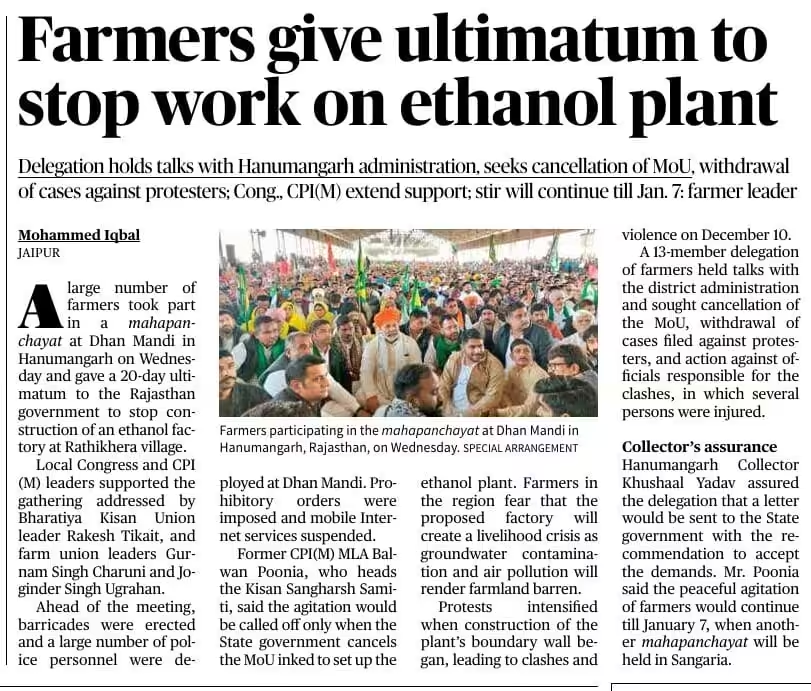
Farmers in Hanumangarh district, Rajasthan, have issued a 20-day ultimatum to the State government to halt construction of an ethanol plant at Rathikhera village. They are demanding cancellation of the MoU, withdrawal of cases against protesters, and action against officials involved in clashes.
UPSC Relevance:
Environment
UPSC PYQ:
Q. According to India’s National Policy on Biofuels, which of the following can be used as raw materials for the production of biofuels? (2020)
- Cassava
- Damaged wheat grains
- Groundnut seeds
- Horse gram
- Rotten potatoes
- Sugar beet
Select the correct answer using the code given below:
(a) 1, 2, 5 and 6 only
(b) 1, 3, 4 and 6 only
(c) 2, 3, 4 and 5 only
(d) 1, 2, 3, 4, 5 and 6
About Ethanol Issue:
The ethanol plant, part of India’s Ethanol Blended Petrol (EBP) Programme, is being opposed due to fears of:
- Long-term land degradation
- Groundwater depletion
- Water contamination
- Air pollution
Farmers’ Concerns:
Environmental & Resource Concerns
- Groundwater stress in an already semi-arid region like Hanumangarh.
- Risk of industrial effluents contaminating aquifers.
- Fear that pollution will render farmland unproductive.
Livelihood Concerns
- Agriculture is the primary economic activity in the region.
- Farmers argue that industrial activity may create short-term jobs but cause long-term agrarian distress.
- Loss of soil fertility threatens food security and rural income.
Procedural Concerns
- Demand for withdrawal of police cases and accountability for clashes.
- Alleged lack of prior consultation with local communities.
- Opposition to MoU being signed without adequate social and environmental impact assessment.
Government’s Position:
- The district administration has assured that:
- Prohibitory orders and internet shutdowns indicate law and order sensitivity of the issue.
- Farmers’ demands will be forwarded to the State government.
- No immediate cancellation, but continued dialogue.
Case Study: Andhra Pradesh
Buoyed by the encouraging results of the Ethanol Blended Petrol (EBP) programme, which was introduced in India as a pilot project in 2001, the Central government in 2020 decided to advance the target of 20% ethanol blending in petrol from 2030 to 2025 as the way towards a greener future. As of 2024, the blend percentage was 15% in the country. To meet the required target of 20% ethanol in petrol by 2025-26, 1,016 crore litres of ethanol would be required. All ethanol production plants and distilleries fall under the ‘red category’, which means that they have a pollution score of 60 or more, as per Central government norms. Farmers also fear that the water-guzzling factories will leave them with no water for their crops. A grain-based ethanol factory requires 8-12 litres of water per litre of ethanol. Ethanol Blended Petrol (EBP) programme refuse to die down in Andhra Pradesh, with scientists and farmers saying water resources are depleting and emissions from factories are polluting the air, water, and soil.
Tell Google you want more of this.
Add Anantam IAS as a preferred sourceOne tap, and this site shows up more often in your own Top Stories, AI Overviews and AI Mode. Remove it any time.