Daily Digest
UPSC · Civil Services Examination
Current Affairs · Sunday, 2 August 2026
Current affairs curated and edited by Anantam IAS faculty — pulled from The Hindu, PIB, IDSA, Foreign Affairs and the ministries. Read, annotate, revise.
Old Rajinder Nagar · Delhi 110005 · anantamias.com
Nasha Mukt Yuva Campaign: A National Youth-Led Drug Prevention Push
Why in News?
The Prime Minister’s Office said the Prime Minister would launch the Nasha Mukt Yuva for Viksit Bharat Sankalp Abhiyan by video conference at 11 AM on 2 August 2026.
- The campaign is planned for 100 weeks, with public activities scheduled every Sunday across the country.
- The launch programme is expected to connect youth from more than 10,000 locations through virtual participation.
- Participants include MY Bharat volunteers, National Service Scheme volunteers, youth clubs, schools, colleges and universities.
- The official list also includes NGOs, youth wings of industry associations and more than 125 partner spiritual organisations.
- Planned activities include sports events, walkathons, meditation sessions, cultural programmes, awareness drives, street plays, discussion forums and art competitions.
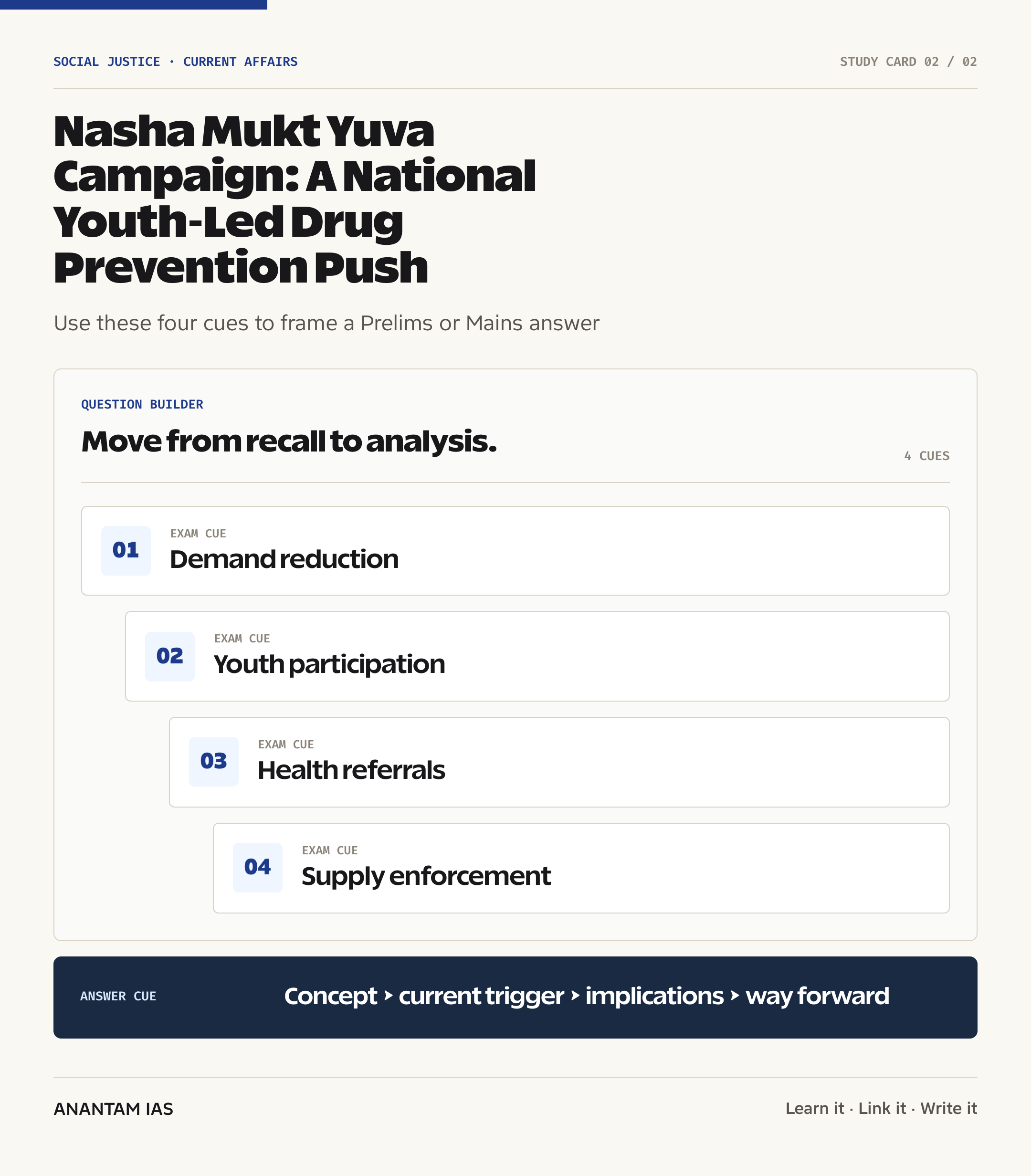
- The campaign makes drug-demand reduction, not seizure or prosecution, its immediate policy entry point: it seeks to prevent initiation and change social behaviour.
- Its youth-led design tests whether peer influence and repeated local activity can turn a central message into sustained community action.
- Drug control requires separate but coordinated tracks: prevention and rehabilitation, clinical treatment, and supply-side enforcement against trafficking networks.
UPSC Relevance
Prelims Relevance
- Nasha Mukt Yuva for Viksit Bharat Sankalp Abhiyan: a 100-week nationwide public-participation campaign announced for launch on 2 August 2026.
- MY Bharat: a national youth platform under the Department of Youth Affairs, Ministry of Youth Affairs and Sports; it mobilises volunteering and youth participation.
- Nasha Mukt Bharat Abhiyaan: launched by the Ministry of Social Justice and Empowerment on 15 August 2020 in 272 identified districts and extended nationwide in August 2023.
- National Action Plan for Drug Demand Reduction: the Social Justice Ministry’s umbrella scheme for prevention, counselling, treatment support, aftercare and rehabilitation.
- Narcotics Control Bureau: the apex coordinating and enforcement agency under the Ministry of Home Affairs for action under the NDPS framework.
- NDPS Act, 1985: prohibits specified activities involving narcotic drugs and psychotropic substances except for medical and scientific purposes, while distributing regulatory and enforcement responsibilities.
Mains Relevance
GS Paper 2
- Social justice: substance dependence can deepen family distress, stigma, school exclusion and loss of livelihood, so prevention must connect people to care rather than moralise their condition.
- Health governance: community awareness works best when referral pathways lead to counselling, de-addiction treatment, aftercare and rehabilitation.
GS Paper 1
- Indian society and youth: peer networks, family environments, educational institutions and community norms can either increase vulnerability or strengthen protective behaviour.
- Social change: cultural forms such as street theatre, sport and creative competitions can carry prevention messages in local languages, but visibility alone doesn’t guarantee access to treatment.
Essay
- A healthy nation is built not only in hospitals but also through everyday social choices.
Background and Context
What the 100-week campaign is designed to do
The new campaign uses repetition and local participation to keep drug prevention in public view.
- Its core mechanism is a calendar of weekly Sunday activities, rather than a single commemorative event.
- Sports, walkathons and meditation frame a drug-free life through healthy alternatives and collective practice.
- Street plays, art competitions, cultural programmes and discussion forums allow the prevention message to travel through local languages and familiar formats.
- Community-engagement programmes seek to turn participants from a passive audience into peer messengers within campuses, youth clubs and neighbourhoods.
- The launch-day reach of more than 10,000 locations is an announced participation footprint; it shouldn’t be treated as a verified impact measure.
Demand reduction is different from supply control
UPSC answers score better when they separate the people-facing health track from the market-facing enforcement track.
- Demand reduction seeks to prevent first use, delay initiation, reduce harmful use, motivate treatment and support recovery and social reintegration.
- Supply reduction targets cultivation, manufacture, diversion, trafficking, illicit finance and distribution through intelligence, policing, customs and prosecution.
- The Ministry of Social Justice and Empowerment leads the national demand-reduction architecture, including outreach, capacity building and rehabilitation support.
- The Ministry of Health and Family Welfare supports clinical treatment through government health institutions and specialist drug-dependence services.
- The Narcotics Control Bureau under the Ministry of Home Affairs coordinates drug-law enforcement and action by central and state agencies under the NDPS framework.
How it fits the Nasha Mukt Bharat architecture
The Sankalp Abhiyan adds a youth-mobilisation layer to an existing national demand-reduction ecosystem.
- The Nasha Mukt Bharat Abhiyaan was launched on 15 August 2020 in 272 identified vulnerable districts.
- It expanded to 372 districts in August 2022 and has been implemented in all districts since 15 August 2023, according to the Social Justice Ministry’s official FAQ.
- NMBA focuses on awareness in schools, universities and communities, identification of people with substance dependence, counselling, treatment linkages and service-provider capacity.
- NMBA sits within the National Action Plan for Drug Demand Reduction, whose scope includes prevention, counselling, de-addiction treatment, aftercare, rehabilitation, training and research.
- The new 100-week initiative should be understood as a current youth participation campaign; the official launch release doesn’t describe it as a substitute for NMBA or as a new enforcement programme.
Why youth participation can matter
Young people can shape the social environments in which substance use is normalised, discouraged or discussed without stigma.
- Peer-led conversations may make prevention messages more credible than one-way official communication, especially in schools, colleges and youth clubs.
- Repeated local activities can create protective routines, belonging and access to trusted adults, all of which matter for early prevention.
- MY Bharat’s platform gives the State a network for registration, volunteering and campaign coordination across public, non-profit and community partners.
- The participation of educational institutions and civil society widens reach, while industry and spiritual groups add organisational networks outside government.
- But peer ambassadors need training on confidentiality, referral and non-stigmatising language; they aren’t counsellors or clinicians.
Way Forward
Connect awareness to care
- Give every event a clear, confidential route to screening, counselling, treatment and rehabilitation through verified local services.
- Train volunteers to recognise warning signs and make safe referrals without diagnosing, shaming or publicly identifying a person.
- Publish a simple monitoring framework separating inputs, reach, referrals and outcomes so event volume isn’t confused with behaviour change.
- Use anonymous baseline and follow-up surveys, while protecting minors and sensitive health data.
Conclusion
- The Nasha Mukt Yuva campaign’s strongest idea is continuity: a 100-week public-participation calendar can keep prevention in campuses and communities long after the launch broadcast ends.
- Its real test is the bridge from awareness to care.
UPSC Practice Questions
Prelims MCQ 1
With reference to India’s drug-control architecture, consider the following statements:
- Drug-demand reduction is primarily handled by the Ministry of Social Justice and Empowerment.
- The Narcotics Control Bureau functions under the Ministry of Home Affairs.
- Article 47 directs the State to work toward prohibiting intoxicating drugs injurious to health, except for medicinal purposes.
How many of the above statements are correct?
(a) Only one (b) Only two (c) All three (d) None
Answer: (c) All three
Explanation:
All three statements are correct. Social Justice leads the demand-reduction track, NCB is under the Home Ministry, and Article 47 supplies the constitutional public-health direction.
Prelims MCQ 2
Which one of the following best describes the immediate focus of the Nasha Mukt Yuva for Viksit Bharat Sankalp Abhiyan?
(a) Licensing the medical use of narcotic drugs (b) Youth-led awareness and public participation against substance abuse (c) Investigation of cross-border narcotics trafficking (d) Regulation of pharmaceutical exports
Answer: (b) Youth-led awareness and public participation against substance abuse
Explanation:
The 100-week campaign centres on weekly youth and community activities for prevention and awareness. It isn’t an enforcement or pharmaceutical-licensing programme.
UPSC Mains Questions
- Drug control is not a choice between public health and law enforcement but a question of assigning each instrument to the right problem. Examine this statement with reference to India’s demand-reduction, treatment and supply-control architecture.
- Youth-led campaigns can expand the reach of preventive health policy, but participation numbers alone don’t prove social impact. Assess the promise and limits of the Nasha Mukt Yuva for Viksit Bharat Sankalp Abhiyan and suggest an outcome-based implementation framework.
Sources: PIB, Prime Minister's Office and Department of Social Justice and Empowerment.
Frequently Asked Questions
What is the Nasha Mukt Yuva campaign?
It is a nationwide youth-led public-participation initiative against substance abuse. The Prime Minister’s Office announced its launch for 2 August 2026. The campaign is planned for 100 weeks, with activities every Sunday to promote awareness, healthy choices and community action.
How long will the campaign run?
The announced duration is 100 weeks. Weekly activities are to be held every Sunday across the country. The design aims to sustain public engagement through sport, walkathons, meditation, culture, street theatre, discussion, art and other community programmes.
Is it the same as Nasha Mukt Bharat Abhiyaan?
No. Nasha Mukt Bharat Abhiyaan is the Social Justice Ministry’s established demand-reduction programme, launched in 2020 and expanded nationwide in 2023. The 2026 Sankalp Abhiyan is a distinct youth-mobilisation campaign; it fits the wider prevention ecosystem but doesn’t replace NMBA.
Who handles drug-demand reduction in India?
The Ministry of Social Justice and Empowerment leads the national demand-reduction track, including awareness, counselling, rehabilitation support and NAPDDR. The Health Ministry supports clinical treatment, while NCB and other enforcement agencies focus on illicit supply and trafficking.
What is MY Bharat’s role?
MY Bharat is the Department of Youth Affairs’ national youth platform. For this campaign, its volunteer and institutional network helps mobilise young people, educational institutions, youth clubs, civil society, industry groups and partner organisations for weekly local action.
Source: https://anantamias.com/current-affairs/nasha-mukt-yuva-viksit-bharat-campaign/
South China Sea Shoal Rules: China Deepens Its Administrative Control Claim
Why in News?
China issued rules for the national nature reserve it created around Scarborough Shoal , known as Huangyan Dao in China and Bajo de Masinloc or Panatag Shoal in the Philippines.
- China approved the Huangyan Island National Nature Reserve in September 2025 and later published its area and functional zoning.
- China’s National Forestry and Grassland Administration listed a total reserve area of 3,523.67 hectares, comprising a core zone and an experimental zone, with the coral-reef ecosystem as the principal object of protection.
- The latest rules add an operational layer by identifying prohibited or permission-based activities inside the reserve framework.
- The Philippines contests China’s authority at the shoal and continues to rely on UNCLOS and the 2016 arbitral award.
- The development came alongside Chinese military drills near the shoal, making the combination of civil regulation and coercive presence especially significant.
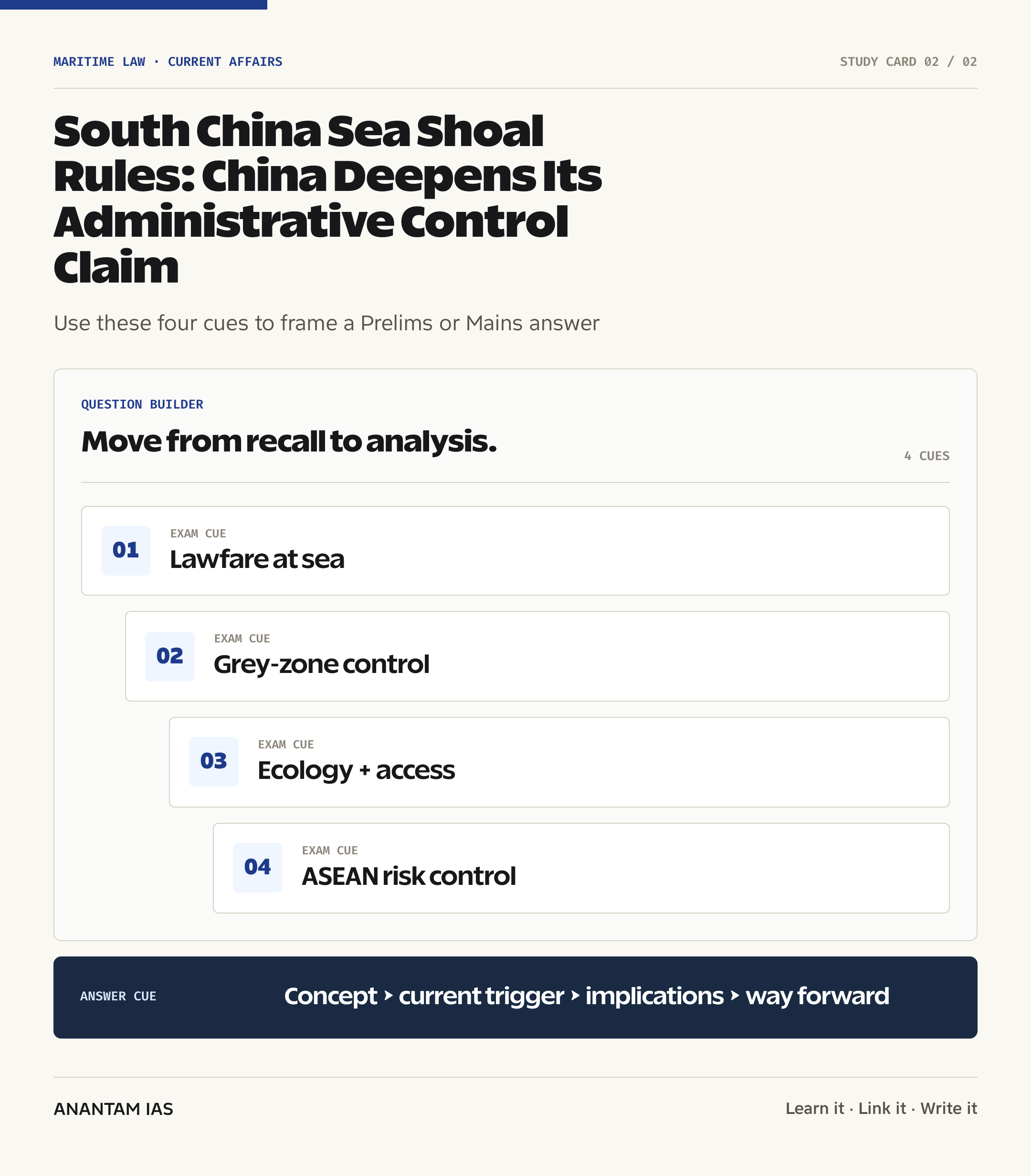
- The dispute shows how a state can use domestic law, environmental administration and coast-guard enforcement to consolidate a claim without a formal change in internationally recognized title.
- It tests the practical value of UNCLOS dispute settlement when one party rejects an award but retains stronger operational control at sea.
- Restrictions on access directly affect traditional fishing communities, which the 2016 tribunal treated as having long-established fishing rights at the shoal.
UPSC Relevance
Prelims Relevance
- Scarborough Shoal is a contested coral atoll in the South China Sea, called Huangyan Dao by China and Bajo de Masinloc or Panatag Shoal by the Philippines.
- The dispute principally involves China and the Philippines; it is distinct from the separate but connected contests over features in the Spratly and Paracel groups.
- The United Nations Convention on the Law of the Sea entered into force in 1994 and provides the legal framework for maritime zones and dispute settlement.
- Under UNCLOS Article 57, an exclusive economic zone may extend up to 200 nautical miles from the relevant baselines.
- Under UNCLOS Article 121(3), rocks that cannot sustain human habitation or economic life of their own generate no EEZ or continental shelf.
- The 2016 tribunal held that Scarborough Shoal is a rock for Article 121(3), so the feature itself cannot generate an EEZ or continental shelf.
Mains Relevance
GS Paper 2
- The tension between rules-based maritime order and unilateral administrative action in a contested space.
- Limits of international adjudication when an award is legally authoritative but lacks direct enforcement machinery.
GS Paper 3
- Use of coast guards, fishing regulations and environmental rules as instruments of grey-zone strategy below the threshold of open war.
- Links among marine conservation, fisher livelihoods, maritime-domain awareness and regional security.
Essay
- Law without compliance: why legitimacy and enforcement capacity must reinforce each other.
Background and Context
Why Scarborough Shoal Matters
The shoal matters because geography, fisheries access and strategic position converge in one small maritime feature.
- Scarborough Shoal is a ring of reefs and rocks enclosing a lagoon in the South China Sea, west of the Philippine island of Luzon.
- It is a rich traditional fishing ground used over long periods by fishers from more than one nationality.
- Control of access allows a state to regulate fishing, scientific activity and navigation around the lagoon, converting physical presence into day-to-day authority.
- The shoal sits within a wider theatre that carries major commercial traffic and is central to the security calculations of China, ASEAN states and the United States.
- A 2012 standoff ended with China maintaining a persistent operational presence, while the Philippines continued to assert its claim through diplomacy, patrols and international law.
What the Reserve Framework Does
A conservation designation can perform ecological and strategic functions at the same time.
- China says the reserve protects the shoal’s coral-reef ecosystem and maintains ecological diversity, stability and sustainability.
- The published zoning identifies a core zone and an experimental zone, creating an administrative geography for differentiated control.
- Rules against unauthorized fishing, mining and coral harvesting can support genuine ecosystem protection, especially where destructive extraction has damaged reefs.
- But the authority to issue permits, inspect vessels and penalize violations presupposes a claim to jurisdiction. The Philippines rejects that presupposition.
- The key analytical point is not that conservation is illegitimate, but that a unilateral reserve cannot by itself resolve the prior question of sovereign title.
UNCLOS: Maritime Zones and Feature Status
UNCLOS separates sovereignty over land features from the maritime zones those features may generate.
- A coastal state may claim a territorial sea up to 12 nautical miles from lawful baselines and an EEZ up to 200 nautical miles, subject to UNCLOS rules.
- In an exclusive economic zone, the coastal state has sovereign rights over natural resources and jurisdiction over specified matters such as marine environmental protection; it does not possess full territorial sovereignty over the water column.
- Article 121 distinguishes islands capable of generating full maritime zones from rocks that cannot sustain human habitation or economic life of their own.
- The tribunal found that Scarborough Shoal’s high-tide features fall within Article 121(3). They can generate at most a territorial sea, not an EEZ or continental shelf of their own.
- That classification narrows possible maritime entitlements, but it does not answer which state owns the feature. Feature status and sovereignty are separate legal questions.
What the 2016 Arbitral Award Decided
The award is often described too broadly, so its actual holdings must be stated carefully.
- The Philippines initiated proceedings in 2013 under UNCLOS Annex VII; China’s decision not to participate did not stop the tribunal from examining jurisdiction and the merits.
- The tribunal held that UNCLOS left no legal basis for Chinese historic rights to resources beyond the maritime entitlements permitted by the Convention within the nine-dash line.
- It found that Filipino and Chinese fishermen, and potentially fishermen of other nationalities, had long exercised traditional fishing rights at Scarborough Shoal.
- The tribunal found that China unlawfully prevented Filipino fishermen from engaging in traditional fishing at the shoal after May 2012.
- It also addressed failures to protect the marine environment from destructive harvesting, linking ecological obligations with state responsibility for conduct at sea.
Way Forward
Protect Traditional Fishing Access
- China and the Philippines should adopt a practical arrangement that guarantees safe artisanal fishing access while prohibiting destructive methods.
- Patrol agencies should publish clear, multilingual rules and use graduated enforcement before detention or force, with special protection for small fishing vessels.
- Any interim arrangement should be expressly without prejudice to the competing sovereignty claims.
Conclusion
- China’s Scarborough Shoal rules show how administrative regulation can shape a maritime dispute as powerfully as a naval deployment.
- The durable answer is not to choose between ecology and law.
- For India and ASEAN, the lesson is clear: a rules-based Indo-Pacific needs both sound legal principles and practical mechanisms that reduce incidents, preserve access and make coercive faits accomplis harder to normalize.
UPSC Practice Questions
Prelims MCQ 1
With reference to Scarborough Shoal and the 2016 South China Sea arbitral award, consider the following statements:
- The tribunal held that Scarborough Shoal is a rock under Article 121(3) of UNCLOS.
- The tribunal awarded sovereignty over Scarborough Shoal to the Philippines.
- The tribunal recognized traditional fishing rights at the shoal.
How many of the above statements are correct?
(a) Only one (b) Only two (c) All three (d) None
Answer: (b) Only two
Explanation:
Statements 1 and 3 are correct. The tribunal classified the feature under UNCLOS Article 121(3) and recognized traditional fishing rights. It did not decide territorial sovereignty over the shoal.
Prelims MCQ 2
Which one of the following best describes a coastal state’s exclusive economic zone under UNCLOS?
(a) An area of complete territorial sovereignty extending 200 nautical miles (b) An area where no other state enjoys freedom of navigation (c) A maritime zone of sovereign rights over resources and specified jurisdiction, extending up to 200 nautical miles (d) A zone generated by every low-tide elevation regardless of location
Answer: (c) A maritime zone of sovereign rights over resources and specified jurisdiction, extending up to 200 nautical miles
Explanation:
Under UNCLOS Articles 55-57, the EEZ is a specific legal regime. It grants resource-related sovereign rights and specified jurisdiction, while preserving relevant rights of other states, including navigation and overflight.
UPSC Mains Questions
- China’s Scarborough Shoal nature-reserve rules illustrate how environmental administration can become an instrument of grey-zone strategy. Examine the interaction among domestic regulation, coast-guard enforcement, traditional fishing rights and UNCLOS in this dispute.
- The 2016 South China Sea arbitral award clarified maritime entitlements but did not settle sovereignty or ensure compliance. Discuss the legal significance and practical limitations of international adjudication in managing the China-Philippines dispute.
Sources: Permanent Court of Arbitration, South China Sea Arbitration Award and The Hindu.
Frequently Asked Questions
Where is Scarborough Shoal?
Scarborough Shoal is a coral atoll in the South China Sea, west of Luzon in the Philippines. China calls it Huangyan Dao, while the Philippines calls it Bajo de Masinloc or Panatag Shoal. Both countries claim the feature, and.
What do China’s new shoal rules restrict?
The rules reported in August 2026 restrict activities including unauthorized fishing, mining and coral harvesting within China’s nature-reserve framework. The measures are presented as ecological protection, but their enforcement also asserts China’s claimed authority to regulate access and conduct.
Did the tribunal award the shoal to the Philippines?
No. The 2016 arbitral tribunal decided issues concerning maritime entitlements, traditional fishing and the lawfulness of certain conduct under UNCLOS. It did not determine territorial sovereignty over Scarborough Shoal and did not delimit a maritime boundary between China and the.
Can Scarborough Shoal generate an EEZ?
No. The tribunal classified Scarborough Shoal’s high-tide features as rocks under Article 121(3) of UNCLOS. Such rocks may generate a territorial sea, but they cannot generate an exclusive economic zone or continental shelf of their own.
What are traditional fishing rights there?
The tribunal found that fishermen from the Philippines, China and potentially other states had long used the shoal as a traditional fishing ground. It held that China unlawfully prevented Filipino fishermen from exercising those rights after May 2012, while.
Source: https://anantamias.com/current-affairs/south-china-sea-shoal-control-rules/
Royal Estates and Succession: Karnataka High Court Upholds a Surviving Protection
Why in News?
The Karnataka High Court , in Chaduranga Kantharaj Urs v.
- Justice M.G.S. Kamal delivered the common order on 16 July 2026 in W.P. Nos. 53075/2015, 35524/2018 and 3221/2022.
- The petitions arose from succession disputes connected with the former princely States of Mysore and Sandur.
- The petitioners argued that deleting Articles 291 and 362 and inserting Article 363A had made Section 5(ii) redundant and discriminatory.
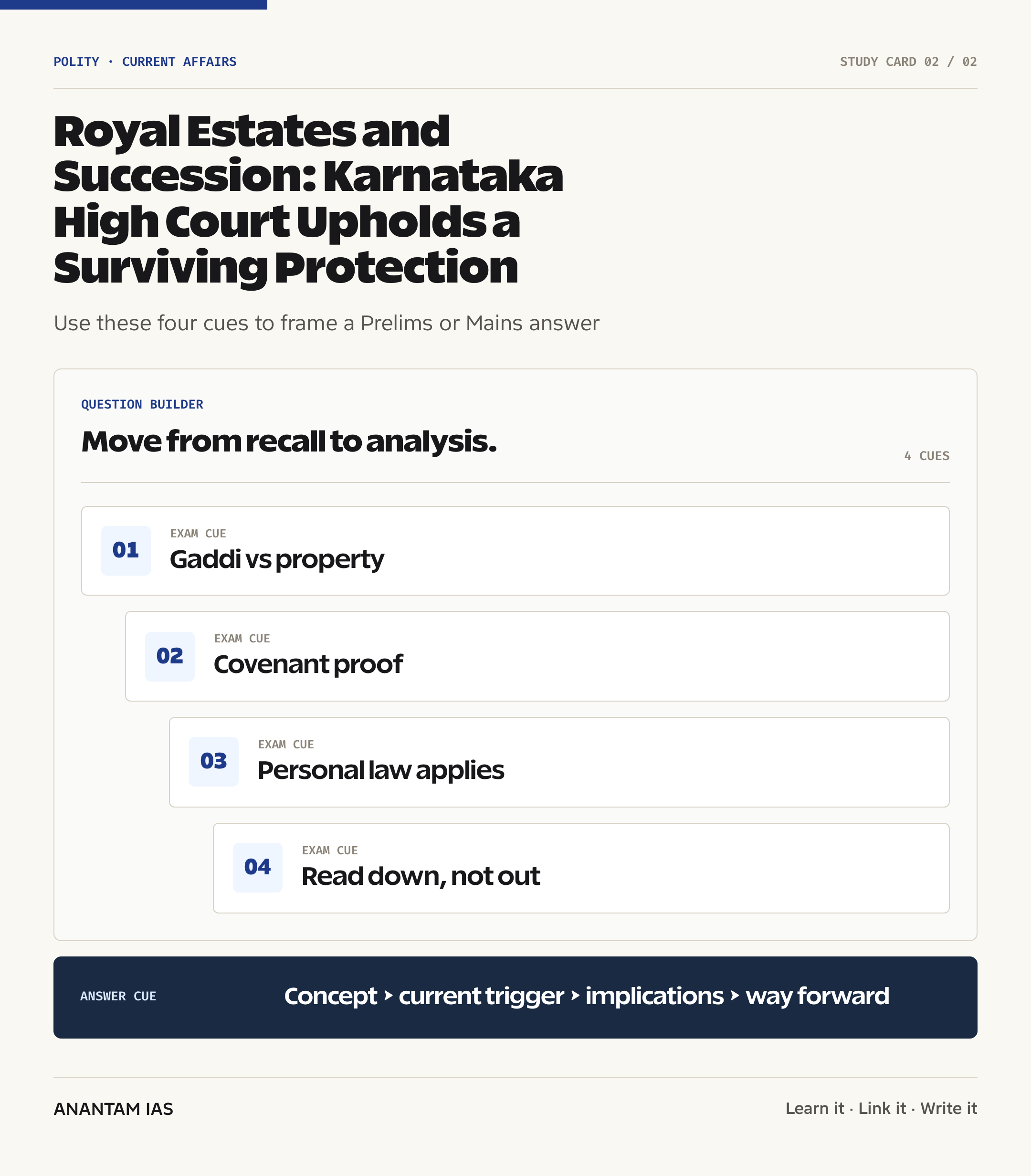
- The High Court rejected a blanket invalidation and said a claimant invoking the exception must establish the relevant covenant, estate and custom through specific pleadings and proof.
- The Court followed the Supreme Court’s 2026 clarification in Tikka Shatrujit Singh v. Sukhjit Singh: a symbolic throne may follow primogeniture, but a ruler’s ordinary private properties follow applicable personal law.
- The ruling matters in the context of how constitutional abolition of privileges interacts with a statutory exception that remains in the text of a central law.
- It distinguishes the public status of a former ruler from the private-law character of particular property, preventing royal lineage from becoming an automatic exemption from ordinary succession law.
- It also shows why courts avoid deciding a constitutional challenge in the abstract when the challenger cannot demonstrate a concrete injury caused by the provision.
UPSC Relevance
Prelims Relevance
- The Hindu Succession Act, 1956 codifies intestate succession among Hindus and came into force on 17 June 1956.
- Section 4 gives the Act overriding effect over inconsistent pre-existing Hindu law, custom or usage, subject to the Act’s own exceptions.
- Section 5(ii) excludes an estate that descends to a single heir under a covenant between a ruler and the Government of India, or under a pre-Act enactment.
- An impartible estate is an estate that devolves as one unit on a single heir; it is not synonymous with every private property of a former ruler.
- The Twenty-Sixth Amendment, 1971 deleted Articles 291 and 362, inserted Article 363A and changed the constitutional definition of a ruler under Article 366(22).
- Article 363A ended official recognition of rulers and successors and abolished privy purses from the amendment’s commencement.
Mains Relevance
GS Paper 2
- Interaction between constitutional amendments, merger covenants and an unrepealed statutory exception.
- Judicial review of legislation, including the requirement of a concrete constitutional injury and the presumption favouring validity.
GS Paper 1
- Political integration of princely States and the legal role of instruments of accession and merger.
- Continuity and reform in personal law, inheritance customs and family property arrangements.
Essay
- Constitutional equality can coexist with narrowly preserved historical arrangements only when courts separate status, property and provable legal rights.
Background and Context
What Section 5(ii) Actually Protects
Section 5(ii) is a property-specific exception, not a personal immunity for former royal families.
- The main rule in the Hindu Succession Act, 1956 governs succession among persons within its scope; Section 5 lists limited property classes to which the Act does not apply.
- Clause (ii) requires an estate descending to one heir by the terms of a ruler’s covenant or agreement with the Government of India, or by a pre-1956 enactment.
- The exception attaches to the legal character of the estate. A claimant cannot rely only on royal ancestry, a family label or past ownership by a recognised ruler.
- The High Court described the protected category as an impartible estate, meaning property that devolves undivided on one successor under the controlling instrument and custom.
- For examination purposes, distinguish an intestate succession rule from testamentary transfer by will and from a special covenant-based mode of devolution.
What the Twenty-Sixth Amendment Changed
The Twenty-Sixth Amendment ended constitutional recognition and payments linked to rulership, but it did not expressly repeal Section 5(ii).
- Before 1971, Article 291 dealt with privy-purse payments, while Article 362 required due regard to guarantees concerning rulers’ personal rights, privileges and dignities.
- The amendment deleted both provisions and inserted Article 363A, ending recognition of rulers and successors and extinguishing privy-purse rights and obligations.
- Former rulers became part of the ordinary citizenry, subject to the country’s civil and municipal laws; a throne no longer carries recognised sovereign authority.
- The High Court treated three matters separately: privy purse and privileges, ownership of private property, and succession to a gaddi under law and custom.
- Because Section 5(ii) speaks to a defined kind of estate rather than a privy purse or official dignity, the Court found no automatic repeal by constitutional amendment. See also the site’s overview of the
The Mysore and Sandur Disputes
The connected petitions arose from concrete family-property disputes, but the relief sought was a broad declaration against the statutory clause.
- In the Mysore matter, Chaduranga Kantharaj Urs had filed a civil suit seeking partition after the death of Srikantadatta Narasimharaja Wadiyar; defendants invoked Section 5(ii) against the claim.
- In the Sandur matter, Venkatrao Y. Ghorpade and Gayatri Ghorpade challenged the provision amid litigation concerning a will, succession and the Shiva Vilas Trust.
- The petitions asked the High Court to declare Section 5(ii) obsolete, repugnant and unconstitutional and to direct the Union to remove it from the statute book.
- The Court noted that a constitutional court should not answer an abstract challenge without a clear showing of how the provision causes adverse civil consequences or violates a protected right.
- This procedural point matters: family claims over particular assets still require adjudication on title, instrument, custom and evidence in the proper proceedings.
The Supreme Court's Controlling Distinction
The High Court read Section 5(ii) through the Supreme Court’s recent treatment of primogeniture and private property.
- In Tikka Shatrujit Singh v. Sukhjit Singh, the Supreme Court held that Kapurthala’s merger arrangement preserved primogeniture for the gaddi, not for all private properties.
- The Supreme Court treated private assets of the former ruler as property of an ordinary citizen, devolving under the applicable Hindu law rather than automatically to the eldest male heir.
- The Karnataka High Court used that clarification to say that the perceived throne may follow the proved special rule, while personal private property ordinarily remains within personal succession law.
- A party claiming that a specific private asset forms part of an impartible estate bears the burden of particular pleading and proof.
- The result is a narrow boundary: Section 5(ii) survives in the statute, but it cannot be converted into a sweeping royal-property shield.
Way Forward
Demand Asset-Level Proof
- Civil courts should require the claimant to identify the exact merger covenant, clause, property schedule and governing custom before treating an asset as impartible.
- Courts should record separately whether the dispute concerns a gaddi, heirloom, trust asset or ordinary private property; loose use of the word estate can conceal legally different categories.
- Where the special exception is not proved, adjudication should proceed under the applicable personal and succession law without presumptions based on royal status.
- Women and other heirs should receive full procedural opportunity to contest claims of primogeniture and demand documentary proof.
Conclusion
- The Karnataka High Court did not restore political privilege to former rulers.
- The practical rule is evidence-led: a symbolic gaddi may devolve under a proved covenant and custom, while ordinary private property follows personal succession law .
UPSC Practice Questions
Prelims MCQ 1
With reference to Section 5(ii) of the Hindu Succession Act, 1956, consider the following statements:
- It concerns an estate descending to a single heir under a ruler’s covenant with the Government of India or a pre-Act enactment.
- It automatically excludes every private property once owned by a former ruler from the Act.
- A party invoking it for a particular estate must establish the relevant legal basis and facts.
How many of the above statements are correct?
(a) Only one (b) Only two (c) All three (d) None
Answer: (b) Only two
Explanation:
Statements 1 and 3 are correct. Section 5(ii) is a narrow estate-specific exception. Former royal ownership alone does not exempt all private property from ordinary succession law.
Prelims MCQ 2
Which constitutional change abolished official recognition of former rulers and privy purses?
(a) The Twenty-Fourth Amendment (b) The Twenty-Fifth Amendment (c) The Twenty-Sixth Amendment (d) The Forty-Fourth Amendment
Answer: (c) The Twenty-Sixth Amendment
Explanation:
The Constitution (Twenty-Sixth Amendment) Act, 1971 deleted Articles 291 and 362 and inserted Article 363A, ending recognition of rulers and abolishing privy purses.
UPSC Mains Questions
- The Karnataka High Court’s ruling on Section 5(ii) of the Hindu Succession Act separates constitutional abolition of princely privileges from the legal character of a covenant-based impartible estate. Explain this distinction and assess its implications for equality and personal law.
- Why do constitutional courts prefer a narrow, workable interpretation of a statute before striking it down? Discuss with reference to the doctrine of reading down, concrete injury and the continued operation of historically rooted legal provisions.
Sources: Karnataka High Court judgment in Chaduranga Kantharaj Urs v. Union of India and The Hindu.
Frequently Asked Questions
What did the Karnataka High Court decide?
It dismissed petitions seeking to invalidate Section 5(ii) of the Hindu Succession Act. The Court said the 1971 abolition of rulers’ recognition and privy purses did not automatically repeal this separate statutory exception, but confined it to a proved covenant-based.
Does primogeniture govern all former royal property?
No. The Supreme Court and Karnataka High Court distinguished a symbolic gaddi or proved impartible estate from ordinary private property. Private assets normally devolve under the applicable personal law. Anyone claiming a special rule for a specific asset must plead.
What is an impartible estate?
An impartible estate is property that descends as one undivided unit to a single heir under a valid covenant, enactment, law or proved custom. In this context, it is a narrow legal category and cannot be assumed merely because property.
What did the Twenty-Sixth Amendment abolish?
The 1971 amendment ended constitutional recognition of former rulers and successors, abolished privy purses, deleted Articles 291 and 362, inserted Article 363A and amended Article 366(22). Former rulers thereafter stood within the ordinary citizenry and remained subject to general civil.
Was Section 5(ii) declared fully immune from challenge?
No. The Court found no sufficient ground in these petitions to declare it obsolete or invalid. It stressed limited application, proof of the relevant covenant and estate, and the need for a challenger to show concrete adverse impact before seeking.
Source: https://anantamias.com/current-affairs/royal-estates-succession-karnataka-high-court/
Forest Rights in Jammu and Kashmir: Claims Must Precede Eviction
Why in News?
On August 1, 2026 , Jammu and Kashmir Minister Javed Ahmed Rana said the Tribal Affairs Department would act as the nodal department for implementing the Forest Rights Act, 2006 in the Union Territory.
- The announcement followed controversy over eviction action in Sunjwan, Bathindi, Raika and Sidhra in the Jammu region.
- An official circular reaffirmed the Gram Sabha as the authority that initiates determination of individual and community forest-right claims.
- The Gram Sabha must receive, scrutinise and verify claims, prepare maps of recommended claims and send its resolution to the Sub-Divisional Level Committee.
- At an outreach camp in Kanidajan, Charar-i-Sharief, villagers raised complaints about eviction notices and obstruction of cultivation on land they said had been used for generations.
- J&K Assembly Speaker Abdul Rahim Rather called for protection of eligible beneficiaries while cautioning against using the Act to justify fresh occupation of forest or government land.
- The issue tests whether rights recognition will precede coercive forest administration in a Union Territory where FRA implementation began only after the 2019 reorganisation.
- It places tribal welfare, forest conservation and land administration inside one due-process framework rather than treating them as separate departmental questions.
- The quality of claim verification matters as much as speed: weak records, mobile pastoral livelihoods and administrative overlap can exclude genuine claimants or validate unsupported claims.
UPSC Relevance
Prelims Relevance
- The full law is the Scheduled Tribes and Other Traditional Forest Dwellers (Recognition of Forest Rights) Act, 2006, commonly called the FRA.
- The Gram Sabha, not an individual forest officer, initiates the process of receiving, consolidating and verifying claims under Section 6.
- The statutory chain is Gram Sabha → Sub-Divisional Level Committee → District Level Committee; the District Level Committee takes the final decision on the record of forest rights.
- A claimant aggrieved by a Gram Sabha resolution may approach the SDLC within 60 days; an SDLC decision may be challenged before the DLC within 60 days.
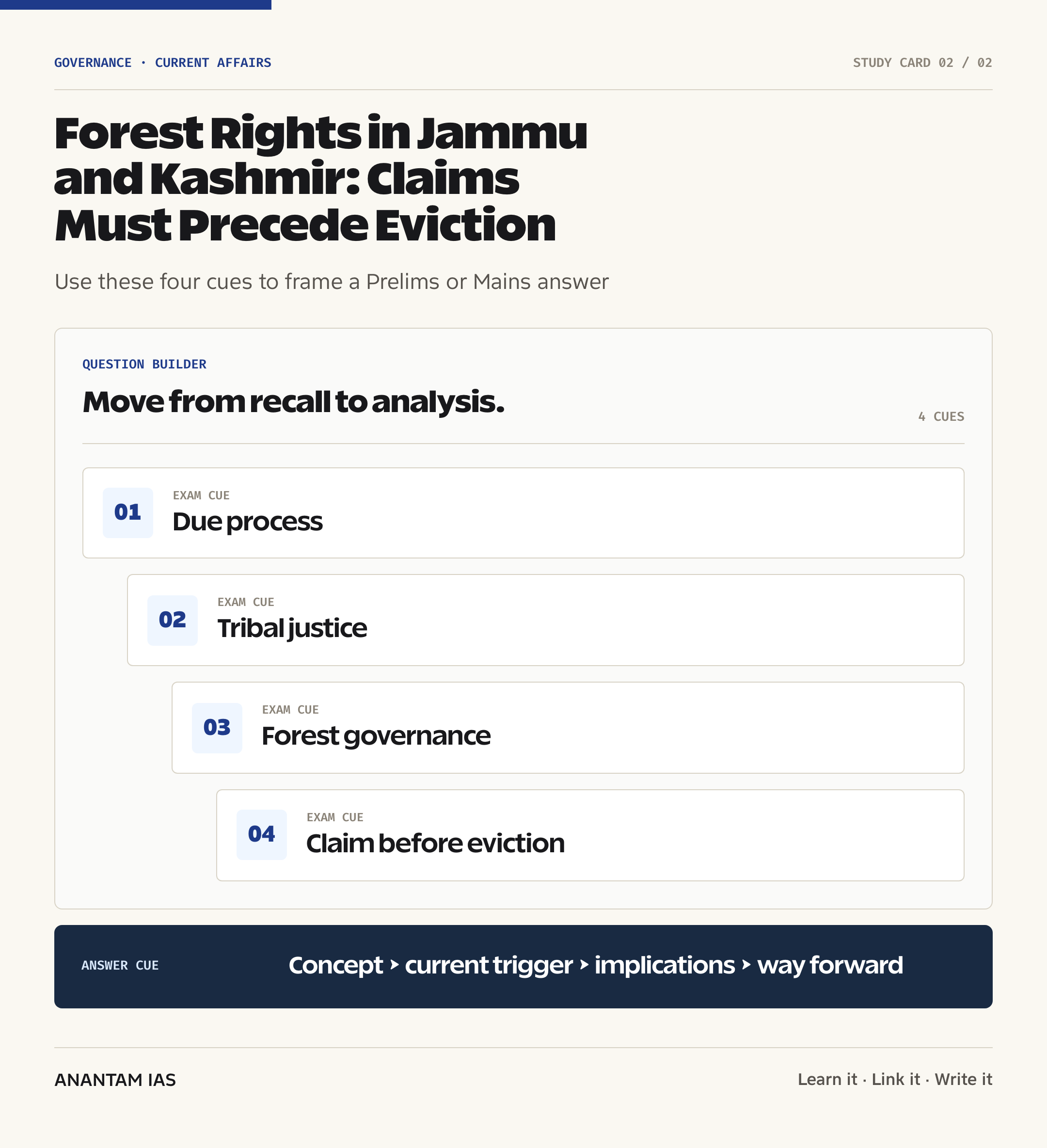
- Section 4(5) bars eviction or removal until recognition and verification are complete; it is a procedural protection, not a title by itself.
- An Other Traditional Forest Dweller must show primary residence in, and livelihood dependence on, forest or forest land for at least three generations before December 13, 2005; one generation is counted as 25 years under the.
Mains Relevance
GS Paper 2
- Rights-based governance: Section 4(5) converts prior hearing and claim verification into a restraint on executive eviction power.
- Social justice: implementation must account for low documentation, seasonal migration, oral evidence and the dispersed settlement patterns of forest-dependent communities.
GS Paper 3
- Environmental governance: the FRA combines livelihood rights with duties to protect wildlife, biodiversity, catchments and community forest resources.
- Conservation conflict: durable protection improves when forest dwellers are treated as rights-holders and knowledge partners, not only as alleged encroachers.
Essay
- Procedure is substantive justice when an administrative notice can separate a community from land, livelihood and cultural memory.
Background and Context
Why the FRA Was Enacted
The FRA is a corrective law designed to address the historical failure to record the rights of forest-dependent communities.
- Colonial and post-colonial forest administration often treated customary occupation and use as concessions, while land and forest records centred state control. The FRA shifts the legal starting point toward recognition and vesting of pre-existing rights.
- The law covers forest-dwelling Scheduled Tribes and Other Traditional Forest Dwellers, but their eligibility conditions are not identical. OTFDs carry the additional three-generation residence-and-dependence test.
- The Ministry of Tribal Affairs is the central nodal ministry for the FRA. Forest and Revenue departments supply records and participate in verification, but they do not replace the statutory authority of the Gram Sabha.
- For the wider syllabus link, read Tribal Issues: Forest Rights, Displacement and PESA and distinguish rights recognition from welfare delivery.
The Three-Tier Claim Process
Section 6 begins decision-making at the village assembly and builds review into successive statutory levels.
- The Gram Sabha authorises a Forest Rights Committee, receives individual and community claims, consolidates evidence, conducts field verification and prepares a map for each recommended claim.
- After considering the Forest Rights Committee’s findings, the Gram Sabha passes a resolution and forwards it to the SDLC. This makes community-level scrutiny the first decision point rather than a departmental afterthought.
- The SDLC examines resolutions, hears petitions, reconciles government records and prepares a draft record. The DLC considers and finally approves the record of forest rights.
- A claimant must receive a reasonable opportunity to present the case. Modifications or rejections require communication and detailed reasons; incomplete claims can be remanded for fresh examination rather than dismissed mechanically.
- No block-level, panchayat-level, forest-beat or range officer acting alone can receive, reject, modify or decide a forest-right claim outside this structure.
What Section 4(5) Protects
The no-eviction clause preserves the subject matter of a claim until the lawfully designated bodies finish their work.
- An eviction carried out while a claim remains unrecognised or unverified can make the remedy meaningless. Section 4(5) prevents that irreversible outcome during the claim process.
- The protection applies to removal from forest land under occupation. Administrations must first determine whether a person falls within an eligible category and whether the claimed right is supported.
- A pause on eviction is not a declaration that every occupant has a vested title. It keeps the status quo while eligibility, evidence and extent are assessed through the statute.
- The rule also guards against collective punishment: an allegation of recent encroachment cannot justify bypassing pending claims of other residents who may meet the Act’s conditions.
- The legal tension is best understood alongside the older control-oriented framework explained in Indian Forest Act, 1927: Categories and Powers.
Evidence, Eligibility and Fair Hearing
The FRA Rules allow multiple forms of evidence because customary forest rights are often absent from conventional title records.
- Permitted material includes government records, maps, ration or voter documents, physical improvements, court records, customary studies, traditional structures, genealogy and written statements of elders.
- The authorities must consider more than one form of evidence, but they cannot insist on one particular documentary format as the only route to recognition.
- Satellite imagery may supplement other evidence; it cannot replace field inquiry, oral evidence and community knowledge. Absence from an old encroacher list cannot by itself defeat a claim.
- Field verification requires notice to the claimant and participation by Forest and Revenue officials. Their role is evidentiary and administrative, while the Gram Sabha’s resolution remains central.
- Transparent speaking orders, accessible claim receipts, public lists and reasoned appeal decisions reduce both wrongful exclusion and politically driven regularisation.
Way Forward
Freeze coercive action during lawful verification
- Create a district-wise protocol that flags every pending individual and community claim before any eviction notice is approved.
- Require written certification that the Section 6 process, including available appeals, has concluded for the affected claimant.
- Publish claim calendars, forms and evidence options in locally understood languages, and provide trained facilitation without allowing officials to take over the Gram Sabha’s statutory role.
- Hold verification at accessible locations and account for pastoral, transhumant, elderly and women claimants whose evidence may not fit standard land-record formats.
Conclusion
- Jammu and Kashmir’s direction is legally important because it restores the correct sequence: recognise, verify, decide and only then enforce .
- A credible FRA system must protect genuine forest dwellers, reject unsupported claims through speaking orders and give communities a real role in conservation.
UPSC Practice Questions
Prelims MCQ 1
With reference to the Forest Rights Act, 2006, consider the following statements:
- The Gram Sabha initiates determination of individual and community forest rights.
- The District Level Committee takes the final decision on the record of forest rights.
- Every Other Traditional Forest Dweller must establish forest residence and livelihood dependence for at least three generations before December 13, 2005.
How many of the above statements are correct?
(a) Only one (b) Only two (c) All three (d) None
Answer: (c) All three
Explanation:
All three are correct. Section 6 starts with the Gram Sabha, the DLC finally approves the record, and the Act defines an OTFD through the three-generation residence-and-dependence test.
Prelims MCQ 2
What is the most accurate effect of Section 4(5) of the Forest Rights Act?
(a) It grants ownership to every person occupying forest land (b) It bars all removal from forest land permanently (c) It prevents eviction until recognition and verification are complete (d) It transfers claim decisions from the Gram Sabha to the Forest Department
Answer: (c) It prevents eviction until recognition and verification are complete
Explanation:
Section 4(5) preserves possession during the statutory process. It neither grants automatic title nor removes the eligibility, evidence and final-decision requirements.
UPSC Mains Questions
- Section 4(5) of the Forest Rights Act turns procedural fairness into a substantive protection against displacement. Examine this statement with reference to claim verification, appeal rights and the recent direction against premature eviction notices in Jammu and Kashmir.
- Forest-rights recognition and biodiversity conservation need not be competing goals. Discuss how Gram Sabha-led community forest governance can protect livelihoods and improve ecological stewardship, while also preventing misuse of the Forest Rights Act for fresh encroachment.
Sources: Ministry of Tribal Affairs: Forest Rights Act, Rules and Guidelines and The Hindu.
Frequently Asked Questions
What did Jammu and Kashmir direct?
The government said the Tribal Affairs Department would be the nodal department for FRA implementation and warned the Forest Department against evicting forest dwellers before claim recognition and verification are complete. The direction follows Section 4(5) and does not confer.
What does FRA Section 4(5) say?
Section 4(5) protects a forest-dwelling Scheduled Tribe member or Other Traditional Forest Dweller from eviction or removal from forest land under occupation until the recognition and verification procedure is complete. It preserves due process while eligibility and the claimed right.
Who begins a forest-right claim?
The Gram Sabha begins the statutory process. It receives, consolidates and verifies individual and community claims, prepares maps and passes a resolution. The SDLC examines the resolution and appeals, while the DLC finally approves the record of forest rights.
Does the pause validate fresh encroachment?
No. The pause prevents premature eviction of people whose rights require recognition and verification. A claimant must still satisfy the FRA’s category, occupation-date and evidence requirements. Authorities may act against fresh occupation through lawful procedure without prejudicing genuine pending claims.
What evidence can support a claim?
Evidence may include government records, maps, voter or ration documents, physical improvements, court records, traditional structures, genealogy and written statements of elders. Authorities must consider multiple forms and cannot demand one particular document as the sole route to recognition.
Source: https://anantamias.com/current-affairs/jk-forest-rights-act-claims-evictions/
Satpura-Melghat Tiger Corridor: Rail Approval Comes With Wildlife Safeguards
Why in News?
The Standing Committee of the National Board for Wildlife recommended in-principle wildlife clearance for a third railway line from Jujharpur to Chichonda in Madhya Pradesh at its 9 July meeting, The Indian Express reported.
- The proposed section is about 160.6 km, between Jujharpur in Betul district and Chichonda in Narmadapuram district.
- Official proposal records cover 206.09 hectares in the notified corridor: 74.69 hectares of forest land and 131.4 hectares of non-forest land.
- The section forms part of a larger Itarsi-Nagpur route capacity-expansion plan involving third-line and possible fourth-line works.
- Central Railway proposed 34 wildlife overpasses, but the inspection committee found that their siting was not yet backed by a completed landscape-level scientific assessment.
- The State Forest Research Institute, Jabalpur had submitted a mitigation study; the inspection committee must examine it and revisit the project area before definitive recommendations.
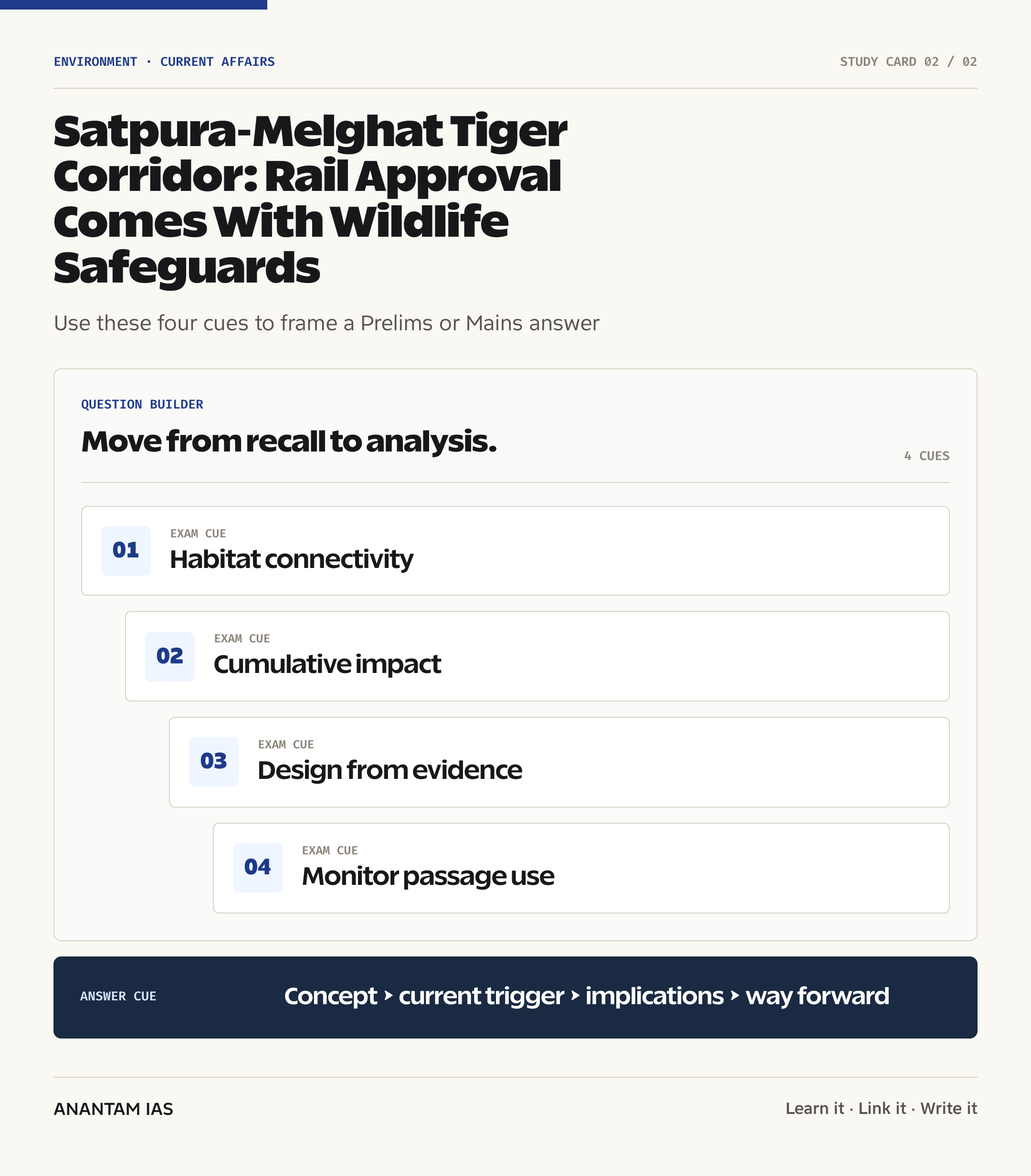
- The case tests whether linear infrastructure can add transport capacity without turning a functional habitat link into a barrier or mortality zone.
- A wildlife passage works only when its location, width, approach habitat and connectivity correspond to how animals actually move across the landscape.
- The approval process illustrates the distinct roles of the NBWL Standing Committee, NTCA, Wildlife Institute of India and state forest authorities.
UPSC Relevance
Prelims Relevance
- The Satpura Tiger Reserve is in Madhya Pradesh; the Melghat Tiger Reserve is in Maharashtra.
- A wildlife corridor connects habitat patches and supports dispersal, seasonal movement and genetic exchange between populations.
- A corridor may extend beyond the boundary of a National Park, Wildlife Sanctuary or Tiger Reserve; landscape connectivity is the core ecological idea.
- The National Board for Wildlife is a statutory body under the Wildlife (Protection) Act, 1972 and is chaired by the Prime Minister.
- Its Standing Committee appraises project proposals affecting protected areas and wildlife values on behalf of the Board.
- The National Tiger Conservation Authority is a statutory authority under the Wildlife (Protection) Act and advises on tiger-reserve and corridor safeguards.
Mains Relevance
GS Paper 3
- Biodiversity conservation, habitat fragmentation and the ecological value of landscape-scale tiger corridors.
- Environmental appraisal of railways, highways and other linear infrastructure in wildlife-sensitive areas.
GS Paper 2
- Institutional coordination among the Union environment ministry, NBWL, NTCA, WII, Railways and state governments.
- Reasoned, science-based conditional approvals as part of accountable environmental governance.
Essay
- Connectivity is as important for ecosystems as it is for economies.
Background and Context
What Is the Satpura-Melghat Corridor?
The corridor is a landscape link between major tiger habitats of central India, not merely a narrow line drawn between two reserve boundaries.
- It links the Satpura landscape of Madhya Pradesh with the Melghat landscape of Maharashtra through forests and mixed-use areas.
- The NTCA’s corridor assessment describes the Satpura-Melghat link as mostly forested, with relatively low-intensity agriculture and human density in parts of the landscape.
- The link supports movement by tigers, leopards, sloth bears and herbivores, allowing animals to disperse beyond individual protected areas.
- Dispersal can maintain gene flow, reduce isolation and help recolonisation when local habitats retain breeding and prey conditions.
- For a broader species overview, revise India’s tiger conservation story.
Why Railways Can Fragment Habitat
A railway becomes an ecological barrier when animals cannot cross it safely or when repeated disturbance changes their movement behaviour.
- Tracks, embankments, fencing and associated works can create a physical barrier across established animal routes.
- Train movement can cause collision mortality, while noise, vibration and night-time activity may disturb sensitive stretches.
- Construction access, vegetation clearing and material movement can widen the project’s disturbance footprint beyond the rails themselves.
- Adding a third and potentially a fourth line can create cumulative impacts; assessing each structure in isolation may miss the wider barrier effect.
- Fragmentation risk depends on local topography, drainage, forest cover, prey use and movement data, so a standard passage design cannot be copied everywhere.
The Proposal and Its Approval Path
The present decision sits inside a staged appraisal process rather than granting an unconditional right to begin work across the corridor.
- The project proponent is Central Railway, which argues that another line will improve capacity, operational efficiency and safety on the busy route.
- At an earlier meeting, the Standing Committee deferred the proposal and asked for a site inspection involving the environment ministry, WII, NTCA, the state forest department and the user agency.
- The July recommendation came with a rider that the proposed mitigation structures be supported by scientific study and engineering design.
- The inspection committee must re-examine the project after considering the SFRI study and other data, then recommend the location, dimensions, design and connectivity of the passages.
- Students should distinguish an in-principle recommendation from final approval and compliance through construction and operation.
Institutions and Legal Logic
Tiger-corridor appraisal combines statutory authority, scientific advice and site-level administration.
- Under the Wildlife (Protection) Act, 1972, the NBWL provides the central statutory framework for wildlife policy and project appraisal; revise the Act’s institutions and protected-area provisions.
- Section 38-O assigns the NTCA a role in ensuring that tiger reserves and areas linking protected areas or tiger reserves are not diverted for ecologically unsustainable uses except under the statutory public-interest and approval safeguards.
- The WII contributes ecological expertise, while the state Chief Wildlife Warden and field staff supply site knowledge and records. See the WII mandate and research role.
- The Railways remains the user agency responsible for engineering, funding and implementing the conditions attached to approval.
- Good appraisal connects central rules with a state wildlife action framework and measurable field outcomes.
Way Forward
Complete the Landscape-Level Assessment
- Place the SFRI study, movement evidence and mortality data before the inspection committee and record how each finding changes the design.
- Assess the third and possible fourth lines together so that cumulative impacts are not split across separate files.
- Finalise each passage’s location, span, approach and connectivity jointly with wildlife scientists and railway engineers.
- Protect the habitat leading to each structure; an isolated crossing cannot sustain landscape connectivity.
Conclusion
- The Satpura-Melghat case is not a simple contest between trains and tigers.
- The in-principle recommendation remains credible only if the rider changes the final design on the ground.
UPSC Practice Questions
Prelims MCQ 1
With reference to the Satpura-Melghat landscape, consider the following statements:
- Satpura Tiger Reserve is in Madhya Pradesh.
- Melghat Tiger Reserve is in Maharashtra.
- A wildlife corridor must lie entirely inside the notified boundaries of tiger reserves.
How many of the above statements are correct?
(a) Only one (b) Only two (c) All three (d) None
Answer: (b) Only two
Explanation:
Statements 1 and 2 are correct. Statement 3 is incorrect: corridors connect habitat patches and may include forests and other lands outside notified tiger-reserve boundaries.
Prelims MCQ 2
Which institution is specifically constituted under the Wildlife (Protection) Act to strengthen tiger conservation and advise on tiger reserves and linking areas?
(a) Central Pollution Control Board (b) National Tiger Conservation Authority (c) Forest Survey of India (d) Central Zoo Authority
Answer: (b) National Tiger Conservation Authority
Explanation:
The National Tiger Conservation Authority is the statutory authority for tiger conservation. Its mandate includes safeguards concerning tiger reserves and areas linking protected areas or tiger reserves.
UPSC Mains Questions
- Wildlife passages are effective only when ecological evidence determines engineering design. Examine this statement in the context of the proposed third railway line through the Satpura-Melghat tiger corridor and suggest an outcome-based monitoring framework.
- How should environmental governance reconcile the capacity needs of linear infrastructure with the long-term connectivity of wildlife landscapes? Discuss the roles of the NBWL Standing Committee, NTCA, WII, state agencies and the project proponent.
Sources: The Indian Express and Standing Committee of the National Board for Wildlife, MoEFCC.
Frequently Asked Questions
What is the Satpura-Melghat tiger corridor?
It is a central Indian landscape connection between the Satpura tiger habitat in Madhya Pradesh and the Melghat tiger habitat in Maharashtra. Its forests and intervening lands support animal movement, dispersal and genetic exchange. A corridor is valued for ecological.
Has the railway project received final wildlife clearance?
No unconditional final clearance is described. The Standing Committee recommended in-principle wildlife clearance with a rider: scientific findings and engineering review must guide the location, dimensions, design and connectivity of mitigation structures, and the inspection committee must revisit the area.
How much corridor land does the proposal cover?
Official proposal records describe 206.09 hectares within the notified corridor, comprising 74.69 hectares of forest land and 131.4 hectares of non-forest land. The proposed Jujharpur-Chichonda railway section is about 160.6 km long and forms part of a wider Itarsi-Nagpur capacity.
Why were 34 proposed overpasses not enough?
The issue was not only the count. The inspection committee noted that the proposed sites relied largely on field inputs and mortality records while a comprehensive landscape-level assessment and final engineering designs were still pending. A passage succeeds only if.
Which institutions are reviewing the safeguards?
The process involves the Standing Committee of the National Board for Wildlife, the National Tiger Conservation Authority, the Wildlife Institute of India, the Union environment ministry, Madhya Pradesh forest authorities and Central Railway. The State Forest Research Institute, Jabalpur, prepared.
Source: https://anantamias.com/current-affairs/satpura-melghat-tiger-corridor-rail-line/
Samudra Manthan: India Approves a National Offshore Exploration Mission
Why in News?
The Union Cabinet approved Samudra Manthan , formally the National Offshore Exploration Scheme, on 31 July 2026.
- The mission will support drilling of 60 deepwater exploration wells with an allocation of ₹43,200 crore.
- Government support can cover up to 50% of eligible drilling cost or ₹675 crore per well, whichever is lower.
- A further ₹28,534 crore is assigned to modern offshore seismic-data acquisition, processing and record-building.
- Shared offshore infrastructure hubs receive ₹10,000 crore, while oil-and-gas manufacturing and service zones receive ₹2,000 crore.
- The scheme includes ₹350 crore for monitoring and support activities, taking the total outlay to ₹84,084 crore.
- It matters in the context of energy security: PIB placed India’s annual petroleum import bill at about $144 billion, or roughly ₹13 lakh crore.
- It matters in the context of investment risk: a single deepwater exploratory well can cost about $125-150 million, while a discovery is never assured.
- It matters in the context of declining mature fields: existing oil and gas fields face a natural production decline of about 6-7% a year.
UPSC Relevance
Prelims Relevance
- Samudra Manthan is a central sector scheme under the Ministry of Petroleum and Natural Gas, not a coastal-development or fisheries programme.
- Its implementation period runs through financial year 2030-31, with the first phase approved up to 31 March 2031.
- The mission covers offshore seismic data, deepwater wells, common infrastructure hubs, and domestic equipment and service capacity.
- Seismic surveys use reflected energy waves to infer subsurface geological structures; they indicate prospects but do not prove commercially recoverable hydrocarbons.
- The National Data Repository supports storage, reprocessing and access to Indian exploration and production data.
- Deepwater prospects highlighted by the government include the Krishna-Godavari, Cauvery and Mahanadi basins and the Andaman region.
Mains Relevance
GS Paper 3
- Energy security, import dependence and the role of domestic oil and gas during India’s transition to a lower-carbon economy.
- Public risk-sharing in capital-intensive exploration, crowding-in of private investment and the conditions needed for fiscal accountability.
GS Paper 2
- Design of a central sector scheme, regulatory certainty, contract enforcement and transparent allocation of public support.
- Balancing Union control over mineral oil resources with coastal-state interests, fishing livelihoods and environmental governance.
Essay
- Energy independence is built through resilience and diversification, not through a single fuel or a single source.
Background and Context
Why offshore exploration needs public risk-sharing
Offshore exploration combines high upfront costs, uncertain geology and a long delay before any possible revenue.
- PIB estimates that the journey from award of an exploration block to commercial production normally takes five to ten years.
- A deepwater exploratory well may cost about $125-150 million, yet drilling can still produce a dry well or a non-commercial discovery.
- Private firms may underinvest where the geological risk is high, infrastructure is absent and payback is distant. The scheme uses capped public support to reduce part of that first-mover risk.
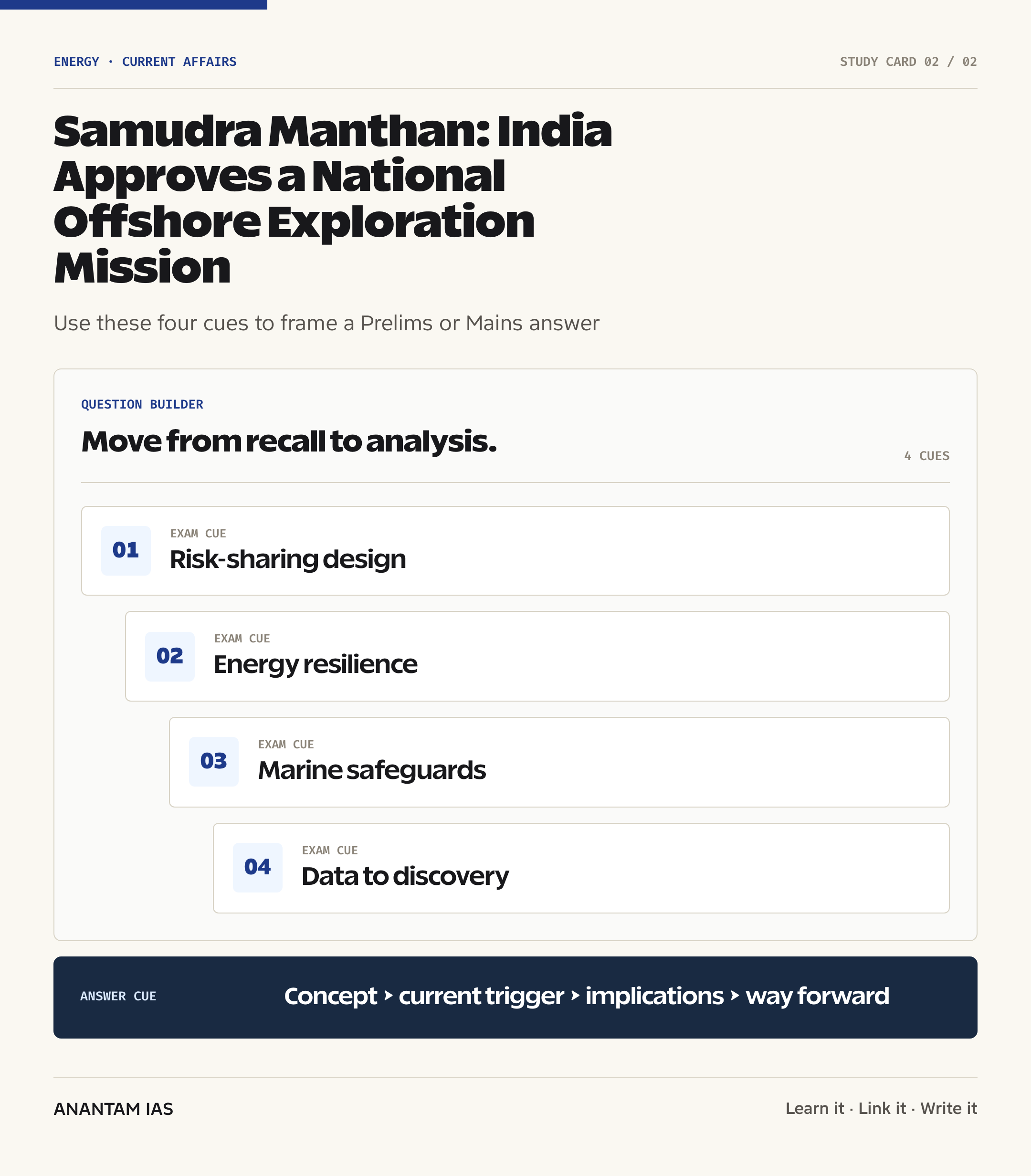
- Risk-sharing is not the same as underwriting profits: public payment should be tied to eligible expenditure, technical milestones, open data and audit trails.
- Existing fields lose output naturally. The cited 6-7% annual decline makes continuous exploration important even before demand growth is considered.
How the ₹84,084-crore package is structured
The mission links geological knowledge, exploratory drilling, evacuation infrastructure and industrial capability rather than funding wells alone.
- Offshore data acquisition: ₹28,534 crore. PIB breaks this into ₹12,000 crore for basin-wide 2D seismic coverage, ₹12,534 crore for 3D seismic and other technologies, and ₹4,000 crore for National Data Repository reprocessing.
- Deepwater exploration: ₹43,200 crore. This supports 60 wells, with assistance capped at 50% of eligible drilling cost or ₹675 crore per well, whichever is lower.
- Common offshore hubs: ₹10,000 crore. Shared facilities can lower the threshold for bringing separate discoveries into production by avoiding complete duplication of costly infrastructure.
- Manufacturing and service zones: ₹2,000 crore. The aim is localisation of critical equipment, maintenance and specialised services across the exploration and production value chain.
- Monitoring and support: ₹350 crore. Digital measures, evaluation, human resources, awareness and programme administration complete the total outlay.
From seismic signal to commercial production
Each stage reduces a different uncertainty, and success at one stage does not guarantee success at the next.
- A 2D seismic survey provides broad subsurface profiles across a basin; 3D seismic produces a more detailed volume model for prospect selection and well planning.
- Geoscientists integrate seismic interpretation with gravity, magnetic, geological and existing well data to identify a prospect that may trap hydrocarbons.
- Only an exploratory well can directly test whether the predicted reservoir contains oil or gas in potentially recoverable quantities.
- An appraisal programme then estimates the discovery’s size, flow characteristics and commercial viability. Development needs platforms, subsea systems, pipelines, processing facilities and safety systems.
- Shared hubs can improve the economics of smaller discoveries, but commercialisation still depends on reservoir quality, prices, regulation, technology and environmental clearance.
Priority basins and the licensing context
The next exploration frontier lies in deeper waters where geological potential and technical difficulty rise together.
- PIB identifies the Krishna-Godavari, Cauvery and Mahanadi basins and the Andaman region as important deepwater and ultra-deepwater prospects.
- The government says more than 99% of earlier offshore no-go areas have been removed, opening over one million square kilometres of India’s exclusive economic zone for exploration.
- The Hindu reported that OALP Round X offered one deepwater and 12 ultra-deepwater blocks, while Round XI includes one deepwater and four ultra-deepwater blocks.
- For maritime context, compare exploration rights inside the EEZ with India’s wider high-seas governance responsibilities.
Way Forward
Make risk-sharing measurable
- Publish basin-wise selection criteria, eligible-cost rules, assistance released and the technical milestones achieved for every supported well.
- Use independent cost verification and disclose the treatment of dry wells, cost overruns, relinquished blocks and commercially successful discoveries.
- Design contracts so that public support earns public value through data access, capability-building and an appropriate share of upside.
Conclusion
- Samudra Manthan is an attempt to solve a real coordination failure: companies face expensive frontier geology, limited common infrastructure and long payback periods, while India remains exposed to imported energy.
- But public risk-sharing must produce public knowledge and accountable outcomes.
UPSC Practice Questions
Prelims MCQ 1
With reference to the Samudra Manthan National Offshore Exploration Scheme, consider the following statements:
- It is a central sector scheme of the Ministry of Petroleum and Natural Gas.
- It provides government support of up to 50% of eligible drilling cost or ₹675 crore per deepwater well, whichever is lower.
- It is limited to acquiring seismic data and does not support common offshore infrastructure.
How many of the above statements are correct?
(a) Only one (b) Only two (c) All three (d) None
Answer: (b) Only two
Explanation:
Statements 1 and 2 are correct. Statement 3 is incorrect because the mission also allocates ₹10,000 crore for common offshore infrastructure hubs, apart from data, wells and manufacturing-service zones.
Prelims MCQ 2
What is the primary purpose of a 3D seismic survey in offshore hydrocarbon exploration?
(a) To confirm the commercial flow rate of a discovered reservoir (b) To create a detailed subsurface volume model for identifying and planning prospects (c) To measure the exclusive economic zone from the coastline (d) To replace the need for exploratory drilling
Answer: (b) To create a detailed subsurface volume model for identifying and planning prospects
Explanation:
A 3D seismic survey improves the geological image used to select and plan a prospect. It cannot prove a commercial discovery; an exploratory well and later appraisal are still required.
UPSC Mains Questions
- India’s National Offshore Exploration Scheme seeks to socialise part of the geological risk while attracting private capital. Examine the economic rationale for this design and suggest safeguards that can ensure fiscal accountability, open data and a fair public return.
- Domestic oil and gas exploration can improve energy resilience but may create marine ecological and carbon lock-in risks. Discuss how Samudra Manthan should be implemented within a diversified energy-security and environmental-governance framework.
Sources: PIB, Ministry of Petroleum and Natural Gas and The Hindu Explained.
Frequently Asked Questions
What is Samudra Manthan?
Samudra Manthan is the Ministry of Petroleum and Natural Gas’s National Offshore Exploration Scheme. The central sector scheme funds better offshore data, 60 deepwater exploration wells, common production infrastructure, and domestic manufacturing and services. Its approved outlay is ₹84,084 crore.
How much support can one well receive?
For an eligible deepwater exploration well, government support may cover up to 50% of eligible drilling cost or ₹675 crore, whichever is lower. The ceiling shares part of the geological and capital risk; it does not assure that drilling will.
Which offshore basins are important?
PIB identifies the Krishna-Godavari, Cauvery and Mahanadi basins and the Andaman region as major deepwater and ultra-deepwater frontiers. These areas may hold future hydrocarbon potential, but they need advanced seismic interpretation, costly drilling and careful marine environmental assessment.
Why are seismic surveys used?
Seismic surveys record reflected energy waves to infer rock structures below the seabed. Two-dimensional surveys provide broad profiles, while three-dimensional surveys create a more detailed subsurface model. They help identify prospects and plan wells, but only drilling can directly test.
Will the mission end oil imports?
No. The government projects higher domestic output and potential annual import savings if exploration succeeds. Actual gains depend on discoveries, recoverable volumes, costs and production timelines. India will still need a broader strategy of supplier diversification, efficiency, electrification, renewables and.
Source: https://anantamias.com/current-affairs/national-offshore-exploration-samudra-manthan/