The Indian Forest Act of 1927 is the oldest still-functional forest law in the country. Almost a century after the British colonial administration enacted it to consolidate timber and revenue extraction, the Act continues to be the procedural backbone for declaring, classifying, and policing forests across India. Every reserved forest gazette notification, every protected forest boundary marker, every check-post seizure of illegally felled timber, and every prosecution for unauthorised grazing in a forest area runs on the procedural rails laid down in 1927.
For UPSC GS-III, the Indian Forest Act sits at the foundation of any answer on forest governance, and the typical exam questions test three things at once. First, the structure of the Act itself: the three forest categories, the powers of the Forest Department, and the offences and penalties. Second, the relationship between IFA 1927 and the later environmental laws like the Forest Conservation Act 1980 and the Forest Rights Act 2006, which sit on top of IFA without replacing it. Third, the reform debate around the Act, which has been a live policy issue through the 2019 draft amendment, the 2023 Forest Conservation (Amendment) Act, and the renewed scrutiny of colonial-era restrictions on community forest use.
This guide walks through the historical context of the Act, the three forest categories, the procedural sequence by which a forest is declared, the powers of forest officers under sections 18 to 32, the offences and penalties, the major amendments through to 2024, and the policy hooks for mains answers.
Quick Facts
- Full title: The Indian Forest Act, 1927
- Enacted: 21 September 1927
- Predecessor laws: Indian Forest Act 1865, Indian Forest Act 1878
- Author: British colonial administration, primarily on the model developed by Dietrich Brandis (the first Inspector General of Forests, 1864-83)
- Primary purpose: Consolidate state control over forests, regulate timber and forest produce, prescribe offences and penalties
- Forest categories: Reserved forest (highest protection), protected forest (intermediate), village forest (community use under state control)
- Power to notify: State Government, by gazette notification
- Power to dereserve or reclassify: State Government alone (under section 26 and 27)
- Forest officer powers: Police-like powers including search, seizure, and arrest without warrant for forest offences
- Key amendments: 1948, 1951, 1952, 1957, 1990, 2017, with state-level amendments by Maharashtra, Karnataka, and others
- Related laws: Forest Conservation Act 1980, Wildlife Protection Act 1972, Forest Rights Act 2006, Compensatory Afforestation Fund Act 2016
- Constitutional status: Forest is on the Concurrent List (Entry 17A, added by 42nd Amendment 1976), so both Centre and State can legislate
Historical Context
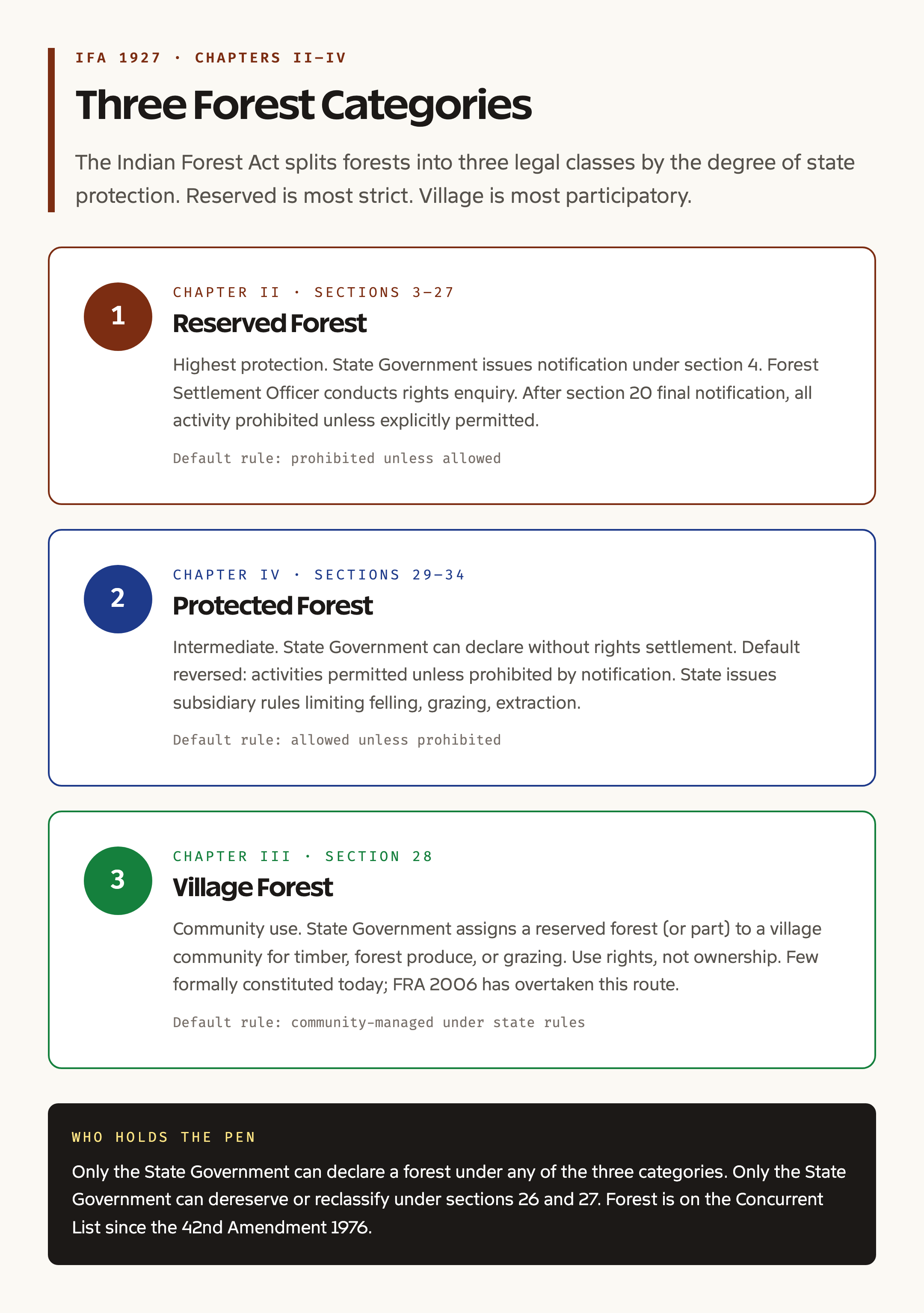
The Indian Forest Act 1927 is the third in a sequence of British colonial forest laws. The 1865 Act was the first, enacted to give the colonial state a legal claim over forests so that the new railway network’s enormous timber demand could be met. The 1878 Act expanded the framework, introducing the three-tier classification (reserved, protected, village) and the procedure for settling pre-existing rights. The 1927 Act consolidated the 1878 Act with later amendments and the experience of 50 years of forest department operation, producing the comprehensive code that remains in force.
The Act was written for a particular purpose: to assert state ownership of forests so that timber, fuelwood, charcoal, lac, resin, and other forest produce could be extracted, taxed, and traded under government control. Conservation, biodiversity, and community rights were not part of the design objective. This colonial DNA is the source of most contemporary critiques of the Act and the reason later laws, particularly the Forest Rights Act 2006, were necessary to correct the asymmetry between state power and community use.
After independence, the Act was retained substantially unchanged. The Government of India Act 1935 had already moved forests to the Provincial List, and after independence forests stayed on the State List until 1976. The 42nd Constitutional Amendment of 1976 moved forests to the Concurrent List, which gave the Centre the legal basis to enact the Forest Conservation Act 1980. IFA 1927 nonetheless remained the procedural foundation, and most state forest legislation builds on it.
Three Forest Categories
The Indian Forest Act classifies forests into three legal categories, each with a different level of protection and use rights. The three-fold classification is the single most testable fact about the Act in UPSC prelims.
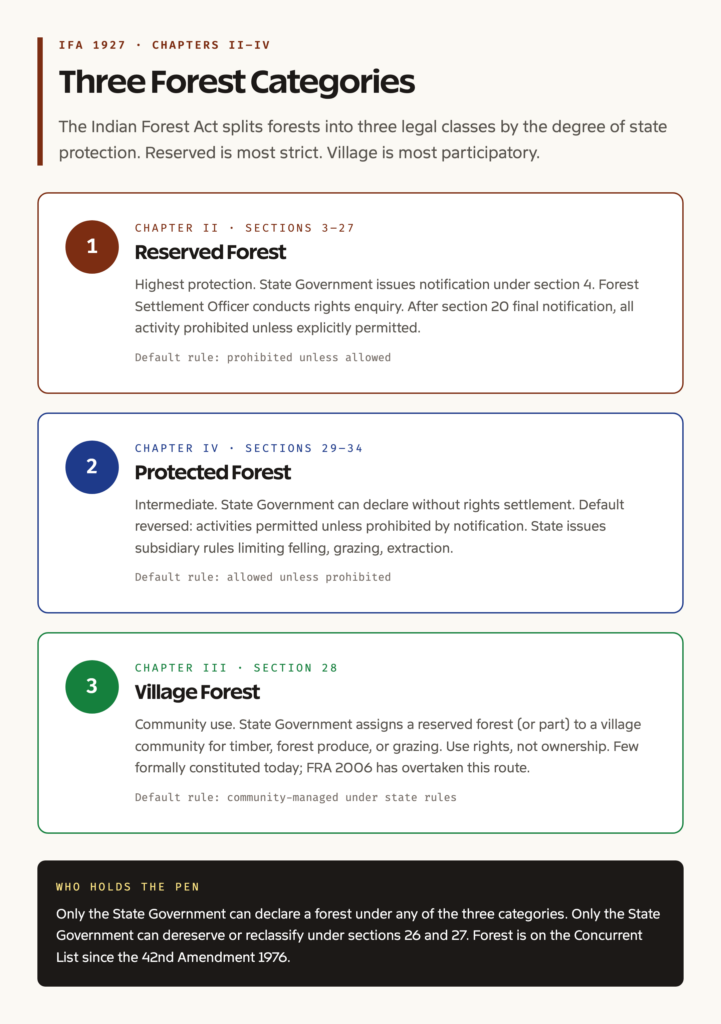
Reserved Forest (Chapter II, Sections 3 to 27) is the most strictly protected category. The State Government issues a notification declaring an area to be a reserved forest, after which a Forest Settlement Officer conducts a public enquiry into existing rights of local communities (grazing, fuelwood collection, water access, traditional pathways). The Officer either extinguishes those rights with compensation, commutes them into a defined permission, or excludes the rights-bearing area from the reserved boundary. Once the reservation is complete, all activities not specifically permitted are prohibited. Hunting, grazing, fuelwood collection, quarrying, and clearing are offences unless explicitly licensed.
Protected Forest (Chapter IV, Sections 29 to 34) is the intermediate category. The State Government can declare a protected forest by notification without going through the formal rights settlement process. The default rule is reversed compared to reserved forest: activities are permitted unless specifically prohibited by notification. The State Government typically issues subsidiary rules that prohibit felling of certain tree species, set seasonal limits on grazing, or restrict commercial extraction. Protected forests are easier to declare and easier to manage administratively, but offer weaker legal protection.
Village Forest (Chapter III, Sections 28) is the community-managed category. The State Government can assign a reserved forest, or a portion of it, to any village community for the supply of timber, forest produce, or grazing. The village community manages the forest under rules set by the State Government, and the rights are use rights rather than ownership rights. In practice, very few village forests have been formally constituted under section 28, and most community forest management today operates under the Forest Rights Act 2006 framework rather than the IFA village forest framework.
Procedure for Declaring a Reserved Forest
The procedure for declaring a reserved forest is one of the most-tested procedural sequences in Indian environmental law. The sequence runs from section 4 to section 20 of the Act.
The State Government issues a preliminary notification under section 4, declaring the intention to constitute a specified area as a reserved forest. The notification is published in the official gazette and posted in the headquarters of the district. From the date of the notification, no fresh rights can be acquired in the proposed area.
A Forest Settlement Officer is appointed under section 5 to conduct the enquiry. Local people who claim any right in the proposed forest must submit their claims within a specified period (typically three months). The Officer hears the claims under sections 6 to 10, and may admit, reject, or modify each claim. Admitted rights can be compensated, commuted into a defined permission, or excluded from the reserved area.
Once the rights settlement is complete, the State Government issues the final notification under section 20, declaring the area to be a reserved forest from a specified date. From that date, all rights not admitted or settled are extinguished, and the area is subject to the full reserved forest regime.
The procedure has been criticised for two systematic gaps. First, the rights enquiry depends on local communities being aware of the section 4 notification and able to submit formal claims, which has rarely been the case in tribal and forest-dwelling communities. Second, traditional non-property rights such as cultural and religious access have historically been undervalued by Forest Settlement Officers. The Forest Rights Act 2006 was designed in part to retrospectively correct these gaps.
Powers of Forest Officers (Sections 18-32 and Chapter IX)
The Indian Forest Act gives forest officers extensive police-like powers within and around forest areas. The powers cluster around several functions.
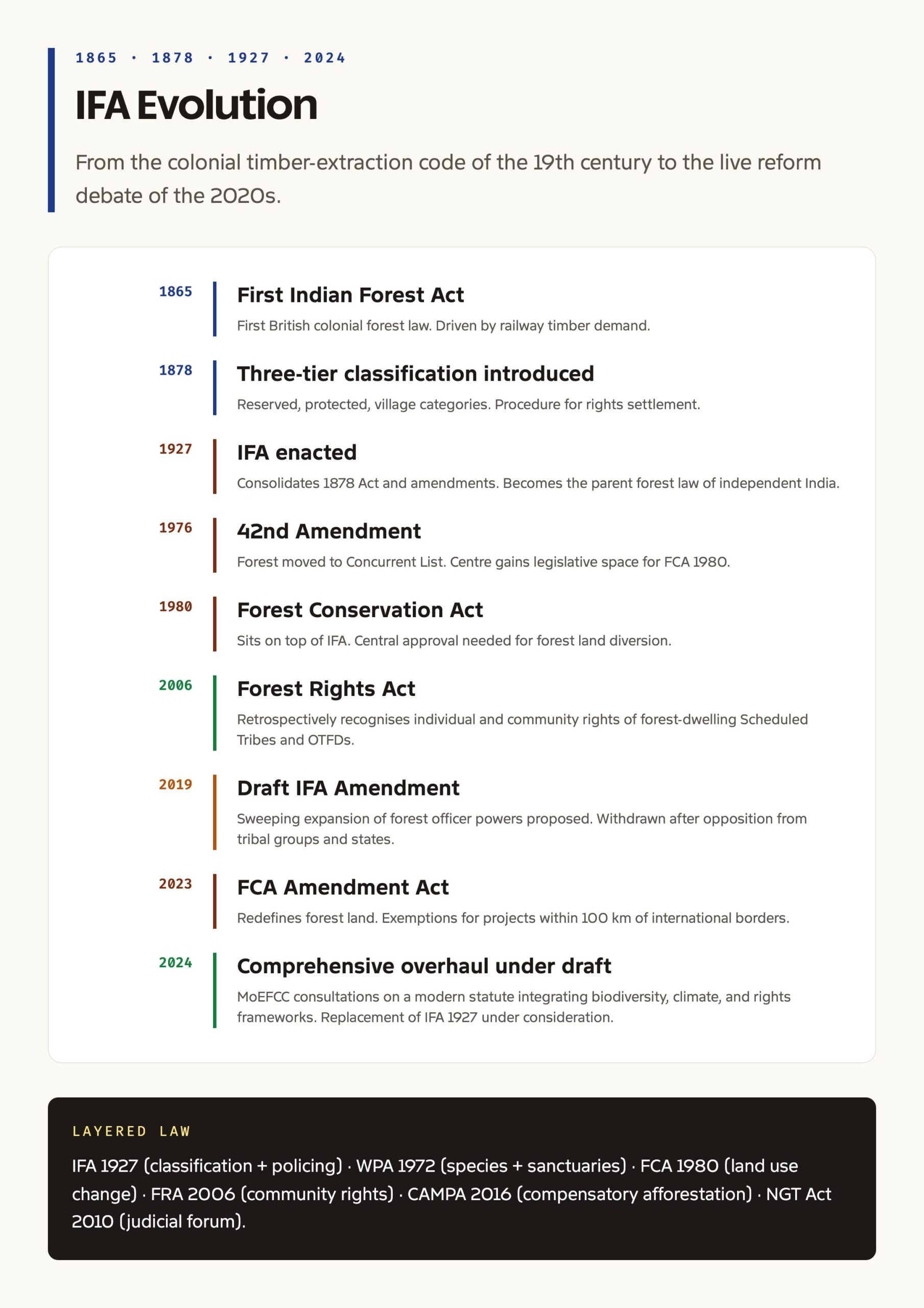
Power to enter and search (Section 64) allows a forest officer of and above a specified rank to enter any land or building, search any vehicle or vessel, and inspect any timber or forest produce, without a search warrant if there is reason to believe that a forest offence has been committed.
Power of seizure (Section 52) allows seizure of any forest produce that is reasonably suspected of being the subject of a forest offence, along with the tools, vehicles, cattle, and packaging used in the offence. Seized property is reported to a magistrate, who decides on confiscation.
Power of arrest without warrant (Section 64) allows arrest of any person reasonably suspected of having committed a forest offence punishable with imprisonment of one month or more.
Power to compound offences (Section 68) allows specified forest officers to accept a compounding fee from the offender in lieu of prosecution for less serious offences. This is the most-used disposal route for routine forest cases.
Power to issue rules is delegated to the State Government under various sections (such as section 32 for protected forests and section 36 for village forests), allowing detailed operational rules to be framed without going back to the legislature.
The breadth of these powers, combined with the Act’s colonial framing, has been a recurring concern for civil liberties and tribal rights bodies. The 2019 draft amendment proposed expanding several of these powers further, including a contested provision allowing forest officers to use firearms with reduced legal liability. The draft was withdrawn after sustained public opposition.
Offences and Penalties
The Act prescribes graded penalties for forest offences. Hunting, felling, removal of forest produce, grazing, fishing, kindling fire, clearing for cultivation, or quarrying within a reserved forest without lawful authority can attract imprisonment up to six months or a fine up to Rs 500 or both, with enhanced penalties for repeat offences. The penalties have been considered unrealistically low for decades, since they were set in 1927 and rarely revised, and most state amendments have raised the fines to Rs 5,000 or more.
The Act also prescribes special offences in protected forests (section 33) and rules-based offences for village forests. Forest produce found in suspicious circumstances can be presumed to be government property under section 69, shifting the burden of proof to the person in possession.
Amendments and Reform Debates
The Act has been amended several times at the Union level and many more times by states. Major Union-level amendments include 1948 (administrative consolidation), 1951 (penalty enhancement), 1952 (special powers in transit), 1957 (procedure refinements), and 1990 (procedural updates linked to the Forest Conservation Act 1980). State amendments by Maharashtra, Karnataka, Tamil Nadu, and several others have raised penalties, expanded forest officer powers, and added state-specific procedural provisions.
The 2019 draft amendment by the Ministry of Environment, Forest and Climate Change proposed sweeping changes including expanded powers to declare any forest as reserved, broader definitions of forest produce, enhanced powers of forest officers including the use of firearms, and stricter penalties. The draft was withdrawn after opposition from tribal rights groups, state governments, and civil society. The Forest Conservation (Amendment) Act 2023 instead modified the Forest Conservation Act 1980 framework, redefining what counts as forest land and introducing exemptions for strategic projects within 100 km of international borders.
In 2024, the Ministry signalled fresh consultations on a comprehensive forest law overhaul that would replace IFA 1927 with a modern statute integrating biodiversity, climate, and rights frameworks. The new law remains under draft.
Linkage with Other Forest and Environmental Laws
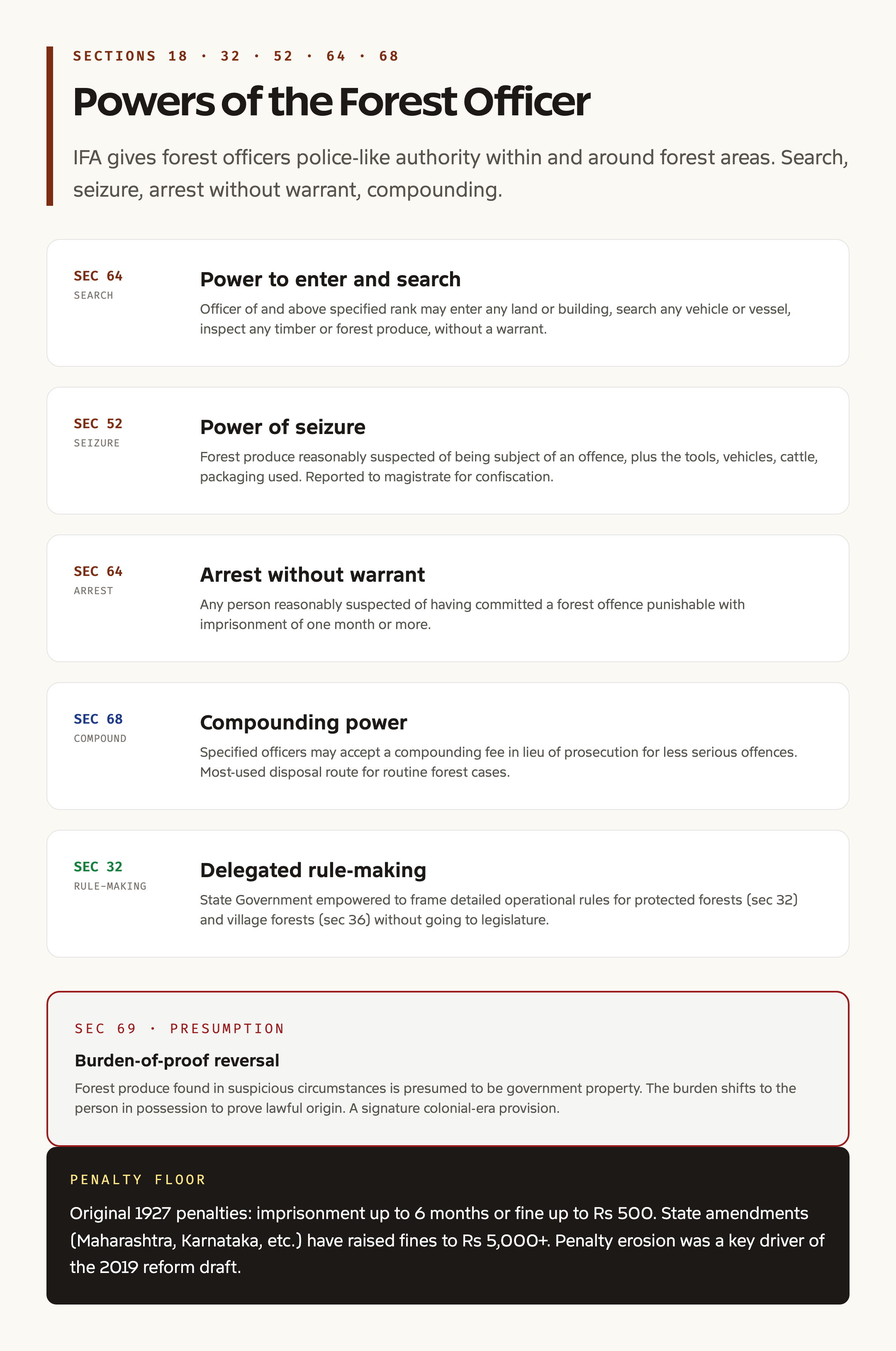
The Indian Forest Act 1927 sits at the base of a layered legal system. The Wildlife Protection Act 1972 supersedes IFA 1927 for the protection of listed species and sanctuaries. The Forest Conservation Act 1980 sits on top of IFA 1927 for any diversion of forest land to non-forest use, requiring central government approval regardless of the state-level IFA classification. The Compensatory Afforestation Fund Act 2016 governs the financial compensation for forest land diverted under the FCA 1980. The Forest Rights Act 2006 retrospectively recognises individual and community forest rights of forest-dwelling Scheduled Tribes and other traditional forest dwellers, overriding earlier rights settlements under IFA where applicable. The National Green Tribunal Act 2010 provides specialised judicial forum for disputes arising under all of these laws.
The result is that any forest decision in India today involves a stacked legal architecture: IFA 1927 for the underlying classification and policing, FCA 1980 for any change in land use, FRA 2006 for community rights, and the WPA 1972 for species protection.
Mains Hooks
For UPSC mains, the IFA 1927 sits at the centre of three running policy debates. The first is the colonial legacy debate: should a 1927 Act remain the procedural foundation of forest governance in 2026, or should it be replaced with a modern statute that integrates climate and biodiversity objectives? The second is the rights debate: how does IFA 1927 interact with the FRA 2006, particularly where rights settlements were inadequate and need to be reopened? The third is the federalism debate: with forest on the Concurrent List, how do state amendments and Union policy align, and what happens when state amendments dilute Union-level conservation standards?
Frequently Asked Questions
What are the three categories of forest under the Indian Forest Act 1927?
The three categories are reserved forest (most protected, all activity prohibited unless allowed), protected forest (intermediate, activities permitted unless prohibited), and village forest (community use under state government rules). Reserved forest is declared after a formal rights settlement; protected forest can be declared without one.
Who has the power to declare a reserved forest?
The State Government has the power to declare a reserved forest by gazette notification, after a Forest Settlement Officer conducts a rights enquiry. Only the State Government can later dereserve or reclassify a reserved forest under sections 26 and 27.
What is the difference between IFA 1927 and the Forest Conservation Act 1980?
IFA 1927 governs the classification, policing, and offences in forests. FCA 1980 sits on top and requires central government approval for any diversion of forest land to non-forest use. A forest is classified under IFA 1927 but cannot be cleared for a project without FCA 1980 clearance.
Can a forest officer arrest someone without a warrant under IFA 1927?
Yes. Section 64 of the Act allows a forest officer to arrest without warrant any person reasonably suspected of committing a forest offence punishable with imprisonment of one month or more. The officer also has powers of search, seizure, and compounding.
Why is IFA 1927 considered a colonial-era law?
The Act was enacted by the British colonial administration with the primary purpose of asserting state control over forests for timber and revenue extraction. Conservation, biodiversity, and community rights were not part of the original design, and most provisions reflect a state-versus-people framing rather than a participatory framing.
Tell Google you want more of this.
Add Anantam IAS as a preferred sourceOne tap, and this site shows up more often in your own Top Stories, AI Overviews and AI Mode. Remove it any time.