Why in News?
The Karnataka High Court , in Chaduranga Kantharaj Urs v.
- Justice M.G.S. Kamal delivered the common order on 16 July 2026 in W.P. Nos. 53075/2015, 35524/2018 and 3221/2022.
- The petitions arose from succession disputes connected with the former princely States of Mysore and Sandur.
- The petitioners argued that deleting Articles 291 and 362 and inserting Article 363A had made Section 5(ii) redundant and discriminatory.
- The High Court rejected a blanket invalidation and said a claimant invoking the exception must establish the relevant covenant, estate and custom through specific pleadings and proof.
- The Court followed the Supreme Court’s 2026 clarification in Tikka Shatrujit Singh v. Sukhjit Singh: a symbolic throne may follow primogeniture, but a ruler’s ordinary private properties follow applicable personal law.
- The ruling matters in the context of how constitutional abolition of privileges interacts with a statutory exception that remains in the text of a central law.
- It distinguishes the public status of a former ruler from the private-law character of particular property, preventing royal lineage from becoming an automatic exemption from ordinary succession law.
- It also shows why courts avoid deciding a constitutional challenge in the abstract when the challenger cannot demonstrate a concrete injury caused by the provision.
UPSC Relevance
Prelims Relevance
- The Hindu Succession Act, 1956 codifies intestate succession among Hindus and came into force on 17 June 1956.
- Section 4 gives the Act overriding effect over inconsistent pre-existing Hindu law, custom or usage, subject to the Act’s own exceptions.
- Section 5(ii) excludes an estate that descends to a single heir under a covenant between a ruler and the Government of India, or under a pre-Act enactment.
- An impartible estate is an estate that devolves as one unit on a single heir; it is not synonymous with every private property of a former ruler.
- The Twenty-Sixth Amendment, 1971 deleted Articles 291 and 362, inserted Article 363A and changed the constitutional definition of a ruler under Article 366(22).
- Article 363A ended official recognition of rulers and successors and abolished privy purses from the amendment’s commencement.
Mains Relevance
GS Paper 2
- Interaction between constitutional amendments, merger covenants and an unrepealed statutory exception.
- Judicial review of legislation, including the requirement of a concrete constitutional injury and the presumption favouring validity.
GS Paper 1
- Political integration of princely States and the legal role of instruments of accession and merger.
- Continuity and reform in personal law, inheritance customs and family property arrangements.
Essay
- Constitutional equality can coexist with narrowly preserved historical arrangements only when courts separate status, property and provable legal rights.
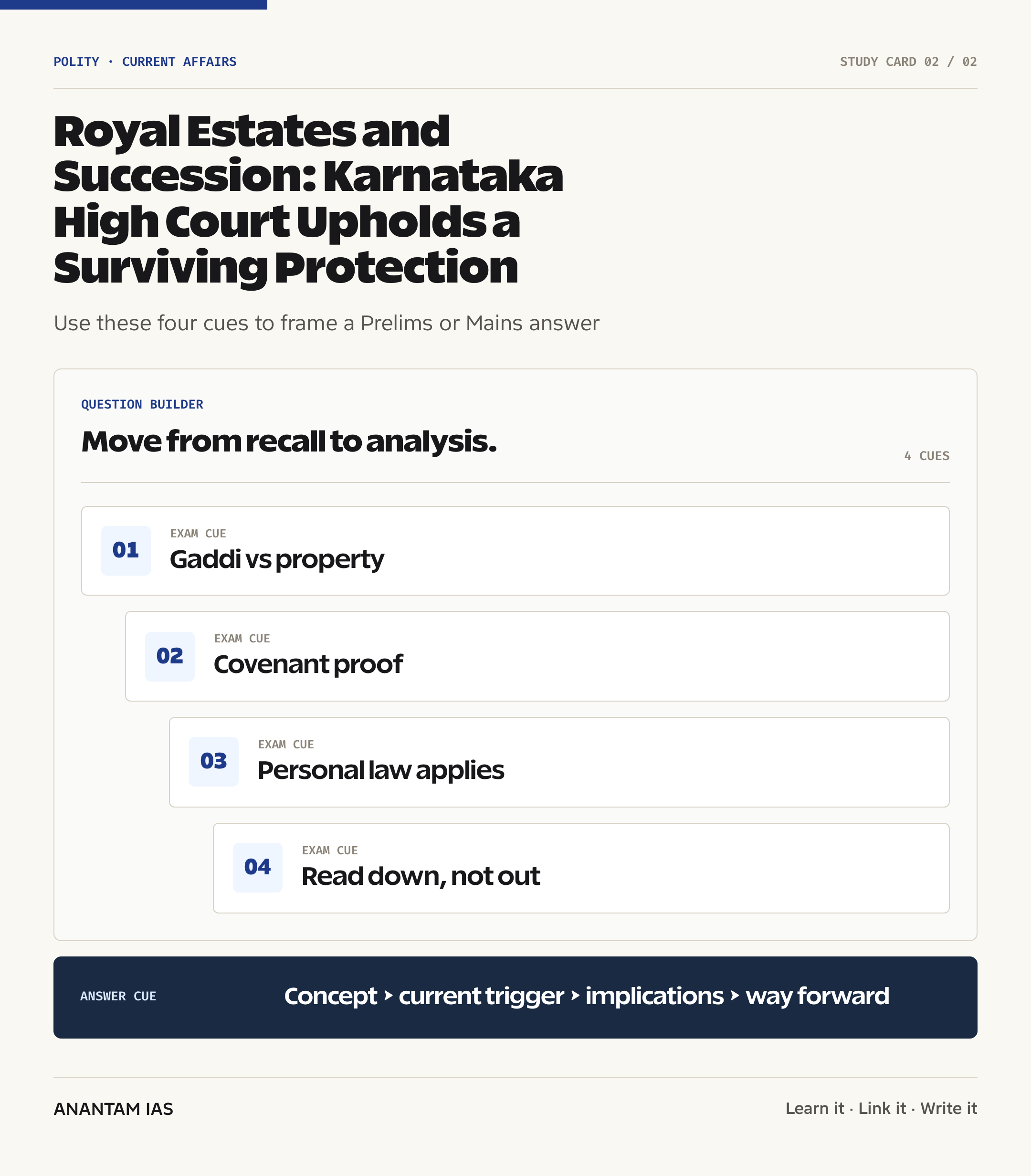
Background and Context
What Section 5(ii) Actually Protects
Section 5(ii) is a property-specific exception, not a personal immunity for former royal families.
- The main rule in the Hindu Succession Act, 1956 governs succession among persons within its scope; Section 5 lists limited property classes to which the Act does not apply.
- Clause (ii) requires an estate descending to one heir by the terms of a ruler’s covenant or agreement with the Government of India, or by a pre-1956 enactment.
- The exception attaches to the legal character of the estate. A claimant cannot rely only on royal ancestry, a family label or past ownership by a recognised ruler.
- The High Court described the protected category as an impartible estate, meaning property that devolves undivided on one successor under the controlling instrument and custom.
- For examination purposes, distinguish an intestate succession rule from testamentary transfer by will and from a special covenant-based mode of devolution.
What the Twenty-Sixth Amendment Changed
The Twenty-Sixth Amendment ended constitutional recognition and payments linked to rulership, but it did not expressly repeal Section 5(ii).
- Before 1971, Article 291 dealt with privy-purse payments, while Article 362 required due regard to guarantees concerning rulers’ personal rights, privileges and dignities.
- The amendment deleted both provisions and inserted Article 363A, ending recognition of rulers and successors and extinguishing privy-purse rights and obligations.
- Former rulers became part of the ordinary citizenry, subject to the country’s civil and municipal laws; a throne no longer carries recognised sovereign authority.
- The High Court treated three matters separately: privy purse and privileges, ownership of private property, and succession to a gaddi under law and custom.
- Because Section 5(ii) speaks to a defined kind of estate rather than a privy purse or official dignity, the Court found no automatic repeal by constitutional amendment. See also the site’s overview of the
The Mysore and Sandur Disputes
The connected petitions arose from concrete family-property disputes, but the relief sought was a broad declaration against the statutory clause.
- In the Mysore matter, Chaduranga Kantharaj Urs had filed a civil suit seeking partition after the death of Srikantadatta Narasimharaja Wadiyar; defendants invoked Section 5(ii) against the claim.
- In the Sandur matter, Venkatrao Y. Ghorpade and Gayatri Ghorpade challenged the provision amid litigation concerning a will, succession and the Shiva Vilas Trust.
- The petitions asked the High Court to declare Section 5(ii) obsolete, repugnant and unconstitutional and to direct the Union to remove it from the statute book.
- The Court noted that a constitutional court should not answer an abstract challenge without a clear showing of how the provision causes adverse civil consequences or violates a protected right.
- This procedural point matters: family claims over particular assets still require adjudication on title, instrument, custom and evidence in the proper proceedings.
The Supreme Court's Controlling Distinction
The High Court read Section 5(ii) through the Supreme Court’s recent treatment of primogeniture and private property.
- In Tikka Shatrujit Singh v. Sukhjit Singh, the Supreme Court held that Kapurthala’s merger arrangement preserved primogeniture for the gaddi, not for all private properties.
- The Supreme Court treated private assets of the former ruler as property of an ordinary citizen, devolving under the applicable Hindu law rather than automatically to the eldest male heir.
- The Karnataka High Court used that clarification to say that the perceived throne may follow the proved special rule, while personal private property ordinarily remains within personal succession law.
- A party claiming that a specific private asset forms part of an impartible estate bears the burden of particular pleading and proof.
- The result is a narrow boundary: Section 5(ii) survives in the statute, but it cannot be converted into a sweeping royal-property shield.
Way Forward
Demand Asset-Level Proof
- Civil courts should require the claimant to identify the exact merger covenant, clause, property schedule and governing custom before treating an asset as impartible.
- Courts should record separately whether the dispute concerns a gaddi, heirloom, trust asset or ordinary private property; loose use of the word estate can conceal legally different categories.
- Where the special exception is not proved, adjudication should proceed under the applicable personal and succession law without presumptions based on royal status.
- Women and other heirs should receive full procedural opportunity to contest claims of primogeniture and demand documentary proof.
Conclusion
- The Karnataka High Court did not restore political privilege to former rulers.
- The practical rule is evidence-led: a symbolic gaddi may devolve under a proved covenant and custom, while ordinary private property follows personal succession law .
UPSC Practice Questions
Prelims MCQ 1
With reference to Section 5(ii) of the Hindu Succession Act, 1956, consider the following statements:
- It concerns an estate descending to a single heir under a ruler’s covenant with the Government of India or a pre-Act enactment.
- It automatically excludes every private property once owned by a former ruler from the Act.
- A party invoking it for a particular estate must establish the relevant legal basis and facts.
How many of the above statements are correct?
(a) Only one (b) Only two (c) All three (d) None
Answer: (b) Only two
Explanation:
Statements 1 and 3 are correct. Section 5(ii) is a narrow estate-specific exception. Former royal ownership alone does not exempt all private property from ordinary succession law.
Prelims MCQ 2
Which constitutional change abolished official recognition of former rulers and privy purses?
(a) The Twenty-Fourth Amendment (b) The Twenty-Fifth Amendment (c) The Twenty-Sixth Amendment (d) The Forty-Fourth Amendment
Answer: (c) The Twenty-Sixth Amendment
Explanation:
The Constitution (Twenty-Sixth Amendment) Act, 1971 deleted Articles 291 and 362 and inserted Article 363A, ending recognition of rulers and abolishing privy purses.
UPSC Mains Questions
- The Karnataka High Court’s ruling on Section 5(ii) of the Hindu Succession Act separates constitutional abolition of princely privileges from the legal character of a covenant-based impartible estate. Explain this distinction and assess its implications for equality and personal law.
- Why do constitutional courts prefer a narrow, workable interpretation of a statute before striking it down? Discuss with reference to the doctrine of reading down, concrete injury and the continued operation of historically rooted legal provisions.
Sources: Karnataka High Court judgment in Chaduranga Kantharaj Urs v. Union of India and The Hindu.
Frequently Asked Questions
What did the Karnataka High Court decide?
It dismissed petitions seeking to invalidate Section 5(ii) of the Hindu Succession Act. The Court said the 1971 abolition of rulers’ recognition and privy purses did not automatically repeal this separate statutory exception, but confined it to a proved covenant-based.
Does primogeniture govern all former royal property?
No. The Supreme Court and Karnataka High Court distinguished a symbolic gaddi or proved impartible estate from ordinary private property. Private assets normally devolve under the applicable personal law. Anyone claiming a special rule for a specific asset must plead.
What is an impartible estate?
An impartible estate is property that descends as one undivided unit to a single heir under a valid covenant, enactment, law or proved custom. In this context, it is a narrow legal category and cannot be assumed merely because property.
What did the Twenty-Sixth Amendment abolish?
The 1971 amendment ended constitutional recognition of former rulers and successors, abolished privy purses, deleted Articles 291 and 362, inserted Article 363A and amended Article 366(22). Former rulers thereafter stood within the ordinary citizenry and remained subject to general civil.
Was Section 5(ii) declared fully immune from challenge?
No. The Court found no sufficient ground in these petitions to declare it obsolete or invalid. It stressed limited application, proof of the relevant covenant and estate, and the need for a challenger to show concrete adverse impact before seeking.
Tell Google you want more of this.
Add Anantam IAS as a preferred sourceOne tap, and this site shows up more often in your own Top Stories, AI Overviews and AI Mode. Remove it any time.