Daily Digest
UPSC · Civil Services Examination
Current Affairs · Monday, 24 August 2026
Current affairs curated and edited by Anantam IAS faculty — pulled from The Hindu, PIB, IDSA, Foreign Affairs and the ministries. Read, annotate, revise.
Old Rajinder Nagar · Delhi 110005 · anantamias.com
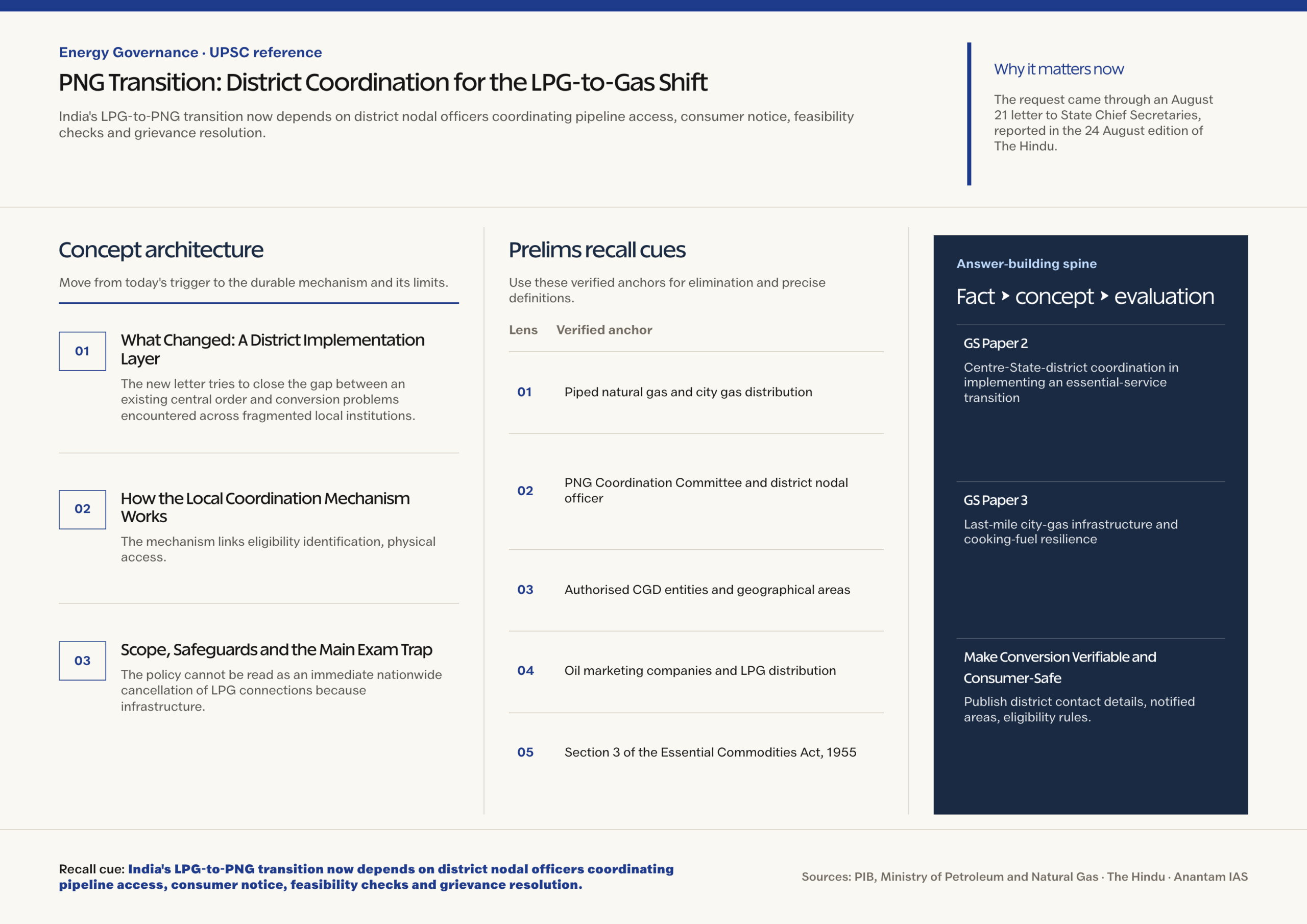
PNG Transition: District Coordination for the LPG-to-Gas Shift
Why in News?
The Petroleum Ministry asked States and Union Territories to nominate district nodal officers to help implement household LPG-to-PNG conversion in operational city-gas areas.
- The request came through an August 21 letter to State Chief Secretaries, reported in the 24 August edition of The Hindu.
- Each nominated officer should be associated with the local PNG Coordination Committee and should not be below district supply officer rank.
- District support covers pipeline access, consumer outreach, verification, transition coordination, adoption monitoring and grievance resolution.
- The underlying distribution order was notified in March 2026; the current development concerns implementation, not a newly created national rule.
- A central regulatory direction still depends on district administration because pipelines cross roads, housing societies and other spaces controlled by different local actors.
- The transition is geographically limited: it concerns premises in notified city-gas areas where operational PNG supply and a feasible connection exist.
- Consumer protection matters because notice, technical feasibility and accessible remedies must precede any disruption of an established cooking-fuel service.
UPSC Relevance
Prelims Relevance
- Piped natural gas and city gas distribution
- PNG Coordination Committee and district nodal officer
- Authorised CGD entities and geographical areas
- Oil marketing companies and LPG distribution
- Section 3 of the Essential Commodities Act, 1955
Mains Relevance
GS Paper 2
- Centre-State-district coordination in implementing an essential-service transition
- Notice, feasibility, grievance redress and administrative accountability
GS Paper 3
- Last-mile city-gas infrastructure and cooking-fuel resilience
- Using existing pipeline investment while managing consumer and distribution costs
Essay
- Infrastructure succeeds when the last administrative mile is designed as carefully as the physical network.
Background and Context
What Changed: A District Implementation Layer
The new letter tries to close the gap between an existing central order and conversion problems encountered across fragmented local institutions, districts and housing complexes.
- Chief Secretaries were asked to nominate one district nodal officer, preferably through the food and civil supplies administration that already regulates LPG distributors.
- The officer joins the local PNG Coordination Committee’s working chain rather than replacing the authorised city-gas entity or oil marketing company within its regulated commercial role.
- CGD entities and public-sector OMCs must coordinate which premises can receive PNG and how the existing LPG relationship will be transitioned.
- District involvement gives the process an authority able to convene agencies, verify field facts and prevent unresolved files from blocking time-bound execution.
- This is a governance change in implementation capacity, not a new announcement that makes PNG universally available across every district.
How the Local Coordination Mechanism Works
The mechanism links eligibility identification, physical access, formal notice and service transition into one auditable sequence instead of treating connection numbers as the only outcome.
- The local committee identifies eligible housing societies and households within an authorised geographical area where pipeline infrastructure can serve them.
- It may issue statutory notices to societies, resident welfare associations and individual consumers, then organise outreach and verification before a connection decision.
- District officials can help obtain right of way or right of use and mediate access to non-public areas needed for safe pipeline installation.
- They also coordinate LPG distributors with CGD entities so one service is not withdrawn before the substitute connection is technically ready and usable.
- Monitoring and grievance handling create an accountable local feedback loop for access refusal, disputed eligibility, metering, restoration, delay or other implementation failures.
Scope, Safeguards and the Main Exam Trap
The policy cannot be read as an immediate nationwide cancellation of LPG connections because infrastructure, building types and household feasibility vary sharply.
- The rule operates where PNG supply is available in a notified area; an unserved village or building outside operational reach is not automatically convertible.
- Physical proximity does not always prove feasibility in practice: internal piping, permissions, safety conditions, metering and building access must support an actual working connection.
- Due notice is a procedural safeguard, but it becomes meaningful only when households can understand the decision, contest errors and reach an effective remedy.
- PNG can reduce cylinder transport and use installed city-gas assets, yet it creates dependence on a fixed network whose reliability and emergency response require district-scale oversight.
- A sound evaluation measures successful, safe connections and resolved grievances, not merely notices issued or LPG records closed on an administrative dashboard.
Way Forward
Make Conversion Verifiable and Consumer-Safe
- Publish district contact details, notified areas, eligibility rules, service timelines and an escalation path in a simple public protocol.
- Require a joint feasibility record from the CGD entity and district officer before any LPG discontinuation process advances for a household.
- Track connection activation, service reliability, grievance disposal and failed installations separately so reported progress reflects usable supply.
- Audit access and safety decisions periodically while preserving alternatives for premises where PNG remains technically unavailable or unreliable.
Conclusion
- The district nodal officer turns the PNG transition into a coordinated and locally accountable service-delivery process linking regulators, gas companies, LPG distributors, housing bodies and households.
- In a Mains answer, pair energy resilience with procedural safeguards: defined scope, verified feasibility, prior notice, continuity of cooking fuel and accessible grievance redress.
UPSC Practice Questions
Prelims MCQ 1
With reference to the LPG-to-PNG transition mechanism, consider the following statements:
- District nodal officers are intended to coordinate with local PNG Coordination Committees.
- The mechanism automatically applies to every household in India, irrespective of pipeline availability.
- Authorised city-gas entities and oil marketing companies have distinct roles in the transition.
How many of the above statements are correct?
(a) Only one (b) Only two (c) All three (d) None
Answer: (b) Only two
Explanation:
Statements 1 and 3 are correct. The mechanism concerns notified city-gas areas where PNG supply and a feasible connection are available; it is not an automatic nationwide conversion.
Prelims MCQ 2
Which function best explains why district administration has been added to the PNG transition mechanism?
(a) Manufacturing all household gas meters (b) Setting international natural-gas prices (c) Coordinating access, verification, consumer transition and grievance resolution among local actors (d) Replacing the Petroleum and Natural Gas Regulatory Board
Answer: (c) Coordinating access, verification, consumer transition and grievance resolution among local actors
Explanation:
District authorities can convene agencies, address right-of-way and housing access, verify local conditions and handle grievances. They do not replace sector regulators or market participants.
UPSC Mains Questions
- Why does India’s LPG-to-PNG transition require a district-level coordination mechanism despite having a central regulatory framework? Examine.
- Energy transitions must protect continuity, choice and due process at the point of service delivery. Discuss with reference to household PNG implementation.
Sources: PIB, Ministry of Petroleum and Natural Gas and The Hindu.
Frequently Asked Questions
What is new in the PNG transition?
The March regulatory framework already existed. The new step asks States and Union Territories to nominate district officers who can coordinate access, verification, service transition and grievances.
Does every LPG household now have to switch to PNG?
No. The mechanism concerns notified city-gas areas where operational PNG supply reaches the premises and a technically feasible connection can be provided after due notice.
What does a PNG Coordination Committee do?
It brings authorised city-gas entities and public-sector oil marketing companies together to identify eligible premises, issue notices, conduct outreach and coordinate the shift from LPG.
Why are district supply officers suited to the role?
They already interact with LPG distributors and have field-level administrative reach, allowing them to coordinate agencies, verify facts, address access barriers and resolve consumer complaints.
What safeguard should precede LPG discontinuation?
Authorities should verify that PNG is operational and technically feasible, provide clear prior notice, preserve cooking-fuel continuity and offer an accessible process to challenge errors or delays.
Source: https://anantamias.com/current-affairs/png-lpg-transition-district-coordination/
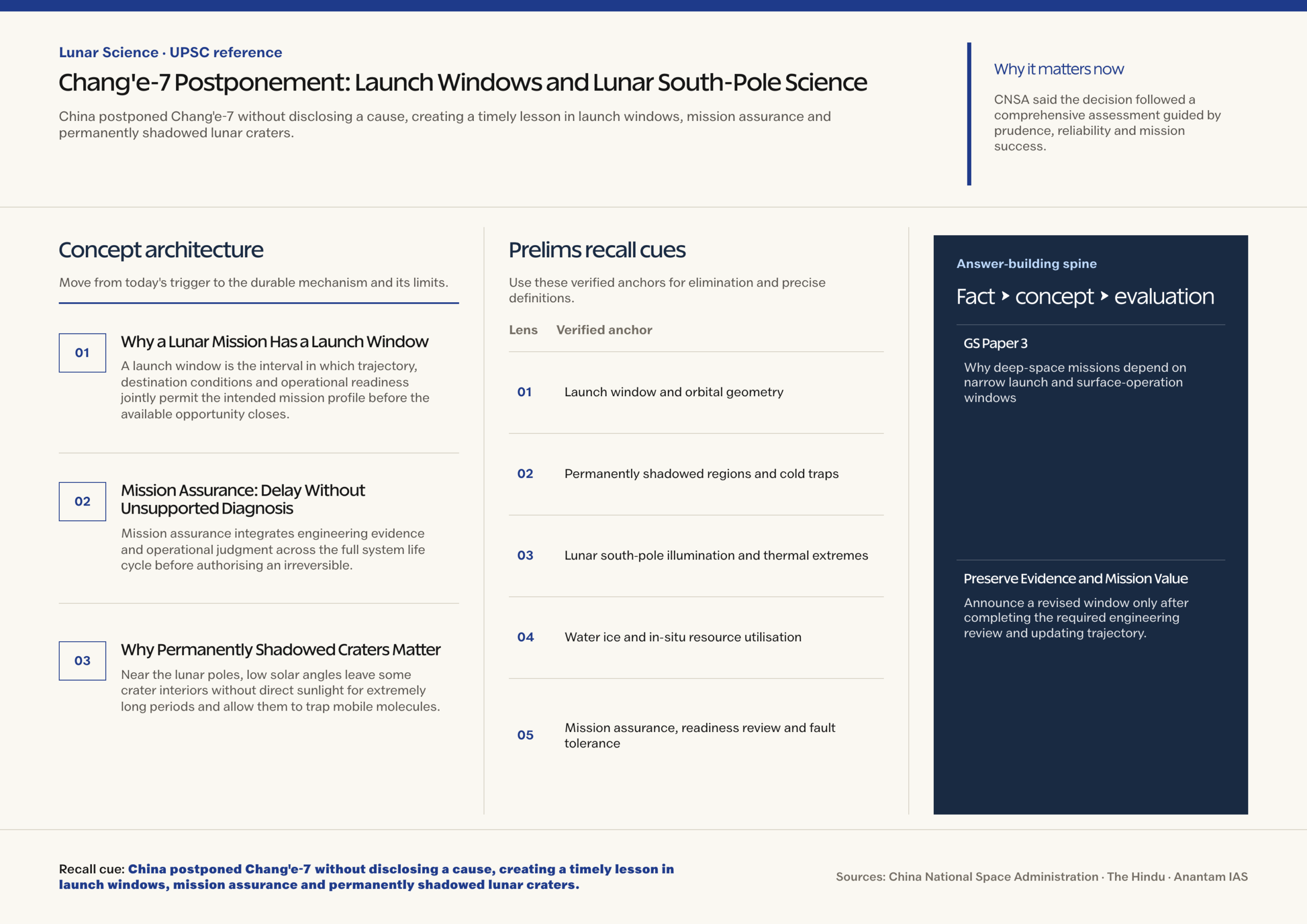
Chang’e-7 Postponement: Launch Windows and Lunar South-Pole Science
Why in News?
China officially postponed Chang’e-7 after concluding that the lunar mission did not meet launch conditions for its planned 2026 window.
- CNSA said the decision followed a comprehensive assessment guided by prudence, reliability and mission success.
- The official notice does not disclose the failed criterion, technical cause or a replacement launch date.
- Chang’e-7 was designed to investigate the lunar south-pole environment, resources and permanently shadowed regions.
- The postponement is confirmed; claims of a rocket defect, causal link to another launch failure or a definite 2027 flight remain unsupported.
- A deep-space launch window joins orbital geometry with spacecraft readiness, ground operations, communications, lighting and thermal constraints at the destination.
- Mission assurance treats postponement as a possible risk-control decision; delay alone does not reveal which subsystem or external condition was unsatisfactory.
- The lunar south pole matters because permanently shadowed cold traps may preserve water ice and other volatiles with scientific and resource-use value.
UPSC Relevance
Prelims Relevance
- Launch window and orbital geometry
- Permanently shadowed regions and cold traps
- Lunar south-pole illumination and thermal extremes
- Water ice and in-situ resource utilisation
- Mission assurance, readiness review and fault tolerance
Mains Relevance
GS Paper 3
- Why deep-space missions depend on narrow launch and surface-operation windows
- Mission assurance as a systems-engineering response to high-consequence uncertainty
- Scientific and strategic value of lunar polar exploration
Essay
- In high-risk technology, postponement can be evidence of institutional discipline rather than proof of failure.
Background and Context
Why a Lunar Mission Has a Launch Window
A launch window is the interval in which trajectory, destination conditions and operational readiness jointly permit the intended mission profile before the available opportunity closes.
- Earth and Moon positions determine whether the launch vehicle can inject the spacecraft into the required transfer trajectory with available energy while limiting correction demand.
- A polar landing mission may also depend on sunlight, surface temperature, communications geometry and planned observation conditions for imaging, power and descent near its landing zone.
- Range safety, weather, upper-level winds, tracking networks, ground stations and recovery plans add Earth-side constraints to the celestial geometry.
- Missing a suitable window can require new trajectory design, propellant calculations, thermal analysis, operations planning, mission simulations and repeated readiness checks.
- CNSA confirmed that this year’s conditions were not met but did not identify which constraint closed the window or how severe it was.
Mission Assurance: Delay Without Unsupported Diagnosis
Mission assurance integrates engineering evidence and operational judgment across the full system life cycle before authorising an irreversible, expensive and high-consequence launch.
- Teams review hardware, software, interfaces, international payloads, environmental tests, margins, procedures and ground systems as one connected mission architecture before they interact under flight conditions.
- A readiness review asks whether residual risks are understood and acceptable within agreed mission rules, not whether every component can be declared perfectly risk-free.
- Fault tolerance and redundancy protect against some failures, but they do not justify launch when an unresolved condition exceeds approved risk limits or violates safety assumptions.
- Postponement preserves the spacecraft, scientific opportunity and institutional credibility when the cost of an avoidable failure exceeds the cost of schedule delay.
- The evidence supports only one diagnosis: authorities withheld launch approval. It does not establish a rocket, spacecraft, payload, operations or site defect.
Why Permanently Shadowed Craters Matter
Near the lunar poles, low solar angles leave some crater interiors without direct sunlight for extremely long periods and allow them to trap mobile molecules.
- These regions remain exceptionally cold, allowing them to act as cold traps where water ice and other volatile compounds may persist over geological timescales.
- Sampling their deposits could reveal how water and volatiles reached, migrated across and survived on the Moon, while testing competing delivery histories.
- Water could potentially support future crews and be separated into useful products for in-situ resource use, but accessible quantity, purity and extraction cost remain open questions.
- Permanent darkness, steep terrain, communications limits and severe thermal conditions make mobility, power, navigation and instruments unusually difficult without continuous sunlight or line of sight.
- Chang’e-7’s planned combined orbital and surface investigation aims to connect remote observations with local measurements of the polar environment, resource distribution and accessibility.
Way Forward
Preserve Evidence and Mission Value
- Announce a revised window only after completing the required engineering review and updating trajectory, surface-lighting and ground-support plans.
- Separate confirmed readiness information from speculation so public communication does not convert an undisclosed condition into a false technical diagnosis.
- Protect scientific payload calibration, contamination control and international-partner interfaces during extended storage or re-testing before launch.
- Use the delay to verify polar navigation, power, communications and sampling scenarios against the conditions expected in permanently shadowed terrain.
Conclusion
- Chang’e-7’s postponement demonstrates that a launch window is both an orbital opportunity and a readiness gate for the complete mission system.
- In a Mains answer, connect mission assurance with the scientific challenge: lunar cold traps are valuable precisely because they are difficult to reach and investigate.
UPSC Practice Questions
Prelims MCQ 1
With reference to lunar south-pole exploration, consider the following statements:
- Some polar crater interiors can remain permanently shadowed because sunlight reaches the lunar poles at low angles.
- Permanently shadowed regions may preserve water ice and other volatiles as cold traps.
- Permanent shadow makes surface operations simpler by eliminating thermal and power constraints.
How many of the above statements are correct?
(a) Only one (b) Only two (c) All three (d) None
Answer: (b) Only two
Explanation:
Statements 1 and 2 are correct. Permanent darkness creates severe challenges for power, thermal control, navigation and communications rather than simplifying surface operations.
Prelims MCQ 2
Which statement best describes a deep-space launch window?
(a) Any day on which local weather is clear (b) An interval when trajectory geometry, destination conditions and operational readiness permit the planned mission (c) A fixed annual date that never changes (d) The period after a spacecraft has landed
Answer: (b) An interval when trajectory geometry, destination conditions and operational readiness permit the planned mission
Explanation:
Weather is only one factor. Orbital geometry, propulsion, landing-site illumination, communications, range safety and system readiness can all constrain a launch window.
UPSC Mains Questions
- Why do lunar missions depend on carefully defined launch windows? Explain how mission assurance shapes a launch decision under uncertainty.
- Permanently shadowed lunar craters combine high scientific value with severe engineering difficulty. Discuss in the context of lunar south-pole exploration.
Sources: China National Space Administration and The Hindu.
Frequently Asked Questions
Why was Chang’e-7 postponed?
CNSA said the mission did not meet launch conditions after a comprehensive assessment. It did not disclose the technical cause, affected system or a replacement date.
Does postponement prove a rocket defect?
No. A closed launch window can reflect spacecraft, payload, range, weather, trajectory, ground-system or risk-review constraints. The official notice identifies none of them.
What is a permanently shadowed region?
It is terrain, usually inside a polar crater, that receives no direct sunlight because of low solar angles and local topography, allowing extreme cold to persist.
Why is lunar water ice important?
It records the Moon’s volatile history and could potentially supply water, oxygen or propellant inputs. Its abundance, accessibility, purity and extraction economics still require investigation.
Is a new Chang’e-7 launch date confirmed?
No. The official statement only rules out implementation within the planned 2026 window. Any specific replacement date should remain labelled as speculation until authorities announce it.
Source: https://anantamias.com/current-affairs/change-7-lunar-mission-postponement/
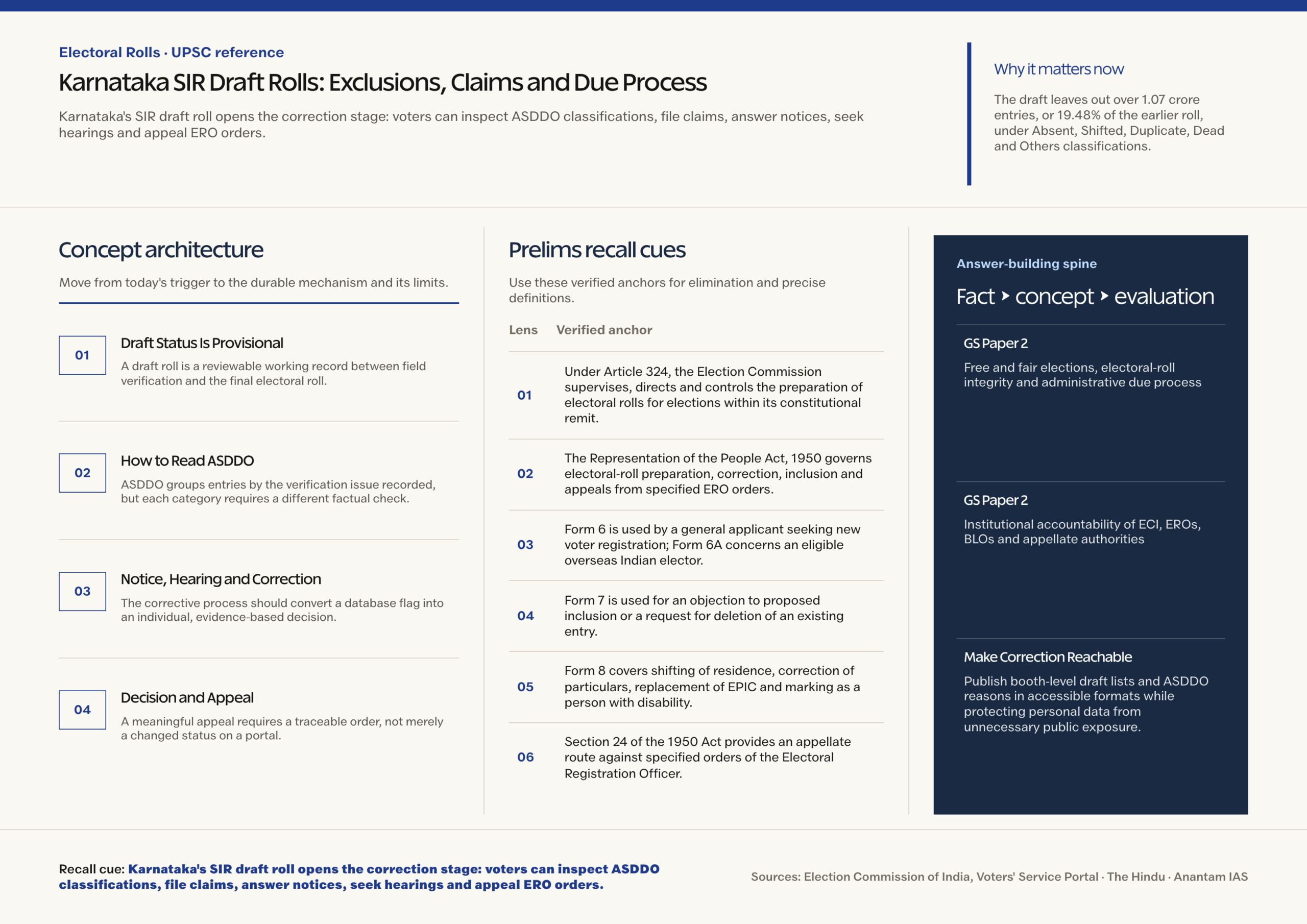
Karnataka SIR Draft Rolls: Exclusions, Claims and Due Process
Why in News?
Karnataka published its Special Intensive Revision draft electoral rolls on August 24, opening the statutory claims, objections, notice and hearing stage before final publication.
- The draft leaves out over 1.07 crore entries, or 19.48% of the earlier roll, under Absent, Shifted, Duplicate, Dead and Others classifications.
- An ASDDO label is an administrative classification used during roll verification; it is not by itself a final adjudication of voting eligibility or citizenship.
- Claims and objections may be filed until September 23, while notices, hearings and disposal continue during the broader revision window.
- The final roll is scheduled for October 27, making the intervening correction process decisive for both inclusion and roll accuracy.
- Electoral-roll integrity requires two protections together: removing confirmed dead, duplicate or shifted entries and preventing wrongful exclusion of eligible ordinary residents.
- A draft roll gives public notice of proposed entries and omissions; it invites correction before the Electoral Registration Officer settles claims and publishes the final roll.
- Due process is practical, not ceremonial: voters need accessible lists, intelligible reasons, adequate time, a hearing where facts are disputed and an effective appeal.
UPSC Relevance
Prelims Relevance
- Under Article 324, the Election Commission supervises, directs and controls the preparation of electoral rolls for elections within its constitutional remit.
- The Representation of the People Act, 1950 governs electoral-roll preparation, correction, inclusion and appeals from specified ERO orders.
- Form 6 is used by a general applicant seeking new voter registration; Form 6A concerns an eligible overseas Indian elector.
- Form 7 is used for an objection to proposed inclusion or a request for deletion of an existing entry.
- Form 8 covers shifting of residence, correction of particulars, replacement of EPIC and marking as a person with disability.
- Section 24 of the 1950 Act provides an appellate route against specified orders of the Electoral Registration Officer.
Mains Relevance
GS Paper 2
- Free and fair elections, electoral-roll integrity and administrative due process
- Notice, hearing, reasoned orders, correction and accessible appellate remedies
GS Paper 2
- Institutional accountability of ECI, EROs, BLOs and appellate authorities
Essay
- Democratic accuracy is not achieved by choosing between clean rolls and inclusive rolls; institutions must secure both.
Background and Context
Draft Status Is Provisional
A draft roll is a reviewable working record between field verification and the final electoral roll.
- Publication lets each elector inspect whether the name appears, whether particulars are accurate and whether the assigned polling details reflect ordinary residence.
- Omission from the draft triggers a need to check and use the prescribed remedy; it does not automatically amount to final disenfranchisement.
- A roll proceeding determines electoral registration under the governing election law; an entry-level classification is not a general declaration about citizenship status.
- Finality comes only after claims, objections, notices and applicable hearings are disposed of and the final roll is published, subject to statutory remedies.
How to Read ASDDO
ASDDO groups entries by the verification issue recorded, but each category requires a different factual check.
- Absent means the person was not found during verification; absence at that moment does not alone prove that the person ceased to be ordinarily resident.
- Shifted concerns ordinary residence elsewhere, while Duplicate concerns more than one entry; both require the correct entry and constituency to be identified.
- Dead entries should be removed on reliable verification, with safeguards against mistaken identity where names or family details are similar.
- Others is the least self-explanatory category, making a specific reason and accessible supporting record especially important before an adverse final decision.
Notice, Hearing and Correction
The corrective process should convert a database flag into an individual, evidence-based decision.
- A notice should identify the questioned entry, reason for scrutiny, response method, deadline and authority, allowing the elector to answer the actual issue.
- A hearing matters when residence, identity, mapping or another fact is disputed; the ERO should consider the response rather than treat non-matching data as conclusive.
- Form 6 supports inclusion, Form 7 supports objections or deletion requests, and Form 8 addresses shifting or correction; each performs a distinct procedural job.
- Offline access through electoral officials remains important for electors facing digital, language, disability, migration or documentation barriers during a time-bound revision.
Decision and Appeal
A meaningful appeal requires a traceable order, not merely a changed status on a portal.
- The ERO should record whether a claim or objection is accepted or rejected and give reasons sufficient for the elector to understand the finding.
- ECI guidance provides an appeal during revision to the designated district-level appellate authority, followed by a further appeal to the State Chief Electoral Officer.
- Section 24 links appeals to specified ERO orders under the 1950 Act; the prescribed authority, time and manner must be checked against the applicable revision instructions.
- An appellate authority should examine notice, evidence, hearing opportunity and legal eligibility rather than merely repeat the original database classification.
Way Forward
Make Correction Reachable
- Publish booth-level draft lists and ASDDO reasons in accessible formats while protecting personal data from unnecessary public exposure.
- Send multilingual notices through more than one channel and operate assisted filing desks for migrants, older persons, persons with disabilities and low-connectivity areas.
- Track claims by category, disposal time and outcome, then audit unusual booth-level rejection patterns before final publication.
- Provide downloadable reasoned orders and prominent appeal instructions so an adverse ERO decision can be challenged within the prescribed period.
Conclusion
- The constitutional question is not the size of the draft omission alone, but whether every proposed exclusion passes through notice, evidence, hearing and correction before finality.
- In a Mains answer, distinguish roll-cleaning from wrongful exclusion and assess SIR through proportional verification, reasoned ERO decisions and remedies that voters can realistically use.
UPSC Practice Questions
Prelims MCQ 1
With reference to electoral-roll forms, consider the following statements:
- Form 6 is used for new voter registration by a general applicant.
- Form 7 is used for objection to proposed inclusion or seeking deletion of an existing entry.
- Form 8 can be used for shifting residence or correcting particulars in an existing entry.
How many of the above statements are correct?
(a) Only one (b) Only two (c) All three (d) None
Answer: (c) All three
Explanation:
All three statements match the ECI’s current functions for Forms 6, 7 and 8. Form 6A separately concerns eligible overseas Indian electors.
Prelims MCQ 2
Which statement best describes omission from a draft electoral roll during a revision?
(a) It is automatically a final citizenship determination (b) It is automatically a permanent bar on voting (c) It is a provisional roll status open to prescribed claims, hearings and correction (d) It can be corrected only after the next general election
Answer: (c) It is a provisional roll status open to prescribed claims, hearings and correction
Explanation:
Draft publication begins public scrutiny and the claims-and-objections process. Final treatment follows disposal by the competent authority and remains subject to statutory remedies.
UPSC Mains Questions
- Electoral-roll revision must reconcile inclusion with accuracy. Examine how notice, hearing and reasoned decisions can protect both objectives.
- Why should an ASDDO classification in a draft electoral roll not be confused with final disenfranchisement or a citizenship finding? Discuss the available corrective safeguards.
Sources: Election Commission of India, Voters' Service Portal and The Hindu.
Frequently Asked Questions
What does omission from Karnataka’s draft roll mean?
It means the entry does not presently appear in the provisional roll. The elector can inspect the reason and use prescribed claims, correction, hearing and appeal procedures before finality.
What does ASDDO stand for?
ASDDO groups entries as Absent, Shifted, Duplicate, Dead or Others during verification. The label indicates the recorded issue; it is not itself a final legal determination.
Which form is used to seek inclusion?
Form 6 is the general new-voter registration form. Form 6A is for an eligible overseas Indian elector, while Form 8 handles correction or shifting.
Why is a hearing important in roll revision?
A hearing lets an elector answer disputed facts about identity, residence or mapping and requires the ERO to consider evidence before making an adverse decision.
Can an ERO order be appealed?
Yes. Section 24 of the Representation of the People Act, 1950 and ECI guidance provide appeals against specified ERO orders through prescribed authorities and procedures.
Source: https://anantamias.com/current-affairs/karnataka-sir-draft-roll-claims-hearings/
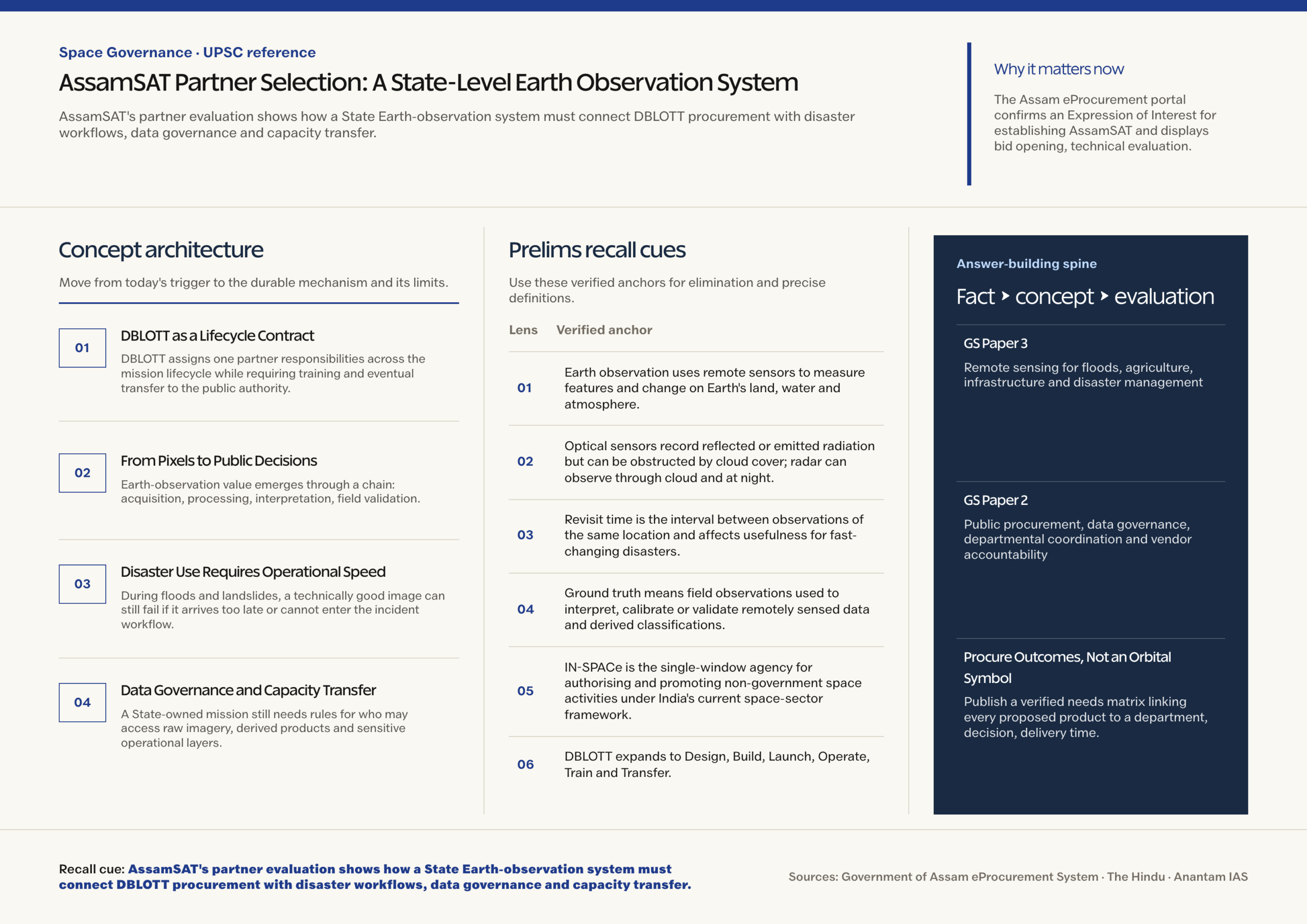
AssamSAT Partner Selection: A State-Level Earth Observation System
Why in News?
Assam said on August 23 that committees were evaluating proposals to select a private partner for AssamSAT, a proposed Earth-observation system under a DBLOTT procurement model.
- The Assam eProcurement portal confirms an Expression of Interest for establishing AssamSAT and displays bid opening, technical evaluation, financial evaluation and award stages.
- The State says proposals are in an advanced evaluation stage, but no partner has been selected in the verified public record reviewed for this note.
- No fixed launch date has been announced, and AssamSAT is not an operational satellite; present claims concern procurement and intended applications.
- The proposed model is DBLOTT: Design, Build, Launch, Operate, Train and Transfer, combining delivery with an eventual capability-transfer obligation.
- A dedicated system is valuable only if imagery becomes timely, validated decision products for departments rather than an isolated stream of satellite files.
- Assam’s recurring floods, riverbank change, agriculture and dispersed infrastructure create a strong use case for repeat observation joined with field and administrative data.
- A lifecycle contract can accelerate access to private expertise, but the State must retain control over public-purpose data, continuity, security and long-term institutional knowledge.
UPSC Relevance
Prelims Relevance
- Earth observation uses remote sensors to measure features and change on Earth’s land, water and atmosphere.
- Optical sensors record reflected or emitted radiation but can be obstructed by cloud cover; radar can observe through cloud and at night.
- Revisit time is the interval between observations of the same location and affects usefulness for fast-changing disasters.
- Ground truth means field observations used to interpret, calibrate or validate remotely sensed data and derived classifications.
- IN-SPACe is the single-window agency for authorising and promoting non-government space activities under India’s current space-sector framework.
- DBLOTT expands to Design, Build, Launch, Operate, Train and Transfer.
Mains Relevance
GS Paper 3
- Remote sensing for floods, agriculture, infrastructure and disaster management
- Private participation, mission assurance and State-level space capability
GS Paper 2
- Public procurement, data governance, departmental coordination and vendor accountability
Essay
- Technology becomes State capacity only when institutions can interpret, govern and act on it without permanent dependence on a vendor.
Background and Context
DBLOTT as a Lifecycle Contract
DBLOTT assigns one partner responsibilities across the mission lifecycle while requiring training and eventual transfer to the public authority.
- Design and build should translate departmental needs into sensor, orbit, ground-segment, processing and service requirements instead of procuring a satellite as a prestige object.
- Launch and operate place schedule, commissioning, health monitoring, data delivery and service continuity within a performance-managed arrangement.
- Train and transfer should leave Assam with qualified staff, documented procedures, usable ground systems and lawful access to software, data and mission knowledge.
- Evaluation must test technical feasibility, total lifecycle cost, launch and insurance risk, service levels, cybersecurity, exit terms and the credibility of capacity transfer.
From Pixels to Public Decisions
Earth-observation value emerges through a chain: acquisition, processing, interpretation, field validation, departmental decision and later evaluation.
- Agriculture departments can combine vegetation, moisture and land-use indicators with crop calendars and field reports to prioritise advisories, surveys and relief verification.
- Repeated imagery can track riverbank erosion, wetland change, forest disturbance and construction progress, but a spectral change does not explain its cause by itself.
- Infrastructure monitoring needs stable baselines, georeferenced project boundaries and clear thresholds for inspection; imagery should trigger verification rather than automatic punitive action.
- Product specifications should state resolution, revisit, latency, accuracy, cloud constraints and uncertainty so officials know which decisions each dataset can support.
Disaster Use Requires Operational Speed
During floods and landslides, a technically good image can still fail if it arrives too late or cannot enter the incident workflow.
- Before monsoon, baseline maps can identify exposed settlements, embankments, roads, shelters and critical facilities for contingency planning and resource positioning.
- During an event, rapid flood-extent products can support route planning and village prioritisation when combined with forecasts, gauges, local reports and rescue-team observations.
- Cloud cover can limit optical imagery during monsoon; procurement should plan complementary radar access, realistic acquisition windows and backup sources rather than promise uninterrupted visibility.
- After an event, change detection can guide damage surveys and recovery monitoring, but compensation decisions need transparent methods, field checks and an avenue to correct errors.
Data Governance and Capacity Transfer
A State-owned mission still needs rules for who may access raw imagery, derived products and sensitive operational layers.
- The contract should distinguish public datasets, restricted layers and commercially licensed inputs, with metadata, retention, audit logs and lawful sharing terms for each.
- Cybersecurity must cover spacecraft commands, ground stations, cloud processing, user credentials and supply-chain access because compromise can affect both data integrity and mission control.
- Training should be role-based for engineers, GIS analysts, disaster managers and departmental users, followed by supervised operations and measurable competency before transfer.
- Open interfaces, documented algorithms and portable archives reduce vendor lock-in and let Assam combine AssamSAT products with ISRO, international and field datasets.
Way Forward
Procure Outcomes, Not an Orbital Symbol
- Publish a verified needs matrix linking every proposed product to a department, decision, delivery time, validation method and accountable user.
- Use milestone payments and acceptance tests for design, launch, commissioning, data quality, service availability, training and transfer rather than hardware delivery alone.
- Create an independent governance board for data access, security, algorithm review, interdepartmental standards and public-interest release of low-risk products.
- Run flood and agriculture pilots using existing imagery before launch so workflows, staff and ground validation mature even if the mission schedule changes.
Conclusion
- AssamSAT is presently a procurement-stage proposal, so success should be judged by partner selection quality and institutional readiness, not an assumed launch or operating capability.
- A strong Mains answer should connect DBLOTT accountability with rapid disaster products, governed data access and a verified transfer of skills that survives the original vendor contract.
UPSC Practice Questions
Prelims MCQ 1
With reference to Earth-observation systems, consider the following statements:
- Optical satellite observations can be obstructed by cloud cover.
- Radar observation can operate through cloud and during night.
- Ground truth is used to validate interpretations derived from remotely sensed data.
How many of the above statements are correct?
(a) Only one (b) Only two (c) All three (d) None
Answer: (c) All three
Explanation:
All three are correct. Sensor choice and ground validation are especially important for operational flood mapping during cloudy monsoon conditions.
Prelims MCQ 2
In the AssamSAT procurement context, what does DBLOTT stand for?
(a) Design, Build, Launch, Operate, Train and Transfer (b) Develop, Borrow, Lease, Observe, Track and Test (c) Design, Bid, License, Orbit, Track and Terminate (d) Deploy, Build, Locate, Operate, Test and Transfer
Answer: (a) Design, Build, Launch, Operate, Train and Transfer
Explanation:
The model combines end-to-end mission delivery and initial operation with training and eventual transfer of capability to the procuring authority.
UPSC Mains Questions
- How can a DBLOTT procurement model build lasting State capacity rather than long-term vendor dependence in an Earth-observation mission?
- A satellite image is not a disaster-management decision. Explain the institutional chain required to convert Earth-observation data into timely flood response.
Sources: Government of Assam eProcurement System and The Hindu.
Frequently Asked Questions
Has Assam selected the AssamSAT partner?
No selection was visible in the verified public record reviewed for this note. The State reported that committees were evaluating private-sector proposals.
Is AssamSAT already operational?
No. AssamSAT remains a proposed system in procurement evaluation. No operational satellite or fixed launch date has been established by the verified sources.
What is the main benefit of DBLOTT?
It can combine end-to-end delivery with training and transfer, provided the contract defines performance, knowledge transfer, data rights, exit conditions and measurable public capacity.
How can Earth observation support flood management?
It can provide baseline exposure maps, rapid flood extent and post-event change products when combined with forecasts, gauges, field reports and timely emergency workflows.
Why does AssamSAT need a data-governance policy?
Earth-observation products may combine public, commercial and sensitive layers. Governance defines access, sharing, retention, security, auditability and correction of consequential derived decisions.
Source: https://anantamias.com/current-affairs/assamsat-partner-selection-earth-observation/
H1N1 Surveillance: Rising Cases Without a New Strain
Why in News?
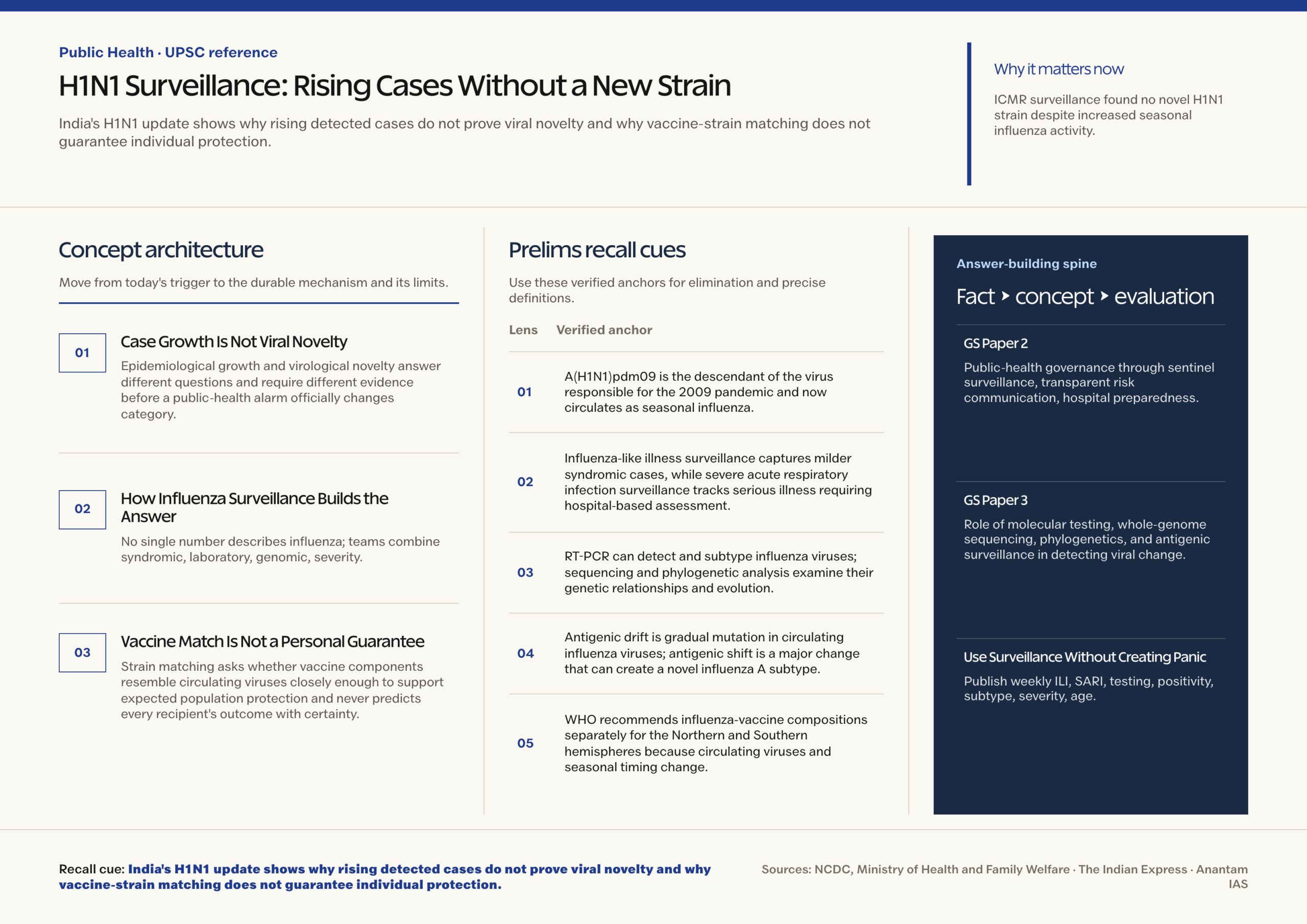
The Health Ministry reviewed seasonal-influenza preparedness after H1N1 predominated in recent ICMR-network detections, while scientists reported no new strain and NCDC found current vaccine matching.
- ICMR-network data reported by The Indian Express attributed around 70% of detected respiratory infections in the previous week to H1N1, with activity easing over the latest two reported weeks.
- ICMR scientists separately said circulating A(H1N1)pdm09 viruses did not represent a new H1N1 strain; the lineage has circulated seasonally since the 2009 pandemic.
- NCDC’s 2026 recommendation found circulating influenza strains in India broadly matched the WHO Northern Hemisphere 2026–27 vaccine components.
- The Ministry reviewed surveillance, early detection, clinical management, beds, critical-care readiness, supplies, and public communication rather than declaring a new pandemic emergency.
- A rising case count measures infections detected under a defined surveillance system; it does not, by itself, reveal whether the virus has acquired a novel lineage or pandemic potential.
- A sentinel-network percentage describes the tested surveillance sample and period, not the proportion of every respiratory infection among India’s entire population.
- Vaccine matching supports expected population benefit, while individual protection still varies with age, immune response, health conditions, timing, exposure, and changes within circulating viruses.
UPSC Relevance
Prelims Relevance
- A(H1N1)pdm09 is the descendant of the virus responsible for the 2009 pandemic and now circulates as seasonal influenza.
- Influenza-like illness surveillance captures milder syndromic cases, while severe acute respiratory infection surveillance tracks serious illness requiring hospital-based assessment.
- RT-PCR can detect and subtype influenza viruses; sequencing and phylogenetic analysis examine their genetic relationships and evolution.
- Antigenic drift is gradual mutation in circulating influenza viruses; antigenic shift is a major change that can create a novel influenza A subtype.
- WHO recommends influenza-vaccine compositions separately for the Northern and Southern hemispheres because circulating viruses and seasonal timing change.
Mains Relevance
GS Paper 2
- Public-health governance through sentinel surveillance, transparent risk communication, hospital preparedness, and coordination with States and Union Territories.
- Protection of high-risk groups without turning a seasonal rise into panic, stigma, indiscriminate testing, or inappropriate medicine use.
GS Paper 3
- Role of molecular testing, whole-genome sequencing, phylogenetics, and antigenic surveillance in detecting viral change.
- Translation of surveillance evidence into vaccine composition, clinical guidance, stock planning, and pandemic early warning.
Essay
- Good risk communication must produce vigilance without panic and reassurance without complacency.
Background and Context
Case Growth Is Not Viral Novelty
Epidemiological growth and virological novelty answer different questions and require different evidence before a public-health alarm officially changes category.
- Case growth asks how many infections are being detected over time; answers depend on transmission, seasonality, susceptibility, health-seeking behavior, testing intensity, and surveillance coverage.
- Viral novelty asks whether analysis identifies a materially different virus, lineage, or subtype and whether those changes alter transmissibility, severity, immune escape, or antiviral susceptibility.
- A familiar seasonal lineage can produce a large wave when immunity has waned, contact patterns favor transmission, or weather and indoor crowding support spread.
- The label pdm09 records the lineage’s pandemic origin in 2009; it does not mean every later seasonal wave is a new pandemic.
- A pandemic concern would require evidence beyond rising local cases, including a novel virus with sustained human transmission and widespread geographic spread.
How Influenza Surveillance Builds the Answer
No single number describes influenza; teams combine syndromic, laboratory, genomic, severity, and geographic evidence because each layer has a different denominator and decision purpose.
- Sentinel sites sample people meeting ILI or SARI definitions, creating a consistent window into which respiratory viruses are circulating and which patients develop severe disease.
- Laboratories use molecular tests to distinguish influenza A and B and subtype influenza A viruses such as H1N1 and H3N2 before selected samples undergo sequencing for finer genetic resolution.
- Representative isolates undergo sequencing and phylogenetic analysis, which places their gene sequences within known clades and reveals divergence from earlier viruses.
- NCDC reports that 73 sentinel sites collect year-round influenza-testing data through the DHR-ICMR VRDL network and the National Influenza Centre at ICMR-NIV Pune.
- Interpretation needs denominators: the proportion positive among tested samples, testing criteria, sites, week, geography, age mix, and disease severity determine what a percentage can support.
Vaccine Match Is Not a Personal Guarantee
Strain matching asks whether vaccine components resemble circulating viruses closely enough to support expected population protection and never predicts every recipient’s outcome with certainty.
- WHO updates recommended composition because influenza evolves; NCDC compares Indian surveillance isolates with those components before advising which seasonal formulation best fits circulation.
- For 2026, NCDC found India’s circulating strains broadly matched the Northern Hemisphere recommendation, including an A/Missouri/11/2025-like H1N1pdm09 component.
- A match does not create sterilizing immunity: vaccinated people may still become infected, particularly when immune response is weaker or exposure is intense.
- Protection can differ against infection, symptomatic illness, hospitalization, and death; a vaccine may reduce severe outcomes even when it does not prevent every infection.
- Risk communication should pair the match finding with limits, recommended timing, clinical advice for high-risk people, and warning signs requiring timely medical assessment.
Way Forward
Use Surveillance Without Creating Panic
- Publish weekly ILI, SARI, testing, positivity, subtype, severity, age, and geography indicators with clear denominators and notes on reporting lag.
- Sequence representative and unusual samples, link genomic findings with clinical outcomes, and rapidly investigate clusters showing unexpected severity, spread, or antiviral resistance.
- Maintain hospital surge plans, diagnostics, oxygen and critical-care readiness, and evidence-based antiviral access while coordinating alerts across national and State networks.
- Explain plainly that rising seasonal H1N1 warrants prevention and preparedness, but current evidence does not support claims of a new pandemic strain.
Conclusion
- The 2026 H1N1 update demonstrates why more detected disease and a novel virus are separate findings: one comes from epidemiological trends, the other from virological characterization, with different consequences for policy and communication.
- In a Mains answer, evaluate the surveillance denominator, genomic evidence, vaccine match, individual protection limits, clinical severity, and preparedness before assigning national prevalence or pandemic significance.
UPSC Practice Questions
Prelims MCQ 1
With reference to influenza surveillance, consider the following statements:
- A rise in detected H1N1 cases necessarily proves the emergence of a novel influenza strain.
- RT-PCR can detect and subtype influenza viruses.
- Phylogenetic analysis helps compare circulating viruses with known genetic lineages.
How many of the above statements are correct?
(a) Only one (b) Only two (c) All three (d) None
Answer: (b) Only two
Explanation:
Statements 2 and 3 are correct. Case growth can occur within an established seasonal lineage; novelty requires virological evidence.
Prelims MCQ 2
Which one of the following best describes a good match between circulating influenza strains and seasonal-vaccine components?
(a) Every vaccinated person is guaranteed to avoid infection (b) The vaccine contains live copies of every virus detected that year (c) Vaccine components resemble circulating viruses sufficiently to support expected population protection (d) No further influenza surveillance is required during the season
Answer: (c) Vaccine components resemble circulating viruses sufficiently to support expected population protection
Explanation:
Matching supports expected protection but cannot guarantee individual immunity; surveillance remains necessary because viruses and transmission patterns continue changing.
UPSC Mains Questions
- Why should public-health communication distinguish a rise in influenza cases from the emergence of a novel viral strain? Explain using surveillance evidence.
- Vaccine-strain matching is necessary but not sufficient for influenza control. Discuss with reference to surveillance, individual protection, and health-system preparedness.
Sources: NCDC, Ministry of Health and Family Welfare and The Indian Express.
Frequently Asked Questions
Does the rise in H1N1 cases mean a new strain has emerged?
No. ICMR scientists reported that the circulating A(H1N1)pdm09 lineage is not new. Case growth and viral novelty require different epidemiological and laboratory evidence.
Does the reported 70% describe national prevalence?
No. It describes the share attributed to H1N1 within a specific ICMR-network surveillance dataset and reporting period, not every respiratory infection across India’s population.
What does pdm09 mean in A(H1N1)pdm09?
It identifies the lineage descended from the virus that caused the 2009 pandemic. That lineage now circulates seasonally; the label does not declare a new pandemic.
What does vaccine-strain matching tell us?
It indicates that vaccine components resemble circulating viruses closely enough to support expected population benefit, but it cannot guarantee that every vaccinated person avoids infection.
Why are both ILI and SARI surveillance useful?
ILI surveillance tracks broader flu-like illness patterns, while SARI surveillance adds evidence about severe respiratory disease, hospital burden, and changes requiring urgent investigation.
Source: https://anantamias.com/current-affairs/h1n1-surveillance-no-new-strain/
Hawk Fire: Wildland-Urban Interface and Mass Evacuation
Why in News?
A fast-moving wildfire near Reno, Nevada, expanded evacuation zones as shifting winds threatened homes and complicated firefighting, prompting a multi-agency emergency response.
- The Hawk Fire spread through rugged foothills ringed by homes and businesses, illustrating exposure at the wildland-urban interface.
- Authorities used a GO NOW zone and an adjacent warning zone, allowing evacuation instructions to change with the evolving threat.
- A resident reported that a fire-tracking application lagged behind actual conditions, showing how alert latency can distort household risk perception.
- Officials described the fire as human-caused but had not established whether ignition was accidental or intentional in the verified reporting.
- No event-attribution evidence reviewed for this note connects this individual fire to climate change; the article focuses on observed weather, exposure and response.
- Wildfire becomes a disaster when a moving fire front intersects exposed people, buildings, utilities, roads and institutions that cannot avoid or absorb its effects.
- Wind speed and direction can change flame spread, ember transport, smoke and safe routes within minutes, making static perimeters unreliable for household decisions.
- Mass evacuation is a network problem: warnings, transport, traffic control, shelters, health support, animal care and security must work under one operational picture.
UPSC Relevance
Prelims Relevance
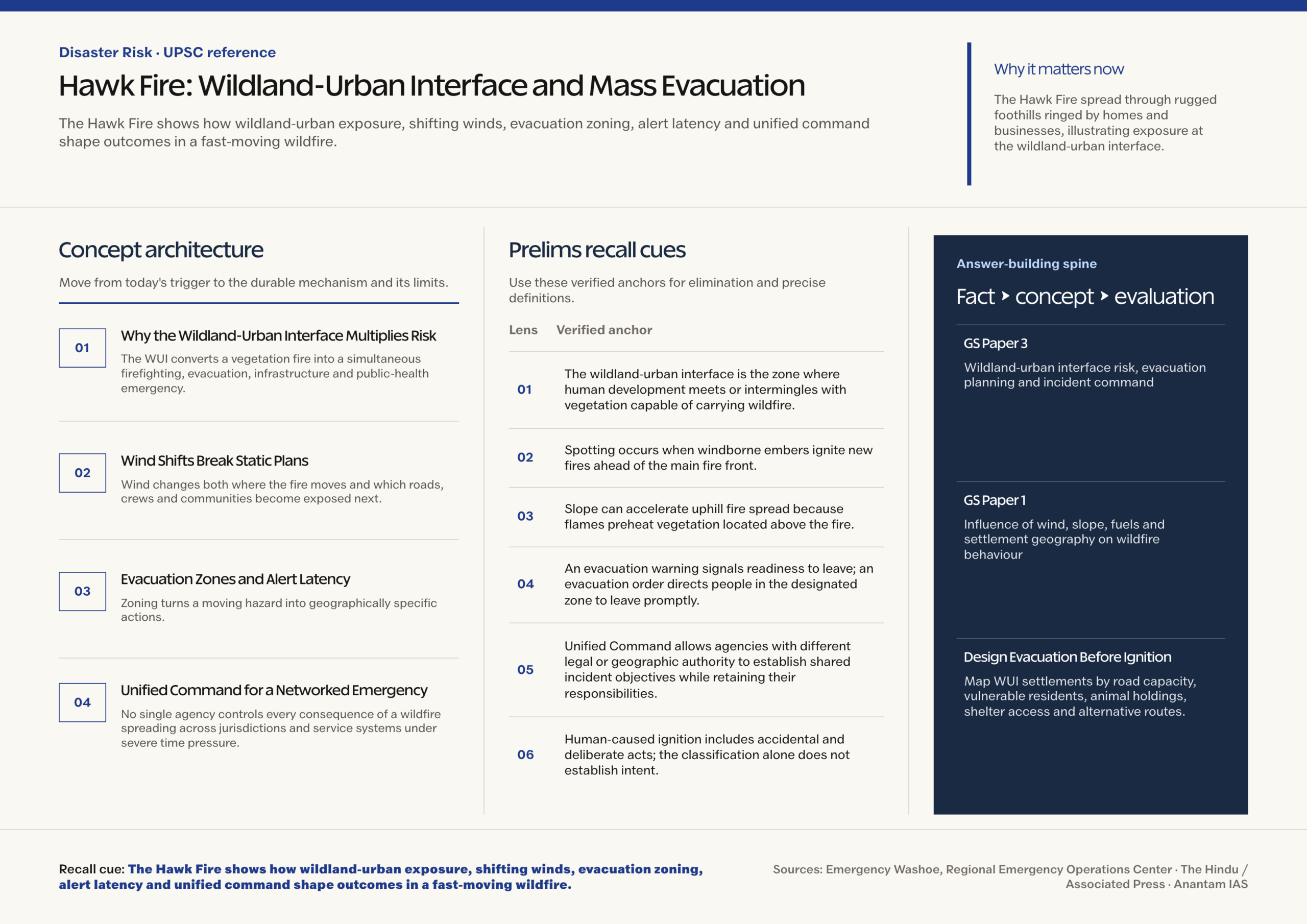
- The wildland-urban interface is the zone where human development meets or intermingles with vegetation capable of carrying wildfire.
- Spotting occurs when windborne embers ignite new fires ahead of the main fire front.
- Slope can accelerate uphill fire spread because flames preheat vegetation located above the fire.
- An evacuation warning signals readiness to leave; an evacuation order directs people in the designated zone to leave promptly.
- Unified Command allows agencies with different legal or geographic authority to establish shared incident objectives while retaining their responsibilities.
- Human-caused ignition includes accidental and deliberate acts; the classification alone does not establish intent.
Mains Relevance
GS Paper 3
- Wildland-urban interface risk, evacuation planning and incident command
- Early warning, last-mile communication and resilient critical infrastructure
GS Paper 1
- Influence of wind, slope, fuels and settlement geography on wildfire behaviour
Essay
- A warning succeeds only when accurate information reaches people early enough for safe action.
Background and Context
Why the Wildland-Urban Interface Multiplies Risk
The WUI converts a vegetation fire into a simultaneous firefighting, evacuation, infrastructure and public-health emergency.
- In an interface setting, buildings border a larger vegetated area; in an intermix setting, homes and vegetation are distributed through the same landscape.
- Roads may serve arriving fire crews and departing residents at once, creating congestion precisely when wind narrows the evacuation window and smoke reduces visibility at junctions.
- Combustible roofs, decks, fences and ornamental plants can carry embers from wildland fuels into neighbourhoods even before the flame front arrives.
- Risk reduction needs defensible space, ember-resistant construction, maintained access, backup utilities and land-use decisions that account for evacuation capacity.
Wind Shifts Break Static Plans
Wind changes both where the fire moves and which roads, crews and communities become exposed next.
- Stronger wind tilts flames toward unburned fuel, increases oxygen supply and transports embers, potentially creating spot fires beyond control lines.
- A direction shift can turn a flank into the head of the fire, requiring rapid reassessment of evacuation zones and crew safety positions before map updates reach residents.
- Topography interacts with wind: ridges, canyons and slopes can channel flow, limit access and produce local behaviour not visible in broad forecasts.
- Operational forecasts should be updated through weather observations and field reports, then translated into trigger points for zone expansion or route closure.
Evacuation Zones and Alert Latency
Zoning turns a moving hazard into geographically specific actions, while latency determines whether residents receive those actions in time.
- A warning zone lets households prepare medicines, documents, transport and animals; an order zone prioritises immediate movement rather than belongings.
- Alert latency accumulates across detection, verification, command decision, map editing, message distribution, device receipt, comprehension and household departure; each handoff can introduce delay.
- A consumer map may refresh slowly or lose connectivity, so official alerts should use redundant channels such as cell broadcast, SMS, radio, sirens and door-to-door notification during network or power failure.
- Messages should name the zone, required action, time, safe direction, shelter and update source; vague county-wide language creates delay and unnecessary traffic.
Unified Command for a Networked Emergency
No single agency controls every consequence of a wildfire spreading across jurisdictions and service systems under severe time pressure.
- Fire services manage suppression, police manage evacuation and access, medical agencies handle casualties, while utilities reduce power, gas and infrastructure hazards.
- Shelter agencies, transport providers and animal services need the same zone map and operational periods so households receive compatible instructions.
- Unified Command establishes shared objectives, priorities and resource allocation without erasing the statutory authority of participating agencies.
- A common operating picture should record fire behaviour, road status, alerts, shelter capacity, vulnerable facilities and unresolved information gaps with timestamps and named ownership for each update.
Way Forward
Design Evacuation Before Ignition
- Map WUI settlements by road capacity, vulnerable residents, animal holdings, shelter access and alternative routes, then test assumptions through drills.
- Set pre-agreed weather and fire-behaviour triggers for warnings, orders and zone expansion while preserving incident-command discretion for unexpected change.
- Audit alert systems end to end, including map refresh, telecom failure, multilingual comprehension and the time households actually need to depart.
- Use post-incident review to compare forecast, decision, message and movement timestamps, then correct the slowest link rather than blaming residents generically.
Conclusion
- The Hawk Fire’s durable lesson is that wildfire mortality is shaped before flames arrive by settlement exposure, warning speed and evacuation capacity.
- A Mains answer should connect wind-sensitive zoning with redundant alerts and Unified Command, while separating observed incident facts from unproved intent or climate attribution.
UPSC Practice Questions
Prelims MCQ 1
With reference to wildfire behaviour, consider the following statements:
- Windborne embers can ignite spot fires ahead of the main fire front.
- A sudden wind-direction change can alter which flank becomes most dangerous.
- Slope generally has no effect on the rate of uphill fire spread.
How many of the above statements are correct?
(a) Only one (b) Only two (c) All three (d) None
Answer: (b) Only two
Explanation:
Statements 1 and 2 are correct. Fire commonly spreads faster uphill because flames and hot gases preheat vegetation above the fire.
Prelims MCQ 2
What is the primary purpose of Unified Command in a multi-agency disaster?
(a) To transfer every agency’s legal authority to the fire department (b) To establish shared objectives and coordinated resource use across responsible agencies (c) To replace field observations with one public map (d) To delay evacuation until all agencies agree unanimously
Answer: (b) To establish shared objectives and coordinated resource use across responsible agencies
Explanation:
Unified Command coordinates agencies with different responsibilities while each retains its legal authority and accountability.
UPSC Mains Questions
- Why does development in the wildland-urban interface turn wildfire response into a land-use and evacuation-governance problem?
- Alert latency can make an accurate warning operationally useless. Discuss the institutional measures required for timely mass evacuation during a fast-moving hazard.
Sources: Emergency Washoe, Regional Emergency Operations Center and The Hindu / Associated Press.
Frequently Asked Questions
What is the wildland-urban interface?
It is the zone where homes, businesses or infrastructure meet or intermingle with vegetation capable of carrying wildfire, exposing people and structures to flames and embers.
Why are wind shifts dangerous during wildfire?
They can rapidly redirect the fire, transport embers, invalidate safe routes and turn a previously less active flank toward crews or settlements.
What is alert latency?
Alert latency is the delay from hazard detection through official decision, message delivery and comprehension to protective action by the person at risk.
Does human-caused mean the fire was deliberately set?
No. Human-caused ignition may be accidental or intentional. The classification does not establish motive, and officials had not reported intent in the verified sources.
Was climate change proved to have caused the Hawk Fire?
No event-attribution evidence reviewed here establishes that claim. Weather, fuels and exposure shaped the incident, but attribution requires a separate scientific analysis.
Source: https://anantamias.com/current-affairs/hawk-fire-wildland-urban-evacuation/
Syria-Israel Security Talks: Jordan, the Golan and Turkey’s Role
Why in News?
AFP reported that Syrian and Israeli officials met in Jordan on August 23 to discuss security deconfliction, but neither government confirmed the meeting or any proposed mechanism.
- Citing anonymous diplomatic and Syrian government sources, the report said Syria’s Foreign Minister and Israel’s Mossad chief discussed a Jordan-based operations room under U.S. supervision.
- The sources described its purpose as preventing confrontations inside Syria, including incidents involving Turkey; no mandate, participants, command structure, or activation was officially announced.
- The report also attributed discussion of Israeli incursions into southern Syria and described the meeting as a restart after a gap of several months.
- The same reporting said January contacts produced an intelligence-sharing or communication mechanism, but neither side publicly confirmed a signed security agreement or operational cell.
- Deconfliction is a narrow risk-reduction tool for preventing accidental escalation; it does not resolve sovereignty, occupation, borders, diplomatic recognition, or the legal status of military action.
- Jordan matters as the reported venue because it borders Syria and Israel and has direct security interests in stability across southern Syria.
- Turkey adds a third military and political actor: reported Israeli concern about Turkish deployment intersects with Ankara’s relationship with Syria’s authorities and U.S. mediation.
UPSC Relevance
Prelims Relevance
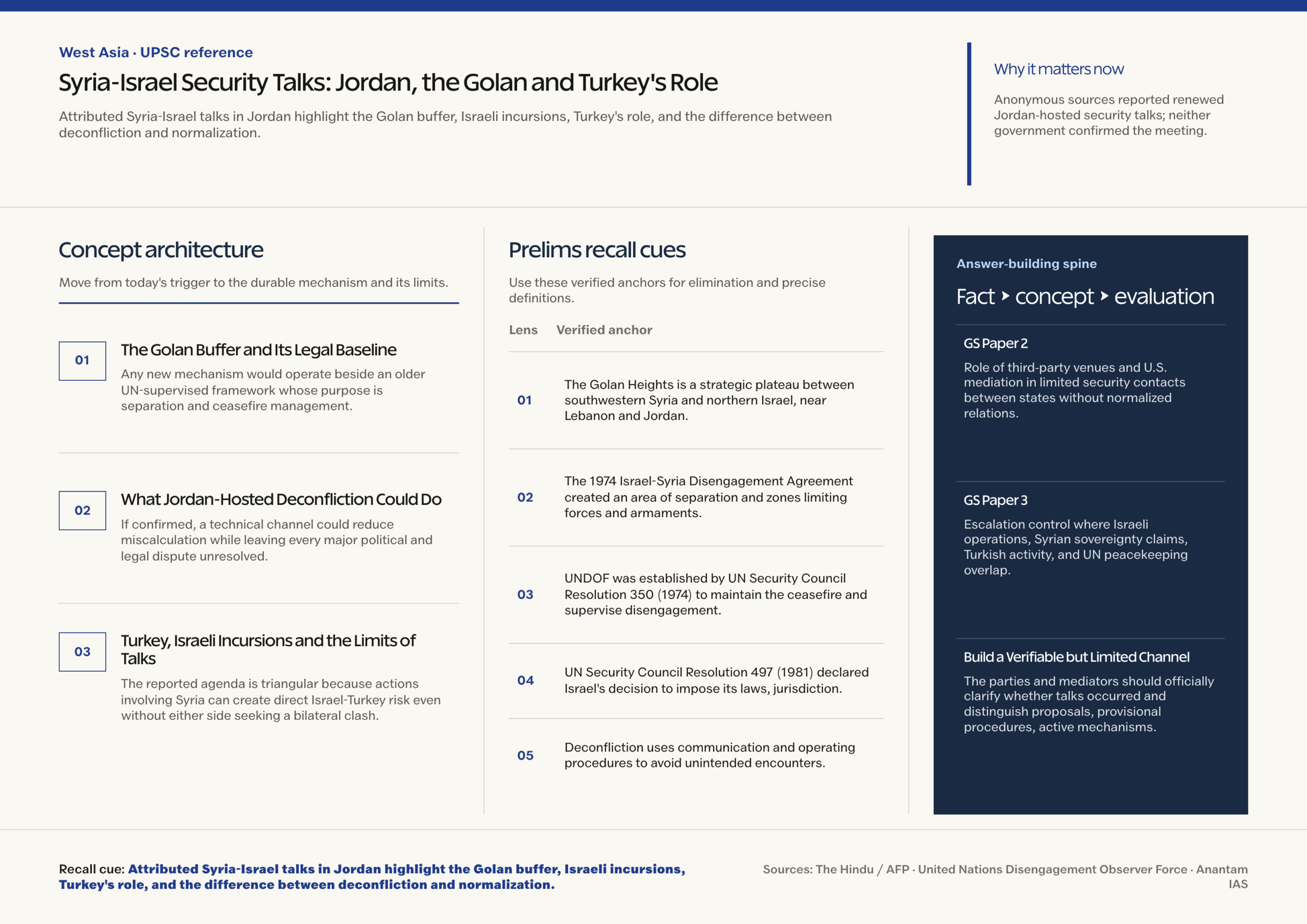
- The Golan Heights is a strategic plateau between southwestern Syria and northern Israel, near Lebanon and Jordan.
- The 1974 Israel-Syria Disengagement Agreement created an area of separation and zones limiting forces and armaments; it was not a peace agreement.
- UNDOF was established by UN Security Council Resolution 350 (1974) to maintain the ceasefire and supervise disengagement.
- UN Security Council Resolution 497 (1981) declared Israel’s decision to impose its laws, jurisdiction, and administration on occupied Syrian Golan null and void internationally.
- Deconfliction uses communication and operating procedures to avoid unintended encounters; normalization establishes broader formal relations between states.
Mains Relevance
GS Paper 2
- Role of third-party venues and U.S. mediation in limited security contacts between states without normalized relations.
- Distinction among tactical deconfliction, a security agreement, recognition, normalization, and settlement of territorial disputes.
GS Paper 3
- Escalation control where Israeli operations, Syrian sovereignty claims, Turkish activity, and UN peacekeeping overlap.
- Design limits of hotlines, incident-notification cells, shared operating procedures, and verification mechanisms.
Essay
- Communication between adversaries can prevent catastrophe without pretending that the underlying conflict has been solved.
Background and Context
The Golan Buffer and Its Legal Baseline
Any new mechanism would operate beside an older UN-supervised framework whose purpose is separation and ceasefire management, not final peace.
- Israel captured most of the Golan Heights from Syria in the 1967 war, making territory, security depth, and sovereignty inseparable from later military arrangements.
- The 1974 Disengagement Agreement created an area of separation between designated lines and equal zones limiting forces and armaments on either side.
- The agreement states that it is not a peace agreement; it is a step toward peace and a mechanism for separating armed forces after war.
- UNDOF, established by Security Council Resolution 350, monitors the ceasefire, observes the separation area, and inspects compliance with limits on forces and armaments.
- Security Council Resolution 497 later declared Israel’s imposition of laws and administration in occupied Syrian Golan null and void without international legal effect.
What Jordan-Hosted Deconfliction Could Do
If confirmed, a technical channel could reduce miscalculation while leaving every major political and legal dispute unresolved.
- The anonymous sources described a special operations room in Jordan under U.S. supervision, but no government released written terms or confirmed that it exists.
- A deconfliction cell could, in principle, exchange alerts, establish emergency contacts, clarify locations, log incidents, and separate forces before a tactical encounter escalates.
- The report also referred to an earlier communication or intelligence-sharing cell; without official documentation, its membership, data rules, authority, and continuity remain unknown.
- Jordan offers geographic proximity and a third-country venue, but hosting a channel would not make Jordan guarantor of compliance or party to a Syria-Israel settlement.
- A U.S. supervisory role could add convening power and verification pressure, yet outside mediation cannot replace consent, clear rules, accountability, and functioning military chains of command.
Turkey, Israeli Incursions and the Limits of Talks
The reported agenda is triangular because actions involving Syria can create direct Israel-Turkey risk even without either side seeking a bilateral clash.
- Israel said its August 18 strike on the disused Abu Duhur airbase aimed to prevent Turkish deployment; Turkey denied that its forces had visited the site.
- AFP’s sources said the reported Jordan discussions included preventing confrontations involving Turkey, but this does not confirm Turkish participation in the meeting or proposed room.
- The sources also said Israeli incursions into southern Syria were discussed, where Damascus frames strikes and deployments as violations of Syrian sovereignty.
- Israel seeks security depth and a wider demilitarized space, while Syria’s interests include territorial control and limiting foreign military action; a hotline cannot reconcile these positions alone.
- Even a functioning channel would reduce accidental escalation, not legalize incursions, determine the Golan’s status, guarantee withdrawal, or amount to diplomatic normalization.
Way Forward
Build a Verifiable but Limited Channel
- The parties and mediators should officially clarify whether talks occurred and distinguish proposals, provisional procedures, active mechanisms, and signed commitments.
- Any channel should define participants, geographic scope, notification triggers, response times, incident records, confidentiality, escalation contacts, and consequences for non-compliance.
- Technical arrangements should interface transparently with the 1974 Agreement and UNDOF rather than create ambiguous parallel rules around the separation area.
- Diplomatic reporting should preserve attribution and avoid calling tactical deconfliction a peace deal, normalization process, territorial settlement, or guarantee against future strikes.
Conclusion
- The reported Jordan meeting is best understood as an unconfirmed deconfliction effort shaped by the Golan buffer, Israeli operations in Syria, Turkish involvement, and U.S. mediation.
- In a Mains answer, separate the verified 1974 UN framework from attributed 2026 proposals, then assess what communication can prevent and what it cannot politically or legally resolve.
UPSC Practice Questions
Prelims MCQ 1
With reference to the Israel-Syria disengagement framework, consider the following statements:
- The 1974 Disengagement Agreement created an area of separation and zones limiting forces and armaments.
- UNDOF was established by UN Security Council Resolution 350 (1974).
- The 1974 agreement itself established full diplomatic normalization between Israel and Syria.
How many of the above statements are correct?
(a) Only one (b) Only two (c) All three (d) None
Answer: (b) Only two
Explanation:
Statements 1 and 2 are correct. The agreement explicitly was not a peace agreement and did not normalize bilateral relations.
Prelims MCQ 2
Which one of the following best distinguishes deconfliction from normalization?
(a) Deconfliction reduces operational collision risk; normalization establishes broader formal interstate relations (b) Deconfliction settles every territorial claim; normalization concerns only military radio frequencies (c) Deconfliction requires annexation; normalization requires a UN peacekeeping force (d) There is no meaningful distinction between the two
Answer: (a) Deconfliction reduces operational collision risk; normalization establishes broader formal interstate relations
Explanation:
A technical safety channel can operate between adversaries without resolving sovereignty, recognition, borders, or the wider political relationship.
UPSC Mains Questions
- Deconfliction can reduce escalation without resolving the underlying conflict. Discuss with reference to the Golan disengagement framework and attributed Syria-Israel contacts.
- How do Turkey, Jordan, the United States, and UNDOF shape the opportunities and limits of a Syria-Israel security mechanism? Examine.
Sources: The Hindu / AFP and United Nations Disengagement Observer Force.
Frequently Asked Questions
Did Syria and Israel confirm the reported Jordan meeting?
No. AFP based the report on anonymous diplomatic and Syrian government sources. Neither government publicly confirmed the meeting or issued agreed terms.
Was a Syria-Israel security agreement signed?
No signed agreement was announced. Sources described discussions and earlier communication proposals, which should not be presented as an operational pact, normalization, or peace deal.
What is UNDOF’s role in the Golan?
UNDOF maintains the ceasefire and supervises the 1974 Disengagement Agreement, including the area of separation and limits on forces and armaments.
Why does Turkey matter to the reported talks?
Turkey supports Syria’s authorities and may have security interests or activity inside Syria. Sources said the proposed mechanism aimed to prevent confrontations involving Turkey.
Would a deconfliction room amount to normalization?
No. It could reduce accidental military encounters through communication, but it would not establish diplomatic relations or settle sovereignty, occupation, borders, or the Golan’s legal status.
Source: https://anantamias.com/current-affairs/syria-israel-security-talks-jordan/
Vande Mataram and the Right to Dissent
Why in News?
The Prevention of Insults to National Honour (Amendment) Act, 2026 amends Section 3 of the Prevention of Insults to National Honour Act, 1971. It extends the same legal protection to the National Song (Vande Mataram) that is currently afforded to the National Anthem (Jana Gana Mana).
| UPSC Relevance: GS-2 Polity and Governance: Fundamental Rights, Fundamental Duties, Secularism Prelims: Vande Mataram; National Song and National Anthem, Prevention of Insults to National Honour Act, 1971; Articles 19, 25, 26 and 51A Mains: Freedom of conscience; limits of compelled patriotism; national symbols versus individual liberty; constitutional secularism |
About Vande Mataram:
- Vande Mataram was composed by Bankim Chandra Chattopadhyay, also known as Bankim Chandra Chatterjee.
- It was first published in the literary journal Bangadarshan in 1875 and later incorporated into his novel Anandamath in 1882.
- Rabindranath Tagore first sang it at the 1896 Calcutta Session of the Indian National Congress.
- It emerged as a powerful nationalist slogan during the Swadeshi Movement of 1905.
- The words Vande Mataram broadly mean “I bow to thee, Mother”.
First two and later stanzas:
- The first two stanzas portray the motherland through predominantly natural imagery: fertile fields, rivers, fruit, cool breezes, moonlight and prosperity.
- The later stanzas adopt a more explicitly devotional register. They identify the motherland through imagery associated with:
- Durga: power and protection;
- Kamala or Lakshmi: prosperity; and
- Vani or Saraswati: knowledge and learning.
While many understand these references as cultural metaphors for the nation, some religious communities may regard their vocal recitation as participation in a devotional invocation.
Constitutional Status of Vande Mataram:
- In 1937, against the backdrop of objections to the devotional content of the later verses, the Congress Working Committee accepted the practice of singing the first two stanzas at Congress gatherings.
- On 24 January 1950, Constituent Assembly President Dr Rajendra Prasad announced that:
- The composition known as Jana Gana Mana would be the National Anthem of India; and
- Vande Mataram, having played a historic role in the freedom struggle, would be honoured equally and accorded equal status.
The declaration was made through a presidential statement, not through a formally voted constitutional resolution. It also did not specify whether Vande Mataram meant the first two stanzas or the complete composition.
However, after the 2026 amendment, Vande Mataram also enjoys specific statutory protection. Statutory protection, however, does not transform the National Song into a constitutional provision or a second National Anthem.
Prevention of Insults to National Honour Act, 1971:
- The original Act protected the Indian National Flag, the Constitution of India, and the National Anthem.
- Section 2 criminalises specified forms of disrespect to the National Flag and the Constitution in a public place or within public view.
- Section 3 punishes anyone who intentionally prevents the singing of the National Anthem; or causes disturbance to an assembly engaged in singing it.
Prevention of Insults to National Honour (Amendment) Act, 2026:
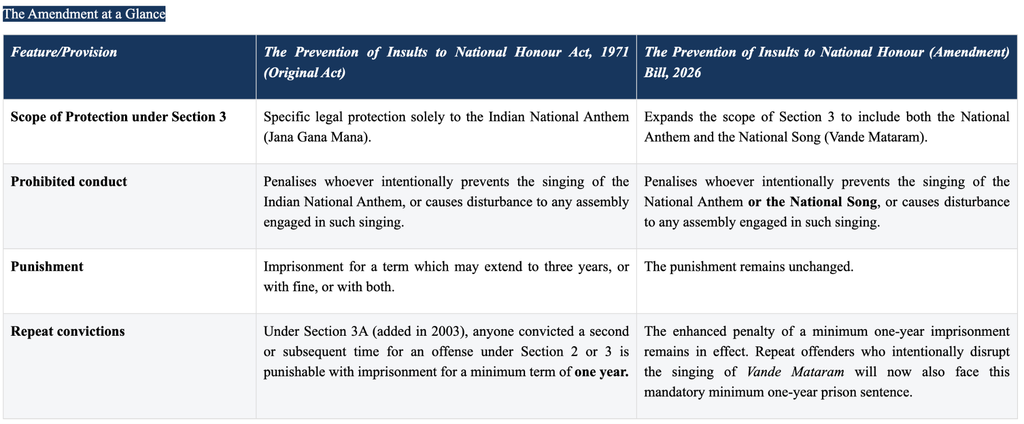
- The Prevention of Insults to National Honour (Amendment) Act, 2026 amended Section 3 to cover both the National Anthem and the National Song.
- Amended Section 3: A person is punishable if they intentionally:
- Prevent the singing of the National Anthem or the National Song; or
- Cause disturbance to an assembly engaged in such singing.
- Punishment: Imprisonment extending up to three years; fine; or both. Under Section 3A, a second or subsequent conviction under Sections 2 or 3 attracts a minimum imprisonment of one year.
What the Amended Act Does and Does Not Do?
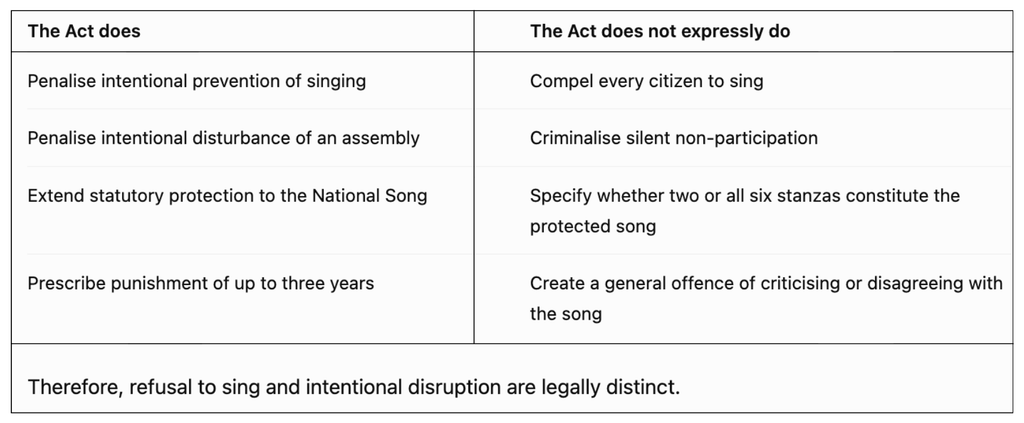
Constitutional Dimensions:
(i) Freedom of Conscience:
India’s constitutional order is founded on the coexistence of Hindus, Muslims, Christians, Sikhs, Buddhists, Jains, Parsis and numerous other belief systems.
- Article 25: Article 25(1) guarantees every person:
- Freedom of conscience; and
- The right freely to profess, practise and propagate religion. These rights are subject to public order, morality, health and other provisions of Part III.
Freedom of conscience protects the inner domain of belief as well as the right not to be compelled to affirm or participate in an expression contrary to a sincerely held conviction.
- Article 26 protects the collective autonomy of religious denominations to manage their religious affairs. The individual right not to sing primarily arises under Article 25, read with Article 19(1)(a). Article 26 may become relevant where State action interferes with the institutional practices of a religious denomination.
For adherents of some monotheistic faiths, vocal recitation of the last stanzas may be understood as participation in the invocation or worship of deities outside their faith. Such an objection cannot automatically be dismissed as eccentric, disrespectful or unpatriotic. Constitutional rights are especially important when they protect beliefs held by a minority.
At the same time, freedom of conscience does not include a right to prevent other citizens from singing. The Constitution protects peaceful non-participation, not intentional obstruction. This distinction allows the State to protect both collective expression and individual conscience.
(ii) Freedom of Expression and the Right to Remain Silent:
- Article 19(1)(a) protects freedom of speech and expression. Judicial interpretation has recognised that the guarantee includes: right to speak; right not to speak; right not to adopt a State-prescribed belief; and right to remain silent.
- Any restriction must: be imposed by law; fall within one of the grounds enumerated in Article 19(2); and satisfy the constitutional test of proportionality.
Therefore, refusing to sing is legally different from preventing others from singing.
(iii) Fundamental Rights and Fundamental Duties:
- Article 51A(a) imposes a fundamental duty on every citizen to respect: The Constitution; Its ideals and institutions; the National Flag; and the National Anthem. Notably, Article 51A(a) does not expressly mention the National Song.
- Fundamental Duties are non-justiciable, although they may guide legislation and judicial interpretation. They cannot automatically override Fundamental Rights.
- Respect for a national symbol also cannot invariably be equated with vocal participation. A citizen may show respect by maintaining silence and allowing others to participate.
(iv) Secularism and Constitutional Patriotism:
- Secularism is part of the Constitution’s basic structure, as recognised in S.R. Bommai v. Union of India.
- The State must therefore balance:
- Recognition of India’s civilisational heritage;
- Respect for the song’s role in the freedom struggle;
- Equal citizenship irrespective of religion;
- Freedom from compelled religious affirmation; and
- Maintenance of public order during national ceremonies.
- Constitutional patriotism is rooted not merely in common symbols but also in shared commitment to liberty, equality, fraternity, dignity and tolerance.
Bijoe Emmanuel v. State of Kerala, 1986:
This is the leading Supreme Court judgment on compelled patriotic expression.
- Background: Three schoolchildren belonging to the Jehovah’s Witnesses stood respectfully while the National Anthem was sung during their school assembly. They did not sing because their religious beliefs prohibited participation in such rituals. The school authorities expelled them.
- Supreme Court’s judgment: The Court ordered their readmission and held that:
- No law obligated them to sing the National Anthem;
- Standing respectfully without singing did not amount to disrespect;
- They neither prevented the singing nor disturbed the assembly;
- Compelling them to sing violated Articles 19(1)(a) and 25(1); and
- A genuine conscientious belief deserves protection even if it appears unusual to others.
The Court emphasised that India’s Constitution and civilisational tradition require the practice of tolerance.
Application to Vande Mataram:
The principle applies with considerable force to the National Song:
- A citizen cannot be compelled to vocalise words contrary to a genuine conscientious belief.
- Respectful silence does not prevent the rendition.
- Silent non-participation cannot ordinarily be treated as a disturbance.
- Protection of conscience does not authorise obstruction of others.
However, the Supreme Court has not yet finally adjudicated the scope or constitutionality of the amended 2026 provision.
Thus, respect for national symbols and respect for individual liberty are not competing visions of India; together, they constitute the democratic and plural character of the Republic.
Source: https://anantamias.com/current-affairs/vande-mataram-and-the-right-to-dissent/
Rural-Urban Divide in Female Labour Force Participation
Why in News?
The Periodic Labour Force Survey (PLFS) 2025 shows a substantial post-2019-20 rise in India’s Female Labour Force Participation Rate (FLFPR), with rural areas recording much stronger growth than urban areas.
| UPSC Relevance: GS-2 Social Justice: Human Development, Women; GS-3 Economy: Employment, inclusive growth Prelims: Key Trends (PLFS, LFPR, WPR and Unemployment Rate) Mains: Female employment, rural-urban disparities, quality of work and care economy |
What is Female Labour Force Participation Rate?
- The Female Labour Force Participation Rate refers to women (over 15 years) who are either employed or unemployed but seeking or available for work.
- It is different from the Worker Population Ratio (WPR), which covers only those actually employed.
Key Findings of PLFS 2025:
According to the PLFS 2025 released by the Ministry of Statistics and Programme Implementation (MoSPI), for women aged 15 years and above under the usual-status approach (principal plus subsidiary status), all-India LFPR stood at 40%, the Worker Population Ratio (WPR) was 38.8%, and the Unemployment Rate (UR) was 3.1%.
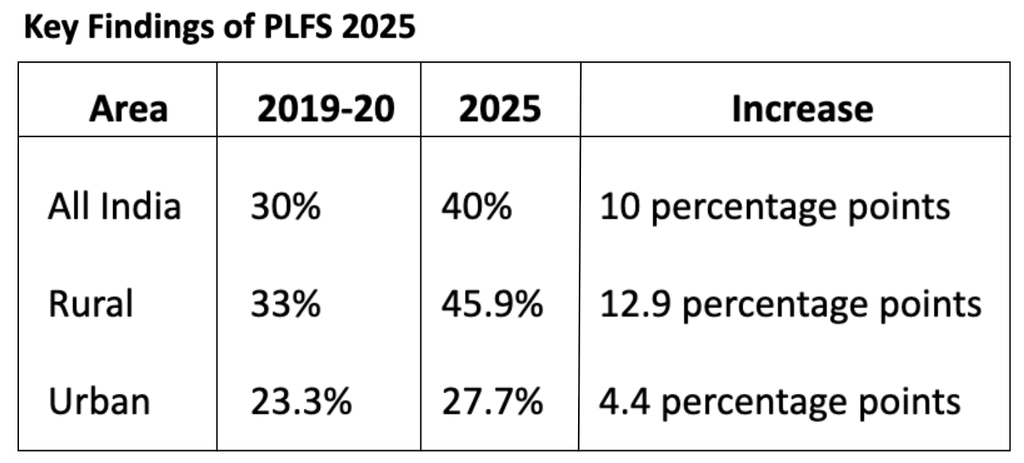
- Overall FLFPR for women aged 15+ rose from 30% in 2019-20 to 40% in 2025.
- Rural FLFPR: increased sharply from 33% to 45.9%.
- Urban FLFPR: rose more modestly from 23.3% to 27.7%.
Thus, the pace of improvement has been substantially higher in rural than urban areas.
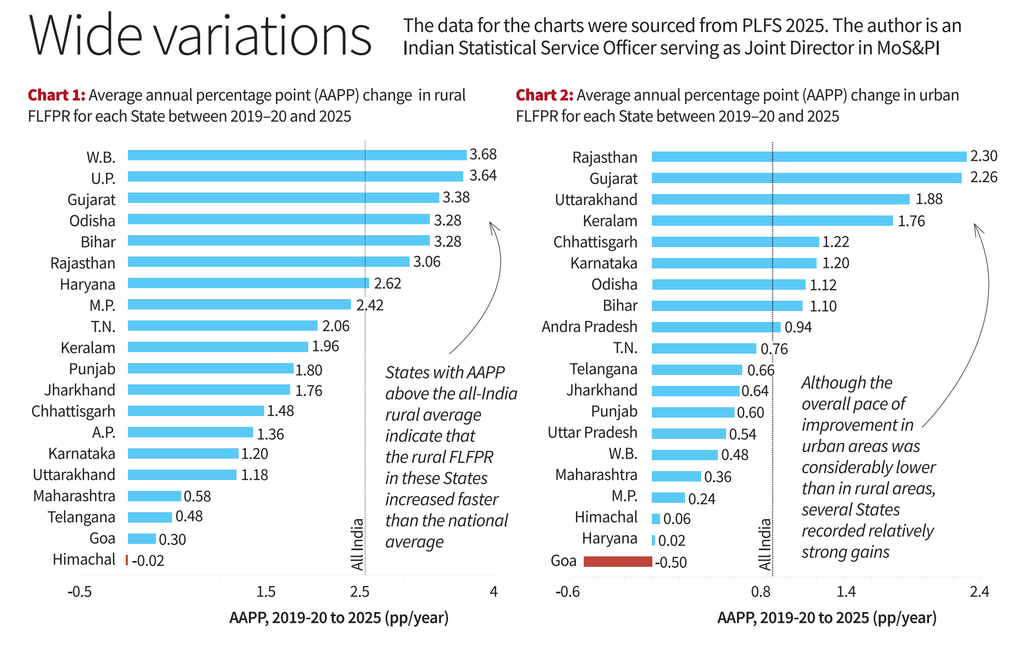
Significant Inter-State Variations:
The Average Annual Percentage Point change (AAPP) indicates the yearly pace at which FLFPR increased.
- Rural areas: Bihar, Uttar Pradesh and West Bengal combined a low initial FLFPR with rapid improvement. Gujarat, Odisha and Rajasthan registered strong growth despite starting from relatively higher baselines.
- Urban areas: Keralam, Karnataka, Chhattisgarh, Odisha and Andhra Pradesh combined relatively high initial participation with above-average improvement. In contrast, Goa recorded a decline, while Haryana and Himachal Pradesh saw negligible urban growth.
The data also shows that high growth is not necessarily linked to a low starting base. For example, Odisha, Gujarat and Rajasthan had relatively higher initial rural FLFPR but still recorded rapid improvement.
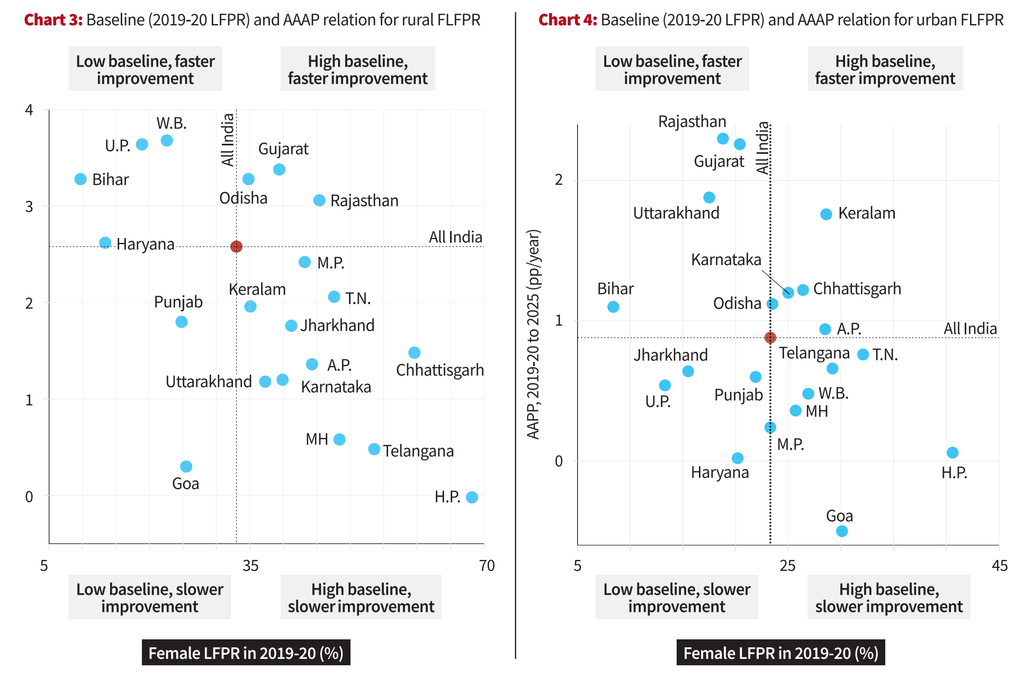
Why the Baseline Matters?
The article cautions against judging States solely by the Average Annual Percentage Point (AAPP) change.
- Low baseline + rapid improvement: Bihar, Uttar Pradesh and West Bengal in rural areas.
- Low baseline + slow improvement: Goa and Punjab.
- High baseline + rapid improvement: Gujarat, Odisha and Rajasthan in rural areas; Kerala, Karnataka and others in urban areas.
Therefore, both the level of participation and its rate of improvement must be considered when assessing women’s labour-market outcomes. Thus, a State with a lower AAPP may still have a higher absolute FLFPR.
Why Has Rural FLFPR Increased Faster?
- Greater absorption of women in agriculture, livestock and allied activities
- Expansion of self-employment and unpaid family work
- DAY-NRLM-supported Self-Help Groups and women-led microenterprises
- MGNREGS and other public employment opportunities
- Post-pandemic livelihood pressures encouraging additional household members to work
- Greater statistical recognition of women’s subsidiary economic activities; and
- Male migration leaving women with greater responsibility for farms and family enterprises.
Therefore, the rise may represent both greater economic agency and, in some cases, a distress-driven entry into low-productivity work.
Why does Urban FLFPR Remain Low?
- Scarcity of suitable and secure jobs for educated women
- Skill-employment mismatch
- Safety concerns and unreliable public transport
- High commuting and housing costs
- Marriage and motherhood-related withdrawal from employment
- Inadequate childcare and eldercare facilities
- Lack of flexible work arrangements
- Occupational segregation and gender discrimination; and
- Social norms that discourage women from accepting certain jobs.
In 2025, 44.4% of women outside the labour force cited childcare, personal commitments or homemaking as their main reason, highlighting the central role of unpaid care work.
Participation Does Not Necessarily Mean Empowerment:
The increase in FLFPR must be assessed alongside the quality of employment:
- In 2025, 64.2% of employed women were self-employed, while only 18.2% had regular wage or salaried employment.
- Average female self-employment earnings were about ₹6,374, compared with ₹17,914 for men.
- Women also worked fewer paid hours, partly reflecting their disproportionate unpaid-care burden.
Thus, higher participation may coexist with Informality, Unpaid family labour, Underemployment, Low productivity, Gender wage gaps and Absence of social security.
Way Forward:
- Diversify rural employment towards food processing, manufacturing, digital services and the care economy.
- Expand affordable crèches through Palna and workplace childcare facilities.
- Improve safe transport, working-women hostels and street lighting.
- Provide market, credit and technology linkages to women’s SHGs and enterprises.
- Promote flexible work without weakening wages or social security.
- Strengthen gender-responsive skilling in STEM, green jobs and emerging services.
- Recognise, reduce and redistribute unpaid care work.
- Publish State-wise data on wages, hours worked, formality and occupational status—not only participation rates.
The rise in female labour force participation is encouraging, but its rural concentration reveals a divided employment transition.
India must move from merely bringing more women into the labour force to ensuring that they obtain productive, remunerative, secure and dignified employment. Only then will higher FLFPR translate into genuine economic empowerment and inclusive growth.
UPSC PYQ 2023:
Q. Distinguish between ‘care economy’ and ‘monetized economy’. How can care economy be brought into monetized economy through women empowerment? (GS III)
Source: https://anantamias.com/current-affairs/rural-urban-divide-in-female-labour-force-participation/
India can become global Shipbuilding Hub
Why in News?
Defence Minister stated that declining or saturated capacity in traditional shipbuilding centres offers India an opportunity to become a global hub for shipbuilding, ship repair and maritime manufacturing.
Expansion projects of Garden Reach Shipbuilders and Engineers (GRSE) and Yantra India Limited are expected to strengthen indigenous shipbuilding, metallurgical and precision manufacturing capabilities.
| UPSC Relevance: GS-3 Economy: Infrastructure, manufacturing and employment; GS-3 Security: Defence indigenisation Prelims: Sagarmala Programme; Maritime Development Fund; Shipbuilding Financial Assistance Scheme Mains: Maritime economy, logistics competitiveness, defence self-reliance and Blue Economy |
Distinguishing the Three Segments:
- Ports: Infrastructure where cargo and vessels are handled.
- Shipping: Ownership and operation of merchant vessels transporting cargo.
- Shipbuilding: Construction, repair and retrofitting of commercial and defence vessels.
Thus, better port performance does not automatically produce a larger Indian-owned fleet or a globally competitive shipbuilding industry.
Present Status:
- India’s major ports handled a record 915.17 million tonnes of cargo in 2025-26, up from 581 million tonnes in 2014-15. Their cargo-handling capacity increased from around 873 MMTPA in 2014 to 1,728 MMTPA in 2025-26.
- Average vessel turnaround time declined from about 94 hours in 2014 to approximately 49 hours in 2025-26, indicating improved port efficiency.
- Under Sagarmala, 845 projects worth ₹6.06 lakh crore had been identified, of which 315 worth ₹1.57 lakh crore were completed by April 2026.
- However, India still accounts for less than 1% of global shipbuilding output. China, South Korea and Japan dominate global production.
- India’s merchant fleet remains relatively small and foreign-flagged vessels carry a large proportion of its overseas cargo, resulting in substantial foreign-exchange outgo.
Why does Shipbuilding Matter?
- Strategic autonomy: Indigenous warships and auxiliary vessels reduce vulnerability to foreign supply disruptions.
- Trade security: Around 95% of India’s merchandise trade by volume moves through the maritime route.
- Industrial multiplier: Shipbuilding generates demand for steel, engines, electronics, design services and thousands of MSMEs.
- Employment: It is both labour- and skill-intensive and can generate extensive indirect employment.
- Foreign-exchange savings: Indian-built and Indian-flagged vessels can reduce dependence on overseas shipyards and shipping companies.
- Blue Economy: It supports coastal shipping, fisheries, offshore energy, cruises and marine services.
- Green transition: Demand for low-emission and alternative-fuel vessels creates a new market that India can enter before production patterns become entrenched.
India’s Advantages:
- Long coastline and expanding port infrastructure
- Large engineering and skilled-workforce base
- Strong domestic steel and information-technology industries
- Experience in constructing aircraft carriers, stealth frigates, patrol vessels and specialised ships
- Lower labour costs and growing expertise in AI, simulation and digital ship design; and
- Saturated order books and capacity constraints in established shipbuilding countries.
Government Initiatives:
- ₹69,725-crore maritime package: Approved in 2025 to improve financing, shipyard capacity, skills and regulatory conditions.
- Shipbuilding Financial Assistance Scheme: ₹24,736 crore, extended until March 2036; provides assistance of approximately 15-25% depending on vessel category.
- Maritime Development Fund: ₹25,000 crore, comprising:
- ₹20,000-crore Maritime Investment Fund for equity financing; and
- ₹5,000-crore Interest Incentivisation Fund to lower borrowing costs.
- Shipbuilding Development Scheme: ₹19,989 crore for greenfield and brownfield shipyards, clusters, infrastructure and technology.
- National Shipbuilding Mission: Provides coordinated implementation and policy direction.
- Customs incentives: Basic customs duty exemption on specified shipbuilding inputs has been extended for ten years.
- Sagarmala Programme: Promotes port modernisation, connectivity, port-led industrialisation and coastal community development.
Major Challenges:
- High capital costs, expensive credit and long vessel-construction cycles
- Limited scale and uncertain domestic order books
- Dependence on imported marine engines, propulsion systems and specialised components
- Cost disadvantages relative to subsidised Asian shipyards
- Delays in construction and weak after-sales and repair ecosystems
- Ageing merchant vessels and limited Indian-flag participation in EXIM trade
- Shortage of specialised design, welding and marine-engineering skills; and
- Need to comply with increasingly stringent global decarbonisation standards.
Way Forward:
- India should create integrated maritime clusters connecting shipyards, component manufacturers, ports and research institutions
- Provide predictable orders to public and private shipyards
- Promote leasing and long-tenure finance
- Encourage joint ventures and technology transfer
- Specialise in green ships, offshore vessels, ferries and naval platforms.
India’s improved ports provide the logistical foundation, but becoming a maritime power requires simultaneous expansion of Indian ship ownership, domestic shipbuilding and repair capabilities. A competitive maritime ecosystem can advance economic growth, employment, export competitiveness and strategic autonomy.
Source: https://anantamias.com/current-affairs/india-can-become-global-shipbuilding-hub/
Civilisational Approach to Social Media: Beyond Bans for Minors
Why in News?
Growing concerns over social-media addiction, cyberbullying, harmful content and online exploitation have prompted several countries to restrict children’s access to social media.
The debate raises an important question for India: Should it rely primarily on prohibition or combine regulation with family, educational and cultural institutions that develop responsible digital behaviour?
| UPSC Relevance: GS-2 Polity and Governance: Digital regulation; Social Justice: Children, Education, Mental health Prelims: DPDP Act, 2023; IT Rules, 2021 Mains: Online child safety, platform accountability, digital citizenship and role of social institutions |
Emerging Global Response:
- Australia: In 2025, the government announced that designated platforms must take reasonable steps to prevent persons below 16 from maintaining social media accounts. Responsibility falls on platforms rather than children or parents.
- United Kingdom: In 2026, the government announced an under 16 social media prohibition, proposed for implementation by 2027, along with restrictions on addictive and harmful platform features.
- United States: Regulation remains fragmented, with federal child-privacy protections and varying state-level age-verification and parental-consent laws.
Why are Restrictions being Considered?
Social media may expose children to:
- Cyberbullying, grooming and sexual exploitation
- Violent, extremist or self-harm-related content
- Algorithmically amplified misinformation
- Addictive design, infinite scrolling and compulsive engagement
- Sleep disruption and reduced physical activity
- Social comparison, body-image concerns and anxiety; and
- Behavioural profiling and targeted advertising.
A WHO study covering nearly 2.8 lakh adolescents across 44 countries and regions found that problematic social-media use increased from 7% in 2018 to 11% in 2022.
However, the WHO also recognises that social media can support connection, learning and self-expression, demonstrating that its impact is not uniformly negative.
Why Blanket bans may be Inadequate?
- Easy circumvention: VPNs, false age declarations, encrypted platforms and borrowed devices can undermine prohibitions.
- Age-verification risks: Collection of identity documents or biometric information can create new privacy and surveillance concerns.
- Migration to unsafe spaces: Children may shift from regulated platforms to less visible and more dangerous services.
- Digital exclusion: Social media also facilitates education, creativity, community support and civic participation.
- Parental digital divide: Many parents lack the knowledge required to supervise rapidly evolving digital platforms.
- AI challenge: Children will increasingly interact with generative AI tutors, companions and recommendation systems, making a social-media-only ban technologically narrow.
- Rights concerns: Excessive restrictions may affect adolescents’ access to information and freedom of expression.
Therefore, regulation is necessary, but it cannot substitute for the capacity to exercise judgment.
India’s Existing Framework:
- Under the Digital Personal Data Protection Act, 2023, a child is a person below 18 years. Section 9:
- Requires verifiable parental consent before processing a child’s personal data;
- Prohibits processing likely to harm a child’s well-being; and
- Restricts tracking, behavioural monitoring and targeted advertising directed at children, subject to statutory exemptions.
- The framework is supplemented by:
- Information Technology Rules, 2021: Platform due diligence and grievance redressal;
- POCSO Act, 2012: Protection against online sexual abuse and child sexual-abuse material; and
- General criminal laws dealing with stalking, intimidation, fraud and obscenity.
However, India does not yet have a comprehensive child-centric online-safety law addressing addictive design, algorithmic amplification and age-appropriate platform architecture.
What is a Civilisational Approach?
A civilisational approach does not mean mechanically recreating the past. It means adapting India’s traditions of intergenerational learning, self-discipline, ethical reasoning and community responsibility to the digital age.
The guru-shishya tradition treated education as more than the transmission of information; it sought to cultivate character, restraint and judgment. Its contemporary equivalent should involve:
- Families: Digitally literate parents, open communication, shared screen-time norms and age-appropriate supervision.
- Schools: Integrate digital literacy, critical thinking, ethical reasoning, media literacy and digital citizenship into education.
- Teachers and mentors: Guidance on navigating online pressure rather than mere technological instruction.
- Community and cultural organisations: Constructive engagement with technology instead of complete withdrawal from it.
- Peers: Student-led digital-safety clubs and bystander training against cyberbullying.
- Technology companies: Build safer-by-design platforms and stronger safeguards for minors.
Way Forward: Balanced Indian Strategy:
India should follow a protection-participation-preparedness model:
- Protection:
- Impose a statutory duty of care on platforms;
- Ban targeted advertising and manipulative design for children;
- Provide default high-privacy settings;
- Ensure rapid reporting of grooming and abuse;
- Conduct independent audits of recommendation algorithms.
- Participation:
- Consult children while framing rules affecting their digital lives;
- Preserve access to educational, creative and mental-health resources;
- Develop age-appropriate rather than purely exclusionary platforms.
- Preparedness:
- Introduce compulsory digital and AI literacy in schools;
- Train parents and teachers in emerging online risks;
- Expand school counselling and cybercrime-reporting mechanisms;
- Promote critical thinking, self-control and responsible online conduct.
India need not choose between technological freedom and child protection. A blanket ban may offer temporary insulation, but it cannot prepare children for an AI-driven society. India’s most effective response would combine firm platform accountability and privacy safeguards with family guidance, ethical education and digital citizenship.
The objective should not merely be to keep children away from technology, but to enable them to use it with judgment, resilience and responsibility.
Supreme Court Revisits the Definition of ‘Industry’
Why in News?
A nine-judge Constitution Bench of the Supreme Court, in State of Uttar Pradesh v. Jai Bir Singh (2026), held that the expansive interpretation of “industry” evolved in the 1978 Bangalore Water Supply and Sewerage Board judgment will not automatically govern Section 2(p) of the Industrial Relations Code (IRC), 2020.
The Court clarified that the new provision must be interpreted independently, according to its “own text and context”.
Note: The 1978 judgment has not been declared void or overruled altogether. It continues to govern pending disputes under the repealed Industrial Disputes Act, 1947.
| UPSC Relevance: GS-2 Social Justice: Labour Rights; GS-3 Economy: Industrial Policy Prelims: IRC 2020; Section 2(p); Bangalore Water Supply case Mains: Labour Rights; Tension between institutional autonomy and worker protection |
What was the 1978 Bangalore Water Supply Judgment?
- Section 2(j) of the Industrial Disputes Act, 1947 defined “industry”. The Supreme Court interpreted it broadly through the following triple test:
- There must be a systematic or organised activity
- It must involve cooperation between employer and employees; and
- It must produce goods or services intended to satisfy human wants or wishes.
Profit motive, capital investment and whether the organisation was public, private or charitable were largely considered irrelevant.
- Consequently, hospitals, educational institutions, research bodies, municipalities and several welfare-oriented government activities could be treated as industries.
- It had exempted only core sovereign activities such as the judiciary, law and order, defence, etc. from the purview of ‘industry’, in order to protect the state’s functional autonomy.
- Significance: The judgment enabled workers employed in a wide range of jobs to have a legal recourse, including collective bargaining, against unfair labour practices by employers. It reflected the welfare orientation of Articles 38, 39, 43 and 43A of the Constitution.
Position under the Industrial Relations Code, 2020:
- The Industrial Relations Code (IRC) came into force in 2025, consolidating laws relating to trade unions, standing orders and industrial disputes.
- Section 2(p) defines an industry as a systematic employer-worker activity for producing, supplying or distributing goods or services, irrespective of capital investment or profit motive. However, it expressly excludes:
- Institutions substantially engaged in charitable, social or philanthropic services;
- Government activities relatable to sovereign functions, including defence research, atomic energy and space;
- Domestic services; and
- Any other activity notified by the Union government.
Thus, although the positive part of the definition resembles the 1978 test, the Code contains its own exclusions.
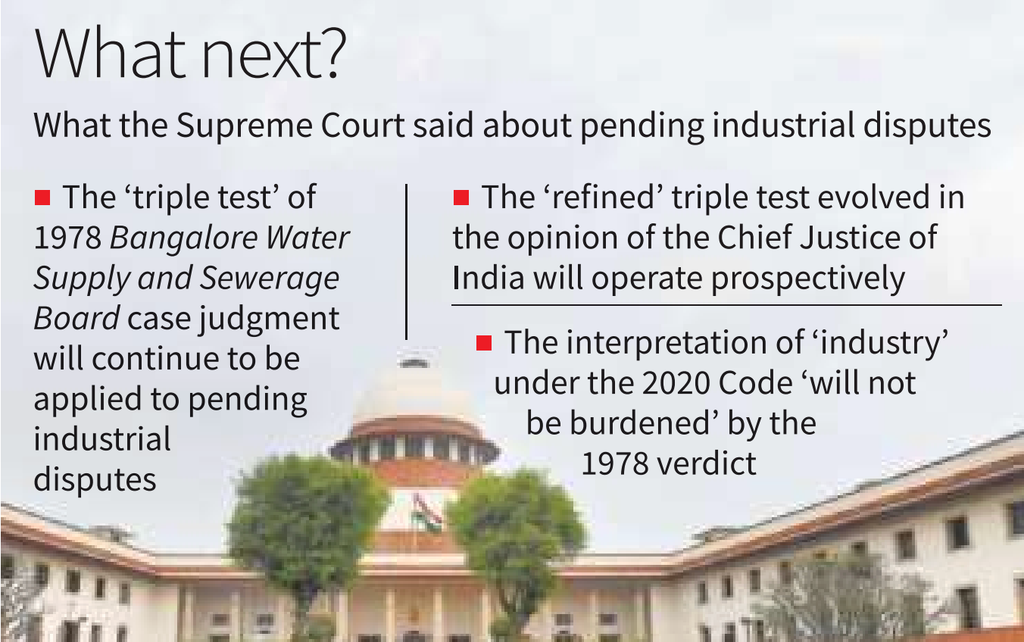
What did the Supreme Court Hold?
- Independent interpretation: The Court held that the 1978 interpretation cannot serve as the “sheet anchor” for interpreting Section 2(p) of the IRC.
- Refinement of triple test: The Court observed that some elements of the 1978 test required refinement, even though its essential framework had stood the test of time.
- Prospective operation: The refined formulation will operate prospectively.
- Pending disputes protected: Cases pending under the Industrial Disputes Act, 1947 will continue to be decided according to the original Bangalore Water Supply test.
- Finality preserved: Settled judgments, awards and disputes that have attained finality cannot be reopened.
Significance of the Judgment:
- Legislative supremacy: A judicial interpretation of a repealed law cannot automatically control a successor statute containing altered language and exclusions.
- Legal certainty: It separates disputes arising under the old Act from those governed by the new Code.
- Functional autonomy: Governmental, charitable and welfare institutions may receive greater protection from the indiscriminate application of industrial dispute procedures.
- Worker-protection concerns: Workers in charitable institutions and certain public or welfare bodies may face uncertainty regarding access to industrial tribunals and collective remedies.
- Scope for executive discretion: The power of the Union government to notify additional excluded activities must be exercised transparently and remain open to judicial review.
- Not complete exclusion from labour protection: An establishment falling outside “industry” may still be governed by other labour, contractual, service law and constitutional remedies.
Courts should interpret the new definition consistently with both its express exclusions and the constitutional commitment to dignity of labour.
Clear rules must also prevent genuine commercial activities from avoiding labour obligations merely by claiming a charitable or welfare character. Workers excluded from the IRC should be provided an effective alternative grievance and dispute-resolution mechanism.
Source: https://anantamias.com/current-affairs/supreme-court-revisits-the-definition-of-industry/
Return of Profanation as a New Political Language
Why in News?
The youth-led Cockroach Janta Party (CJP) protests at Jantar Mantar centred on examination irregularities, unemployment and governmental accountability have drawn attention to the growing use of humour, memes, satire and unconventional symbols in political mobilisation.
| UPSC Relevance: GS-2 Polity and Governance: Democratic participation, right to protest and accountability; GS-4 Ethics: Dissent and political civility Prelims: Articles 19(1)(a) and 19(1)(b) Mains: Informal politics, youth participation, digital activism and democratic dissent |
What is Profanation?
- Italian philosopher Giorgio Agamben describes profanation as returning something that has been placed in a “sacred”, exclusive or restricted sphere to the ordinary use of people.
- In politics, it means symbolically dismantling the aura of invincibility surrounding rulers and institutions through:
- humour and satire;
- parody, memes and political cartoons;
- informal language and symbolism; and
- rejection of titles, rituals and official conventions.
- Profanation should not be confused with profanity. The former challenges power symbolically, while the latter involves abusive or obscene language. Threats, slurs and violence cannot be justified as democratic dissent.
Historical Roots in India:
Profanation has long figured in India’s political history:
- Non-Cooperation and Swadeshi challenged the prestige and legitimacy of colonial institutions.
- Bonfires of foreign cloth converted an object of imperial commerce into a symbol of resistance.
- Gandhi returned the Kaiser-i-Hind medal, while Rabindranath Tagore renounced his knighthood after the Jallianwala Bagh massacre.
- Gandhi’s simple dress, political humour and refusal to conform to imperial etiquette symbolically undermined colonial authority.
Thus, anti-colonial politics challenged not only British coercive power but also the rituals and symbols through which colonial rule presented itself as superior.
Rise of Informal Politics:
- Contemporary youth movements increasingly combine physical demonstrations with digital tools such as memes, hashtags, satire and short videos.
- The CJP’s adoption of the “cockroach” identity illustrates how a derogatory label can be appropriated and transformed into a collective symbol of resilience.
- Such movements are generally:
- decentralised and non-party based;
- issue-specific rather than ideologically comprehensive;
- driven by digital-native youth;
- sceptical of established political organisations; and
- capable of rapidly linking online mobilisation with street protest.
Democratic Significance:
- Democratisation of political communication: Makes complex issues accessible to wider audiences.
- Reduction of fear: Humour weakens the psychological authority of powerful institutions.
- Agenda-setting: Digital mobilisation can compel governments and mainstream media to address neglected concerns.
- Political inclusion: Creates space for individuals outside formal parties and civil-society organisations.
- Non-violent resistance: Satire can provide an alternative outlet when conventional channels appear unresponsive.
Associated Concerns:
- Leaderless movements may lack internal accountability and negotiating capacity.
- Memes can oversimplify policy questions and facilitate misinformation.
- Trolling, abusive language and personal attacks may undermine constitutional morality.
- Episodic, single-issue mobilisation may struggle to produce sustained institutional reform.
- Governments may delegitimise unconventional dissent as disorder, while protesters may wrongly treat all regulation as repression.
Constitutional Balance:
- Articles 19(1)(a) and 19(1)(b) protect freedom of speech and peaceful assembly. However, these freedoms are subject to reasonable restrictions under Articles 19(2) and 19(3), including public order and the sovereignty and integrity of India.
- The Supreme Court has recognised peaceful protest as an essential democratic right, while holding that public spaces cannot be occupied indefinitely. (Amit Sahni v. Commissioner of Police, 2020).
Informal politics cannot replace elections, legislatures, courts or organised political opposition.
Nevertheless, humour, satire and symbolic profanation can complement formal institutions by questioning concentrated power and expanding democratic participation. Their legitimacy ultimately depends upon remaining peaceful, truthful, inclusive and constitutionally responsible.
Source: https://anantamias.com/current-affairs/return-of-profanation-as-a-new-political-language/