Why in News?
China officially postponed Chang’e-7 after concluding that the lunar mission did not meet launch conditions for its planned 2026 window.
- CNSA said the decision followed a comprehensive assessment guided by prudence, reliability and mission success.
- The official notice does not disclose the failed criterion, technical cause or a replacement launch date.
- Chang’e-7 was designed to investigate the lunar south-pole environment, resources and permanently shadowed regions.
- The postponement is confirmed; claims of a rocket defect, causal link to another launch failure or a definite 2027 flight remain unsupported.
- A deep-space launch window joins orbital geometry with spacecraft readiness, ground operations, communications, lighting and thermal constraints at the destination.
- Mission assurance treats postponement as a possible risk-control decision; delay alone does not reveal which subsystem or external condition was unsatisfactory.
- The lunar south pole matters because permanently shadowed cold traps may preserve water ice and other volatiles with scientific and resource-use value.
UPSC Relevance
Prelims Relevance
- Launch window and orbital geometry
- Permanently shadowed regions and cold traps
- Lunar south-pole illumination and thermal extremes
- Water ice and in-situ resource utilisation
- Mission assurance, readiness review and fault tolerance
Mains Relevance
GS Paper 3
- Why deep-space missions depend on narrow launch and surface-operation windows
- Mission assurance as a systems-engineering response to high-consequence uncertainty
- Scientific and strategic value of lunar polar exploration
Essay
- In high-risk technology, postponement can be evidence of institutional discipline rather than proof of failure.
Background and Context
Why a Lunar Mission Has a Launch Window
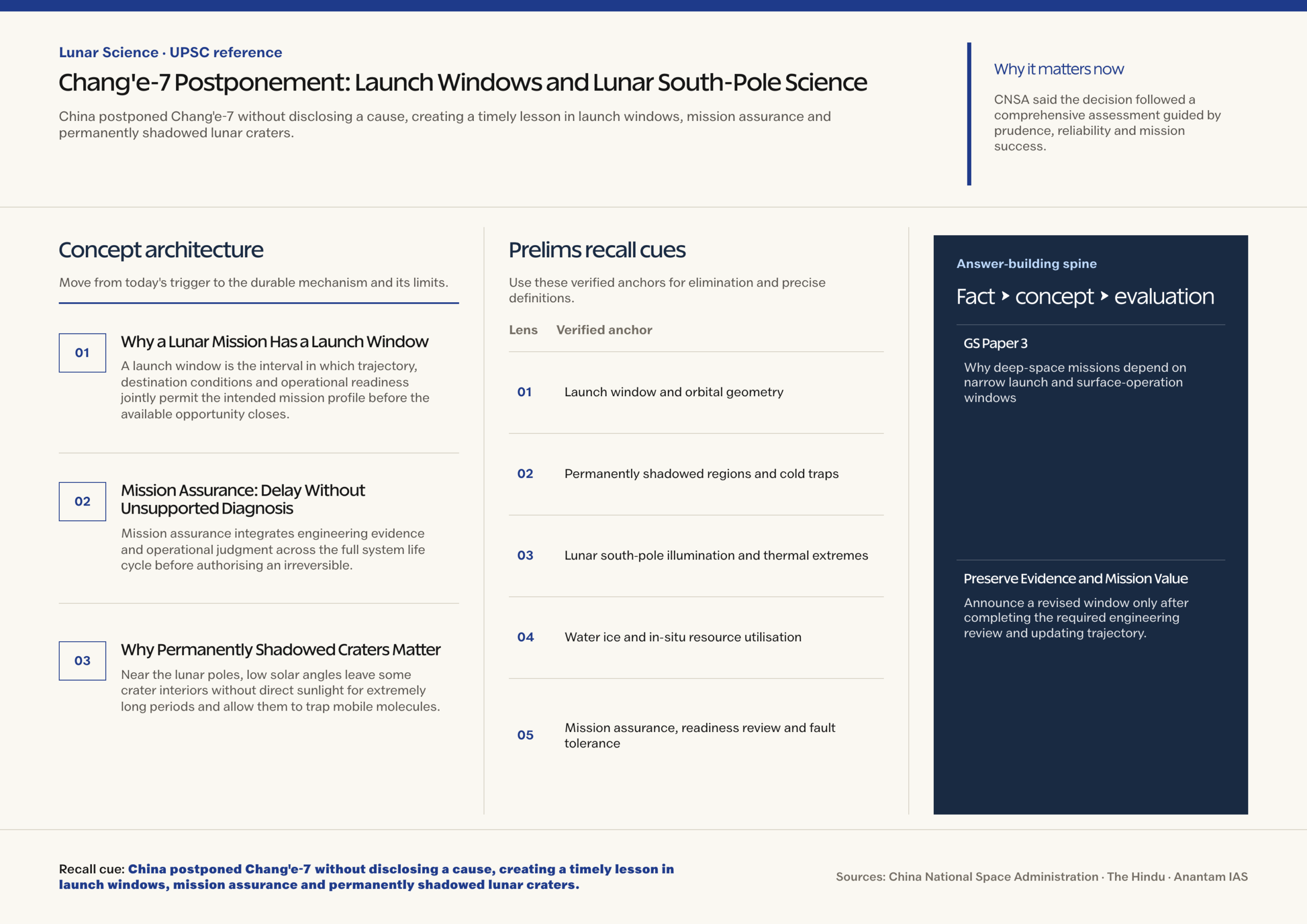
A launch window is the interval in which trajectory, destination conditions and operational readiness jointly permit the intended mission profile before the available opportunity closes.
- Earth and Moon positions determine whether the launch vehicle can inject the spacecraft into the required transfer trajectory with available energy while limiting correction demand.
- A polar landing mission may also depend on sunlight, surface temperature, communications geometry and planned observation conditions for imaging, power and descent near its landing zone.
- Range safety, weather, upper-level winds, tracking networks, ground stations and recovery plans add Earth-side constraints to the celestial geometry.
- Missing a suitable window can require new trajectory design, propellant calculations, thermal analysis, operations planning, mission simulations and repeated readiness checks.
- CNSA confirmed that this year’s conditions were not met but did not identify which constraint closed the window or how severe it was.
Mission Assurance: Delay Without Unsupported Diagnosis
Mission assurance integrates engineering evidence and operational judgment across the full system life cycle before authorising an irreversible, expensive and high-consequence launch.
- Teams review hardware, software, interfaces, international payloads, environmental tests, margins, procedures and ground systems as one connected mission architecture before they interact under flight conditions.
- A readiness review asks whether residual risks are understood and acceptable within agreed mission rules, not whether every component can be declared perfectly risk-free.
- Fault tolerance and redundancy protect against some failures, but they do not justify launch when an unresolved condition exceeds approved risk limits or violates safety assumptions.
- Postponement preserves the spacecraft, scientific opportunity and institutional credibility when the cost of an avoidable failure exceeds the cost of schedule delay.
- The evidence supports only one diagnosis: authorities withheld launch approval. It does not establish a rocket, spacecraft, payload, operations or site defect.
Why Permanently Shadowed Craters Matter
Near the lunar poles, low solar angles leave some crater interiors without direct sunlight for extremely long periods and allow them to trap mobile molecules.
- These regions remain exceptionally cold, allowing them to act as cold traps where water ice and other volatile compounds may persist over geological timescales.
- Sampling their deposits could reveal how water and volatiles reached, migrated across and survived on the Moon, while testing competing delivery histories.
- Water could potentially support future crews and be separated into useful products for in-situ resource use, but accessible quantity, purity and extraction cost remain open questions.
- Permanent darkness, steep terrain, communications limits and severe thermal conditions make mobility, power, navigation and instruments unusually difficult without continuous sunlight or line of sight.
- Chang’e-7’s planned combined orbital and surface investigation aims to connect remote observations with local measurements of the polar environment, resource distribution and accessibility.
Way Forward
Preserve Evidence and Mission Value
- Announce a revised window only after completing the required engineering review and updating trajectory, surface-lighting and ground-support plans.
- Separate confirmed readiness information from speculation so public communication does not convert an undisclosed condition into a false technical diagnosis.
- Protect scientific payload calibration, contamination control and international-partner interfaces during extended storage or re-testing before launch.
- Use the delay to verify polar navigation, power, communications and sampling scenarios against the conditions expected in permanently shadowed terrain.
Conclusion
- Chang’e-7’s postponement demonstrates that a launch window is both an orbital opportunity and a readiness gate for the complete mission system.
- In a Mains answer, connect mission assurance with the scientific challenge: lunar cold traps are valuable precisely because they are difficult to reach and investigate.
UPSC Practice Questions
Prelims MCQ 1
With reference to lunar south-pole exploration, consider the following statements:
- Some polar crater interiors can remain permanently shadowed because sunlight reaches the lunar poles at low angles.
- Permanently shadowed regions may preserve water ice and other volatiles as cold traps.
- Permanent shadow makes surface operations simpler by eliminating thermal and power constraints.
How many of the above statements are correct?
(a) Only one (b) Only two (c) All three (d) None
Answer: (b) Only two
Explanation:
Statements 1 and 2 are correct. Permanent darkness creates severe challenges for power, thermal control, navigation and communications rather than simplifying surface operations.
Prelims MCQ 2
Which statement best describes a deep-space launch window?
(a) Any day on which local weather is clear (b) An interval when trajectory geometry, destination conditions and operational readiness permit the planned mission (c) A fixed annual date that never changes (d) The period after a spacecraft has landed
Answer: (b) An interval when trajectory geometry, destination conditions and operational readiness permit the planned mission
Explanation:
Weather is only one factor. Orbital geometry, propulsion, landing-site illumination, communications, range safety and system readiness can all constrain a launch window.
UPSC Mains Questions
- Why do lunar missions depend on carefully defined launch windows? Explain how mission assurance shapes a launch decision under uncertainty.
- Permanently shadowed lunar craters combine high scientific value with severe engineering difficulty. Discuss in the context of lunar south-pole exploration.
Sources: China National Space Administration and The Hindu.
Frequently Asked Questions
Why was Chang’e-7 postponed?
CNSA said the mission did not meet launch conditions after a comprehensive assessment. It did not disclose the technical cause, affected system or a replacement date.
Does postponement prove a rocket defect?
No. A closed launch window can reflect spacecraft, payload, range, weather, trajectory, ground-system or risk-review constraints. The official notice identifies none of them.
What is a permanently shadowed region?
It is terrain, usually inside a polar crater, that receives no direct sunlight because of low solar angles and local topography, allowing extreme cold to persist.
Why is lunar water ice important?
It records the Moon’s volatile history and could potentially supply water, oxygen or propellant inputs. Its abundance, accessibility, purity and extraction economics still require investigation.
Is a new Chang’e-7 launch date confirmed?
No. The official statement only rules out implementation within the planned 2026 window. Any specific replacement date should remain labelled as speculation until authorities announce it.
Tell Google you want more of this.
Add Anantam IAS as a preferred sourceOne tap, and this site shows up more often in your own Top Stories, AI Overviews and AI Mode. Remove it any time.