

Why in News?
Karnataka published its Special Intensive Revision draft electoral rolls on August 24, opening the statutory claims, objections, notice and hearing stage before final publication.
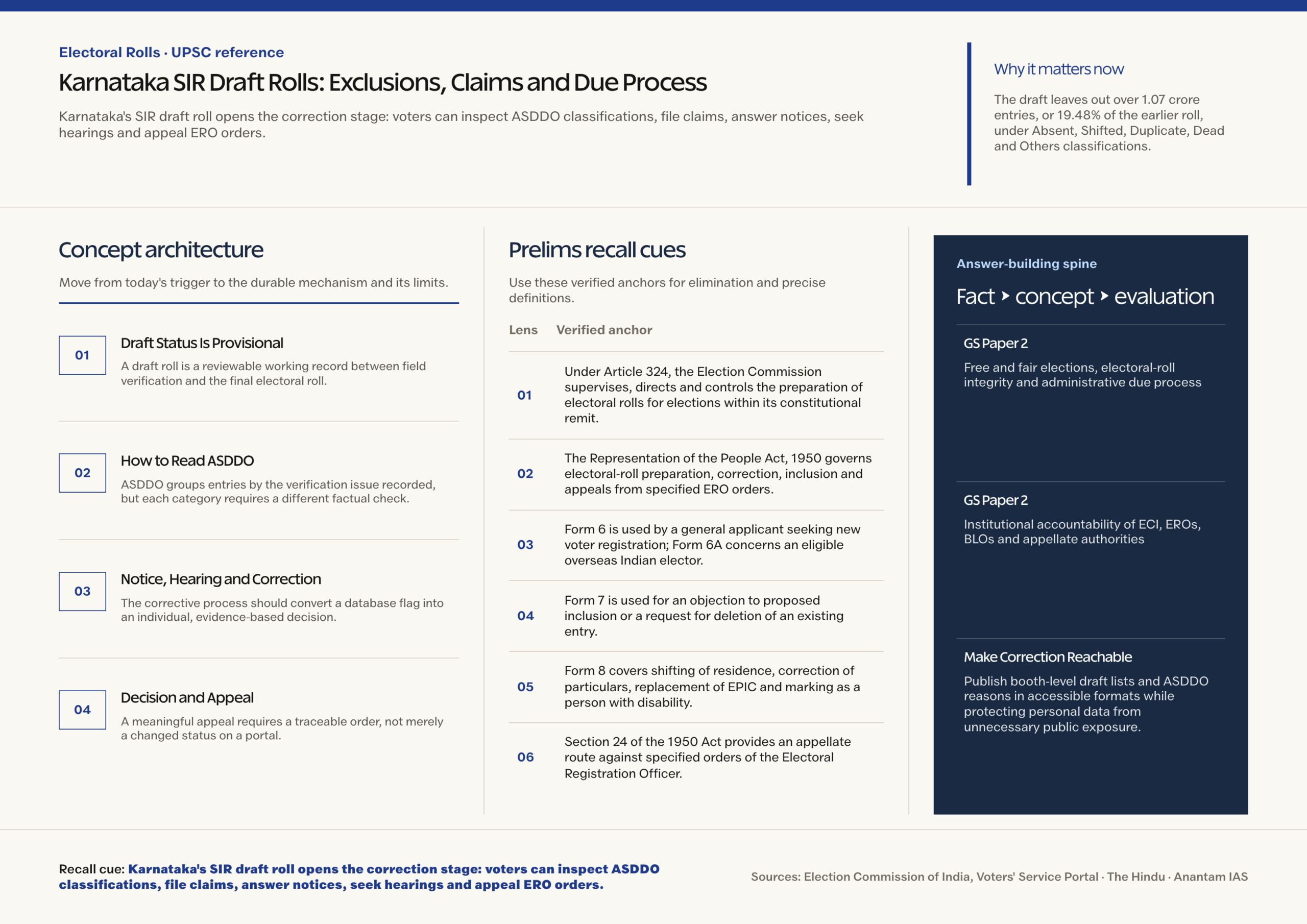
- The draft leaves out over 1.07 crore entries, or 19.48% of the earlier roll, under Absent, Shifted, Duplicate, Dead and Others classifications.
- An ASDDO label is an administrative classification used during roll verification; it is not by itself a final adjudication of voting eligibility or citizenship.
- Claims and objections may be filed until September 23, while notices, hearings and disposal continue during the broader revision window.
- The final roll is scheduled for October 27, making the intervening correction process decisive for both inclusion and roll accuracy.
- Electoral-roll integrity requires two protections together: removing confirmed dead, duplicate or shifted entries and preventing wrongful exclusion of eligible ordinary residents.
- A draft roll gives public notice of proposed entries and omissions; it invites correction before the Electoral Registration Officer settles claims and publishes the final roll.
- Due process is practical, not ceremonial: voters need accessible lists, intelligible reasons, adequate time, a hearing where facts are disputed and an effective appeal.
UPSC Relevance
Prelims Relevance
- Under Article 324, the Election Commission supervises, directs and controls the preparation of electoral rolls for elections within its constitutional remit.
- The Representation of the People Act, 1950 governs electoral-roll preparation, correction, inclusion and appeals from specified ERO orders.
- Form 6 is used by a general applicant seeking new voter registration; Form 6A concerns an eligible overseas Indian elector.
- Form 7 is used for an objection to proposed inclusion or a request for deletion of an existing entry.
- Form 8 covers shifting of residence, correction of particulars, replacement of EPIC and marking as a person with disability.
- Section 24 of the 1950 Act provides an appellate route against specified orders of the Electoral Registration Officer.
Mains Relevance
GS Paper 2
- Free and fair elections, electoral-roll integrity and administrative due process
- Notice, hearing, reasoned orders, correction and accessible appellate remedies
GS Paper 2
- Institutional accountability of ECI, EROs, BLOs and appellate authorities
Essay
- Democratic accuracy is not achieved by choosing between clean rolls and inclusive rolls; institutions must secure both.
Background and Context
Draft Status Is Provisional
A draft roll is a reviewable working record between field verification and the final electoral roll.
- Publication lets each elector inspect whether the name appears, whether particulars are accurate and whether the assigned polling details reflect ordinary residence.
- Omission from the draft triggers a need to check and use the prescribed remedy; it does not automatically amount to final disenfranchisement.
- A roll proceeding determines electoral registration under the governing election law; an entry-level classification is not a general declaration about citizenship status.
- Finality comes only after claims, objections, notices and applicable hearings are disposed of and the final roll is published, subject to statutory remedies.
How to Read ASDDO
ASDDO groups entries by the verification issue recorded, but each category requires a different factual check.
- Absent means the person was not found during verification; absence at that moment does not alone prove that the person ceased to be ordinarily resident.
- Shifted concerns ordinary residence elsewhere, while Duplicate concerns more than one entry; both require the correct entry and constituency to be identified.
- Dead entries should be removed on reliable verification, with safeguards against mistaken identity where names or family details are similar.
- Others is the least self-explanatory category, making a specific reason and accessible supporting record especially important before an adverse final decision.
Notice, Hearing and Correction
The corrective process should convert a database flag into an individual, evidence-based decision.
- A notice should identify the questioned entry, reason for scrutiny, response method, deadline and authority, allowing the elector to answer the actual issue.
- A hearing matters when residence, identity, mapping or another fact is disputed; the ERO should consider the response rather than treat non-matching data as conclusive.
- Form 6 supports inclusion, Form 7 supports objections or deletion requests, and Form 8 addresses shifting or correction; each performs a distinct procedural job.
- Offline access through electoral officials remains important for electors facing digital, language, disability, migration or documentation barriers during a time-bound revision.
Decision and Appeal
A meaningful appeal requires a traceable order, not merely a changed status on a portal.
- The ERO should record whether a claim or objection is accepted or rejected and give reasons sufficient for the elector to understand the finding.
- ECI guidance provides an appeal during revision to the designated district-level appellate authority, followed by a further appeal to the State Chief Electoral Officer.
- Section 24 links appeals to specified ERO orders under the 1950 Act; the prescribed authority, time and manner must be checked against the applicable revision instructions.
- An appellate authority should examine notice, evidence, hearing opportunity and legal eligibility rather than merely repeat the original database classification.
Way Forward
Make Correction Reachable
- Publish booth-level draft lists and ASDDO reasons in accessible formats while protecting personal data from unnecessary public exposure.
- Send multilingual notices through more than one channel and operate assisted filing desks for migrants, older persons, persons with disabilities and low-connectivity areas.
- Track claims by category, disposal time and outcome, then audit unusual booth-level rejection patterns before final publication.
- Provide downloadable reasoned orders and prominent appeal instructions so an adverse ERO decision can be challenged within the prescribed period.
Conclusion
- The constitutional question is not the size of the draft omission alone, but whether every proposed exclusion passes through notice, evidence, hearing and correction before finality.
- In a Mains answer, distinguish roll-cleaning from wrongful exclusion and assess SIR through proportional verification, reasoned ERO decisions and remedies that voters can realistically use.
UPSC Practice Questions
Prelims MCQ 1
With reference to electoral-roll forms, consider the following statements:
- Form 6 is used for new voter registration by a general applicant.
- Form 7 is used for objection to proposed inclusion or seeking deletion of an existing entry.
- Form 8 can be used for shifting residence or correcting particulars in an existing entry.
How many of the above statements are correct?
(a) Only one (b) Only two (c) All three (d) None
Answer: (c) All three
Explanation:
All three statements match the ECI’s current functions for Forms 6, 7 and 8. Form 6A separately concerns eligible overseas Indian electors.
Prelims MCQ 2
Which statement best describes omission from a draft electoral roll during a revision?
(a) It is automatically a final citizenship determination (b) It is automatically a permanent bar on voting (c) It is a provisional roll status open to prescribed claims, hearings and correction (d) It can be corrected only after the next general election
Answer: (c) It is a provisional roll status open to prescribed claims, hearings and correction
Explanation:
Draft publication begins public scrutiny and the claims-and-objections process. Final treatment follows disposal by the competent authority and remains subject to statutory remedies.
UPSC Mains Questions
- Electoral-roll revision must reconcile inclusion with accuracy. Examine how notice, hearing and reasoned decisions can protect both objectives.
- Why should an ASDDO classification in a draft electoral roll not be confused with final disenfranchisement or a citizenship finding? Discuss the available corrective safeguards.
Sources: Election Commission of India, Voters' Service Portal and The Hindu.
Frequently Asked Questions
What does omission from Karnataka’s draft roll mean?
It means the entry does not presently appear in the provisional roll. The elector can inspect the reason and use prescribed claims, correction, hearing and appeal procedures before finality.
What does ASDDO stand for?
ASDDO groups entries as Absent, Shifted, Duplicate, Dead or Others during verification. The label indicates the recorded issue; it is not itself a final legal determination.
Which form is used to seek inclusion?
Form 6 is the general new-voter registration form. Form 6A is for an eligible overseas Indian elector, while Form 8 handles correction or shifting.
Why is a hearing important in roll revision?
A hearing lets an elector answer disputed facts about identity, residence or mapping and requires the ERO to consider evidence before making an adverse decision.
Can an ERO order be appealed?
Yes. Section 24 of the Representation of the People Act, 1950 and ECI guidance provide appeals against specified ERO orders through prescribed authorities and procedures.
Tell Google you want more of this.
Add Anantam IAS as a preferred sourceOne tap, and this site shows up more often in your own Top Stories, AI Overviews and AI Mode. Remove it any time.






