Why in News?
The Health Ministry reviewed seasonal-influenza preparedness after H1N1 predominated in recent ICMR-network detections, while scientists reported no new strain and NCDC found current vaccine matching.
- ICMR-network data reported by The Indian Express attributed around 70% of detected respiratory infections in the previous week to H1N1, with activity easing over the latest two reported weeks.
- ICMR scientists separately said circulating A(H1N1)pdm09 viruses did not represent a new H1N1 strain; the lineage has circulated seasonally since the 2009 pandemic.
- NCDC’s 2026 recommendation found circulating influenza strains in India broadly matched the WHO Northern Hemisphere 2026–27 vaccine components.
- The Ministry reviewed surveillance, early detection, clinical management, beds, critical-care readiness, supplies, and public communication rather than declaring a new pandemic emergency.
- A rising case count measures infections detected under a defined surveillance system; it does not, by itself, reveal whether the virus has acquired a novel lineage or pandemic potential.
- A sentinel-network percentage describes the tested surveillance sample and period, not the proportion of every respiratory infection among India’s entire population.
- Vaccine matching supports expected population benefit, while individual protection still varies with age, immune response, health conditions, timing, exposure, and changes within circulating viruses.
UPSC Relevance
Prelims Relevance
- A(H1N1)pdm09 is the descendant of the virus responsible for the 2009 pandemic and now circulates as seasonal influenza.
- Influenza-like illness surveillance captures milder syndromic cases, while severe acute respiratory infection surveillance tracks serious illness requiring hospital-based assessment.
- RT-PCR can detect and subtype influenza viruses; sequencing and phylogenetic analysis examine their genetic relationships and evolution.
- Antigenic drift is gradual mutation in circulating influenza viruses; antigenic shift is a major change that can create a novel influenza A subtype.
- WHO recommends influenza-vaccine compositions separately for the Northern and Southern hemispheres because circulating viruses and seasonal timing change.
Mains Relevance
GS Paper 2
- Public-health governance through sentinel surveillance, transparent risk communication, hospital preparedness, and coordination with States and Union Territories.
- Protection of high-risk groups without turning a seasonal rise into panic, stigma, indiscriminate testing, or inappropriate medicine use.
GS Paper 3
- Role of molecular testing, whole-genome sequencing, phylogenetics, and antigenic surveillance in detecting viral change.
- Translation of surveillance evidence into vaccine composition, clinical guidance, stock planning, and pandemic early warning.
Essay
- Good risk communication must produce vigilance without panic and reassurance without complacency.
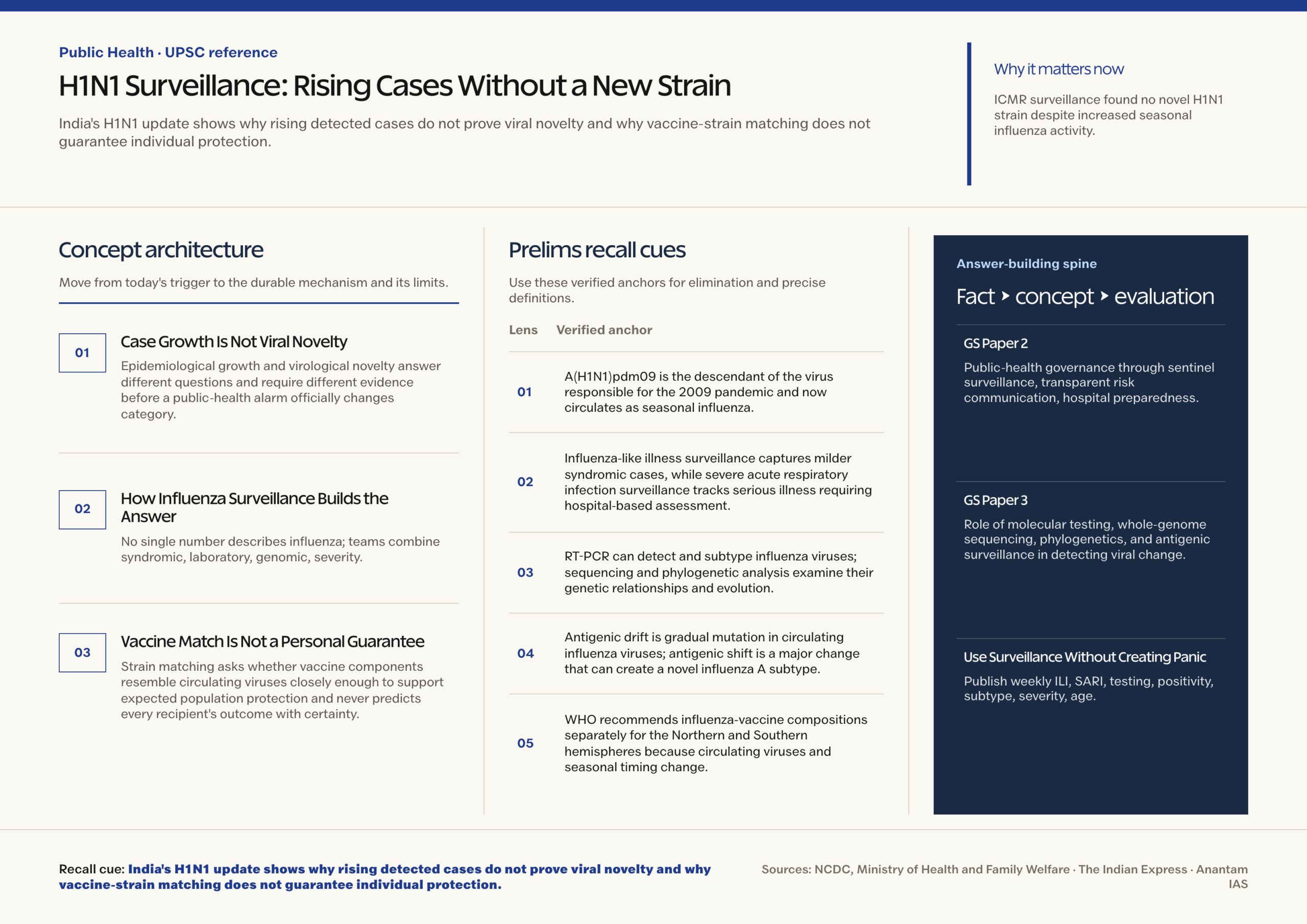
Background and Context
Case Growth Is Not Viral Novelty
Epidemiological growth and virological novelty answer different questions and require different evidence before a public-health alarm officially changes category.
- Case growth asks how many infections are being detected over time; answers depend on transmission, seasonality, susceptibility, health-seeking behavior, testing intensity, and surveillance coverage.
- Viral novelty asks whether analysis identifies a materially different virus, lineage, or subtype and whether those changes alter transmissibility, severity, immune escape, or antiviral susceptibility.
- A familiar seasonal lineage can produce a large wave when immunity has waned, contact patterns favor transmission, or weather and indoor crowding support spread.
- The label pdm09 records the lineage’s pandemic origin in 2009; it does not mean every later seasonal wave is a new pandemic.
- A pandemic concern would require evidence beyond rising local cases, including a novel virus with sustained human transmission and widespread geographic spread.
How Influenza Surveillance Builds the Answer
No single number describes influenza; teams combine syndromic, laboratory, genomic, severity, and geographic evidence because each layer has a different denominator and decision purpose.
- Sentinel sites sample people meeting ILI or SARI definitions, creating a consistent window into which respiratory viruses are circulating and which patients develop severe disease.
- Laboratories use molecular tests to distinguish influenza A and B and subtype influenza A viruses such as H1N1 and H3N2 before selected samples undergo sequencing for finer genetic resolution.
- Representative isolates undergo sequencing and phylogenetic analysis, which places their gene sequences within known clades and reveals divergence from earlier viruses.
- NCDC reports that 73 sentinel sites collect year-round influenza-testing data through the DHR-ICMR VRDL network and the National Influenza Centre at ICMR-NIV Pune.
- Interpretation needs denominators: the proportion positive among tested samples, testing criteria, sites, week, geography, age mix, and disease severity determine what a percentage can support.
Vaccine Match Is Not a Personal Guarantee
Strain matching asks whether vaccine components resemble circulating viruses closely enough to support expected population protection and never predicts every recipient’s outcome with certainty.
- WHO updates recommended composition because influenza evolves; NCDC compares Indian surveillance isolates with those components before advising which seasonal formulation best fits circulation.
- For 2026, NCDC found India’s circulating strains broadly matched the Northern Hemisphere recommendation, including an A/Missouri/11/2025-like H1N1pdm09 component.
- A match does not create sterilizing immunity: vaccinated people may still become infected, particularly when immune response is weaker or exposure is intense.
- Protection can differ against infection, symptomatic illness, hospitalization, and death; a vaccine may reduce severe outcomes even when it does not prevent every infection.
- Risk communication should pair the match finding with limits, recommended timing, clinical advice for high-risk people, and warning signs requiring timely medical assessment.
Way Forward
Use Surveillance Without Creating Panic
- Publish weekly ILI, SARI, testing, positivity, subtype, severity, age, and geography indicators with clear denominators and notes on reporting lag.
- Sequence representative and unusual samples, link genomic findings with clinical outcomes, and rapidly investigate clusters showing unexpected severity, spread, or antiviral resistance.
- Maintain hospital surge plans, diagnostics, oxygen and critical-care readiness, and evidence-based antiviral access while coordinating alerts across national and State networks.
- Explain plainly that rising seasonal H1N1 warrants prevention and preparedness, but current evidence does not support claims of a new pandemic strain.
Conclusion
- The 2026 H1N1 update demonstrates why more detected disease and a novel virus are separate findings: one comes from epidemiological trends, the other from virological characterization, with different consequences for policy and communication.
- In a Mains answer, evaluate the surveillance denominator, genomic evidence, vaccine match, individual protection limits, clinical severity, and preparedness before assigning national prevalence or pandemic significance.
UPSC Practice Questions
Prelims MCQ 1
With reference to influenza surveillance, consider the following statements:
- A rise in detected H1N1 cases necessarily proves the emergence of a novel influenza strain.
- RT-PCR can detect and subtype influenza viruses.
- Phylogenetic analysis helps compare circulating viruses with known genetic lineages.
How many of the above statements are correct?
(a) Only one (b) Only two (c) All three (d) None
Answer: (b) Only two
Explanation:
Statements 2 and 3 are correct. Case growth can occur within an established seasonal lineage; novelty requires virological evidence.
Prelims MCQ 2
Which one of the following best describes a good match between circulating influenza strains and seasonal-vaccine components?
(a) Every vaccinated person is guaranteed to avoid infection (b) The vaccine contains live copies of every virus detected that year (c) Vaccine components resemble circulating viruses sufficiently to support expected population protection (d) No further influenza surveillance is required during the season
Answer: (c) Vaccine components resemble circulating viruses sufficiently to support expected population protection
Explanation:
Matching supports expected protection but cannot guarantee individual immunity; surveillance remains necessary because viruses and transmission patterns continue changing.
UPSC Mains Questions
- Why should public-health communication distinguish a rise in influenza cases from the emergence of a novel viral strain? Explain using surveillance evidence.
- Vaccine-strain matching is necessary but not sufficient for influenza control. Discuss with reference to surveillance, individual protection, and health-system preparedness.
Sources: NCDC, Ministry of Health and Family Welfare and The Indian Express.
Frequently Asked Questions
Does the rise in H1N1 cases mean a new strain has emerged?
No. ICMR scientists reported that the circulating A(H1N1)pdm09 lineage is not new. Case growth and viral novelty require different epidemiological and laboratory evidence.
Does the reported 70% describe national prevalence?
No. It describes the share attributed to H1N1 within a specific ICMR-network surveillance dataset and reporting period, not every respiratory infection across India’s population.
What does pdm09 mean in A(H1N1)pdm09?
It identifies the lineage descended from the virus that caused the 2009 pandemic. That lineage now circulates seasonally; the label does not declare a new pandemic.
What does vaccine-strain matching tell us?
It indicates that vaccine components resemble circulating viruses closely enough to support expected population benefit, but it cannot guarantee that every vaccinated person avoids infection.
Why are both ILI and SARI surveillance useful?
ILI surveillance tracks broader flu-like illness patterns, while SARI surveillance adds evidence about severe respiratory disease, hospital burden, and changes requiring urgent investigation.
Tell Google you want more of this.
Add Anantam IAS as a preferred sourceOne tap, and this site shows up more often in your own Top Stories, AI Overviews and AI Mode. Remove it any time.