Daily Digest
UPSC · Civil Services Examination
Current Affairs · Thursday, 24 July 2025
Current affairs curated and edited by Anantam IAS faculty — pulled from The Hindu, PIB, IDSA, Foreign Affairs and the ministries. Read, annotate, revise.
Old Rajinder Nagar · Delhi 110005 · anantamias.com
Paika Rebellion

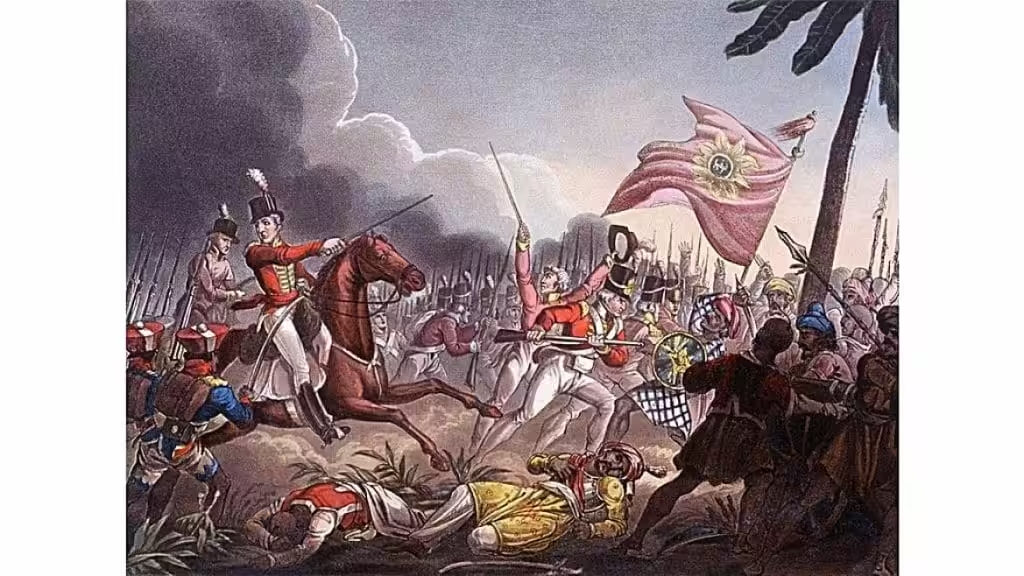
Context: Former Odisha Chief Minister Naveen Patnaik expressed concern over the “omission” of the Paika Rebellion from NCERT’s new Class 8 history textbook, calling it a “huge dishonour” to the brave Paikas.
UPSC Relevance: CSE in prelims as well as in mains examination has focused on various subaltern movements. A case in point is a following PYQ:
Prelims 2020
With reference to the history of India, “Ulgulan” or the Great Tumult is the description of which of the following events?
A The Revolt of 1857
B The Mappila of 1921
C The Indigo Revolt of 1859 – 60
D Birsa Munda‘s Revolt of 1899 – 1900
Paikas of Odisha:
The Paikas (pronounced “paiko”, literally “foot soldiers”) were a class of military retainers who had been recruited by the Gajapati rulers of Odisha since the 16th century to provide martial services in return for hereditary rent-free land (nish-kar jagirs).
Reason for Paikas revolt:
British policies of exploitation
After the Raja of Khurda was deposed, Major Fletcher assumed command of the estate’s entire administration. Thus began the British administration’s exploitative policies, which became increasingly intolerable for the people of Odisha.
Faulty revenue policy
The British government’s erroneous revenue policy harmed the local zamindars and royats. Short-term land revenue settlements disproportionately impacted zamindars who had failed to pay their dues to the British authority. The British never granted remission or time to local zamindars for revenue collection.
British salt policy
The British government stripped the zamindars and indigenous peoples of the coastal region of their traditional rights to salt manufacture. Due to the heavy importation of Liverpool salt, every household in this land felt the increase in the price of salt.
Difficulties of the Khurda people
The amlas involved in administration smuggled large quantities of salt and profited handsomely. The common people of Khurda, who relied on smuggled salt, faced utter destitution. They violated British salt laws by producing salt.
The new monetary system
During the early years of British administration in Odisha, the scarcity of cowrie currency was acute. As a result, British troops found it exceedingly difficult to obtain small items of daily consumption from the local market. As a result, the British government introduced sicca rupees in Odisha in November 1804. The zamindars, peasants, and Talukdars all encountered difficulties when it came to collecting revenue in cowrie currency.
Contemporary political condition of Khurda
Khurda’s people were rebellious due to the country’s political situation at the time. The hanging of Jayi Rajaguru, the deposition of Raja Mukundadeva II, and Major Fletcher’s reorganisation of Khurda’s administration enraged the local populace. They were determined to resist British rule in Khurda at all costs.
Displeasure of Buxi Jagabandhu
Buxi Jagabandhu’s displeasure was the immediate trigger for the Paik rebellion. He was the Raja of Khurda’s Commander, and his position was hereditary. He commanded respect from the populace on a par with the king. As a reward for his service, the Raja granted him jagir lands known as Buxibari, which included the quilla of Rorung and four paraganas, namely Rahang, Lembai, Sarai, and Chabiskud. Major Fletcher deprived Buxi of the quilla Rorung when he established new administration in Khurda.
Hence Paika Rebellion: Began on 29 March 1817.
The rebellion
- In March 1817, some 400 Kondh tribals marched from Ghumusar towards Khurda.
- They were joined by Paikas led by Bakshi Jagabandhu Bidyadhar Mahapatra Bhramarabar Ray, the former commander-in-chief of the king of Khurda.
- The rebels attacked the police station, burnt government quarters, killed policemen, looted the treasury, and proceeded towards Khurda.
- Over the next few months, the Paikas killed a number of British officials.
- But the revolt was crushed, and Bakshi Jagabandhu escaped into the jungles.
- He remained on the run until 1825
Consequences
Odisha’s administrative changes
Changes have been made in the administrative field. Odias was employed by the government and entrusted with important tasks. This enables the indigenous people to develop a relationship with the British authorities through these employees.
Modifications to the judicial process
Changes were also made in the judiciary. Because Persi was the court language, the Odias were unable to comprehend the judicial procedure and verdict. Now, judges have been instructed to visit even the interior villages of a district accompanied by the Odia Amlas and redress the people’s grievances on the spot.
Salt price reduction
The price of salt was reduced and more salt was made readily available to the populace. The British government took this measure to appease the common people of Odisha in general and the people of Khurda in particular.
Management of the Jagannath temple of Puri
Raja Mukundadeva II’s death on 30 November 1817 allowed his son Ramachandradeva III to relocate to Puri. He was granted a pension of Rs. 24,000 per year and given charge of the Jagannath temple in Puri. The British government gained the support and sentiment of the Odisha people through this arrangement.
Reduced revenue burden on local zamindars
The British government relieved local zamindars of their revenue burdens. The way properties are handled has been altered. In several instances, the government purchased defaulters’ estates and returned them to their original owners. On the other hand, the Paiks were treated with contempt and contempt. They were compelled to abandon their profession as king’s militial men and take up cultivation and other manual labour as a means of subsistence.
Odisha’s British administrative structure reorganised
The British government took appropriate measures to restructure its administrative structure in Odisha. The commissioner was appointed and given special authority to enact a variety of reform measures. He retained control of the Board of Revenue, the Board of Trade, the Provincial Court of Appeal, and the Circuit Courts, among others. No military administration, but amity and cooperation with the local populace became his motto for effectively running the Odisha administration.
Source: https://anantamias.com/current-affairs/paika-rebellion/
Foreign Direct Investment

Context:
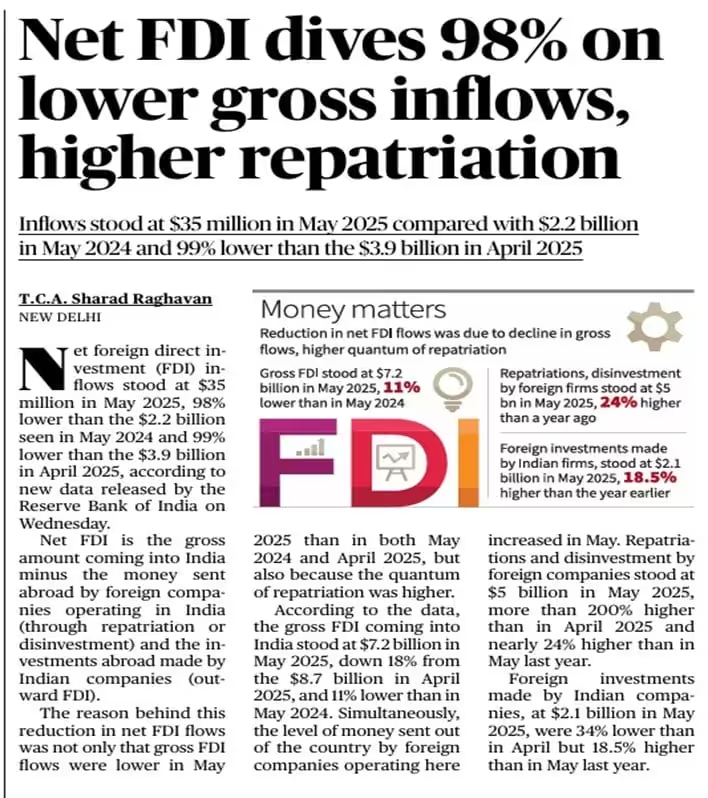
Net foreign direct investment (FDI) in-flows stood at $35 million in May 2025, 98% lower than the $2.2 billion seen in May 2024 and 99% lower than the $3.9 billion in April 2025, according to new data released by the Reserve Bank of India.
UPSC Relevance:
CSE in prelims as well as in mains examination has focused on FDI. A case in point is a following PYQ
Mains PYQ 2014
Q1: Foreign direct investment in the defence sector is now set to be liberalized. What influence this is expected to have on Indian defence and economy in the short and long run?
Mains PYQ 2013
Q2: Though India allowed foreign direct investment (FDI) in what is called multi brand retail through joint venture route in September 2012, the FDI ,even after a year, has not picket up. Discuss the reasons.(2013)
Consider the following:(2021)
Foreign currency convertible bonds
Foreign institutional investment with certain conditions
Global depository receipts
Non-resident external deposits
Which of the above can be included in Foreign Direct Investments?
A 1, 2 and 3 only
B 3 only
C 2 and 4 only
D 1 and 4 only
What is FDI
Foreign direct investment are the net inflows of investment to acquire a lasting management interest (10 percent or more of voting stock) in an enterprise operating in an economy other than that of the investor.
or
‘FDI’ or ‘Foreign Direct Investment’ means investment through capital instruments
by a person resident outside India in an unlisted Indian company; or in ten per cent
or more of the post issue paid-up equity capital on a fully diluted basis of a listed
Indian company.(According to Ministry of Commerce and Industry FDI Policy 2020)
Routes of FDI investment in India
Automatic route: It means the entry route through which investment by a person
resident outside India does not require the prior approval of the Reserve Bank of
India or the Central Government.
Examples: Agriculture & Animal Husbandry, Air-Transport Services (Non Scheduled Air Transport Service / Helicopters services/ seaplane services requiring DGCA approval), Airports (Greenfield + Brownfield), Asset Reconstruction Companies, Auto-components, Automobiles etc.
Government Route: means the entry route through which investment by a person
resident outside India requires prior Government approval and foreign investment
received under this route shall be in accordance with the conditions stipulated by
the Government in its approval.
Examples: Banking (Public sector) – 20%, Broadcasting Content Services (FM Radio, uplinking of news and current affairs TV Channels)– 49%, Uploading/Streaming of ‘News & Current affairs’ through digital media – 26%, Investment by Foreign airlines – 49%.etc.
Data Summary-GOI
India has attracted total FDI inflow of USD 70.97 bn during the financial year 2022-23. Total FDI inflows in the country in the last 23 years (April 2000 – March 2023) are USD 919 bn while the total FDI inflows received in the last 9 years (April 2014- March 2023) was USD 595.25 bn which amounts to nearly 65% of total FDI inflow in last 23 years.
Top 5 sectors receiving highest FDI Equity Inflow during FY 2022-23 are Services Sector (Fin., Banking, Insurance, Non Fin/ Business, Outsourcing, R&D, Courier, Tech. Testing and Analysis, Other) (16%), Computer Software & Hardware (15%), Trading (6%), Telecommunications (6%) and Automobile Industry (5%).
Mauritius (26%), Singapore (23%), USA (9%), Netherland (7%) and Japan (6%) emerge as top 5 countries for FDI equity inflows into India FY 2022-23.
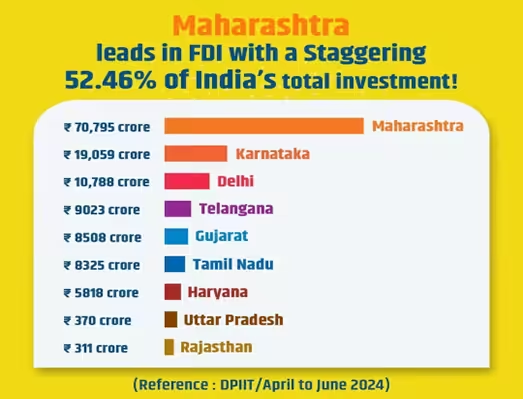
Top 5 States receiving highest FDI Equity Inflow during FY 2022-23 are Maharashtra (29%), Karnataka (24%), Gujarat (17%), Delhi (13%), and Tamil Nadu (5%).
Advantages of FDI:
Increased Employment and Economic Growth
Human Resource Development
Development of Backward Areas
Provision of Finance & Technology
Increase in Exports
Exchange Rate Stability
Stimulation of Economic Development
Improved Capital Flow
Creation of a Competitive Market
Disadvantages of FDI:
Increase Regional disparity
Growth and benefit only particular sector
Burden on local resources
Job loss due to automation
Environment loss due to increase carbon emission
Round tripping of money by big MNC companies for profit
Monopolization of markets by large multinational corporations, potentially harming small businesses and consumers
Source: https://anantamias.com/current-affairs/foreign-direct-investment/
AdFalciVax Malaria Vaccine
Context : The Indian Council of Medical Research (ICMR) has announced a promising candi-date vaccine for malaria, which it will now further develop, test and manufacture for commercial purposes in partnership with private companies and has invited bids for the same.

UPSC relevance: Various questions have been previously asked regarding diseases in prelims examination.
Prelims 2013
Which of the following diseases can be transmitted from one person to another through tattooing?
1.Chikungunya
2. Hepatitis B
3. NW-AIDS
Select the correct answer using the codes given below.
A 1 only
B 2 and 3 only
C 1 and 3 only
D 1, 2 and 3
Prelims 2022
In the context of vaccines manufactured to prevent COVID-19 pandemic, consider the following statements :
- The Serum Institute of India produced COVID-19 vaccine named Covishield using mRNA platform.
- Sputnik V vaccine is manufactured using vector based platform.
- COVAXIN is an inactivated pathogen based vaccine.
Which of the statements given above are correct?
D 1, 2 and 3
A 1 and 2 only
B 2 and 3 only
C 1 and 3 only

Malaria
Malaria cases have declined in India in past few years as per government records. However, the estimates of Malaria cases in India by the WHO are still very high as government records show only confirmed deaths.
- Caused by pathogen Plasmodium.
- Most common source – Plasmodium Falciparum
- In India, major source is – Plasmodium Vivax
- A parasitic infection transmitted by infected female Anopheles mosquitoes.
- Blood transfusion and contaminated needles may also transmit malaria.
- Symptoms – Fever, chills, night sweats, nausea, vomiting and diarrhea. Severe complications may cause seizures, fluid in lungs, organ damage and death.
- It is preventable and curable.
- One of the deadliest diseases killing 4 lakh people annually according to WHO.
- It is mostly found in tropical countries.
- Most endemic in Africa.
AdFalciVax
Pro6C protein prevents the spread of infection in the community by disrupting the lifecycle of the pathogen.
A chimeric recombinant vaccine– a type of vaccine that uses different parts of the genes of a pathogen (in this case, Plasmodium) to create target proteins that trigger an immune response after being injected.
- AdFalciVax uses two types of target proteins to prevent the spread of infection in two different ways:
- Circumsporozoite protein (CSP) to prevent infection in the person who has been immunised.
Difference with other vaccines like RTS,S and R21
- An adjuvant is a substance used in vaccines to boost the body’s immune response against the tar-geted disease.
- RTS,S and R21 only use the CSP protein, and can prevent infection only in vaccinated persons.
- Unlike AdFalciVax, RTS,S and R21 vaccines also do not use full-length CSP proteins. This is why the ICMR’s candidate vaccine – AdFalciVax is “likely to produce a stronger immune response and better protect against infection,”
- Unlike RTS,S and R21, whose efficacy is just 75%, the AdFalciVax has been found 90% effective in animal trials so far.
- AdFalciVax uses Alum as an adjuvant that does not pose a risk of causing chronic inflammation unlike the AS01 and Matrix M adjuvants used in RTS,S and R21 vaccines.
Source: https://anantamias.com/current-affairs/adfalcivax-malaria-vaccine/
International Court of Justice
Context : The United Nations’ top court in a landmark advisory opinion on Wednesday said countries could be in violation of international law if they fail to take measures to protect the planet from climate change, and nations harmed by its effects could be entitled to reparations.
UPSC relevance: GS II
- Important International institutions, agencies and fora their structure, mandate.
2020 Mains:
- Critically examine the role of WHO in providing global health security during the COVID-19 pandemic.
2022 Mains:
- What are the key areas of reform if the WTO has to survive in the present context of Trade War’, especially keeping in mind the interest of India?

About ICJ
- One of the six “principal organs” of the United Nations was established in 1945
- Known as the “world court”
- Situated in the Peace Palace in The Hague, a city in the Netherlands.
- A continuing and autonomous body that is permanently in session.
Composition
- The court is composed of 15 judges.
- all of are elected to 9 year terms of office by majority votes in the UN General Assembly and Security Council.
- Elections are held every three years for one third of the seats, and retiring judges may be re-elected.
- The members do not represent their governments but are independent magistrates, and there is only ever one judge of any nationality on the court.
- The judges elect their own president and vice president, each of whom serves a three-year term, and can appoint administrative personnel as necessary.
Power and Jurisdiction
- The court can rule on two types of case:
- Contentious cases – legal disputes between States
- Advisory proceedings – requests for advisory opinions on legal questions referred to it by United Nations organs and certain specialized agencies.
- Unlike the Court of Justice of the European Union, the ICJ is not a supreme court to which national courts can turn; it can only hear a dispute when requested to do so by one or more States.
- The court itself has no powers of enforcement, but according to Article 94 of the Charter of the United Nations:
- If any party to a case fails to perform the obligations incumbent upon it under a judgment rendered by the Court, the other party may have recourse to the Security Council, which may, if it deems necessary, make recommendations or decide upon measures to be taken to give effect to the judgment.
- Cases before the ICJ are resolved in one of three ways:
- they can be settled by the parties at any time during the proceedings;
- a state can discontinue the proceedings and withdraw at any point; or
- the court can deliver a verdict.
States have no permanent representatives accredited to the Court.
The ICJ decides disputes in accordance with international law as reflected in international conventions, international custom, general principles of law recognized by civilized nations, judicial decisions, and writings of the most highly qualified experts on international law.
The verdicts— in both English and French—are delivered in open court.
Difference with ICC :
| ICJ | ICC | |
| Statute | UN Charter | Rome Statute |
| Year | 1945 | 2000 |
| Jurisdiction | Civil and legal disputes between sovereign States based on International Laws. | Crimes committed by individuals like: genocide, war crimes, crimes against humanity, and the crime of aggression. |
| Parties | only entertain cases where states appear before it. | States that have ratified the Rome statute and the crime is either committed on their territory or by the nationals of States that have ratified Rome statute. |
| Relation with UN | Organ of UN | Independent of UN but can accept referrals fromUNSC |
| Judges | Elected- 15 | Elected – 18 |
| Term | Renewable 9 years | Non Renewable 9 years |
Source: https://anantamias.com/current-affairs/international-court-of-justice/
Critical Minerals
Context: Amitabh Kant, former CEO NITI Aayog has underscored the need to ensure timely execution, sustained institutional support and a clear commitment to self-reliance and sustainability to overcome the critical mineral challenge.

UPSC Relevance
Q1. Consider the following minerals: (2020)
- Bentonite
- Chromite
- Kyanite
- Sillimanite
In India, which of the above is/are officially designated as major minerals?
(A) 1 and 2 only
(B) 4 only
(C) 1 and 3 only
(D) 2, 3 and 4 only
Q2.Recently, there has been a concern over the short supply of a group of elements called ‘rare earth metals’. Why? (2012)
- China, which is the largest producer of these elements, has imposed some restrictions on their export.
- Other than China, Australia, Canada and Chile, these elements are not found in any country.
- Rare earth metals are essential for the manufacture of various kinds of electronic items and there is a growing demand for these elements.
Which of the statements given above is/are correct?
(A) 1 only
(B) 2 and 3 only
(C) 1 and 3 only
(D) 1, 2 and 3
What are Critical Minerals?
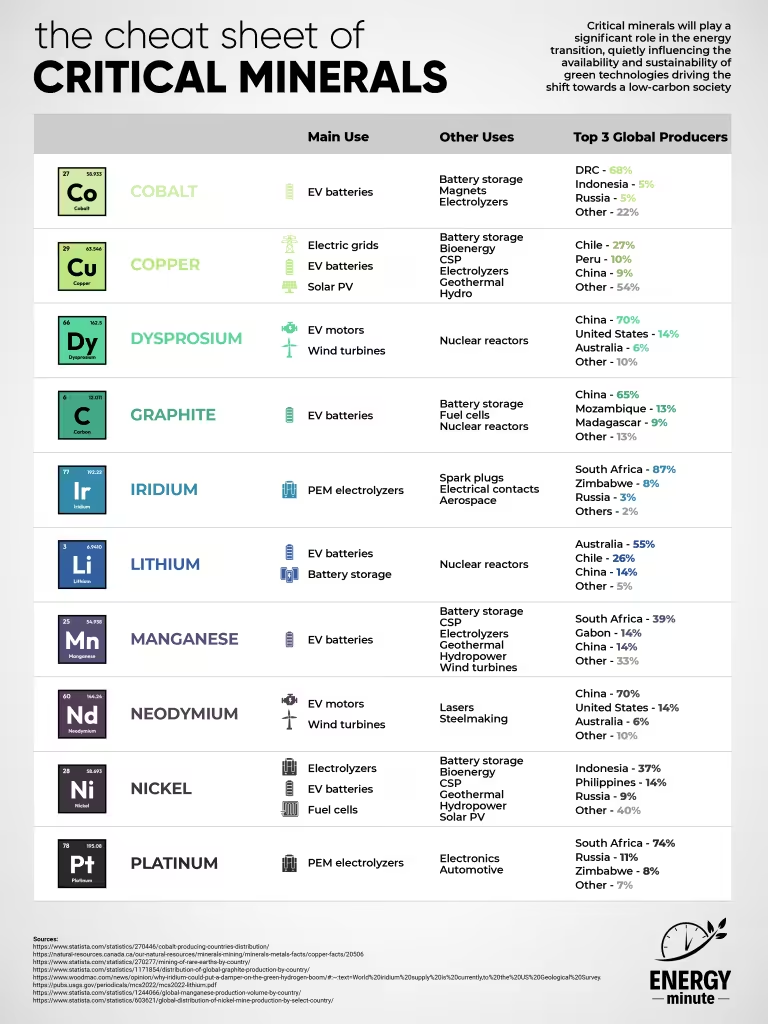
Critical minerals are those minerals that are essential for economic development and national security. The critical minerals for a country may vary based on its availability and concentration in the country. The government has released a list of 30 critical minerals for India.
These minerals are Antimony, Beryllium, Bismuth, Cobalt, Copper, Gallium, Germanium, Graphite, Hafnium, Indium, Lithium, Molybdenum, Niobium, Nickel, PGE, Phosphorous, Potash, REE,Rhenium, Silicon, Strontium, Tantalum, Tellurium, Tin, Titanium, Tungsten, Vanadium, Zirconium, Selenium and Cadmium.
Some major critical minerals and their largest producer countries:-
- Cobalt – Democratic Republic of Congo
- Lithium – Australia
- Nickel – Indonesia
- Silicon – China
- Graphite – China
- Rare Earth Elements (as a whole) – China
Rare Earth Elements
The term “rare earth elements” is a bit misleading. While they are not always rare in terms of their abundance in the Earth’s crust, they are often found dispersed in low concentrations, making them difficult and costly to extract and refine.
The 17 REEs include:
Lanthanides: Lanthanum (La), Cerium (Ce), Praseodymium (Pr), Neodymium (Nd), Promethium (Pm), Samarium (Sm), Europium (Eu), Gadolinium (Gd), Terbium (Tb), Dysprosium (Dy), Holmium (Ho), Erbium (Er), Thulium (Tm), Ytterbium (Yb), and Lutetium (Lu).
Scandium (Sc) and Yttrium (Y): These are included because they share similar properties with the lanthanides and are often found together with them.
- India has 5th largest reserves of Rare Earth Elements according to the Government of India but doesn’t possess the capacity to extract and process the same.
Significance of Critical Minerals for India in :-
- Advanced manufacturing – Critical minerals are fundamental to advanced industries like electronics, telecommunications, and defense.
- Green Technologies and Sustainability – Transitioning to clean energy systems like e-transportation, solar panels etc.and meeting the goal of Net Zero by 2070.
- Strategic technologies – like semiconductors, advanced materials, and energy storage as India aspires to become a semiconductor hub.
- National Security – These minerals are indispensable for India’s defense, aerospace, and nuclear applications, requiring high-quality and reliable materials for sensitive equipment and infrastructure.
- Supply Chain Resilience: To mitigate risks associated with global monopolies and supply disruptions to ensure Atmanirbharta.
Their availability and accessibility will determine the pace and quality of growth for all major economies, especially India which is aiming for a Viksit Bharat by 2047.
Challenges
- High geographical concentration in some regions like Latin America and Africa.
- With limited transparency and complex value chains, China dominates the mid-stream processing stage for most key minerals, accounting for over 90 per cent of rare earth refining, 70 per cent of cobalt processing and close to 60 per cent of lithium conversion capacity.
- Recent export restrictions on rare earth elements by China have also exposed the vulnerability of India’s automotive sector, with some firms already indicating potential production cuts.
- Currently, India is 100 percent import dependent for lithium, cobalt, nickel, rare earth elements and silicon. At the same time, India’s domestic resource base for critical minerals is underdeveloped.
- Limited domestic processing capacity to refine and process minerals into battery grade or component ready materials.
- A shortage of technically qualified bidders for auctioning critical mineral blocks due to poor industry confidence in the viability of critical mineral development.
Recent Initiatives by Government:
- In 2022, the Ministry of Mines identified 30 critical minerals based on their strategic importance to clean energy and future technologies, high import dependence, domestic resource constraints and relevance for agricultural and industrial needs.
- In January 2025, the National Critical Mineral Mission (NCMM) was announced to secure critical mineral supply chains by ensuring mineral availability.
- The Geological Survey of India has ramped up exploration, with 195 projects underway over the past year and another 227 approved for the up-coming year.
- In response to the inclusion of critical minerals in the Mines and Minerals Development and Regulation) Act, the government launched four tranches of auctions for critical mineral blocks last year, and a fifth was concluded in January 2025.
- India has taken steps by joining the Mineral Security Partnership and initiating collaborations with Australia, Argentina and others. These partnerships signal a deeper alignment with global efforts to di-versify supply chains away from China.
- Khanij Bidesh India Ltd. (KABIL) was established in 2019 to ensure a consistent supply of critical and strategic minerals to the Indian domestic market and help in realizing the overall objective of import substitution.
Way Ahead :
- The NCMM plans to set up dedicated mineral processing zones with modern infrastructure.
- Production incentives modelled on PLI schemes could be used to catalyse private investment into refining, separation and chemical conversion facilities.
- International engagement and friendshoring will be vital to the creation of a diversified and resilient supply chain by leveraging geopolitical platforms such as the QUAD and G20 to secure further stable mineral trade relationships, promote joint ventures and facilitate best-practice sharing.
- Developing a critical mineral stockpiling framework will also be essential to buffer against supply disruptions and price volatility.
- Recycling offers a promising path to reduce import dependency. The recycling chain for batteries and electronics is fragmented and largely informal. India must also prioritise resource recovery by incentivising recyclers and by expanding formal infrastructure for waste collection.
- Sustainable mining practices and responsible sourcing of critical minerals are crucial. Several critical mineral reserves lie in tribal or ecologically sensitive areas where inadequate environmental, social and governance (ESG) compliance has led to delays, protests and legal challenges. India must adopt comprehensive ESG frameworks in mining, incorporating community trust-building and third-party audit mechanisms.
The contest for critical minerals will shape the contours of future economic resilience and technological sovereignty. India has the market scale, industrial ambi-tion and diplomatic leverage to lead. It must now ensure timely execution of the same.
Source: https://anantamias.com/current-affairs/critical-minerals/