Context: Former Odisha Chief Minister Naveen Patnaik expressed concern over the “omission” of the Paika Rebellion from NCERT’s new Class 8 history textbook, calling it a “huge dishonour” to the brave Paikas.
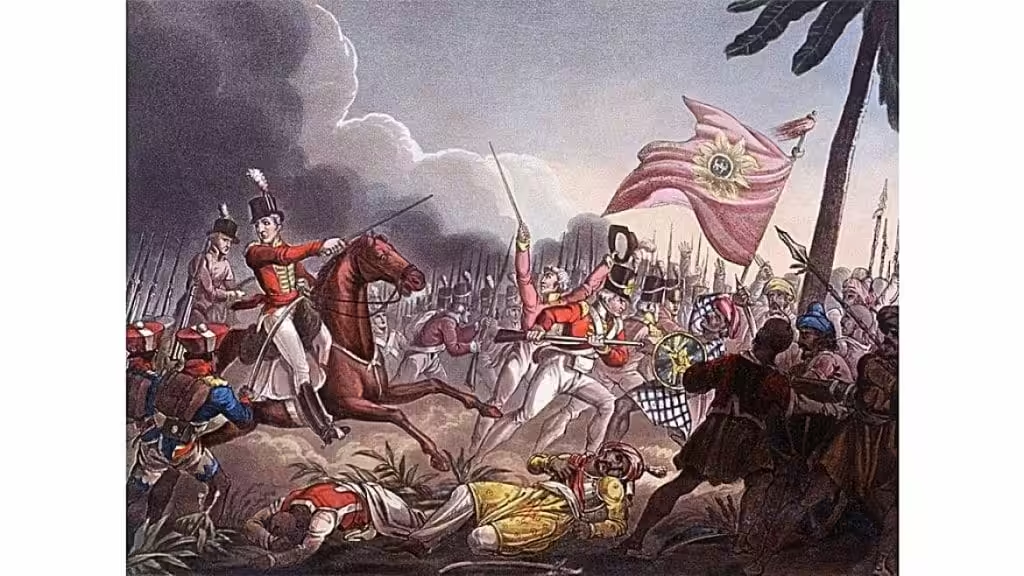
UPSC Relevance: CSE in prelims as well as in mains examination has focused on various subaltern movements. A case in point is a following PYQ:
Prelims 2020
With reference to the history of India, “Ulgulan” or the Great Tumult is the description of which of the following events?
A The Revolt of 1857
B The Mappila of 1921
C The Indigo Revolt of 1859 – 60
D Birsa Munda‘s Revolt of 1899 – 1900
Paikas of Odisha:
The Paikas (pronounced “paiko”, literally “foot soldiers”) were a class of military retainers who had been recruited by the Gajapati rulers of Odisha since the 16th century to provide martial services in return for hereditary rent-free land (nish-kar jagirs).
Reason for Paikas revolt:
British policies of exploitation
After the Raja of Khurda was deposed, Major Fletcher assumed command of the estate’s entire administration. Thus began the British administration’s exploitative policies, which became increasingly intolerable for the people of Odisha.
Faulty revenue policy
The British government’s erroneous revenue policy harmed the local zamindars and royats. Short-term land revenue settlements disproportionately impacted zamindars who had failed to pay their dues to the British authority. The British never granted remission or time to local zamindars for revenue collection.
British salt policy
The British government stripped the zamindars and indigenous peoples of the coastal region of their traditional rights to salt manufacture. Due to the heavy importation of Liverpool salt, every household in this land felt the increase in the price of salt.
Difficulties of the Khurda people
The amlas involved in administration smuggled large quantities of salt and profited handsomely. The common people of Khurda, who relied on smuggled salt, faced utter destitution. They violated British salt laws by producing salt.
The new monetary system
During the early years of British administration in Odisha, the scarcity of cowrie currency was acute. As a result, British troops found it exceedingly difficult to obtain small items of daily consumption from the local market. As a result, the British government introduced sicca rupees in Odisha in November 1804. The zamindars, peasants, and Talukdars all encountered difficulties when it came to collecting revenue in cowrie currency.
Contemporary political condition of Khurda
Khurda’s people were rebellious due to the country’s political situation at the time. The hanging of Jayi Rajaguru, the deposition of Raja Mukundadeva II, and Major Fletcher’s reorganisation of Khurda’s administration enraged the local populace. They were determined to resist British rule in Khurda at all costs.
Displeasure of Buxi Jagabandhu
Buxi Jagabandhu’s displeasure was the immediate trigger for the Paik rebellion. He was the Raja of Khurda’s Commander, and his position was hereditary. He commanded respect from the populace on a par with the king. As a reward for his service, the Raja granted him jagir lands known as Buxibari, which included the quilla of Rorung and four paraganas, namely Rahang, Lembai, Sarai, and Chabiskud. Major Fletcher deprived Buxi of the quilla Rorung when he established new administration in Khurda.
Hence Paika Rebellion: Began on 29 March 1817.
The rebellion
- In March 1817, some 400 Kondh tribals marched from Ghumusar towards Khurda.
- They were joined by Paikas led by Bakshi Jagabandhu Bidyadhar Mahapatra Bhramarabar Ray, the former commander-in-chief of the king of Khurda.
- The rebels attacked the police station, burnt government quarters, killed policemen, looted the treasury, and proceeded towards Khurda.
- Over the next few months, the Paikas killed a number of British officials.
- But the revolt was crushed, and Bakshi Jagabandhu escaped into the jungles.
- He remained on the run until 1825
Consequences
Odisha’s administrative changes
Changes have been made in the administrative field. Odias was employed by the government and entrusted with important tasks. This enables the indigenous people to develop a relationship with the British authorities through these employees.
Modifications to the judicial process
Changes were also made in the judiciary. Because Persi was the court language, the Odias were unable to comprehend the judicial procedure and verdict. Now, judges have been instructed to visit even the interior villages of a district accompanied by the Odia Amlas and redress the people’s grievances on the spot.
Salt price reduction
The price of salt was reduced and more salt was made readily available to the populace. The British government took this measure to appease the common people of Odisha in general and the people of Khurda in particular.
Management of the Jagannath temple of Puri
Raja Mukundadeva II’s death on 30 November 1817 allowed his son Ramachandradeva III to relocate to Puri. He was granted a pension of Rs. 24,000 per year and given charge of the Jagannath temple in Puri. The British government gained the support and sentiment of the Odisha people through this arrangement.
Reduced revenue burden on local zamindars
The British government relieved local zamindars of their revenue burdens. The way properties are handled has been altered. In several instances, the government purchased defaulters’ estates and returned them to their original owners. On the other hand, the Paiks were treated with contempt and contempt. They were compelled to abandon their profession as king’s militial men and take up cultivation and other manual labour as a means of subsistence.
Odisha’s British administrative structure reorganised
The British government took appropriate measures to restructure its administrative structure in Odisha. The commissioner was appointed and given special authority to enact a variety of reform measures. He retained control of the Board of Revenue, the Board of Trade, the Provincial Court of Appeal, and the Circuit Courts, among others. No military administration, but amity and cooperation with the local populace became his motto for effectively running the Odisha administration.
Tell Google you want more of this.
Add Anantam IAS as a preferred sourceOne tap, and this site shows up more often in your own Top Stories, AI Overviews and AI Mode. Remove it any time.