Daily Digest
UPSC · Civil Services Examination
Current Affairs · Wednesday, 26 November 2025
Current affairs curated and edited by Anantam IAS faculty — pulled from The Hindu, PIB, IDSA, Foreign Affairs and the ministries. Read, annotate, revise.
Old Rajinder Nagar · Delhi 110005 · anantamias.com
GM Crop

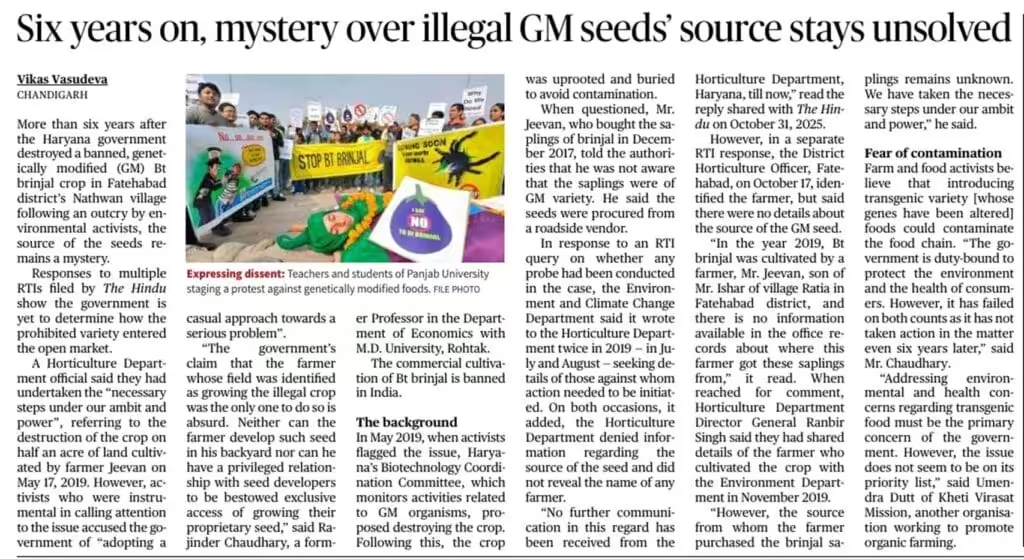
Why in news:
Six years after the Haryana government destroyed a banned genetically modified (GM) Bt brinjal crop in Fatehabad district (Nathwan village), the source of the illegal GM seeds remains unidentified.
UPSC Relevance:
Environment and S&T
UPSC PYQ:
Q1. Other than resistance to pests, what are the prospects for which genetically engineered plants have been created? (2012)
- To enable them to withstand drought
- To increase the nutritive value of the produce
- To enable them to grow and do photosynthesis in spaceships and space stations
- To increase their shelf life
Select the correct answer using the codes given below:
(a) 1 and 2 only
(b) 3 and 4 only
(c) 1, 2 and 4 only
(d) 1, 2, 3 and 4
Mains PYQ:
Q. How can biotechnology help to improve the living standards of farmers? (2019)
About GM Crop:
GM is a technology that involves inserting DNA into the genome of an organism. To produce a GM plant, new DNA is transferred into plant cells. Usually, the cells are then grown in tissue culture where they develop into plants. The seeds produced by these plants will inherit the new DNA.
GM Crops in India:
- Bt Cotton: The only GM crop approved for commercial cultivation in India (since 2002). It is resistant to cotton bollworm.
- GM Mustard Crop (DMH-11): Developed by Centre for Genetic Manipulation of Crop Plants (Delhi University). Mustard has not been released for commercial cultivation yet.
- Bt Brinjal: Bt brinjal (genetically modified eggplant) is banned for commercial cultivation in India since 2010 due to biosafety concerns.
How GM Crops are developed?
- Gene Gun Approach: In this method, DNA-coated metal particles are shot into plant cells at high speed so that the DNA can enter the cell.
- Agrobacterium Approach: This technique uses the bacterium Agrobacterium tumefaciens, which naturally transfers the desired gene into plant cells.
- Electroporation: Used when the plant tissue does not have cell walls. Electric pulses are applied to create tiny pores in the plant cell membrane through which the DNA enters.
- Microinjection: In this method, foreign DNA is directly injected into the plant cell using a very fine needle.
Benefits?
1. Agricultural Productivity
- Higher crop yields
- Resistance to drought, salinity & other abiotic stresses
- Better growth in challenging environments
2. Pest & Disease Resistance
- Reduced pesticide use (e.g., Bt cotton)
- Lower crop losses due to pests and pathogens
3. Nutritional Enhancement
- Bio-fortification (e.g., Golden Rice – Vitamin A)
- Higher oil, protein, or micronutrient content (e.g., GM soybeans)
- Better food quality for consumers
4. Environmental Benefits
- Lower carbon footprint due to reduced pesticide spraying
- Better adaptability to climate change
- Soil conservation through reduced chemical load
5. Other Benefits
- Stable supply even under climate stress
- Enhanced food security
- Reduction in post-harvest losses
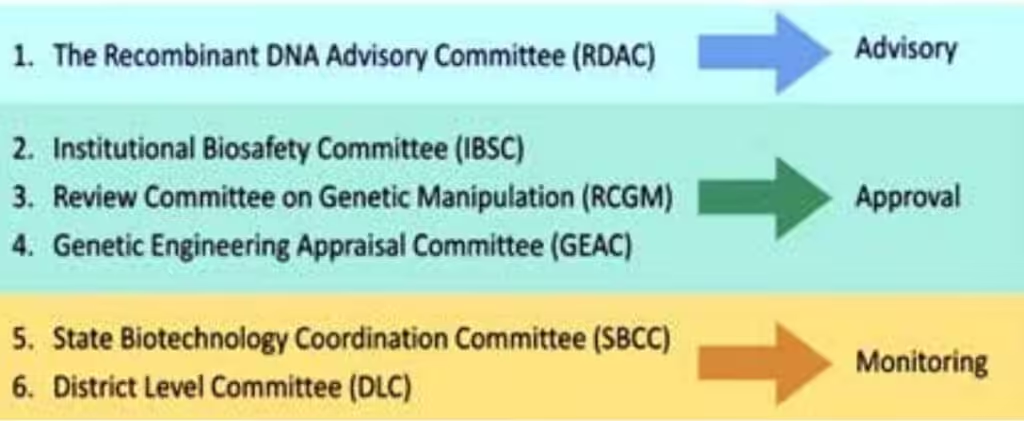
Regulation?
Key Issues:
- Regulatory Failure:
- It exposes loopholes in:
- seed certification,
- market surveillance,
- GM crop monitoring.
- Government agencies passed responsibility between departments.
- It exposes loopholes in:
- Lack of Traceability:
- Farmer claims seeds came from an informal market.
- No tracking mechanism exists for illegal GM seeds
- Biosafety Risks
- Activists warn Bt brinjal can contaminate:
- indigenous varieties,
- organic farms,
- the food chain
- Activists warn Bt brinjal can contaminate:
- Weak Enforcement of GM Crop Ban
- Despite 6 years, no accountability has been established.
- No probe into GM seed developers or black-market distributors.
Concerns of Environmentalists & Scientists:
- Failure to protect consumers despite repeated warnings.
- Risk to biodiversity due to gene flow from GM varieties to local brinjal species.
- Public health concerns: transgenic food risks remain debated.
- Regulatory apathy: activists accuse the government of a “casual approach”.
Way Forward:
Regulatory Reforms
- Enhance transparency and safety protocols within the GEAC.
- Include Members of Parliament in district-level biotechnology monitoring committees.
- Make independent environmental and socio-economic impact assessments mandatory, instead of relying solely on data submitted by the applicant company.
Strengthened Scientific Evaluation
- Conduct rigorous, controlled field trials before granting approvals.
- Evaluate real-world yield performance (e.g., learning from yield stagnation in Bt cotton).
- Assess long-term impacts on pesticide use, soil quality, water resources, and biodiversity.
Mandatory GM Food Labelling
- Implement clear, compulsory labeling of all GM foods sold in India to ensure consumer choice and awareness.
Animal Health Impact Studies
- The Department of Animal Husbandry should carry out long-term feeding trials on livestock and fish to examine the effects of GM crops on animal health and productivity.
National Policy Framework
- Formulate a comprehensive national policy governing the research, cultivation, commercialization, import, and trade of GM crops in India.
Custodial Deaths and SC Decision

Context:
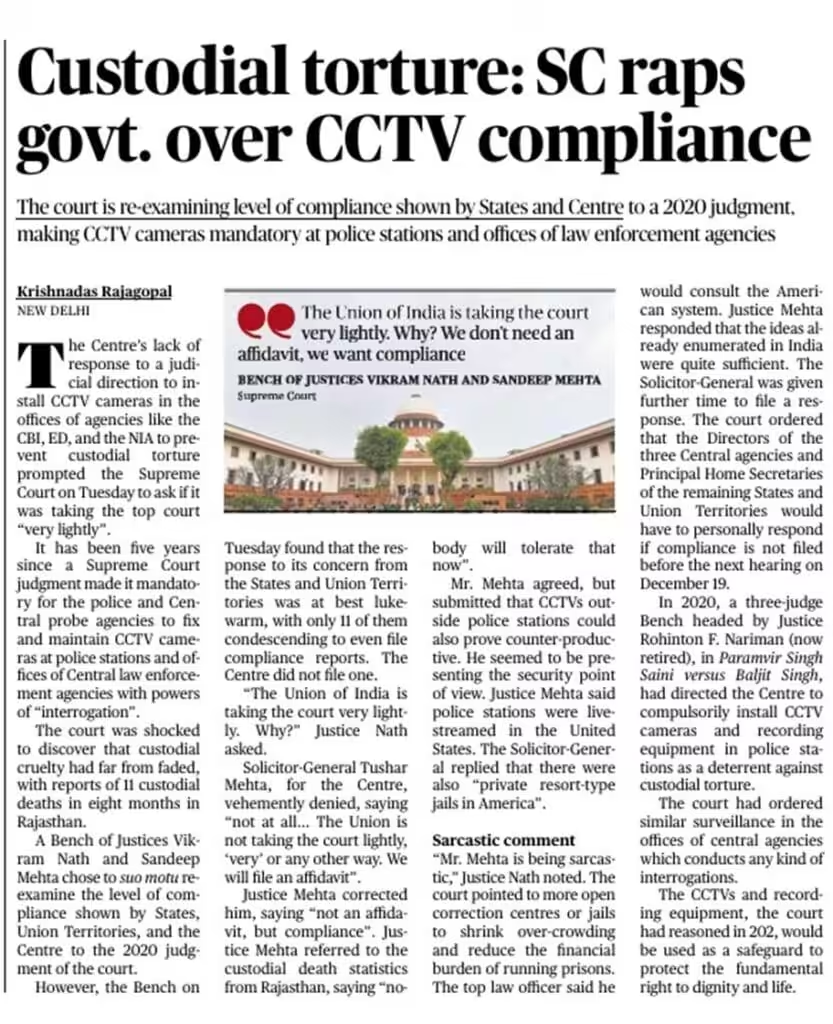
The Supreme Court sharply criticised the Centre and States for failing to comply with its 2020 judgment mandating installation of CCTV cameras in all police stations and offices of investigative agencies (CBI, ED, NIA, etc.). The Court observed that both the Union and States were taking the Court’s orders “very lightly.” Compliance review revealed poor and indifferent response, even five years after the order.
2020 Judgment (Paramvir Singh Saini vs Baljit Singh)
The SC had directed:
- Mandatory installation of CCTV cameras in:
- All police stations,
- Offices of central agencies with interrogation powers,
- Lock-ups, corridors, interrogation rooms, entry/exit points.
- CCTV footage to be preserved for 18 months.
- Purpose:
- Prevent custodial torture,
- Ensure transparency,
- Protect the fundamental right to dignity under Article 21.
Current Situation (2025)
- Alarming data: 11 custodial deaths in Rajasthan in eight months.
- Only 11 States/UTs submitted compliance reports — most were perfunctory.
- The Union government did not file any report.
UPSC Relevance:
Polity and Governance
UPSC PYQ:
Q. Though the Human Rights Commissions have contributed immensely to the protection of human rights in India, yet they have failed to assert themselves against the mighty and powerful. Analysing their structural and practical limitations, suggest remedial measures. (2021)
Custodial Torture:
Custodial torture refers to the deliberate infliction of physical or psychological pain on individuals who are detained or held in the custody of police or other authorities.
Type of Custody:
- Police custody — when a person is detained, arrested, or otherwise held by the police (in a police station, lock-up, or during transit).
- Judicial custody — when a person is lodged in a prison or jail while on trial or after conviction.
Both are the State’s responsibility, because the State controls the person’s movement, safety, and access to care.
Custodial Torture in India:
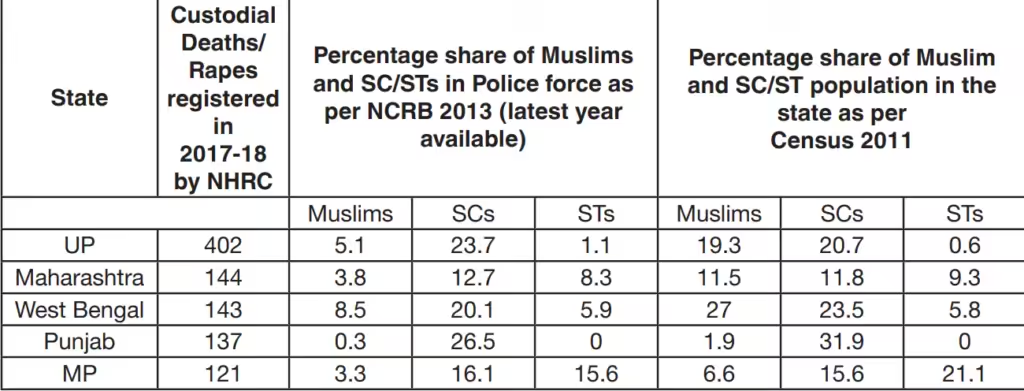
The National Human Rights Commission reported 2,152 deaths in judicial custody and 155 deaths in police custody up to 28 February 2022 (for the financial year 2021–22). The Union Home Ministry told Parliament that 4,484 cases of custodial deaths were reported over financial years 2020–21 and 2021–22.

Why custodial deaths happen?
- Weak discipline around arrest and detention
- Pressure to solve cases and reliance on confessions
- Health and mental-health gaps
- Cameras and audit trails that do not actually work
- Investigations that are not fully independent
SC Judgements:
- D. K. Basu case (1997): A checklist that every police station must follow during arrest and detention. Officers must wear identification; an arrest memo must be prepared; a relative or friend must be informed; entries must be made in the station diary; the arrested person must get medical examination and legal aid; and these rights must be displayed in police stations. These directions are binding across India.
- Joginder Kumar case (1994): Arrest is not automatic; it must serve a clear need. Police must record reasons and inform a relative or friend promptly.
- Arnesh Kumar case (2014): For many offences, police should prefer issuing a notice to appear instead of arrest. Reasons for arrest must be written down.
- Nilabati Behera case (1993): Constitutional courts can award compensation for violation of the right to life in custodial-death cases.
- People’s Union for Civil Liberties vs State of Maharashtra (2014): For alleged “encounter” deaths, there must be an independent investigation and a magisterial inquiry.
- Paramvir Singh Saini case (2020): Police stations and interrogation rooms must have cameras with audio, and footage must be preserved with proper oversight.
LEGAL PROVISIONS?
- The United Nations Convention Against Torture (UNCAT), which mandates a global prohibition on torture by monitoring governments and making them accountable, was signed by India in 1997, more than a decade after the Convention was adopted by the UN in 1984 (UNTC 1984).
- There are certain statutory and procedural provisions, most prominently Article 21 of the Constitution and Sections 330 and 331 of the Indian Penal Code (IPC), that address custodial violence and torture. However, these provisions have been found to be inadequate.
- Section 120 of Bharatiya Nyaya Sanhita (2023): It penalizes those who intentionally cause hurt or grievous hurt to extract confessions, information, through violence or coercion.
- Section 35 of Bharatiya Nagarik Suraksha Sanhita (BNSS, 2023): It mandates that arrests and detentions follow valid reasons, documented procedures.
- Section 22 of Bharatiya Sakshya Adhiniyam (2023): It invalidates confessions made under inducement, threat, coercion, or promise.
Law Commission of India: In its 273rd Report (2017), the Law Commission of India recommended ratification of UNCAT 1984, and enact a specific law to implement its provisions, highlighting the urgent need to criminalize torture.
CONCLUSION
Torture by police does not occur in isolation, but as a result of the absence of structural reform to hold state agencies accountable and apprise them of their primary duties as public servants. While ratification to the UNCAT and bringing in a new legislation for torture is a serious need, a lot more is required to address custodial violence comprehensively.
Source: https://anantamias.com/current-affairs/custodial-deaths-and-sc-decision/
India’s Constitutional journey

Context:
This year’s Constitution day marks the marks 76 years since the adoption of India’s Constitution.
UPSC Relevance:
PYQ:
Q. Consider the following statements in respect of the Constitution Day :(2023)
Statement-I : The Constitution Day is celebrated on 26th November every year to promote constitutional values among citizens.
Statement-II : On 26th November, 1949, the Constituent Assembly of India set up a Drafting Committee under the Chairmanship of Dr. B.R. Ambedkar to prepare a Draft Constitution of India.
Which one of the following is correct in respect of the above statements?
(a) Both Statement-I and Statement-II are correct and Statement-II is the correct explanation for Statement-I
(b) Both Statement-I and Statement-II are correct and Statement-II is not the correct explanation for Statement-I
(c) Statement-I is correct but Statement-II is incorrect
(d) Statement-I is incorrect but Statement-II is correct
Overview of Indian Constitution Day
- Origin: On November 26, 1949, the Constitution of India was adopted by the Constituent Assembly.
- To mark this momentous occasion, the Ministry of Social Justice and Empowerment in 2015 notified the decision of the Indian Government to celebrate the 26th November every year as ‘Constitution Day’ in order promote Constitutional values among citizens.
- Indian Constitution Day is a day to celebrate the democratic values enshrined in the Constitution, ensuring justice, liberty, and equality for all citizens.
Why is Constitution Day Celebrated?
- Indian Constitution Day or Samvidhan Diwas was first observed on 19th November 2015. The Ministry of Social Justice and Empowerment notified the decision of the Government of India to celebrate the 26th day of November every year as ‘Constitution Day’ to promote Constitution values among citizens and to honour Dr. B.R. Ambedkar, the chief architect of the Indian Constitution.
- The primary purpose of Indian Constitution Day is to recognize the huge contribution of the Constituent Assembly in formulating the world’s longest-written Constitution. The reasons include:
- Honouring the Constituent Assembly’s Efforts: Led by Dr. B.R. Ambedkar, the drafting committee have worked tirelessly to frame this document which ensures India’s unity and diversity.
- Promoting Awareness: This day educates citizens about their constitutional rights and duties.
- Celebrating Democratic Values: The Indian Constitution is the backbone of India’s democratic governance.
- To educate citizens about the values, principles, and rights glorified in the Constitution and encourage active participation in upholding these ideals.
What is the supremacy of the Indian Constitution?
- Fundamental Law – A constitution is the fundamental law of a nation.
- It outlines the basic principles and laws that determine the powers and duties of the government and guarantee certain rights to the people.
- Supreme Legal Authority – Serves as the supreme legal document, against which all other laws are measured.
- Expression of Sovereignty –Reflects the sovereign will of the people, often established through a constituent assembly or similar body.
- Living Document – While foundational, constitutions often include provisions for amendments to adapt to changing societal needs.
What is Constitutional Government?
- Limited Government – A constitutional government operates under a constitution that limits the powers of political authorities, ensuring they act within established legal frameworks.
- Rule of Law – Emphasizes that all individuals and institutions, including the government, are subject to the law.
- Separation of Powers – Distributes governmental powers among separate branches to prevent abuse and provide checks and balances.
- Protection of Fundamental Rights – Guarantees individual liberties and rights, safeguarding citizens against government overreach.
- Democratic Principles – Often incorporates democratic processes, allowing for representation and participation of the people in governance.
- Judicial Review – Courts have the power to interpret and review laws to ensure they follow the Constitution.
What is Constitutional Morality?
- The term was taken from George Grote’s study of Athenian democracy.
- Adherence to Constitutional Values – Dr. B.R. Ambedkar emphasized that governance must follow constitutional principles, not personal beliefs.
- Supporting democracy – It involves supporting a democratic political process that serves both individual and collective interests.
- Respecting rights – It involves respecting and protecting the fundamental rights guaranteed by the constitution.
- Balancing freedom and restraint – It involves citizens submitting to constitutional authorities while also having the freedom to criticize those in power.
- Judicial Interpretation -Courts use it to safeguard democratic principles.
- Example – In the Navtej Singh Johar Case (2018), the Supreme Court decriminalized homosexuality (Section 377), citing constitutional morality.
Why Does India Need Constitutional Morality?
- To Prevent Majoritarian Rule – Ensures democracy functions beyond electoral politics.
- Protection of Minority Rights -Reservations (Articles 15 & 16) protect marginalized communities.
- Role of Institutions -Ensures institutions function independently and impartially.
- Example – The Sabarimala Temple Case (2018) upheld women’s entry, enforcing constitutional morality over religious practices.
What are the Challenges to Indian Constitution?
- Communalism and Religious Conflicts – Religious tensions challenge the secular Constitution.
- Example -Ram Janmabhoomi Babri Masjid dispute caused legal battles and violence.
- Caste based discrimination – persists despite Article 15 & 16 reservations. Example- Dalit atrocities and honour killings under SC/ST Prevention of Atrocities Act, 1989
- Corruption in Public Institutions – Corruption undermines governance and citizens’ rights. Example- Lokpal and Lokayuktas Act, 2013 aims to reduce corruption
- Threats to Secularism – Rising religious intolerance impacts harmony and pluralism. Example- Hate speech and mob lynching incidents raise Article 25 concerns
- Misuse of Laws for Political Gains – Laws like UAPA are criticized for limiting dissent and free speech. Example- Sedition cases filed against journalists and activists
- Growing Economic Inequality – Rich poor gap has widened despite economic growth. Example- Multidimensional Poverty Index indicates economic inequalities
- Unemployment and Job Creation Issues – Job creation remains difficult despite schemes like PMEGP. Example – Unemployment rate rose during COVID• 19 lockdown
- Agrarian Crisis and Farmers’ Protests – Issues like low MSP, water shortages, and land acquisition unresolved.
- Climate Change and Environmental Degradation- Environmental issues often conflict with economic development.
What are the Reasons for the Indian Constitution’s Survival for 75+ Years?
- People’s Faith in Democracy – Sustains the Constitution. Example – High voter turnout in Lok Sabha elections.
- Strong Democratic Institutions
- Independent Judiciary- Protects constitutional rights. Example- Basic Structure Doctrine (Kesavananda Bharati Case, 1973).
- Election Commission – It’s role in free and fair elections. Example: Introduction of EVMs, VVPAT for transparency.
- Media and Civil Society- Keep the government accountable. Example: Right to Information Act (2005) empowers citizens.
- Constitutional Adaptability and Flexible Amendments – Keep it relevant. Example- 73rd & 74th Amendments (Panchayati Raj, 1992).
- Judicial Activism and PILs – Expand constitutional rights. Example -Vishaka Case (1997) led to sexual harassment laws.
- Socio-Political Stability- Federalism – Balances Centre-State relations. Example- GST Council ensures cooperative federalism.
- Secularism – Maintains religious harmony. Example-Special Marriage Act, 1954 allows interfaith marriages.
- Welfare Policies – Reduce inequalities. Example-Mahatma Gandhi National Rural Employment Guarantee Act (MGNREGA).
- Robust Defence – Rights through NHRC and SC. Example-Decriminalization of Triple Talaq (2019).
Source: https://anantamias.com/current-affairs/indias-constitutional-journey/