Daily Digest
UPSC · Civil Services Examination
Current Affairs · Tuesday, 28 April 2026
Current affairs curated and edited by Anantam IAS faculty — pulled from The Hindu, PIB, IDSA, Foreign Affairs and the ministries. Read, annotate, revise.
Old Rajinder Nagar · Delhi 110005 · anantamias.com
India and New Zealand sign Free Trade Agreement
Why in News?
India and New Zealand have signed a Free Trade Agreement (FTA), marking a significant step in strengthening bilateral economic ties. The FTA is being described as one of India’s fastest concluded bilateral trade deals.
The agreement will require ratification by both countries. India is expected to complete the process through executive approval, while New Zealand will require parliamentary clearance for the agreement to come into force.
| UPSC Relevance: GS-2 International Relations: Trade Agreements; Bilateral Trade Prelims: India-New Zealand Free Trade Agreement (Key Facts) |
What is Free Trade Agreement?
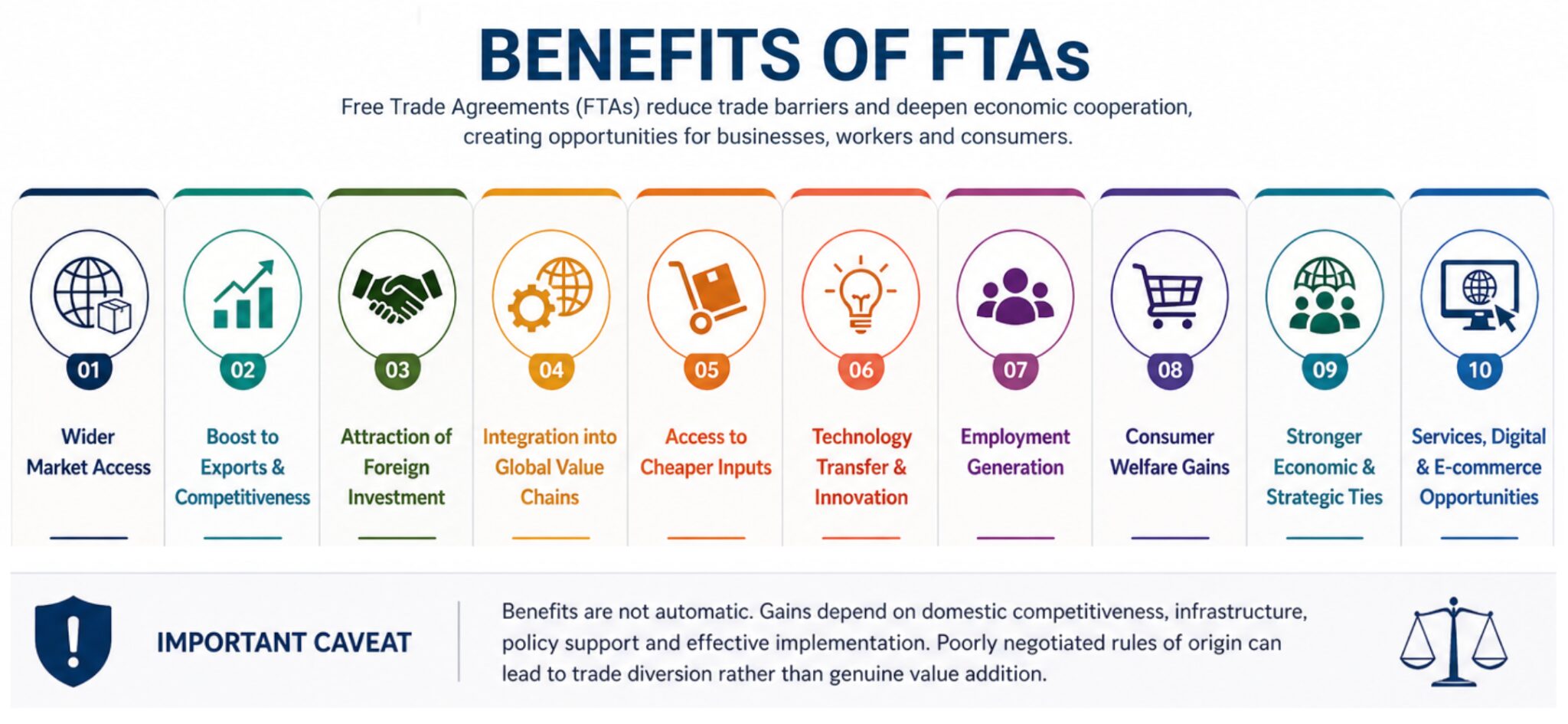
- FTA is an economic arrangement between two or more countries or trading blocs to eliminate or substantially reduce tariff and non-tariff barriers on substantial trade between them.
- FTAs cover trade in goods (agricultural, pharma, industrial products) or trade in services (banking, construction, trading, etc.). FTAs can also cover other areas such as intellectual property rights (IPRs), cross-border investment, government procurement and competition policy, etc.
India-New Zealand Free Trade Agreement: Key Highlights
The bilateral trade between India and New Zealand is valued at around $2.4 billion, which includes both goods and services.
1. Trade in Goods:
- The FTA will cut or eliminate tariffs on 95% of New Zealand’s exports to India.
- The FTA eliminates duty on 100% of Indian exports to New Zealand, covering sectors like textiles, leather, engineering goods and manufacturing products.
- India has kept several sensitive sectors, including dairy, onions, sugar, spices and edible oils, outside the agreement to safeguard domestic farmers and industry interests.
2. Investment and Trade Expansion:
- New Zealand has committed to invest ~$20 billion in India over the next 15 years while easing trade barriers and simplifying regulatory standards.
- The FTA sets an ambitious target of doubling bilateral trade to around 5 billion dollars over the next five years.
3. Services and Labour Mobility:
- The FTA lays out a detailed services framework, where New Zealand commits market access across around 118 sectors, including IT, finance, education, telecom, tourism and professional services.
- It establishes a Temporary Employment Entry (TEE) Visa pathway, with a quota of 5,000 visas for skilled Indian nationals, allowing a stay of up to 3 years. The sectors of interest to India include AYUSH practitioners, Yoga Instructors, Indian Chefs, and Music Teachers, as well as IT, Engineering, Healthcare, Education, and Construction.
4. Addressing Non-Tariff Barriers:
- Product Specific Rules of Origin (PSRs): FTA provides for a balanced and robust framework of PSRs to effectively prevent circumvention, misuse, or falsification of Rules of Origin criteria.
- Sanitary and Phytosanitary (SPS) and Technical Barriers: Advances fast-tracking of market access applications on a reciprocal basis, simplifying certification and import permit procedures, and provides for electronic SPS certification.
5. Intellectual Property Rights:
- Binding commitment by New Zealand to amend its laws within 18 months to provide EU-level protection for India’s Geographical Indications (GIs).
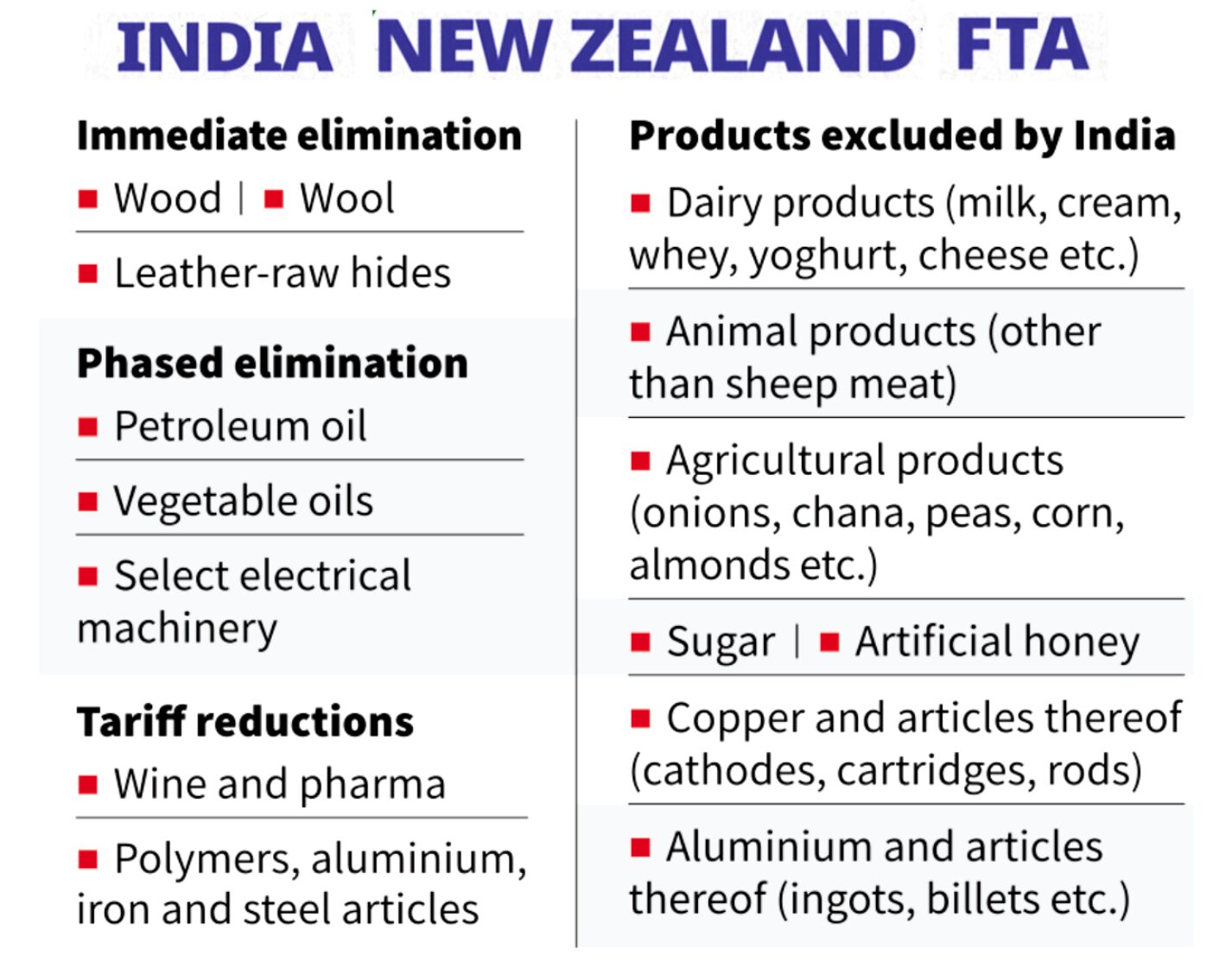
Once the FTA comes into force, Indian sectors are expected to see expanded market access, including textiles and apparel, engineering goods, leather and footwear, and marine products. New Zealand is likely to register increased exports in horticulture, timber, coal, wool and meat.
UPSC PYQ 2020
Q. With reference to the international trade of India at present, which of the following statements is/are correct?
1. India’s merchandise exports are less than its merchandise imports.
2. India’s imports of iron and steel, chemicals, fertilisers and machinery have decreased in recent years.
3. India’s exports of services are more than its imports of services.
4. India suffers from an overall trade/current account deficit.
Select the correct answer using the code given below:
(a) 1 and 2 only
(b) 2 and 4 only
(c) 3 only
(d) 1, 3 and 4 only
Answer: (d)
UPSC PYQ 2020
Q. Consider the following statements:
1. The value of Indo-Sri Lanka trade has consistently increased in the last decade.
2. “Textile and textile articles” constitute an important item of trade between India and Bangladesh.
3. In the last five years, Nepal has been the largest trading partner of India in South Asia.
Which of the statements given above is/are correct?
(a) 1 and 2 only
(b) 2 only
(c) 3 only
(d) 1, 2 and 3
Answer: (b)
Source: https://anantamias.com/current-affairs/india-and-new-zealand-sign-free-trade-agreement/
Light Pollution Threatens the World’s Clearest Skies
Why in News?
Increasing light pollution and industrial expansion are threatening the pristine night skies of the Atacama Desert, one of the world’s most important astronomical regions.
A proposed green energy project near the Paranal Observatory sparked global concern, highlighting gaps in regulatory frameworks for dark-sky preservation.
| UPSC Relevance: GS-3 Science and Technology: Astronomy and Space Technology Prelims: Light Pollution (impacts); Dark Reserves; Extremely Large Telescope; Very Large Telescope; ALMA |
What is Light Pollution?
Light pollution refers to excessive artificial light that alters the natural darkness of the night sky. Over 80% of the world’s population lives under light-polluted skies.
What are the Impacts of Light Pollution?
- Human Health: Disrupts the Circadian Rhythm, affecting melatonin secretion. Lead to sleep disorders, hormonal imbalance, and increased risk of metabolic disorders.
- Fauna:
- Disrupts natural behaviour (especially nocturnal species) like navigation, foraging, reproductive cycles and predator-prey interactions. E.g., Sea turtle hatchlings rely on the brightness of the natural horizon to move towards oceans, but artificial beachfront lighting leads them inland, causing fatality.
- Disrupts the seasonal migration schedule of migrating birds.
- Flora:
- Light pollution disrupts Photoperiodism (the response of plants to the relative length of day and night) and thus impacts flowering cycles, dormancy, and seed germination.
- Artificial light reduces zooplankton grazing and leads to algal blooms.
- Astronomy: Light pollution creates skyglow and reduces the visibility of stars, galaxies, nebulae, etc. It hampers both amateur observation and professional astronomy.
Astronomical Significance of the Atacama Desert:
1. Why is Atacama Unique?
- Climate: Hyperarid (<1 mm of rainfall annually), driest non-polar desert on Earth.
- Altitude: Most observatories are located above 3000 m, reducing atmospheric water vapour interference with infrared and millimetre-wave astronomy.
- Clear Skies: More than 300 cloud-free nights annually, critical for deep-sky and exoplanet research.
- Light Isolation: Historically isolated from major urban centres.
This has made Atacama an unrivalled hub for world-class astronomy and home to the world’s largest ground-based astronomical projects.
2. Important Astronomical Projects in the Atacama Desert:
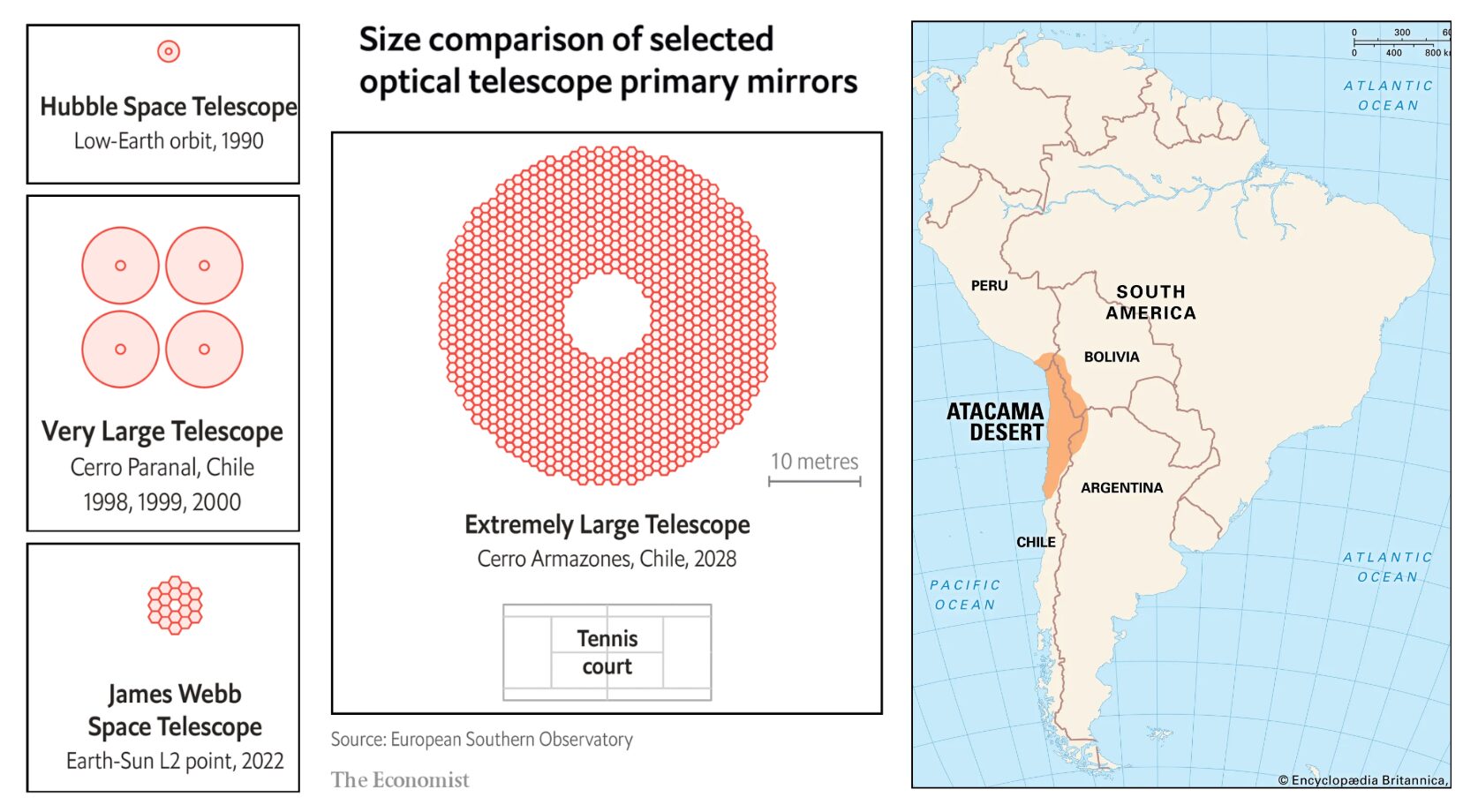
Photon Valley in Chile is a high-altitude corridor where several observatories operate side by side.
- Paranal Observatory: Managed by the European Southern Observatory (ESO). It currently houses the Very Large Telescope (VLT) and will operate the future Extremely Large Telescope (ELT).
- Extremely Large Telescope:
- ELT is under construction atop Cerro Armazones in the Atacama Desert in Chile by ESO. Expected to be completed by 2028.
- It has a five-mirror optical design and a primary mirror (M1) that is 39.3 meters in diameter, made of 798 hexagonal segments.
- Upon completion, it will be the largest optical/near-infrared telescope in the world. It will have unparalleled light-gathering power (~ 15 times more light than the current leading telescopes). Light-gathering area of nearly 1000 square metres.
- Very Large Telescope: One of the world’s most advanced optical telescopes, consisting of four Unit Telescopes (with main mirrors of 8.2m diameter) and four Auxiliary Telescopes (mirrors of 1.8m diameter). The telescopes can work together to form a giant interferometer (ESO Very Large Telescope Interferometer) to achieve much higher angular resolution, allowing astronomers to see finer details of the cosmos.
- ALMA (Atacama Large Millimeter /submillimeter Array): The world’s largest ground-based radio telescope array, featuring 66 high-precision antennas located at an altitude of 5000 meters. The project is a massive international partnership (Europe, the US, Canada, Japan, etc.)
Key Facts: Optical telescopes use a series of mirrors to capture light from space and redirect it to their various instruments. A bigger mirror can collect more light, which means it can both see dimmer things and resolve them in finer detail than a smaller one.
Concerns:
- A proposed green energy complex near Paranal Observatory triggered strong opposition from the scientific community. The project, planned about 10 kilometres from the observatory, raised concerns over light pollution, dust, vibrations and atmospheric instability that could make observations unfeasible.
This highlights the need to frame robust regulations to strengthen protections for global astronomical zones against light pollution.
UPSC PYQ 2016
Q. With reference to ‘Astrosat’, the astronomical observatory launched by India, which of the following statements is/are correct?
(1) Other than the USA and Russia, India is the only country to have launched a similar observatory into space.
(2) Astrosat is a 2000 kg satellite placed in an orbit at 1650 km above the surface of the Earth.
Select the correct answer using the code given below.
(a) 1 only
(b) 2 only
(c) Both 1 and 2
(d) Neither 1 nor 2
Answer: (d)
Source: https://anantamias.com/current-affairs/light-pollution-threatens-the-worlds-clearest-skies/
Livelihood of Mumbai fishers at risk as mangroves make way for road
Why in News?
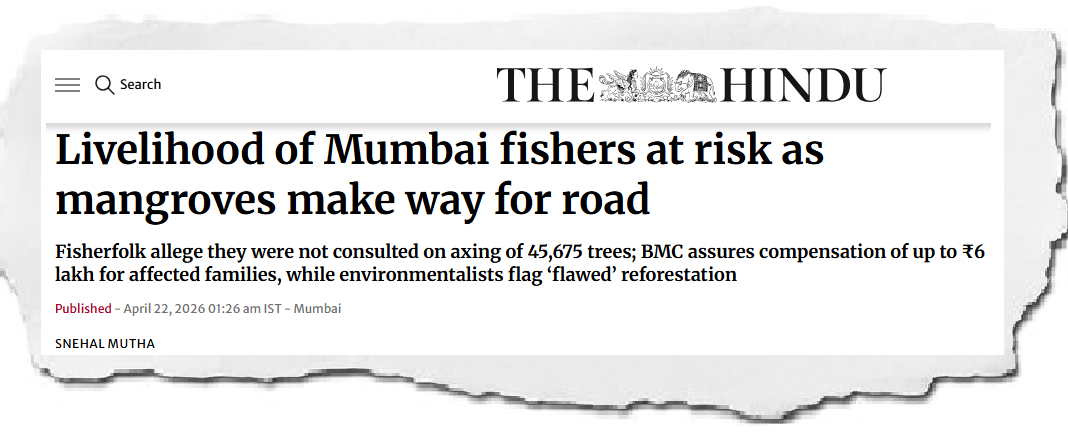
Large-scale diversion of mangrove forests for the Versova–Bhayandar Coastal Road project in Mumbai has raised concerns regarding ecological sustainability and the livelihood security of coastal fishing communities.
UPSC Relevance
GS-I: Coastal ecosystems, Mangroves
GS-II: Governance, Environmental decision-making
GS-III: Environment, Biodiversity, Sustainable Development, Urbanisation
Mangroves: Ecological Profile
Mangroves are salt-tolerant forest ecosystems found in intertidal coastal zones. In India, they are distributed across the eastern and western coasts and island territories.
They play a crucial role in:
- Supporting marine biodiversity through nursery and breeding habitats
- Protecting coastlines from erosion, storm surges, and flooding
- Acting as significant carbon sinks (blue carbon ecosystems)
The Issue: Coastal Infrastructure vs Ecological Stability
The proposed coastal road project aims to improve connectivity and reduce travel time. However, it involves large-scale removal of mangrove cover, leading to a conflict between infrastructure development and environmental sustainability.
Livelihood Implications
Fishing communities along Mumbai’s coast depend heavily on mangrove ecosystems. These areas sustain fish populations and provide a stable resource base for small-scale fisheries. Loss of mangroves can therefore:
- Disrupt traditional occupations
- Increase economic vulnerability
- Lead to occupational displacement without adequate alternatives
Environmental Concerns
Loss of Ecosystem Services
Mangroves provide multiple ecosystem services such as coastal protection, biodiversity support, and carbon sequestration. Their removal leads to long-term ecological costs that may outweigh short-term infrastructure gains.
Limitations of Compensatory Afforestation
Afforestation efforts often fail to replicate the ecological complexity of natural mangroves due to:
- Use of limited or non-native species
- Poor site selection
- High mortality rates
Thus, compensatory measures may not adequately substitute the ecological functions lost.
Increased Climate Vulnerability
Mumbai is highly vulnerable to sea-level rise and extreme weather events. Reduction in mangrove cover weakens natural coastal defence mechanisms, increasing the risk of flooding and damage.
Governance and Planning Challenges
Public Participation Deficit
Concerns have been raised about inadequate consultation with affected communities, particularly traditional fisher groups. This raises issues of procedural fairness and participatory governance.
Limitations in Environmental Impact Assessment
Environmental Impact Assessment processes are often criticised for:
- Insufficient evaluation of cumulative and long-term impacts
- Inadequate incorporation of local ecological knowledge
Urban Planning Concerns
The prioritisation of road-based infrastructure reflects a broader challenge in urban planning, where ecological considerations and sustainable transport alternatives are not sufficiently integrated.
Judicial Approach
Courts have permitted the project subject to compensatory measures such as afforestation. This reflects an attempt to balance development needs with environmental protection, though questions remain regarding the adequacy of such safeguards.
Way Forward
1. Integrating Ecosystem-Based Planning
Urban infrastructure planning must adopt an ecosystem-based approach, wherein natural features such as mangroves are treated as integral components of urban resilience. Spatial planning tools, including coastal zone mapping and vulnerability assessments, should guide project design to minimise ecological disruption.
2. Strengthening Environmental Impact Assessment Framework
The EIA process should be made more rigorous by incorporating:
- Comprehensive cumulative impact assessments
- Independent expert review mechanisms
- Greater transparency in data and decision-making
This would ensure that environmental costs are properly evaluated before project approval.
3. Ensuring Meaningful Stakeholder Participation
Consultation processes should go beyond procedural compliance and involve genuine engagement with affected communities. Mechanisms such as social impact assessments and participatory planning can help incorporate local concerns and knowledge into decision-making.
4. Livelihood Protection and Rehabilitation
A structured rehabilitation framework is necessary for affected fisher communities, including:
- Fair and timely compensation
- Skill development and alternative livelihood opportunities
- Recognition of traditional rights and dependence on coastal ecosystems
5. Promoting Sustainable Urban Transport
Urban transport policy should prioritise:
- Expansion of public transport systems
- Multimodal connectivity
- Reduction of dependence on private vehicles
This can reduce the need for ecologically disruptive infrastructure projects.
6. Scientific Mangrove Conservation and Restoration
Mangrove conservation efforts should focus on:
- Protection of existing natural ecosystems
- Restoration using native species and site-specific ecological conditions
- Long-term monitoring of survival and ecological functionality
Conclusion
The conflict between coastal infrastructure development and mangrove conservation highlights the need for a balanced approach that integrates ecological sustainability with developmental objectives. Protecting mangroves is essential not only for environmental reasons but also for safeguarding livelihoods and enhancing urban resilience in the face of climate change.
Practice Questions
Prelims
- With reference to mangroves in India, consider the following statements:
- Mangroves act as breeding grounds for marine organisms.
- They are found only along the eastern coast of India.
- Mangroves contribute to carbon sequestration.
Which of the statements given above is/are correct?
(a) 1 only
(b) 1 and 3 only
(c) 2 and 3 only
(d) 1, 2 and 3
Mains
- Discuss the ecological and economic significance of mangroves in India. Examine the challenges posed by coastal infrastructure projects.
- Evaluate the effectiveness of Environmental Impact Assessment in balancing development and environmental conservation in India.
- Coastal ecosystems are critical for both environmental sustainability and livelihood security. Analyse with examples.
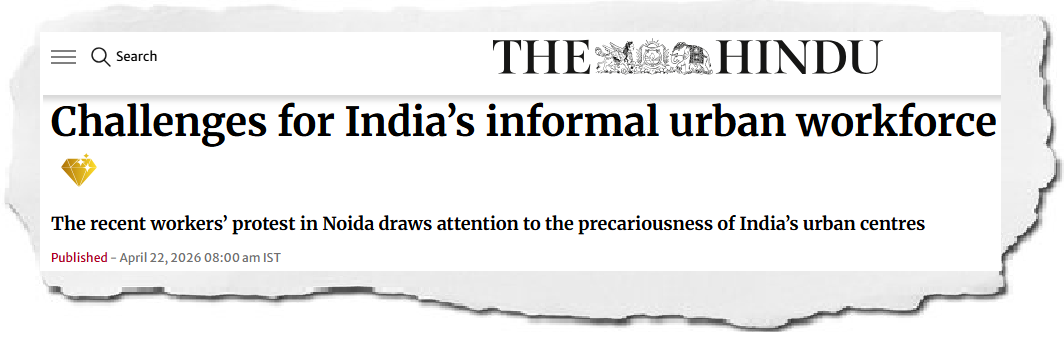
Challenges for India’s informal urban workforce
Why in News?
Recent protests by industrial workers in Noida have highlighted the growing precariousness of India’s urban informal workforce, reflecting deeper structural issues in urbanisation, labour markets, and governance.
UPSC Relevance
GS-I: Urbanisation, Social Issues
GS-II: Governance, Welfare Schemes, Urban Policy
GS-III: Economy (Labour Market), Inclusive Growth
Context: Informalisation of Urban Workforce
India’s labour market is characterised by a high degree of informality:
- Nearly 90% of total workforce is employed in the informal sector
- In urban areas, a large proportion of workers are:
- Casual labourers
- Self-employed
- Without written contracts or social security
This indicates that urban economic growth has not translated into secure and formal employment opportunities.
Structural Transformation of Urban Economy
Decline of Industrial Labour
Historically, cities such as Mumbai and Ahmedabad were centres of organised industrial employment. However:
- Closure of textile mills and manufacturing units
- Shift towards service-sector-led growth
has led to a decline in formal, unionised labour.
Urbanisation of “Social Reproduction”
Urban spaces are increasingly shaped by the daily struggle for survival rather than production:
- Securing housing, water, sanitation
- Managing household labour and care work
This reflects a shift where cities are no longer primarily centres of production, but spaces where precarious livelihoods are sustained.
Changing Role of the State
From Rights-Based to Market-Oriented Approach
Economic reforms influenced by neoliberal policies led to:
- Reduced role of the state in direct service provision
- Increasing reliance on:
- Privatisation
- User-fee-based services
This has transformed essential services such as:
- Water
- Electricity
- Education
into market commodities, increasing the burden on the poor.
Key Challenges Faced by Informal Urban Workers
1. Employment Insecurity
- Lack of formal contracts
- Absence of job security
- Weak bargaining power
This results in vulnerability to:
- Sudden layoffs
- Wage exploitation
2. Housing and Land Insecurity
- Around 40% of urban poor live in informal settlements
- High expenditure (30–50% of income) on rent
These settlements often lack:
- Legal tenure
- Basic services
Additionally, eviction and displacement due to urban redevelopment are common.
3. Exposure to Climate and Environmental Risks
- Informal urban workers often live in unsafe areas such as low-lying zones, riverbanks, or near drains, which are prone to flooding and other hazards.
- Their houses are usually poorly built and lack basic infrastructure, making them more vulnerable during heavy rains or heatwaves.
- Since most depend on daily wages and lack insurance or savings, any disruption caused by climate events directly affects their income and survival.
4. Rising Cost of Living
Privatisation and commodification of services have led to:
- Increased cost of water, electricity, healthcare
- Reduced affordability for low-income groups
5. Financial Exclusion
- Informal workers often lack assets or documents required to access formal banking services. As a result, they depend on local moneylenders who charge high interest rates.
- This leads to a cycle of debt, making their financial condition unstable and difficult to improve over time.
6. Weak Collective Representation
- Decline of trade unions
- Fragmentation of workforce
This reduces the ability of workers to:
- Negotiate wages
- Demand rights
What is Urban Intersectionality
Urban vulnerability is multidimensional, involving:
- Labour insecurity
- Housing deprivation
- Environmental risk
- Social inequality
These factors interact, creating a cycle of vulnerability rather than isolated problems.
Governance Innovations (Emerging Approaches)
Worker Participation in Urban Governance
- Experiments like workers’ councils (e.g., Kerala) aim to:
- Include informal workers in decision-making
- Recognise them as stakeholders in urban development
Integration of Informal and Formal Systems
- Need to connect:
- Informal workers
- Trade unions
- Urban governance institutions
This can improve representation and policy responsiveness.
Way Forward
1. Formalisation with Flexibility
Policies should aim at gradual formalisation of informal work by:
- Promoting written contracts
- Expanding social security coverage
- Supporting small enterprises
At the same time, excessive regulation should be avoided to prevent job loss.
2. Strengthening Social Security Systems
Universal and portable social protection mechanisms are needed, including:
- Health insurance
- Pension schemes
- Accident insurance
Schemes such as e-Shram need to be expanded and effectively implemented.
3. Affordable and Inclusive Urban Housing
Urban policy must prioritise:
- Affordable rental housing
- In-situ slum redevelopment
- Legal recognition of informal settlements
This will reduce displacement and improve living conditions.
4. Reclaiming the Role of the State in Basic Services
Essential services like water, health, and education should be:
- Accessible
- Affordable
- Treated as public goods
Reducing excessive reliance on market-based provisioning is crucial.
5. Strengthening Urban Labour Institutions
- Revitalise trade unions
- Create platforms for informal worker representation
- Encourage collective bargaining mechanisms
6. Climate-Resilient Urban Planning
Urban planning must integrate:
- Risk-sensitive land use
- Protection of vulnerable settlements
- Disaster-resilient infrastructure
This is essential for safeguarding informal workers from climate shocks.
7. Financial Inclusion
- Expand access to formal banking and credit
- Promote microfinance and SHG-based models
- Reduce dependence on informal lenders
8. Participatory Urban Governance
Institutionalise mechanisms such as:
- Worker councils
- Community participation forums
This will ensure that urban policies reflect the needs of the most vulnerable.
Conclusion
The challenges of India’s informal urban workforce highlight the limitations of current urbanisation and economic models. Addressing these issues requires a shift towards inclusive, rights-based, and participatory urban development, where economic growth is aligned with social justice and human dignity.
Practice Questions
Prelims
- With reference to informal sector employment in India, consider the following statements:
- It accounts for more than 80% of total employment.
- Workers in this sector generally have formal contracts and social security benefits.
- Informal employment is limited only to rural areas.
Which of the statements given above is/are correct?
(a) 1 only
(b) 1 and 2 only
(c) 2 and 3 only
(d) 1, 2 and 3
Answer: (a)
Mains
- Discuss the structural challenges faced by the informal urban workforce in India. How can urban governance address these issues?
- “Urbanisation in India has led to the growth of informalisation rather than formal employment.” Examine.
- Analyse the role of the state in ensuring inclusive urban development in the context of informal labour.
Source: https://anantamias.com/current-affairs/challenges-for-indias-informal-urban-workforce/
New Advances in CAR-T Therapy to target Solid Tumours
Source: https://anantamias.com/current-affairs/new-advances-in-car-t-therapy-to-target-solid-tumours/