
Why in News?
Scientists have developed a highly sensitive receptor that can detect trace amounts of proteins on solid tumours, potentially overcoming a major limitation of CAR-T therapy in treating cancers such as kidney or ovarian cancer.
| UPSC Relevance: GS-3 Science and Technology: Biology and Biotechnology Prelims & Mains: CAR T-cell therapy (Immunology): Applications & Challenges |
What is CAR T-cell therapy?
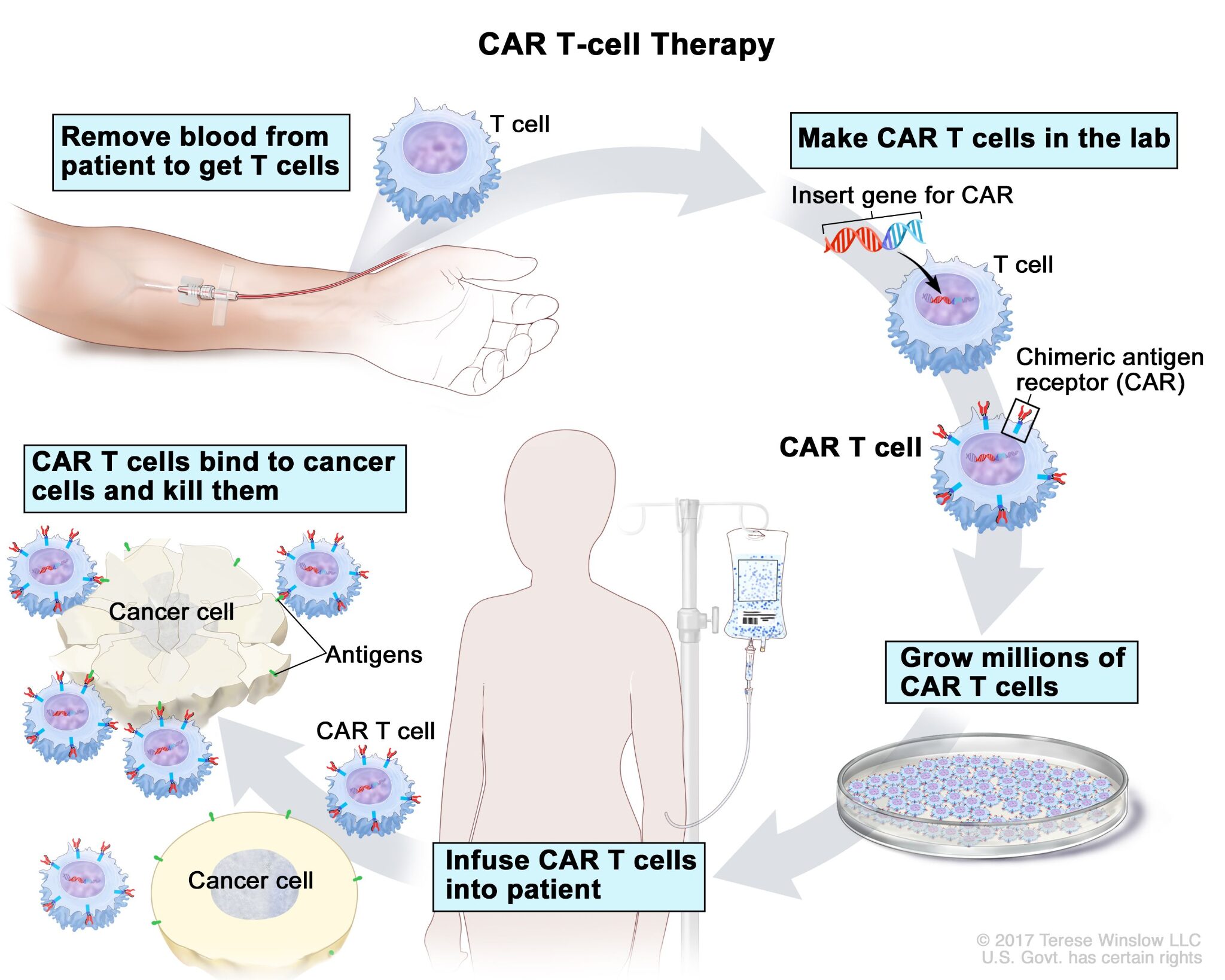
- Chimeric Antigen Receptor (CAR) T-cell therapy is a gene therapy where a patient’s own T-cells are genetically modified in a laboratory to identify and destroy cancer cells.
- T-cells are harvested from the patient’s blood. Researchers genetically modify these cells in the laboratory to express specific proteins on their surface known as chimeric antigen receptors (CAR).
- These cells are then multiplied in the laboratory and then reinfused into the patient. This genetic modification allows CAR T-cells to effectively bind to cancer cells and destroy them.
- CAR-T cells directly activate the patient’s immune system against cancer, and thus make cancer treatment more clinically effective than surgery, radiotherapy, and Chemotherapy.
Current Applications of CAR T-cell therapy:
- CAR-T therapy is currently approved for several haematological malignancies such as B-cell acute lymphoblastic leukaemia, lymphomas, and multiple myeloma.
- It has shown high response rates (up to ~80-90% in certain cases), particularly in relapsed or refractory cancers, though long-term outcomes vary.
Limitations of CAR T-cell therapy:
- CAR-T therapy is associated with significant side effects, notably:
- Cytokine Release Syndrome (CRS): widespread activation of the immune system and collateral damage to the body’s normal cells.
- Immune Effector Cell-Associated Neurotoxicity Syndrome (ICANS): may manifest as fever, breathing difficulty, nausea, confusion, seizures, and speech impairment.
- The efficacy of CAR T-cell therapy in solid tumours remains limited due to biological barriers.
- The complexity of preparing CAR T-cells involves considerable cost and highly skilled human resources for its administration.
Recent Breakthrough: CAR-T Therapy to target Solid Tumours
1. The Challenge: Why CAR T-cell therapy fails in Solid Tumours?
- Antigen Homogeneity in Blood cells: Blood cancers have uniform, abundantly expressed target antigens (such as CD19 and BCMA) on malignant cells, with minimal presence on critical healthy tissue. This enables the genetically engineered T-cells (having artificial CAR receptors) to target the specific cancer antigen.
- Antigen Heterogeneity in Tumour cells: Tumours are not made of identical cells, and consist of diverse cell populations. Some cells express the target protein that CAR-T cells detect and destroy. But some invisible cells (antigen-negative) survive and allow the cancer to grow back.
2. Concept of Pseudo-Heterogeneity:
- Recent research shows that tumour cells thought to lack the target protein (CD70) actually carry small amounts — too little for current CAR T-cells to detect. The target protein was being suppressed by an enzyme called EZH2, which chemically modifies proteins around DNA.
3. The Solution: HIT receptor-equipped T-cells
- Scientists have developed a highly sensitive receptor called HLA independent T-cell (HIT) receptor that can detect trace amounts of proteins/ ultra-low antigen levels on solid tumours.
The team tested HIT receptor-modified T-cells in xenograft models (where real human tumour tissue was implanted into mice). The results were significant as HIT receptor-equipped T-cells eliminated these previously undetectable cells, achieving complete and lasting tumour eradication across multiple models of kidney, ovarian, and pancreatic cancer.
This breakthrough overcomes the major biological hurdle to using CAR T-cell therapy against cancers such as kidney or ovarian cancer.
| Back to Basics: Key Concepts |
| Cancer: Cancer is defined as a group of diseases involving abnormal, uncontrolled cell growth and division. This occurs due to DNA damage or mutations that interfere with the cell’s ability to regulate cell division. |
| Immunotherapy: A type of cancer treatment (or biological therapy) that empowers a person’s own immune system to recognise, target, and destroy cancer cells. While chemotherapy and radiotherapy directly kill cancer cells (and some healthy cells too), immunotherapy pushes the body’s own immune system to recognise and kill cancer cells. As immunotherapy is highly targeted, it spares healthy cells. |
Antibody: Proteins produced by the immune system to neutralise any foreign substance entering the human body. An antibody attaches itself to an antigen (a foreign substance- usually a disease-causing molecule) and helps the immune system eliminate it from the body. |
| T-cells: T-cells are special cells (type of White Blood Cells) whose primary function is to attack and kill pathogens and foreign cells. |
UPSC PYQ 2022
Q. Which one of the following statements best describes the role of B-cells and T-cells in the human body?
(a) They protect the body from environmental allergens.
(b) They alleviate the body’s pain and inflammation.
(c) They act as immunosuppressants in the body.
(d) They protect the body from the diseases caused by pathogens.
Answer: (d)
Tell Google you want more of this.
Add Anantam IAS as a preferred sourceOne tap, and this site shows up more often in your own Top Stories, AI Overviews and AI Mode. Remove it any time.