Why in News?
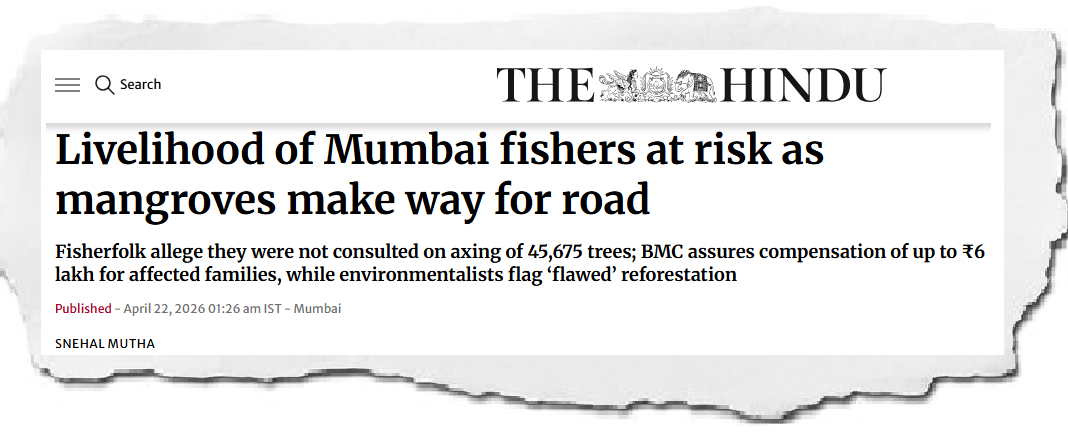
Large-scale diversion of mangrove forests for the Versova–Bhayandar Coastal Road project in Mumbai has raised concerns regarding ecological sustainability and the livelihood security of coastal fishing communities.
UPSC Relevance
GS-I: Coastal ecosystems, Mangroves
GS-II: Governance, Environmental decision-making
GS-III: Environment, Biodiversity, Sustainable Development, Urbanisation
Mangroves: Ecological Profile
Mangroves are salt-tolerant forest ecosystems found in intertidal coastal zones. In India, they are distributed across the eastern and western coasts and island territories.
They play a crucial role in:
- Supporting marine biodiversity through nursery and breeding habitats
- Protecting coastlines from erosion, storm surges, and flooding
- Acting as significant carbon sinks (blue carbon ecosystems)
The Issue: Coastal Infrastructure vs Ecological Stability
The proposed coastal road project aims to improve connectivity and reduce travel time. However, it involves large-scale removal of mangrove cover, leading to a conflict between infrastructure development and environmental sustainability.
Livelihood Implications
Fishing communities along Mumbai’s coast depend heavily on mangrove ecosystems. These areas sustain fish populations and provide a stable resource base for small-scale fisheries. Loss of mangroves can therefore:
- Disrupt traditional occupations
- Increase economic vulnerability
- Lead to occupational displacement without adequate alternatives
Environmental Concerns
Loss of Ecosystem Services
Mangroves provide multiple ecosystem services such as coastal protection, biodiversity support, and carbon sequestration. Their removal leads to long-term ecological costs that may outweigh short-term infrastructure gains.
Limitations of Compensatory Afforestation
Afforestation efforts often fail to replicate the ecological complexity of natural mangroves due to:
- Use of limited or non-native species
- Poor site selection
- High mortality rates
Thus, compensatory measures may not adequately substitute the ecological functions lost.
Increased Climate Vulnerability
Mumbai is highly vulnerable to sea-level rise and extreme weather events. Reduction in mangrove cover weakens natural coastal defence mechanisms, increasing the risk of flooding and damage.
Governance and Planning Challenges
Public Participation Deficit
Concerns have been raised about inadequate consultation with affected communities, particularly traditional fisher groups. This raises issues of procedural fairness and participatory governance.
Limitations in Environmental Impact Assessment
Environmental Impact Assessment processes are often criticised for:
- Insufficient evaluation of cumulative and long-term impacts
- Inadequate incorporation of local ecological knowledge
Urban Planning Concerns
The prioritisation of road-based infrastructure reflects a broader challenge in urban planning, where ecological considerations and sustainable transport alternatives are not sufficiently integrated.
Judicial Approach
Courts have permitted the project subject to compensatory measures such as afforestation. This reflects an attempt to balance development needs with environmental protection, though questions remain regarding the adequacy of such safeguards.
Way Forward
1. Integrating Ecosystem-Based Planning
Urban infrastructure planning must adopt an ecosystem-based approach, wherein natural features such as mangroves are treated as integral components of urban resilience. Spatial planning tools, including coastal zone mapping and vulnerability assessments, should guide project design to minimise ecological disruption.
2. Strengthening Environmental Impact Assessment Framework
The EIA process should be made more rigorous by incorporating:
- Comprehensive cumulative impact assessments
- Independent expert review mechanisms
- Greater transparency in data and decision-making
This would ensure that environmental costs are properly evaluated before project approval.
3. Ensuring Meaningful Stakeholder Participation
Consultation processes should go beyond procedural compliance and involve genuine engagement with affected communities. Mechanisms such as social impact assessments and participatory planning can help incorporate local concerns and knowledge into decision-making.
4. Livelihood Protection and Rehabilitation
A structured rehabilitation framework is necessary for affected fisher communities, including:
- Fair and timely compensation
- Skill development and alternative livelihood opportunities
- Recognition of traditional rights and dependence on coastal ecosystems
5. Promoting Sustainable Urban Transport
Urban transport policy should prioritise:
- Expansion of public transport systems
- Multimodal connectivity
- Reduction of dependence on private vehicles
This can reduce the need for ecologically disruptive infrastructure projects.
6. Scientific Mangrove Conservation and Restoration
Mangrove conservation efforts should focus on:
- Protection of existing natural ecosystems
- Restoration using native species and site-specific ecological conditions
- Long-term monitoring of survival and ecological functionality
Conclusion
The conflict between coastal infrastructure development and mangrove conservation highlights the need for a balanced approach that integrates ecological sustainability with developmental objectives. Protecting mangroves is essential not only for environmental reasons but also for safeguarding livelihoods and enhancing urban resilience in the face of climate change.
Practice Questions
Prelims
- With reference to mangroves in India, consider the following statements:
- Mangroves act as breeding grounds for marine organisms.
- They are found only along the eastern coast of India.
- Mangroves contribute to carbon sequestration.
Which of the statements given above is/are correct?
(a) 1 only
(b) 1 and 3 only
(c) 2 and 3 only
(d) 1, 2 and 3
Mains
- Discuss the ecological and economic significance of mangroves in India. Examine the challenges posed by coastal infrastructure projects.
- Evaluate the effectiveness of Environmental Impact Assessment in balancing development and environmental conservation in India.
- Coastal ecosystems are critical for both environmental sustainability and livelihood security. Analyse with examples.
Tell Google you want more of this.
Add Anantam IAS as a preferred sourceOne tap, and this site shows up more often in your own Top Stories, AI Overviews and AI Mode. Remove it any time.