
Why in News?
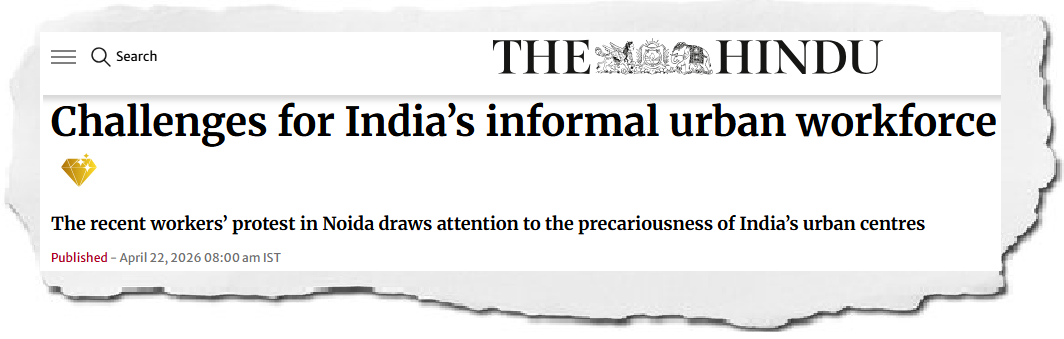
Recent protests by industrial workers in Noida have highlighted the growing precariousness of India’s urban informal workforce, reflecting deeper structural issues in urbanisation, labour markets, and governance.
UPSC Relevance
GS-I: Urbanisation, Social Issues
GS-II: Governance, Welfare Schemes, Urban Policy
GS-III: Economy (Labour Market), Inclusive Growth
Context: Informalisation of Urban Workforce
India’s labour market is characterised by a high degree of informality:
- Nearly 90% of total workforce is employed in the informal sector
- In urban areas, a large proportion of workers are:
- Casual labourers
- Self-employed
- Without written contracts or social security
This indicates that urban economic growth has not translated into secure and formal employment opportunities.
Structural Transformation of Urban Economy
Decline of Industrial Labour
Historically, cities such as Mumbai and Ahmedabad were centres of organised industrial employment. However:
- Closure of textile mills and manufacturing units
- Shift towards service-sector-led growth
has led to a decline in formal, unionised labour.
Urbanisation of “Social Reproduction”
Urban spaces are increasingly shaped by the daily struggle for survival rather than production:
- Securing housing, water, sanitation
- Managing household labour and care work
This reflects a shift where cities are no longer primarily centres of production, but spaces where precarious livelihoods are sustained.
Changing Role of the State
From Rights-Based to Market-Oriented Approach
Economic reforms influenced by neoliberal policies led to:
- Reduced role of the state in direct service provision
- Increasing reliance on:
- Privatisation
- User-fee-based services
This has transformed essential services such as:
- Water
- Electricity
- Education
into market commodities, increasing the burden on the poor.
Key Challenges Faced by Informal Urban Workers
1. Employment Insecurity
- Lack of formal contracts
- Absence of job security
- Weak bargaining power
This results in vulnerability to:
- Sudden layoffs
- Wage exploitation
2. Housing and Land Insecurity
- Around 40% of urban poor live in informal settlements
- High expenditure (30–50% of income) on rent
These settlements often lack:
- Legal tenure
- Basic services
Additionally, eviction and displacement due to urban redevelopment are common.
3. Exposure to Climate and Environmental Risks
- Informal urban workers often live in unsafe areas such as low-lying zones, riverbanks, or near drains, which are prone to flooding and other hazards.
- Their houses are usually poorly built and lack basic infrastructure, making them more vulnerable during heavy rains or heatwaves.
- Since most depend on daily wages and lack insurance or savings, any disruption caused by climate events directly affects their income and survival.
4. Rising Cost of Living
Privatisation and commodification of services have led to:
- Increased cost of water, electricity, healthcare
- Reduced affordability for low-income groups
5. Financial Exclusion
- Informal workers often lack assets or documents required to access formal banking services. As a result, they depend on local moneylenders who charge high interest rates.
- This leads to a cycle of debt, making their financial condition unstable and difficult to improve over time.
6. Weak Collective Representation
- Decline of trade unions
- Fragmentation of workforce
This reduces the ability of workers to:
- Negotiate wages
- Demand rights
What is Urban Intersectionality
Urban vulnerability is multidimensional, involving:
- Labour insecurity
- Housing deprivation
- Environmental risk
- Social inequality
These factors interact, creating a cycle of vulnerability rather than isolated problems.
Governance Innovations (Emerging Approaches)
Worker Participation in Urban Governance
- Experiments like workers’ councils (e.g., Kerala) aim to:
- Include informal workers in decision-making
- Recognise them as stakeholders in urban development
Integration of Informal and Formal Systems
- Need to connect:
- Informal workers
- Trade unions
- Urban governance institutions
This can improve representation and policy responsiveness.
Way Forward
1. Formalisation with Flexibility
Policies should aim at gradual formalisation of informal work by:
- Promoting written contracts
- Expanding social security coverage
- Supporting small enterprises
At the same time, excessive regulation should be avoided to prevent job loss.
2. Strengthening Social Security Systems
Universal and portable social protection mechanisms are needed, including:
- Health insurance
- Pension schemes
- Accident insurance
Schemes such as e-Shram need to be expanded and effectively implemented.
3. Affordable and Inclusive Urban Housing
Urban policy must prioritise:
- Affordable rental housing
- In-situ slum redevelopment
- Legal recognition of informal settlements
This will reduce displacement and improve living conditions.
4. Reclaiming the Role of the State in Basic Services
Essential services like water, health, and education should be:
- Accessible
- Affordable
- Treated as public goods
Reducing excessive reliance on market-based provisioning is crucial.
5. Strengthening Urban Labour Institutions
- Revitalise trade unions
- Create platforms for informal worker representation
- Encourage collective bargaining mechanisms
6. Climate-Resilient Urban Planning
Urban planning must integrate:
- Risk-sensitive land use
- Protection of vulnerable settlements
- Disaster-resilient infrastructure
This is essential for safeguarding informal workers from climate shocks.
7. Financial Inclusion
- Expand access to formal banking and credit
- Promote microfinance and SHG-based models
- Reduce dependence on informal lenders
8. Participatory Urban Governance
Institutionalise mechanisms such as:
- Worker councils
- Community participation forums
This will ensure that urban policies reflect the needs of the most vulnerable.
Conclusion
The challenges of India’s informal urban workforce highlight the limitations of current urbanisation and economic models. Addressing these issues requires a shift towards inclusive, rights-based, and participatory urban development, where economic growth is aligned with social justice and human dignity.
Practice Questions
Prelims
- With reference to informal sector employment in India, consider the following statements:
- It accounts for more than 80% of total employment.
- Workers in this sector generally have formal contracts and social security benefits.
- Informal employment is limited only to rural areas.
Which of the statements given above is/are correct?
(a) 1 only
(b) 1 and 2 only
(c) 2 and 3 only
(d) 1, 2 and 3
Answer: (a)
Mains
- Discuss the structural challenges faced by the informal urban workforce in India. How can urban governance address these issues?
- “Urbanisation in India has led to the growth of informalisation rather than formal employment.” Examine.
- Analyse the role of the state in ensuring inclusive urban development in the context of informal labour.
Tell Google you want more of this.
Add Anantam IAS as a preferred sourceOne tap, and this site shows up more often in your own Top Stories, AI Overviews and AI Mode. Remove it any time.