Why in News?
Increasing light pollution and industrial expansion are threatening the pristine night skies of the Atacama Desert, one of the world’s most important astronomical regions.
A proposed green energy project near the Paranal Observatory sparked global concern, highlighting gaps in regulatory frameworks for dark-sky preservation.
| UPSC Relevance: GS-3 Science and Technology: Astronomy and Space Technology Prelims: Light Pollution (impacts); Dark Reserves; Extremely Large Telescope; Very Large Telescope; ALMA |
What is Light Pollution?
Light pollution refers to excessive artificial light that alters the natural darkness of the night sky. Over 80% of the world’s population lives under light-polluted skies.
What are the Impacts of Light Pollution?
- Human Health: Disrupts the Circadian Rhythm, affecting melatonin secretion. Lead to sleep disorders, hormonal imbalance, and increased risk of metabolic disorders.
- Fauna:
- Disrupts natural behaviour (especially nocturnal species) like navigation, foraging, reproductive cycles and predator-prey interactions. E.g., Sea turtle hatchlings rely on the brightness of the natural horizon to move towards oceans, but artificial beachfront lighting leads them inland, causing fatality.
- Disrupts the seasonal migration schedule of migrating birds.
- Flora:
- Light pollution disrupts Photoperiodism (the response of plants to the relative length of day and night) and thus impacts flowering cycles, dormancy, and seed germination.
- Artificial light reduces zooplankton grazing and leads to algal blooms.
- Astronomy: Light pollution creates skyglow and reduces the visibility of stars, galaxies, nebulae, etc. It hampers both amateur observation and professional astronomy.
Astronomical Significance of the Atacama Desert:
1. Why is Atacama Unique?
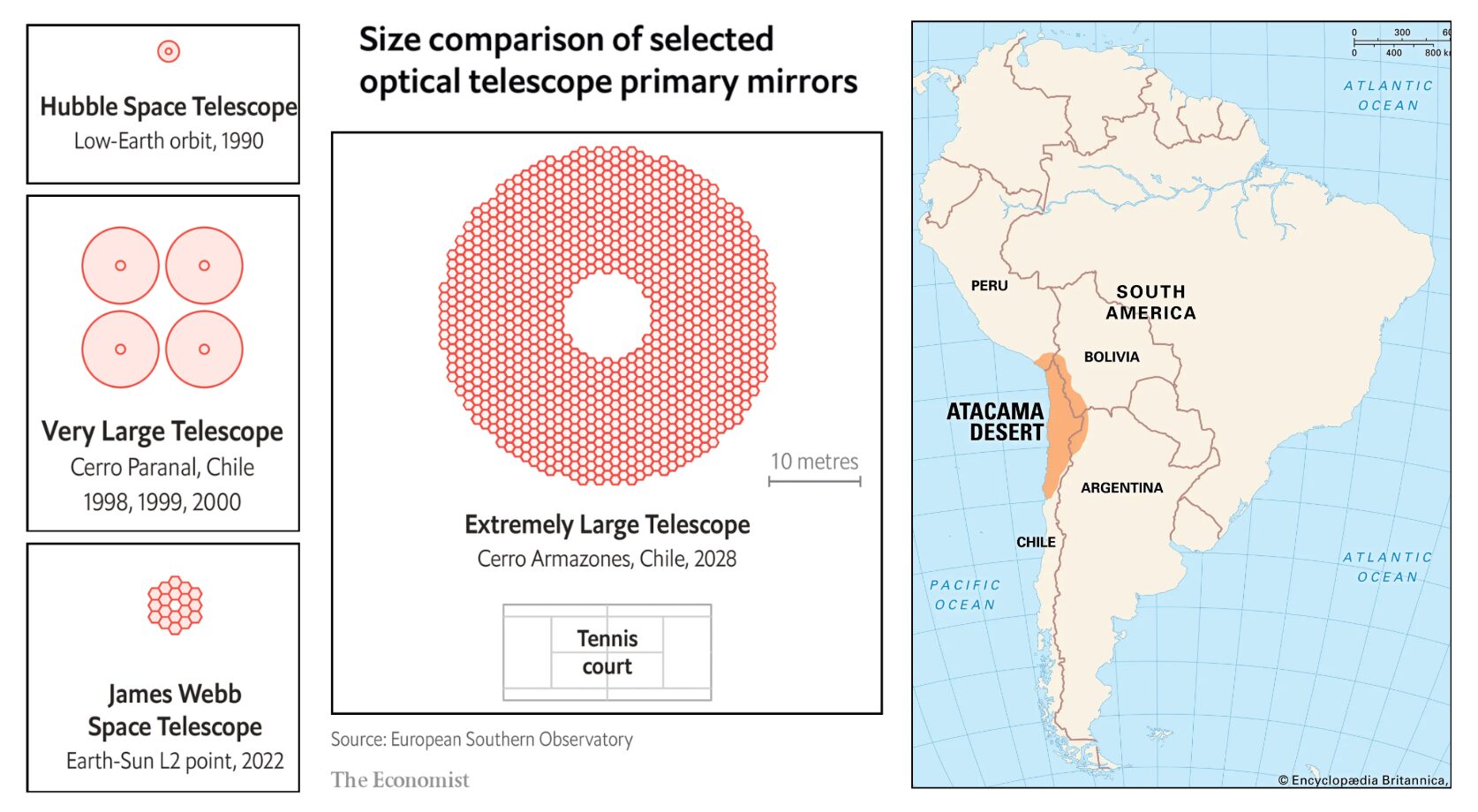
- Climate: Hyperarid (<1 mm of rainfall annually), driest non-polar desert on Earth.
- Altitude: Most observatories are located above 3000 m, reducing atmospheric water vapour interference with infrared and millimetre-wave astronomy.
- Clear Skies: More than 300 cloud-free nights annually, critical for deep-sky and exoplanet research.
- Light Isolation: Historically isolated from major urban centres.
This has made Atacama an unrivalled hub for world-class astronomy and home to the world’s largest ground-based astronomical projects.
2. Important Astronomical Projects in the Atacama Desert:
Photon Valley in Chile is a high-altitude corridor where several observatories operate side by side.
- Paranal Observatory: Managed by the European Southern Observatory (ESO). It currently houses the Very Large Telescope (VLT) and will operate the future Extremely Large Telescope (ELT).
- Extremely Large Telescope:
- ELT is under construction atop Cerro Armazones in the Atacama Desert in Chile by ESO. Expected to be completed by 2028.
- It has a five-mirror optical design and a primary mirror (M1) that is 39.3 meters in diameter, made of 798 hexagonal segments.
- Upon completion, it will be the largest optical/near-infrared telescope in the world. It will have unparalleled light-gathering power (~ 15 times more light than the current leading telescopes). Light-gathering area of nearly 1000 square metres.
- Very Large Telescope: One of the world’s most advanced optical telescopes, consisting of four Unit Telescopes (with main mirrors of 8.2m diameter) and four Auxiliary Telescopes (mirrors of 1.8m diameter). The telescopes can work together to form a giant interferometer (ESO Very Large Telescope Interferometer) to achieve much higher angular resolution, allowing astronomers to see finer details of the cosmos.
- ALMA (Atacama Large Millimeter /submillimeter Array): The world’s largest ground-based radio telescope array, featuring 66 high-precision antennas located at an altitude of 5000 meters. The project is a massive international partnership (Europe, the US, Canada, Japan, etc.)
Key Facts: Optical telescopes use a series of mirrors to capture light from space and redirect it to their various instruments. A bigger mirror can collect more light, which means it can both see dimmer things and resolve them in finer detail than a smaller one.
Concerns:
- A proposed green energy complex near Paranal Observatory triggered strong opposition from the scientific community. The project, planned about 10 kilometres from the observatory, raised concerns over light pollution, dust, vibrations and atmospheric instability that could make observations unfeasible.
This highlights the need to frame robust regulations to strengthen protections for global astronomical zones against light pollution.
UPSC PYQ 2016
Q. With reference to ‘Astrosat’, the astronomical observatory launched by India, which of the following statements is/are correct?
(1) Other than the USA and Russia, India is the only country to have launched a similar observatory into space.
(2) Astrosat is a 2000 kg satellite placed in an orbit at 1650 km above the surface of the Earth.
Select the correct answer using the code given below.
(a) 1 only
(b) 2 only
(c) Both 1 and 2
(d) Neither 1 nor 2
Answer: (d)
Tell Google you want more of this.
Add Anantam IAS as a preferred sourceOne tap, and this site shows up more often in your own Top Stories, AI Overviews and AI Mode. Remove it any time.