Daily Digest
UPSC · Civil Services Examination
Current Affairs · Monday, 29 September 2025
Current affairs curated and edited by Anantam IAS faculty — pulled from The Hindu, PIB, IDSA, Foreign Affairs and the ministries. Read, annotate, revise.
Old Rajinder Nagar · Delhi 110005 · anantamias.com
Astrosat

Why in news:
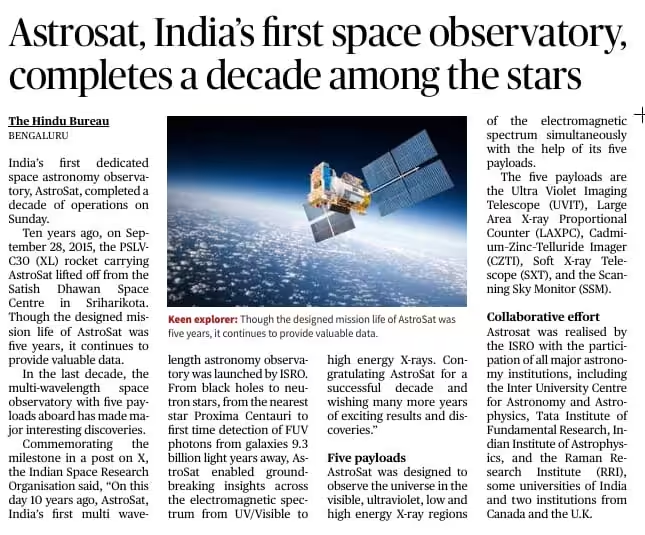
India’s first space observatory, Astrosat, has successfully completed a decade of operations since its launch on September 28, 2015, by PSLV-C30 from Sriharikota. Although its designed mission life was only 5 years, Astrosat has continued to function and provide valuable scientific data for 10 years.
Observatory: A space-based instrument designed to study celestial objects.
UPSC Relevance:
Achievements of Indians in science & technology.
UPSC PYQ:
Q. Recently, scientists observed the merger of giant ‘blackholes’ billions of light-years away from the Earth. What is the significance of this observation? (2019)
(a) ‘Higgs boson particles’ were detected.
(b) ‘Gravitational waves’ were detected.
(c) Possibility of intergalactic space travel through ‘wormhole’ was confirmed.
(d) It enabled the scientists to understand ‘singularity’
About Astrosat:
AstroSat with a lift-off mass of 1515 kg was launched on September 28, 2015 into a 650 km orbit inclined at an angle of 6 deg to the equator by PSLV-C30 from Satish Dhawan Space Centre, Sriharikota.
- AstroSat is the first dedicated Indian astronomy mission aimed at studying celestial sources in X-ray, optical and UV spectral bands simultaneously.
- The payloads cover the energy bands of Ultraviolet (Near and Far), limited optical and X-ray regime (0.3 keV to 100keV).
- One of the unique features of AstroSat mission is that it enables the simultaneous multi-wavelength observations of various astronomical objects with a single satellite.
Objectives:
- To understand high energy processes in binary star systems containing neutron stars and black holes.
- Study star birth regions and high energy processes in star systems lying beyond our galaxy.
- Detect new briefly bright X-ray sources in the sky, etc.
Five Payloads:
- Ultra Violet Imaging Telescope (UVIT)
- Large Area X-ray Proportional Counter (LAXPC)
- Cadmium-Zinc-Telluride Imager (CZTI)
- Soft X-ray Telescope (SXT)
- Scanning Sky Monitor (SSM)
Scientific Achievements:
- Studied phenomena from black holes to neutron stars.
- Provided first detection of UV photons from Proxima Centauri.
- Helped measure X-rays from distant galaxies (as far as 9.3 billion light years away).
- Enabled groundbreaking insights across the electromagnetic spectrum.
UNGA

Why in news:
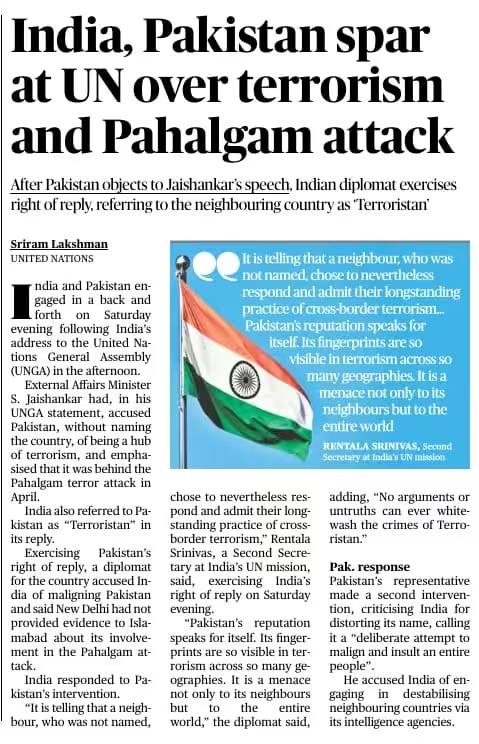
At the United Nations General Assembly (UNGA), India and Pakistan engaged in a sharp exchange over cross-border terrorism. External Affairs Minister S. Jaishankar in his UN speech highlighted Pakistan’s role in fostering terrorism, without directly naming it. Following this, Pakistan objected, but India exercised its Right of Reply, calling Pakistan “Terroristan.”
UPSC relevance:
Important International institutions, agencies and fora their structure, mandate.
UPSC Prelims PYQ 2022:
Q. With reference to the United Nations General Assembly, consider the following statements:
- The UN General Assembly can grant observer status to the non-member States.
- Inter-governmental organisations can seek observer status in the UN General Assembly.
- Permanent Observers in the UN General Assembly can maintain missions at the UN headquarters.
Which of the statements given above are correct?
a) 1 and 2 only
b) 2 and 3 only
c) 1 and 3 only
d) 1, 2 and 3
About UNGA:
Food Wastage

Why in news:
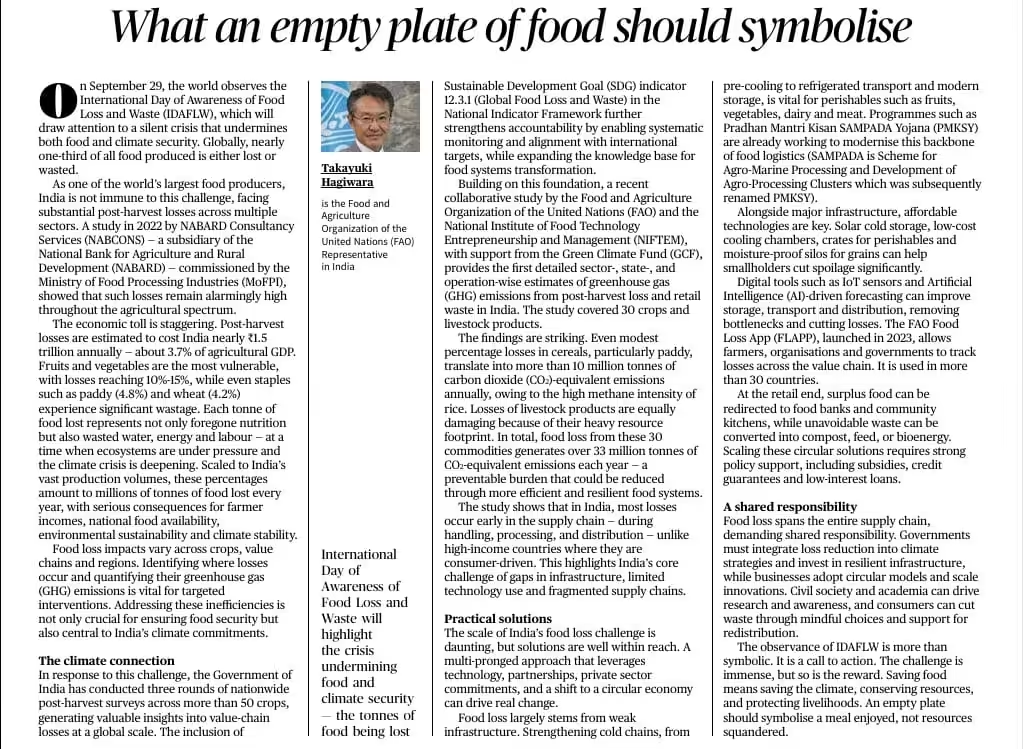
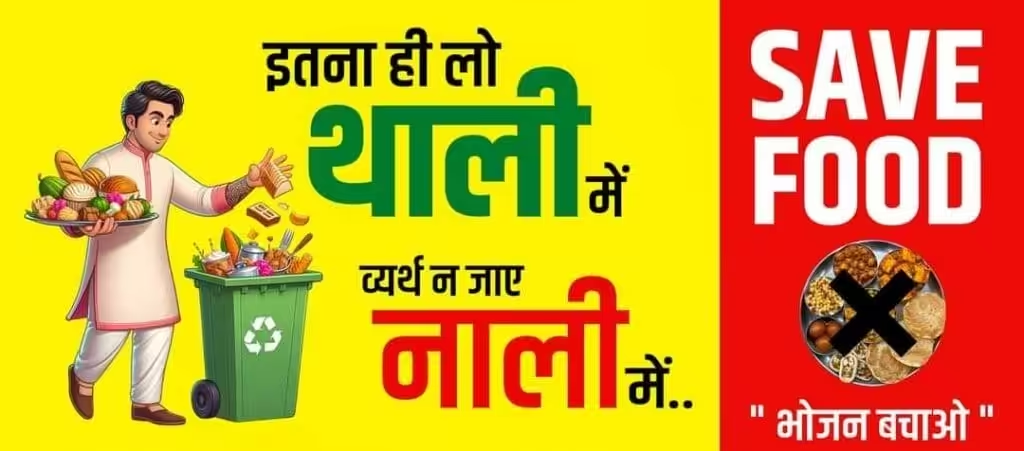
This article discusses International Day of Awareness of Food Loss and Waste (IDAFLW) observed on September 29, highlighting the global and Indian context of food loss and wastage.
UPSC Relevance:
Issues of buffer stocks and food security
UPSC PYQ:
Q: Food Security Bill is expected to eliminate hunger and malnutrition in India. Critically discuss various apprehensions in its effective implementation along with the concerns it has generated in WTO. (2013)
Q. What are the challenges and opportunities of food processing sector in the country? How can income of the farmers be substantially increased by encouraging food processing?(2020)
Highlight in the Article:
- In Global Context nearly one-third of food waste in a year. This may affect food security and climate change.
- Food waste increase GHG in atmosphere.
India:
According to NABARD Consultancy Services (NABCONS) study (2022):
- Annual post-harvest food loss in India = ₹1.5 trillion (~3.7% of GDP).
- Fruits & vegetables are most vulnerable (10–15% loss).
- Staples like paddy (4.8%) and wheat (4.2%) also face wastage.
- Losses mean not only nutritional deficit, but also waste of water, energy, labour, and land.

Source:-FAO
Food Waste:
- It is estimated that the food that is lost and wasted could feed 1.26 billion hungry people every year. Meanwhile, world hunger affected about 9.2% of the world’s population in 2022 and the greenhouse gases (GHG) from the food industry account for one-third of the total of the total emissions that have led to today’s climate crisis.
- Food and Agriculture Organisation of the United Nations (FAO), which estimates that loss and waste of food cause between 8 and 10% of the emissions of the gases responsible for global warming.
Food Wase and Climate Change:
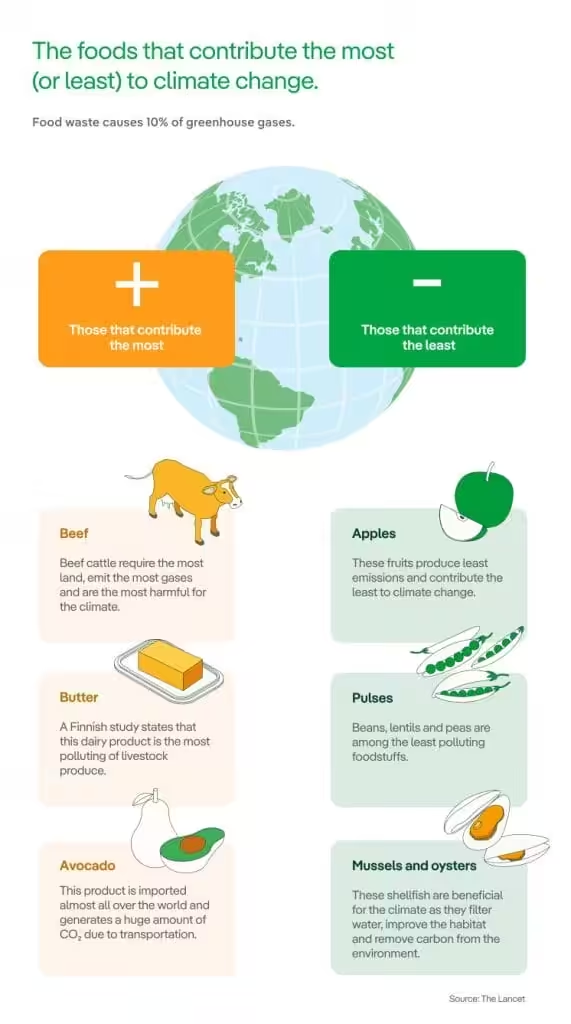
Source:- Lancet
Cause of Food Waste- FAO
- Improper storage – food not being used before it goes bad. Food spoilage at home occurs due to, lack of visibility in refrigerators, partially used ingredients and misjudged food needs.
- Over-Preparing – cooking or serving too much food. Cooking portions have increased over time and large meals often include more food than can be finished. In addition, people often forget to eat leftovers and end up throwing them away.
- Large Portions – commonly observed at restaurants, increased portion size largely contributes to waste. Restaurants meals are often left uneaten and edible leftovers are often left at the restaurant. All-you-can-eat buffets are particularly wasteful as extra food can’t legally be re-used or donated due to health code restrictions. The common practice of keeping buffets fully stocked during business hours (rather than allowing items to run out near closing) creates waste.
- Date Label Confusion – food is prematurely discarded due to confusion over the meaning of date labels (e.g., “sell by,” “best by,” “use by,” etc.).
- Overbuying – sales on unusual products and promotions that encourage impulse and bulk food purchases at retail stores often lead consumers to purchase items that don’t fit into their regular meal plans and spoil before they can be used.
- Poor Planning – Without meal plans and shopping lists, consumers often make inaccurate estimates of what and how many ingredients they will use during the week. Unplanned restaurant meals or food delivery can also lead to food at home going bad before it can be used.
- Lack of freezing – confusion about whether a product is suitable for freezing and how best to freeze it to maintain its quality and storage life can lead to food spoilage.
Schemes that would reduce food waste, benefit farmers:
- MEGA FOOD PARKS
- The scheme aims to link agricultural production to markets by using a cluster approach, implemented by an SPV. It supports the creation of infrastructure for setting up of modern food processing units in the park and connecting it with a well-established supply chain.
- AGRO PROCESSING CLUSTER:
- The scheme aims at cluster approach based development of modern infrastructure and common facilities to encourage a group of entrepreneurs to set up food processing units.
- Pradhan Mantri Kisan Sampada Yojana:
- is a central sector umbrella scheme by the Ministry of Food Processing Industries (MoFPI) aimed at reducing food loss and waste through the development of robust food processing and preservation infrastructure across India.
Source: https://anantamias.com/current-affairs/food-wastage/