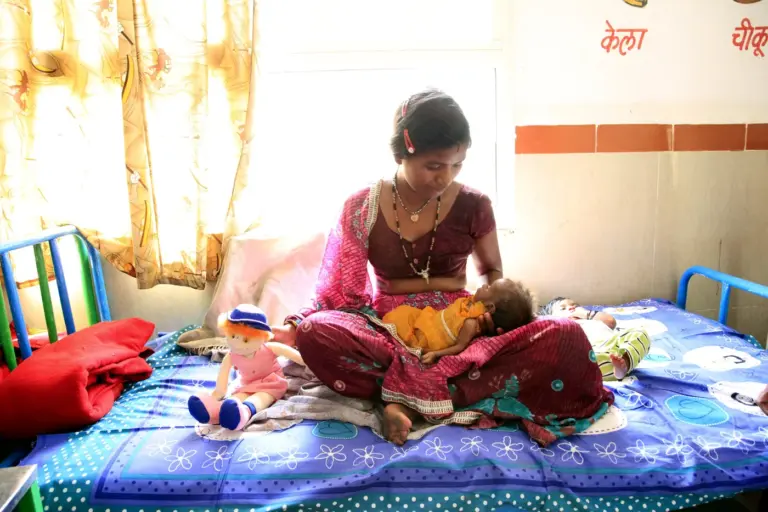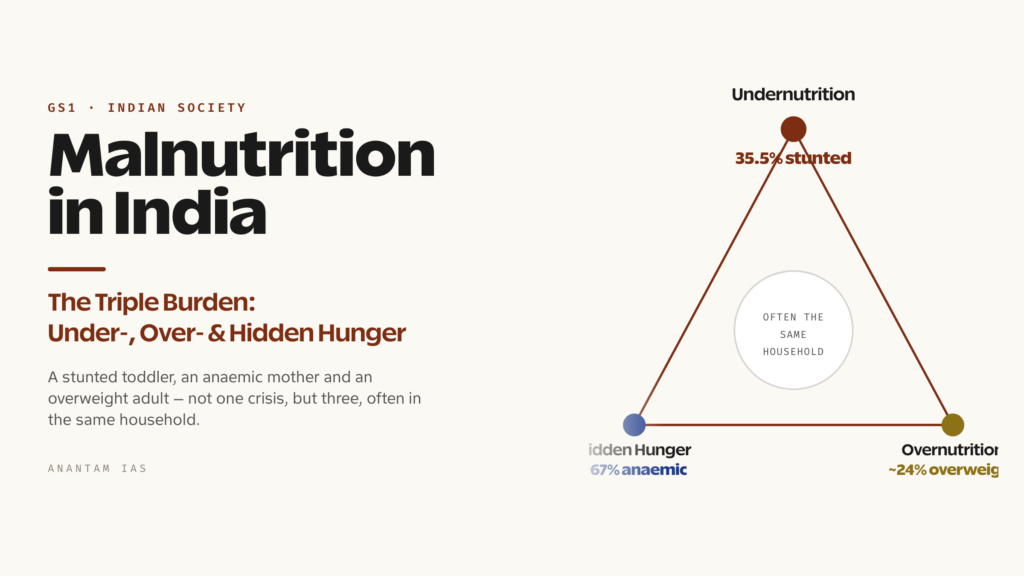
A child can be hungry and overweight at the same time, and in India that’s no longer a paradox. In the same village, sometimes in the same home, you’ll find a stunted toddler, an anaemic mother, and an adult sliding into obesity on a diet of cheap, energy-dense food. That overlap is what makes malnutrition in India so hard to fix: it isn’t one problem you can solve with more calories. It’s three problems pulling in different directions.
This is the “triple burden” — undernutrition, micronutrient deficiency, and rising overnutrition. And the stakes are enormous. India is home to roughly a third of the world’s stunted children, and the World Bank has long estimated that child under-nutrition costs the country 2 to 3 per cent of its GDP every year in lost productivity, illness and avoidable deaths. So this is not a welfare footnote. It’s a drag on the whole human-capital story India is trying to write.
What “Malnutrition” Actually Means
Start with the word, because it trips up most candidates. Malnutrition does not mean “not enough food.” The World Health Organization defines it as any deficiency, excess or imbalance in a person’s intake of energy and nutrients. That definition deliberately stretches in two opposite directions — too little and too much — and that’s why India can run both crises at once.
Break it into three forms and the picture gets sharp. The first is undernutrition, which the data tracks through three anthropometric measures: stunting (low height-for-age, the marker of chronic, long-run deprivation), wasting (low weight-for-height, the marker of acute, recent food or illness shock), and underweight (low weight-for-age, which catches both). Stunting is the one to worry about most, because by the time a child is stunted, much of the damage to the brain and body is already locked in.
The second form is micronutrient deficiency, often called “hidden hunger” — and the name is the point. A person can eat enough to feel full, even gain weight, and still be starved of the iron, iodine, vitamin A, zinc, folate or vitamin B12 the body needs. There’s no swollen belly to photograph, so it slips past both families and surveys. Iron-deficiency anaemia is the giant here, sapping energy, learning and safe childbirth across the population.
The third form is overnutrition — overweight, obesity, and the diet-related non-communicable diseases that follow, like type-2 diabetes and hypertension. For decades this was treated as a rich-country problem. It isn’t anymore. As cheap edible oil, sugar and ultra-processed snacks reach every corner of the market, overnutrition is rising fastest among exactly the groups still fighting undernutrition. That’s the trap India is now caught in.
The Triple Burden in Numbers
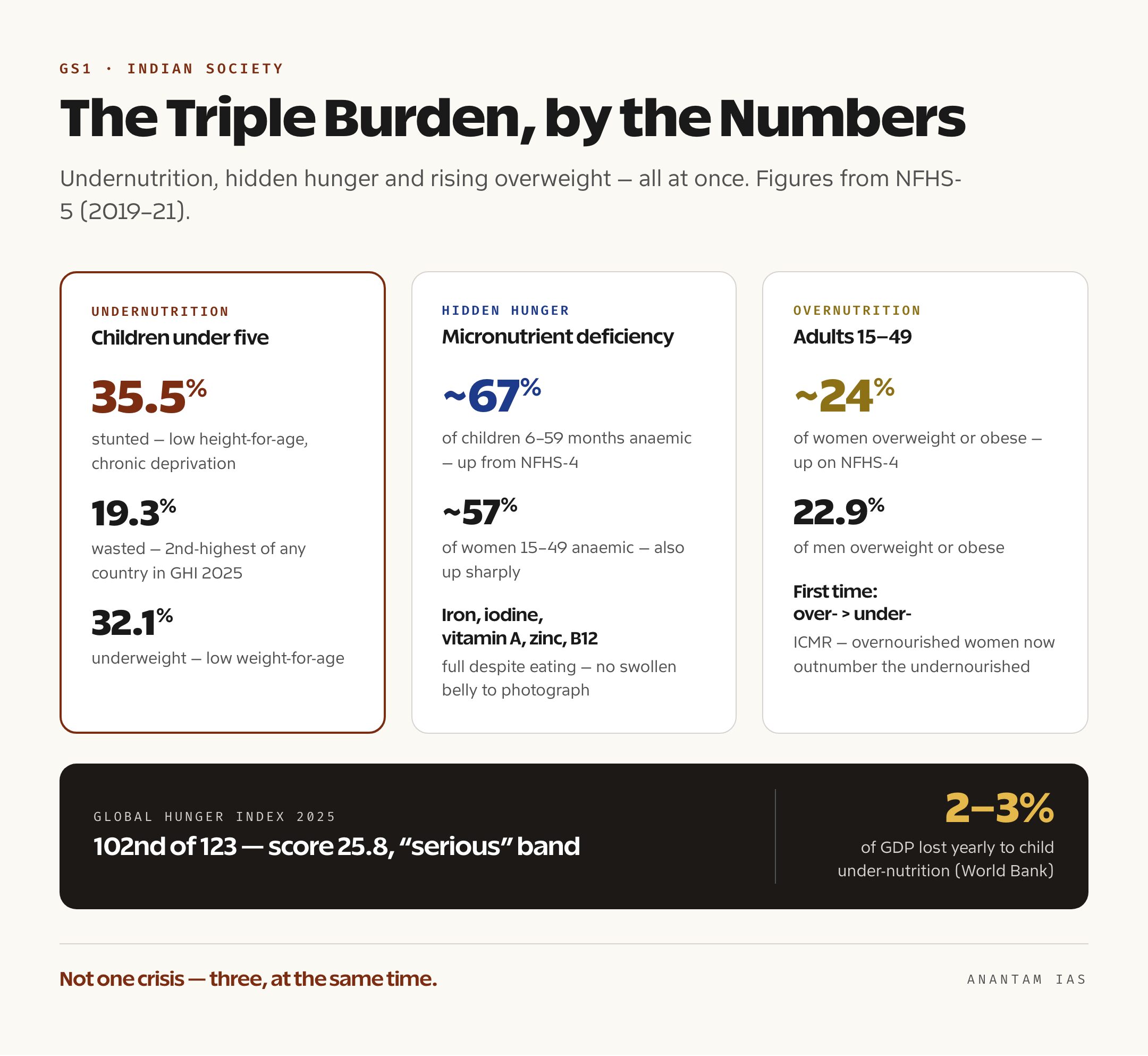
Here’s the picture in current data. The latest National Family Health Survey, NFHS-5 (2019-21), found that among children under five, 35.5 per cent were stunted, 19.3 per cent wasted and 32.1 per cent underweight. To put that wasting figure in perspective, the 2025 Global Hunger Index flagged India’s child wasting rate as the second-highest of any country it assessed. Stunting has fallen slowly across surveys, but wasting has barely budged — and on several indicators a number of states showed no improvement or even slipped backwards between NFHS-4 and NFHS-5.
The hidden-hunger numbers are worse, and they’re the ones that should set off alarms. NFHS-5 found anaemia in about 67 per cent of children aged 6-59 months and roughly 57 per cent of women aged 15-49 — both up sharply from the previous survey. So even as India’s grain stocks overflow and the economy grows, the share of anaemic children and women went the wrong way. Anaemia in a pregnant woman raises the risk of maternal death and a low-birth-weight baby, which is how the deprivation hands itself down to the next generation before that child has drawn breath.
And now the new face of the problem. NFHS-5 recorded about 24 per cent of women and 22.9 per cent of men aged 15-49 as overweight or obese — both well up on NFHS-4. The Indian Council of Medical Research has noted that, for the first time, overnourished women now outnumber undernourished women in that age group. So India hasn’t replaced undernutrition with obesity; it’s running both at once, which is the textbook definition of the triple burden.
Two things hide inside those averages, and both matter for an answer. The first is geography and group: malnutrition is not spread evenly but concentrated among the poorest, in tribal and Scheduled-Caste households, and in a cluster of states — Bihar, Uttar Pradesh, Jharkhand and Madhya Pradesh among them — where stunting runs well above the national figure. The second is that the obesity surge is no longer urban-only; NFHS data show overweight rising steeply in rural India too, as cheap edible oil and packaged snacks reach village markets. So a national headline of “improving slowly” can mask districts that are getting worse on undernutrition and worse on obesity at the same time.
The international scorecard captures the strain. In the 2025 Global Hunger Index, India ranked 102nd of 123 countries with a score of 25.8, placing it in the “serious” band; the 2024 edition had it at 105th of 127. The government rejects the GHI as a flawed measure of hunger — its main objection is that three of the index’s four indicators are child-specific, that the undernourishment estimate rests on a small opinion poll, and that the Poshan Tracker‘s measured child-wasting figure of under 7.2 per cent is roughly a third of the 18.7 per cent the index uses. Whether you accept the rank or the rebuttal, the underlying truth holds: too many Indian children are still wasted, stunted and anaemic. The argument is about the thermometer, not the fever. And the cost is real money: beyond the World Bank’s 2-3 per cent of GDP, micronutrient deficiencies alone are estimated to drain billions of dollars a year through lost cognition, schooling and adult earnings.
Why Malnutrition Persists
The single most important idea in this whole topic is the first 1,000 days — the window from conception to a child’s second birthday. This is when the brain and body grow fastest, and damage done here is largely irreversible. A child stunted by age two doesn’t catch up later; the lost height, cognition and immunity stay lost. So the timing of deprivation matters as much as its depth, and a country can be feeding its population reasonably well overall while still failing the only window that counts.
But nutrition is rarely just about food on the plate, which is why decades of subsidised grain haven’t ended the crisis. Poor sanitation is a hidden driver: a child living amid open defecation suffers repeated gut infections that block the absorption of whatever food they do eat, so calories go in and nourishment doesn’t. Unsafe water, low immunisation and weak primary health care work the same way, turning every meal into a leaky bucket.
Then there’s the mother. Maternal undernutrition, anaemia, low education and early marriage form a tight knot — a teenage, anaemic, underweight mother is far more likely to deliver a low-birth-weight baby who starts life already behind. This is the intergenerational cycle, and it’s why nutrition policy that ignores adolescent girls and pregnant women is treating symptoms, not the cause.
Poverty and dietary quality close the loop. The poor can afford calories but not balance — cereals fill the stomach while protein, fruit, vegetables and animal-source foods stay out of reach, which is precisely the recipe for stunting plus hidden hunger. And as ultra-processed food gets cheaper than fresh, the same low-income households start adding obesity on top. Food inflation tightens the squeeze further: the Reserve Bank’s monetary-policy commentary has repeatedly flagged high food prices as a threat to the diets of the poor, because when vegetables and pulses spike, it’s the protein and the greens that get cut first, not the cereal.
Delivery gaps then turn a hard problem into an unfair one. The public distribution system leaks; migrants who lack local documents fall outside welfare cover even as they’re most exposed; and Anganwadi quality varies wildly from a model centre in one block to an empty room in the next. Audits have flagged under-utilised nutrition budgets and unspent funds even as the need stayed acute, which means the constraint is often not money but the machinery to deliver it. So the schemes designed to catch the most vulnerable child too often miss the very child they were built for.
India’s Policy Response
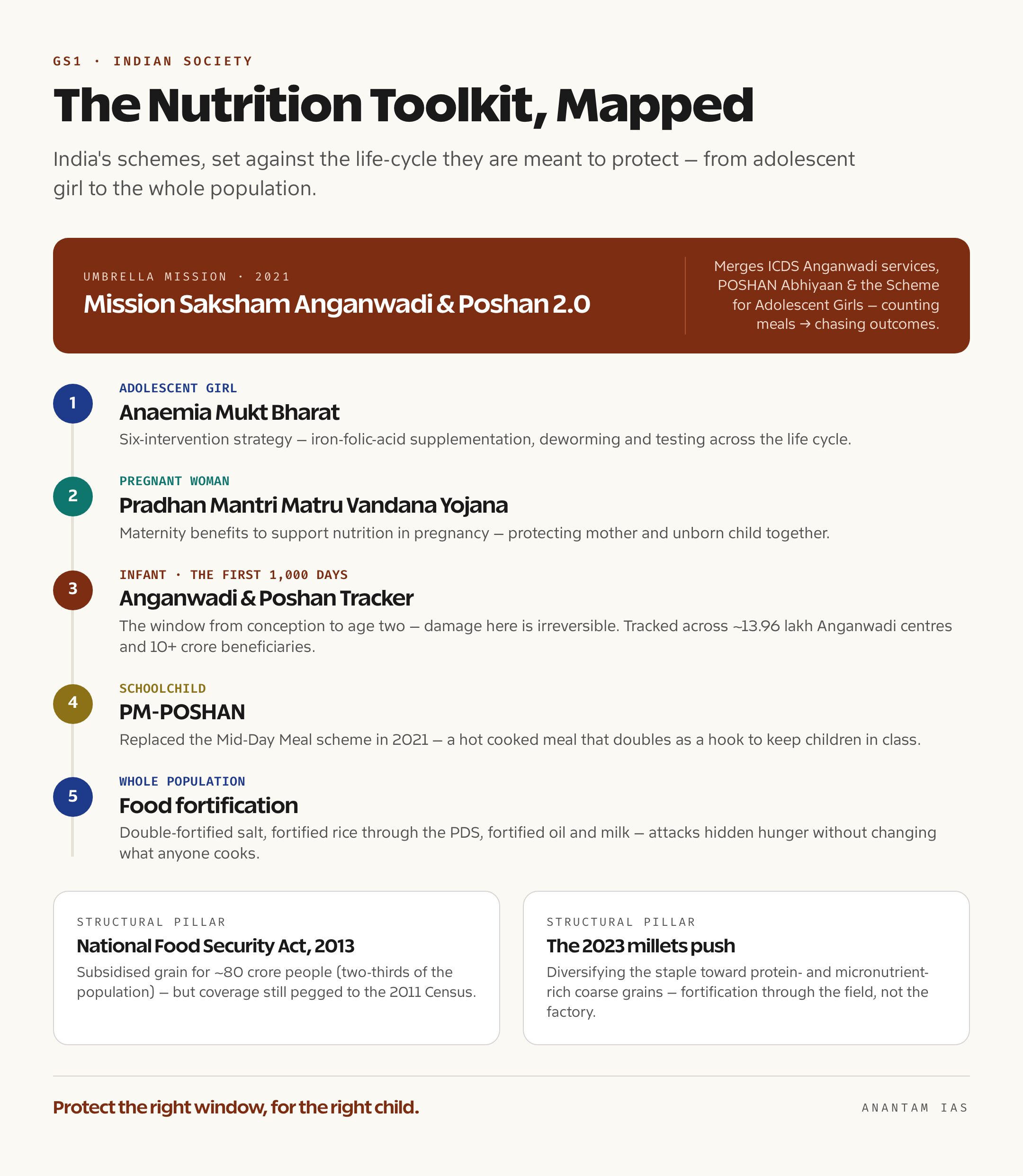
India’s nutrition architecture has been consolidated rather than expanded, and the headline is Mission Saksham Anganwadi and Poshan 2.0 — usually shortened to Mission Poshan 2.0. Launched in 2021, it merges the old Anganwadi (ICDS) services, POSHAN Abhiyaan and the Scheme for Adolescent Girls into a single integrated nutrition mission. The shift in emphasis matters for an answer: Poshan 2.0 reframes the goal around nutrition outcomes — maternal nutrition, infant and young-child feeding, and the treatment of severe and moderate acute malnutrition — and adds wellness through AYUSH, rather than just counting meals served.
The delivery engine underneath it is the Poshan Tracker, a real-time digital platform that, by the government’s account, now covers roughly 13.96 lakh Anganwadi centres and more than 10 crore beneficiaries. To plug leakages, facial-recognition verification for take-home rations was made mandatory from July 2025. This data layer is also the government’s evidence base in the Global Hunger Index dispute — the same wasting numbers it uses to monitor children are the ones it cites to reject the index.
Alongside it sits a life-cycle of overlapping schemes worth knowing by name. PM-POSHAN, which replaced the Mid-Day Meal scheme in 2021, provides a hot cooked meal to schoolchildren — nutrition used as a hook to keep children in class. Anaemia Mukt Bharat runs a six-intervention strategy of iron-folic-acid supplementation, deworming and testing across the life cycle. The Pradhan Mantri Matru Vandana Yojana pays maternity benefits to support nutrition in pregnancy. And large-scale food fortification — iron-and-iodine double-fortified salt, fortified rice through the public distribution system, fortified edible oil and milk — attacks hidden hunger at the population level without asking anyone to change what they cook.
Two structural pillars underpin all of this. The National Food Security Act, 2013 entitles around two-thirds of the population — close to 80 crore people — to subsidised grain, though its coverage is still pegged to the 2011 Census and so misses a decade of population growth. And the 2023 millets push, building on the International Year of Millets, is a quieter bet that diversifying the staple itself — toward protein-and-micronutrient-rich coarse grains — can do what fortification does, but through the field rather than the factory.
The Way Forward
The first move is to defend the first 1,000 days as fiercely as the data demands. That means concentrating money and the best Anganwadi workers on pregnant women, infants and adolescent girls, because a rupee spent in that window returns far more than the same rupee spent later. Maternal nutrition and adolescent-girl health aren’t a side programme; they’re the lever that breaks the intergenerational cycle.
The second is to treat nutrition as more than food. Stunting won’t fall without parallel gains in sanitation, safe water, immunisation and primary health care, so convergence across ministries — women and child development, health, drinking water, rural development — has to move from a slide in a presentation to a habit on the ground. The states that have cut stunting fastest are the ones that ran these together, not in silos.
The third is to make diets diverse, not just full. Fortification and millets should sit beside a real push on protein, pulses, eggs, fruit and vegetables in supplementary nutrition and school meals, so the system tackles hidden hunger and quietly heads off the obesity wave instead of feeding it. And as overnutrition climbs, India will need front-of-pack labelling and curbs on junk-food marketing to children — the demand side of malnutrition that no Anganwadi can fix.
Finally, fix the plumbing. Use the Poshan Tracker not just to count beneficiaries but to find and follow the wasted child; portability so migrants don’t fall through the cracks; and an honest, transparent measurement system that ends the annual squabble over indices. A country that can argue this confidently about its own data can also afford to act on the worst of what that data shows. The goal isn’t to win the Global Hunger Index. It’s to make the next NFHS report something India can be proud of.
For Your Mains Answer
Malnutrition is a workhorse topic that spans the General Studies papers. It’s core to GS1 (population and society, the problems of vulnerable sections), central to GS2 (welfare schemes, the Food Security Act, health), relevant to GS3 (food security, agriculture, the economics of human capital), and usable in GS4 as a question of distributive justice and the ethics of feeding a nation’s children. Frame it as a development-and-equity issue, not a charity issue.
How to Build the Answer
Lead with the triple-burden frame in one crisp line, then anchor it in NFHS-5 numbers, then explain why it persists, then evaluate the response, then close on the way forward. Don’t just list schemes — show that you understand the logic shift from POSHAN Abhiyaan to Mission Poshan 2.0 (counting meals to chasing outcomes) and the centrality of the first 1,000 days. That analytical spine is what separates a top answer from a data dump.
Common Mistakes to Avoid
Don’t equate malnutrition with hunger or with too few calories — that misses overnutrition and hidden hunger entirely. Don’t recite the Global Hunger Index rank without flagging the government’s methodological objections; examiners reward balance. Don’t ignore the obesity side just because it feels counter-intuitive. And don’t list schemes without mapping them to who they reach, which is where most answers go flat.
A Compact Answer Spine
Triple burden (undernutrition + hidden hunger + overnutrition) → the data (NFHS-5: stunting 35.5%, wasting 19.3%, child anaemia ~67%, women’s anaemia ~57%, adult overweight ~24%) → why it persists (first-1,000-days, sanitation, maternal health, diet quality, delivery gaps) → response (Mission Poshan 2.0, Poshan Tracker, PM-POSHAN, Anaemia Mukt Bharat, fortification, NFSA) → way forward (protect the window, convergence beyond food, dietary diversity, fix delivery and measurement).
Diagram or Flowchart Idea
Draw a simple triangle labelled “the triple burden,” each vertex naming one form with its headline NFHS-5 number, and a circle in the middle reading “often the same household.” Or sketch a life-cycle arrow — adolescent girl → pregnant woman → infant (first 1,000 days) → child → adult — and tag each stage with the scheme meant to protect it. Either earns marks fast and shows you grasp the structure, not just the facts.
A Balanced-Conclusion Line
“India’s challenge is no longer producing enough food but delivering the right nutrition in the right window to the right child — a shift from food security to nutrition security that the schemes have begun, but not yet finished.”
How to Use Data Without Cramming
Memorise four anchors and stop: stunting 35.5 per cent, child anaemia about two-thirds, the 2-3 per cent of GDP economic cost, and the first-1,000-days window. Round confidently (“roughly two in three children are anaemic”) rather than reciting decimals you might misremember. One well-placed NFHS-5 figure and one World Bank cost figure do more work than a table of numbers an examiner can’t check.
FAQ
What is the triple burden of malnutrition in India? It’s the coexistence of three forms of malnutrition — undernutrition (stunting, wasting, underweight), micronutrient deficiency or “hidden hunger” (iron, iodine, vitamin A, zinc, B12), and rising overnutrition (overweight, obesity and diet-related diseases). In India all three often appear in the same community, and sometimes the same household, which is why simply supplying more calories doesn’t solve it.
What do the latest NFHS-5 figures show? NFHS-5 (2019-21) found 35.5 per cent of under-fives stunted, 19.3 per cent wasted and 32.1 per cent underweight. Anaemia affected about 67 per cent of children aged 6-59 months and roughly 57 per cent of women aged 15-49 — both up from the previous survey. At the same time, about 24 per cent of women and 22.9 per cent of men were overweight or obese, showing overnutrition rising alongside undernutrition.
Why does India dispute the Global Hunger Index? India ranked 102nd of 123 countries in the 2025 Global Hunger Index, in the “serious” band, and the government rejects the index as a flawed measure. Its main objections are that three of the four indicators are child-specific, that the undernourishment estimate rests on a small opinion poll, and that the Poshan Tracker’s measured child-wasting rate of under 7.2 per cent is far below the 18.7 per cent the index uses.
What is Mission Poshan 2.0 and how is it different? Mission Saksham Anganwadi and Poshan 2.0, launched in 2021, merges the old Anganwadi (ICDS) services, POSHAN Abhiyaan and the Scheme for Adolescent Girls into one integrated nutrition mission. Its key shift is from counting services delivered to chasing nutrition outcomes — maternal nutrition, infant feeding and the treatment of severe and moderate acute malnutrition — tracked in real time through the Poshan Tracker platform.
Practice Questions
Prelims MCQs
- With reference to forms of malnutrition, “hidden hunger” most accurately refers to:
(a) seasonal food shortage in lean agricultural months
(b) deficiency of micronutrients such as iron, iodine and vitamin A despite adequate calorie intake
(c) under-reporting of hunger in official surveys
(d) chronic energy deficiency among adults.
Answer: (b) — Hidden hunger is micronutrient deficiency that persists even when a person eats enough calories. - As per NFHS-5 (2019-21), which anthropometric indicator measures chronic, long-term undernutrition among children?
(a) Wasting (low weight-for-height)
(b) Underweight (low weight-for-age)
(c) Stunting (low height-for-age)
(d) Body Mass Index.
Answer: (c) — Stunting (low height-for-age) reflects long-term, chronic deprivation, whereas wasting reflects acute, recent shocks. - Consider the following about Mission Saksham Anganwadi and Poshan 2.0:
1. It merged Anganwadi services, POSHAN Abhiyaan and the Scheme for Adolescent Girls.
2. It is monitored through the Poshan Tracker.
3. It replaced the Mid-Day Meal scheme in schools. Which are correct?
(a) 1 and 2 only
(b) 2 and 3 only
(c) 1 and 3 only
(d) 1, 2 and 3.
Answer: (a) — Statements 1 and 2 are correct; the Mid-Day Meal scheme was replaced by PM-POSHAN, a separate scheme, not by Poshan 2.0. - The Global Hunger Index is jointly published by:
(a) the World Bank and the FAO
(b) Concern Worldwide and Welthungerhilfe
(c) UNICEF and the WHO
(d) NITI Aayog and the UNDP.
Answer: (b) — The GHI is published by Concern Worldwide (Ireland) and Welthungerhilfe (Germany); India ranked 102nd of 123 in 2025. - The “first 1,000 days,” a key concept in nutrition policy, refers to the period from:
(a) birth to the third birthday
(b) conception to the second birthday
(c) the start of complementary feeding to age five
(d) the last trimester of pregnancy to age one.
Answer: (b) — The first 1,000 days span conception to a child’s second birthday, the window when most stunting damage becomes irreversible.
Mains Practice Questions
- “India faces not a single nutrition crisis but a triple burden.” Explain the triple burden of malnutrition and analyse why all three forms can coexist in the same household. (15 marks, 250 words)
- Despite decades of public investment and overflowing grain stocks, child malnutrition in India remains stubbornly high. Critically examine the causes and evaluate the effectiveness of Mission Poshan 2.0. (15 marks, 250 words)
- “The argument over the Global Hunger Index is about the thermometer, not the fever.” Discuss the controversy surrounding India’s GHI ranking and the government’s objections, and assess what it tells us about measuring hunger. (15 marks, 250 words)
- Malnutrition is a determinant as well as a consequence of poverty and gender inequality. Discuss the intergenerational cycle of malnutrition and the centrality of the first 1,000 days to breaking it. (10 marks, 150 words)
- India is increasingly battling undernutrition and obesity at the same time. Examine the drivers of rising overnutrition and suggest a multi-sectoral strategy to address the full spectrum of malnutrition. (15 marks, 250 words)
Tell Google you want more of this.
Add Anantam IAS as a preferred sourceOne tap, and this site shows up more often in your own Top Stories, AI Overviews and AI Mode. Remove it any time.