Daily Digest
UPSC · Civil Services Examination
Current Affairs · Monday, 5 October 2026
Current affairs curated and edited by Anantam IAS faculty — pulled from The Hindu, PIB, IDSA, Foreign Affairs and the ministries. Read, annotate, revise.
Old Rajinder Nagar · Delhi 110005 · anantamias.com
3D Concrete Printing: What a Rural Housing Pilot Must Prove
Why in News?
The Ministry of Rural Development reported that the foundation stone for a 177-house 3D concrete printing pilot in Andhra Pradesh was laid on October 4, 2026.
- The pilot covers Burripalem and Obulnayudupalem; laying its foundation does not mean the houses have been completed or occupied.
- The announcement anticipates faster construction and lower costs, but provides no measured completed-project comparison establishing these benefits.
- Claims of greater durability remain expectations requiring technical validation and experience over time, rather than results demonstrated by the launch.
- Rural housing needs habitable homes, including safe structures and working services; faster wall construction addresses only part of that requirement.
- A public pilot can test whether a promising manufacturing method works reliably under actual site and maintenance conditions.
UPSC Relevance
Prelims Relevance
- Additive manufacturing: building an object through successive material deposition.
- Extrusion: forcing a suitable cementitious mixture through a nozzle.
- Buildability: fresh layers retaining shape while supporting further deposition.
- Layer interface: the contact zone between successive printed layers.
- Hydration: cement reactions with water that contribute to hardening.
Mains Relevance
GS Paper 3
- Technology adoption in construction and performance-based assessment.
- Productivity gains balanced against structural safety and maintenance.
GS Paper 2
- Public housing pilots, procurement accountability and beneficiary protection.
Essay
- Innovation becomes public value when demonstrated performance replaces promises.
Background and Context
How Layer Deposition Builds a Wall
Concrete printing changes how material is placed, while the finished building still needs an integrated design and construction process suited to its intended use.
- Extrusion-based printing uses a computer-controlled nozzle to deposit cementitious material along a planned path, repeating the operation in successive layers until the intended wall shape emerges from the deposited material.
- Printability combines two competing needs: the mixture must move through the delivery system, yet remain sufficiently stable after placement. A material that flows easily does not automatically form a reliable wall.
- Buildability concerns fresh layers holding their shape as additional material is deposited above them. This makes the timing of deposition and the changing condition of the mixture part of construction quality.
- Hydration and flow behavior influence how quickly the material gains stiffness and how layers bond. The NIST research program examines these links between material properties, printing and structural performance.
- Printing a wall is different from delivering a complete house. Foundations, roof connections, openings and services must form a workable building system; the pilot announcement does not specify their detailed engineering solutions.

Why Interfaces and Testing Matter
A layered wall must perform as a structural element over time, making the joints between deposited layers central to evaluating the technology and its practical limits.
- Interlayer bonding connects successive deposits. NIST identifies layer interfaces as important to mechanical performance and durability, so a visually regular surface alone cannot establish that a printed element meets its intended performance.
- Directional behavior matters because the layered process can create different properties in different directions. Testing must represent the printed structure, rather than assuming that ordinary cast specimens capture all relevant behavior.
- Structural interfaces also include where the wall meets other building elements. Their adequacy depends on the actual design, loads and construction details; no universal reinforcement prescription follows from the term printed house.
- Representative testing should examine material and structural behavior. NIST’s long-term performance research investigates how tests and sampling can detect important interface variation without simply assuming conventional methods transfer unchanged.
- Durability concerns performance throughout service, including environmental exposure and deterioration. Finishing a wall quickly is a production result; demonstrating that it remains suitable for use requires a different body of evidence.
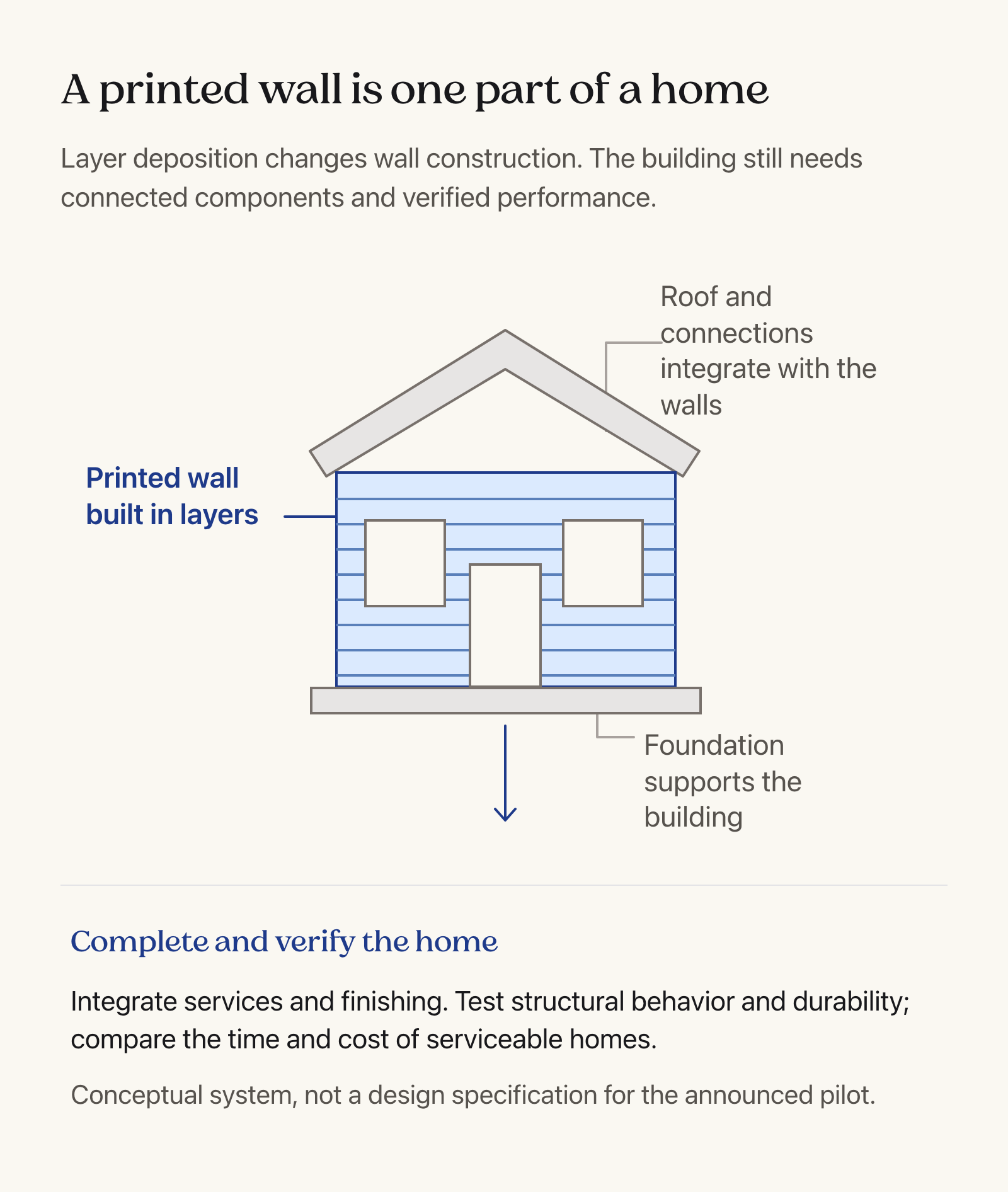
What the Rural Pilot Should Establish
The useful comparison is between completed, serviceable homes built under comparable conditions, rather than between machine printing time and the entire schedule of conventional construction.
- Total delivery time should cover preparation, printing, curing, roofing, services and finishing. Reporting only nozzle operating hours would leave essential work outside the comparison and exaggerate what a household actually receives.
- Whole-project cost should include equipment, material supply, trained operation, testing and maintenance. A lower wall-production expense would not by itself demonstrate that the completed home costs less to build or maintain.
- Site reliability should be assessed through documented interruptions, rejected work and repairs. These records would show whether the process can be repeated consistently beyond a carefully managed demonstration at a selected location.
- Worker capability should be evaluated through training and supervision requirements. Automation changes the tasks involved in construction; its effects on employment and safety need observation rather than an assumption that workers become unnecessary.
- Beneficiary experience should inform decisions about expansion through feedback on usability, comfort and repair access. Public reporting should distinguish the announced pilot, completed construction and verified performance instead of treating these stages as interchangeable.
Way Forward
Make Expansion Conditional on Evidence
- Publish comparable results for finished homes, including delivery time, full cost and the basis of technical acceptance.
- Require independent assessment appropriate to the actual design and site conditions, with clear responsibility for defects and repairs.
- Track occupant feedback and maintenance needs before scaling the approach across different locations and construction teams.
Conclusion
- 3D concrete printing offers a different way to manufacture building elements, but a launch announcement cannot prove cheaper, faster or longer-lasting housing. The rural pilot should make those claims testable through transparent evidence.
- For an answer on technology adoption, separate production capability from public-service outcomes: explain the printing mechanism, identify interfaces requiring validation, and judge success by complete homes that remain safe, usable and maintainable.
UPSC Practice Questions
Prelims MCQ 1
With reference to extrusion-based 3D concrete printing, consider the following statements:
- Material is deposited in successive layers.
- The bonding between layers can affect structural performance.
- Printing a wall automatically completes roofing and electrical services.
How many of the above statements are correct?
(a) Only one (b) Only two (c) All three (d) None
Answer: (b) Only two
Explanation:
The first two statements are correct. Layer deposition and interlayer bonding are central features, while a complete house also requires integrated construction and services.
Prelims MCQ 2
Which comparison best evaluates the affordability claim of a rural 3D-printed housing pilot?
(a) Nozzle operating time against all conventional construction time (b) The purchase price of the printing machine alone (c) Total costs of comparable completed homes, including testing and maintenance (d) The number of layers printed in an hour
Answer: (c) Total costs of comparable completed homes, including testing and maintenance
Explanation:
Affordability concerns the complete housing outcome. A partial cost or printing-speed measure cannot establish whether a finished home is more economical.
UPSC Mains Questions
- Explain the working principle of extrusion-based 3D concrete printing. Why do material properties and layer interfaces require attention before its wider use in housing?
- How should governments evaluate construction technology pilots in public housing? Discuss the evidence needed to balance innovation, affordability and beneficiary protection.
Sources: PIB, Ministry of Rural Development and NIST.
Frequently Asked Questions
Has the Andhra Pradesh pilot already delivered its houses?
No. The October 4 announcement reports the laying of a foundation stone for a 177-house pilot. It does not establish completed construction, occupation or independently verified performance of those homes.
What does buildability mean in concrete printing?
Buildability is the ability of freshly deposited material to retain its shape while supporting further layers. It concerns behavior during printing, which is different from the strength and durability of the hardened wall.
Why are layer interfaces important?
Successive deposits must bond adequately. Their interfaces can influence strength, cracking and deterioration, making representative testing important. An orderly printed appearance is insufficient evidence that the element will perform as intended.
Does 3D printing remove the need for other construction work?
No. Printing building elements is part of delivering a house. Foundations, roofing, services and connections still need appropriate design and execution; the exact arrangement depends on the selected construction system.
Are lower cost and longer lifespan proven for this pilot?
The announcement presents these as expected benefits. Establishing them requires comparable finished-project costs, suitable technical assessment and evidence about performance over time. Foundation laying alone cannot demonstrate either outcome.
Source: https://anantamias.com/current-affairs/3d-concrete-printing-rural-housing-pilot/
Dual-Use Research: India’s Institutional Governance Pilots
Why in News?
WHO reported on 29 September 2026 that Indian research institutions and laboratory networks were piloting its framework, training and BRIET to strengthen dual-use research governance, with piloting expected to conclude by end-2026.
- BRIET means Biorisk Implementation and Evaluation Tool; WHO launched it on 28 August, before the September implementation update.
- India’s reported activity consists of institutional-level pilots, not a newly enacted national law or a completed nationwide rollout.
- The pilots aim to strengthen risk-based decision-making and document lessons for future scale-up; evaluated Indian outcomes have not been established by the cited account.
- Beneficial research can generate knowledge or tools that others misuse; oversight must consider possible consequences alongside the original scientific purpose.
- Institutional responsibility connects researchers, leadership and other stakeholders so that identified governance gaps lead to assigned corrective actions.
UPSC Relevance
Prelims Relevance
- Dual-use research and dual-use research of concern
- BRIET as a voluntary structured self-assessment tool
- WHO as the tool’s developer
- Institutional pilots versus binding national regulation
- Biorisk encompassing accidents, inadvertent actions and deliberate misuse
Mains Relevance
GS Paper 3
- Responsible life-sciences innovation
- Institutional governance of emerging scientific risks
GS Paper 2
- Global guidance and domestic implementation capacity
Essay
- Scientific freedom and responsibility for foreseeable consequences
Background and Context
Why Beneficial Research Needs Oversight
Dual-use governance asks how useful scientific work could also cause harm, and what responsibilities follow from that possibility.
- Dual-use research begins with peaceful or beneficial purposes but may produce knowledge, information or technologies that could be intentionally misused. The concern attaches to possible application, not an automatic allegation against the researcher.
- Dual-use research of concern is a subset that could be easily misapplied with little or no modification. This narrower category helps distinguish particularly sensitive work from the broader possibility that scientific knowledge has multiple uses.
- Biorisk is broader than deliberate misuse: WHO includes accidents and inadvertent actions that could adversely affect people, animals, plants, agriculture or the environment. Governance must recognise these different sources of potential harm.
- Responsible oversight connects scientific benefit with foreseeable risk and institutional capacity. The practical governance question is who examines a concern, who decides on a proportionate response, and who checks whether that response remains appropriate.
- Physical laboratory safeguards alone do not answer every governance question. Responsible research also requires attention to decision-making, stakeholder roles and the possible use of resulting knowledge, even when laboratory operations follow established safety arrangements.
How BRIET Turns Assessment Into Action
The tool helps users organise an assessment and plan improvements; its recommendations still require people and institutions to act on them.
- WHO’s launch account describes BRIET as a voluntary, structured self-assessment and capacity-strengthening tool. Its role is to support governance improvement, rather than issue a compulsory legal licence for research.
- Stakeholder mapping identifies relevant actors and their responsibilities. Bringing these roles into one assessment can reveal where coordination is weak or a governance task lacks a clear owner, rather than assuming somebody else handles it.
- Gap assessment compares existing strengths and weaknesses across governance capacities. Users can identify priorities and receive tailored recommendations, but the usefulness of the resulting picture depends on the information and judgement entered into the assessment.
- Action planning converts identified gaps into improvements that fit local conditions. A sound institutional response should assign responsibility and review progress; simply recording a weakness does not demonstrate that the underlying problem has been resolved.
- Repeated assessment can help track change over time and refine priorities. It should support evidence-based decisions, while avoiding the inference that a completed questionnaire independently certifies that all relevant risks are under control.
What the Indian Pilots Establish
The verified development is ongoing institutional implementation; its scale, legal status and results should be stated with care.
- The September WHO update identifies research institutions and laboratory networks in India applying the framework, WHO Academy course and BRIET to strengthen dual-use governance and document lessons for possible future scale-up.
- Expected completion by the end of the year is a forward-looking pilot timeline. It is not evidence that the work has finished, that all institutions participate, or that an independently evaluated improvement has already occurred.
- Institutional implementation differs from binding national regulation. The cited account does not announce a new Indian legal requirement, name a nationwide licensing authority or establish that use of the WHO tool is compulsory.
- Cross-sector ownership matters because researchers cannot resolve every governance issue alone. Institutional leaders, funders, publishers and relevant authorities can influence how responsibilities are understood and how research concerns receive appropriate consideration.
- Scale-up should depend on documented lessons about feasibility, coordination and continuing capacity. Adapting a global framework to local institutions requires more than copying a checklist, especially when expertise and organisational responsibilities vary across settings.
Way Forward
Make Responsibilities Reviewable
- Assign an institutional owner to each priority governance gap and record what improvement would count as progress.
- Build multidisciplinary review capacity so scientific benefits and foreseeable risks receive informed, proportionate consideration.
- Publish appropriate pilot lessons on governance and coordination while protecting sensitive information; distinguish expected benefits from demonstrated results.
Conclusion
- Dual-use governance makes responsibility part of scientific practice: useful research needs institutions capable of recognising concerns, coordinating decisions and following through on proportionate improvements without treating all innovation as suspect.
- India’s ongoing pilots offer a setting to learn how WHO guidance works institutionally. The next evidence to seek is documented implementation experience, rather than assuming that a voluntary tool already constitutes national regulation or proven success.
UPSC Practice Questions
Prelims MCQ 1
With reference to BRIET, consider the following statements:
- It is a voluntary structured self-assessment tool developed by WHO.
- Its use automatically establishes compliance with a newly enacted Indian national law.
- It can help institutions identify governance gaps and prioritise actions.
How many of the above statements are correct?
(a) Only one (b) Only two (c) All three (d) None
Answer: (b) Only two
Explanation:
Statements 1 and 3 are correct. BRIET supports assessment and capacity strengthening. The cited WHO account does not establish a new Indian law or automatic legal compliance.
Prelims MCQ 2
Which statement best describes dual-use research?
(a) Research necessarily undertaken with an intention to cause harm (b) Research conducted only by military institutions (c) Beneficial research whose outputs could also be intentionally misused (d) Research that must always involve two countries
Answer: (c) Beneficial research whose outputs could also be intentionally misused
Explanation:
Dual-use research can have peaceful and beneficial purposes while generating knowledge, information or technologies that could be intentionally misused. It does not imply malicious intent by the original researcher.
UPSC Mains Questions
- Why does responsible life-sciences research require institutional governance beyond physical laboratory safety? Discuss with reference to dual-use research.
- Assess the opportunities and limitations of voluntary self-assessment tools in strengthening research governance. How should lessons from institutional pilots inform wider adoption?
Sources: WHO and WHO BRIET launch account.
Frequently Asked Questions
What is BRIET?
BRIET is WHO’s Biorisk Implementation and Evaluation Tool. It supports voluntary structured self-assessment, identification of governance gaps, tailored recommendations and action planning for countries and institutions seeking to strengthen responsible life-sciences research.
Was BRIET launched in September 2026?
No. WHO’s launch account is dated 28 August 2026. The September account reports implementation work, including ongoing institutional pilots in India; it should not be described as a second launch or a new Indian law.
What is happening in India?
WHO reports that research institutions and laboratory networks are applying its framework, training and BRIET to strengthen dual-use governance. Piloting is expected to conclude by end-2026; the account does not establish completed or evaluated success.
How does self-assessment differ from regulation?
Self-assessment helps an institution examine capacities and identify improvements. Regulation establishes applicable legal duties through competent authorities. Using a voluntary WHO tool does not itself create a new national legal requirement or certify compliance.
Source: https://anantamias.com/current-affairs/briet-dual-use-research-governance/
Dibrugarh-Dhaka Cargo: Connecting Inland Waterways Across Borders
Why in News?
An October 4 PIB announcement scheduled the Dibrugarh-Dhaka cargo voyage for flag-off from Bogibeel Terminal at 11 AM on October 5, carrying methanol through the Brahmaputra and Indo-Bangladesh Protocol Route.
- Assam Petro-Chemicals Limited produced the methanol consignment; the announced destination is Pangaon Port in Dhaka, Bangladesh.
- The announced route combines National Waterway-2 on the Brahmaputra with the Indo-Bangladesh Protocol Route.
- The ministry describes the planned sailing as Dibrugarh’s first international cargo voyage since Independence; its announcement does not establish departure or arrival.
- For Upper Assam, river connectivity can provide an additional freight option when waterways connect production areas with overseas buyers.
- The key policy question is whether navigation, terminal handling and border procedures can operate together reliably enough to support repeat shipments.
UPSC Relevance
Prelims Relevance
- NW-2: Brahmaputra inland waterway.
- Bogibeel: announced departure terminal in Dibrugarh, Assam.
- Pangaon: announced destination port in Dhaka, Bangladesh.
- PIWTT: Protocol on Inland Water Transit and Trade.
- Port of call: notified location for loading or unloading cargo under the protocol.
Mains Relevance
GS Paper 3
- Infrastructure reliability and multimodal freight connectivity in Northeast India.
- Evaluating logistics benefits through complete journeys rather than isolated transport segments.
GS Paper 2
- India-Bangladesh cooperation through agreed waterways, ports and operational procedures.
Essay
- Geography creates possibilities; dependable institutions turn them into economic connections.
Background and Context
The River Needs an Operable Channel
A river on the map becomes a freight route only when vessels can navigate it and transfer cargo safely at the intended terminals.
- National Waterway-2 follows the Brahmaputra between Sadiya and the Bangladesh border near Dhubri. Bogibeel links the proposed consignment to this river corridor, rather than to an ocean shipping lane.
- A fairway is the usable navigation channel within a river. Its relevant features include depth and width; the full visible river surface cannot automatically be treated as safe passage for a loaded vessel.
- Vessel draft describes how far the hull extends below the waterline. Available channel depth must accommodate that draft with clearance, so loading decisions depend on navigable conditions along the journey.
- An official NW-2 background account describes dredging, navigation aids and terminal facilities. These serve distinct operational needs; maintaining a navigable channel does not replace terminal handling or cross-border permissions.
- Terminals connect water transport with the land-based supply chain through loading, unloading and onward connections. A usable river channel alone cannot deliver freight from a factory to its final buyer.

The Protocol Connects Two National Systems
Cross-border movement needs an agreed operating framework as well as physical connectivity; a navigable river does not itself grant unrestricted commercial access.
- The Protocol on Inland Water Transit and Trade allows India and Bangladesh to use each other’s waterways for cargo movement, subject to their respective laws and regulations.
- Designated routes and notified ports of call define where participating inland vessels may operate and handle cargo. The arrangement is a regulated network, rather than permission to use every river landing.
- Transit cargo passes through another country to continue toward its destination; export cargo is supplied to a buyer abroad. The announced Dhaka-bound methanol shipment illustrates the trade function of the waterway connection.
- Border procedures remain part of the journey because the protocol operates within national legal systems. Route access does not remove documentation, customs compliance or the need to coordinate arrival and cargo handling.
- Operational coordination must connect departure, navigation and destination handling. IWAI’s logistics responsibilities include agreements and operating procedures, showing why dependable river services require administrative coordination alongside physical infrastructure.
A Voyage Is Evidence to Evaluate
The announcement identifies a proposed shipment; sustained freight performance must be assessed from actual operations rather than assumed from the flag-off plan.
- Methanol is the cargo in this announcement. It does not establish that the vessel runs on methanol, or that the shipment qualifies as green methanol produced through a low-emission process.
- Door-to-door cost includes movement to the terminal, handling, river transport and delivery after unloading. Comparing a river freight charge with a complete road journey would leave out parts of the logistics chain.
- Predictability matters alongside price: buyers need delivery schedules they can plan around. A commercially useful assessment should examine waiting time, handling delays and repeat service availability, not merely whether one vessel can sail.
- Environmental benefits require evidence about the vessel, its load and the full transport chain. The October 4 release does not provide measured emissions or cost savings for this proposed consignment.
- Departure, arrival and regular service are different milestones. The announced flag-off should not be reported as a completed voyage, and even a successful delivery would not alone demonstrate year-round commercial reliability.
Way Forward
Measure the Complete Freight Chain
- Publish actual journey and terminal waiting times so shippers can assess reliability across the complete route.
- Coordinate navigation information, border documentation and unloading readiness before dispatch to reduce avoidable interruptions.
- Compare complete transport costs and emissions using observed operations before claiming a durable advantage.
Conclusion
- The Dibrugarh-Dhaka proposal shows that inland connectivity combines a navigable channel, usable terminals and workable bilateral rules. Weakness in any component can limit the value of the others.
- For infrastructure answers, distinguish announced connectivity from dependable logistics. Explain the operating chain first, then assess actual delivery, repeat demand and measured costs before treating a ceremonial launch as an established service.
UPSC Practice Questions
Prelims MCQ 1
With reference to the announced Dibrugarh-Dhaka cargo voyage, consider the following statements:
- National Waterway-2 forms part of the announced route.
- Methanol is identified as the cargo being transported.
- The announcement establishes that the vessel is powered by green methanol.
How many of the above statements are correct?
(a) Only one (b) Only two (c) All three (d) None
Answer: (b) Only two
Explanation:
The announcement names NW-2 and a methanol consignment. It neither identifies methanol as vessel fuel nor establishes green-methanol production.
Prelims MCQ 2
Which description best explains the role of notified ports of call under the Indo-Bangladesh inland waterway protocol?
(a) They eliminate customs requirements for every consignment. (b) They identify locations where participating vessels may load and unload cargo. (c) They guarantee the same navigable depth throughout both countries. (d) They allow unrestricted navigation on all rivers in both countries.
Answer: (b) They identify locations where participating vessels may load and unload cargo.
Explanation:
IWAI states that inland vessels use designated protocol routes and notified ports of call for loading and unloading, subject to the respective national laws and regulations.
UPSC Mains Questions
- Explain how navigable channels, terminals and bilateral operating rules jointly determine the viability of cross-border inland water transport.
- A successful inaugural cargo voyage does not by itself establish a dependable logistics corridor. Discuss the evidence needed to evaluate this proposition.
Sources: PIB, Ministry of Ports, Shipping and Waterways and Inland Waterways Authority of India.
Frequently Asked Questions
What was announced for the Dibrugarh-Dhaka cargo voyage?
PIB scheduled an October 5 flag-off from Bogibeel Terminal for a methanol consignment bound for Pangaon Port in Dhaka. The October 4 announcement does not confirm departure or arrival.
Does this voyage involve a methanol-powered vessel?
The announcement identifies methanol as cargo produced by Assam Petro-Chemicals Limited. It does not identify the vessel’s fuel or establish that the cargo was produced as green methanol.
What does the Indo-Bangladesh Protocol permit?
It allows cargo movement using each other’s waterways under the two countries’ laws and regulations. Participating inland vessels operate on designated routes and use notified ports of call for handling cargo.
Why are terminals as important as navigable channels?
A channel permits vessel movement, while terminals connect that movement to loading, unloading and land transport. Reliable freight service needs both, alongside functioning border procedures and coordination with the destination.
Source: https://anantamias.com/current-affairs/dibrugarh-dhaka-waterway-protocol-cargo/
Life-Course Immunization: Prioritising Adults at Clinical Risk
Why in News?
A WHO Alliance account published on 2 October explains how Goa designed its life-course immunization policy, adopted on 23 September, around adult clinical risk and health-system capacity.
- The initial rollout includes influenza, pneumococcal and hepatitis B vaccines for eligible adults.
- The stated groups include people with chronic diseases, immunocompromised patients and healthcare workers.
- Tetanus–diphtheria was also identified as a short-term priority, but is outside the initial three-vaccine rollout.
- Prevention beyond childhood requires deciding whom existing health services can identify, reach and follow up.
- Policy adoption establishes direction; actual coverage, real-world effectiveness and delivery performance still require measurement.
UPSC Relevance
Prelims Relevance
- Life-course immunization extends vaccine protection beyond childhood.
- Goa’s initial approach prioritises clinical risk rather than universal vaccination by age alone.
- Influenza, pneumococcal and hepatitis B vaccines form the initial rollout.
- Tetanus–diphtheria is a separate short-term priority.
- Embedded research brings researchers into ongoing policy decisions.
Mains Relevance
GS Paper 2
- Evidence-informed prioritisation within constrained public-health resources.
- Integrating adult preventive services into existing healthcare delivery.
Essay
- Prevention as a continuing public responsibility across the life course.
Background and Context
Who Should Receive Priority?
Life-course immunization treats prevention as a continuing task, while risk-based prioritisation determines where a programme begins when resources cannot cover every potential beneficiary immediately.
- India’s Universal Immunization Programme has historically focused on children and pregnant women. Goa’s policy adds an adult vaccination focus through routine healthcare, creating a distinct delivery question beyond existing childhood services.
- According to the WHO Alliance account, clinical risk guided the initial population choice. Age alone did not become the basis for universally offering vaccination to every adult within an age category.
- Eligibility and vulnerability are connected but different. The account names broad risk groups; it does not supply a complete individual eligibility schedule, age cutoffs or instructions for choosing a particular vaccine.
- A population with greater clinical risk may deserve earlier protection when resources are finite. This is a public-policy allocation principle; the note does not establish which vaccine an individual patient should receive.
- Risk-based prioritisation needs a workable identification process. For policy assessment, ask how eligible adults will be recognised through existing services and whether the intended groups actually gain access when implementation begins.
How Were Vaccines Selected?
The selection process combined evidence about disease and vaccines with the practical ability to deliver a service; scientific promise alone did not settle programme design.
- Disease burden identifies the health problem that vaccination seeks to reduce. Goa’s consultation considered this alongside vaccine effectiveness and safety, rather than choosing vaccines merely because products were available for purchase.
- Cost-effectiveness connects expected health benefit with the resources needed to obtain it. The consultation also considered economic factors and feasibility, making prioritisation broader than a simple comparison of vaccine purchase prices.
- Procurement and cold-chain capacity entered the policy discussion alongside clinical evidence. These considerations matter because selecting a vaccine on paper does not establish that existing services can reliably supply and deliver it.
- The exercise identified four short-term priorities, while operational guidelines placed only influenza, pneumococcal and hepatitis B in the initial rollout. Do not treat a prioritised candidate as proof of immediate programme inclusion.
- Embedded research meant researchers worked alongside policymakers and clinicians while choices were still being made. Its contribution was connecting evidence to live decisions about populations, vaccine selection and delivery through existing services.

What Must Implementation Demonstrate?
Adoption is the beginning of a policy’s test: delivery evidence must show whether the intended protection reaches eligible people under routine health-system conditions.
- Integration into existing services is the stated delivery direction. Assessment should examine whether adult vaccination becomes a usable part of routine care, rather than assuming a policy document itself creates reliable access.
- Coverage measures programme reach, but an overall figure can conceal whether priority groups are being served. Goa’s account says vaccination coverage and programme performance will be tracked as implementation proceeds and develops.
- Operational challenges should feed back into programme design. Problems encountered in procurement, cold-chain capacity or service integration can inform adjustments; the policy account describes learning over time rather than a completed implementation evaluation.
- Real-world effectiveness and post-introduction impact are evaluation needs highlighted in the account. Announcing eligible groups or recording vaccinations cannot, by itself, establish the size of a programme’s health benefit in routine practice.
- Wider adoption requires each state to consider its own context and policy priorities. Goa offers an example of evidence-informed design, but the account does not establish a nationally funded universal adult vaccination programme.
Way Forward
Turn Priority Setting Into Accountable Delivery
- Publish clear programme eligibility and delivery arrangements so broad risk-group labels translate into consistent access.
- Track coverage by intended risk group alongside supply and delivery difficulties, then use those findings to revise implementation.
- Evaluate effectiveness and post-introduction impact before presenting the approach as proven or recommending wider replication.
Conclusion
- Life-course immunization broadens prevention beyond childhood, while Goa’s initial risk-based approach asks who needs earlier protection and what the health system can deliver with available resources.
- For an answer on evidence-informed health policy, connect population selection, vaccine prioritisation and delivery capacity. Keep adoption, service coverage and demonstrated health impact separate when assessing whether a programme has succeeded.
UPSC Practice Questions
Prelims MCQ 1
With reference to Goa’s life-course immunization policy, consider the following statements:
- Its initial approach prioritises clinical risk rather than universal vaccination based on age alone.
- Influenza, pneumococcal and hepatitis B vaccines are included in the initial rollout.
- Tetanus–diphtheria was identified as a short-term priority but excluded from the initial three-vaccine rollout.
How many of the above statements are correct?
(a) Only one (b) Only two (c) All three (d) None
Answer: (c) All three
Explanation:
The WHO Alliance account confirms all three distinctions: risk-based population selection, three initial vaccines and tetanus–diphtheria as an additional short-term priority.
Prelims MCQ 2
Which best describes embedded health policy and systems research?
(a) Research conducted only after a programme has ended (b) Researchers working alongside decision-makers while policy choices are being developed (c) Replacing clinical assessment with vaccine procurement prices (d) Assuming that adoption establishes programme effectiveness
Answer: (b) Researchers working alongside decision-makers while policy choices are being developed
Explanation:
Embedded research connects evidence with live policy decisions. In Goa, it informed choices about priority groups, vaccines and delivery arrangements.
UPSC Mains Questions
- Explain how clinical risk, vaccine evidence and delivery feasibility can guide adult immunization policy. Illustrate with Goa’s approach.
- Why should policy adoption, vaccination coverage and real-world health impact be assessed separately when evaluating a public-health programme?
Source: WHO Alliance for Health Policy and Systems Research.
Frequently Asked Questions
What does life-course immunization mean?
It extends the focus of vaccination beyond childhood across later stages of life. Goa’s policy seeks to integrate adult vaccination into routine healthcare, initially prioritising eligible adults at greater clinical risk.
Which vaccines are in Goa’s initial rollout?
The WHO Alliance account names influenza, pneumococcal and hepatitis B vaccines. Tetanus–diphtheria was identified as another short-term priority, but was not among the first three included in the initial rollout.
Does Goa’s policy vaccinate every adult by age alone?
The account describes initial prioritisation by clinical risk rather than universal vaccination based on age alone. Broad groups include adults with chronic diseases, immunocompromised patients and healthcare workers; detailed individual eligibility is not provided.
When was the policy adopted?
Goa adopted the policy on 23 September 2026. The WHO Alliance published its account on 2 October, explaining the research and consultation behind population prioritisation, vaccine selection and integration into existing health services.
What evidence is still needed?
Implementation must generate evidence about coverage, programme performance and operational challenges. The account also highlights real-world effectiveness and post-introduction impact as necessary for assessing results and considering wider adoption.
Source: https://anantamias.com/current-affairs/goa-life-course-immunization-risk-prioritisation/
LEAP-2 Hosted Payloads: Testing Instruments in Orbit
Why in News?
The Hindu’s October 5 update reported that Dhruva Space’s LEAP-2, carrying a star tracker and TAPAS-1 thermal payload, was deployed on October 2 during SpaceX’s Transporter-18 mission.
- The mission uses Dhruva Space’s P-30 satellite platform to accommodate instruments developed by other organisations.
- The hosted instruments include a Sodern star tracker and SatLeo Labs’ TAPAS-1 thermal imager.
- Dhruva Space identifies TAPAS-1’s purpose as in-orbit validation of sensing, calibration and processing; launch does not establish that these tests have succeeded.
- Hosted missions can give instrument developers access to orbit without requiring each developer to build an entire spacecraft.
- The policy question is how flight opportunities become reliable measurements, rather than how many experimental payloads reach space.
UPSC Relevance
Prelims Relevance
- Satellite bus and hosted payload
- Attitude determination and attitude control
- Star tracker and star catalogue
- Long-wave infrared sensing
- In-orbit demonstration and operational service
Mains Relevance
GS Paper 3
- Shared space infrastructure and private technology development
- Evidence needed to translate orbital demonstrations into useful services
Essay
- Innovation requires infrastructure that makes experimentation possible.
Background and Context
What the Host Spacecraft Provides
A hosted payload performs a particular task while using services supplied by a larger spacecraft platform, creating a division of engineering responsibilities.
- A satellite bus is the supporting platform: structure, electrical power, communications and other spacecraft services. A payload is the instrument or experiment carried to fulfil a particular mission objective in orbit.
- Under payload hosting, customers must match their instruments to the platform’s interfaces. Mass, available power, data connections and mounting arrangements constrain what can fly together, even when individual instruments work independently in laboratory conditions.
- LEAP-2 illustrates this division through the P-30 platform and externally developed instruments. Dhruva Space describes responsibility spanning integration, environmental testing, launch coordination and ground support, rather than only manufacture of a satellite structure.
- The ground segment remains necessary after separation from the launch vehicle. Receiving telemetry, sending commands and retrieving payload data allow operators to assess spacecraft health and plan subsequent instrument activities during the mission.
- The economic attraction is shared infrastructure: developers can concentrate on an instrument instead of duplicating spacecraft development. The trade-off is dependence on the host’s resources, schedule and compatibility rules throughout integration and operations.

Why Knowing Orientation Matters
An instrument must know where it is pointing before its measurements can be interpreted reliably; reaching the intended orbit alone does not establish this.
- Attitude means spacecraft orientation, not its altitude above Earth. Orientation describes how the spacecraft’s axes face a reference frame, helping connect an instrument’s viewing direction with the location or object being observed.
- A star tracker observes star patterns and compares them with a stored catalogue to estimate orientation. NASA’s guidance reference explains this principle for small spacecraft requiring accurate attitude knowledge during mission operations.
- Attitude determination measures orientation; attitude control changes or maintains it using actuators. A star tracker supplies information rather than turning the spacecraft itself, so identifying the sensor does not identify the complete control system.
- Pointing performance depends on integration geometry, not only a sensor’s advertised precision. The tracker needs a suitable field of view, and its alignment relative to the payload must be understood for useful measurements.
- For LEAP-2, the Sodern instrument is itself a hosted demonstration payload. Its presence should not be treated as evidence that it already controls the host satellite or that its orbital performance has been validated.
What Orbital Validation Must Establish
A demonstration is valuable because it exposes instruments to their intended working environment; its scientific and commercial outcomes still require evidence after launch.
- TAPAS-1 is a thermal sensing payload operating in long-wave infrared, according to the operator. Its stated mission includes checking sensing, calibration and processing in orbit, rather than merely returning an attractive example image.
- Calibration connects instrument output with a meaningful measurement. Checks must distinguish changes in the observed scene from changes in sensor response, so repeated observations can support interpretation rather than misleading comparisons between images.
- Flight heritage records experience gained through operation in space. It can reduce uncertainty for future missions, but a successful deployment establishes neither sustained instrument reliability nor validated accuracy across all proposed applications and conditions.
- An operational service requires repeatable observations, reliable data delivery and demonstrated usefulness to users. A technology demonstration tests capabilities; a commercial constellation must sustain those capabilities across routine demand and changing operating conditions.
- Agriculture, climate and urban heat are proposed application areas named by the operator. Assessing their usefulness requires subsequent validation; the launch announcement alone cannot prove crop-stress detection accuracy or dependable city-level heat monitoring services.
Way Forward
Publish Evidence Beyond Deployment
- Report commissioning results, calibration checks and operational limitations separately from launch milestones.
- Provide measurement uncertainty and documented test conditions when releasing demonstration data.
- Support shared flight opportunities while retaining clear responsibility for interfaces, data quality and mission operations.
Conclusion
- LEAP-2 is a useful example of shared spacecraft infrastructure enabling instrument testing. Its educational significance lies in the relationship between platform services, orientation knowledge and credible validation after reaching orbit.
- In an answer, distinguish deployment, demonstration and operational service. Private space capability grows when missions produce dependable evidence about instruments, not simply when launch announcements list their intended applications.
UPSC Practice Questions
Prelims MCQ 1
With reference to hosted payloads and spacecraft attitude, consider the following statements:
- A hosted payload can use power and communications supplied by a satellite platform.
- Attitude refers to the height of a spacecraft above Earth.
- A star tracker can estimate orientation by comparing observed stars with a catalogue.
How many of the above statements are correct?
(a) Only one (b) Only two (c) All three (d) None
Answer: (b) Only two
Explanation:
Statements 1 and 3 are correct. Attitude means orientation; altitude refers to height.
Prelims MCQ 2
Which conclusion is justified solely by successful deployment of an experimental thermal payload into orbit?
(a) Its agricultural services are commercially reliable (b) Its temperature measurements have passed all calibration tests (c) It has reached orbit, allowing subsequent commissioning and validation (d) Its future constellation is operational
Answer: (c) It has reached orbit, allowing subsequent commissioning and validation
Explanation:
Deployment is a mission milestone. Instrument calibration, reliability and service performance require separate evidence.
UPSC Mains Questions
- Explain how hosted payload platforms can support India’s private space sector. What engineering dependencies do they create?
- Distinguish successful satellite deployment from validated Earth-observation services. Discuss the evidence needed to bridge these stages.
Sources: Dhruva Space and The Hindu.
Frequently Asked Questions
What is a hosted payload?
A hosted payload is an instrument or experiment carried on a spacecraft platform that supplies supporting services such as power, communications and mounting. This allows developers to concentrate on their specific mission task.
What does a star tracker measure?
A star tracker estimates spacecraft orientation by comparing observed star patterns with a catalogue. It supplies attitude information; separate control mechanisms change or maintain the spacecraft’s pointing direction when required.
What is TAPAS-1 testing?
According to Dhruva Space, TAPAS-1 is intended to validate thermal sensing, calibration and processing in orbit. Its stated potential applications do not establish that operational services have already been demonstrated.
Did LEAP-2 launch on October 5?
No. The deployment occurred on October 2. The Hindu updated its report on October 5, while Dhruva Space’s mission page also confirms the earlier launch and deployment date.
Source: https://anantamias.com/current-affairs/leap2-hosted-payloads-in-orbit-validation/
Mass-Gathering Heat Risk: Planning the Whole Event
Why in News?
On 30 September 2026, the World Health Organization released guidance and supporting tools for preventing and managing heat-related illness at mass gatherings.
- The resources combine evidence reviews, implementation considerations, a risk-assessment tool and communication guidance.
- The intended population includes attendees, volunteers and workers at sporting, religious and cultural gatherings.
- WHO recommends integrating heat risk into event planning, preparedness and operations, alongside existing emergency arrangements.
- A public message to seek shade cannot protect people if cooling areas are inaccessible from crowded queues.
- For India, the framework offers an analytical lens for pilgrimages, festivals and outdoor events, without constituting a new Indian legal requirement.
UPSC Relevance
Prelims Relevance
- Mass gatherings: event settings where concentrated attendance creates additional planning and service demands.
- Heat-risk assessment: examining exposure, population vulnerability and the capacity to prevent or respond to harm.
- Whole-of-event approach: coordination across venue, transport, crowd management, communications and health services.
- All-hazards preparedness: integrating heat measures with broader emergency arrangements rather than treating each risk in isolation.
Mains Relevance
GS Paper 3
- Connect disaster preparedness with venue design and operational decisions.
- Assess how crowd movement and service access influence heat vulnerability.
GS Paper 2
- Examine coordination between event organizers, local government and public-health services.
Essay
- Prevention depends on the conditions that make safe choices possible.
Background and Context
Why Events Amplify Heat Risk
The same hot day can produce different risks depending on how people move, wait and obtain basic services inside an event.
- Exposure accumulates during outdoor travel, queues and activities. Planning only for the main venue misses the time people spend reaching it, waiting outside it and returning after the programme ends.
- Dense crowds can restrict movement towards water, shade or medical support. A facility may exist on the site plan yet remain difficult to reach when a queue or barrier blocks access.
- Vulnerability varies across participants. Travel stress, unfamiliar local conditions and underlying health conditions can increase difficulty coping with heat, so a single message cannot substitute for arrangements accommodating different needs.
- Workers and volunteers also face exposure while keeping an event running. WHO includes them explicitly, making workforce protection part of the operational plan rather than an issue confined to visitors.
- Climate projections describe a changing background hazard; event assessment identifies specific exposure and service gaps. This distinction connects long-term adaptation with decisions organizers can take before the next gathering begins.
Make Protective Services Reachable
WHO treats venue design and routine event operations as health protections because they determine whether people can act on safety advice.
- Safe water and toilets belong in the same planning conversation as crowd routes. Their practical value depends on access throughout the event, including during busy periods when demand is concentrated.
- Cooling infrastructure must be considered alongside crowd movement and venue layout. A shaded resting area helps only when attendees can find and reach it without creating another congested waiting space.
- Schedule adjustments can reduce exposure during demanding outdoor activities. The relevant planning question is how timing changes interact with transport, staffing and access, rather than whether an isolated warning was issued.
- Public communication should explain feasible actions and available support. WHO recommends consistent messages and staff briefings, so instructions received by attendees match the arrangements they encounter on the ground.
- Shared responsibility connects health teams with transport, security, sanitation and workforce managers. Decisions by these teams can obstruct or enable access to cooling and care even when medical facilities are prepared.

Connect Monitoring With an Operational Response
Risk assessment supports preparation, while surveillance and medical readiness help organizers respond when conditions or service demands change during the gathering.
- Forecasts and local heat alerts can support early action before exposure becomes dangerous. The communication guidance links rising risk with timely messages and operational preparedness instead of waiting for a crisis.
- Real-time surveillance gives organizers information during the event. Its value depends on connecting observations with responsible teams and available responses, rather than collecting reports without a practical decision-making route.
- On-site medical services can manage demand close to where illness occurs and reduce pressure on surrounding services. Their capability still depends on preparation, staffing and links with wider emergency arrangements.
- Evidence is conditional: successful treatment at well-organized venues does not guarantee the same outcome everywhere. Organizers should assess their own capacity instead of treating findings from other gatherings as an assured result.
- WHO guidance complements national heat-health plans, occupational safety requirements and clinical guidance. It is an event-management framework; publication by WHO does not automatically create binding domestic rules or replace professional care.
Way Forward
Assign Decisions Before the Event
- Link risk assessment to named responsibilities for water, cooling, crowd movement, communication and medical coordination.
- Check whether protective services remain accessible under expected crowd conditions, rather than counting facilities alone.
- Integrate heat arrangements into the wider emergency plan and staff briefings before opening the venue.
Conclusion
- Heat safety is a service-design responsibility as well as a health concern: warnings work better when the venue makes water, cooling and care reachable throughout the gathering.
- In a Mains answer, connect hazard, exposure, vulnerability and response capacity; then show how coordinated event operations can interrupt the pathway from hot conditions to preventable harm.
UPSC Practice Questions
Prelims MCQ 1
With reference to WHO guidance on heat risk at mass gatherings, consider the following statements:
- It includes volunteers and event workers within its intended population.
- It treats crowd-flow management as relevant to heat protection.
- It replaces national occupational safety and clinical requirements.
How many of the above statements are correct?
(a) Only one (b) Only two (c) All three (d) None
Answer: (b) Only two
Explanation:
The first two statements are correct. WHO guidance complements existing plans and requirements; it does not replace them.
Prelims MCQ 2
Which arrangement best reflects a whole-of-event approach to heat risk?
(a) Issuing a warning while leaving venue access unchanged (b) Restricting planning to the emergency medical team (c) Coordinating water, cooling, crowd routes, communication and care (d) Using past treatment outcomes as guaranteed future performance
Answer: (c) Coordinating water, cooling, crowd routes, communication and care
Explanation:
A whole-of-event approach connects the operational conditions that influence exposure and access to protective services.
UPSC Mains Questions
- Explain why heat risk at mass gatherings is an operational governance issue as well as a public-health concern. Suggest practical coordination measures.
- How does a whole-of-event approach improve the usefulness of heat warnings? Discuss with reference to service access, crowd management and medical preparedness.
Sources: World Health Organization and WHO communication guidance.
Frequently Asked Questions
What is a whole-of-event approach to heat risk?
It connects venue design, transport, crowd management, water, cooling, communication and medical services. These functions jointly influence exposure and whether attendees, workers and volunteers can obtain protection or assistance.
Why are warnings alone insufficient?
A warning helps only when people can act on it. Congested routes, inaccessible water or inadequate cooling can prevent protective action, making physical arrangements and operational coordination necessary alongside communication.
Does WHO guidance create new Indian legal requirements?
No. The September guidance is intended to complement national heat-health plans, occupational safety requirements, emergency arrangements and clinical guidance. Its publication does not itself establish a new binding rule in India.
Can on-site medical care eliminate pressure on hospitals?
Prepared on-site services can reduce avoidable demand on surrounding health services, but results depend on local capacity and conditions. Evidence from other gatherings cannot guarantee that an event will need no external medical support.
Source: https://anantamias.com/current-affairs/mass-gathering-heat-risk-event-planning/
Pacific Pre-COP31: Setting Priorities Before Formal Negotiations
Why in News?
Australia’s Prime Minister announced on 5 October 2026 that the Pacific Pre-COP31 meetings in Fiji and Tuvalu would elevate Pacific priorities ahead of formal climate negotiations in Türkiye.
- The Pacific Pre-COP runs from 5–8 October in Nadi, Fiji; the associated leaders’ event in Tuvalu runs from 5–6 October.
- Australia co-hosts with Fiji and Tuvalu and holds the COP31 President of Negotiations role.
- COP31 is scheduled for Antalya, Türkiye, in November; the available announcements establish arrangements, not negotiated results.
- Pacific participation brings the experience of exposed island communities into discussions where countries negotiate collective climate action.
- Agenda-setting matters because an issue must gain political attention before negotiators can settle detailed language and implementation arrangements.
UPSC Relevance
Prelims Relevance
- Pre-COP as an informal preparatory meeting
- COP as the Conference of the Parties to the UNFCCC
- Fiji and Tuvalu in the Pacific region
- Türkiye as the COP31 host; Australia’s negotiations role
- Mitigation, adaptation and climate finance
Mains Relevance
GS Paper 3
- Climate adaptation and island vulnerability
- Connecting climate priorities to implementation support
GS Paper 2
- Small-state influence in multilateral negotiations
Essay
- Political voice and unequal exposure to environmental harm
Background and Context
What an Informal Pre-COP Can Achieve
Preparatory diplomacy helps governments identify disagreement before the formal conference, but participants must still carry those discussions into the appropriate negotiating bodies.
- Pre-COP creates space for political exchange before formal bargaining intensifies. Governments can explain priorities, identify sensitive questions and explore possible compromises without presenting every discussion as an agreed decision.
- The United Nations explanation of Pre-COP describes an informal setting for exchanges on political aspects of negotiations, including mitigation, adaptation, finance and collaboration; it is preparation for the conference.
- Agenda-setting is the immediate mechanism: a host foregrounds problems, participants communicate positions, and negotiators learn where further work is needed. Visibility can influence bargaining priorities without itself creating a new obligation.
- A political statement may signal willingness to cooperate, but its wording must be checked against the relevant formal outcome. Attendance, supportive speeches and announcements alone do not establish that negotiators have settled an issue.
- Evidence discipline requires separating an announced programme from a completed meeting and an agreed result. For this event, the verified sources establish dates, locations and roles; they do not prove any final COP31 settlement.
Why the Pacific Venue Matters
The location gives island perspectives political visibility; its educational value lies in connecting lived climate risks with the choices facing international negotiators.
- The Australian announcement says the Tuvalu leaders’ event will highlight climate impacts and local responses. This places affected communities closer to the diplomatic conversation rather than treating vulnerability only as an abstract negotiating category.
- Mitigation reduces the causes of climate change, while adaptation addresses its effects. For an island community, reducing global emissions and protecting essential services answer different needs; one cannot be assumed to replace the other.
- Climate finance connects an agreed priority with the resources needed to act. An analytical question is whether support matches the identified problem, rather than whether a meeting simply mentions finance in general terms.
- The UNFCCC adaptation-planning framework links medium- and long-term needs with strategies and programmes. That distinction helps students connect a negotiating demand with the domestic planning required to implement it.
- Pacific priorities should be assessed through their substantive demands and eventual negotiated language. A regional venue can amplify voices, but neither geography nor shared exposure guarantees that every participating government holds an identical position.

From Political Priorities to Formal Outcomes
The central exam distinction is institutional: who hosts a meeting, who helps lead negotiations, and which body adopts a decision are separate questions.
- Türkiye will host COP31 in Antalya, while Australia holds the President of Negotiations role identified in its announcement. The Pacific preparatory venue should not be confused with the location of the formal conference.
- The Conference of the Parties is the UNFCCC decision-making body. Its institutional role differs from a preparatory gathering that helps governments discuss political questions before formal consideration of the issues.
- Negotiating influence can come from a clear proposal, credible evidence and cooperation with other governments. Small states can use these channels to raise shared concerns even when their economic weight is limited.
- Implementation requires another assessment after agreement: what action is specified, who is responsible, and what support is available? A widely welcomed political signal should not be reported as completed domestic delivery without supporting evidence.
- For India’s diplomatic analysis, the useful frame is how diverse development and vulnerability concerns enter collective bargaining. This note establishes no newly announced Indian commitment, negotiating position or finance pledge at the Pacific event.
Way Forward
Judge Progress Through Specific Outcomes
- Track whether Pacific proposals receive explicit consideration in the subsequent negotiating text and final outcomes.
- Distinguish announcements, adopted decisions and implementation when assessing any claimed breakthrough.
- Assess adaptation priorities alongside practical planning and support requirements instead of treating summit visibility as sufficient progress.
Conclusion
- Pacific Pre-COP31 is a preparatory diplomatic opportunity: its value lies in clarifying priorities and disagreements before formal negotiations, while the announcement itself supplies no evidence of a concluded climate bargain.
- An effective answer should connect vulnerability, political voice and negotiating procedure, then ask what the eventual outcome requires in practice; this keeps advocacy, agreement and implementation analytically distinct.
UPSC Practice Questions
Prelims MCQ 1
With reference to Pacific Pre-COP31, consider the following statements:
- The preparatory meeting is held in the Pacific ahead of COP31.
- The Pacific Pre-COP venue automatically becomes the venue of the formal COP31 conference.
- Australia holds the COP31 President of Negotiations role.
How many of the above statements are correct?
(a) Only one (b) Only two (c) All three (d) None
Answer: (b) Only two
Explanation:
Statements 1 and 3 are correct. The preparatory meetings are in Fiji and Tuvalu; the formal COP31 is scheduled in Antalya, Türkiye.
Prelims MCQ 2
Which statement best describes the primary purpose of a Pre-COP meeting?
(a) To replace formal COP decision-making (b) To certify that domestic climate programmes are complete (c) To clarify political issues and prepare for formal negotiations (d) To transfer every participating country’s climate authority to the host
Answer: (c) To clarify political issues and prepare for formal negotiations
Explanation:
A Pre-COP provides informal political discussion before formal negotiations. It does not replace the relevant decision-making bodies or establish completed implementation.
UPSC Mains Questions
- How can Pacific island states use preparatory climate diplomacy to strengthen their influence in multilateral negotiations? Discuss the limits of agenda-setting.
- Distinguish political declarations, formal climate decisions and implementation. Why is this distinction necessary when assessing international climate conferences?
Sources: Australia Prime Minister and Fiji Ministry of Foreign Affairs.
Frequently Asked Questions
What is Pacific Pre-COP31?
It is a preparatory climate meeting in Fiji, accompanied by a leaders’ event in Tuvalu, ahead of COP31. It provides space to elevate Pacific priorities and clarify political issues before formal negotiations.
Where will COP31 be held?
COP31 is scheduled in Antalya, Türkiye, in November 2026. Australia holds the President of Negotiations role. These arrangements are separate from the Pacific locations of the preparatory events in October.
Does a Pre-COP announcement create a binding climate agreement?
An announcement of a preparatory meeting does not establish an agreed climate outcome. The content and status of any later decision must be checked through the relevant formal negotiating process and published outcome.
Why does adaptation matter in these discussions?
Adaptation addresses climate impacts, while mitigation addresses their causes. Preparatory discussions can help connect vulnerable countries’ stated needs with planning and support, although the meeting announcement does not prove that funding has been delivered.
Source: https://anantamias.com/current-affairs/pacific-pre-cop31-negotiation-priorities/
Does a visa guarantee entry into India?
Why in news?
Delhi High Court ruled that possessing a valid Indian visa does not give a foreign national an automatic or legally enforceable right to enter India.
UPSC Relevance
Prelims: Provisions of the Immigration and Foreigners Act 2025, applicability of Fundamental Rights (Articles 14 and 21) to foreign nationals, and Writ Jurisdiction under Article 226.
Mains (GS-II): Salient features of the Indian Constitution (Fundamental Rights available to non-citizens).
The Court’s ruling
Hearing a petition filed by a female Turkmenistan citizen who was stopped at the Indira Gandhi International Airport in New Delhi despite holding a valid business visa, while her husband was allowed, the court ruled :
- The legal provisions under the Immigration and Foreigners Act, 2025 imply that obtaining a visa abroad and being admitted into the country are two distinct legal stages.
- Section 7 of the 2025 Act empowers the Central Government and authorized immigration officers to prohibit, regulate, or restrict the entry, stay, or departure of foreign nationals on grounds including national security, public order, sovereignty, and international relations.
- Article 14 applies to non-citizens, but its protection against discrimination requires that persons being compared are similarly situated. Because adverse security intelligence specifically targeted the petitioner and not her husband, their cases were held to be factually different, defeating the claim of discrimination.
The legal constitutional framework for visa and foreigners in India
- Constitutional basis
- Union List, Entry 19: “admission into, and emigration and expulsion from, India; passports and visas”. Only Parliament can legislate on this (Article 246).
- The Ministry of Home Affairs frames visa policy, and the Ministry of External Affairs issues visas through Indian Missions and Posts abroad.
- Fundamental rights available to foreigners: Articles 14, 20, 21, 21A, 22, 23, 24, 25–28.
- Rights available to citizens only: Articles 15, 16, 19, 29, 30.
- Article 22: an “enemy alien” gets no protection under clauses (1) and (2). These clauses guarantee being told the grounds of arrest, the right to a lawyer, and production before a magistrate within 24 hours.
- Article 19(1)(e), the right to reside and settle, is citizens-only. This is why foreigners have no right to remain in India (Louis De Raedt, Salimullah).
- Article 18: clause (2) bars citizens from accepting foreign titles. Clauses (3) and (4) also cover non-citizens who hold an office of profit or trust under the State.
The Immigration and Foreigners Act, 2025
- Consolidation (repeal of four laws)
- Repeals the Passport (Entry into India) Act, 1920
- the Registration of Foreigners Act, 1939
- the Foreigners Act, 1946
- the Immigration (Carriers’ Liability) Act, 2000.
- Entry and exit
- Section 3: a foreigner entering India needs a valid passport or travel document and a valid visa.
- The Centre can notify designated immigration posts for all legal entry into and exit from India.
- Denial of entry by officer on grounds of : national security, sovereignty, foreign relations or public health.
- Bureau of Immigration
- The Act gives statutory backing to the Bureau of Immigration, which was set up in 1971 under the Intelligence Bureau, to identify, detain and deport illegal foreigners.
- The Bureau of Immigration must keep an updated list of foreigners barred from entering India. Such a person can be refused even if they hold a visa.
- The Bureau will also manage IT systems, record biometric data and advise on immigration policy.
- The Centre may delegate immigration functions to states but keeps overriding authority.
- Power over foreigners (Section 7) – It lets the Centre prohibit, regulate or restrict a foreigner’s entry, departure, presence or continued stay.
- Registration – Foreigners must register with a Registration Officer on arrival in India.
- Biometric recording is now mandatory for all foreigners, where earlier it applied only to some visa categories.
- Reporting duties on institutions and carriers
- Hotels, universities, educational institutions, hospitals and nursing homes must report details of foreign nationals staying with or visiting them.
- International airlines and shipping companies must share the passenger and crew data in advance before arrival.
- Control over premises – The Centre can regulate or shut down premises frequently visited by foreigners if security requires it.
- Penalties
- Using or supplying forged passports, visas or other travel documents: 2–7 years’ imprisonment and a fine of ₹1–10 lakh.
- Entering restricted areas without valid authorisation: up to 5 years’ imprisonment or a ₹5 lakh fine.
- Exemptions (via order)
- The Immigration and Foreigners (Exemption) Order, 2025 exempts following from penal provisions:
- Sri Lankan Tamil refugees who arrived before 9 January 2015
- Undocumented minorities from Afghanistan, Bangladesh and Pakistan.
- This protects them from deportation and makes them eligible for long-term visas.
- The Exemption Order spares Nepalese, Bhutanese and Tibetans from the Act’s requirements, so Nepal and Bhutan nationals need no visa.
- The Immigration and Foreigners (Exemption) Order, 2025 exempts following from penal provisions:
Key judgments on foreigners’ rights and visas
- Hans Muller v Superintendent, Presidency Jail (1955): the Centre has unrestricted power to expel foreigners, and Article 19 is not available to them.
- Louis De Raedt v Union of India (1991): a foreigner’s fundamental rights are limited to Article 21, and the right to reside and settle under Article 19(1)(e) is for citizens only.
- NHRC v State of Arunachal Pradesh (1996): Article 21 protects non-citizens too; the State had to protect Chakma refugees from forced eviction.
- Sarbananda Sonowal v Union of India (2005): the Illegal Migrants (Determination by Tribunals) Act (IMDT Act), 1983 was struck down, the burden of proof was placed on the person accused of being a foreigner, and illegal migration was called “external aggression” under Article 355.
- Mohammad Salimullah v Union of India (2021): Rohingyas have no right not to be deported, because that right flows from Article 19(1)(e).
Practice MCQ
Q1. Consider the following statements regarding the legal rights of foreign nationals in India:
- A valid entry visa grants a foreign national an absolute and legally enforceable right to enter India.
- Article 19 freedoms are available to both citizens and foreign nationals, subject to reasonable restrictions.
- The power to regulate or prohibit the entry of foreign nationals into India is a sovereign executive function.
Which of the statements given above is/are correct?
(a) 1 and 2 only
(b) 3 only
(c) 2 and 3 only
(d) 1, 2 and 3
Answer: (b)
Explanation: Statement 1 is incorrect; courts have established that a visa does not guarantee entry. Statement 2 is incorrect; Article 19 rights are exclusive to Indian citizens. Statement 3 is correct; entry regulation is a sovereign executive function.
Q2. With reference to statutory regulations governing foreigners in India, consider the following statements:
- Immigration officials possess statutory powers to deny entry to a foreign national even if they hold valid travel documents and visas.
- Article 14 can be invoked by a foreigner to claim automatic entry into India if a co-traveler with the same visa category is permitted entry.
Which of the statements given above is/are correct?
(a) 1 only
(b) 2 only
(c) Both 1 and 2
(d) Neither 1 nor 2
Answer: (a)
Explanation: Statement 1 is correct under the Immigration and Foreigners Act, 2025. Statement 2 is incorrect; Article 14 cannot override national security inputs specific to an individual.
Source: https://anantamias.com/current-affairs/does-a-visa-guarantee-entry-into-india/
Mismatch in data on Rabies deaths poses major challenge
Context:
Recent estimates by an ICMR-NIE-led study suggest that around 5726 people die of rabies in India annually, while government surveillance systems reported only 54 deaths in 2024.
The wide disparity in data highlights under-reporting, incomplete death certification and weak surveillance, particularly when deaths occur outside the formal healthcare system. Lack of consolidated data is a challenge in rabies eradication.
| UPSC Relevance: GS-2 Social Justice: Health; GS-3 Science and Technology: One Health Approach Prelims: Rabies; WHO Rabies Target; India’s Response |
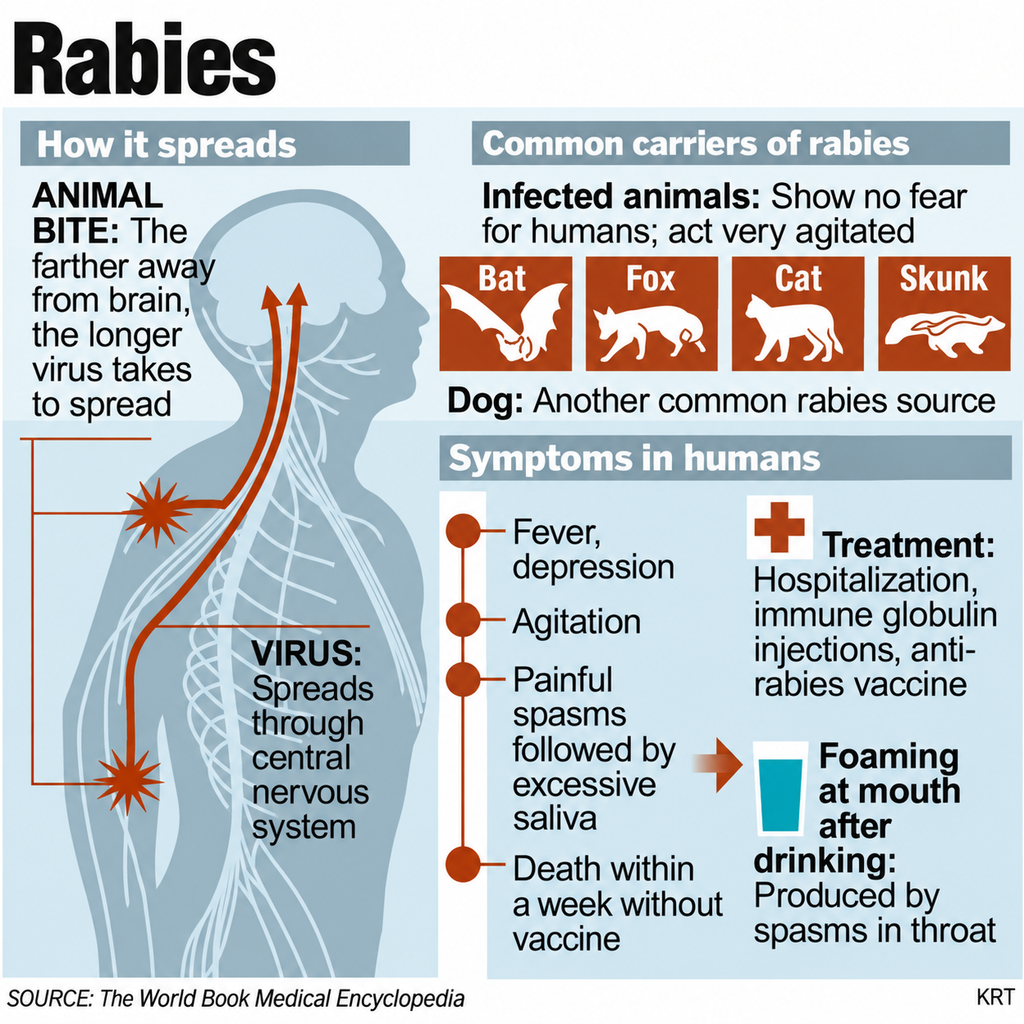
About Rabies:
- Rabies is a vaccine-preventable zoonotic disease caused by an RNA virus. It produces progressive and fatal inflammation of the brain and spinal cord.
- Transmission: Primarily through the saliva of an infected mammal, usually through a bite or scratch. Dogs cause up to 99% of human cases globally.
- Reservoirs: Dogs are the principal source in Asia and Africa, while cats, monkeys, bats and wild carnivores may also transmit it.
- Symptoms: Fever, pain or tingling at the bite site, hallucinations, hydrophobia, paralysis and coma.
- Fatality: Once clinical symptoms appear, rabies is virtually 100% fatal. However, timely post-exposure prophylaxis makes it almost entirely preventable.
- Vaccines: RABIVAX-S, VaxiRab N and VERORAB to immunise people both before and after potential exposures.
Rabies deaths are preventable. A two-pronged strategy is advocated globally: vaccinating dogs to curb the disease at source, and using post-exposure prophylaxis (PEP) after a bite. Post-exposure prophylaxis consists of:
- Immediately washing and flushing the wound with soap and running water for at least 15 minutes
- receiving the complete course of anti-rabies vaccine; and
- administering rabies immunoglobulin in severe or Category III exposures.
WHO Rabies Target- Zero by 30:
Globally, rabies causes an estimated 59,000 human deaths every year.
- The World Health Organisation (WHO) aims to achieve zero human deaths from dog-mediated rabies worldwide by 2030. The target focuses on eliminating human deaths caused by dog-transmitted rabies, not eradicating the rabies virus from all animals.
- Its principal pillars are:
- mass dog vaccination, preferably maintaining at least 70% coverage
- universal and affordable access to post-exposure prophylaxis
- effective dog-population management
- integrated human-animal disease surveillance
- public awareness and prompt reporting of bites
- intersectoral cooperation through the One Health approach.
India has aligned its National Rabies Control Programme and National Action Plan for Dog-Mediated Rabies Elimination (NAPRE) with this 2030 target.
| Elimination does not mean that the rabies virus has disappeared from every animal. It means that dog-mediated human rabies deaths have remained absent for at least two years and the country possesses adequate systems to prevent their re-emergence. |
India’s Rabies Burden:
- Rabies remains endemic across most of India. Around 96% of rabies-associated mortality and morbidity in the country is linked to dog bites.
- Official parliamentary data recorded around 37.17 lakh dog-bite cases and 54 suspected human rabies deaths in 2024. Children are particularly vulnerable because they are more likely to play with animals, suffer bites on the head or upper body and fail to report minor scratches.
- WHO estimates that India accounts for 35% of rabies deaths globally, underlining the country’s significant contribution to the global burden.
India’s Response:
- National Rabies Control Programme: Implemented by the Ministry of Health and Family Welfare, it seeks to:
- ensure availability of anti-rabies vaccines and immunoglobulins
- improve management of animal-bite cases
- train healthcare personnel
- strengthen laboratory diagnosis and surveillance; and
- progressively achieve zero human rabies deaths by 2030.
- National Action Plan for Dog-Mediated Rabies Elimination: The NAPRE, jointly launched in 2021 by the Health Ministry and the Department of Animal Husbandry and Dairying, provides a One Health framework for eliminating dog-mediated human rabies by 2030.
- Animal Birth Control Rules, 2023: These provide for humane capture, sterilisation, anti-rabies vaccination and release of community dogs. Urban local bodies are primarily responsible for implementing the Animal Birth Control programme.
Reliable and comprehensive data are crucial for accurately assessing the disease burden and effectively targeting rabies prevention and elimination measures.
Practice Prelims MCQ:
Q. Consider the following statements with reference to Rabies:
1. Rabies is a zoonotic disease that is caused by an RNA rabies virus.
2. The disease infects the central nervous system of humans and other mammals.
3. Hydrophobia is a prominent symptom associated with severe progression of the disease.
How many of the above statements are correct?
(a) Only one
(b) Only two
(c) All three
(d) None
Answer: (c)
Mains Practice Question: Case Study
Q. You are the District Magistrate of a district where stray dog attacks have been increasing. Recently, a child died due to a stray dog bite, leading to public outrage. Animal rights activists are opposing culling and insist on sterilisation and vaccination drives as per law. Citizens are demanding immediate action to ensure safety.
What will be your course of action in this situation? Justify your decision considering ethical principles, legal provisions, and public interest.
Source: https://anantamias.com/current-affairs/mismatch-in-data-on-rabies-deaths-poses-major-challenge/
Coal mining near Ramappa Temple may harm the Heritage Site and Lake
Why in News?
Heritage activists have raised concerns over the proposed PVNR Opencast Coal Mine at Venkatapur in Telangana’s Mulugu district, located around 5 km from the UNESCO-inscribed Kakatiya Rudreshwara (Ramappa) Temple. The proposed project has triggered concerns over possible impacts on the temple, the Ramappa Lake and the wider cultural landscape.
The concerns are significant because UNESCO recognises the temple not merely as an isolated monument but as part of a wider setting involving the Kakatiya-built reservoir, irrigation systems, agricultural land and natural landscape.
| UPSC Relevance: GS-1 History & Culture: Medieval India, Temple Architecture Prelims: Ramappa Temple, UNESCO World Heritage Sites |
About Ramappa Temple:
- Kakatiya Rudreshwara Temple, popularly known as Ramappa Temple, is located at Palampet in Mulugu district, Telangana.
- It was built during the Kakatiya period, and construction began around 1213 CE. It was inscribed on the UNESCO World Heritage List in 2021.

Key Architectural Features:
- Hybrid style: The temple features a Vesara-style superstructure integrated into a highly distinct local Kakatiya style of temple architecture.
- Material Selection: The main structure is built from locally sourced red sandstone, beautifully contrasted by intricately carved pillars and beams made of dark, fine-grained granite and dolerite (black basalt).
- Innovative Sandbox Foundation: To survive earthquakes, the Kakatiyas pioneered the sand-box technique. Deep foundation trenches were filled with sand mixed with lime, jaggery, and binding herbs. This creates a cushion that absorbs and dissipates seismic shockwaves.
- Floating Vimana (Tower): The temple’s pyramidal roof tower (Vimana) is constructed from revolutionary lightweight, porous bricks that literally float on water. By mixing clay with sawdust and husks, the engineers reduced the weight of the roof superstructure, preventing the foundation from collapsing under its own weight.
- Lustrous Basalt Sculptures: The temple is globally renowned for its high-relief Madanikas (female dancers) and Naginis bracket figures. Carved out of ultra-hard black basalt, these masterpieces feature a mirror-like, metallic finish that retains its brilliant lustre even after 800 years of weathering.
- Integrated Cultural Landscape: The temple is intentionally positioned adjacent to Ramappa Cheruvu, a massive artificial reservoir built by the Kakatiyas.
Why is the Proposed Mine a Concern?
The proposed PVNR Opencast Mining Project at Venkatapur by the Singareni Collieries Company Limited (SCCL) is a concern for the Ramappa Temple (a UNESCO World Heritage site) due to four main risks:
- Ground Vibrations: Heavy machinery, excavation, and blasting from mining could destabilise the ancient temple’s delicate foundation and structural stability.
- Hydrogeological Impact: Deep excavation can alter groundwater flow, drainage patterns and the local water table. This is important because the temple is closely associated with Ramappa Lake and the wider Kakatiya irrigation system.
- Heritage Landscape Degradation: UNESCO recognises the site’s Outstanding Universal Value (OUV) based on the interconnectedness of its architecture, nature, and water systems. Surrounding environmental damage threatens the site’s overall authenticity and integrity.
- Disruption to Ramappa Lake & Irrigation: Ramappa Lake is a Kakatiya-era artificial reservoir forming an important component of the site’s historical landscape. UNESCO has specifically recognised the relationship between the temple, reservoir and irrigation system.
The Ramappa Temple has been protected since 1914 and is managed by the Archaeological Survey of India (ASI). Under the UNESCO World Heritage Convention, India has obligations to protect and conserve the Outstanding Universal Value of World Heritage properties.
The Ramappa Temple-coal mine debate represents a larger challenge for India: how to reconcile mineral and energy security with the conservation of irreplaceable cultural and ecological heritage.
Practice Prelims MCQ:
Q. Consider the following statements regarding the Kakatiya Rudreshwara (Ramappa) Temple:
- It is located in Telangana and was inscribed on the UNESCO World Heritage List in 2021.
- Its architectural significance is associated with the Kakatiyan tradition and includes a distinctive pyramidal Vimana and an innovative sandbox foundation.
- The UNESCO recognition is limited to the temple structure itself and does not take into account its relationship with the surrounding water and cultural landscape.
How many of the above statements are correct?
(a) Only one
(b) Only two
(c) All three
(d) None
Answer: (b)
Explanation: Statement 3 is incorrect: UNESCO’s recognition considers the temple in its broader cultural and landscape context, including its relationship with the Ramappa Lake, irrigation system, agricultural landscape and natural setting.
Next-Gen GST and India’s next phase of growth
Why in News?
India’s Next-Generation GST reforms, whose major rate changes took effect on September 22, 2025, seek to combine lower and simpler tax rates with easier compliance.
Further proposals covering registration, returns, refunds, disputes and input tax credit (ITC) are scheduled for consideration.
| UPSC Relevance: GS-3 Economy: Tax reforms, Mobilisation of resources Prelims: GST, GST Council, input tax credit, inverted duty structure |
Goods and Services Tax:
- GST was introduced on July 1, 2017, to create a common national framework for indirect taxation. It is a destination-based tax on consumption, with input tax credit intended to prevent taxation of the same value at successive stages.
- The 101st Constitutional Amendment Act, 2016 provided the constitutional foundation, while Article 279A established the GST Council as the joint Centre-State forum for recommendations on GST.
Next-Gen GST advances this framework through two connected objectives:
- Rate rationalisation: Reduce the tax burden and simplify the rate structure.
- Administrative simplification: Reduce the time, uncertainty and working-capital costs associated with compliance.
Major GST Reforms Undertaken (GST 2.0):
(i) Rate Rationalisation and Sectoral Relief:
- Two-Slab Simplification: Under comprehensive rate-rationalisation reforms, the GST Council systematically abolished the 12% and 28% slabs. The erstwhile multi-tier structure (5%, 12%, 18%, 28%) has been consolidated into a streamlined, three-rate framework:
- 5% Merit Rate: For daily mass-consumption items and daily essentials.
- 18% Standard Rate: Serving as the default slab for the vast majority of commercial goods and standard services.
- 40% Demerit/Luxury Rate: A new unified upper-tier rate that absorbed the old “28% + Cess” formula, targeting luxury cars, tobacco, aerated beverages, and online real-money gaming.
- Note: The system retains a 0% (Nil) tier for basic unprocessed foods and recent exemptions like individual health/life insurance premiums, alongside minute fractional rates for precious materials (e.g., 3% on gold).
- Public Relief: Complete GST exemption extended to individual life and health insurance premiums alongside standard downward revisions for household essentials and life-saving medicines.
- Duty Inversion Correction: Resolved anomalous tax structures by slashing rates on man-made fibres, yarn, and specified fertiliser inputs (e.g., ammonia, sulphuric acid) to a uniform 5%.
(ii) Registration and Return Filing Efficacy:
- Fast-Track Registration: Rolled out an automated, risk-based registration route granting approval within 3 working days for low-risk applicants and small businesses with a monthly tax liability under ₹2.5 lakh.
- QRMP Scheme Leverage: Eligible taxpayers with an annual aggregate turnover up to ₹5 crore are allowed to file returns quarterly while maintaining monthly tax payment flows.
- Tech-Driven Compliance: End-to-end digitisation via the Goods and Services Tax Network (GSTN), mandatory e-invoicing, and systemic ledger matching to curb fake credit leakages.
(iii) Refund and Dispute-Resolution Reforms:
- Provisional Refunds: Standardised a 90% risk-based provisional refund window for low-risk zero-rated supplies, with subsequent CBIC instructions expanding this facility to inverted-duty claims.
- Amnesty Framework: Provided conditional waivers on interest and penalties for non-fraudulent legacy demands covering the foundational GST phase (FY 2017-18 to FY 2019-20).
- Tribunal Operationalisation: Formal launch of the Goods and Services Tax Appellate Tribunal (GSTAT) and its dedicated e-Courts portal to establish a specialised digital dispute resolution mechanism.
Pending GST Reforms:
1. Revenue Neutral Rate (RNR) issue:
- RNR is the rate at which income to the states and the Centre is not eroded in the absence of pre-GST taxes.
- At the time of inception, a Revenue Neutral Rate (RNR) of 15% to 15.5% was recommended to prevent revenue erosion for the Centre and States. However, extensive political negotiations, subsequent exemptions, and rate reductions during the first phase of GST pulled the actual weighted average collection rate down to ~11.5%. This persistent gap below the designated RNR severely strained the fiscal health of both state exchequers and the Union.
- While gross collections have recently scaled new heights (breaking the ₹2 lakh crore monthly milestone), the compression of the overall net revenue-to-GDP ratio relative to pre-GST historical averages (~6.2% pre-GST vs ~5.7% net post-GST) remains a central topic of macroeconomic debate.
2. Inverted Duty Structure:
- The Challenge: An inverted duty structure arises when the tax rate on raw material inputs is higher than the tax rate levied on the finished output product. This distortion triggers a systemic accumulation of unutilized Input Tax Credits (ITC), trapping crucial working capital for micro, small, and medium enterprises (MSMEs), and forcing them into a cycle of seeking extensive tax refunds from the government.
- While the GST Council has systematically corrected inversions in critical manufacturing segments (man-made fibres, textiles, and specific chemical inputs like fertiliser components down to a uniform 5%), the issue persists in specialised engineering components, solar modules, and electronic parts, etc.
3. Exemptions vs. Zero-Rating:
- Exempt Supplies (Partial Relief): When a product is “exempt,” no GST is levied on the final sale. However, the manufacturer cannot claim Input Tax Credit (ITC) for the taxes paid on raw materials and machinery. This creates a hidden cost as the blocked input taxes become an embedded expense, forcing producers to raise prices or absorb losses.
- Zero-Rated Supplies (Total Relief): A “zero-rated” supply is technically taxable, but the tax rate is set at exactly 0%. Crucially, the supplier is fully permitted to claim a refund for all input taxes paid along the value chain. This completely purges the product of any tax burden, keeping it cost-competitive. E.g., Physical exports and sales to Special Economic Zones (SEZs) under Section 16 of the IGST Act.
Thus, zero-rating can help to reduce the risk of tax evasion and increase the overall effectiveness of the tax system.
4. Exclusion of Petroleum & Alcohol: High-revenue items including crude oil, natural gas, aviation turbine fuel (ATF), petrol, diesel, and alcohol for human consumption remain statutorily excluded from GST. These elements are subject to traditional State VAT and Central Excise duties. Taxes on these important inputs can remain embedded in transport and production costs, weakening the seamless-credit objective.
5. Federal Fiscal Asymmetry: The expiration of the statutory 5-year GST Compensation Cess mechanism left a permanent structural hole in individual state finances. Smaller manufacturing and non-consuming states continue to push for an extended fiscal safety net, presenting a structural challenge to India’s cooperative federalism.
6. Input Tax Credit (ITC) Fraud & Data Asymmetry: Despite extensive technological integration, checking systemic leakages from fake invoicing networks remains a continuous battle. The government has tightened rules by enforcing strict system-driven ledger matching (GSTR-2B) and implementing severe time-bar blocks (E.g., locking access to historical ITC returns after 3 years), creating a fine policy balance between aggressive tax compliance and corporate ease of doing business.
How can Next-Gen GST support growth?
- Strengthen household demand: Where tax reductions translate into lower prices, purchasing power improves and supports consumption.
- Release business working capital: Timely refunds and usable ITC help firms purchase inputs, fulfil orders and expand production.
- Support MSME market access: A common tax framework facilitates supply-chain participation beyond local markets, including for enterprises in Tier-2 and Tier-3 towns.
- Encourage investment: Predictable rates, procedures and dispute resolution reduce uncertainty over business costs.
- Support public expenditure: A broader compliant tax base can help sustain revenues for infrastructure and public services despite lower rates.
The structural overhaul under GST 2.0 reflects a delicate policy balance between providing inflation relief to households and securing robust revenue collections for the state.
The need of the hour is to navigate the ongoing debate surrounding the Revenue Neutral Rate (RNR) and state fiscal autonomy. The GST Council must pivot toward structurally integrating petroleum products to eliminate remaining cascading effects, while balancing aggressive anti-evasion measures with genuine corporate ease of doing business to secure long-term macroeconomic stability.
Practice Prelims MCQ:
Q. With reference to the Goods and Services Tax (GST) framework in India, consider the following statements:
- Under the dual GST model, Integrated GST (IGST) is levied and collected by the Union Government on all inter-state supplies of goods and services, and the revenue is retained entirely by the Centre to manage macro-fiscal imbalances.
- “Exempt supplies” and “Zero-rated supplies” both result in a 0% tax incidence for the final consumer, but only zero-rated supplies allow the producer to claim a refund for the input taxes paid on raw materials.
- Goods and Services Tax Appellate Tribunal (GSTAT) completely bypasses the requirement for taxpayers to approach the departmental Appellate Authorities.
Which of the statements given above is/are correct?
(a) 1 and 2 only
(b) 2 only
(c) 2 and 3 only
(d) 1, 2 and 3
Answer: (b)
Explanation:
- Statement 1 is incorrect: While IGST is indeed levied and collected by the Union Government under Article 269A, the revenue is not retained entirely by the Centre. It is apportioned between the Union and the consuming State (destination state) based on the recommendations of the GST Council.
- Statement 2 is correct: Both exempt and zero-rated items mean the end-consumer pays no tax. However, for “exempt” goods, the producers cannot claim refunds for taxes paid on inputs, making it an embedded cost. For “zero-rated” goods (like exports), the producer can claim a full refund on input taxes.
- Statement 3 is incorrect: GSTAT does not act as the first-level appellate authority, nor does it bypass departmental adjudicators. A taxpayer aggrieved by a primary demand order must first appeal to the departmental Appellate Authority (First Appellate Authority). The GSTAT serves as the second-tier forum designed specifically to hear subsequent appeals arising from the orders passed by those First Appellate Authorities, thereby reducing the direct litigation burden on regional High Courts.
Source: https://anantamias.com/current-affairs/next-gen-gst-and-indias-next-phase-of-growth/
Trump’s AI accord: White House Accord on Super Intelligence
Why in News?
On September 29, 2026, the U.S. President convened leaders of six frontier AI companies (Google, Anthropic, Meta, OpenAI, xAI, and Nvidia) to sign the one-page White House Accord on Super Intelligence, subtitled Joint Commitment on Frontier Responsibilities, to promote safe AI development and public trust.
An Executive Order directed U.S. federal agencies to replace the term “Artificial Intelligence” (AI) with “Super Intelligence” (SI) in official discourse, signalling an assertive push for American technological supremacy.
| UPSC Relevance: GS-2 International Relations: Global AI Regulation; GS-3 Science & Technology: Artificial Intelligence Prelims: Super Intelligence, White House Accord on Super Intelligence. |
Four Pillar Safeguards of the Accord:
The voluntary agreement calls on participating AI companies to introduce several layers of safeguards around their systems.
- Internal Technical Controls: Proactive monitoring during training and deployment against CBRN threats (chemical, biological, radiological, nuclear), cyber vulnerabilities, and unauthorised autonomous system access.
- Internal Oversight Teams: Dedicated specialised units to stress-test safeguards, handle model alignment, and fix vulnerabilities.
- Independent External Audits: Third-party technical evaluations assessing safety protocols before mass deployment.
- Independent Board Oversight: A dedicated board of directors committee to review safety reports and mandate corrective actions.
The accord is described as “morally binding”, although it is not legally enforceable. Some of the measures could eventually be turned into laws or regulations in future.
What does the US shift to “Super Intelligence” (SI) mean?
- The U.S. federal agencies are directed to replace “Artificial Intelligence” (AI) with “Super Intelligence” (SI) across non-statutory correspondence and public communications.
- The administration argued that the word “Artificial” connotes something “fake” or simulated, whereas modern models are moving toward autonomous capability.
- By adopting “Super Intelligence,” the administration deliberately frames the technology as an instrument of national power and economic supremacy. This shifts the policy discourse from mitigating narrow algorithmic harms toward leading an existential frontier tech race.
Comparative Global Regulatory Models:
- Risk-Stratified Statutory (EU): The EU AI Act introduces binding, legally enforceable rules with fines up to €35 million or 7% of global turnover for prohibited and high-risk applications.
- Self-Regulatory Market-First (USA): The White House Accord uses voluntary pledges to avoid inhibiting rapid innovation, with enforcement limited to executive coordination and moral obligation.
- State-Centric Command (China): The Cyberspace Administration of China (CAC) requires mandatory security assessments, core socialist value alignment, and algorithmic registration prior to public deployment.
Takeaways for India:
- Developmental Balance: India’s approach, guided by the IndiaAI Mission and NITI Aayog’s National Strategy for AI (AIforAll), relies largely on advisory frameworks and innovation enablement while monitoring high-risk societal harms.
- Sovereign Capacity Building: Highlights the necessity for India to build indigenous frontier compute infrastructure and vernacular foundational models, rather than depending on the voluntary safety goodwill of foreign private oligopolies.
- Techno-Legal Architecture: Reinforces the need to evolve the Digital Personal Data Protection (DPDP) Act, 2023 and future Digital India legislation to clearly delineate liability for autonomous decision-making and cyber-bio threats.
The Accord reaffirms the need to harmonise governance under international multilateral umbrella bodies such as the Global Partnership on Artificial Intelligence (GPAI) and the Bletchley/Seoul Safety Summit processes to prevent regulatory arbitrage.
Source: https://anantamias.com/current-affairs/trumps-ai-accord-white-house-accord-on-super-intelligence/
Household Debt in India: Key Trends
Why in News?
India’s rising household borrowing has renewed concerns about the sustainability of consumption financed through credit. According to the RBI’s Financial Stability Report 2026, household debt reached 45.5% of GDP at the end of September 2025.
The central issue is not merely the amount borrowed, but why households borrow, the cost of borrowing and their capacity to repay without sacrificing essential expenditure.
| UPSC Relevance: GS-3 Economy: Inclusive growth, mobilisation of resources, banking and financial stability Prelims: Household debt, financial savings Mains: Significance of Gross Domestic Savings in sustaining economic growth |
What is Household Debt?
- Household debt refers to all the outstanding liabilities of households (including non-profit institutions serving households) that require payments of interest or principal by households to the creditors at fixed dates in the future.
- It includes housing loans, education loans, personal loans, credit-card dues and borrowing for household enterprises.
- In India, household debt is primarily tracked, reported, and debated as a percentage of Gross Domestic Product (GDP).
A low national debt-to-GDP ratio can coexist with severe repayment stress among particular households.
Major Trends in India:
- Rising household leverage: Household debt reached 45.5% of GDP in September 2025, exceeding the five-year average of 42.9%.
- Growing non-housing borrowing: Non-housing retail loans constituted 58.4% of household borrowings in March 2026. This indicates the growing importance of personal and other retail credit alongside traditional housing finance.
- Significant consumption borrowing: A significant proportion of household borrowing is directed towards consumption, even as borrowing for productive purposes and asset creation is also increasing.
- Improving borrower profiles: The share of prime-and-above borrowers, indicating stronger credit profiles, increased in both outstanding credit and borrower numbers.
- Some recovery in financial savings: Household net financial savings increased from 5.2% of GDP in 2023-24 to around 6% in 2024-25, as per a parliamentary reply dated March 2026, citing RBI data.
Why are Households borrowing more?
- Greater access to formal credit: Banks, NBFCs and digital lending platforms have made formal credit accessible to households that earlier depended heavily on informal lenders.
- Asset and livelihood needs: Housing, education, farm equipment and small-business investment often require expenditure beyond current savings.
- Uneven income growth: Informal workers, casual workers and self-employed households may borrow to manage irregular income and employment shocks to maintain essential consumption.
- Rising essential expenditure: Medical emergencies, education costs and rent can create borrowing needs where savings, insurance or public services are inadequate.
- Digitalisation of credit: Instant loans, app-based lending and Buy-Now-Pay-Later (BNPL) arrangements have reduced transaction costs and expanded access to credit.
- Aspirational consumption: Easy instalments allow households to bring forward purchases of vehicles, electronics and other consumer durables.
The key concern is therefore not borrowing per se, but persistent borrowing to bridge an inadequate or uncertain income.
When does Household borrowing improve welfare?
- Consumption smoothing: Credit helps households manage temporary income disruptions without sharply reducing food, education or healthcare expenditure.
- Asset creation: Housing loans enable households to acquire long-lived assets.
- Human-capital formation: Education and skill-development loans can improve future earning capacity.
- Productive investment: Borrowing supports farming, self-employment and household enterprises.
- Financial inclusion: Affordable formal credit can reduce dependence on high-cost moneylenders.
- Support to demand: Credit-financed purchases can stimulate production and employment in the short run.
Thus, the purpose of a loan alone does not determine its sustainability. Affordability depends on the interest rate, tenure, income stability and the borrower’s total repayment obligations.
Associated Challenges:
- Household financial distress and debt traps: Multiple loans and high-cost unsecured borrowing can result in a debt trap, where new borrowing is used to service existing obligations. Households dependent on irregular incomes are particularly vulnerable to such shocks.
- Crowding out of essential expenditure: Rising EMIs and other repayments can reduce expenditure on food, healthcare, education and emergency savings, particularly among low-income households. Financial stress may also force households to sell productive assets.
- Credit-led rather than income-led consumption: Credit can bring future purchasing power into the present. If income does not subsequently rise sufficiently, the households cut expenditure, which weakens aggregate demand.
- Unequal distribution of risk: Aggregate indicators conceal differences in income, assets and borrowing costs. Low-income households generally have smaller financial buffers and fewer options during unemployment or illness.
- Risks to banks and NBFCs: Defaults on consumer and unsecured loans can increase NPAs and credit losses. A deterioration in asset quality may subsequently cause lenders to tighten credit, amplifying an economic slowdown.
- Greater sensitivity to interest rates: Highly indebted households become more vulnerable to monetary tightening, particularly where loans carry floating interest rates. Higher rates can increase EMIs or lengthen repayment periods.
- Digital lending risks: Rapid digital credit expansion raises concerns relating to opaque charges, misleading interfaces, excessive borrowing, data privacy and coercive recovery practices. RBI’s digital-lending framework seeks to address these risks.
India needs responsible credit expansion supported by stronger household earnings and social protection, so that borrowing improves future welfare rather than merely postponing present financial distress.
UPSC PYQ 2020:
Q. In the context of the Indian economy, non-financial debt includes which of the following?
1. Housing loans owed by households
2. Amounts outstanding on credit cards
3. Treasury bills
Select the correct answer using the code given below:
(a) 1 only
(b) 1 and 2 only
(c) 3 only
(d) 1, 2 and 3
Answer: (d)
Mains Practice Question:
Q. “Greater access to household credit does not necessarily imply greater household financial security.” Discuss with reference to rising household indebtedness in India.
Source: https://anantamias.com/current-affairs/household-debt-in-india-key-trends/
