Why in News?
The Hindu’s October 5 update reported that Dhruva Space’s LEAP-2, carrying a star tracker and TAPAS-1 thermal payload, was deployed on October 2 during SpaceX’s Transporter-18 mission.
- The mission uses Dhruva Space’s P-30 satellite platform to accommodate instruments developed by other organisations.
- The hosted instruments include a Sodern star tracker and SatLeo Labs’ TAPAS-1 thermal imager.
- Dhruva Space identifies TAPAS-1’s purpose as in-orbit validation of sensing, calibration and processing; launch does not establish that these tests have succeeded.
- Hosted missions can give instrument developers access to orbit without requiring each developer to build an entire spacecraft.
- The policy question is how flight opportunities become reliable measurements, rather than how many experimental payloads reach space.
UPSC Relevance
Prelims Relevance
- Satellite bus and hosted payload
- Attitude determination and attitude control
- Star tracker and star catalogue
- Long-wave infrared sensing
- In-orbit demonstration and operational service
Mains Relevance
GS Paper 3
- Shared space infrastructure and private technology development
- Evidence needed to translate orbital demonstrations into useful services
Essay
- Innovation requires infrastructure that makes experimentation possible.
Background and Context
What the Host Spacecraft Provides
A hosted payload performs a particular task while using services supplied by a larger spacecraft platform, creating a division of engineering responsibilities.
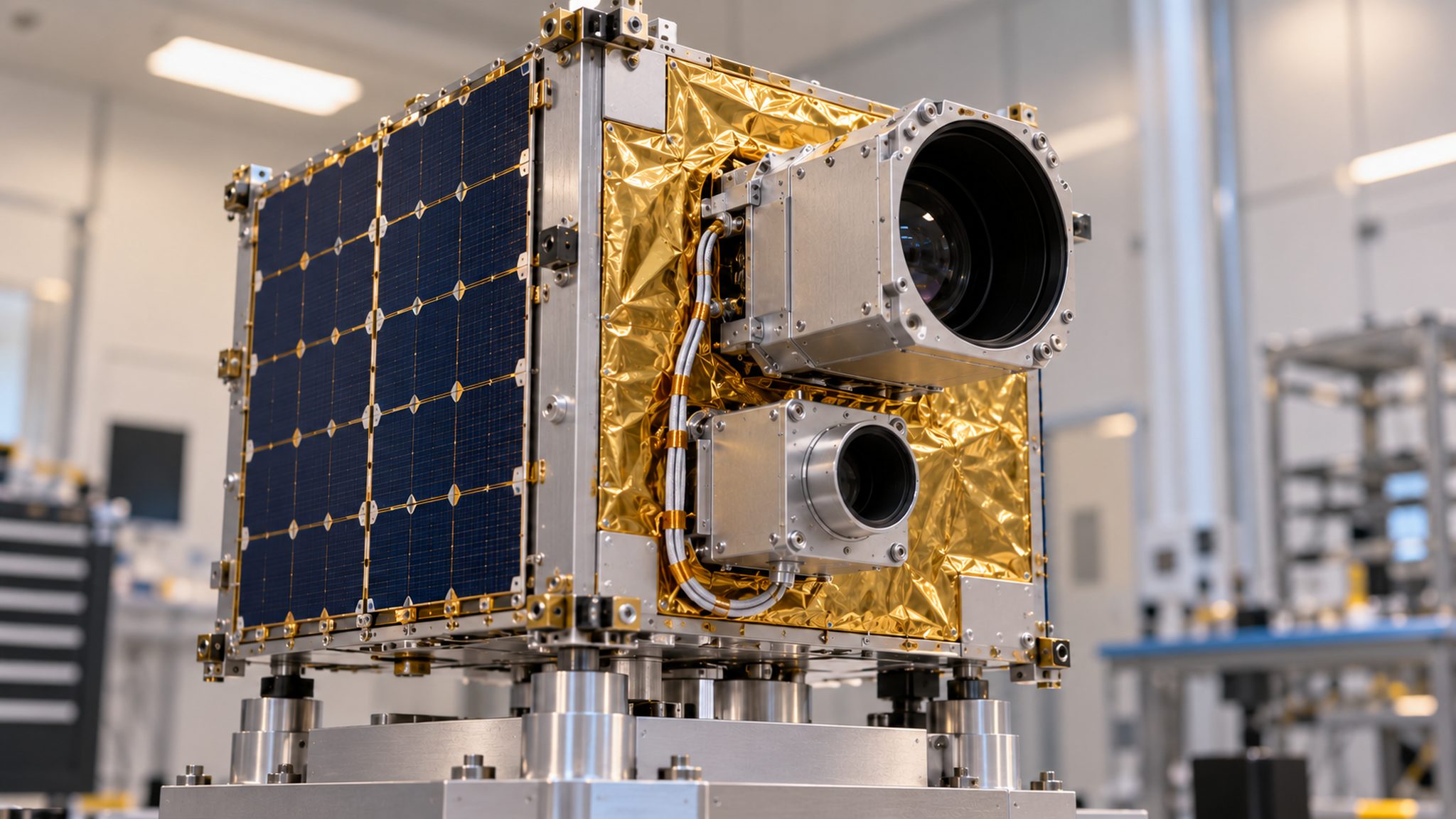
- A satellite bus is the supporting platform: structure, electrical power, communications and other spacecraft services. A payload is the instrument or experiment carried to fulfil a particular mission objective in orbit.
- Under payload hosting, customers must match their instruments to the platform’s interfaces. Mass, available power, data connections and mounting arrangements constrain what can fly together, even when individual instruments work independently in laboratory conditions.
- LEAP-2 illustrates this division through the P-30 platform and externally developed instruments. Dhruva Space describes responsibility spanning integration, environmental testing, launch coordination and ground support, rather than only manufacture of a satellite structure.
- The ground segment remains necessary after separation from the launch vehicle. Receiving telemetry, sending commands and retrieving payload data allow operators to assess spacecraft health and plan subsequent instrument activities during the mission.
- The economic attraction is shared infrastructure: developers can concentrate on an instrument instead of duplicating spacecraft development. The trade-off is dependence on the host’s resources, schedule and compatibility rules throughout integration and operations.
Why Knowing Orientation Matters
An instrument must know where it is pointing before its measurements can be interpreted reliably; reaching the intended orbit alone does not establish this.
- Attitude means spacecraft orientation, not its altitude above Earth. Orientation describes how the spacecraft’s axes face a reference frame, helping connect an instrument’s viewing direction with the location or object being observed.
- A star tracker observes star patterns and compares them with a stored catalogue to estimate orientation. NASA’s guidance reference explains this principle for small spacecraft requiring accurate attitude knowledge during mission operations.
- Attitude determination measures orientation; attitude control changes or maintains it using actuators. A star tracker supplies information rather than turning the spacecraft itself, so identifying the sensor does not identify the complete control system.
- Pointing performance depends on integration geometry, not only a sensor’s advertised precision. The tracker needs a suitable field of view, and its alignment relative to the payload must be understood for useful measurements.
- For LEAP-2, the Sodern instrument is itself a hosted demonstration payload. Its presence should not be treated as evidence that it already controls the host satellite or that its orbital performance has been validated.
What Orbital Validation Must Establish
A demonstration is valuable because it exposes instruments to their intended working environment; its scientific and commercial outcomes still require evidence after launch.
- TAPAS-1 is a thermal sensing payload operating in long-wave infrared, according to the operator. Its stated mission includes checking sensing, calibration and processing in orbit, rather than merely returning an attractive example image.
- Calibration connects instrument output with a meaningful measurement. Checks must distinguish changes in the observed scene from changes in sensor response, so repeated observations can support interpretation rather than misleading comparisons between images.
- Flight heritage records experience gained through operation in space. It can reduce uncertainty for future missions, but a successful deployment establishes neither sustained instrument reliability nor validated accuracy across all proposed applications and conditions.
- An operational service requires repeatable observations, reliable data delivery and demonstrated usefulness to users. A technology demonstration tests capabilities; a commercial constellation must sustain those capabilities across routine demand and changing operating conditions.
- Agriculture, climate and urban heat are proposed application areas named by the operator. Assessing their usefulness requires subsequent validation; the launch announcement alone cannot prove crop-stress detection accuracy or dependable city-level heat monitoring services.
Way Forward
Publish Evidence Beyond Deployment
- Report commissioning results, calibration checks and operational limitations separately from launch milestones.
- Provide measurement uncertainty and documented test conditions when releasing demonstration data.
- Support shared flight opportunities while retaining clear responsibility for interfaces, data quality and mission operations.
Conclusion
- LEAP-2 is a useful example of shared spacecraft infrastructure enabling instrument testing. Its educational significance lies in the relationship between platform services, orientation knowledge and credible validation after reaching orbit.
- In an answer, distinguish deployment, demonstration and operational service. Private space capability grows when missions produce dependable evidence about instruments, not simply when launch announcements list their intended applications.
UPSC Practice Questions
Prelims MCQ 1
With reference to hosted payloads and spacecraft attitude, consider the following statements:
- A hosted payload can use power and communications supplied by a satellite platform.
- Attitude refers to the height of a spacecraft above Earth.
- A star tracker can estimate orientation by comparing observed stars with a catalogue.
How many of the above statements are correct?
(a) Only one (b) Only two (c) All three (d) None
Answer: (b) Only two
Explanation:
Statements 1 and 3 are correct. Attitude means orientation; altitude refers to height.
Prelims MCQ 2
Which conclusion is justified solely by successful deployment of an experimental thermal payload into orbit?
(a) Its agricultural services are commercially reliable (b) Its temperature measurements have passed all calibration tests (c) It has reached orbit, allowing subsequent commissioning and validation (d) Its future constellation is operational
Answer: (c) It has reached orbit, allowing subsequent commissioning and validation
Explanation:
Deployment is a mission milestone. Instrument calibration, reliability and service performance require separate evidence.
UPSC Mains Questions
- Explain how hosted payload platforms can support India’s private space sector. What engineering dependencies do they create?
- Distinguish successful satellite deployment from validated Earth-observation services. Discuss the evidence needed to bridge these stages.
Sources: Dhruva Space and The Hindu.
Frequently Asked Questions
What is a hosted payload?
A hosted payload is an instrument or experiment carried on a spacecraft platform that supplies supporting services such as power, communications and mounting. This allows developers to concentrate on their specific mission task.
What does a star tracker measure?
A star tracker estimates spacecraft orientation by comparing observed star patterns with a catalogue. It supplies attitude information; separate control mechanisms change or maintain the spacecraft’s pointing direction when required.
What is TAPAS-1 testing?
According to Dhruva Space, TAPAS-1 is intended to validate thermal sensing, calibration and processing in orbit. Its stated potential applications do not establish that operational services have already been demonstrated.
Did LEAP-2 launch on October 5?
No. The deployment occurred on October 2. The Hindu updated its report on October 5, while Dhruva Space’s mission page also confirms the earlier launch and deployment date.
Tell Google you want more of this.
Add Anantam IAS as a preferred sourceOne tap, and this site shows up more often in your own Top Stories, AI Overviews and AI Mode. Remove it any time.