
Context:
Recent estimates by an ICMR-NIE-led study suggest that around 5726 people die of rabies in India annually, while government surveillance systems reported only 54 deaths in 2024.
The wide disparity in data highlights under-reporting, incomplete death certification and weak surveillance, particularly when deaths occur outside the formal healthcare system. Lack of consolidated data is a challenge in rabies eradication.
| UPSC Relevance: GS-2 Social Justice: Health; GS-3 Science and Technology: One Health Approach Prelims: Rabies; WHO Rabies Target; India’s Response |
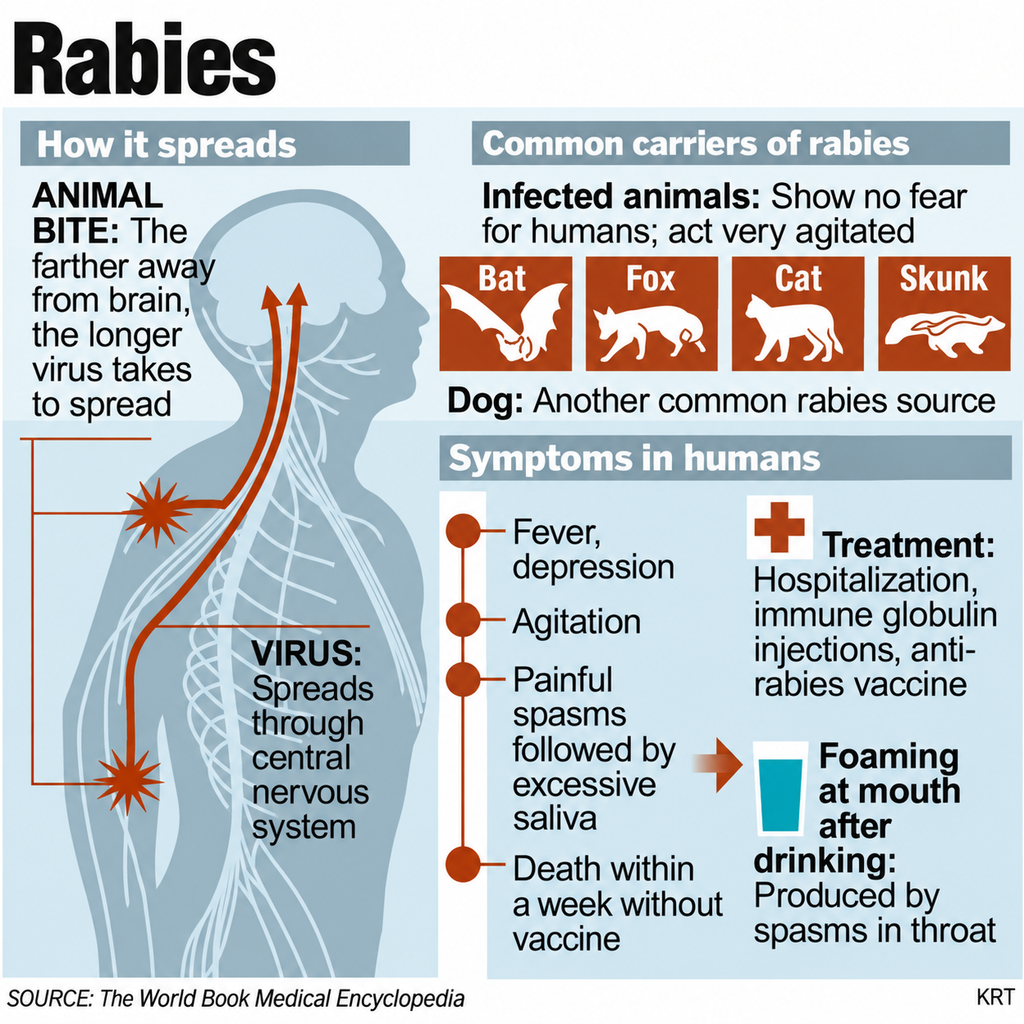
About Rabies:
- Rabies is a vaccine-preventable zoonotic disease caused by an RNA virus. It produces progressive and fatal inflammation of the brain and spinal cord.
- Transmission: Primarily through the saliva of an infected mammal, usually through a bite or scratch. Dogs cause up to 99% of human cases globally.
- Reservoirs: Dogs are the principal source in Asia and Africa, while cats, monkeys, bats and wild carnivores may also transmit it.
- Symptoms: Fever, pain or tingling at the bite site, hallucinations, hydrophobia, paralysis and coma.
- Fatality: Once clinical symptoms appear, rabies is virtually 100% fatal. However, timely post-exposure prophylaxis makes it almost entirely preventable.
- Vaccines: RABIVAX-S, VaxiRab N and VERORAB to immunise people both before and after potential exposures.
Rabies deaths are preventable. A two-pronged strategy is advocated globally: vaccinating dogs to curb the disease at source, and using post-exposure prophylaxis (PEP) after a bite. Post-exposure prophylaxis consists of:
- Immediately washing and flushing the wound with soap and running water for at least 15 minutes
- receiving the complete course of anti-rabies vaccine; and
- administering rabies immunoglobulin in severe or Category III exposures.
WHO Rabies Target- Zero by 30:
Globally, rabies causes an estimated 59,000 human deaths every year.
- The World Health Organisation (WHO) aims to achieve zero human deaths from dog-mediated rabies worldwide by 2030. The target focuses on eliminating human deaths caused by dog-transmitted rabies, not eradicating the rabies virus from all animals.
- Its principal pillars are:
- mass dog vaccination, preferably maintaining at least 70% coverage
- universal and affordable access to post-exposure prophylaxis
- effective dog-population management
- integrated human-animal disease surveillance
- public awareness and prompt reporting of bites
- intersectoral cooperation through the One Health approach.
India has aligned its National Rabies Control Programme and National Action Plan for Dog-Mediated Rabies Elimination (NAPRE) with this 2030 target.
| Elimination does not mean that the rabies virus has disappeared from every animal. It means that dog-mediated human rabies deaths have remained absent for at least two years and the country possesses adequate systems to prevent their re-emergence. |
India’s Rabies Burden:
- Rabies remains endemic across most of India. Around 96% of rabies-associated mortality and morbidity in the country is linked to dog bites.
- Official parliamentary data recorded around 37.17 lakh dog-bite cases and 54 suspected human rabies deaths in 2024. Children are particularly vulnerable because they are more likely to play with animals, suffer bites on the head or upper body and fail to report minor scratches.
- WHO estimates that India accounts for 35% of rabies deaths globally, underlining the country’s significant contribution to the global burden.
India’s Response:
- National Rabies Control Programme: Implemented by the Ministry of Health and Family Welfare, it seeks to:
- ensure availability of anti-rabies vaccines and immunoglobulins
- improve management of animal-bite cases
- train healthcare personnel
- strengthen laboratory diagnosis and surveillance; and
- progressively achieve zero human rabies deaths by 2030.
- National Action Plan for Dog-Mediated Rabies Elimination: The NAPRE, jointly launched in 2021 by the Health Ministry and the Department of Animal Husbandry and Dairying, provides a One Health framework for eliminating dog-mediated human rabies by 2030.
- Animal Birth Control Rules, 2023: These provide for humane capture, sterilisation, anti-rabies vaccination and release of community dogs. Urban local bodies are primarily responsible for implementing the Animal Birth Control programme.
Reliable and comprehensive data are crucial for accurately assessing the disease burden and effectively targeting rabies prevention and elimination measures.
Practice Prelims MCQ:
Q. Consider the following statements with reference to Rabies:
1. Rabies is a zoonotic disease that is caused by an RNA rabies virus.
2. The disease infects the central nervous system of humans and other mammals.
3. Hydrophobia is a prominent symptom associated with severe progression of the disease.
How many of the above statements are correct?
(a) Only one
(b) Only two
(c) All three
(d) None
Answer: (c)
Mains Practice Question: Case Study
Q. You are the District Magistrate of a district where stray dog attacks have been increasing. Recently, a child died due to a stray dog bite, leading to public outrage. Animal rights activists are opposing culling and insist on sterilisation and vaccination drives as per law. Citizens are demanding immediate action to ensure safety.
What will be your course of action in this situation? Justify your decision considering ethical principles, legal provisions, and public interest.
Tell Google you want more of this.
Add Anantam IAS as a preferred sourceOne tap, and this site shows up more often in your own Top Stories, AI Overviews and AI Mode. Remove it any time.