Daily Digest
UPSC · Civil Services Examination
Current Affairs · Saturday, 8 August 2026
Current affairs curated and edited by Anantam IAS faculty — pulled from The Hindu, PIB, IDSA, Foreign Affairs and the ministries. Read, annotate, revise.
Old Rajinder Nagar · Delhi 110005 · anantamias.com
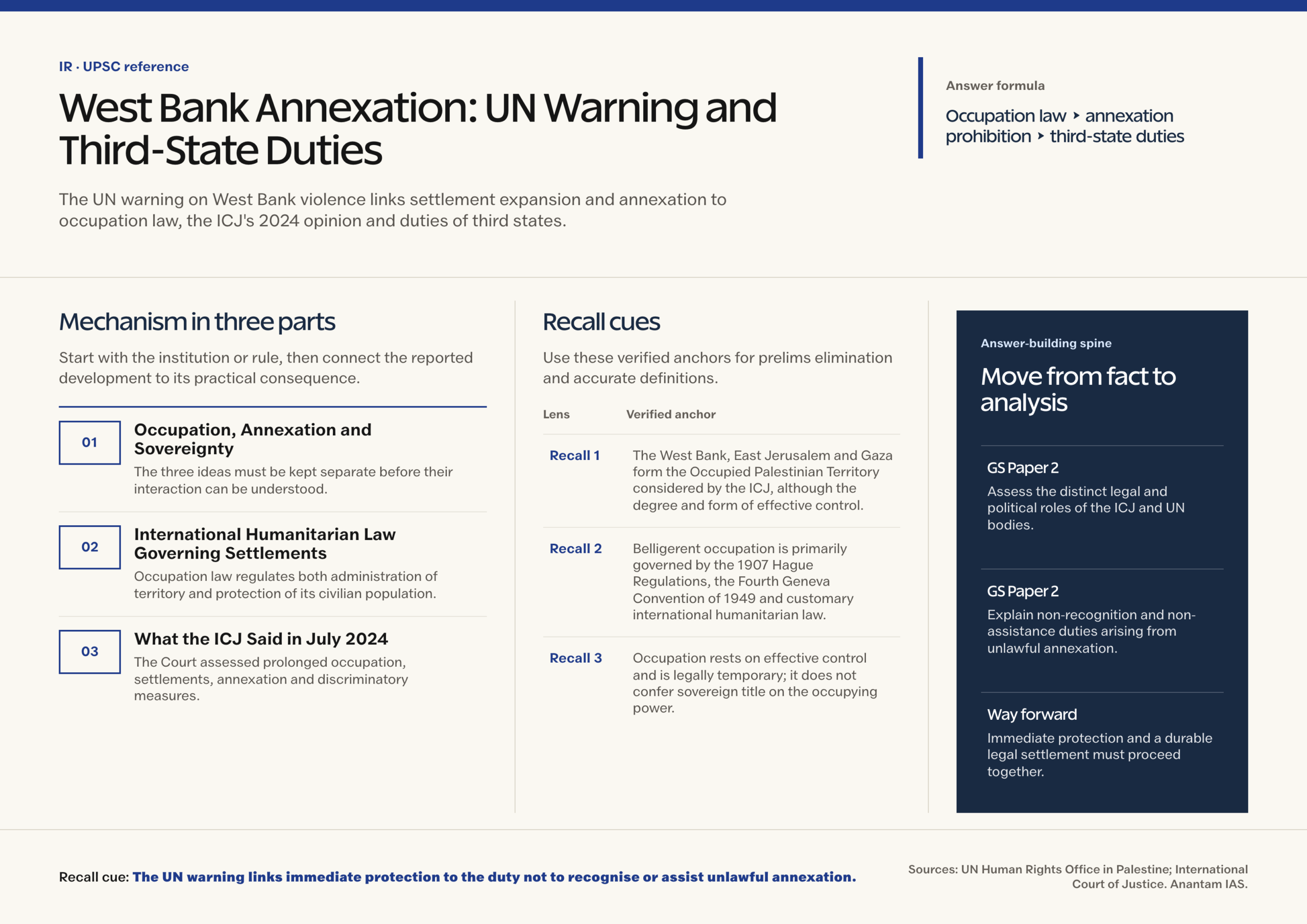
West Bank Annexation: UN Warning and Third-State Duties
Why in News?
On 29 July 2026, the UN Human Rights Office warned that settler violence , settlement expansion and the widening annexation of Palestinian territory in the occupied West Bank were worsening, two years after the International Court of Justice’s 2024 advisory.
- The UN statement reported that, since the preceding Thursday, eight Palestinians, including a boy, and two members of the Israeli military had been killed in the occupied West Bank.
- It alleged attacks by settlers and Israeli security forces on communities, including assaults on families, destruction or confiscation of property, burning of mosques and tighter movement restrictions that obstruct access to essential services.
- The Office also expressed alarm over an Israeli government announcement to increase the number of settlements and outposts, alongside calls by Israeli leaders for revenge and collective punishment.
- The immediate UN appeal was directed not only at Israel. It called on third states to act urgently and collectively to halt killing and dispossession and help bring the occupation to an end.
- The warning should be read as an allegation and legal assessment by a UN human-rights body. Accountability for particular violent incidents still requires credible investigation, individual attribution and due process.
- Settlement growth can create facts on the ground that fragment territory, alter its demographic character and make a viable two-state settlement harder to implement.
- The issue connects international humanitarian law, human rights law, the right to self-determination and the law of state responsibility; it cannot be reduced to a bilateral political dispute alone.
- For India, the case raises a practical diplomatic question: how to support a negotiated two-state solution while ensuring that trade, investment, official dealings and public positions distinguish Israel from territory occupied since 1967.
UPSC Relevance
Prelims Relevance
- The West Bank, East Jerusalem and Gaza form the Occupied Palestinian Territory considered by the ICJ, although the degree and form of effective control differ across them.
- Belligerent occupation is primarily governed by the 1907 Hague Regulations, the Fourth Geneva Convention of 1949 and customary international humanitarian law.
- Occupation rests on effective control and is legally temporary; it does not confer sovereign title on the occupying power.
- Article 49(6) of the Fourth Geneva Convention prohibits an occupying power from deporting or transferring parts of its own civilian population into occupied territory.
- Article 47 of the Fourth Geneva Convention protects occupied persons from losing Convention safeguards because of annexation or institutional changes introduced by the occupier.
- UN Security Council Resolution 2334 (2016) states that Israeli settlements in Palestinian territory occupied since 1967, including East Jerusalem, have no legal validity and are a flagrant violation under international law.
Mains Relevance
GS Paper 2
- Assess how the ICJ, Security Council, General Assembly and UN human-rights mechanisms perform different legal and political functions in the Israel-Palestine question.
- Explain India’s interest in a rules-based order, Palestinian self-determination, Israeli security and a negotiated two-state solution without treating these concerns as mutually exclusive.
Essay
- A prolonged temporary arrangement can become a method of permanent control when law is not matched by enforcement.
Background and Context
Occupation, Annexation and Sovereignty
The three ideas must be kept separate before their interaction can be understood.
- Occupation is the factual exercise of authority by a hostile army over foreign territory. It can trigger duties even without a lawful claim to sovereignty and even when control is exercised through a combination of military.
- De jure annexation is a formal claim to absorb territory. De facto annexation describes measures that permanently integrate territory without a single formal declaration, such as extending domestic law, transferring civilian population, appropriating land and building.
- The law of occupation permits temporary administration for security and the welfare of the local population; it does not allow the occupier to convert control into territorial title. The prohibition on acquisition of territory by force.
International Humanitarian Law Governing Settlements
Occupation law regulates both administration of territory and protection of its civilian population.
- Under the Fourth Geneva Convention, protected civilians must be treated humanely. Collective penalties, pillage, unlawful destruction and forcible transfers are prohibited subject to the precise elements and exceptions in the Convention.
- Article 49(6) bars the occupying power from transferring parts of its own civilian population into occupied territory. The ICJ and Security Council have treated Israeli settlement policy as contrary to this rule.
- Private perpetrators remain individually responsible for violence. State responsibility may also arise where officials participate, direct, support, fail to exercise due diligence or leave serious abuses uninvestigated, depending on the applicable attribution and human-rights standards.
What the ICJ Said in July 2024
The Court assessed the legal consequences of prolonged occupation, settlements, annexation and discriminatory measures across the Occupied Palestinian Territory.
- The ICJ found that Israel’s continued presence in the Occupied Palestinian Territory was unlawful because policies and practices violated the prohibition on acquiring territory by force and obstructed the Palestinian people’s right to self-determination.
- It stated that Israel must end that unlawful presence as rapidly as possible, cease all new settlement activity, evacuate settlers and make reparation for damage caused by internationally wrongful acts.
- The opinion was advisory, not a directly enforceable damages judgment. Its legal reasoning still carries major authority, while implementation depends on states, UN organs, domestic institutions and political processes.
Third-State Duties: Non-Recognition and Non-Assistance
The legal consequences do not stop with the state directly responsible for the unlawful situation.
- The ICJ said all states must not recognize as legal the situation arising from Israel’s unlawful presence and must not render aid or assistance in maintaining it. These duties reflect the special consequences attached to serious.
- States must distinguish, in their dealings with Israel, between Israeli territory and the Palestinian territory occupied since 1967. Security Council Resolution 2334 had already called on states to make this distinction.
- Non-recognition does not require denying Israel’s statehood or ending every bilateral relationship. Its focus is avoiding conduct that treats sovereignty over occupied territory or the resulting settlement situation as lawful.
Way Forward
Protect Civilians and Establish Accountability
- Israeli authorities should prevent attacks, protect all civilians without discrimination, investigate alleged settler and security-force abuses independently, prosecute where evidence supports charges and provide effective remedies.
- Palestinian armed actors and individuals must also comply with international law; attacks on civilians cannot be justified as retaliation for occupation or settlement violence.
- Freeze new settlement and outpost activity, prevent seizure or destruction of property, and address unlawful settlement structures in line with the ICJ opinion and applicable international law.
- Reject formal annexation and administrative measures that amount to permanent integration, including discriminatory land, planning and legal systems that fragment Palestinian territory.
Conclusion
- The UN warning is not only a report about another spike in West Bank violence.
- The 2024 ICJ opinion places responsibility at three levels: Israel must end unlawful policies and protect civilians; perpetrators must face lawful accountability; and third states must avoid recognition or assistance.
UPSC Practice Questions
Prelims MCQ 1
With reference to the law of belligerent occupation, consider the following statements:
- Occupation by itself transfers sovereignty over the territory to the occupying power.
- The Fourth Geneva Convention prohibits an occupying power from transferring parts of its own civilian population into occupied territory.
- Annexation does not deprive protected persons in occupied territory of the Convention’s protections.
How many of the above statements are correct?
(a) Only one (b) Only two (c) All three (d) None
Answer: (b) Only two
Explanation:
Statements 2 and 3 are correct. Article 49(6) governs transfer of the occupier’s civilian population, while Article 47 preserves Convention protection despite annexation or institutional change. Occupation does not transfer sovereign title.
Prelims MCQ 2
Which one of the following best describes a duty of third states identified by the ICJ’s 2024 advisory opinion on the Occupied Palestinian Territory?
(a) To recognize every administrative act of the occupying power until a peace treaty is signed (b) To terminate all diplomatic relations with Israel regardless of their territorial scope (c) To distinguish in their dealings between Israel and the Palestinian territory occupied since 1967 (d) To enforce individual criminal liability through the International Court of Justice
Answer: (c) To distinguish in their dealings between Israel and the Palestinian territory occupied since 1967
Explanation:
The Court identified non-recognition, non-assistance and territorial differentiation duties. It did not require universal termination of relations, and the ICJ is not a criminal court.
UPSC Mains Questions
- The distinction between occupation and annexation is central to preserving the prohibition on acquisition of territory by force. Explain with reference to the occupied West Bank and the ICJ’s 2024 advisory opinion. (250 words)
- What do the duties of non-recognition and non-assistance require from third states in an unlawful territorial situation? Discuss their practical relevance for diplomacy and economic relations. (250 words)
Sources: UN Human Rights Office in Palestine and International Court of Justice.
Frequently Asked Questions
What did the UN say about West Bank violence in July 2026?
The UN Human Rights Office said settler violence, settlement and outpost creation, property destruction and movement restrictions were worsening. It reported recent deaths of Palestinians and Israeli soldiers and urged third states to act collectively. Allegations concerning particular attacks still.
What is the difference between occupation and annexation?
Occupation is effective control of foreign territory during armed conflict and is legally temporary. It does not transfer sovereignty. Annexation is the claimed permanent incorporation of territory, either formally or through measures that integrate land, law, infrastructure and population. Territory.
Why are Israeli settlements considered illegal under international law?
Article 49(6) of the Fourth Geneva Convention prohibits an occupying power from transferring parts of its civilian population into occupied territory. The ICJ and UN Security Council Resolution 2334 have applied this rule to Israeli settlements in territory occupied since.
Is the ICJ’s 2024 advisory opinion legally binding?
An advisory opinion is not binding in the same manner as a judgment between states in a contentious case. It remains an authoritative judicial statement of international law. Its implementation relies on states, UN organs, domestic institutions and other lawful.
What are third-state duties in this context?
Third states must not recognize as lawful the situation arising from the unlawful presence, must not aid or assist its maintenance, and must distinguish between Israel and the territories occupied since 1967 in their dealings. The application to trade, finance.
Source: https://anantamias.com/current-affairs/west-bank-annexation-settler-violence-un-warning/
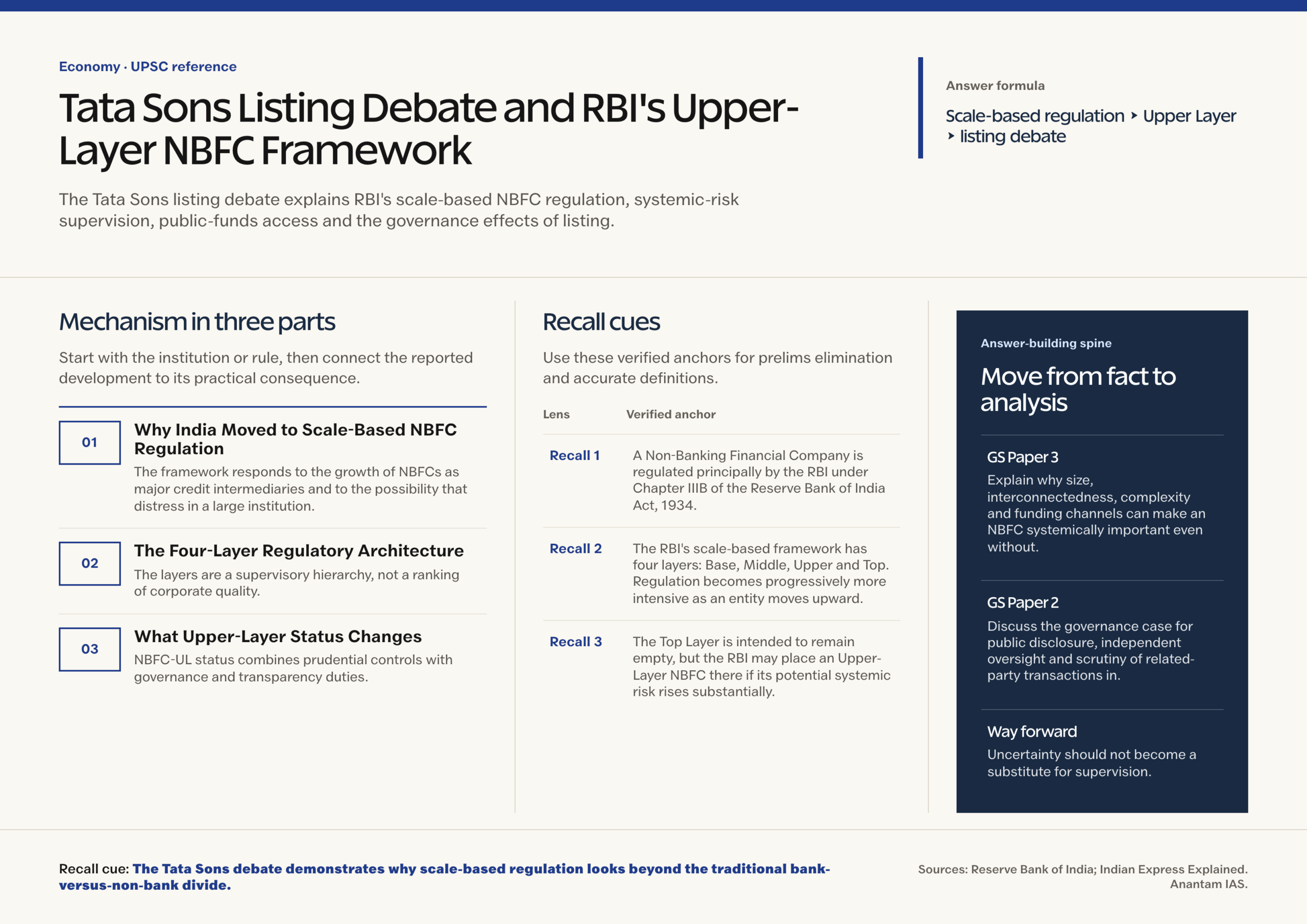
Tata Sons Listing Debate and RBI’s Upper-Layer NBFC Framework
Why in News?
The Reserve Bank of India’s latest treatment of Tata Sons under the Upper-Layer NBFC framework has renewed the debate over whether the privately held group holding company must list its equity shares.
- Tata Sons was identified as an NBFC-UL in the RBI’s first list issued on September 30, 2022, in the category of a core investment company.
- The RBI’s 2021 Scale Based Regulation framework says an NBFC-UL shall be mandatorily listed within three years of identification and must adopt listed-company-like disclosures even before listing.
- Tata Sons has sought cancellation of its RBI registration as a core investment company. The RBI stated in its January 16, 2025 list that continued inclusion was without prejudice to the outcome of that application, which.
- The dispute turns on regulatory status, size, interconnectedness and public-funds linkages; repayment of direct debt does not settle every concern.
- A public listing would bring market disclosure, shareholder, related-party transaction and corporate-governance obligations in addition to the RBI’s prudential oversight.
- Large NBFCs can transmit stress to banks, bond markets and group companies. Systemic importance depends on linkages, not only labels.
- A core investment company mainly holds and finances group companies. Its balance sheet can become a channel through which risks and funding conditions travel across a conglomerate.
- The case separates prudential regulation by the RBI from market disclosure regulation by SEBI.
UPSC Relevance
Prelims Relevance
- A Non-Banking Financial Company is regulated principally by the RBI under Chapter IIIB of the Reserve Bank of India Act, 1934; it is not a bank and cannot issue cheques drawn on itself.
- The RBI’s scale-based framework has four layers: Base, Middle, Upper and Top. Regulation becomes progressively more intensive as an entity moves upward.
- The Top Layer is intended to remain empty, but the RBI may place an Upper-Layer NBFC there if its potential systemic risk rises substantially.
- Core investment companies, housing finance companies, infrastructure finance companies and deposit-taking NBFCs are placed in the Middle or Upper Layer, depending on the applicable rules.
- Under the original 2021 framework, the Upper Layer included NBFCs specifically identified through parameters and scoring, while the ten largest eligible NBFCs by asset size were to remain in it.
- An NBFC-UL is subject to Middle-Layer requirements plus stronger rules concerning capital, leverage, large exposures, governance and disclosure.
Mains Relevance
GS Paper 3
- Explain why size, interconnectedness, complexity and funding channels can make an NBFC systemically important even without a bank-like deposit franchise.
- Assess scale-based regulation as an instrument for reducing regulatory arbitrage between large NBFCs and banks while preserving a differentiated financial system.
GS Paper 2
- Discuss the governance case for public disclosure, independent oversight and scrutiny of related-party transactions in economically important private holding companies.
- Examine the need for transparent, rule-based regulatory decisions when deregistration, exemption or transition requests affect large corporate groups.
Essay
- Good regulation should follow the risk generated by an institution, not only the legal form it chooses.
Background and Context
Why India Moved to Scale-Based NBFC Regulation
The framework responds to the growth of NBFCs as major credit intermediaries and to the possibility that distress in a large institution can spread through the financial system.
- NBFCs supplement banks through housing, vehicle, infrastructure, consumer and microfinance. Their specialised models can expand credit access.
- Expansion also increases interconnectedness. Bank borrowing, debt issuance and group investments allow a funding shock to travel across markets.
- A uniform rulebook would overburden small NBFCs or under-regulate large ones. The RBI adopted proportionality, with stronger requirements in higher layers.
- The framework, broadly effective from October 1, 2022, links regulation to size, activity and perceived riskiness and limits regulatory arbitrage.
- The design reflects a key financial-stability lesson: an institution need not resemble a commercial bank to create bank-like spillovers. Wholesale borrowing can connect an NBFC to banks and bond investors, while concentrated group investments can transmit.
The Four-Layer Regulatory Architecture
The layers are a supervisory hierarchy, not a ranking of corporate quality.
- The Base Layer contains smaller non-deposit-taking NBFCs and specified categories such as peer-to-peer platforms and account aggregators.
- The Middle Layer includes all deposit-taking NBFCs, larger non-deposit-taking NBFCs and specified categories such as CICs and housing finance companies, unless placed higher.
- The Upper Layer contains NBFCs identified for enhanced regulation, while the Top Layer is expected to remain empty unless systemic risk rises substantially.
- Movement upward adds obligations without erasing lower-layer safeguards, so intensity follows spillover risk.
- The RBI’s 2021 framework required the ten largest eligible NBFCs by asset size to remain in the Upper Layer irrespective of other factors, alongside entities selected through the prescribed assessment. The approach recognised that absolute scale.
What Upper-Layer Status Changes
NBFC-UL status combines prudential controls with governance and transparency duties.
- The RBI requires an Internal Capital Adequacy Assessment Process covering credit, market, operational and residual risks.
- Upper-Layer NBFCs face differential provisioning, leverage discipline and a Large Exposure Framework for concentrated counterparty and group exposures.
- Boards need appropriate competence; premature exit of an independent director must be reported to supervisors.
- Listed-company-like disclosure before listing narrows information gaps, while mandatory listing adds market discipline. Neither replaces RBI supervision.
- Transition rules separate immediate planning from full implementation. Within three months of being advised about Upper-Layer status, the NBFC must adopt a Board-approved plan and submit its roadmap to the RBI; the enhanced requirements must be.
Why Tata Sons Is a Special Case
Tata Sons is both a private holding company and a core investment company at the centre of a large corporate group.
- As a CIC, its significance comes mainly from holdings and financial relationships within the Tata group, not conventional retail lending.
- The RBI included Tata Sons in the inaugural September 2022 Upper-Layer list and again identified it as a CIC in the official 2024-25 list published on January 16, 2025.
- Its deregistration application raises whether NBFC-specific obligations continue if the RBI cancels its certificate. An application is not approval.
- Lower direct leverage does not settle concerns about indirect public funds, group linkages, asset concentration or stress at a central holding entity.
- The RBI’s phrase without prejudice preserves a separate decision on deregistration while classification continues.
Way Forward
Issue a Reasoned, Time-Bound Regulatory Decision
- The RBI should conclude the deregistration application through a speaking order or an appropriately detailed public explanation of the governing principles, while protecting genuinely confidential supervisory information.
- The decision should state how the listing timeline, five-year retention rule and transition obligations interact with cancellation; comparable NBFCs need the same criteria.
- Regulators should map guarantees, cross-holdings, funding flows, common counterparties and concentrated exposures across the group to identify contagion channels.
- Stress tests should examine valuation shocks, funding freezes and group-company distress; regulator information-sharing needs clear safeguards.
Conclusion
- The Tata Sons debate demonstrates why scale-based regulation looks beyond the traditional bank-versus-non-bank divide.
- The durable policy answer is a transparent, consistent and risk-sensitive decision.
UPSC Practice Questions
Prelims MCQ 1
With reference to the RBI’s Scale Based Regulation framework for NBFCs, consider the following statements:
- The regulatory structure comprises Base, Middle, Upper and Top Layers.
- The Top Layer is intended to contain the ten largest eligible NBFCs at all times.
- An NBFC identified in the Upper Layer is ordinarily subject to enhanced regulation for at least five years.
How many of the above statements are correct?
(a) Only one (b) Only two (c) All three (d) None
Answer: (b) Only two
Explanation:
Statements 1 and 3 are correct. The Top Layer is intended to remain empty and may be populated only when the RBI sees a substantial increase in potential systemic risk. The largest eligible NBFCs are associated with Upper-Layer identification, not permanent placement in the Top Layer.
Prelims MCQ 2
Which one of the following best describes a Core Investment Company in the context of RBI regulation?
(a) An NBFC whose principal function is operating a retail payments system (b) A company primarily holding shares, securities and financial exposures in group companies, subject to prescribed conditions (c) A scheduled bank created solely to finance infrastructure projects (d) A securities exchange that lists corporate bonds
Answer: (b) A company primarily holding shares, securities and financial exposures in group companies, subject to prescribed conditions
Explanation:
A CIC is a specialised NBFC centred on investments and financial exposures in group companies. It is not a bank, payment-system operator or stock exchange.
UPSC Mains Questions
- How does the RBI’s scale-based regulatory framework address systemic risk in the non-banking financial sector? Explain with reference to the Tata Sons listing debate. (250 words)
- Public listing can strengthen transparency but cannot replace prudential supervision. Discuss in the context of large NBFCs and core investment companies. (250 words)
Sources: Reserve Bank of India and Indian Express Explained.
Frequently Asked Questions
Why is Tata Sons discussed as an NBFC?
Tata Sons is the principal holding company of the Tata group and has been registered with the RBI as a core investment company, a specialised category of NBFC. Its financial holdings and relationships with group companies bring it within.
What is an Upper-Layer NBFC?
An NBFC-UL is an NBFC specifically identified by the RBI for enhanced regulation because of its scale and risk significance. It follows Middle-Layer rules plus stronger capital, exposure, governance and disclosure requirements. Under the framework, Upper-Layer NBFCs are also required.
Does Tata Sons’ deregistration application automatically cancel the listing requirement?
No. Filing an application does not amount to approval. The RBI’s January 2025 release said Tata Sons’ inclusion in the Upper Layer was without prejudice to its deregistration application, which remained under examination. The legal consequences depend on the RBI’s.
What are indirect public funds?
In this regulatory context, indirect public funds are funds received through associates or group entities that themselves have access to public funds. The concept helps the RBI examine the substance of a funding chain, so an entity cannot be assessed.
Why can a debt-free holding company still attract systemic-risk scrutiny?
Direct debt is only one source of risk. A central holding company may have concentrated investments, guarantees, cross-holdings, common creditors and funding links with major group entities. Stress at that node can affect listed companies and lenders, so the RBI.
Source: https://anantamias.com/current-affairs/tata-sons-listing-upper-layer-nbfc-framework/
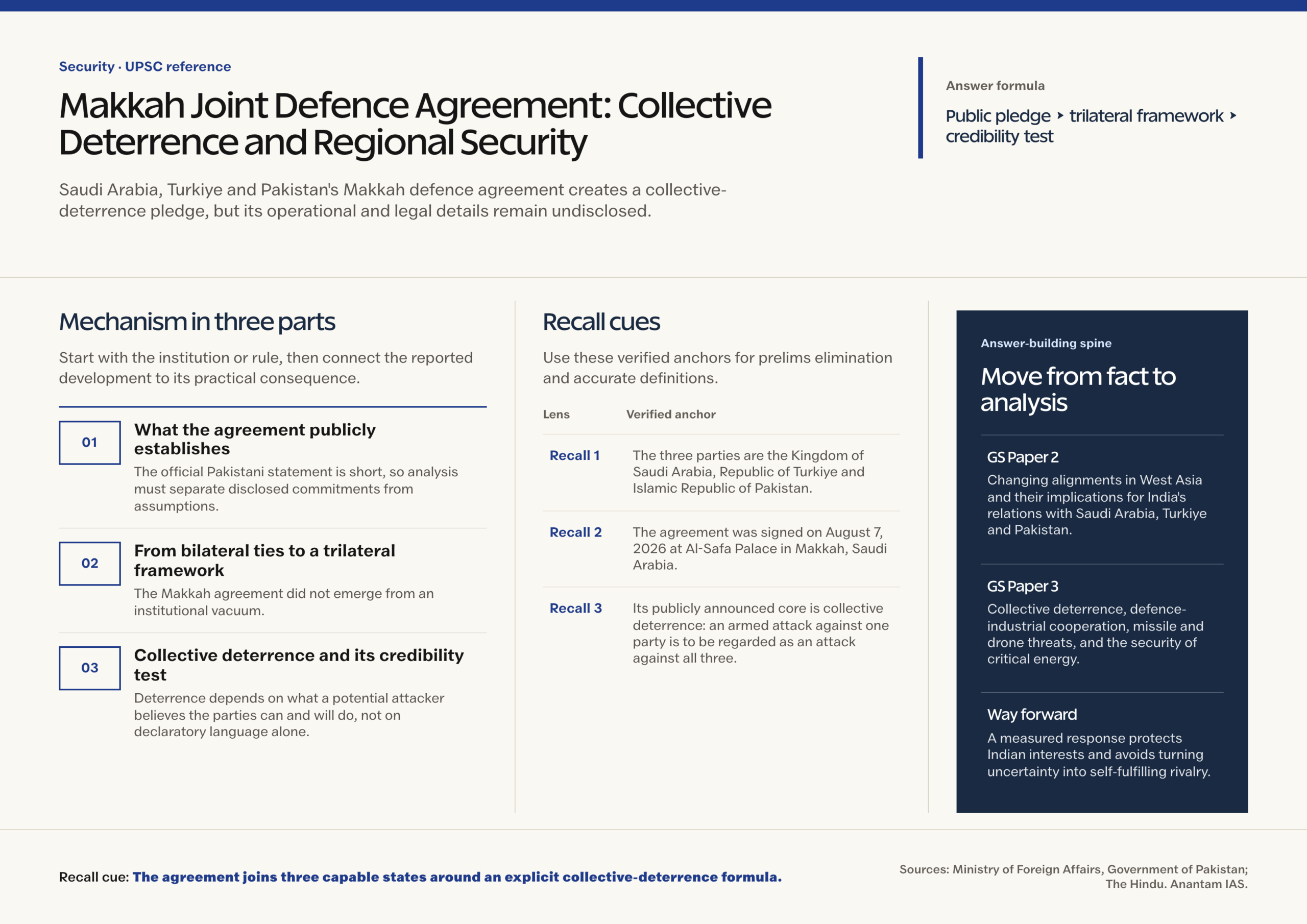
Makkah Joint Defence Agreement: Collective Deterrence and Regional Security
Why in News?
Saudi Arabia, Turkiye and Pakistan signed the Makkah Joint Defence Agreement at Al-Safa Palace in Makkah on August 7, 2026.
- The signatories were Saudi Crown Prince and Prime Minister Mohammed bin Salman, Turkish President Recep Tayyip Erdogan and Pakistani Prime Minister Muhammad Shehbaz Sharif.
- Pakistan’s Foreign Ministry said the agreement seeks to strengthen collective deterrence against aggression and enhance all aspects of defence cooperation among the three states.
- The official release ties the agreement to longstanding relations, Islamic solidarity and shared strategic interests, but it does not identify a target state in the text made public.
- The public communique does not disclose a full treaty text, geographic limits, common command, force commitments, entry-into-force clause or ratification requirements. These details cannot be presumed.
- The agreement builds on the Saudi Arabia-Pakistan Strategic Mutual Defense Agreement signed in Riyadh on September 17, 2025, while adding Turkiye as a third party to a new trilateral instrument.
- The agreement combines Saudi financial weight, Turkiye’s defence-industrial capacity, and Pakistan’s armed forces. These strengths improve deterrence only when backed by credible planning and coordination.
- For India, the relevant channels are wider than Pakistan. West Asian stability affects energy imports, maritime trade, the Indian diaspora and investment, while Turkiye’s NATO membership gives the pact an additional institutional dimension.
- The phrase ‘attack on one is an attack on all’ signals solidarity, but does not prove automatic military intervention. Unpublished clauses and domestic processes will shape any response.
UPSC Relevance
Prelims Relevance
- The three parties are the Kingdom of Saudi Arabia, Republic of Turkiye and Islamic Republic of Pakistan; Egypt is not a signatory to the Makkah Joint Defence Agreement.
- The agreement was signed on August 7, 2026 at Al-Safa Palace in Makkah, Saudi Arabia.
- Its publicly announced core is collective deterrence: an armed attack against one party is to be regarded as an attack against all three.
- Deterrence aims to prevent aggression by convincing an adversary that expected costs will outweigh gains; collective defence concerns assistance after a qualifying attack.
- Article 51 of the UN Charter preserves the inherent right of individual or collective self-defence if an armed attack occurs, until the Security Council takes necessary measures; measures taken must be reported to the Council.
- Turkiye is a member of NATO, but Saudi Arabia and Pakistan are not. The Makkah agreement is a separate arrangement and does not make either country a NATO ally.
Mains Relevance
GS Paper 2
- Changing alignments in West Asia and their implications for India’s relations with Saudi Arabia, Turkiye and Pakistan.
- Difference between flexible strategic partnerships, minilateral arrangements and treaty-based military alliances.
GS Paper 3
- Collective deterrence, defence-industrial cooperation, missile and drone threats, and the security of critical energy infrastructure.
- Possible effects of regional military coordination on escalation control, sea lanes and India’s national-security planning.
Essay
- Security promises deter conflict only when capability, credibility and communication reinforce one another.
Background and Context
What the agreement publicly establishes
The official Pakistani statement is short, so analysis must separate disclosed commitments from assumptions.
- The parties explicitly connect the pact to collective security, peace and regional stability, and commit to enhance all aspects of defence cooperation.
- The operative signal is that an armed attack on one party will be regarded as an attack on all three, raising the expected cost of aggression.
- No public clause specifies what assistance each state must provide, how an attack is jointly attributed, whether non-state, cyber or proxy attacks qualify, or which territories and forces are covered.
- It is a signed trilateral defence agreement with a public collective-defence clause, not yet a demonstrated integrated alliance or automatic war obligation.
From bilateral ties to a trilateral framework
The Makkah agreement did not emerge from an institutional vacuum.
- Saudi Arabia and Pakistan formalised an ‘attack on one, attack on both’ commitment through their Strategic Mutual Defense Agreement on September 17, 2025. Their defence relationship also rests on decades of training and security cooperation.
- Turkiye and Pakistan have developed military dialogue, personnel links and defence-industrial projects. Their February 2025 package included cooperation on electronic warfare, military health and defence production.
- Saudi Arabia and Turkiye signed an implementation plan on defence cooperation in 2023, alongside a major defence-industry agreement involving Baykar. Their relationship has increasingly moved from political repair toward practical cooperation.
- The pact can connect these bilateral tracks, but interoperability still requires shared doctrine, secure communications, logistics and decision procedures.
Collective deterrence and its credibility test
Deterrence depends on what a potential attacker believes the parties can and will do, not on declaratory language alone.
- A collective pledge can create deterrence by denial by improving air defence, intelligence and resilience, or deterrence by punishment by threatening a coordinated response.
- Credibility grows through joint planning, exercises, compatible equipment, pre-positioned logistics, intelligence sharing and clear crisis consultation. None of these implementation elements is detailed in the released statement.
- Ambiguity may leave an aggressor uncertain, but can also cause miscalculation if the parties interpret ‘armed attack’ differently.
- Pakistan possesses nuclear weapons, but the public statement does not announce a nuclear umbrella, nuclear sharing or extended nuclear guarantee. Nuclear implications must not be inferred from Pakistan’s status alone.
Relationship with international law and NATO
The right of collective self-defence exists within the UN Charter framework, while Turkiye’s NATO obligations remain institutionally separate.
- Under Article 51 of the UN Charter, collective self-defence follows an armed attack and does not displace the Security Council’s responsibility for international peace and security.
- A lawful response must meet requirements such as necessity and proportionality. A pact cannot legalise aggression or remove the Charter’s prohibition on unlawful force.
- Turkiye remains bound by the North Atlantic Treaty. NATO Article 5 applies within its treaty design and geographic scope, while the Makkah pact has its own, still undisclosed implementation rules.
- The agreement does not extend NATO guarantees to Saudi Arabia or Pakistan. Nor does a crisis involving a Makkah party automatically become a NATO collective-defence case; NATO decisions follow the Washington Treaty and allied procedures.
Way Forward
Seek clarity without alarmism
- Use diplomatic channels with Saudi Arabia and Turkiye to understand the pact’s scope, trigger conditions and implementation mechanisms.
- Distinguish confirmed clauses from scenarios. Public communication should flag genuine concerns without presenting every trilateral activity as directed against India.
- Diversify crude and gas sourcing, maintain emergency preparedness and deepen maritime-domain awareness across the Arabian Sea and western Indian Ocean.
- Update contingency coordination for Indian nationals, ports, shipping and aviation if a West Asian crisis disrupts transport corridors.
Conclusion
- The Makkah Joint Defence Agreement is a consequential political and security signal because it joins three capable states around an explicit collective-deterrence formula.
- Its real effect will depend on unpublished legal provisions and future implementation.
UPSC Practice Questions
Prelims MCQ 1
With reference to the Makkah Joint Defence Agreement, consider the following statements:
- It was signed by Saudi Arabia, Turkiye and Pakistan.
- Its public statement says an armed attack against one of the three states shall be regarded as an attack against all.
- It automatically extends NATO’s Article 5 guarantee to Saudi Arabia and Pakistan.
How many of the above statements are correct?
(a) Only one (b) Only two (c) All three (d) None
Answer: (b) Only two
Explanation:
Statements 1 and 2 reflect the official announcement of August 7, 2026. Statement 3 is incorrect: the Makkah agreement is separate from NATO, and Saudi Arabia and Pakistan are not NATO members.
Prelims MCQ 2
Article 51 of the United Nations Charter is primarily associated with which one of the following?
(a) Prohibition of all regional organisations (b) Inherent right of individual or collective self-defence after an armed attack (c) Compulsory economic sanctions without Security Council action (d) Automatic deployment of UN peacekeepers
Answer: (b) Inherent right of individual or collective self-defence after an armed attack
Explanation:
Article 51 preserves the inherent right of individual or collective self-defence if an armed attack occurs, until the Security Council takes the measures necessary to maintain international peace and security.
UPSC Mains Questions
- The Makkah Joint Defence Agreement reflects both the regionalisation of security and the persistence of overlapping alliances. Discuss its opportunities, limits and implications for India. (250 words)
- Collective-defence declarations create deterrence only when supported by credible institutions and capabilities. Examine with reference to emerging minilateral security arrangements. (250 words)
Sources: Ministry of Foreign Affairs, Government of Pakistan and The Hindu.
Frequently Asked Questions
What is the Makkah Joint Defence Agreement?
It is a trilateral defence agreement signed by Saudi Arabia, Turkiye and Pakistan in Makkah on August 7, 2026. The official announcement says an armed attack against any one of the three will be regarded as an attack against all.
Does the agreement require an automatic military response?
The public communique does not specify the form of assistance, decision process or domestic approvals. It establishes a strong collective-defence commitment, but the available text is insufficient to claim that troops must be deployed automatically in every qualifying crisis.
Is the pact an Islamic NATO?
That label is misleading at present. NATO has a founding treaty, permanent institutions, integrated planning and established procedures. The Makkah statement discloses a collective-defence clause but no comparable command structure, standing force or detailed institutional machinery.
Does Pakistan’s nuclear status create a nuclear umbrella for the other parties?
No such guarantee has been publicly announced. Pakistan is a nuclear-armed state, but the released agreement does not mention nuclear sharing, extended nuclear deterrence or control arrangements. A nuclear umbrella cannot be inferred merely from Pakistan’s participation.
How does Turkiye’s NATO membership affect the agreement?
Turkiye now participates in two separate security frameworks. NATO obligations continue under the North Atlantic Treaty, while the Makkah pact has its own rules. A crisis involving Saudi Arabia or Pakistan does not automatically trigger NATO Article 5.
Source: https://anantamias.com/current-affairs/mecca-joint-defence-agreement-regional-security/
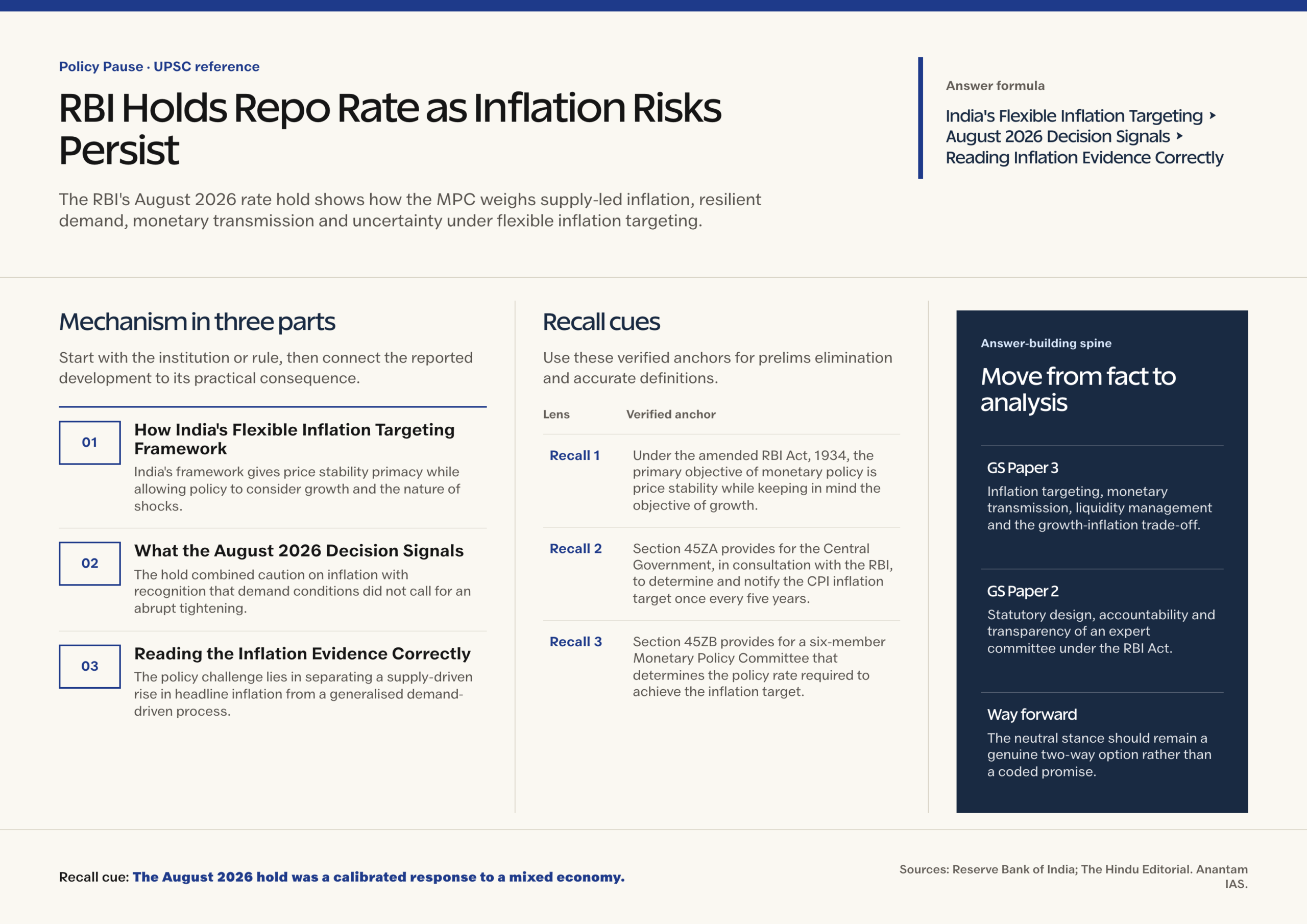
RBI Holds Repo Rate as Inflation Risks Persist
Why in News?
The Reserve Bank of India’s Monetary Policy Committee , meeting from August 3 to 5, 2026, unanimously kept the policy repo rate unchanged at 5.25% and retained a neutral stance.
- The August meeting was the 62nd meeting of the six-member MPC and was chaired by RBI Governor Sanjay Malhotra.
- With the repo rate unchanged, the Standing Deposit Facility rate remained at 5.00%, while the Marginal Standing Facility rate and Bank Rate remained at 5.50%.
- The RBI projected real GDP growth for 2026-27 at 6.7%, with quarterly growth of 7.0%, 6.4%, 6.5% and 6.8% from Q1 to Q4.
- It projected CPI inflation at 5.0% for 2026-27, with Q2 at 4.7%, Q3 at 5.9% and Q4 at 5.5%; Q1 of 2027-28 was projected at 5.3%.
- June 2026 CPI inflation rose to 4.4% after remaining below the 4% target for 16 consecutive months, mainly because of higher food and fuel inflation.
- A rate hold is an active policy choice: it preserves the current degree of monetary restraint while the MPC observes how earlier decisions transmit to credit, demand and prices.
- The distinction between headline inflation and core inflation excluding food, fuel and precious metals helps identify whether a price shock is broad-based or concentrated in volatile supply-sensitive items.
- A neutral stance gives the MPC room to raise, cut or hold rates as data evolve; it is not a promise of an imminent move in either direction.
UPSC Relevance
Prelims Relevance
- Under the amended RBI Act, 1934, the primary objective of monetary policy is price stability while keeping in mind the objective of growth.
- Section 45ZA provides for the Central Government, in consultation with the RBI, to determine and notify the CPI inflation target once every five years.
- Section 45ZB provides for a six-member Monetary Policy Committee that determines the policy rate required to achieve the inflation target.
- The inflation target is 4% CPI inflation, with a tolerance band of 2% to 6%; the target is distinct from the edges of the tolerance band.
- The repo rate is the rate at which the RBI supplies short-term liquidity to banks against eligible collateral under the liquidity adjustment facility.
- The uncollateralised Standing Deposit Facility forms the floor of the policy corridor, while the Marginal Standing Facility forms its upper bound.
Mains Relevance
GS Paper 3
- Inflation targeting, monetary transmission, liquidity management and the growth-inflation trade-off.
- Imported inflation through oil, exchange-rate and supply-chain channels, along with food inflation arising from weather and agricultural supply shocks.
GS Paper 2
- Statutory design, accountability and transparency of an expert committee under the RBI Act.
- Institutional balance between an independent central bank, a government-notified inflation target and elected-government supply measures.
Essay
- Economic stability often requires patience under uncertainty: credible institutions must distinguish temporary shocks from persistent trends before acting.
Background and Context
How India's Flexible Inflation Targeting Framework Works
India’s framework gives price stability primacy while allowing policy to consider growth and the nature of shocks.
- The 2016 amendments to the RBI Act placed flexible inflation targeting and the MPC on a statutory footing, replacing sole-person discretion over the policy rate with committee-based decision-making.
- The numerical anchor is headline Consumer Price Index inflation of 4%, not simply any reading within 2% to 6%. The tolerance band recognises measurement uncertainty and supply shocks but does.
- The MPC has three RBI representatives and three external members appointed by the Central Government. Each member has one vote; the Governor has a casting vote in case of a tie.
- If average inflation is above 6% or below 2% for three consecutive quarters, the framework treats it as a failure to meet the target and requires the RBI to explain the causes.
- Publication of the resolution, vote and later individual statements improves accountability. It also helps households and markets understand the reaction function rather than treating the repo rate as an isolated number.
What the August 2026 Decision Signals
The hold combined caution on inflation with recognition that demand conditions did not call for an abrupt tightening.
- The unanimous decision left the repo rate at 5.25% and kept the corridor symmetric: the SDF was 25 basis points below the repo rate and the MSF and Bank Rate were 25 basis points.
- A neutral stance preserves two-way flexibility. The committee can respond to fresh inflation or growth evidence without a prior commitment to easing or tightening.
- The RBI assessed domestic demand as steady: private consumption remained robust, investment indicators linked to construction, capital goods and bank credit were resilient, and services exports stayed healthy.
- The 2026-27 GDP projection of 6.7% was paired with evenly balanced risks. This matters because resilient growth gives the MPC space to wait for clearer inflation evidence rather than using an immediate cut as.
- A pause also allows the effects of earlier monetary decisions to pass through bank deposit rates, lending rates, bond yields, borrowing decisions and aggregate demand. Transmission operates with lags and is rarely uniform across borrowers.
Reading the Inflation Evidence Correctly
The policy challenge lies in separating a supply-driven rise in headline inflation from a generalised demand-driven process.
- Headline CPI inflation rose to 4.4% in June 2026, mainly due to food and fuel. Food price pressure was broad-based during May and June, while retail fuel revisions followed a spike in international.
- Core inflation excluding food and fuel remained at 3.9% in May and June. When precious metals were also excluded, the RBI placed core inflation at only 2.3% to 2.5%, suggesting contained demand pressure at that stage.
- The RBI expected headline inflation to peak at 5.9% in Q3 of 2026-27 before moderating. A projected peak below the 6% upper tolerance limit still demands attention because the operational aim is.
- A temporary relative-price shock need not justify the same response as persistent generalised inflation. Yet repeated food and fuel shocks can raise transport, restaurant, wage and input costs, creating second-round effects and unanchoring expectations.
- The committee’s wait for clarity is best read as risk management, not complacency: cutting too soon could amplify pass-through, while tightening against a temporary supply shock could impose avoidable costs on investment and employment.
Supply Shocks and the Limits of the Repo Rate
Interest rates influence aggregate demand and expectations, but cannot directly produce food, improve rainfall or increase imported energy supply.
- An uneven south-west monsoon under El Niño conditions can reduce crop yields, affect reservoir conditions and rural income, and raise food prices across regions. Adequate grain stocks and timely releases can soften, but not erase, these.
- Volatile global oil prices can create imported inflation through fuel, freight, fertiliser, petrochemicals and exchange-rate channels. A weaker rupee can raise the domestic cost of dollar-priced imports.
- Higher interest rates can restrain credit-financed demand and help anchor expectations. They are less effective against the first-round impact of a failed crop or an external oil shock, so an excessive response may hurt output without.
- The correct policy mix includes monetary credibility alongside buffer-stock operations, better logistics, calibrated trade measures, energy diversification and targeted fiscal support that does not create broad demand pressure.
- Distribution matters: food and fuel occupy a larger share of poorer households’ budgets, while rate changes affect borrowers, savers, MSMEs, housing demand and public borrowing differently.
Way Forward
Keep Policy Data-Dependent and Symmetric
- Track sequential momentum, diffusion across CPI groups, household expectations, wages and core inflation excluding precious metals before changing the rate.
- Explain which evidence would make a supply shock persistent enough to require monetary action, improving predictability without surrendering flexibility.
- Avoid overreacting to favourable base effects or a single monthly print; place greater weight on the durability and breadth of disinflation.
Conclusion
- The August 2026 hold was a calibrated response to a mixed economy: resilient demand and moderate underlying inflation on one side, rising food-fuel pressure and unusually uncertain global and monsoon conditions on the other.
- The larger lesson is that credible monetary policy cannot substitute for food, energy and logistics reform.
UPSC Practice Questions
Prelims MCQ 1
With reference to India’s monetary policy framework, consider the following statements:
- The Monetary Policy Committee is a six-member body constituted under the Reserve Bank of India Act, 1934.
- The Standing Deposit Facility rate normally forms the ceiling of the liquidity adjustment facility corridor.
- The weighted average call rate is the operating target of monetary policy.
How many of the above statements are correct?
(a) Only one (b) Only two (c) All three (d) None
Answer: (b) Only two
Explanation:
Statements 1 and 3 are correct. The MPC has six members, and liquidity management seeks to align the weighted average call rate with the repo rate. The SDF is the floor of the corridor; the MSF is its ceiling.
Prelims MCQ 2
Which one of the following best describes a neutral monetary policy stance?
(a) A binding commitment to reduce the repo rate at the next meeting (b) A policy of maintaining surplus liquidity regardless of inflation (c) Flexibility to move the policy rate in either direction as the outlook evolves (d) Suspension of the inflation target during supply shocks
Answer: (c) Flexibility to move the policy rate in either direction as the outlook evolves
Explanation:
A neutral stance preserves two-way flexibility. It neither promises a cut nor rules out a hike, and it does not suspend the statutory inflation-targeting framework.
UPSC Mains Questions
- The RBI’s August 2026 policy pause highlights both the value and the limits of interest-rate policy against supply-led inflation. Discuss.
- Explain the institutional design of India’s flexible inflation-targeting framework. How do transparency and committee-based decisions strengthen monetary policy credibility?
Sources: Reserve Bank of India and The Hindu Editorial.
Frequently Asked Questions
What did the RBI decide in August 2026?
The six-member Monetary Policy Committee unanimously kept the repo rate at 5.25% and retained a neutral stance. The SDF stayed at 5.00%, while the MSF and Bank Rate remained at 5.50%. The decision preserved flexibility while the RBI assessed inflation.
Why did the RBI hold the repo rate despite rising inflation?
June inflation rose mainly because of food and fuel, while core inflation excluding precious metals remained low. Growth was resilient and the outlook uncertain. The MPC chose to wait for evidence on whether supply costs would spread into broader prices.
What is the difference between the 4% inflation target and the 2%-6% band?
Four per cent is the medium-term CPI inflation anchor. The 2%-6% range is a tolerance band that recognises shocks and uncertainty; it is not a zone in which every outcome is equally desirable. Policy remains focused on durable alignment of.
How does a repo rate hold affect borrowers?
A hold means the RBI has not changed its benchmark lending rate, so there is no automatic policy-driven reset. Actual loan rates can still change with funding costs, benchmark-reset dates, competition and liquidity. Repo-linked floating loans generally transmit policy changes.
Why is food inflation difficult for monetary policy to control?
Food prices often rise because of rainfall, crop loss, storage, transport or supply restrictions. A higher repo rate can restrain demand and expectations but cannot directly create crops or repair logistics. Supply management and agricultural resilience are needed alongside credible.
Source: https://anantamias.com/current-affairs/rbi-monetary-policy-rate-hold-inflation-risks/
Indian Statistical Institute Bill: Autonomy, Accountability and Governance Reform
Why in News?
The government has prepared the Indian Statistical Institute Bill, 2026 for introduction in the Lok Sabha, proposing a comprehensive statutory framework for the Indian Statistical Institute (ISI).
- The proposed law would repeal and replace the Indian Statistical Institute Act, 1959, while retaining ISI’s status as an Institution of National Importance.
- It seeks to incorporate ISI as a statutory body corporate with perpetual succession, property-holding and contracting powers, replacing the unusual arrangement under which an institution declared nationally important continued to operate as a registered society.
- A March 2026 Lok Sabha reply said the proposed Board of Governors would have 11 members: one government nominee, five external experts including the Chairperson, and five internal members including two Academic Council members.
- The President of India would be the Visitor; the Board would be the principal policy-making executive body; and the Academic Council would remain the principal academic body.
- The framework seeks greater autonomy for centres through Management Councils, while placing them within the Institute’s common academic planning and governance structure.
- ISI was founded in 1931. Parliament declared it an Institution of National Importance through the 1959 Act, recognising its contribution to statistics, research, teaching and planning.
- MoSPI has cited review committees, including the fourth committee chaired by R. A. Mashelkar, as identifying delayed decisions, weak accountability and structural inertia in the society-based model.
- The governance reform matters beyond one institute because credible statistics, data science and quantitative research support evidence-based public policy, economic measurement and state capacity.
UPSC Relevance
Prelims Relevance
- The Indian Statistical Institute is an Institution of National Importance under a law made by Parliament.
- The existing governing statute is the Indian Statistical Institute Act, 1959; it was amended in 1995 to widen the subjects in which ISI could grant degrees and diplomas.
- Under the proposed framework, ISI would be a body corporate, meaning a legal person with perpetual succession that may hold property, contract, and sue or be sued in its own name.
- The President of India is proposed as the Visitor of the Institute, with powers to order reviews or inquiries and act on their reports.
- The proposed Board of Governors is the principal policy-making executive body, while the Academic Council is the principal academic body.
- The publicly available revised draft provided for 11 Board members: five external experts including the Chairperson, five internal representatives and one nominee of the administrative ministry.
Mains Relevance
GS Paper 2
- Governance of autonomous public institutions: balancing functional autonomy with financial, parliamentary and performance accountability.
- Design of governing bodies: representation, independent expertise, transparency of appointments, conflict-of-interest safeguards and the relationship between executive and academic organs.
GS Paper 3
- Building national capability in statistics, data science and frontier technologies for research, innovation and evidence-based governance.
- Protecting research quality and credibility while encouraging collaboration with government, industry and international institutions.
Essay
- Institutions become credible when freedom to pursue knowledge is matched by a duty to explain decisions and outcomes.
Background and Context
Why the 1959 Framework Is Being Revisited
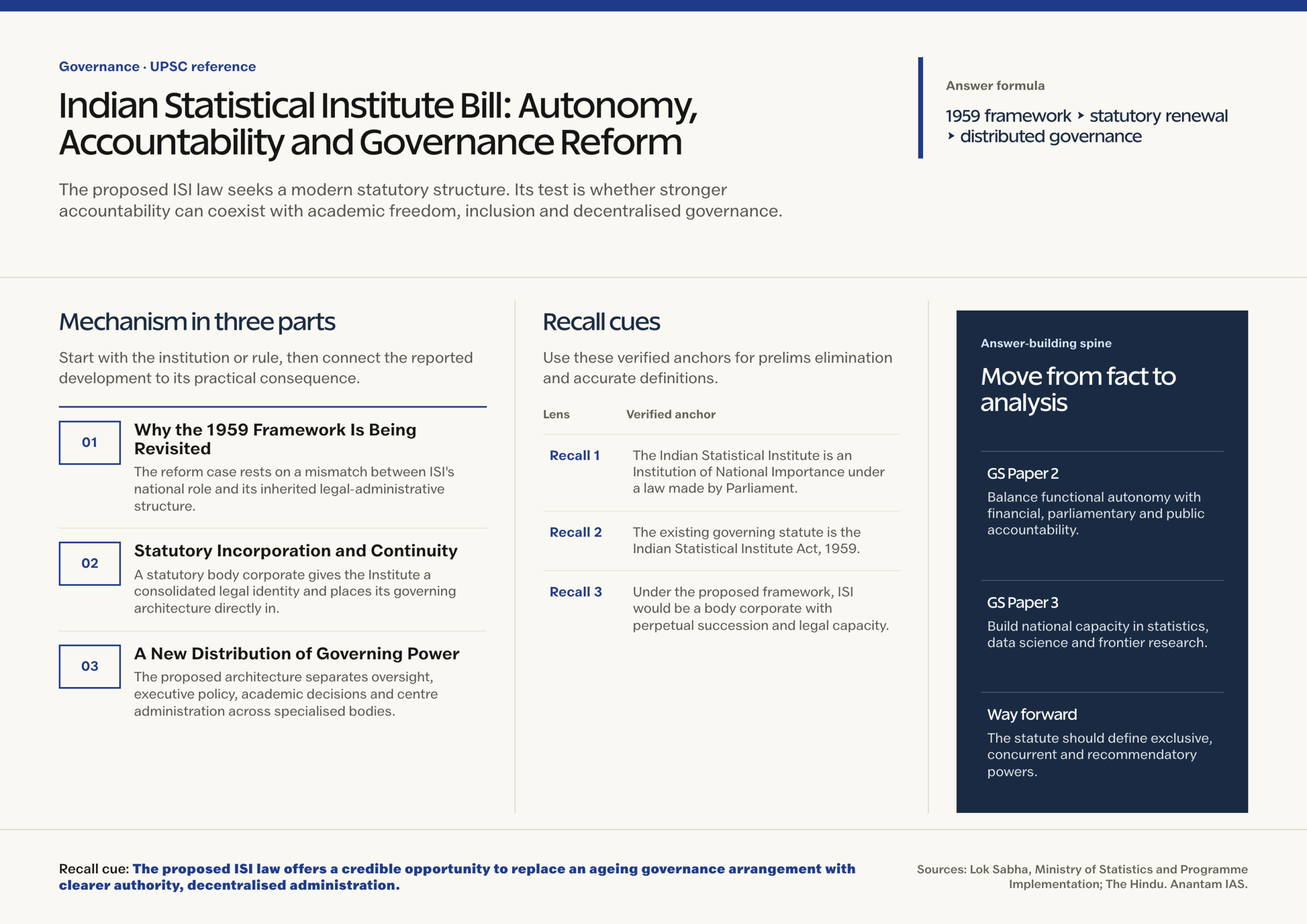
The reform case rests on a mismatch between ISI’s national role and its inherited legal-administrative structure.
- The 1959 Act declared ISI nationally important and empowered it to award academic qualifications, but the Institute continued as a registered society. MoSPI says this structure is now exceptional among more than 160 Institutions of.
- The Ministry’s official FAQ said ISI’s General Body has more than 1,000 members and that changes to prescriptive society instruments require approval by three-fourths of members voting. It presented this as a cause of slow reform.
- MoSPI also reported that the Governing Council had grown to 33 members, with substantial internal representation. Successive review committees had recommended a smaller council and clearer executive responsibility.
- These are the government’s stated reasons, not a complete evaluation. Institutional participation can prevent arbitrary decisions, while an oversized body can diffuse responsibility. Reform must preserve the benefits of collegial governance without allowing veto points to.
Statutory Incorporation and Continuity
A statutory body corporate gives the Institute a consolidated legal identity and places its governing architecture directly in legislation.
- The proposed incorporation would give ISI perpetual succession, a common seal, power to acquire and dispose of property, capacity to contract and the ability to sue or be sued.
- The revised draft contained transition clauses transferring the existing society’s assets, liabilities, contracts and legal proceedings to the statutory Institute.
- It also protected continuity for existing employees and students, subject to the detailed statutory transition. Such provisions reduce the risk that organisational conversion interrupts teaching, research, employment or pending legal obligations.
- Statutory status is not automatically equivalent to autonomy. The practical outcome depends on who appoints office-holders, which matters require government approval, how regulations are made and whether academic bodies possess clearly protected decision rights.
A New Distribution of Governing Power
The proposed architecture separates oversight, executive policy, academic decisions and centre administration across specialised bodies.
- The Visitor may cause the Institute’s work and progress to be reviewed, order inquiries and issue directions after considering reports. This creates an apex oversight channel, but its use should follow due process and respect expert.
- The 11-member Board is intended to be leaner and expertise-led. Its mixed composition can reduce direct government presence, yet safeguards are still needed for transparent nomination, diversity, fixed tenure, conflict disclosure and recorded reasons for major.
- The Board would exercise general superintendence and control, approve budgets and development plans, create posts, and act on centres and programmes. The earlier draft also described it as the final decision-making body across academic, administrative, personnel.
- That breadth creates an important design question: where the Academic Council has mandatory functions, the Board should not substitute managerial preference for disciplinary expertise. A statutory non-interference clause, consultation requirements and published decision protocols can make.
Academic Autonomy and the Role of Faculty
Academic freedom becomes operational only when the academic body controls core scholarly standards.
- The revised draft made the Academic Council the principal academic body and included the Director, Centre-Directors, division heads, all full-time professors, a specified number of other full-time faculty and deans.
- Its direct functions included organising and modifying courses, deciding student eligibility and selection procedures, specifying examination and evaluation systems, and promoting interdisciplinary study and research.
- For introduction or discontinuation of programmes, award of degrees and external collaboration, the draft used a recommendation-to-Board model. This is where careful drafting matters: consultation should be meaningful, and departure from academic recommendations should require written.
- Academic autonomy also needs protections below the council level: peer-led hiring and promotion, freedom to publish, access to research data, ethical review, stable funding for basic research and space for minority scholarly views.
Way Forward
Clarify the Autonomy Boundary in the Law
- Protect the Academic Council’s final authority over curriculum, evaluation and research standards, with a narrowly defined process for reconsideration on legal or financial grounds.
- Require the Board to record reasons when it differs from an academic recommendation and publish non-confidential decisions and minutes within a fixed period.
- Use publicly known eligibility criteria, diverse search-cum-selection committees, conflict-of-interest declarations and fixed timelines for choosing the Chairperson, Director and external experts.
- Ensure meaningful representation of faculty, centres, women and relevant disciplines without allowing any single internal or external constituency to dominate.
Conclusion
- The proposed ISI law offers a credible opportunity to replace an ageing governance arrangement with clearer authority, decentralised administration and stronger public reporting.
- The durable test is whether the final Act makes academic judgement secure, leadership selection transparent, centres genuinely capable, and oversight proportionate.
UPSC Practice Questions
Prelims MCQ 1
With reference to the proposed governance framework for the Indian Statistical Institute, consider the following statements:
- The President of India is proposed to be the Visitor of the Institute.
- The Academic Council is proposed as the principal academic body of the Institute.
- The Institute is proposed to operate as a for-profit government company.
How many of the above statements are correct?
(a) Only one (b) Only two (c) All three (d) None
Answer: (b) Only two
Explanation:
Statements 1 and 2 are correct. The proposed framework names the President as Visitor and the Academic Council as the principal academic body. Statement 3 is incorrect because the revised draft treats ISI as a not-for-profit statutory body corporate, not a government company operating for profit.
Prelims MCQ 2
Which one of the following best describes a statutory body corporate?
(a) A temporary committee created only by an executive order (b) A private association having no separate legal personality (c) A legal entity created or incorporated under a statute, with continuity and powers defined by law (d) A constitutional body whose composition can be changed only by a constitutional amendment
Answer: (c) A legal entity created or incorporated under a statute, with continuity and powers defined by law
Explanation:
A statutory body derives its existence, powers and governance framework from legislation. Incorporation gives it a legal identity with continuity and the capacity to hold property, contract, and sue or be sued, subject to its parent law.
UPSC Mains Questions
- A public academic institution needs autonomy from day-to-day control but cannot be exempt from public accountability. Examine this proposition in the context of the proposed Indian Statistical Institute governance reforms. (250 words)
- How can the design of governing boards and academic councils balance executive efficiency, expert judgement and stakeholder representation in Institutions of National Importance? Discuss. (250 words)
Sources: Lok Sabha, Ministry of Statistics and Programme Implementation and The Hindu.
Frequently Asked Questions
Why is a new law proposed for the Indian Statistical Institute?
The government says the 1959 Act is too limited for contemporary governance, finance and accountability needs, while ISI still operates through a society-based structure. The proposed law would incorporate ISI as a statutory body corporate, create defined authorities and align.
Will the Bill end ISI’s status as an Institution of National Importance?
No. The proposal reiterates ISI’s status as an Institution of National Importance. The change concerns its legal incorporation and governance architecture. It would replace the 1959 Act with a more detailed statute while continuing the Institute’s nationally important academic.
What is the proposed role of the Board of Governors?
The Board would be the principal policy-making executive body. It would oversee strategy, budgets, development, appointments and administration. The official March 2026 parliamentary reply described an 11-member Board with five external experts, five internal members and one nominee of the.
How does the framework seek to protect academic autonomy?
It identifies the Academic Council as the principal academic body and assigns it functions concerning courses, student selection, examinations, evaluation and interdisciplinary research. Real protection will depend on the final allocation of powers, transparent appointments and whether the Board must.
Does the draft require higher fees or end student stipends?
The government’s FAQ says the framework itself does not alter the existing fee or stipend regime. It enables revenue from fees, consultancy, research, intellectual property and donations, while keeping ISI not-for-profit and providing for scholarships. Future regulations, budgets and disclosure.
Source: https://anantamias.com/current-affairs/indian-statistical-institute-bill-governance-reform/
Dedicated Satellite Capacity for Himalayan Forest-Fire Monitoring
Why in News?
The Indian Express reported a parliamentary push for dedicated satellite capacity to monitor forest fires in the Himalayan region, bringing the gaps in detection and response into policy focus.
- The Rajya Sabha Department-related Parliamentary Standing Committee on Science and Technology, Environment, Forests and Climate Change presented its 405th Report on 9 March 2026 while examining the Environment Ministry’s Demands for Grants for 2026-27.
- The committee observed that forest fires were becoming more frequent and damaging forests, biodiversity and wildlife; it specifically noted the recurring summer fire problem in Uttarakhand.
- It recommended a Himalayan fire-dousing protocol and exploration of satellites, drones, artificial intelligence and data-driven systems for early detection, alerts and assessment of the cause and nature of fires.
- The report also asked for adequate budgetary support to states, recognising that a warning is useful only when field teams can reach, verify and contain the fire.
- A dedicated monitoring capability is best understood as an end-to-end public system: suitable sensors, frequent observations, fast processing, interoperable alerts and accountable ground action, not merely a spacecraft launch.
- Himalayan terrain creates a difficult response environment: steep slopes, remote forests, wind-driven spread and weak road access can turn a small ignition into a large incident before crews arrive.
- Satellite thermal observations can watch large and inaccessible areas consistently, but orbital revisit time, cloud, smoke, sensor resolution and alert latency affect what is detected and when.
- Forest fire is both an ecological and governance issue. It affects habitat, soil, water regulation, local livelihoods, public health, carbon storage and the safety of frontline personnel.
UPSC Relevance
Prelims Relevance
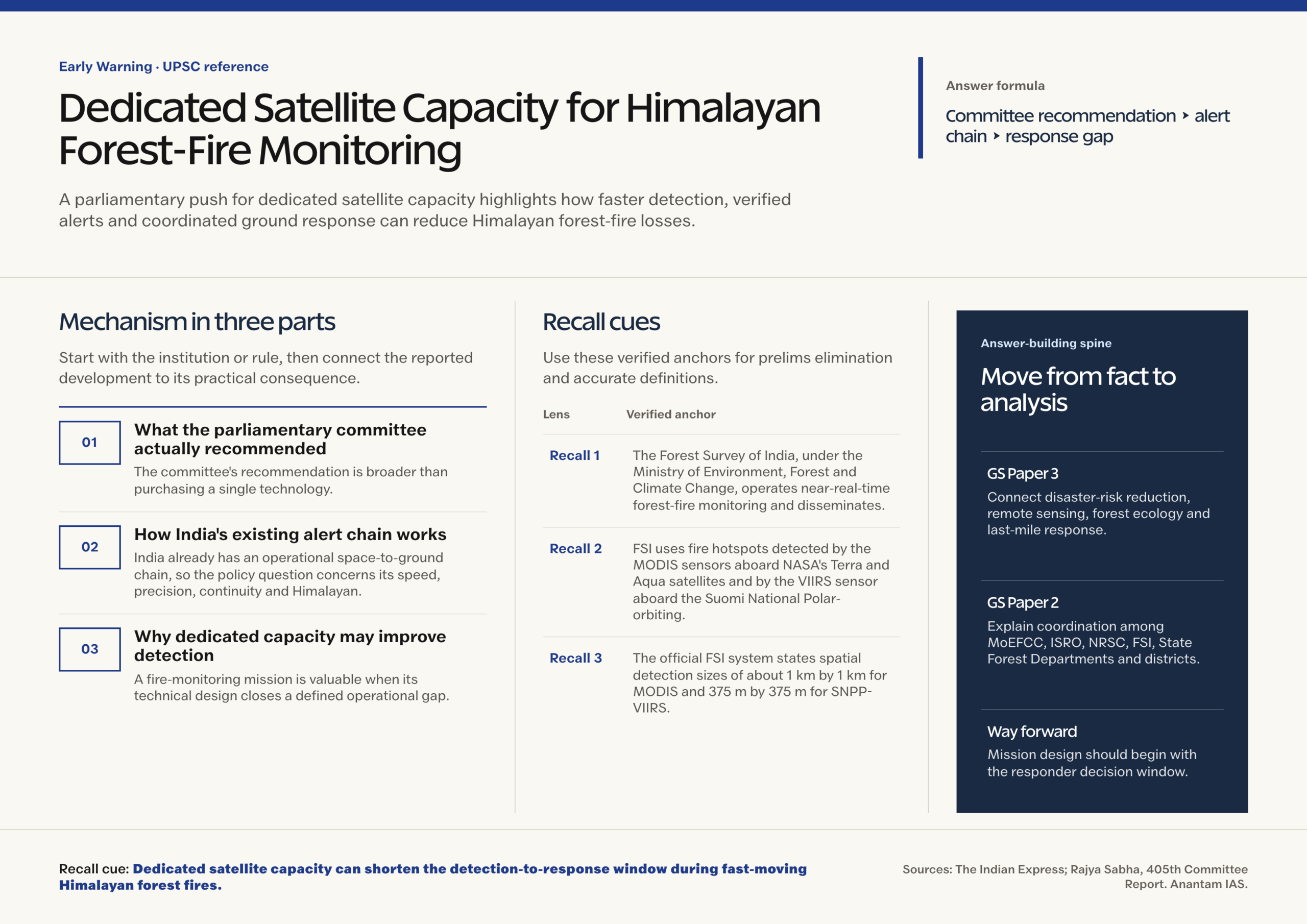
- The Forest Survey of India, under the Ministry of Environment, Forest and Climate Change, operates near-real-time forest-fire monitoring and disseminates alerts to State Forest Departments.
- FSI uses fire hotspots detected by the MODIS sensors aboard NASA’s Terra and Aqua satellites and by the VIIRS sensor aboard the Suomi National Polar-orbiting Partnership satellite.
- The official FSI system states spatial detection sizes of about 1 km by 1 km for MODIS and 375 m by 375 m for SNPP-VIIRS; these are hotspot pixel scales, not precise burnt-area boundaries.
- FSI receives the hotspot data through the National Remote Sensing Centre’s Shadnagar Earth Station, processes it using standard algorithms and sends alerts through email, KML files and registered SMS services.
- The Large Forest Fire Monitoring programme uses VIIRS data and identifies a candidate large fire when at least three contiguous VIIRS pixels are detected; it then tracks the estimated boundary across later satellite passes.
- The FSI system continues scanning a large-fire area for three days after apparent inactivity to detect a possible dormant-fire restart.
Mains Relevance
GS Paper 3
- Use the issue to connect disaster-risk reduction, remote sensing, climate adaptation, forest ecology and last-mile response capacity.
- Evaluate dedicated satellite capacity through four criteria: spatial resolution, temporal frequency, detection latency and integration with field command systems.
GS Paper 2
- Examine cooperative governance among MoEFCC, ISRO and NRSC, FSI, State Forest Departments, district administrations and disaster-management authorities.
- Use parliamentary scrutiny of scheme expenditure to show how legislative committees link public finance, administrative performance and policy redesign.
Essay
- Technology becomes public capacity only when information reaches the right institution in time and produces action on the ground.
Background and Context
What the parliamentary committee actually recommended
The committee’s recommendation is broader than purchasing a single technology.
- It called for a protocol that can be followed when a forest fire occurs in the Himalayan belt, addressing the need for common operational steps across jurisdictions.
- It asked the Environment Ministry to explore modern technologies, including satellites and drones, for early detection, alerts, cause assessment and fire characterisation.
- It urged a proactive model based on artificial intelligence and data, coupled with adequate financial support to State Governments.
- Its budget discussion places technology alongside field infrastructure, watchers, water storage, equipment and prevention work.
How India's existing alert chain works
India already has an operational space-to-ground chain, so the policy question concerns its speed, precision, continuity and Himalayan suitability.
- Polar-orbiting satellites carrying MODIS and VIIRS observe thermal anomalies during their passes. FSI overlays detections with forest information and converts relevant observations into alerts.
- FSI states that it alerts State Forest Departments at least six times in 24 hours. Alerts are shared with Principal Chief Conservators of Forests, forest-fire nodal officers and registered users.
- The Van Agni geoportal, KML layers and web-map services support visualisation. Large-fire monitoring adds repeated tracking and escalation to district or disaster authorities.
- ISRO and NRSC provide Earth-observation capacity, FSI turns detections into forestry alerts, and states retain the decisive field role.
Why dedicated capacity may improve detection
A fire-monitoring mission is valuable when its technical design closes a defined operational gap.
- Higher temporal resolution can reduce the wait between observations. This matters where heat, wind and dry fuel cause rapid spread between polar-orbiting passes.
- Finer spatial resolution may identify smaller ignitions and better separate forest hotspots from nearby settlements, roads or agricultural burns, subject to sensor performance and validation.
- Mid-wave and long-wave infrared sensing can support day-and-night fire detection. On-board processing and priority downlink can reduce latency if the ground segment and alert rules are designed with the spacecraft.
- A Himalayan service could combine hotspots with slope, vegetation, wind, dryness, settlements and access routes to generate a risk-ranked operational picture.
Why a satellite alone cannot solve the problem
Early detection creates decision time; it does not itself put out a fire.
- Cloud, dense smoke, terrain effects and the relationship between fire size and sensor pixel can produce missed detections or uncertain locations. Every alert needs a stated confidence level and a route for field confirmation.
- A dedicated low-Earth-orbit satellite still has revisit limits. Continuous coverage may require a constellation, suitable geostationary observations, data-sharing with other missions or a blended architecture.
- Detection of heat does not automatically prove the ignition source. Claims about negligence, deliberate burning or land-use activity need field evidence and due process.
- Remote Himalayan locations may lack crews, communications, water, equipment or safe access. More alerts without response capacity will not reduce loss.
- Fire exclusion everywhere can be ecologically unsound. Management should distinguish destructive wildfire from carefully governed controlled fire where science and local conditions support it.
Way Forward
Define the capability before choosing the spacecraft
- Specify minimum detectable fire, revisit frequency, night capability, acceptable alert latency, Himalayan coverage, cloud limitations and the intended escalation path.
- Compare a dedicated satellite, hosted payload, constellation, geostationary sensor and shared domestic or international data against life-cycle cost and service reliability.
- Create an open technical evaluation and independent validation plan using known fires and field observations before operational acceptance.
Conclusion
- Dedicated satellite capacity can give Himalayan responders something scarce during a fast-moving forest fire: time .
- India should treat the proposal as a disaster-governance mission rather than a stand-alone space project.
UPSC Practice Questions
Prelims MCQ 1
With reference to near-real-time forest-fire monitoring in India, consider the following statements:
- The Forest Survey of India uses detections from both MODIS and SNPP-VIIRS sensors.
- SNPP-VIIRS fire detections used by FSI have a finer stated spatial resolution than MODIS detections.
- A satellite thermal hotspot by itself conclusively establishes the cause of a forest fire.
How many of the above statements are correct?
(a) Only one (b) Only two (c) All three (d) None
Answer: (b) Only two
Explanation:
Statements 1 and 2 are correct. FSI uses MODIS and SNPP-VIIRS detections, with stated pixel sizes of about 1 km and 375 m respectively. A hotspot shows anomalous thermal activity; field evidence is needed to determine cause and status.
Prelims MCQ 2
Which one of the following best describes the Forest Fire Prevention and Management Scheme?
(a) A Central Sector Scheme implemented exclusively by ISRO (b) A Centrally Sponsored Scheme supporting States and Union Territories (c) A statutory fund administered by the National Disaster Management Authority (d) A component of the National Clean Air Programme limited to the Himalayan states
Answer: (b) A Centrally Sponsored Scheme supporting States and Union Territories
Explanation:
The Environment Ministry provides financial assistance to States and Union Territories under the Centrally Sponsored Forest Fire Prevention and Management Scheme for prevention, infrastructure, equipment, communication, watchers and related measures.
UPSC Mains Questions
- A dedicated forest-fire satellite can improve warning time, but it cannot substitute for last-mile state capacity. Discuss with reference to the Himalayan region. (250 words)
- Examine how remote sensing, artificial intelligence and community-based forest management can be integrated into an accountable Himalayan forest-fire response system. (250 words)
Sources: The Indian Express and Rajya Sabha, 405th Committee Report.
Frequently Asked Questions
What did the parliamentary committee recommend on Himalayan forest fires?
It sought a common protocol for dousing forest fires in the Himalayan belt and asked the Environment Ministry to explore satellites, drones, artificial intelligence and data-driven methods for prevention, early detection, alerts and assessment. It also called for adequate financial.
Does India already monitor forest fires from space?
Yes. The Forest Survey of India uses MODIS and SNPP-VIIRS hotspot detections received through the National Remote Sensing Centre, processes them automatically and sends alerts to State Forest Departments. FSI also operates large-fire tracking, a geoportal and fire-danger-related services.
Why might dedicated satellite capacity still be useful?
A purpose-designed service could improve observation frequency, spatial detail, night detection and alert latency for India’s operational needs. The benefit depends on payload choice, orbit or constellation design, ground processing, communications and integration with responders, not on the label ‘dedicated’.
Can a satellite identify who caused a forest fire?
Not conclusively. Thermal and optical data can locate heat, estimate spread and provide contextual clues, but attribution needs field inspection, witness accounts and other evidence. Public systems should separate detection confidence from claims about negligence or deliberate ignition.
What is the main limitation of technology-led forest-fire policy?
A fast alert has little value if there is no crew, water, equipment, communications or safe access. Technology must sit inside an end-to-end system that covers prevention, verification, dispatch, containment, responder safety, community participation and post-fire ecological restoration.
Source: https://anantamias.com/current-affairs/himalayan-forest-fire-dedicated-satellite-monitoring/
Supreme Court Judicial Sensitivity Guidelines
Why in News?
The Supreme Court has approved an expert report and handbook on judicial sensitivity in sexual-offence and other vulnerable cases, and directed courts across India to follow its expressions and standards.
- The framework was prepared by an Expert Committee of the National Judicial Academy, Bhopal, after the Supreme Court’s February 10, 2026 judgment in In Re: Order dated 17.03.2025 Passed by the High Court of Judicature.
- The Court ordered wide circulation to High Courts, district courts, State Legal Services Authorities, State Law Departments and Directorates of Prosecution so that sensitivity is embedded across the justice chain.
- Directorates of Prosecution were asked to communicate the safeguards to relevant authorities and support the sensitisation of police personnel while registering FIRs and filing charge sheets in sexual-offence cases.
- The immediate institutional concern arose from orders that treated grave allegations through narrow or insensitive reasoning, showing that correct legal doctrine and humane procedure must operate together.
- Insensitive language can reproduce myths about consent, credibility, clothing, resistance or a survivor’s conduct, leading to secondary victimisation inside the justice system.
- A person may formally possess legal rights yet be unable to exercise them if courtroom language, repeated narration, hostile questioning or inaccessible procedure creates fear and humiliation. This makes sensitivity an access-to-justice issue, not courtroom.
- The framework preserves fair-trial rights and the presumption of innocence; sensitivity does not lower the standard of proof.
UPSC Relevance
Prelims Relevance
- The National Judicial Academy is located in Bhopal and provides judicial education, research and training; State Judicial Academies train the subordinate judiciary at the State level.
- The Expert Committee was chaired by Justice Aniruddha Bose, a former Supreme Court judge and Director of the National Judicial Academy, with scope to include practitioners, academics and social workers.
- The Supreme Court’s February 2026 judgment requested a report titled Developing Guidelines to Inculcate Sensitivity and Compassion into Judges and Judicial Processes in sexual offences and other vulnerable cases.
- The Court asked the Committee to account for India’s linguistic diversity, identify harmful expressions used in languages and local dialects, use simple language, and consider translated public-facing material.
- The Protection of Children from Sexual Offences Act, 2012 is gender-neutral in its protection of persons below eighteen years and provides for Special Courts.
- Under Section 33 of the POCSO Act, questions to a child are routed through the Special Court; aggressive questioning and character assassination are barred, and the child’s dignity and identity must be protected.
Mains Relevance
GS Paper 2
- Judiciary, judicial administration and the institutional role of the Supreme Court, High Courts and judicial academies in improving the quality of justice delivery.
- Fundamental rights under Articles 14 and 21, constitutional morality, substantive equality, access to justice and protection of vulnerable persons.
GS Paper 1
- Gender stereotypes, social conditioning and the way patriarchal assumptions shape institutional treatment of women and children.
- The relationship between social attitudes and formal institutions in addressing violence and exclusion.
Essay
- Justice is experienced not only through the final verdict but also through the language, procedure and dignity offered along the way.
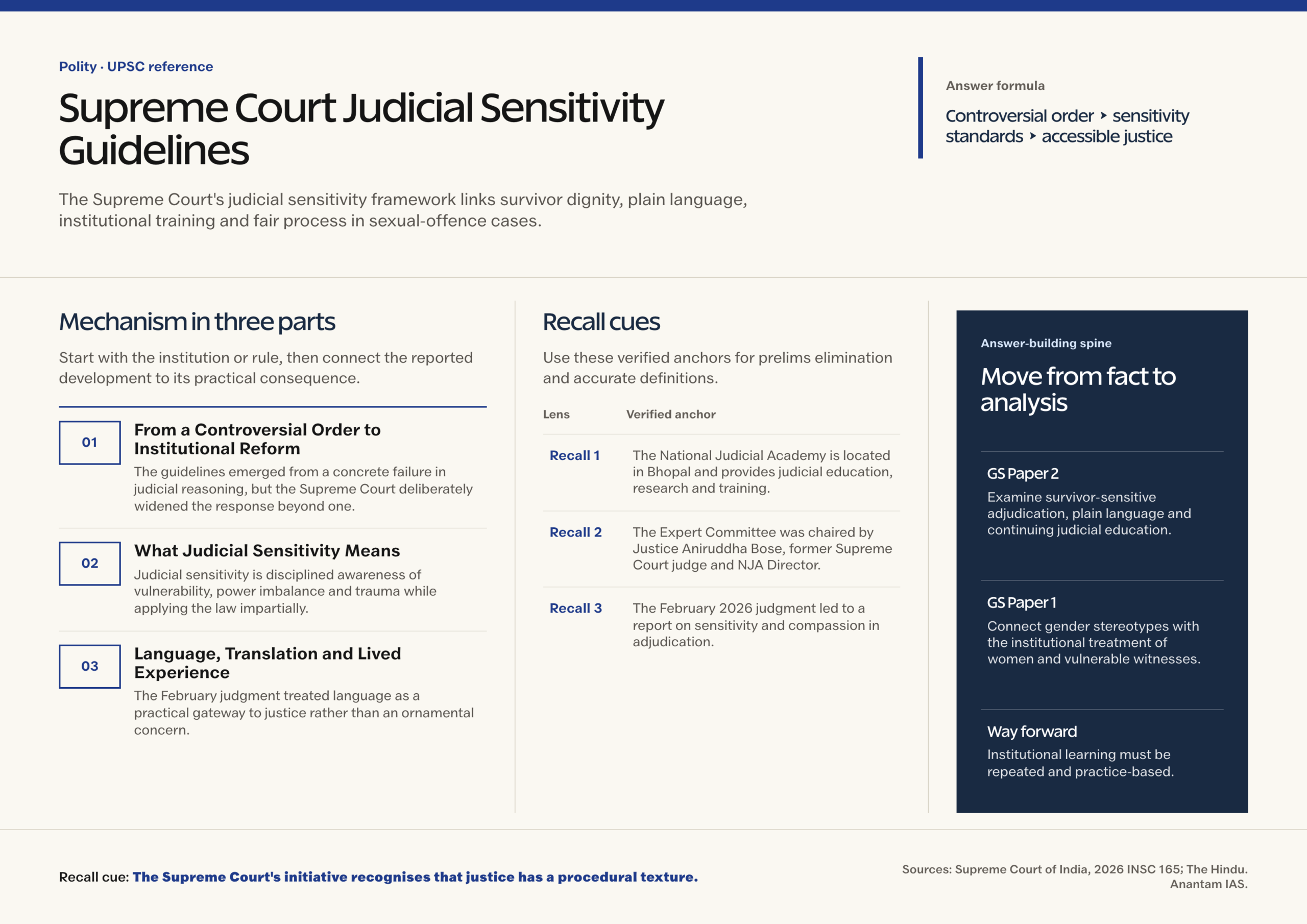
Background and Context
From a Controversial Order to Institutional Reform
The guidelines emerged from a concrete failure in judicial reasoning, but the Supreme Court deliberately widened the response beyond one case.
- An Allahabad High Court order dated March 17, 2025 had treated alleged acts against a minor as preparation rather than attempt to rape. The Supreme Court took suo motu notice amid concern over both the.
- In its February 10, 2026 judgment, the Supreme Court set aside the High Court ruling and restored the Special POCSO Court’s summons order. It clarified that its observations were prima facie and did not decide the.
- The Court said a justice system must combine sound application of constitutional and legal principles with compassion and empathy. A decision cannot do complete justice if it ignores the factual realities and vulnerabilities faced by.
- Instead of framing guidelines from the bench without field evidence, the Court asked an expert committee to study earlier measures, implementation results and experiences across the justice system. This reflects an evidence-led institutional approach.
What Judicial Sensitivity Means
Judicial sensitivity is disciplined awareness of vulnerability, power imbalance and trauma while applying the law impartially.
- It requires judges to avoid stereotypes such as the idea that a genuine survivor must resist physically, report immediately, behave in a prescribed manner or possess a particular social profile. Such assumptions can distort the appreciation.
- It also concerns process: respectful forms of address, privacy, protection from repetitive narration, comprehension of proceedings, appropriate breaks, careful questioning and a courtroom environment that permits effective participation.
- Sensitivity is not a direction to accept every allegation. Courts must still test relevance, reliability, admissibility and proof while ensuring that myth or moral judgment does not substitute for legal analysis.
- The idea is best understood as removing an unfair barrier. An insensitive process may silence relevant evidence or discourage reporting, while a sensitive process helps the court obtain a fuller narrative without compromising the defence.
Language, Translation and Lived Experience
The February judgment treated language as a practical gateway to justice rather than an ornamental concern.
- The Committee was asked to identify harmful words and expressions used in different Indian languages and local dialects. A person may otherwise struggle to describe an offence fully when colloquial speech obscures its abusive or.
- The Court recommended simple language comprehensible to laypersons and cautioned against dense expressions borrowed from foreign jurisdictions without adaptation to Indian social realities.
- Translated public-facing sections can help victims, complainants and witnesses understand rights, procedures and available safeguards irrespective of linguistic or legal proficiency.
- This links Article 14’s equality guarantee with substantive accessibility: formally identical information may still exclude people who cannot understand it.
Existing Child-Friendly Safeguards under POCSO
The new framework does not begin from a legal vacuum; it must make existing statutory protections work consistently.
- Section 33 of the POCSO Act requires counsel’s questions to be communicated through the Special Court, permits frequent breaks, allows a trusted person to remain present, prevents repeated testimony and prohibits aggressive questioning or character.
- The same provision requires protection of the child’s identity during investigation and trial, subject to a reasoned exception when disclosure is in the child’s interest.
- Section 36 ensures that a child is not exposed to the accused while testifying, while preserving the accused’s ability to hear the statement and communicate with counsel. Section 37 requires an in-camera trial, with the.
- Sections 38 to 40 recognise assistance through interpreters, experts and legal practitioners. These safeguards show that participatory fairness and due process can be designed together.
Way Forward
Convert Guidance into Continuous Training
- The National and State Judicial Academies should use anonymised case files, simulated hearings and judgment-rewriting exercises to test recognition of rape myths, stereotyping and trauma-informed procedure.
- Induction modules should be followed by periodic refreshers for judges, prosecutors, police officers, court staff, interpreters and legal-aid lawyers.
- Publish authoritative translations, easy-read summaries, audio versions and accessible digital formats, with plain explanations of reporting, testimony, privacy and support rights.
- Create a reviewed multilingual glossary through collaboration among linguists, survivor-support professionals and local legal practitioners, with a process for periodic correction.
Conclusion
- The Supreme Court’s initiative recognises that justice has a procedural texture .
- The durable reform is not compassion in place of law, but compassion disciplined by law : evidence assessed without stereotypes, rights explained in accessible language, fair-trial guarantees preserved and every participant treated with dignity.
UPSC Practice Questions
Prelims MCQ 1
With reference to the judicial sensitivity initiative of the Supreme Court, consider the following statements:
- The Expert Committee was constituted through the National Judicial Academy in Bhopal.
- The Supreme Court asked the Committee to consider linguistic diversity and translated public-facing material.
- The guidelines dispense with the presumption of innocence in sexual-offence trials.
How many of the above statements are correct?
(a) Only one (b) Only two (c) All three (d) None
Answer: (b) Only two
Explanation:
Statements 1 and 2 are correct. The initiative seeks sensitive, stereotype-free procedure; it does not displace the presumption of innocence, fair-trial rights or the legal standard of proof.
Prelims MCQ 2
Which one of the following is correctly matched under the Protection of Children from Sexual Offences Act, 2012?
(a) Section 33 — aggressive questioning of a child may be allowed at the discretion of counsel (b) Section 36 — child must confront the accused face-to-face while testifying (c) Section 37 — trials are to be conducted in camera (d) Section 40 — legal assistance to a child is prohibited
Answer: (c) Section 37 — trials are to be conducted in camera
Explanation:
Section 37 provides for in-camera trials. Section 33 protects the child from aggressive questioning and character assassination; Section 36 prevents exposure to the accused while testifying; Section 40 recognises legal assistance.
UPSC Mains Questions
- Judicial sensitivity is not an exception to impartiality but a condition for substantive equality. Discuss with reference to the Supreme Court’s guidelines for sexual-offence and vulnerable cases. (250 words)
- Examine how language, courtroom procedure and institutional training can reduce secondary victimisation without compromising the fair-trial rights of the accused. (250 words)
Sources: Supreme Court of India, 2026 INSC 165 and The Hindu.
Frequently Asked Questions
What are the Supreme Court judicial sensitivity guidelines?
They are an expert-developed framework approved by the Supreme Court for handling sexual-offence and other vulnerable cases with dignity, empathy and freedom from stereotypes. They address language, procedure, accessibility and training while retaining ordinary standards of evidence and fair trial.
Why was the National Judicial Academy involved?
The Supreme Court wanted recommendations grounded in prior initiatives, field experience and multidisciplinary expertise. The National Judicial Academy could convene judges, practitioners, academics, social workers, linguists, prosecutors and counsellors and carry the principles into judicial education.
How do the new guidelines differ from the 2023 gender-stereotypes handbook?
The 2023 handbook focused on identifying stereotype-promoting words and assumptions in judicial writing and reasoning. The newer exercise has a wider process lens, covering sensitivity and compassion in sexual-offence and vulnerable cases, simple and multilingual communication, institutional training and coordination.
Do survivor-sensitive procedures weaken the rights of the accused?
No. A sensitive process does not predetermine guilt or lower the burden of proof. It removes stereotypes, humiliating language and avoidable barriers to testimony while preserving cross-examination through lawful methods, the opportunity to challenge evidence, reasoned adjudication and the presumption.
Which constitutional provisions support judicial sensitivity?
Article 14 supports equality and non-arbitrary treatment; Article 21 protects life, dignity and fair procedure; and Article 39A directs the State to secure equal justice and free legal aid. Read together, they support a justice process that is both impartial.
Source: https://anantamias.com/current-affairs/supreme-court-judicial-sensitivity-guidelines/
U.S. Russia-Iran Sanctions Bill and India’s Tariff Risk
Why in News?
The U.S.
- Section 113 of the published Senate text covers a country that knowingly makes new purchases of Russian-origin crude oil or natural gas after the statutory window and ranks among the five largest importers by volume during.
- The same section can cover the top five countries facilitating Russian oil-sanctions evasion, widening the measure beyond direct energy purchases.
- The proposed duty is a range, from more than zero to up to 100%, and the U.S. Trade Representative may modify the rate after assessing whether a country has increased, reduced or stopped relevant purchases.
- The package also targets Russian officials, financial institutions, defence-support networks and the so-called shadow fleet, while extending authority intended to restrict funding for Iran’s energy and weapons sectors.
- The Senate vote is a major legislative step, but passage is not enactment. The House must pass the same text, or differences must be reconciled, before the President can sign it.
- For India, the dispute links three interests that cannot be managed separately: affordable energy, access to the U.S. market and the diplomatic value of India-U.S. strategic cooperation.
- For the United States, a tariff on third-country goods is designed as secondary economic pressure: it seeks to reduce Russia’s energy revenue by changing the choices of Russia’s trading partners.
- For the global economy, coercive tariffs can redirect oil flows, raise freight and insurance costs, fragment payment systems and encourage firms to redesign supply chains around geopolitical risk.
UPSC Relevance
Prelims Relevance
- A primary sanction directly restricts the targeted state, entity, individual or transaction; a secondary sanction pressures third-country persons for specified dealings with the primary target.
- An ad valorem tariff is calculated as a percentage of the customs value of an imported good, unlike a specific duty charged as a fixed amount per unit.
- Under the U.S. Constitution, a bill normally must pass both the Senate and House of Representatives in identical form and be presented to the President before becoming law.
- The bill’s country test uses import volume during a preceding 12-month period, not merely the value of purchases or a permanent list of named countries.
- The draft requires subsequent country determinations not later than 180 days after initial duties and every 180 days after that, allowing the covered set to change.
- The proposed tariff authority concerns goods entering the United States from a covered country; it is distinct from a ban on that country’s purchase of Russian oil.
Mains Relevance
GS Paper 2
- Assess strategic autonomy when relations with two important partners, the United States and Russia, pull Indian policy in different directions.
- Examine how domestic legislation by a major power can create extraterritorial effects for third countries and their firms.
GS Paper 3
- Connect imported crude dependence, refinery configuration, shipping, insurance, payment channels and retail-price stability to the wider idea of energy resilience.
- Analyse how a steep tariff threat can affect Indian exports, exchange-rate expectations, investment decisions and global value-chain participation even before a duty is imposed.
Essay
- Economic interdependence can restrain conflict, but it can also become an instrument of coercion when market access, finance and energy are weaponized.
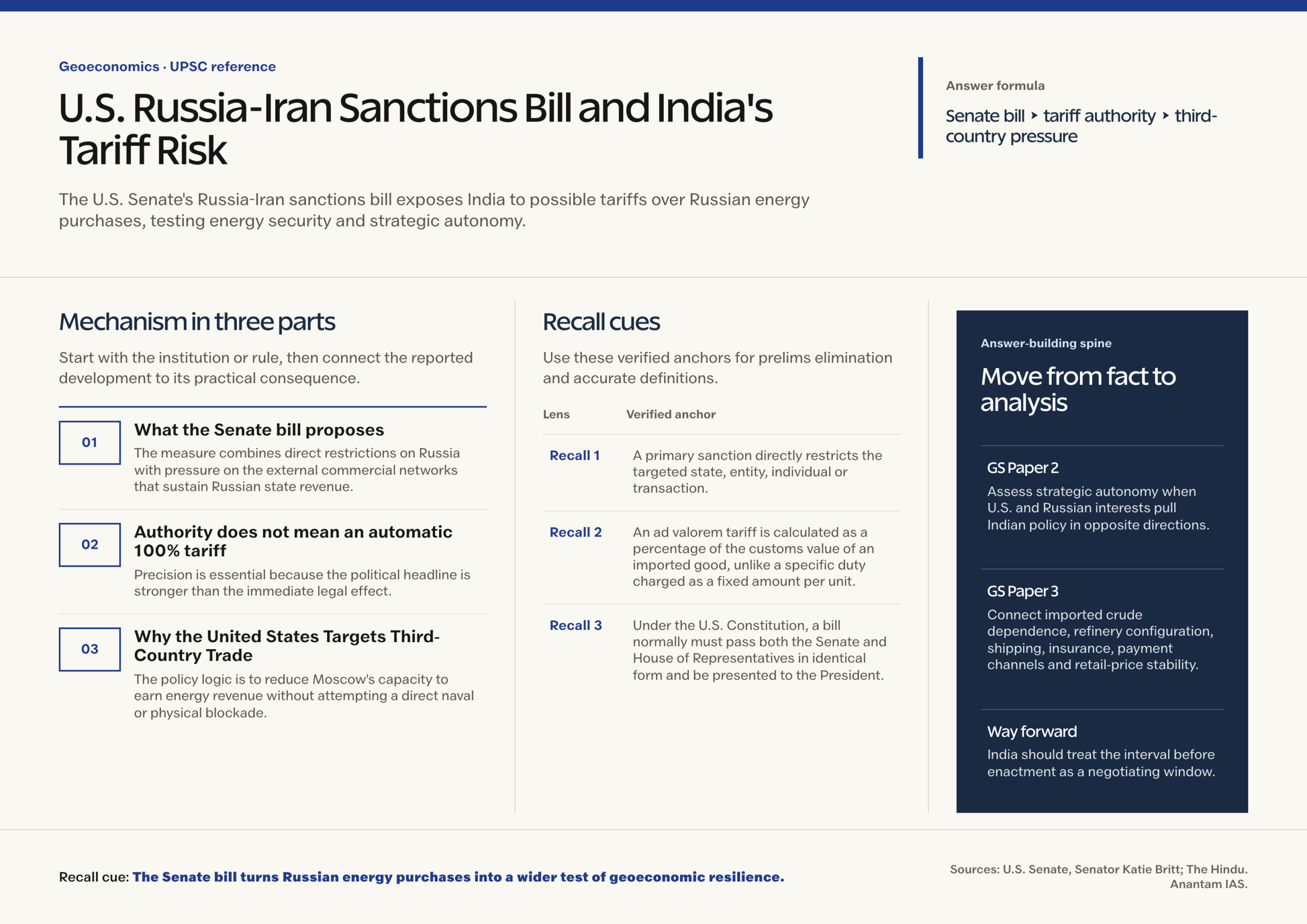
Background and Context
What the Senate bill proposes
The measure combines direct restrictions on Russia with pressure on the external commercial networks that sustain Russian state revenue.
- Its Russia provisions cover categories such as senior officials, oligarchs, Russian financial institutions, government-controlled entities, defence-industrial support and vessels linked to sanctions evasion. This is the primary-sanctions layer.
- Section 113 supplies the secondary-pressure layer. Not later than 30 days after enactment, the President would increase duties on all goods from a country meeting the defined test to a rate up to 100% ad.
- A country may qualify by knowingly making new Russian-origin crude-oil or natural-gas purchases after the statutory period and being among the five largest importers by volume, or by ranking among the top five facilitators of Russian.
- The country list is not frozen in the statute. The U.S. Trade Representative, consulting the Secretaries of State and Energy, would reassess major importers periodically using the most recent 12-month period.
- The wider Senate package also prevents a lapse in sanctions authority aimed at funding for Iran’s energy and weapons sectors. This explains the Iran reference in the enacted title even though India’s immediate concern arises.
Authority does not mean an automatic 100% tariff
Precision is essential because the political headline is stronger than the immediate legal effect.
- First, Senate passage alone does not create an enforceable duty. The House must approve the legislation and the President must sign it, unless Congress overrides a veto under the U.S. constitutional process.
- Second, up to 100% is a ceiling, not a mandatory uniform rate of 100%. The statutory design gives the executive branch room to set and adjust a positive rate within that limit.
- Third, coverage turns on fresh purchases, rankings and official determinations. India is exposed because of its scale in Russian crude trade, but its legal position would depend on the final enacted text and implementing findings.
- Fourth, the President may waive a duty by certifying in writing that the waiver serves the national interests of the United States and explaining the basis to Congress.
- The difference between risk and certainty should guide India’s response. Premature retaliation could narrow negotiating space, while passive reliance on presidential discretion would leave exporters exposed.
Why the United States is targeting third-country energy trade
The policy logic is to reduce Moscow’s capacity to earn energy revenue without attempting a direct naval or physical blockade.
- Russia can redirect barrels when one buyer exits, so sanctions limited to U.S. persons may have weak leverage if large non-U.S. markets remain open. A secondary tariff raises the cost of maintaining those purchases.
- The threat uses access to the large U.S. consumer market as bargaining power. A covered country would have to compare the gains from discounted Russian energy with potential losses across a much wider range of exports.
- The approach also seeks to deter opaque shipping, reflagging, weak insurance and payment structures associated with the shadow fleet. Enforcement quality matters because overly broad risk screening can affect legitimate trade as well.
- Sanctions can produce substitution rather than compliance: cargoes may move through intermediaries, invoices may become less transparent and trade may shift to alternative currencies and financial channels. This makes monitoring and international coordination central to effectiveness.
India's energy-security calculation
India’s choice is shaped by the physical and fiscal realities of a large, import-dependent energy economy.
- Refiners select crude using price, quality, freight, yield, payment and sanctions-compliance considerations. Russian barrels became commercially significant because discounts could lower feedstock costs and support adequate domestic supply.
- A sudden shift away from a major source can raise replacement costs, tanker demand and insurance expenses. Those effects can pass through to inflation, the current account, fiscal calculations and the competitiveness of energy-intensive industries.
- Energy security is not the defence of one supplier. It is the capacity to secure affordable, reliable and diverse supply through multiple geographies, contracts, transport routes, reserves and fuels.
- India must also protect its access to U.S. technology, investment and export demand. Official U.S. data placed bilateral goods trade at an estimated $129.2 billion in 2024, showing why the tariff channel has economy-wide significance beyond.
- The core policy problem is an asymmetric exposure: the benefit of discounted crude may be concentrated in the energy balance, while a country-wide U.S. duty could affect many unrelated Indian export sectors.
Way Forward
Use calibrated diplomacy before the House stage
- Engage the U.S. administration, congressional leadership and industry groups with a quantified account of India’s energy needs, compliance systems and contribution to global oil-market stability.
- Seek clear criteria for country determination, rate-setting, review and waiver decisions so that discretion is bounded by predictable benchmarks rather than political signalling.
- Keep the dispute separated from defence, technology and Indo-Pacific cooperation wherever possible, while preparing a coordinated response if cross-sector pressure grows.
Conclusion
- The Senate bill turns Russian energy purchases into a wider test of geoeconomic resilience .
- India’s credible response is neither abrupt capitulation nor rhetorical defiance.
UPSC Practice Questions
Prelims MCQ 1
With reference to the tariff provisions in the U.S. Sanctioning Russia Act of 2026, consider the following statements:
- The proposed duty ceiling is 100% ad valorem.
- The bill permanently names India as a covered country in its statutory text.
- The proposed country test includes the five largest importers by volume of Russian-origin crude oil or natural gas during the relevant period.
How many of the above statements are correct?
(a) Only one (b) Only two (c) All three (d) None
Answer: (b) Only two
Explanation:
Statements 1 and 3 are correct. The published text sets a ceiling of up to 100% ad valorem and uses a top-five, volume-based test. It defines criteria rather than permanently naming India in the operative provision.
Prelims MCQ 2
Which one of the following best describes a secondary sanction?
(a) A restriction imposed only on a targeted country’s own government departments (b) A measure that pressures third-country persons or states because of specified dealings with a primary target (c) A tariff agreed by all members of the World Trade Organization (d) A subsidy granted to domestic firms affected by foreign competition
Answer: (b) A measure that pressures third-country persons or states because of specified dealings with a primary target
Explanation:
Secondary sanctions seek to alter the conduct of actors outside the sanctioning jurisdiction by attaching costs to specified transactions with the primary target.
UPSC Mains Questions
- The threat of secondary tariffs over Russian energy purchases reveals the economic foundations of strategic autonomy. Discuss with reference to India’s relations with the United States and Russia. (250 words)
- How can India reconcile affordable energy access with growing sanctions and trade-fragmentation risks? Suggest a calibrated policy framework. (250 words)
Sources: U.S. Senate, Senator Katie Britt and The Hindu.
Frequently Asked Questions
Has the United States already imposed a 100% tariff on India under this bill?
No. The U.S. Senate passed the measure, but it still needs House approval and presidential assent to become law. Even after enactment, 100% would be the maximum authorized rate, not an automatic rate. Coverage and the rate would depend on.
Why is India exposed to the proposed tariff authority?
India is exposed because it has been a major importer of Russian crude oil. The bill uses a top-five ranking by volume and post-enactment purchase criteria rather than permanently naming India. The final risk would depend on the enacted text.
What is the difference between a primary and a secondary sanction?
A primary sanction directly restricts the targeted person, entity, state or transaction within the sanctioning country’s jurisdiction. A secondary sanction pressures third-country actors by threatening loss of market access, finance or other benefits if they continue specified dealings with the.
Can the U.S. President waive the proposed duties?
The published bill text permits the President to waive duties or sanctions after certifying in writing that the waiver serves U.S. national interests and reporting the basis to Congress. This creates diplomatic room, but a waiver is discretionary and cannot.
Why could the tariff affect sectors unrelated to oil?
Section 113 is framed as a duty on all goods imported into the United States from a covered country. Its leverage comes from placing broad export access at risk in response to Russian energy purchases, so firms with no role.
Source: https://anantamias.com/current-affairs/us-russia-iran-sanctions-tariff-risk-india/