

Why in News?
The Supreme Court has approved an expert report and handbook on judicial sensitivity in sexual-offence and other vulnerable cases, and directed courts across India to follow its expressions and standards.
- The framework was prepared by an Expert Committee of the National Judicial Academy, Bhopal, after the Supreme Court’s February 10, 2026 judgment in In Re: Order dated 17.03.2025 Passed by the High Court of Judicature.
- The Court ordered wide circulation to High Courts, district courts, State Legal Services Authorities, State Law Departments and Directorates of Prosecution so that sensitivity is embedded across the justice chain.
- Directorates of Prosecution were asked to communicate the safeguards to relevant authorities and support the sensitisation of police personnel while registering FIRs and filing charge sheets in sexual-offence cases.
- The immediate institutional concern arose from orders that treated grave allegations through narrow or insensitive reasoning, showing that correct legal doctrine and humane procedure must operate together.
- Insensitive language can reproduce myths about consent, credibility, clothing, resistance or a survivor’s conduct, leading to secondary victimisation inside the justice system.
- A person may formally possess legal rights yet be unable to exercise them if courtroom language, repeated narration, hostile questioning or inaccessible procedure creates fear and humiliation. This makes sensitivity an access-to-justice issue, not courtroom.
- The framework preserves fair-trial rights and the presumption of innocence; sensitivity does not lower the standard of proof.
UPSC Relevance
Prelims Relevance
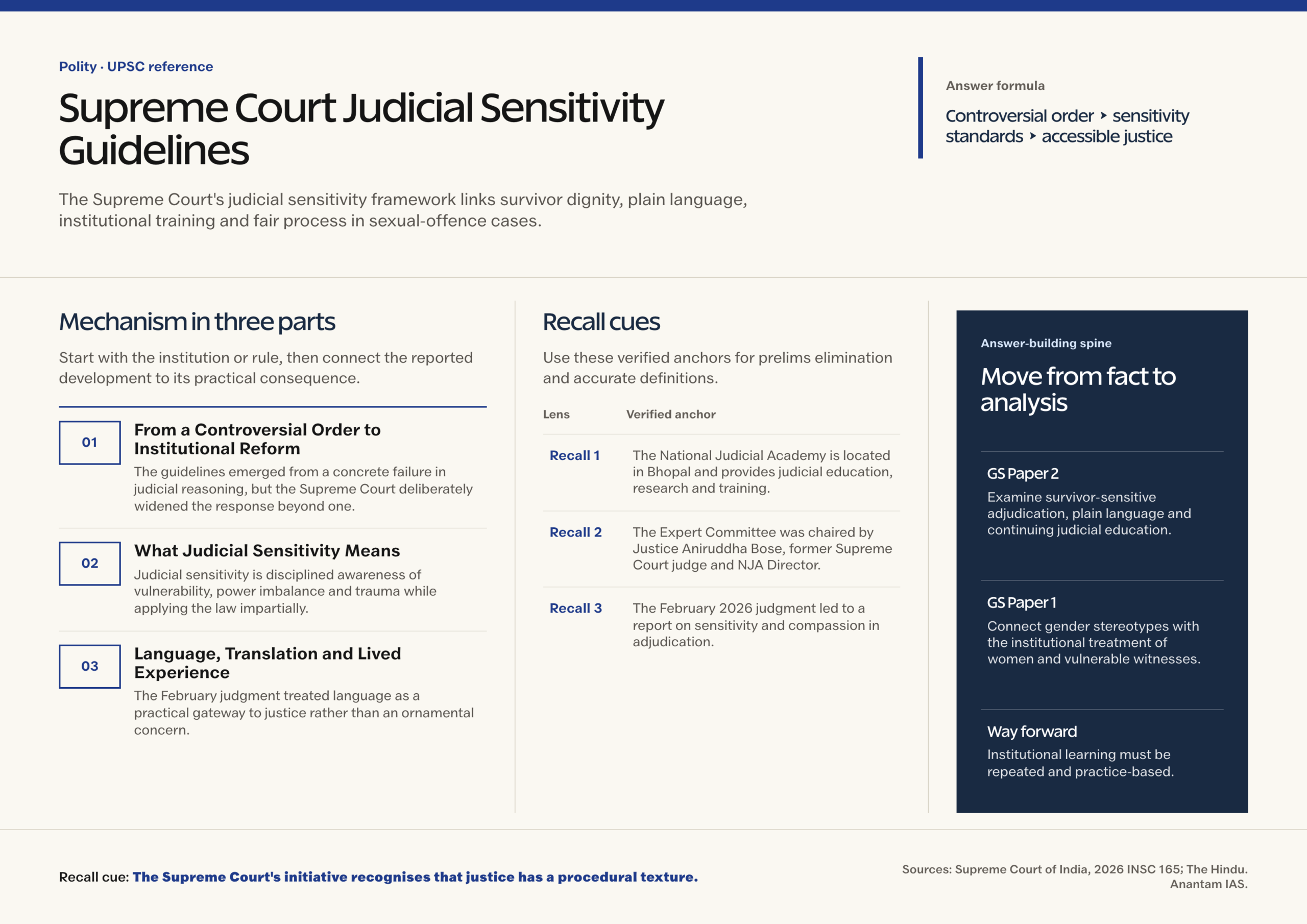
- The National Judicial Academy is located in Bhopal and provides judicial education, research and training; State Judicial Academies train the subordinate judiciary at the State level.
- The Expert Committee was chaired by Justice Aniruddha Bose, a former Supreme Court judge and Director of the National Judicial Academy, with scope to include practitioners, academics and social workers.
- The Supreme Court’s February 2026 judgment requested a report titled Developing Guidelines to Inculcate Sensitivity and Compassion into Judges and Judicial Processes in sexual offences and other vulnerable cases.
- The Court asked the Committee to account for India’s linguistic diversity, identify harmful expressions used in languages and local dialects, use simple language, and consider translated public-facing material.
- The Protection of Children from Sexual Offences Act, 2012 is gender-neutral in its protection of persons below eighteen years and provides for Special Courts.
- Under Section 33 of the POCSO Act, questions to a child are routed through the Special Court; aggressive questioning and character assassination are barred, and the child’s dignity and identity must be protected.
Mains Relevance
GS Paper 2
- Judiciary, judicial administration and the institutional role of the Supreme Court, High Courts and judicial academies in improving the quality of justice delivery.
- Fundamental rights under Articles 14 and 21, constitutional morality, substantive equality, access to justice and protection of vulnerable persons.
GS Paper 1
- Gender stereotypes, social conditioning and the way patriarchal assumptions shape institutional treatment of women and children.
- The relationship between social attitudes and formal institutions in addressing violence and exclusion.
Essay
- Justice is experienced not only through the final verdict but also through the language, procedure and dignity offered along the way.
Background and Context
From a Controversial Order to Institutional Reform
The guidelines emerged from a concrete failure in judicial reasoning, but the Supreme Court deliberately widened the response beyond one case.
- An Allahabad High Court order dated March 17, 2025 had treated alleged acts against a minor as preparation rather than attempt to rape. The Supreme Court took suo motu notice amid concern over both the.
- In its February 10, 2026 judgment, the Supreme Court set aside the High Court ruling and restored the Special POCSO Court’s summons order. It clarified that its observations were prima facie and did not decide the.
- The Court said a justice system must combine sound application of constitutional and legal principles with compassion and empathy. A decision cannot do complete justice if it ignores the factual realities and vulnerabilities faced by.
- Instead of framing guidelines from the bench without field evidence, the Court asked an expert committee to study earlier measures, implementation results and experiences across the justice system. This reflects an evidence-led institutional approach.
What Judicial Sensitivity Means
Judicial sensitivity is disciplined awareness of vulnerability, power imbalance and trauma while applying the law impartially.
- It requires judges to avoid stereotypes such as the idea that a genuine survivor must resist physically, report immediately, behave in a prescribed manner or possess a particular social profile. Such assumptions can distort the appreciation.
- It also concerns process: respectful forms of address, privacy, protection from repetitive narration, comprehension of proceedings, appropriate breaks, careful questioning and a courtroom environment that permits effective participation.
- Sensitivity is not a direction to accept every allegation. Courts must still test relevance, reliability, admissibility and proof while ensuring that myth or moral judgment does not substitute for legal analysis.
- The idea is best understood as removing an unfair barrier. An insensitive process may silence relevant evidence or discourage reporting, while a sensitive process helps the court obtain a fuller narrative without compromising the defence.
Language, Translation and Lived Experience
The February judgment treated language as a practical gateway to justice rather than an ornamental concern.
- The Committee was asked to identify harmful words and expressions used in different Indian languages and local dialects. A person may otherwise struggle to describe an offence fully when colloquial speech obscures its abusive or.
- The Court recommended simple language comprehensible to laypersons and cautioned against dense expressions borrowed from foreign jurisdictions without adaptation to Indian social realities.
- Translated public-facing sections can help victims, complainants and witnesses understand rights, procedures and available safeguards irrespective of linguistic or legal proficiency.
- This links Article 14’s equality guarantee with substantive accessibility: formally identical information may still exclude people who cannot understand it.
Existing Child-Friendly Safeguards under POCSO
The new framework does not begin from a legal vacuum; it must make existing statutory protections work consistently.
- Section 33 of the POCSO Act requires counsel’s questions to be communicated through the Special Court, permits frequent breaks, allows a trusted person to remain present, prevents repeated testimony and prohibits aggressive questioning or character.
- The same provision requires protection of the child’s identity during investigation and trial, subject to a reasoned exception when disclosure is in the child’s interest.
- Section 36 ensures that a child is not exposed to the accused while testifying, while preserving the accused’s ability to hear the statement and communicate with counsel. Section 37 requires an in-camera trial, with the.
- Sections 38 to 40 recognise assistance through interpreters, experts and legal practitioners. These safeguards show that participatory fairness and due process can be designed together.
Way Forward
Convert Guidance into Continuous Training
- The National and State Judicial Academies should use anonymised case files, simulated hearings and judgment-rewriting exercises to test recognition of rape myths, stereotyping and trauma-informed procedure.
- Induction modules should be followed by periodic refreshers for judges, prosecutors, police officers, court staff, interpreters and legal-aid lawyers.
- Publish authoritative translations, easy-read summaries, audio versions and accessible digital formats, with plain explanations of reporting, testimony, privacy and support rights.
- Create a reviewed multilingual glossary through collaboration among linguists, survivor-support professionals and local legal practitioners, with a process for periodic correction.
Conclusion
- The Supreme Court’s initiative recognises that justice has a procedural texture .
- The durable reform is not compassion in place of law, but compassion disciplined by law : evidence assessed without stereotypes, rights explained in accessible language, fair-trial guarantees preserved and every participant treated with dignity.
UPSC Practice Questions
Prelims MCQ 1
With reference to the judicial sensitivity initiative of the Supreme Court, consider the following statements:
- The Expert Committee was constituted through the National Judicial Academy in Bhopal.
- The Supreme Court asked the Committee to consider linguistic diversity and translated public-facing material.
- The guidelines dispense with the presumption of innocence in sexual-offence trials.
How many of the above statements are correct?
(a) Only one (b) Only two (c) All three (d) None
Answer: (b) Only two
Explanation:
Statements 1 and 2 are correct. The initiative seeks sensitive, stereotype-free procedure; it does not displace the presumption of innocence, fair-trial rights or the legal standard of proof.
Prelims MCQ 2
Which one of the following is correctly matched under the Protection of Children from Sexual Offences Act, 2012?
(a) Section 33 — aggressive questioning of a child may be allowed at the discretion of counsel (b) Section 36 — child must confront the accused face-to-face while testifying (c) Section 37 — trials are to be conducted in camera (d) Section 40 — legal assistance to a child is prohibited
Answer: (c) Section 37 — trials are to be conducted in camera
Explanation:
Section 37 provides for in-camera trials. Section 33 protects the child from aggressive questioning and character assassination; Section 36 prevents exposure to the accused while testifying; Section 40 recognises legal assistance.
UPSC Mains Questions
- Judicial sensitivity is not an exception to impartiality but a condition for substantive equality. Discuss with reference to the Supreme Court’s guidelines for sexual-offence and vulnerable cases. (250 words)
- Examine how language, courtroom procedure and institutional training can reduce secondary victimisation without compromising the fair-trial rights of the accused. (250 words)
Sources: Supreme Court of India, 2026 INSC 165 and The Hindu.
Frequently Asked Questions
What are the Supreme Court judicial sensitivity guidelines?
They are an expert-developed framework approved by the Supreme Court for handling sexual-offence and other vulnerable cases with dignity, empathy and freedom from stereotypes. They address language, procedure, accessibility and training while retaining ordinary standards of evidence and fair trial.
Why was the National Judicial Academy involved?
The Supreme Court wanted recommendations grounded in prior initiatives, field experience and multidisciplinary expertise. The National Judicial Academy could convene judges, practitioners, academics, social workers, linguists, prosecutors and counsellors and carry the principles into judicial education.
How do the new guidelines differ from the 2023 gender-stereotypes handbook?
The 2023 handbook focused on identifying stereotype-promoting words and assumptions in judicial writing and reasoning. The newer exercise has a wider process lens, covering sensitivity and compassion in sexual-offence and vulnerable cases, simple and multilingual communication, institutional training and coordination.
Do survivor-sensitive procedures weaken the rights of the accused?
No. A sensitive process does not predetermine guilt or lower the burden of proof. It removes stereotypes, humiliating language and avoidable barriers to testimony while preserving cross-examination through lawful methods, the opportunity to challenge evidence, reasoned adjudication and the presumption.
Which constitutional provisions support judicial sensitivity?
Article 14 supports equality and non-arbitrary treatment; Article 21 protects life, dignity and fair procedure; and Article 39A directs the State to secure equal justice and free legal aid. Read together, they support a justice process that is both impartial.
Tell Google you want more of this.
Add Anantam IAS as a preferred sourceOne tap, and this site shows up more often in your own Top Stories, AI Overviews and AI Mode. Remove it any time.






