Why in News?
Saudi Arabia, Turkiye and Pakistan signed the Makkah Joint Defence Agreement at Al-Safa Palace in Makkah on August 7, 2026.
- The signatories were Saudi Crown Prince and Prime Minister Mohammed bin Salman, Turkish President Recep Tayyip Erdogan and Pakistani Prime Minister Muhammad Shehbaz Sharif.
- Pakistan’s Foreign Ministry said the agreement seeks to strengthen collective deterrence against aggression and enhance all aspects of defence cooperation among the three states.
- The official release ties the agreement to longstanding relations, Islamic solidarity and shared strategic interests, but it does not identify a target state in the text made public.
- The public communique does not disclose a full treaty text, geographic limits, common command, force commitments, entry-into-force clause or ratification requirements. These details cannot be presumed.
- The agreement builds on the Saudi Arabia-Pakistan Strategic Mutual Defense Agreement signed in Riyadh on September 17, 2025, while adding Turkiye as a third party to a new trilateral instrument.
- The agreement combines Saudi financial weight, Turkiye’s defence-industrial capacity, and Pakistan’s armed forces. These strengths improve deterrence only when backed by credible planning and coordination.
- For India, the relevant channels are wider than Pakistan. West Asian stability affects energy imports, maritime trade, the Indian diaspora and investment, while Turkiye’s NATO membership gives the pact an additional institutional dimension.
- The phrase ‘attack on one is an attack on all’ signals solidarity, but does not prove automatic military intervention. Unpublished clauses and domestic processes will shape any response.
UPSC Relevance
Prelims Relevance
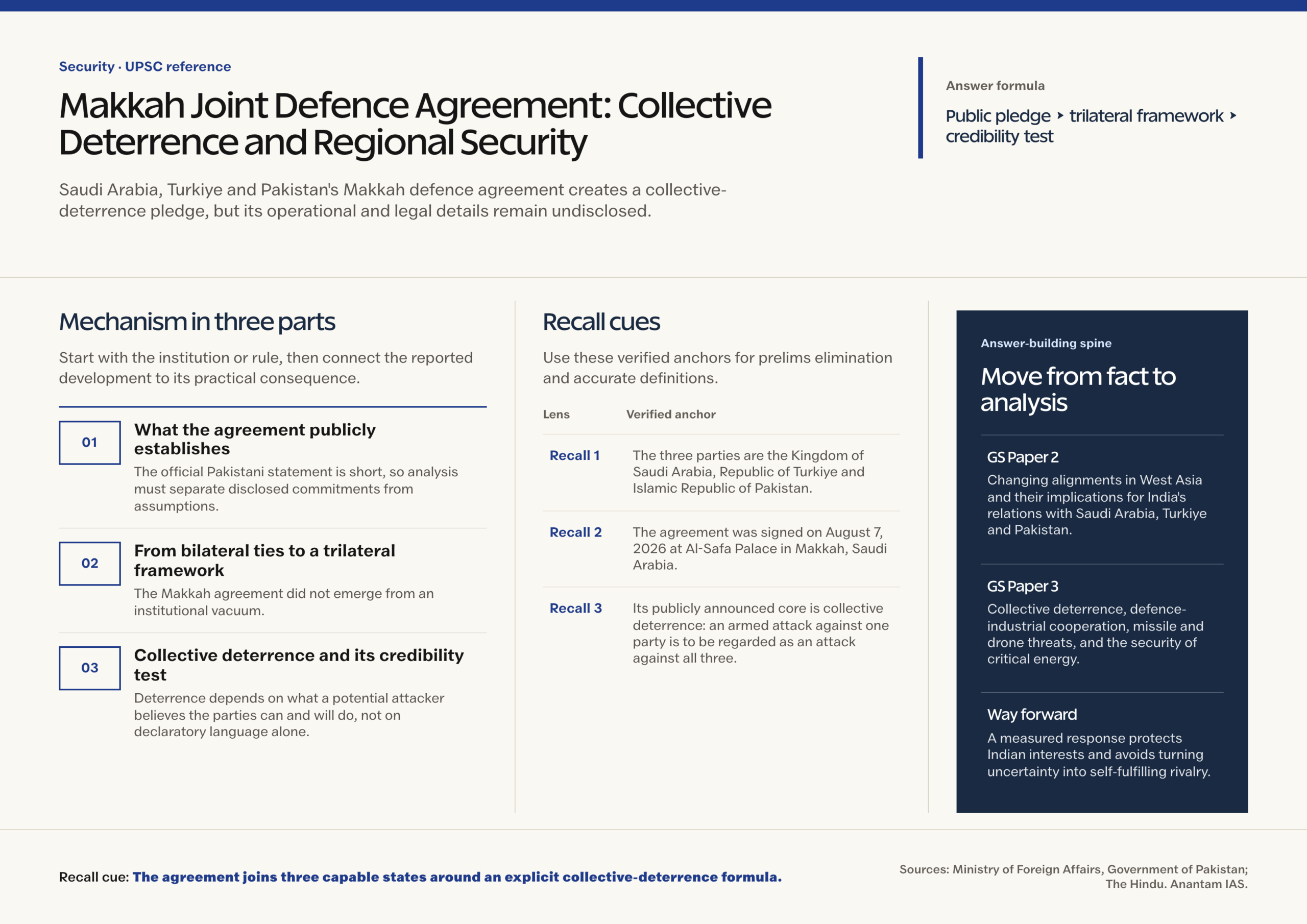
- The three parties are the Kingdom of Saudi Arabia, Republic of Turkiye and Islamic Republic of Pakistan; Egypt is not a signatory to the Makkah Joint Defence Agreement.
- The agreement was signed on August 7, 2026 at Al-Safa Palace in Makkah, Saudi Arabia.
- Its publicly announced core is collective deterrence: an armed attack against one party is to be regarded as an attack against all three.
- Deterrence aims to prevent aggression by convincing an adversary that expected costs will outweigh gains; collective defence concerns assistance after a qualifying attack.
- Article 51 of the UN Charter preserves the inherent right of individual or collective self-defence if an armed attack occurs, until the Security Council takes necessary measures; measures taken must be reported to the Council.
- Turkiye is a member of NATO, but Saudi Arabia and Pakistan are not. The Makkah agreement is a separate arrangement and does not make either country a NATO ally.
Mains Relevance
GS Paper 2
- Changing alignments in West Asia and their implications for India’s relations with Saudi Arabia, Turkiye and Pakistan.
- Difference between flexible strategic partnerships, minilateral arrangements and treaty-based military alliances.
GS Paper 3
- Collective deterrence, defence-industrial cooperation, missile and drone threats, and the security of critical energy infrastructure.
- Possible effects of regional military coordination on escalation control, sea lanes and India’s national-security planning.
Essay
- Security promises deter conflict only when capability, credibility and communication reinforce one another.
Background and Context
What the agreement publicly establishes
The official Pakistani statement is short, so analysis must separate disclosed commitments from assumptions.
- The parties explicitly connect the pact to collective security, peace and regional stability, and commit to enhance all aspects of defence cooperation.
- The operative signal is that an armed attack on one party will be regarded as an attack on all three, raising the expected cost of aggression.
- No public clause specifies what assistance each state must provide, how an attack is jointly attributed, whether non-state, cyber or proxy attacks qualify, or which territories and forces are covered.
- It is a signed trilateral defence agreement with a public collective-defence clause, not yet a demonstrated integrated alliance or automatic war obligation.
From bilateral ties to a trilateral framework
The Makkah agreement did not emerge from an institutional vacuum.
- Saudi Arabia and Pakistan formalised an ‘attack on one, attack on both’ commitment through their Strategic Mutual Defense Agreement on September 17, 2025. Their defence relationship also rests on decades of training and security cooperation.
- Turkiye and Pakistan have developed military dialogue, personnel links and defence-industrial projects. Their February 2025 package included cooperation on electronic warfare, military health and defence production.
- Saudi Arabia and Turkiye signed an implementation plan on defence cooperation in 2023, alongside a major defence-industry agreement involving Baykar. Their relationship has increasingly moved from political repair toward practical cooperation.
- The pact can connect these bilateral tracks, but interoperability still requires shared doctrine, secure communications, logistics and decision procedures.
Collective deterrence and its credibility test
Deterrence depends on what a potential attacker believes the parties can and will do, not on declaratory language alone.
- A collective pledge can create deterrence by denial by improving air defence, intelligence and resilience, or deterrence by punishment by threatening a coordinated response.
- Credibility grows through joint planning, exercises, compatible equipment, pre-positioned logistics, intelligence sharing and clear crisis consultation. None of these implementation elements is detailed in the released statement.
- Ambiguity may leave an aggressor uncertain, but can also cause miscalculation if the parties interpret ‘armed attack’ differently.
- Pakistan possesses nuclear weapons, but the public statement does not announce a nuclear umbrella, nuclear sharing or extended nuclear guarantee. Nuclear implications must not be inferred from Pakistan’s status alone.
Relationship with international law and NATO
The right of collective self-defence exists within the UN Charter framework, while Turkiye’s NATO obligations remain institutionally separate.
- Under Article 51 of the UN Charter, collective self-defence follows an armed attack and does not displace the Security Council’s responsibility for international peace and security.
- A lawful response must meet requirements such as necessity and proportionality. A pact cannot legalise aggression or remove the Charter’s prohibition on unlawful force.
- Turkiye remains bound by the North Atlantic Treaty. NATO Article 5 applies within its treaty design and geographic scope, while the Makkah pact has its own, still undisclosed implementation rules.
- The agreement does not extend NATO guarantees to Saudi Arabia or Pakistan. Nor does a crisis involving a Makkah party automatically become a NATO collective-defence case; NATO decisions follow the Washington Treaty and allied procedures.
Way Forward
Seek clarity without alarmism
- Use diplomatic channels with Saudi Arabia and Turkiye to understand the pact’s scope, trigger conditions and implementation mechanisms.
- Distinguish confirmed clauses from scenarios. Public communication should flag genuine concerns without presenting every trilateral activity as directed against India.
- Diversify crude and gas sourcing, maintain emergency preparedness and deepen maritime-domain awareness across the Arabian Sea and western Indian Ocean.
- Update contingency coordination for Indian nationals, ports, shipping and aviation if a West Asian crisis disrupts transport corridors.
Conclusion
- The Makkah Joint Defence Agreement is a consequential political and security signal because it joins three capable states around an explicit collective-deterrence formula.
- Its real effect will depend on unpublished legal provisions and future implementation.
UPSC Practice Questions
Prelims MCQ 1
With reference to the Makkah Joint Defence Agreement, consider the following statements:
- It was signed by Saudi Arabia, Turkiye and Pakistan.
- Its public statement says an armed attack against one of the three states shall be regarded as an attack against all.
- It automatically extends NATO’s Article 5 guarantee to Saudi Arabia and Pakistan.
How many of the above statements are correct?
(a) Only one (b) Only two (c) All three (d) None
Answer: (b) Only two
Explanation:
Statements 1 and 2 reflect the official announcement of August 7, 2026. Statement 3 is incorrect: the Makkah agreement is separate from NATO, and Saudi Arabia and Pakistan are not NATO members.
Prelims MCQ 2
Article 51 of the United Nations Charter is primarily associated with which one of the following?
(a) Prohibition of all regional organisations (b) Inherent right of individual or collective self-defence after an armed attack (c) Compulsory economic sanctions without Security Council action (d) Automatic deployment of UN peacekeepers
Answer: (b) Inherent right of individual or collective self-defence after an armed attack
Explanation:
Article 51 preserves the inherent right of individual or collective self-defence if an armed attack occurs, until the Security Council takes the measures necessary to maintain international peace and security.
UPSC Mains Questions
- The Makkah Joint Defence Agreement reflects both the regionalisation of security and the persistence of overlapping alliances. Discuss its opportunities, limits and implications for India. (250 words)
- Collective-defence declarations create deterrence only when supported by credible institutions and capabilities. Examine with reference to emerging minilateral security arrangements. (250 words)
Sources: Ministry of Foreign Affairs, Government of Pakistan and The Hindu.
Frequently Asked Questions
What is the Makkah Joint Defence Agreement?
It is a trilateral defence agreement signed by Saudi Arabia, Turkiye and Pakistan in Makkah on August 7, 2026. The official announcement says an armed attack against any one of the three will be regarded as an attack against all.
Does the agreement require an automatic military response?
The public communique does not specify the form of assistance, decision process or domestic approvals. It establishes a strong collective-defence commitment, but the available text is insufficient to claim that troops must be deployed automatically in every qualifying crisis.
Is the pact an Islamic NATO?
That label is misleading at present. NATO has a founding treaty, permanent institutions, integrated planning and established procedures. The Makkah statement discloses a collective-defence clause but no comparable command structure, standing force or detailed institutional machinery.
Does Pakistan’s nuclear status create a nuclear umbrella for the other parties?
No such guarantee has been publicly announced. Pakistan is a nuclear-armed state, but the released agreement does not mention nuclear sharing, extended nuclear deterrence or control arrangements. A nuclear umbrella cannot be inferred merely from Pakistan’s participation.
How does Turkiye’s NATO membership affect the agreement?
Turkiye now participates in two separate security frameworks. NATO obligations continue under the North Atlantic Treaty, while the Makkah pact has its own rules. A crisis involving Saudi Arabia or Pakistan does not automatically trigger NATO Article 5.
Tell Google you want more of this.
Add Anantam IAS as a preferred sourceOne tap, and this site shows up more often in your own Top Stories, AI Overviews and AI Mode. Remove it any time.