

Why in News?
The U.S.
- Section 113 of the published Senate text covers a country that knowingly makes new purchases of Russian-origin crude oil or natural gas after the statutory window and ranks among the five largest importers by volume during.
- The same section can cover the top five countries facilitating Russian oil-sanctions evasion, widening the measure beyond direct energy purchases.
- The proposed duty is a range, from more than zero to up to 100%, and the U.S. Trade Representative may modify the rate after assessing whether a country has increased, reduced or stopped relevant purchases.
- The package also targets Russian officials, financial institutions, defence-support networks and the so-called shadow fleet, while extending authority intended to restrict funding for Iran’s energy and weapons sectors.
- The Senate vote is a major legislative step, but passage is not enactment. The House must pass the same text, or differences must be reconciled, before the President can sign it.
- For India, the dispute links three interests that cannot be managed separately: affordable energy, access to the U.S. market and the diplomatic value of India-U.S. strategic cooperation.
- For the United States, a tariff on third-country goods is designed as secondary economic pressure: it seeks to reduce Russia’s energy revenue by changing the choices of Russia’s trading partners.
- For the global economy, coercive tariffs can redirect oil flows, raise freight and insurance costs, fragment payment systems and encourage firms to redesign supply chains around geopolitical risk.
UPSC Relevance
Prelims Relevance
- A primary sanction directly restricts the targeted state, entity, individual or transaction; a secondary sanction pressures third-country persons for specified dealings with the primary target.
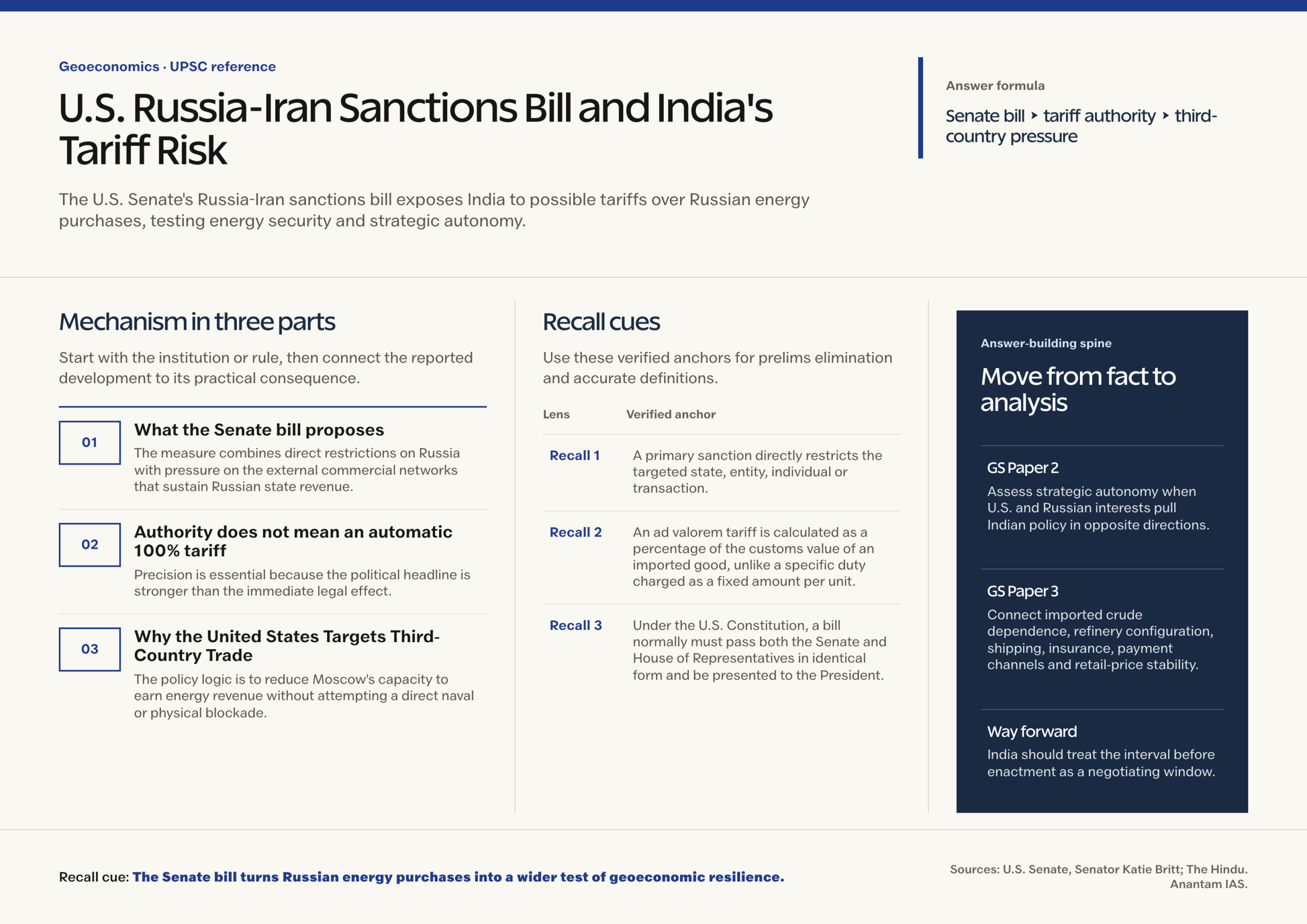
- An ad valorem tariff is calculated as a percentage of the customs value of an imported good, unlike a specific duty charged as a fixed amount per unit.
- Under the U.S. Constitution, a bill normally must pass both the Senate and House of Representatives in identical form and be presented to the President before becoming law.
- The bill’s country test uses import volume during a preceding 12-month period, not merely the value of purchases or a permanent list of named countries.
- The draft requires subsequent country determinations not later than 180 days after initial duties and every 180 days after that, allowing the covered set to change.
- The proposed tariff authority concerns goods entering the United States from a covered country; it is distinct from a ban on that country’s purchase of Russian oil.
Mains Relevance
GS Paper 2
- Assess strategic autonomy when relations with two important partners, the United States and Russia, pull Indian policy in different directions.
- Examine how domestic legislation by a major power can create extraterritorial effects for third countries and their firms.
GS Paper 3
- Connect imported crude dependence, refinery configuration, shipping, insurance, payment channels and retail-price stability to the wider idea of energy resilience.
- Analyse how a steep tariff threat can affect Indian exports, exchange-rate expectations, investment decisions and global value-chain participation even before a duty is imposed.
Essay
- Economic interdependence can restrain conflict, but it can also become an instrument of coercion when market access, finance and energy are weaponized.
Background and Context
What the Senate bill proposes
The measure combines direct restrictions on Russia with pressure on the external commercial networks that sustain Russian state revenue.
- Its Russia provisions cover categories such as senior officials, oligarchs, Russian financial institutions, government-controlled entities, defence-industrial support and vessels linked to sanctions evasion. This is the primary-sanctions layer.
- Section 113 supplies the secondary-pressure layer. Not later than 30 days after enactment, the President would increase duties on all goods from a country meeting the defined test to a rate up to 100% ad.
- A country may qualify by knowingly making new Russian-origin crude-oil or natural-gas purchases after the statutory period and being among the five largest importers by volume, or by ranking among the top five facilitators of Russian.
- The country list is not frozen in the statute. The U.S. Trade Representative, consulting the Secretaries of State and Energy, would reassess major importers periodically using the most recent 12-month period.
- The wider Senate package also prevents a lapse in sanctions authority aimed at funding for Iran’s energy and weapons sectors. This explains the Iran reference in the enacted title even though India’s immediate concern arises.
Authority does not mean an automatic 100% tariff
Precision is essential because the political headline is stronger than the immediate legal effect.
- First, Senate passage alone does not create an enforceable duty. The House must approve the legislation and the President must sign it, unless Congress overrides a veto under the U.S. constitutional process.
- Second, up to 100% is a ceiling, not a mandatory uniform rate of 100%. The statutory design gives the executive branch room to set and adjust a positive rate within that limit.
- Third, coverage turns on fresh purchases, rankings and official determinations. India is exposed because of its scale in Russian crude trade, but its legal position would depend on the final enacted text and implementing findings.
- Fourth, the President may waive a duty by certifying in writing that the waiver serves the national interests of the United States and explaining the basis to Congress.
- The difference between risk and certainty should guide India’s response. Premature retaliation could narrow negotiating space, while passive reliance on presidential discretion would leave exporters exposed.
Why the United States is targeting third-country energy trade
The policy logic is to reduce Moscow’s capacity to earn energy revenue without attempting a direct naval or physical blockade.
- Russia can redirect barrels when one buyer exits, so sanctions limited to U.S. persons may have weak leverage if large non-U.S. markets remain open. A secondary tariff raises the cost of maintaining those purchases.
- The threat uses access to the large U.S. consumer market as bargaining power. A covered country would have to compare the gains from discounted Russian energy with potential losses across a much wider range of exports.
- The approach also seeks to deter opaque shipping, reflagging, weak insurance and payment structures associated with the shadow fleet. Enforcement quality matters because overly broad risk screening can affect legitimate trade as well.
- Sanctions can produce substitution rather than compliance: cargoes may move through intermediaries, invoices may become less transparent and trade may shift to alternative currencies and financial channels. This makes monitoring and international coordination central to effectiveness.
India's energy-security calculation
India’s choice is shaped by the physical and fiscal realities of a large, import-dependent energy economy.
- Refiners select crude using price, quality, freight, yield, payment and sanctions-compliance considerations. Russian barrels became commercially significant because discounts could lower feedstock costs and support adequate domestic supply.
- A sudden shift away from a major source can raise replacement costs, tanker demand and insurance expenses. Those effects can pass through to inflation, the current account, fiscal calculations and the competitiveness of energy-intensive industries.
- Energy security is not the defence of one supplier. It is the capacity to secure affordable, reliable and diverse supply through multiple geographies, contracts, transport routes, reserves and fuels.
- India must also protect its access to U.S. technology, investment and export demand. Official U.S. data placed bilateral goods trade at an estimated $129.2 billion in 2024, showing why the tariff channel has economy-wide significance beyond.
- The core policy problem is an asymmetric exposure: the benefit of discounted crude may be concentrated in the energy balance, while a country-wide U.S. duty could affect many unrelated Indian export sectors.
Way Forward
Use calibrated diplomacy before the House stage
- Engage the U.S. administration, congressional leadership and industry groups with a quantified account of India’s energy needs, compliance systems and contribution to global oil-market stability.
- Seek clear criteria for country determination, rate-setting, review and waiver decisions so that discretion is bounded by predictable benchmarks rather than political signalling.
- Keep the dispute separated from defence, technology and Indo-Pacific cooperation wherever possible, while preparing a coordinated response if cross-sector pressure grows.
Conclusion
- The Senate bill turns Russian energy purchases into a wider test of geoeconomic resilience .
- India’s credible response is neither abrupt capitulation nor rhetorical defiance.
UPSC Practice Questions
Prelims MCQ 1
With reference to the tariff provisions in the U.S. Sanctioning Russia Act of 2026, consider the following statements:
- The proposed duty ceiling is 100% ad valorem.
- The bill permanently names India as a covered country in its statutory text.
- The proposed country test includes the five largest importers by volume of Russian-origin crude oil or natural gas during the relevant period.
How many of the above statements are correct?
(a) Only one (b) Only two (c) All three (d) None
Answer: (b) Only two
Explanation:
Statements 1 and 3 are correct. The published text sets a ceiling of up to 100% ad valorem and uses a top-five, volume-based test. It defines criteria rather than permanently naming India in the operative provision.
Prelims MCQ 2
Which one of the following best describes a secondary sanction?
(a) A restriction imposed only on a targeted country’s own government departments (b) A measure that pressures third-country persons or states because of specified dealings with a primary target (c) A tariff agreed by all members of the World Trade Organization (d) A subsidy granted to domestic firms affected by foreign competition
Answer: (b) A measure that pressures third-country persons or states because of specified dealings with a primary target
Explanation:
Secondary sanctions seek to alter the conduct of actors outside the sanctioning jurisdiction by attaching costs to specified transactions with the primary target.
UPSC Mains Questions
- The threat of secondary tariffs over Russian energy purchases reveals the economic foundations of strategic autonomy. Discuss with reference to India’s relations with the United States and Russia. (250 words)
- How can India reconcile affordable energy access with growing sanctions and trade-fragmentation risks? Suggest a calibrated policy framework. (250 words)
Sources: U.S. Senate, Senator Katie Britt and The Hindu.
Frequently Asked Questions
Has the United States already imposed a 100% tariff on India under this bill?
No. The U.S. Senate passed the measure, but it still needs House approval and presidential assent to become law. Even after enactment, 100% would be the maximum authorized rate, not an automatic rate. Coverage and the rate would depend on.
Why is India exposed to the proposed tariff authority?
India is exposed because it has been a major importer of Russian crude oil. The bill uses a top-five ranking by volume and post-enactment purchase criteria rather than permanently naming India. The final risk would depend on the enacted text.
What is the difference between a primary and a secondary sanction?
A primary sanction directly restricts the targeted person, entity, state or transaction within the sanctioning country’s jurisdiction. A secondary sanction pressures third-country actors by threatening loss of market access, finance or other benefits if they continue specified dealings with the.
Can the U.S. President waive the proposed duties?
The published bill text permits the President to waive duties or sanctions after certifying in writing that the waiver serves U.S. national interests and reporting the basis to Congress. This creates diplomatic room, but a waiver is discretionary and cannot.
Why could the tariff affect sectors unrelated to oil?
Section 113 is framed as a duty on all goods imported into the United States from a covered country. Its leverage comes from placing broad export access at risk in response to Russian energy purchases, so firms with no role.
Tell Google you want more of this.
Add Anantam IAS as a preferred sourceOne tap, and this site shows up more often in your own Top Stories, AI Overviews and AI Mode. Remove it any time.






