Daily Digest
UPSC · Civil Services Examination
Current Affairs · Sunday, 9 August 2026
Current affairs curated and edited by Anantam IAS faculty — pulled from The Hindu, PIB, IDSA, Foreign Affairs and the ministries. Read, annotate, revise.
Old Rajinder Nagar · Delhi 110005 · anantamias.com
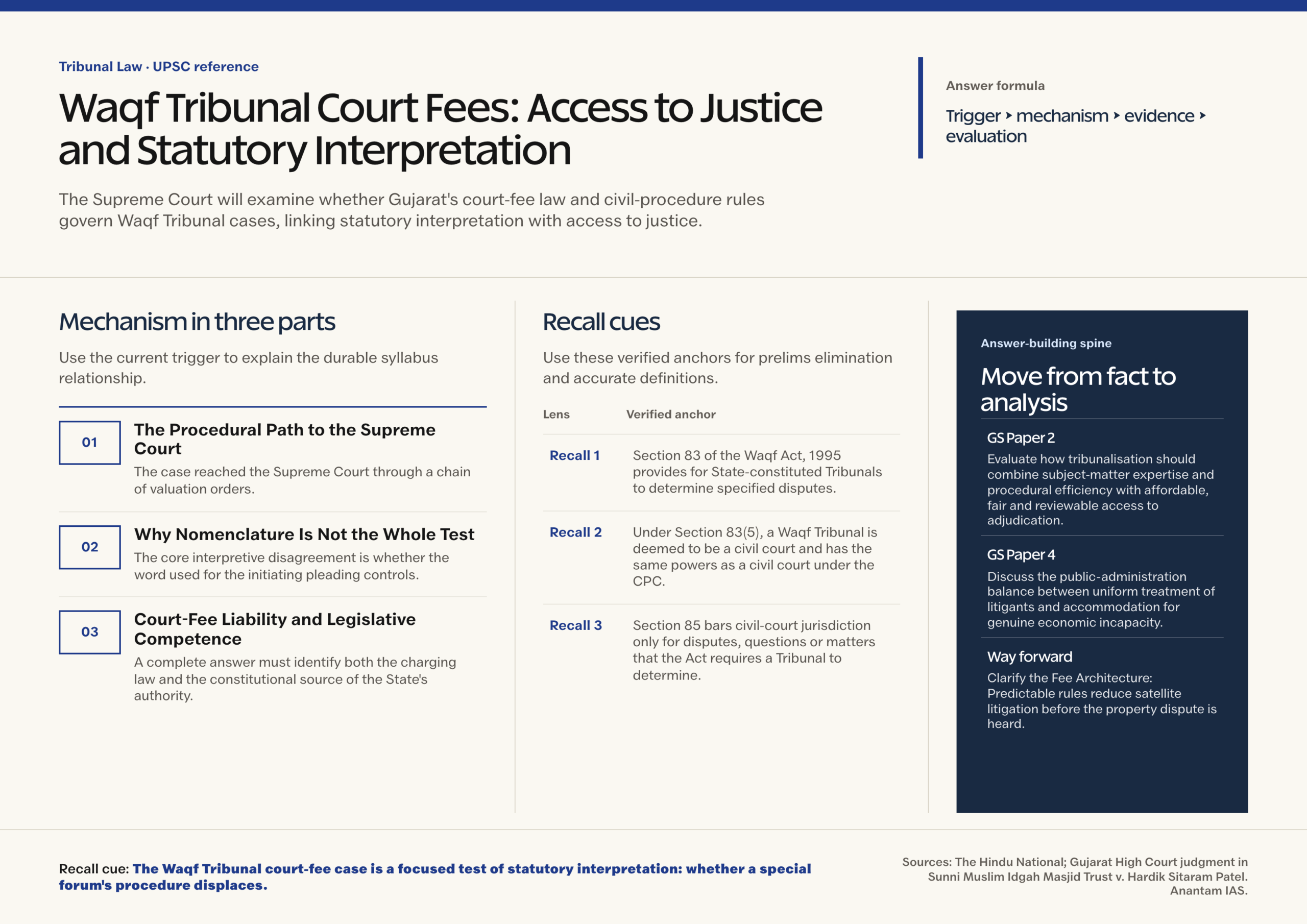
Waqf Tribunal Court Fees: Access to Justice and Statutory Interpretation
Why in News?
The Hindu reported that the Supreme Court is set to hear a special leave petition challenging the Gujarat High Court’s approval of Waqf Tribunal orders that rejected proceedings after the claimants did not correct suit valuation and pay the required.
- The case before the Supreme Court is Ahmedabad Sunni Muslim Waqf Committee v. Gujarat State Waqf Tribunal, SLP(C) No. 18353 of 2026. It remains pending, so the Supreme Court’s questions or oral observations are not.
- On 1 June 2026, a Bench of Justices P. S. Narasimha and Aravind Kumar asked counsel to identify the legal source of the claimed exemption and granted time for additional material. The official cause list identified.
- The challenged line of Gujarat High Court authority began with the 17 December 2025 judgment in Sunni Muslim Idgah Masjid Trust v. Hardik Sitaram Patel, which dismissed a batch of civil revision applications arising from.
- The underlying proceedings concerned recovery of possession from tenants or alleged encroachers and related relief such as mesne profits. The Tribunal had directed correction of valuation and payment of deficit court fees before rejecting the plaints.
- The High Court held that calling the initiating document an application did not remove court-fee liability when the proceeding, in substance, involved adversarial adjudication of civil rights and relief comparable to a suit.
- Court fees serve a fiscal and regulatory role, but an unaffordable upfront demand can become a procedural barrier when a specialised tribunal is the forum designated by law.
- The controversy is not a general ruling on waqf ownership or the validity of the 2025 amendments. Its immediate focus is forum procedure, fee liability and rejection of proceedings.
- For UPSC answers, the issue connects tribunal design with Article 14, fair access under Article 21, the constitutional goal of equal justice in Article 39A, and the division of legislative fields under the Seventh.
UPSC Relevance
Prelims Relevance
- Section 83 of the Waqf Act, 1995 provides for State-constituted Tribunals to determine specified disputes, questions and matters relating to waqf or waqf property, including listed tenancy matters.
- Under Section 83(5), a Waqf Tribunal is deemed to be a civil court and has the same powers as a civil court under the CPC while trying a suit or executing a decree or order.
- Section 85 bars civil-court jurisdiction only for disputes, questions or matters that the Act requires a Tribunal to determine; the bar is tied to the statutory subject matter.
- Order VII Rule 11(b) CPC concerns an undervalued relief when the plaintiff fails to correct the valuation within the time fixed by the court.
- Order VII Rule 11(c) CPC concerns a plaint on insufficiently stamped paper when the plaintiff fails to supply the required stamp paper within the time fixed.
- Section 149 CPC allows a court, in its discretion, to permit payment of the whole or part of a deficient court fee at any stage; once paid, the document ordinarily has the same force as if.
Mains Relevance
GS Paper 2
- Evaluate how tribunalisation should combine subject-matter expertise and procedural efficiency with affordable, fair and reviewable access to adjudication.
- Explain the interpretive tension between a special law creating an exclusive forum and a general State court-fee law that finances or regulates access to adjudicatory institutions.
GS Paper 4
- Discuss the public-administration balance between uniform treatment of litigants and accommodation for genuine economic incapacity.
- Examine why speaking orders, adequate notice and a real chance to cure defects support procedural fairness even when the State is entitled to collect a lawful fee.
Essay
- Access to justice is shaped not only by the existence of courts and tribunals but also by the cost and design of the path leading to them.
Background and Context
The Procedural Path to the Supreme Court
The case reached the Supreme Court through a chain of valuation orders, rejection orders and revision proceedings rather than through a final decision on the underlying property claims.
- Several waqf institutions filed proceedings before the Gujarat State Waqf Tribunal seeking possession of property from tenants or alleged encroachers and, in some matters, mesne profits or connected relief.
- The Tribunal found that the claims were not properly valued and that the corresponding court fee was deficient. It gave the claimants time to correct the valuation and make good the deficit.
- After non-compliance, the Tribunal rejected the proceedings by invoking Order VII Rule 11(b) and (c) CPC. Those clauses treat undervaluation and insufficient stamping as curable defects before rejection follows.
- Rejection of a plaint for a filing defect is distinct from deciding the underlying title, tenancy or possession claim on evidence. Yet it can have serious practical consequences because a fresh filing may face limitation, renewed.
- The institutions invoked the High Court’s revisional jurisdiction under the Waqf Act. On 17 December 2025, the High Court upheld the applicability of the Gujarat Court Fees Act and CPC principles to these proceedings and declined.
Why Nomenclature Is Not the Whole Test
The core interpretive disagreement is whether the word used for the initiating pleading controls, or whether the court should examine the proceeding’s legal substance.
- The petitioners argued before the High Court that Section 83 refers to an application, the Waqf Act contains no express court-fee levy for it, and the special statutory route should not be equated automatically with.
- The High Court focused on substance over form: parties assert competing civil rights, file pleadings, produce evidence, obtain adjudication, and may seek possession and monetary relief.
- Section 83(5) expressly deems the Tribunal a civil court and gives it civil-court powers under the CPC while trying a suit or executing a decree or order. The High Court treated this text as a strong.
- The presence of a statutory fiction does not answer every procedural question. Courts still ask why Parliament created the fiction, the setting in which it operates and whether importing a particular CPC consequence advances or.
- The harder question is the reach of that deeming provision. A statutory fiction must serve its enacted purpose, and it does not automatically import every incident of an ordinary civil court unless text, context and the.
Court-Fee Liability and Legislative Competence
A complete answer must identify both the charging law and the constitutional source of the State’s authority.
- The Gujarat High Court held that the Gujarat Court Fees Act, 2004 governs the relevant Tribunal filings because no applicable notification, circular or statutory clause granted waqf institutions a blanket waiver in the State.
- Court-fee liability is ordinarily created by legislation. An exemption also needs a sound legal basis; institutional purpose or charitable status alone does not necessarily create one.
- A court fee is different from costs awarded between parties, a security deposit or a penalty. Identifying the levy correctly matters because each has a different legal source, purpose and consequence for non-payment.
- Entry 3 of List II in the Seventh Schedule gives States legislative space concerning the administration of justice and fees taken in courts, apart from the Supreme Court. The Waqf Act, by contrast, is the.
- Fiscal charging provisions are read from their text rather than assumed on broad notions of fairness. At the same time, the authority must show that the document, forum and relief fall within the provision that imposes.
Access to Justice Without Inventing an Exemption
Constitutional concern about affordability can shape procedure and policy even when it does not itself erase a valid statutory charge.
- Article 39A directs the State to prevent economic or other disabilities from denying opportunities for justice. Articles 14 and 21 also inform demands for non-arbitrary and fair procedure.
- These principles do not mean that every court fee is invalid or that every religious or charitable body receives an automatic exemption. The legal status, financial position, nature of the claim and text of the fee.
- Formal equality supports applying the same charging rule to similarly placed litigants. Substantive equality asks whether objectively designed legal-aid or remission measures are needed so that inability to pay does not make the statutory forum illusory.
- Access can be protected through notice of deficiency, reasoned valuation, realistic time to cure, legal aid for eligible persons, instalment or remission schemes authorised by law, and restrained use of terminal dismissal.
- Because Section 85 can exclude the ordinary civil court for matters assigned to the Tribunal, the accessibility of the specialised forum carries added weight. An exclusive forum must be practically usable, though that concern does not.
Way Forward
Clarify the Fee Architecture
- States should publish a clear schedule identifying the fee, valuation method and available exemption or remission route for each major category of Waqf Tribunal relief.
- Tribunal forms and filing portals should show worked examples for possession, declaration, injunction and monetary relief, while making clear that the adjudicator retains authority over valuation.
- Any special fixed-fee regime should be created transparently by competent legislation or delegated rules, not through informal practice that varies between benches.
Conclusion
- The Waqf Tribunal court-fee case is a focused test of statutory interpretation : whether a special forum’s procedure displaces, incorporates or coexists with a State’s general court-fee regime.
- The access-to-justice concern remains real even if no blanket exemption exists.
UPSC Practice Questions
Prelims MCQ 1
With reference to Waqf Tribunals under the Waqf Act, 1995, consider the following statements:
- A State Government constitutes Tribunals for specified disputes and matters relating to waqf or waqf property.
- A Tribunal is deemed to be a civil court and has the same powers as a civil court under the Code of Civil Procedure while trying a suit or executing a decree or order.
- Section 85 bars civil-court jurisdiction for matters that the Act requires a Tribunal to determine.
How many of the above statements are correct?
(a) Only one (b) Only two (c) All three (d) None
Answer: (c) All three
Explanation:
All three statements reflect the statutory scheme of Sections 83 and 85. The jurisdictional bar is not a free-standing bar over every dispute touching a waqf; it applies to matters that the Act requires the Tribunal to determine.
Prelims MCQ 2
Which provision of the Code of Civil Procedure, 1908 expressly gives a court discretion to permit payment of a deficient court fee at any stage?
(a) Section 9 (b) Section 80 (c) Section 149 (d) Order II Rule 2
Answer: (c) Section 149
Explanation:
Section 149 CPC permits the court, in its discretion, to allow payment of the whole or part of a deficient fee. Once the deficiency is paid, the document ordinarily has the same force and effect as if the fee had been paid initially.
UPSC Mains Questions
- The effectiveness of a tribunal depends as much on affordable procedure as on specialised jurisdiction. Discuss with reference to the pending dispute over court fees before Waqf Tribunals. (250 words)
- How should courts reconcile a special central statute with a generally applicable State fiscal law when both appear to govern the same adjudicatory proceeding? Explain the relevant principles of statutory interpretation. (250 words)
Sources: The Hindu National and Gujarat High Court judgment in Sunni Muslim Idgah Masjid Trust v. Hardik Sitaram Patel.
Frequently Asked Questions
What is the issue before the Supreme Court?
The pending special leave petition challenges Gujarat High Court rulings that allowed Waqf Tribunal proceedings to be rejected after deficient court fees were not paid. The central questions concern the application of the Gujarat Court Fees Act, the procedural role.
Has the Supreme Court exempted waqf institutions from court fees?
No. The Supreme Court has not delivered a final merits judgment in this matter. At an earlier hearing, the Bench asked counsel to identify the legal basis for exemption and granted time for additional material. A judicial question during oral.
Why did the Gujarat High Court say court fees were payable?
The High Court found no statutory provision, notification or circular creating a blanket waiver in Gujarat. It also viewed Section 83 proceedings as adversarial civil adjudication in substance: parties seek possession or related relief, exchange pleadings, lead evidence and receive.
What does Order VII Rule 11 CPC do in a court-fee dispute?
Clauses (b) and (c) permit rejection when a plaintiff does not correct an undervalued relief or supply the required stamp paper within the time fixed by the court. The rule builds in an opportunity to cure first. The present appeal.
Does access to justice mean that no court fee can be charged?
No. Access to justice does not create an automatic exemption from every valid fee. It calls for non-arbitrary rules, affordable routes for eligible persons, clear notice and fair opportunities to cure defects. Article 39A supports equal justice and legal aid.
Source: https://anantamias.com/current-affairs/waqf-tribunal-court-fees-access-to-justice/
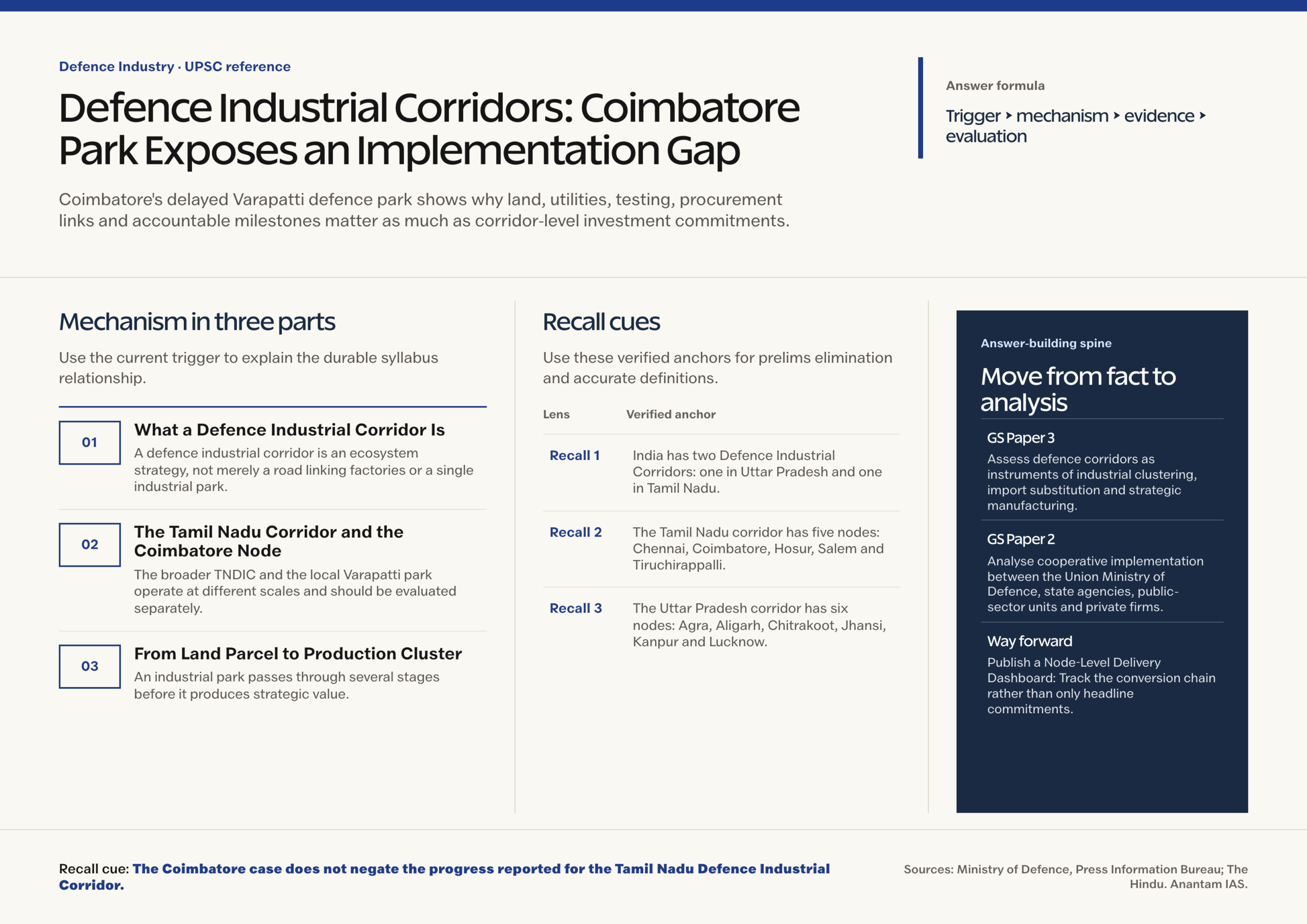
Defence Industrial Corridors: Coimbatore Park Exposes an Implementation Gap
Why in News?
The Hindu reported that the proposed defence industrial park at Varapatti in Coimbatore district has yet to translate its long planning history into a functioning manufacturing cluster.
- Coimbatore is one of the five officially identified nodes of the Tamil Nadu Defence Industrial Corridor, alongside Chennai, Hosur, Salem and Tiruchirappalli.
- The Varapatti project is a specific industrial park within the Coimbatore node. It is not synonymous with the entire Tamil Nadu corridor, which contains several nodes, firms and projects.
- A 2022 TIDCO request for proposals described a land parcel of about 400 acres at Varapatti and sought a consultant for a feasibility study and detailed project report.
- A 2025 TIDCO tender document identified a 10.87-acre developed plot within the park for plug-and-play facilities and recorded basic infrastructure such as roads, water supply, storm-water drains, electricity and streetlights.
- The official project record shows movement through planning, land, environmental and tender stages. The policy question is whether these inputs are converting into occupied units, certified production and supply-chain orders.
- Defence manufacturing combines industrial policy with national security. Delayed facilities can weaken domestic supply chains and prolong dependence on imported systems or components.
- Cluster policy works only when land and incentives are joined by testing, certification, skilled labour, finance, anchor orders and vendor development.
- Public reporting often highlights MoUs and proposed investment. UPSC answers should separate commitments, grounded investment, operational capacity and actual output.
UPSC Relevance
Prelims Relevance
- India has two Defence Industrial Corridors: one in Uttar Pradesh and one in Tamil Nadu.
- The Tamil Nadu corridor has five nodes: Chennai, Coimbatore, Hosur, Salem and Tiruchirappalli.
- The Uttar Pradesh corridor has six nodes: Agra, Aligarh, Chitrakoot, Jhansi, Kanpur and Lucknow.
- The Tamil Nadu Industrial Development Corporation is the nodal agency for TNDIC; the Uttar Pradesh Expressways Industrial Development Authority performs that role for UPDIC.
- The corridors seek to build a defence-manufacturing ecosystem through supply chains, testing, certification and economies of scale.
- The respective state governments provide key enabling inputs such as land, connectivity and basic infrastructure.
Mains Relevance
GS Paper 3
- Assess defence corridors as instruments of industrial clustering, import substitution and strategic manufacturing.
- Explain why MSMEs need common testing, certification, tooling, finance and predictable orders to enter defence supply chains.
GS Paper 2
- Analyse cooperative implementation between the Union Ministry of Defence, state agencies, public-sector units and private firms.
- Use the case to discuss outcome-based monitoring, public disclosure and inter-agency accountability in large industrial projects.
Essay
- Self-reliance is not secured by announcements alone; it is built through institutions that convert capability into dependable production.
Background and Context
What a Defence Industrial Corridor Is
A defence industrial corridor is an ecosystem strategy, not merely a road linking factories or a single industrial park.
- The Union Budget 2018-19 announced two corridors, later located in Uttar Pradesh and Tamil Nadu, to deepen the domestic defence-manufacturing base.
- The node model seeks to connect original equipment manufacturers, public-sector units, private firms, MSMEs, start-ups, laboratories, training institutions and logistics providers.
- Clustering can reduce transaction costs by placing suppliers, tooling, testing and skilled workers close to production facilities.
- For strategic systems, proximity alone is insufficient. Firms also need security-compliant facilities, quality assurance, traceability and certification acceptable to defence buyers.
The Tamil Nadu Corridor and the Coimbatore Node
The broader TNDIC and the local Varapatti park operate at different scales and should be evaluated separately.
- The Ministry of Defence identifies Chennai, Coimbatore, Hosur, Salem and Tiruchirappalli as the corridor’s five nodes, with TIDCO as the state nodal agency.
- Coimbatore brings a dense base of precision engineering, pumps, motors, machine tools, foundries and MSMEs that can potentially diversify into aerospace and defence supply chains.
- TIDCO’s 2022 planning document proposed a dedicated park near Coimbatore because suitable land and a short supplier chain were considered important for attracting large firms and their tiered vendors.
- The Varapatti park is one mechanism for developing the Coimbatore node. Firms elsewhere in the node can still participate in defence production even if this particular estate is delayed.
From Land Parcel to Production Cluster
An industrial park passes through several stages before it produces strategic value.
- The input stage includes land possession, environmental clearance, internal roads, drainage, water, power and digital connectivity.
- The transaction stage includes transparent plot allotment, bankable lease conditions, time-bound approvals and selection of credible developers or concessionaires.
- The capability stage requires plug-and-play buildings, common machinery, laboratories, testing, certification, skilling and links with research institutions.
- The market stage depends on anchor manufacturers, vendor-development programmes and predictable procurement opportunities. Without demand, serviced land may remain underused.
- The outcome stage begins only when units are commissioned, workers are employed, orders are fulfilled and products or components enter domestic or export supply chains.
What the Official Numbers Do and Do Not Show
Corridor-level totals reveal momentum, but they cannot by themselves prove that every node or park is functioning well.
- The Ministry of Defence reported that by April 2026 the TNDIC had attracted investment commitments of ₹32,699 crore, while actual investment had reached ₹6,446 crore.
- These are aggregate corridor figures. They cover the five-node ecosystem and should not be assigned to Coimbatore or Varapatti without a node-wise official breakdown.
- The gap between commitment and actual investment is not automatically evidence of failure because large industrial projects are phased. It is still a reason to track conversion timelines and abandoned commitments.
- A better dashboard would publish node-wise land allotment, units under construction, units commissioned, jobs created, procurement orders, test facilities used and investment actually deployed.
Way Forward
Publish a Node-Level Delivery Dashboard
- Report land acquired, land allotted, construction starts, commissioned units, actual investment, employment and production for each node.
- Show the status, responsible agency and revised completion date for utilities, plug-and-play buildings and testing facilities.
- Map local MSME capabilities against indigenisation lists and the component needs of defence public-sector units and private manufacturers.
- Pair common facilities with vendor-development programmes, trial orders and transparent qualification pathways.
Conclusion
- The Coimbatore case does not negate the progress reported for the Tamil Nadu Defence Industrial Corridor .
- For defence self-reliance, the decisive metric is conversion: land into facilities, facilities into qualified firms, firms into orders, and orders into reliable indigenous capability.
UPSC Practice Questions
Prelims MCQ 1
With reference to Defence Industrial Corridors in India, consider the following statements:
- India has established one Defence Industrial Corridor each in Uttar Pradesh and Tamil Nadu.
- Coimbatore is one of the identified nodes of the Tamil Nadu Defence Industrial Corridor.
- Tamil Nadu Industrial Development Corporation is the nodal agency for the Tamil Nadu Defence Industrial Corridor.
How many of the above statements are correct?
(a) Only one (b) Only two (c) All three (d) None
Answer: (c) All three
Explanation:
The two corridors are located in Uttar Pradesh and Tamil Nadu. Coimbatore is one of TNDIC’s five nodes, and TIDCO is its nodal agency.
Prelims MCQ 2
Which one of the following would best indicate that a defence industrial park has moved from infrastructure creation to ecosystem operation?
(a) A memorandum of understanding announcing potential investment (b) Identification of land for the project (c) Qualified suppliers fulfilling defence orders using shared testing and certification facilities (d) Appointment of a consultant to prepare a detailed project report
Answer: (c) Qualified suppliers fulfilling defence orders using shared testing and certification facilities
Explanation:
Land, MoUs and project reports are inputs or intermediate milestones. Actual order fulfilment by qualified firms shows that infrastructure, capability and demand have combined into an operating ecosystem.
UPSC Mains Questions
- Defence industrial corridors should be evaluated through production capability rather than investment announcements alone. Discuss with reference to the Coimbatore node of the Tamil Nadu Defence Industrial Corridor.
- What prevents established engineering MSMEs from entering defence supply chains? Suggest an implementation framework for node-level defence manufacturing clusters.
Sources: Ministry of Defence, Press Information Bureau and The Hindu.
Frequently Asked Questions
What is a Defence Industrial Corridor?
A Defence Industrial Corridor is a cluster-based policy instrument that brings manufacturers, suppliers, laboratories, testing facilities, skills and logistics into a connected ecosystem. India has established two such corridors, in Uttar Pradesh and Tamil Nadu, to strengthen indigenous defence production.
Is the Varapatti defence park the same as the Tamil Nadu Defence Industrial Corridor?
No. The Tamil Nadu Defence Industrial Corridor is a five-node ecosystem covering Chennai, Coimbatore, Hosur, Salem and Tiruchirappalli. The proposed Varapatti park is a specific industrial-estate project within the Coimbatore node. Delay at that park should not be treated as.
Why is Coimbatore suitable for defence manufacturing?
Coimbatore has a strong base in precision engineering, machine tools, motors, foundries and component manufacturing. This gives local firms capabilities that can be adapted for aerospace and defence work, provided they receive access to specialised testing, certification, finance, skills and.
Why are MoU figures not enough to measure corridor success?
An MoU generally records intended investment or cooperation. It does not by itself prove that capital has been deployed, a factory commissioned or an order delivered. A stronger evaluation separates proposed investment, actual investment, operational units, domestic value addition, employment.
What is the main implementation lesson from the Coimbatore park?
Industrial land must be linked with utilities, approvals, common facilities, anchor buyers, vendor development and accountable timelines. A park can have planning documents and basic infrastructure yet remain economically weak if firms cannot qualify for defence supply chains or see.
Source: https://anantamias.com/current-affairs/coimbatore-defence-industrial-park-implementation-gap/
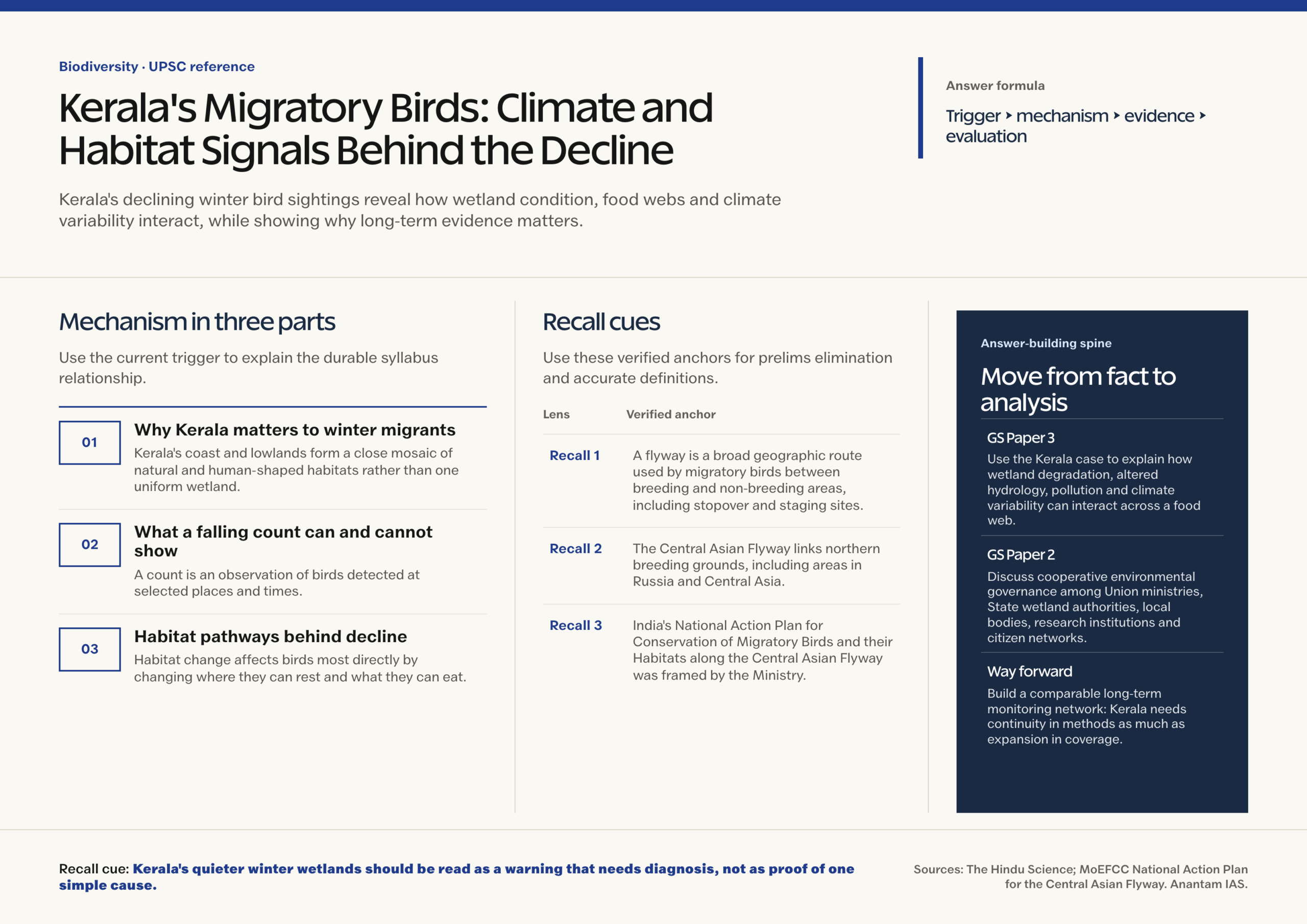
Kerala’s Migratory Birds: Climate and Habitat Signals Behind the Decline
Why in News?
The Hindu has reported concern among Kerala bird researchers and observers over a decline in winter migratory birds , renewing attention to the condition of wetlands, estuaries, mudflats and farm landscapes used by seasonal visitors.
- Kerala receives winter visitors that use a wider migration network commonly discussed in India under the Central Asian Flyway; conserving only the final wintering site cannot address threats across the full annual cycle.
- Local counts have not moved uniformly in every district or every year. Some wetlands have recorded declines while others have recorded stable or higher totals, so a single census must not be treated as proof of.
- A decade-long study at the Kadalundi-Vallikkunnu Community Reserve linked changes in shorebird assemblages to alterations in intertidal habitat, including shrinking mudflats, sediment change and sand-bed expansion.
- Long-term monitoring of coastal wetlands in south-western India has also found simultaneous changes in wading-bird density, water and sediment chemistry, primary productivity, fish availability and rainfall. These associations identify pathways for investigation but do not establish.
- The 2025 update of the State of India’s Birds assessment uses modelled reporting-frequency trends from large citizen-science datasets. Such estimates are valuable for trend detection, but they require correction for observation effort and should be read.
- Bird decline is an ecosystem signal: fewer suitable feeding and roosting sites may indicate degraded mudflats, altered water levels, pollution, invasive vegetation or a weakened aquatic food web.
- Migratory species face full-cycle risk. A bird counted in Kerala may also depend on breeding habitat in northern latitudes and several stopover sites outside the State or country.
- Climate variability can alter rainfall, water depth, salinity, prey availability and migration timing. Attribution needs long time series and species-specific analysis because local land-use change can produce similar observations.
UPSC Relevance
Prelims Relevance
- A flyway is a broad geographic route used by migratory birds between breeding and non-breeding areas, including stopover and staging sites.
- The Central Asian Flyway links northern breeding grounds, including areas in Russia and Central Asia, with wintering grounds in West and South Asia and the Indian Ocean region.
- India’s National Action Plan for Conservation of Migratory Birds and their Habitats along the Central Asian Flyway was framed by the Ministry of Environment, Forest and Climate Change for coordinated species and habitat action.
- The Convention on Migratory Species is a global environmental treaty under the UN system concerned with migratory animals and the habitats on which they depend.
- The Ramsar Convention promotes the conservation and wise use of wetlands; Vembanad-Kol is a Ramsar site in Kerala and supports resident and migratory waterbirds.
- The Wetlands (Conservation and Management) Rules, 2017 were issued under the Environment (Protection) Act, 1986 and provide a regulatory framework for notified wetlands in India.
Mains Relevance
GS Paper 3
- Use the Kerala case to explain how wetland degradation, altered hydrology, pollution and climate variability can interact across a food web.
- Assess the value and limits of migratory birds as indicators for biodiversity and ecosystem health.
GS Paper 2
- Discuss cooperative environmental governance among Union ministries, State wetland authorities, local bodies, research institutions and citizen networks.
- Connect India’s domestic monitoring and habitat protection with cooperation under CMS, Ramsar and the Central Asian Flyway framework.
Essay
- The disappearance of an indicator species can make an otherwise hidden ecological decline visible.
Background and Context
Why Kerala matters to winter migrants
Kerala’s coast and lowlands form a close mosaic of natural and human-shaped habitats rather than one uniform wetland.
- Estuaries, backwaters, beaches, intertidal mudflats, mangroves, reservoirs and seasonally inundated fields offer different combinations of water depth, substrate, shelter and prey.
- Shorebirds often need exposed mud or sand for feeding and undisturbed areas for high-tide roosting. Ducks and other waterbirds may depend on open water, aquatic vegetation or shallow feeding zones.
- Paddy landscapes such as Kole and Kuttanad can function as surrogate wetlands at certain stages of the cropping and water-management cycle. A shift in sowing, drainage, flooding or pesticide practice can change their value to birds.
- The Vembanad-Kol wetland’s Ramsar information identifies a large brackish tropical system with major ecological and livelihood functions, including fisheries, rice production, flood moderation and support for waterbirds.
What a falling count can and cannot show
A count is an observation of birds detected at selected places and times, not a direct measurement of every factor shaping the population.
- Lower numbers may reflect a true population decline, redistribution to another site, changed migration timing, temporary weather, altered water levels, observer effort or detectability. Repeated standardised counts help separate signal from noise.
- Comparisons are strongest when survey dates, site coverage, time spent, observer methods and habitat conditions are comparable. Raw totals from unequal surveys can mislead.
- Citizen-science platforms provide large spatial and temporal datasets, while models can adjust for some differences in effort. They still carry uncertainty and should be combined with field ecology, remote sensing, water-quality data and species-specific studies.
- A district-level increase can coexist with losses elsewhere if birds shift between wetlands. Statewide conclusions need a network view rather than a collection of isolated annual headlines.
Habitat pathways behind decline
Habitat change affects birds most directly by changing where they can rest and what they can eat.
- Reclamation, construction, hard shoreline engineering and disturbance can reduce or fragment shallow-water feeding areas and safe roosts.
- At Kadalundi-Vallikkunnu, long-term research documented changes such as mudflat shrinkage, sand-bed expansion and altered sediment condition alongside changes in shorebird diversity. The lesson is that even conservation-oriented vegetation or hydrological change must be assessed for habitat-specific.
- Nutrient loading, sewage, agricultural runoff and contaminants can alter plankton, benthic invertebrates and fish. The visible bird response may sit at the end of this food-chain pathway.
- Invasive aquatic plants can cover open water, impede access to feeding areas and change oxygen and nutrient conditions. Mechanical removal without ecological planning can also disturb nests or release trapped nutrients.
- Human presence, vehicles, dogs, lighting, fishing activity and repeated flushing increase birds’ energy expenditure. Disturbance is especially costly during migration, when birds must replenish reserves.
Climate signals and the attribution problem
Climate affects migration through several linked mechanisms, but a plausible mechanism is not the same as proved local causation.
- Temperature and day length influence migration schedules, while rainfall and monsoon timing shape water levels, salinity, vegetation and prey production at wintering sites.
- Warmer conditions elsewhere may allow some birds to winter farther north, a pattern called short-stopping. Kerala could then receive fewer individuals even without a collapse in the whole population.
- A mismatch can arise when migration timing does not track a shift in peak food availability. The effect varies by species, diet, route and flexibility.
- Extreme rainfall, drought, heat and storms can reduce habitat quality at breeding, staging or wintering sites. Because these pressures occur across the annual cycle, a local Kerala count cannot by itself locate the decisive stress.
- A defensible attribution study would link multi-year bird trends with comparable habitat, hydrology and climate data, test alternative explanations and report uncertainty.
Way Forward
Build a comparable long-term monitoring network
- Use fixed sites, seasonal windows and standard effort while recording water level, land cover, disturbance and weather with every count.
- Integrate Asian Waterbird Census observations, Kerala Bird Atlas and eBird records, Forest Department surveys and university field studies through a transparent quality-control protocol.
- Publish trends with confidence intervals, survey effort and site-level caveats; avoid treating one annual percentage as a causal finding.
Conclusion
- Kerala’s quieter winter wetlands should be read as a warning that needs diagnosis , not as proof of one simple cause.
- The policy answer is equally layered: protect functional wetland mosaics, improve comparable long-term monitoring, keep farm landscapes ecologically usable and coordinate across the flyway.
UPSC Practice Questions
Prelims MCQ 1
With reference to the Central Asian Flyway, consider the following statements:
- It includes migration routes connecting northern breeding grounds with non-breeding grounds in West and South Asia.
- India has prepared a national action plan for conserving migratory birds and their habitats along this flyway.
- It is confined exclusively to marine birds and excludes inland waterbirds.
How many of the above statements are correct?
(a) Only one (b) Only two (c) All three (d) None
Answer: (b) Only two
Explanation:
Statements 1 and 2 are correct. The Central Asian Flyway covers routes used by many migratory waterbirds across terrestrial, inland-wetland and coastal landscapes; it is not restricted to marine birds.
Prelims MCQ 2
Which one of the following is the most scientifically defensible inference from a lower bird count at one wetland in one winter?
(a) Climate change has been proved to be the sole cause (b) The species has become globally extinct (c) The result is a signal requiring comparison with standardised multi-year and habitat data (d) Wetland quality can be ruled out because birds are mobile
Answer: (c) The result is a signal requiring comparison with standardised multi-year and habitat data
Explanation:
A single count may be affected by population change, redistribution, timing, weather, water levels, effort or detectability. Multi-year standardised monitoring and ecological measurements are needed before causal attribution.
UPSC Mains Questions
- Migratory birds are valuable indicators of wetland health, but their decline cannot be diagnosed from bird counts alone. Discuss with reference to Kerala’s coastal and agricultural wetlands. (250 words)
- Explain how climate variability and local habitat degradation can interact across the annual cycle of migratory birds. Suggest a monitoring framework capable of separating these effects. (250 words)
Sources: The Hindu Science and MoEFCC National Action Plan for the Central Asian Flyway.
Frequently Asked Questions
Why are fewer migratory birds being reported from some Kerala wetlands?
Researchers point to interacting pressures such as loss or alteration of feeding habitat, changing water levels, pollution, reduced prey, disturbance and climate-linked shifts in rainfall or migration timing. A lower count at one site or in one year cannot identify.
Does a decline in Kerala prove that climate change caused it?
No. Climate change offers credible mechanisms, including altered rainfall, temperature, hydrology, prey cycles and wintering ranges, but local land-use change can create similar patterns. Attribution requires multi-year bird, habitat and climate data, tests of alternative explanations and species-specific results.
Why are migratory birds treated as indicators of wetland health?
Their abundance and behaviour respond to water depth, mudflat exposure, vegetation, prey, contaminants and disturbance. Because many occupy higher levels of aquatic food webs, changes can flag wider ecosystem stress. The diagnosis must still be checked with direct measurements of.
What is the Central Asian Flyway?
It is a broad network of migration routes linking northern breeding areas with stopover and non-breeding grounds across Central, West and South Asia and the Indian Ocean region. India is a major range country and has framed a national action.
How can paddy fields help migratory birds?
Seasonally flooded paddy fields can provide shallow feeding areas and prey, acting as surrogate wetlands at particular stages. Their value depends on cropping calendars, water depth, drainage, disturbance and chemical use. They complement natural wetlands but cannot replace every ecological.
Source: https://anantamias.com/current-affairs/kerala-migratory-birds-climate-habitat-decline/
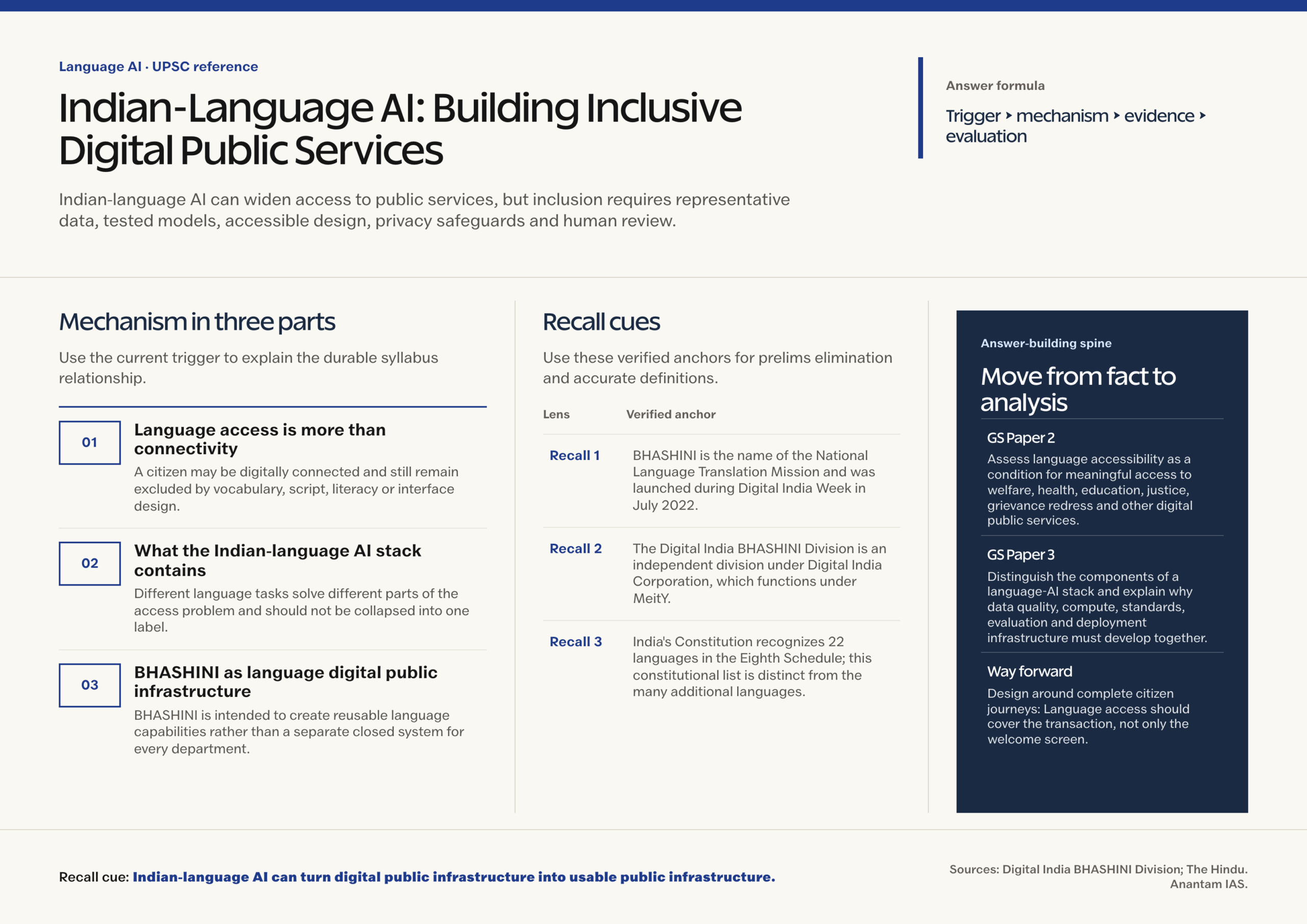
Indian-Language AI: Building Inclusive Digital Public Services
Why in News?
The Hindu examined the effort to make artificial intelligence work across India’s linguistic diversity, drawing attention to the gap between globally dominant language models and the speech, scripts, dialects and public-service needs found in India.
- India’s public language-technology architecture includes BHASHINI, the National Language Translation Mission launched during Digital India Week in July 2022 and implemented through the Digital India BHASHINI Division under Digital India Corporation, MeitY.
- Official MeitY documents describe a wider language stack than translation alone: automatic speech recognition, machine translation, text-to-speech, natural-language understanding, optical character recognition, transliteration and language detection.
- BHASHINI is designed as a national public digital platform for languages, intended to support government agencies, states, startups and other contributors in building Indian-language products and services.
- The IndiaAI Mission complements this work through pillars for compute, datasets, foundation models, application development, skills, startup financing, and safe and trusted AI.
- The policy question is no longer simply whether a model can produce an Indian-language sentence. It is whether the system performs reliably across dialects, code-mixed speech, public-service vocabulary, low-quality audio and high-stakes citizen interactions.
- A service available only in English or a dominant regional language can reproduce the linguistic digital divide even when connectivity and devices improve.
- Language AI can lower the literacy and interface burden by supporting voice, translation, reading assistance and multilingual search, but a wrong translation in health, welfare or grievance redress can also deny an entitlement.
- Low-resource languages face a structural disadvantage because clean, representative and legally usable text and speech datasets are harder to assemble than web-scale English data.
UPSC Relevance
Prelims Relevance
- BHASHINI is the name of the National Language Translation Mission and was launched during Digital India Week in July 2022.
- The Digital India BHASHINI Division is an independent division under Digital India Corporation, which functions under MeitY.
- India’s Constitution recognizes 22 languages in the Eighth Schedule; this constitutional list is distinct from the many additional languages, dialects and speech varieties used across the country.
- Automatic Speech Recognition converts speech into text, while Text-to-Speech converts written text into spoken audio.
- Machine Translation maps content from a source language to a target language; transliteration represents sounds or words in another script without necessarily translating their meaning.
- Optical Character Recognition extracts machine-readable text from images or scanned documents and must be trained and evaluated for the relevant scripts and document conditions.
Mains Relevance
GS Paper 2
- Assess language accessibility as a condition for meaningful access to welfare, health, education, justice, grievance redress and other digital public services.
- Examine the federal and institutional design needed to include state languages, dialect communities and domain experts in public language infrastructure.
GS Paper 3
- Distinguish the components of a language-AI stack and explain why data quality, compute, standards, evaluation and deployment infrastructure must develop together.
- Analyse bias and safety risks arising from low-resource data, code-mixed speech, dialect variation, domain shift and generative-model hallucination.
Essay
- Digital inclusion begins when the state can listen and respond in the language a citizen actually uses.
Background and Context
Language access is more than connectivity
A citizen may be digitally connected and still remain excluded by vocabulary, script, literacy or interface design.
- Public portals often assume that users can read formal administrative language, navigate menus and type accurately. These assumptions disadvantage users who are more comfortable with spoken, regional or code-mixed language.
- Language barriers can affect discovery of a scheme, completion of an application, understanding of eligibility, submission of a grievance and comprehension of the final decision. Translation at only the landing page leaves the core transaction inaccessible.
- Voice interfaces can reduce typing and literacy barriers, but they must work in noisy settings, on low-cost devices and with varied accents. A system that succeeds only with studio-quality speech does not establish practical inclusion.
- Accessibility also overlaps with disability. Text-to-speech may help users with visual impairments, while captions and accurate speech-to-text may help users with hearing-related access needs, subject to the interface and individual context.
- The correct outcome measure is successful completion with informed understanding, not merely the number of languages listed in a menu.
What the Indian-language AI stack contains
Different language tasks solve different parts of the access problem and should not be collapsed into one label.
- Automatic Speech Recognition converts a user’s spoken input into text. It must handle accent, dialect, code-switching, background noise, names and public-service terminology.
- Machine Translation transfers meaning between languages. It requires attention to context, grammar, terminology and ambiguity, especially where a literal translation changes an administrative or legal meaning.
- Text-to-Speech reads text aloud. Natural pronunciation matters, but public-service use also requires correct reading of names, numbers, dates, abbreviations and warnings.
- OCR and transliteration address separate needs. OCR reads text from images or scanned documents; transliteration changes script representation while preserving the sound or form of a word, rather than translating its meaning.
- Natural-language understanding can classify intent or extract entities, while a multilingual foundation model or large language model can answer, summarise or generate text. Generative flexibility must not be mistaken for verified administrative authority.
BHASHINI as language digital public infrastructure
BHASHINI is intended to create reusable language capabilities rather than a separate closed system for every department.
- The official mission vision is to use natural-language technologies to cross language barriers and advance digital inclusion and digital empowerment.
- MeitY describes BHASHINI as a national public digital platform supporting translation among Indian languages and English and enabling an ecosystem of government agencies, states, startups, researchers and citizens.
- Its stated technology scope includes speech-to-speech translation, ASR, machine translation, text-to-speech, natural-language understanding, OCR, transliteration, language detection, data resources, models and benchmarking tools.
- Official documents identify high-use applications such as GeM, eSanjeevani, CPGRAMS, UMANG and UPI123Pay as areas for language interfaces. Each has a different risk profile, so integration must be tested in the actual domain.
- BhashaDaan adds a participatory data route by inviting people to contribute or validate voice, transcription, translation and labelled-image inputs for Indian languages.
Why translation alone is insufficient
A translated interface does not automatically produce a trustworthy multilingual public service.
- Translation usually transforms a defined source text into a target language. A conversational model may instead infer intent, retrieve information, summarise rules and generate a new answer. These are distinct operations with distinct failure modes.
- A fluent answer may still be factually wrong. In a welfare or health interaction, hallucination can convert a helpful interface into an unreliable decision channel.
- Government terminology may have no stable everyday equivalent, and the same word may carry different meanings across regions or domains. Curated glossaries and domain-specific review are needed alongside general models.
- Code-mixing is common in ordinary speech. A user may combine an Indian language with English terms, use a local pronunciation or switch scripts. Evaluation based only on formal written sentences will miss these conditions.
- Language output should be separated from the authoritative decision source. The system should retrieve eligibility, status and entitlements from verified records and show the citizen where the answer came from.
Way Forward
Design around complete citizen journeys
- Map each service from discovery to application, payment, status tracking, notice, grievance and appeal, then test whether the user can complete every step in the chosen language.
- Offer voice, text and assisted channels together so users can switch when speech recognition, literacy, connectivity or privacy conditions make one mode unsuitable.
- Fund language communities, universities and public institutions to create documented datasets across dialects, scripts, domains and real acoustic conditions, with clear consent and licences.
- Maintain dataset cards and model cards covering provenance, intended use, excluded uses, known gaps, version history and disaggregated evaluation.
Conclusion
- Indian-language AI can turn digital public infrastructure into usable public infrastructure .
- The governing principle should be simple: language technology must expand a citizen’s ability to understand, act and appeal.
UPSC Practice Questions
Prelims MCQ 1
With reference to BHASHINI, consider the following statements:
- It is the name given to the National Language Translation Mission.
- Its technology scope includes speech recognition, machine translation, text-to-speech and optical character recognition.
- It is implemented by the Election Commission of India.
How many of the above statements are correct?
(a) Only one (b) Only two (c) All three (d) None
Answer: (b) Only two
Explanation:
Statements 1 and 2 are correct. Statement 3 is incorrect: BHASHINI is implemented through the Digital India BHASHINI Division under Digital India Corporation, MeitY, not by the Election Commission of India.
Prelims MCQ 2
Which one of the following correctly distinguishes transliteration from machine translation?
(a) Transliteration changes script representation while broadly preserving the word’s sound or form; translation transfers meaning into another language (b) Transliteration converts speech to text; translation converts text to speech (c) Transliteration extracts text from scanned images; translation identifies the language of a document (d) Transliteration generates an administrative decision; translation verifies that decision against official records
Answer: (a) Transliteration changes script representation while broadly preserving the word's sound or form; translation transfers meaning into another language
Explanation:
Transliteration represents a word in a different script with attention to its sound or written form. Machine translation seeks to express the meaning of source-language content in a target language.
UPSC Mains Questions
- Indian-language AI is not merely a translation problem; it is a question of equal access to the digital state. Discuss with reference to public-service design and social justice.
- Distinguish the major components of a language-AI stack. What technical and institutional safeguards are needed before deploying it in high-stakes public services?
Sources: Digital India BHASHINI Division and The Hindu.
Frequently Asked Questions
What is BHASHINI?
BHASHINI is the name of India’s National Language Translation Mission. Launched during Digital India Week in July 2022, it is implemented through the Digital India BHASHINI Division under Digital India Corporation, MeitY, and seeks to build a national public digital.
Is Indian-language AI the same as machine translation?
No. Machine translation transfers meaning between languages. A language-AI system may also use speech recognition, text-to-speech, OCR, transliteration, intent detection, retrieval and generative models. Each component has different data needs and failure modes, and the complete service must be tested.
Why are low-resource languages difficult for AI systems?
They often have less digitised text, labelled speech, parallel translation data and domain-specific material. Available data may overrepresent formal writing or a few accents. Model quality also depends on documentation, licensing, annotation, evaluation and community review, not only the size.
How can language AI improve digital public services?
It can support voice queries, multilingual search, translated instructions, reading assistance, form completion and grievance access. The gain is meaningful only when citizens can complete the entire transaction, understand the outcome, correct recognition errors and reach a human when the.
What is the biggest risk of using generative AI in welfare or health services?
A fluent response may be inaccurate, unsupported or inconsistent with the authoritative rule. In high-stakes services, the system should retrieve from verified sources, disclose its automated role, preserve a traceable source, apply confidence thresholds and defer to trained human assistance.
Source: https://anantamias.com/current-affairs/indian-language-ai-digital-inclusion/
Oman Tanker Spill: Risks to the Arabian Sea’s Marine Ecosystem
Why in News?
The Hindu reported that the grounded tanker Caroline Bezengi was sitting deeper in the water off Qibliyah Island in Oman’s Dhofar region as crude oil continued to leak into the surrounding Arabian Sea.
- The tanker had remained grounded near Qibliyah Island in the Hallaniyat archipelago for weeks; satellite imagery reviewed by news organisations showed oil reaching the island’s shores and the vessel becoming more submerged.
- Oman’s government said authorities were monitoring the area through satellite images, field surveys and technical models and preparing measures for possible effects on marine life and navigation safety.
- Independent analysts published changing estimates of the visible oil-sheen footprint. A sheen’s surface area is not the same as the volume discharged, because thickness, oil type, wind, waves, currents, evaporation and dispersion all affect its.
- No reliable official figure for the total quantity released was publicly established in the material reviewed for this note. UPSC answers should avoid repeating a cargo estimate as though the entire cargo had entered the sea.
- The location is ecologically sensitive: the Hallaniyats Bay is recognised in Convention on Migratory Species material as a core habitat for Arabian Sea humpback whales, while the wider island ecosystem supports seabirds and other marine.
- The Arabian Sea connects major energy routes, fisheries, coastal economies and biologically productive waters. Pollution near Oman can be carried beyond the immediate casualty site by monsoon-season winds and currents.
- Oil-spill response is time-sensitive but not one-size-fits-all. Booms, skimmers, sorbents, dispersants, shoreline cleaning and natural recovery each have limits, and a poorly chosen intervention can shift harm from the surface to the water column or seabed.
- The case illustrates why disaster management must protect both people and ecosystems. Sensitive-habitat maps, wildlife rescue, seafood testing, evidence preservation and compensation claims must begin alongside salvage and pollution control.
UPSC Relevance
Prelims Relevance
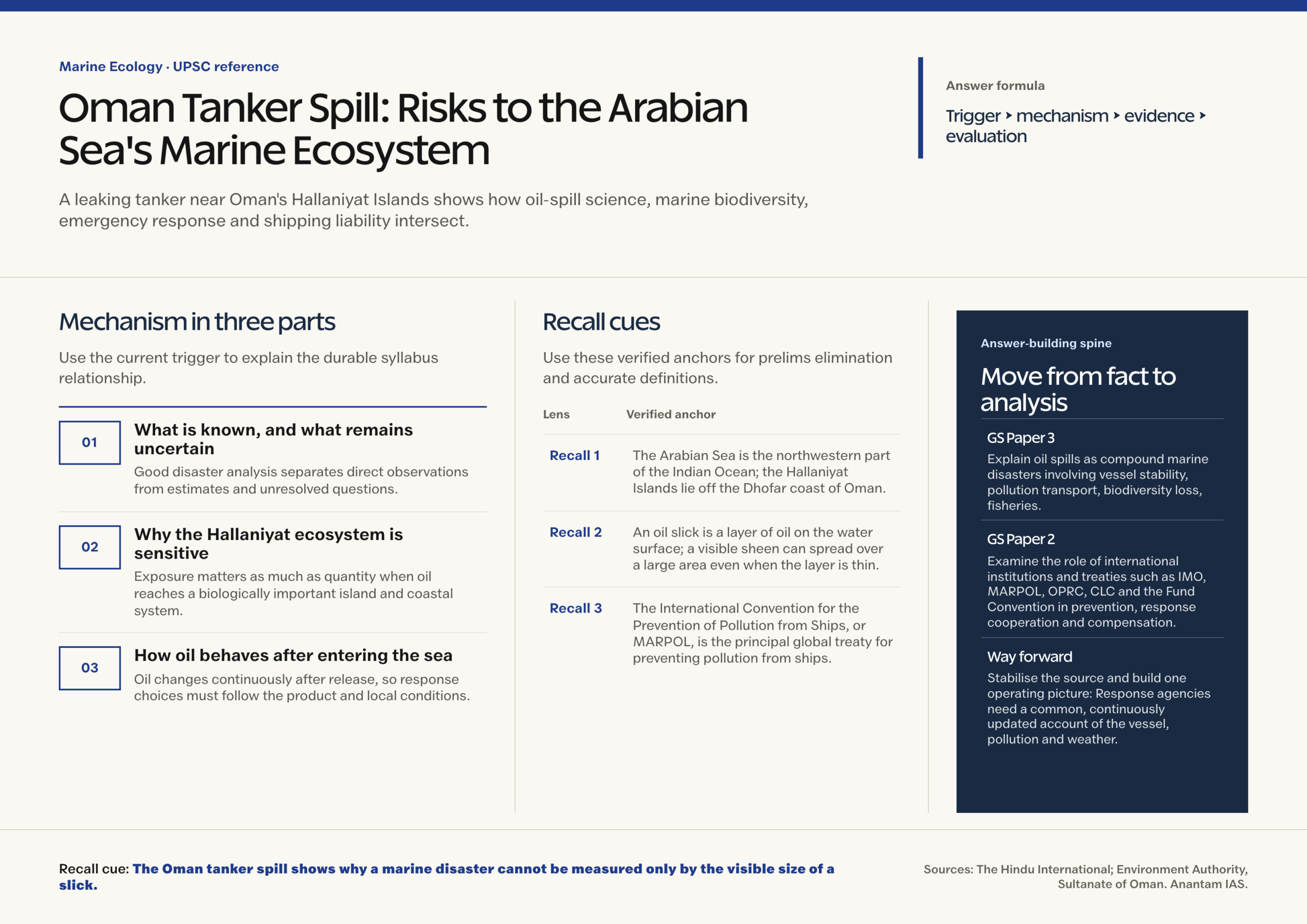
- The Arabian Sea is the northwestern part of the Indian Ocean; the Hallaniyat Islands lie off the Dhofar coast of Oman.
- An oil slick is a layer of oil on the water surface; a visible sheen can spread over a large area even when the layer is thin, so area alone cannot establish spill volume.
- The International Convention for the Prevention of Pollution from Ships, or MARPOL, is the principal global treaty for preventing pollution from ships; Annex I addresses oil pollution.
- MARPOL Annex I contains ship-design and operational controls, including oil-discharge rules; it is not the international compensation fund for spill victims.
- Under MARPOL Annex I Regulation 37, oil tankers of 150 gross tonnage and above and all ships of 400 gross tonnage and above must carry an approved Shipboard Oil Pollution Emergency Plan.
- The OPRC Convention, 1990 creates a framework for national preparedness, reporting, contingency planning, exercises, cooperation and assistance during major oil-pollution incidents.
Mains Relevance
GS Paper 3
- Explain oil spills as compound marine disasters involving vessel stability, pollution transport, biodiversity loss, fisheries, shoreline contamination and hazardous clean-up operations.
- Assess the response chain: source control and salvage, surveillance, trajectory modelling, containment and recovery, shoreline assessment, wildlife rehabilitation, seafood safety and ecological restoration.
GS Paper 2
- Examine the role of international institutions and treaties such as IMO, MARPOL, OPRC, CLC and the Fund Convention in prevention, response cooperation and compensation.
- Discuss the governance difficulty created when ownership, flag, insurer, cargo interests, sanctions, salvage rights and coastal-state jurisdiction do not align neatly.
Essay
- The sea connects economies faster than law assigns responsibility.
Background and Context
What is known, and what remains uncertain
Good disaster analysis separates direct observations from estimates and unresolved questions.
- The directly reported facts are that the tanker was grounded near Qibliyah Island, oil was visible in surrounding waters and on parts of the shore, and later satellite images suggested that the hull was more deeply.
- Omani authorities described a monitoring response using remote sensing, field work and technical modelling. Public reporting did not establish the full condition of every cargo tank or a final discharged quantity.
- Satellite sensors can identify a surface anomaly and help map its movement, but interpretation requires wind, wave, current and vessel data. Dark areas on radar imagery may have causes other than oil and should be corroborated.
- A reported slick area cannot be converted into barrels without defensible information on thickness and composition. The exam-safe formulation is that the extent appeared to expand, while the released volume remained uncertain.
- The immediate operational questions are whether the source can be isolated, whether oil can be lightered safely, whether the hull can be stabilised or salvaged, and which habitats lie in the forecast path.
Why the Hallaniyat ecosystem is sensitive
Exposure matters as much as quantity when oil reaches a biologically important island and coastal system.
- The Hallaniyat Islands lie in the Arabian Sea off southern Oman. Their isolation, rocky shores and surrounding waters support marine and coastal species that cannot be treated as replaceable open-ocean habitat.
- UNEP-linked Convention on Migratory Species material identifies Hallaniyats Bay and the Gulf of Masirah as core habitats associated with Arabian Sea humpback whales, based on surveys and telemetry off Oman.
- Arabian Sea humpback whales are unusual because this population is resident in the northern Indian Ocean rather than making the long migrations typical of many other humpback populations. Its small, isolated status magnifies the importance of.
- Petrels and other seabirds are vulnerable when oil damages the waterproof and insulating structure of feathers. Ingestion during preening and contaminated prey can add toxic exposure.
- Fish, shellfish, turtles and marine mammals face different exposure pathways. Ecological assessment should cover water, sediment, shoreline, prey species and reproduction over time, not only visible mortality.
How oil behaves after entering the sea
Oil changes continuously after release, so response choices must follow the product and local conditions.
- Spreading creates a thinner surface layer, while evaporation, dispersion, emulsification, dissolution, oxidation and biodegradation alter the oil over hours, days and longer periods.
- Wind and surface currents move a slick, waves break part of it into droplets, and weathering can create persistent water-in-oil emulsions. Some residues may strand, mix with sediment or sink after attaching to particles.
- Monsoon conditions can accelerate mixing and make at-sea containment unsafe or ineffective. A less visible sheen after rough weather does not prove that ecological risk has ended; oil may have dispersed, weathered or moved outside the.
- Shoreline type changes clean-up options. High-pressure washing or aggressive sediment removal may cause more damage than carefully monitored natural recovery in some habitats.
- Dispersants can reduce surface oil and shoreline exposure but increase oil droplets in the water column. Their use needs product-specific authorisation and a net environmental benefit assessment, especially near sensitive species and fisheries.
The international prevention and response framework
Different treaties answer different questions: prevention, emergency cooperation and financial liability.
- MARPOL Annex I sets construction and operational rules to prevent oil pollution from ships. Its safeguards include segregated ballast arrangements, double-hull requirements for newer tankers and controls on oily discharges.
- The OPRC Convention requires parties to establish national response systems with a designated authority, operational contact point, contingency plan, equipment, communication arrangements, training and exercises.
- OPRC also creates a channel for international cooperation and mutual assistance. A large incident near a remote protected area may exceed locally available salvage, surveillance, wildlife-response or clean-up resources.
- A Shipboard Oil Pollution Emergency Plan connects onboard reporting and initial action with the coastal state’s system. It does not replace national command, salvage expertise or shore-based capacity.
- The legal status of a ship or cargo may complicate contracting and finance, but the coastal state’s first priority remains protection of life, navigation and the marine environment. Sanctions compliance and environmental emergency action must be.
Way Forward
Stabilise the source and build one operating picture
- Combine satellite imagery, aircraft or drone observations where lawful, vessel inspection, hydrography, weather forecasts and current models under a single incident-command structure.
- Prioritise crew and responder safety, hull stabilisation, leak isolation, safe lightering and salvage options based on specialist assessment.
- Publish verified situation reports that distinguish cargo on board, estimated discharge, observed sheen area and confirmed shoreline impact.
Conclusion
- The Oman tanker spill shows why a marine disaster cannot be measured only by the visible size of a slick.
- For India, the durable lesson is preparedness before landfall: enforce MARPOL, exercise OPRC-style coordination, map sensitive habitats, preserve evidence and connect salvage with long-term ecological monitoring.
UPSC Practice Questions
Prelims MCQ 1
With reference to the international framework for marine oil pollution, consider the following statements:
- The OPRC Convention requires parties to establish measures for preparedness and response to oil-pollution incidents.
- MARPOL Annex I establishes the International Oil Pollution Compensation Fund for victims of tanker spills.
- The 1992 Civil Liability Convention can cover reasonable preventive measures taken against a grave and imminent threat of pollution damage.
How many of the above statements are correct?
(a) Only one (b) Only two (c) All three (d) None
Answer: (b) Only two
Explanation:
Statements 1 and 3 are correct. OPRC provides the preparedness and cooperation framework, while the 1992 CLC covers tanker-pollution liability and certain preventive measures. MARPOL Annex I regulates prevention of oil pollution from ships; the separate 1992 Fund Convention establishes the supplementary compensation fund.
Prelims MCQ 2
In oil-spill response, a net environmental benefit assessment is best understood as:
(a) Choosing the cheapest response technique regardless of habitat (b) Estimating compensation only after all clean-up work ends (c) Comparing response options to select the action likely to reduce overall environmental harm (d) Assuming natural dispersion is always safer than intervention
Answer: (c) Comparing response options to select the action likely to reduce overall environmental harm
Explanation:
Response techniques move risks among the sea surface, water column, shoreline and responders. A net environmental benefit assessment compares feasible options, ecological sensitivities and likely outcomes so that the chosen intervention reduces overall harm. It does not prescribe one technique for every spill.
UPSC Mains Questions
- An oil spill near a marine protected area is both an environmental emergency and a governance test. Discuss with reference to the tanker incident off Oman. (250 words)
- Differentiate the roles of MARPOL, OPRC 1990 and the international civil-liability and compensation regime in addressing tanker pollution. (250 words)
Sources: The Hindu International and Environment Authority, Sultanate of Oman.
Frequently Asked Questions
What happened to the tanker off Oman?
The Caroline Bezengi remained grounded near Qibliyah Island in Oman’s Hallaniyat archipelago and was reported to be leaking crude oil. Later satellite images suggested that the vessel had become more deeply submerged, while oil was observed in surrounding waters and.
Why is the spill’s location ecologically important?
The casualty is near an Arabian Sea protected area in the Hallaniyat Islands. CMS material identifies Hallaniyats Bay as a core habitat associated with the small and endangered Arabian Sea humpback whale population. The island system also supports seabirds and.
Does a large satellite oil sheen mean the same volume of oil was discharged?
No. Satellite imagery can help identify and map a likely sheen, but surface area is not volume. Thickness, oil type, weathering, wind, waves, currents and sensor conditions affect what is visible. A thin film may cover a wide area, so.
What is the difference between MARPOL and OPRC?
MARPOL is the main treaty for preventing pollution from ships; its Annex I addresses oil through ship-design, equipment and operational rules. OPRC 1990 focuses on preparedness and response, requiring national systems, contingency plans, reporting, equipment, exercises and cooperation when a.
Who is liable for damage from a tanker oil spill?
Under the applicable 1992 Civil Liability Convention framework, liability for persistent-oil pollution from a covered tanker is generally channelled to the registered shipowner, backed by compulsory insurance or financial security. The 1992 Fund may provide supplementary compensation when the first.
Source: https://anantamias.com/current-affairs/oman-tanker-spill-arabian-sea-marine-ecosystem/
U.S. Birthright Citizenship: New Executive Orders and Constitutional Limits
Why in News?
On August 6, 2026, the U.S.
- The birth-tourism order targets entry, visas and travel authorization. It defines birth tourism as entering on a nonimmigrant visa for the purpose of giving birth on U.S. soil, and also covers efforts to facilitate such.
- It delegates presidential authority under Section 215(a) of the Immigration and Nationality Act, codified at 8 U.S.C. 1185(a), to the Secretaries of State and Homeland Security for implementation.
- The order says contemplated measures may include preventing entry, denying or revoking a visa or travel authorization, removal, a permanent entry bar and action against facilitators, all within the Secretaries’ discretion and lawful authority.
- A separate citizenship-document order directs federal agencies not to recognize citizenship for specified categories when neither parent is a U.S. citizen. The categories include some foreign-government employees, designated terrorist-linked persons, commercial birth-tourism or surrogacy transactions.
- The companion order requires affected agencies to issue public implementation guidance within 30 days. Its categories and any later guidance remain subject to constitutional, statutory and judicial review.
- The dispute separates three legal questions: who may enter, whether an entrant misrepresented a visa purpose, and whether a U.S.-born child is a citizen. Each question has a different legal source and remedy.
- The case illustrates constitutional supremacy: an executive order can direct agencies within delegated authority but cannot amend the text of the Constitution or displace a binding judicial interpretation.
- It also shows how governments may pursue a policy goal through a narrower administrative route after a broader constitutional claim fails, while courts retain the power to test the new route’s legality.
UPSC Relevance
Prelims Relevance
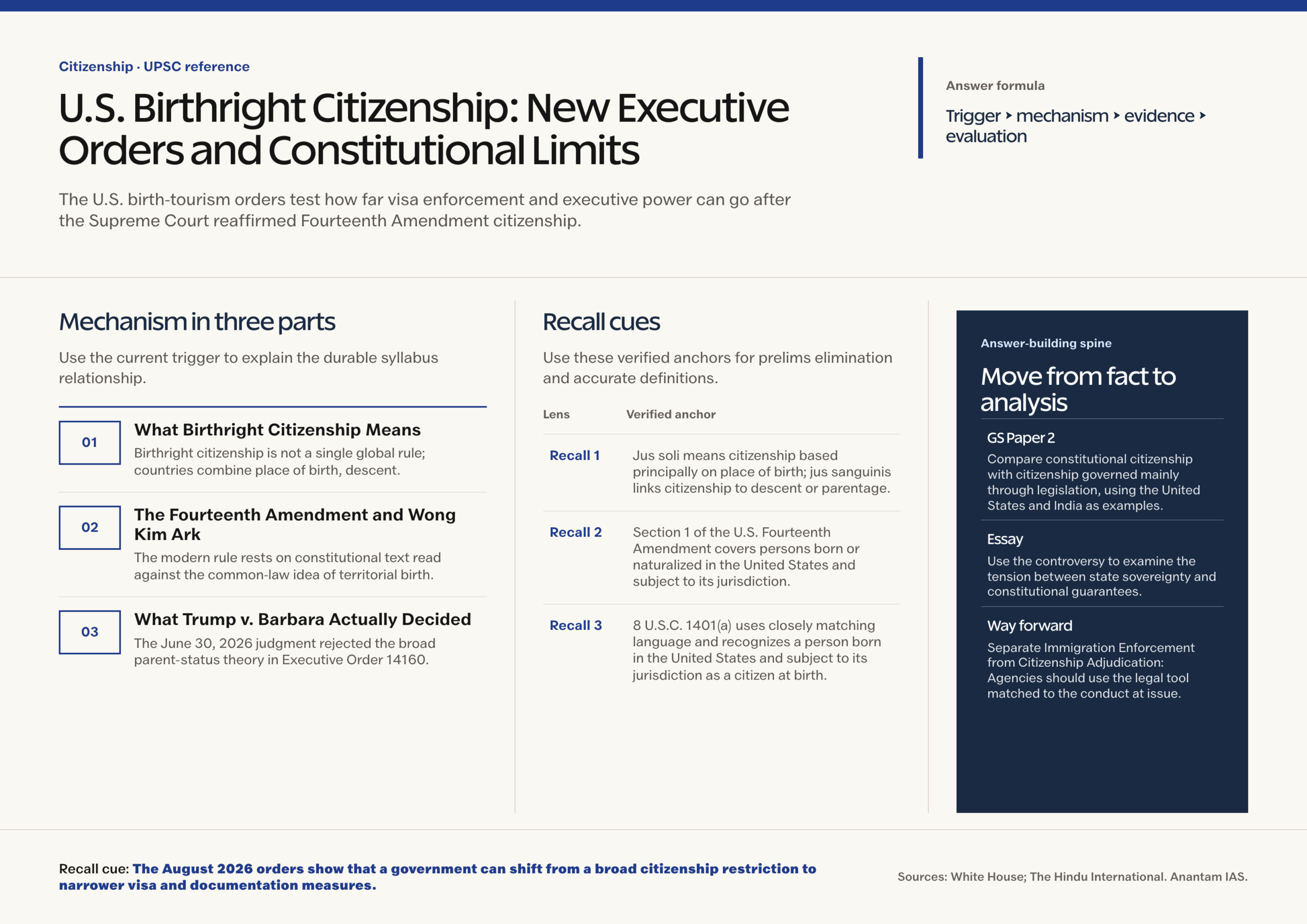
- Jus soli means citizenship based principally on place of birth; jus sanguinis links citizenship to descent or parentage.
- Section 1 of the U.S. Fourteenth Amendment covers persons born or naturalized in the United States and subject to its jurisdiction.
- 8 U.S.C. 1401(a) uses closely matching language and recognizes a person born in the United States and subject to its jurisdiction as a citizen at birth.
- In United States v. Wong Kim Ark (1898), the Supreme Court treated the Citizenship Clause as adopting the common-law rule of citizenship by birth, with narrow jurisdiction-based exceptions.
- In Trump v. Barbara (2026), the Court held that unlawful immigration status or temporary presence of the parents does not by itself remove a U.S.-born child from U.S. jurisdiction.
- The Court’s historical account recognized narrow exceptions associated with children of foreign ministers and births in territory outside the sovereign’s effective control, including hostile occupation.
Mains Relevance
GS Paper 2
- Compare constitutional citizenship with citizenship governed mainly through legislation, using the United States and India as examples.
- Explain the relationship among separation of powers, judicial review, executive implementation and legislative competence.
Essay
- Use the controversy to examine the tension between state sovereignty and constitutional guarantees.
- Discuss how citizenship law shapes belonging, equality, migration incentives and the risk of statelessness.
Essay
- A constitutional right is most seriously tested when a government seeks a popular policy objective through administrative power.
Background and Context
What Birthright Citizenship Means
Birthright citizenship is not a single global rule; countries combine place of birth, descent, residence and parental status in different ways.
- The U.S. rule is anchored in the Citizenship Clause: all persons born or naturalized in the United States and subject to its jurisdiction are citizens of the United States and the State where they reside.
- The phrase subject to the jurisdiction thereof does the limiting work. The central dispute is whether it refers to ordinary governing authority over people present in the territory or demands a stronger parental allegiance or domicile.
- Birthright citizenship concerns status acquired at birth. It is different from naturalization, through which an eligible non-citizen later acquires citizenship under statutory conditions.
- A parent’s breach of an immigration rule may trigger consequences for the parent. It does not, without a valid legal basis, erase an independently conferred constitutional status of the child.
The Fourteenth Amendment and Wong Kim Ark
The modern rule rests on constitutional text read against the common-law idea of territorial birth.
- The Fourteenth Amendment was ratified in 1868 after the Civil War and repudiated the exclusionary citizenship logic of Dred Scott v. Sandford.
- In Wong Kim Ark, the Court held that a U.S.-born child of Chinese parents who were subjects of China but domiciled in the United States was a citizen under the Fourteenth Amendment.
- The 2026 Court explained that Wong Kim Ark’s reasoning was not confined to children of lawful permanent residents. Foreign visitors entering for business or pleasure remain under U.S. law while present, so their children are generally.
- The traditional exception for a child of a foreign minister rests on immunity and an extraterritorial legal fiction, not simply on the parent’s foreign nationality or government employment.
What Trump v. Barbara Actually Decided
The June 30, 2026 judgment rejected the broad parent-status theory in Executive Order 14160, but the Justices did not all use the same reasoning.
- The Court affirmed the judgment 6-3. Chief Justice Roberts wrote a constitutional majority opinion joined by Justices Sotomayor, Kagan, Barrett and Jackson.
- That five-Justice majority held that children born in the United States to parents who are unlawfully or temporarily present are subject to U.S. jurisdiction and are citizens at birth under the Fourteenth Amendment.
- Justice Kavanaugh concurred in the judgment because Executive Order 14160 conflicted with 8 U.S.C. 1401(a), but he disagreed with the majority’s constitutional interpretation. This distinction matters when describing the decision.
- The ruling directly undermined a blanket attempt to exclude children based only on a parent’s unlawful or temporary status. It did not pre-approve every category in the August orders, nor did it settle every possible immunity.
What the Birth-Tourism Order Does
The narrower order focuses primarily on the temporary admission of foreign nationals rather than changing the Citizenship Clause.
- Its definition covers a foreign national entering through a nonimmigrant visa for the purpose of giving birth on U.S. soil, plus any foreign national who facilitates such entry.
- The State Department already stated in 2020 that a B-visa applicant may be denied where a consular officer has reason to believe the primary travel purpose is giving birth in the United States to obtain citizenship.
- Section 215(a) of the INA authorizes presidential rules, limitations and exceptions governing an alien’s departure from or entry into the United States. The August order delegates implementation authority under that provision to State and Homeland Security.
- The order allows humanitarian and national-interest exemptions. Its general clause also requires implementation consistent with applicable law and available appropriations.
- The order’s reference to a permanent bar does not make every suspected case automatically subject to that outcome. Agencies must act within delegated statutory authority, provide applicable procedure and withstand judicial review.
Way Forward
Separate Immigration Enforcement from Citizenship Adjudication
- Investigate proven visa misrepresentation, trafficking or commercial fraud through immigration and criminal law without presuming that parental wrongdoing changes a child’s constitutional status.
- Publish clear standards for purpose-of-travel findings, evidence, exemptions, notice and review so that pregnancy alone does not become a proxy for fraud.
- Record decisions and permit meaningful administrative and judicial review where law requires it.
Conclusion
- The August 2026 orders show that a government can shift from a broad citizenship restriction to narrower visa and documentation measures, but narrower drafting does not guarantee legality.
- The constitutional boundary remains clear after Trump v.
UPSC Practice Questions
Prelims MCQ 1
With reference to U.S. birthright citizenship, consider the following statements:
- The Citizenship Clause is part of the Fourteenth Amendment.
- Trump v. Barbara held that temporary presence of a child’s parents automatically removes the child from U.S. jurisdiction.
- 8 U.S.C. 1401(a) recognizes a person born in the United States and subject to its jurisdiction as a citizen at birth.
How many of the above statements are correct?
(a) Only one (b) Only two (c) All three (d) None
Answer: (b) Only two
Explanation:
Statements 1 and 3 are correct. Trump v. Barbara reached the opposite conclusion to Statement 2: children born in the United States to parents unlawfully or temporarily present are subject to U.S. jurisdiction and are citizens at birth.
Prelims MCQ 2
Which one of the following best distinguishes the August 2026 U.S. order titled Ending Birth Tourism from the Citizenship Clause question?
(a) It amends the Fourteenth Amendment through executive action. (b) It regulates nonimmigrant entry and visa use under delegated immigration authority. (c) It grants state governments exclusive power over nationality. (d) It abolishes judicial review of citizenship decisions.
Answer: (b) It regulates nonimmigrant entry and visa use under delegated immigration authority.
Explanation:
The order delegates authority linked to INA Section 215(a) to State and Homeland Security. Regulation of a parent’s admission is distinct from determining a U.S.-born child’s citizenship under the Fourteenth Amendment and 8 U.S.C. 1401(a).
UPSC Mains Questions
- The power to regulate immigration does not automatically include the power to redefine constitutional citizenship. Discuss with reference to the U.S. birth-tourism orders and Trump v. Barbara. (250 words)
- Compare citizenship by birth in the United States and India. How do constitutional entrenchment and statutory design affect the scope for executive and legislative change? (250 words)
Sources: White House and The Hindu International.
Frequently Asked Questions
What is birth tourism?
The August 2026 order defines birth tourism as entry into the United States on a nonimmigrant visa for the purpose of giving birth on U.S. soil. It also includes efforts by a foreign national to facilitate another foreign national’s entry.
Did Trump v. Barbara abolish all exceptions to U.S. birthright citizenship?
No. The Court held that unlawful or temporary parental presence does not defeat citizenship for a child born in the United States. Its historical analysis continued to recognize narrow jurisdiction-based exceptions, including foreign-minister immunity and births outside effective sovereign control.
Was Trump v. Barbara a 6-3 constitutional ruling?
The judgment was 6-3, but the constitutional majority comprised five Justices. Justice Kavanaugh supplied the sixth vote for the judgment on statutory grounds, concluding that Executive Order 14160 conflicted with 8 U.S.C. 1401(a), while disagreeing with the constitutional majority.
Can the U.S. executive deny a visa sought primarily for giving birth?
U.S. visitor-visa policy has treated travel whose primary purpose is giving birth to obtain citizenship for the child as an impermissible basis for a B visa. Any denial, revocation, removal or bar must still rest on applicable statutory and regulatory.
Does visa fraud by a parent automatically cancel a child’s birthright citizenship?
No. Immigration consequences for a parent and citizenship status of a child are separate legal questions. After Trump v. Barbara, a parent’s temporary or unlawful presence alone does not remove a U.S.-born child from the Fourteenth Amendment’s Citizenship Clause.
Source: https://anantamias.com/current-affairs/us-birthright-citizenship-birth-tourism-orders/
MSME Development Amendment Bill: Tackling Delayed Payments and Liquidity Stress
Why in News?
The Lok Sabha passed the Micro, Small and Medium Enterprises Development (Amendment) Bill, 2026 on August 7, 2026, after the Rajya Sabha passed it on August 3.
- As of August 9, the Bill has been passed by both Houses, but its provisions should not be treated as operative merely because Parliament has passed it; commencement follows the legal process and a Central Government.
- A proposed new Section 15A requires every Central Public Sector Enterprise to route settlement of invoices for goods or services procured from micro, small and medium enterprises through an RBI-authorised Trade Receivables Discounting System platform.
- The Bill sets a 90-day limit for mediation from the date fixed for first appearance, a 30-day limit for referring an unsuccessful mediation to arbitration, and a 90-day limit for making an award after completion of.
- A mediated settlement or arbitral award may be recovered as arrears of land revenue; the amount is also declared a valid and legally enforceable debt liable to recognition under the Insolvency and Bankruptcy Code, 2016.
- Where a challenge to an award or settlement has remained pending for more than six months, the court must order payment to the supplier of at least 50% of the awarded amount from the mandatory deposit.
- Delayed receivables are a working-capital shock: wages, raw materials, utilities and loan instalments fall due even when the buyer has not paid an accepted invoice.
- The existing MSMED Act creates payment discipline for micro and small enterprise suppliers, but delays in dispute disposal and award enforcement can weaken the value of the statutory remedy.
- TReDS can convert an accepted invoice into early liquidity through competitive financing, but its impact still depends on timely invoice acceptance, buyer participation, reliable data and affordable discount rates.
UPSC Relevance
Prelims Relevance
- The parent law is the Micro, Small and Medium Enterprises Development Act, 2006.
- Under the existing delayed-payment framework, the agreed credit period for a micro or small enterprise supplier cannot exceed 45 days from acceptance or deemed acceptance.
- Delayed payment attracts compound interest with monthly rests at three times the RBI bank rate under Section 16 of the MSMED Act.
- A Micro and Small Enterprises Facilitation Council handles references concerning amounts due to eligible micro and small suppliers.
- TReDS is an RBI-regulated electronic platform for financing or discounting MSME trade receivables due from buyers.
- The Bill’s mandatory TReDS provision applies to procurement by every Central Public Sector Enterprise; the Centre and states may notify additional bodies or entities.
Mains Relevance
GS Paper 3
- Explain how delayed receivables transmit into higher borrowing, disrupted production, weaker employment security and reduced competitiveness for MSMEs.
- Assess TReDS as a market-based working-capital mechanism and distinguish invoice financing from final adjudication of a disputed claim.
GS Paper 2
- Examine the federal design: Parliament creates the framework, while state governments constitute and resource adequate numbers of Facilitation Councils.
- Discuss administrative adjudication, appellate review, online dispute resolution and access to justice for geographically dispersed small suppliers.
Essay
- A legal right has limited economic value when enforcement arrives after the enterprise has lost its working capital.
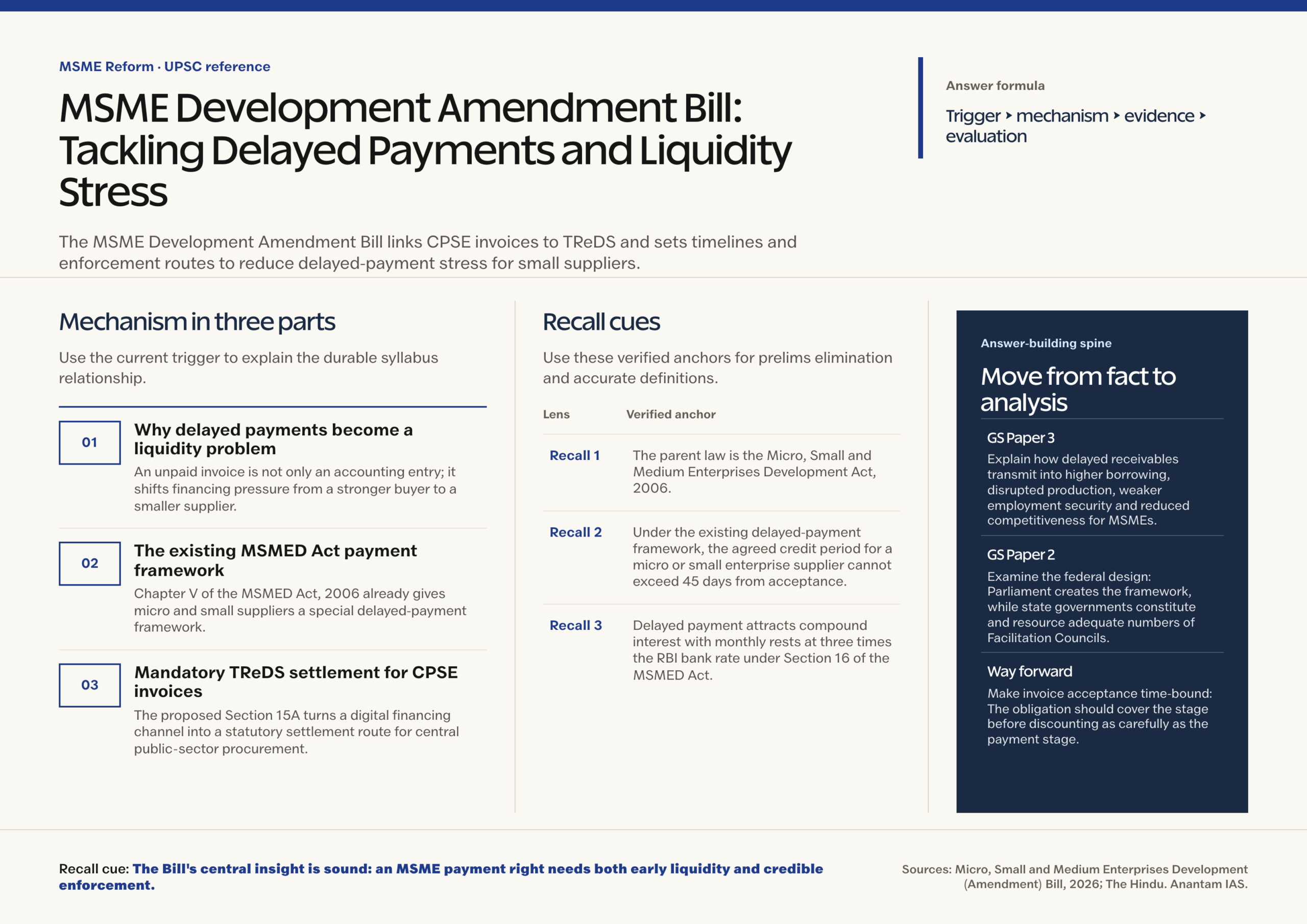
Background and Context
Why delayed payments become a liquidity problem
An unpaid invoice is not only an accounting entry; it shifts financing pressure from a stronger buyer to a smaller supplier.
- The supplier has usually already paid for labour, inputs, transport, electricity and taxes. A delayed receivable creates a cash-flow mismatch even when the enterprise remains profitable on paper.
- The firm may respond by drawing costly short-term credit, postponing wages or investment, reducing inventories, or declining new orders. These choices can turn a buyer’s delay into lower production and employment.
- Micro and small firms often possess weaker bargaining power and may hesitate to pursue a large customer for fear of losing future business. A statutory remedy must account for this power asymmetry.
- Liquidity stress can also discourage formalisation. Registration and tax compliance become less attractive if a formal invoice is enforceable only after a long and expensive dispute.
The existing MSMED Act payment framework
Chapter V of the MSMED Act, 2006 already gives micro and small suppliers a special delayed-payment framework.
- Section 15 requires payment by the agreed date; where the agreement allows credit, the period cannot exceed 45 days from the day of acceptance or deemed acceptance of goods or services.
- Section 16 makes a defaulting buyer liable for compound interest with monthly rests at three times the RBI bank rate. This is designed to make delayed payment more expensive than normal commercial credit.
- A supplier may refer the dispute to the relevant Micro and Small Enterprises Facilitation Council. The framework combines conciliation or mediation with arbitration when settlement does not succeed.
- The special delayed-payment protections are framed around a micro or small supplier. This should not be confused with the Bill’s broader TReDS language covering procurement from micro, small and medium enterprises.
- The statutory interest rule does not by itself put cash into the supplier’s account. Case backlogs, challenges to awards, uneven Council capacity and enforcement delays can postpone effective relief.
Mandatory TReDS settlement for CPSE invoices
The proposed Section 15A turns a digital financing channel into a statutory settlement route for central public-sector procurement from MSMEs.
- Every CPSE must route settlement of covered invoices through an RBI-authorised TReDS platform in the prescribed form and manner.
- The Central Government may notify another authority, body or entity for the same obligation. A state government may notify state public-sector enterprises and other state-level bodies or entities.
- On TReDS, an accepted receivable can be discounted by banks or other permitted financiers. The MSME receives funds before maturity, while the financier receives payment from the buyer on the due date.
- The reform can create a traceable invoice trail, increase financing competition and reduce dependence on collateral-based working-capital loans. It can also produce better compliance data for public procurement.
- TReDS is not a cure for every dispute. If a buyer delays acceptance, contests delivery, withholds documentation or fails to honour the obligation, platform coverage must be backed by grievance resolution and enforcement.
Time-bound mediation, arbitration and online access
The Bill addresses delay within the dispute-resolution chain by fixing separate clocks for its key stages.
- The Council or its mediation service provider must complete mediation within 90 days from the date fixed for first appearance.
- If mediation terminates without settlement, the reference to arbitration must be made within 30 days from termination.
- The Council or alternative dispute-resolution institution must make the arbitral award within 90 days from completion of pleadings.
- Jurisdiction follows the supplier’s official registered address, while the buyer may be located anywhere in India. This can reduce the travel and forum burden on a small supplier.
- The Central Government may establish an online mechanism for mediation and arbitration using audio-video communication, electronic pleadings, evidence and related processes.
Way Forward
Make invoice acceptance time-bound
- Prescribe a short, transparent period for accepting or recording a reasoned dispute against an invoice, with deemed escalation when the buyer remains silent.
- Integrate CPSE procurement and accounting systems with TReDS so invoice data moves automatically and suppliers do not upload the same evidence repeatedly.
- Set caseload-based norms for the number of Councils, legal and financial expertise, e-filing support, hearing infrastructure and trained case managers.
- Publish state-wise data on first appearance, mediation completion, arbitral awards, challenges, amounts released and final recovery, while protecting commercially sensitive details.
Conclusion
- The Bill’s central insight is sound: an MSME payment right needs both early liquidity and credible enforcement.
- The real test will be operational.
UPSC Practice Questions
Prelims MCQ 1
With reference to the Micro, Small and Medium Enterprises Development (Amendment) Bill, 2026, consider the following statements:
- It requires every Central Public Sector Enterprise to route settlement of invoices for MSME procurement through an RBI-authorised TReDS platform.
- It requires mediation to be completed within 90 days from the date fixed for first appearance.
- It abolishes the requirement of a deposit when a buyer seeks to set aside an arbitral award.
How many of the above statements are correct?
(a) Only one (b) Only two (c) All three (d) None
Answer: (b) Only two
Explanation:
Statements 1 and 2 are correct. Statement 3 is incorrect because the Bill retains and extends the rule that a non-supplier applicant must deposit 75% of the relevant award or mediated settlement amount before a court entertains the challenge.
Prelims MCQ 2
Which one of the following best describes the primary function of the Trade Receivables Discounting System (TReDS)?
(a) It classifies enterprises into micro, small and medium categories (b) It provides an electronic platform for financing or discounting MSME trade receivables (c) It adjudicates all contractual disputes between private buyers and suppliers (d) It grants unsecured budgetary subsidies directly to every registered MSME
Answer: (b) It provides an electronic platform for financing or discounting MSME trade receivables
Explanation:
TReDS is an RBI-regulated electronic platform that enables financing or discounting of MSME receivables against buyer invoices. It does not classify enterprises, act as a universal adjudicatory body or automatically distribute subsidies.
UPSC Mains Questions
- Delayed payments are not merely a contractual problem; they are a transmission channel for liquidity stress across the MSME economy. Discuss in the context of the MSME Development (Amendment) Bill, 2026.
- Evaluate the proposed combination of mandatory TReDS settlement, time-bound alternative dispute resolution and stronger award enforcement. What implementation gaps could still weaken payment discipline?
Sources: Micro, Small and Medium Enterprises Development (Amendment) Bill, 2026 and The Hindu.
Frequently Asked Questions
What is the MSME Development (Amendment) Bill, 2026?
It is a Bill passed by both Houses of Parliament to amend the MSMED Act, 2006. Its major changes concern MSME classification and registration, mandatory TReDS settlement for CPSE procurement, deadlines for mediation and arbitration, enforcement of settlements and awards.
Does the Bill reduce the existing 45-day payment limit?
The Bill’s central delayed-payment reforms do not replace the existing Section 15 ceiling under which an agreed credit period for an eligible micro or small supplier cannot exceed 45 days from acceptance or deemed acceptance. It adds TReDS routing and.
How does TReDS help an MSME supplier?
After a buyer accepts an invoice, financiers can competitively discount the receivable on an RBI-authorised TReDS platform. The MSME gets funds before the invoice matures, improving working capital. The mechanism works best when buyers accept invoices promptly and financiers compete.
What timelines does the Bill set for delayed-payment disputes?
Mediation must finish within 90 days from the date fixed for first appearance. If it fails, referral to arbitration must occur within 30 days from termination of mediation. The arbitral award must then be made within 90 days from completion.
How does the Bill strengthen enforcement of an MSME award?
A mediated settlement or arbitral award may be recovered as arrears of land revenue and recognised as a legally enforceable debt under the IBC framework. A non-supplier challenging it must deposit 75%, and a prolonged challenge triggers release of at.
Source: https://anantamias.com/current-affairs/msme-development-amendment-bill-delayed-payments/
GOBARdhan Scheme: Scaling Compressed Biogas and the Circular Economy
Why in News?
The Union Cabinet approved GOBARdhan as a national circular bioenergy scheme on 6 August 2026, with the Ministry of Petroleum and Natural Gas as the nodal ministry for the new compressed-biogas framework.
- The scheme is designed for the period from FY2026-27 to FY2035-36, giving investors a longer policy horizon than short-duration capital-support programmes.
- It seeks to raise domestic compressed biogas production by supporting projects across the value chain rather than treating the plant as an isolated asset.
- Eligible feedstocks include cattle dung, agricultural residue, press mud, municipal organic waste and other biodegradable material.
- CBG can be sold as a transport fuel, injected into natural-gas pipelines or blended in the CNG transport and domestic PNG segments, subject to technical and quality norms.
- The scheme should not be confused with the original GOBARdhan initiative launched in 2018 under Swachh Bharat Mission (Grameen), although both form part of the wider waste-to-wealth policy ecosystem.
- India imports a large share of its crude oil and natural gas requirements. Locally produced biomethane can substitute a part of fossil gas demand while using domestic waste streams.
- Agricultural residue and cattle dung have a collection cost as well as an environmental cost when unmanaged. A reliable CBG value chain can convert them into fuel and digestate-based manure.
- The policy is also a test of the circular economy: environmental gains depend on segregation, methane control, viable logistics and productive use of every output, not only on announcing plant capacity.
UPSC Relevance
Prelims Relevance
- GOBARdhan expands to Galvanizing Organic Bio-Agro Resources Dhan.
- The original GOBARdhan initiative was launched in 2018 under Swachh Bharat Mission (Grameen); the Department of Drinking Water and Sanitation coordinates that umbrella initiative.
- The 2026 national circular bioenergy scheme places the CBG framework under the Ministry of Petroleum and Natural Gas.
- SATAT, launched on 1 October 2018, stands for Sustainable Alternative Towards Affordable Transportation and created an offtake-oriented ecosystem for CBG.
- Biogas is produced by the anaerobic digestion of biodegradable material. It is upgraded by removing carbon dioxide, hydrogen sulphide and moisture before compression as CBG.
- CBG and fossil CNG are both methane-rich gaseous fuels, but CBG comes from renewable biological feedstock.
Mains Relevance
GS Paper 3
- Use the scheme to explain the link between energy security, biofuels, climate mitigation and reduced dependence on imported natural gas.
- Assess CBG as an instrument for managing crop residue, cattle dung, wet municipal waste and agro-industrial by-products.
GS Paper 2
- Discuss the need for whole-of-government coordination across petroleum, sanitation, renewable energy, agriculture, fertilisers, urban affairs and state pollution-control authorities.
- Evaluate implementation through measurable outcomes such as commissioned capacity, verified gas output, methane leakage, manure sales and timely offtake rather than registrations alone.
Essay
- Waste becomes wealth only when institutions connect technology to reliable markets.
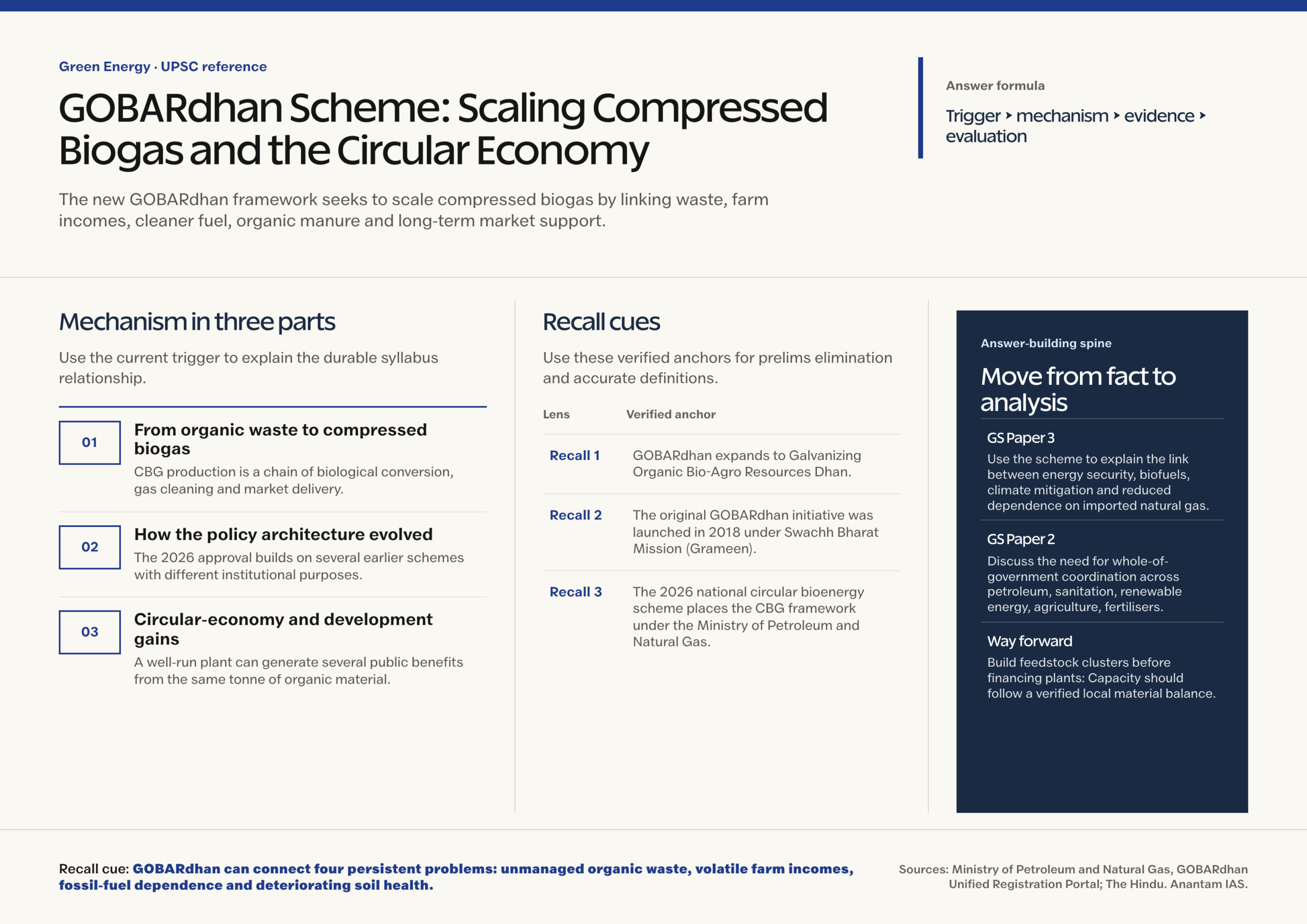
Background and Context
From organic waste to compressed biogas
CBG production is a chain of biological conversion, gas cleaning and market delivery.
- Source-segregated cattle dung, crop residue, press mud, food waste or sewage-derived organic matter enters a sealed digester. Microorganisms break it down in the absence of oxygen through anaerobic digestion.
- Raw biogas contains combustible methane along with carbon dioxide, moisture and trace contaminants. Upgrading removes impurities; compression produces CBG suitable for regulated fuel use.
- The residual digestate is not automatically a saleable fertiliser. It needs quality control, processing, nutrient testing, storage and a credible market as FOM, LFOM or another permitted organic input.
- The climate case depends on preventing fugitive methane emissions. Poorly sealed digesters, leaking equipment or unmanaged digestate can erode the claimed benefit because methane is a potent greenhouse gas.
How the policy architecture evolved
The 2026 approval builds on several earlier schemes with different institutional purposes.
- The 2018 GOBARdhan initiative began as an integral component of solid-waste management under SBM(G), focused on village cleanliness and conversion of biodegradable waste into biogas and bio-slurry.
- SATAT, also launched in 2018 by the petroleum ministry, encouraged entrepreneurs to produce CBG and supply it to oil and gas marketing companies under long-term procurement arrangements.
- The Ministry of New and Renewable Energy’s National Bioenergy Programme has provided central financial assistance for waste-to-energy and Bio-CNG projects, while urban waste projects may receive support under SBM-U 2.0.
- The Department of Fertilisers supports the sale of manure from CBG plants; agriculture programmes support biomass-aggregation machinery; and the petroleum ecosystem addresses offtake and pipeline injection.
- The new framework’s significance lies in integration and policy continuity. It must align capital support, credit, price signals, feedstock logistics, pipeline access and by-product markets.
Circular-economy and development gains
A well-run plant can generate several public benefits from the same tonne of organic material.
- Diverting biodegradable waste from dumps, drains and open heaps can improve sanitation, reduce odour and lower local water and air pollution.
- Using paddy straw and other residues as feedstock can create an alternative to open burning, provided collection payments and transport distances remain economically viable.
- Farmers, cattle owners, self-help groups and cooperatives can earn from feedstock aggregation and local services, while plants create technical and operating jobs.
- Domestic CBG can displace a portion of fossil CNG or imported LNG in transport and city-gas networks. The effect on import dependence will depend on actual annual output and offtake, not announced capacity.
- Properly processed digestate can return organic matter and nutrients to soil, linking the energy system with soil-health and fertiliser-efficiency objectives.
Why CBG projects struggle to scale
The central risk is a mismatch between plant finance and the everyday economics of feedstock and sales.
- Biomass is dispersed, seasonal and bulky. A plant may face high collection, baling, storage and transport costs even when a region has abundant theoretical feedstock.
- Municipal plants require consistent source segregation. Mixed waste raises contamination, maintenance costs and rejection of both gas-system inputs and digestate.
- CBG projects need land, environmental consents, gas-quality testing, compression equipment, safety approvals and dependable pipeline or cascade transport connectivity.
- Delayed commissioning and uncertain offtake can stress debt repayment. Small developers also face technology-selection and working-capital risks.
- The manure side is often treated as a secondary revenue line, although unsold digestate creates storage and environmental liabilities. Farmer trust depends on verified nutrient quality and agronomic guidance.
Way Forward
Build feedstock clusters before financing plants
- Prepare district-level maps of seasonal biomass, cattle dung, wet waste, competing uses, transport radius and storage needs.
- Use transparent multi-year contracts with farmer organisations, dairies, sugar mills and urban local bodies, including quality and contamination standards.
- Support cooperatives, self-help groups and rural entrepreneurs as aggregation partners so value does not bypass the waste suppliers.
Conclusion
- GOBARdhan can connect four persistent problems: unmanaged organic waste, volatile farm incomes, fossil-fuel dependence and deteriorating soil health.
- The real test will be operational discipline.
UPSC Practice Questions
Prelims MCQ 1
With reference to India’s compressed-biogas ecosystem, consider the following statements:
- GOBARdhan was first launched in 2018 under Swachh Bharat Mission (Grameen).
- SATAT is an initiative of the Ministry of Petroleum and Natural Gas.
- Compressed biogas can be blended in the CNG transport and domestic PNG segments of city-gas distribution.
How many of the above statements are correct?
(a) Only one (b) Only two (c) All three (d) None
Answer: (c) All three
Explanation:
All three statements are correct. GOBARdhan began under SBM(G) in 2018; MoPNG launched SATAT in October 2018; and the government has adopted phase-wise CBG blending for the CNG transport and domestic PNG segments.
Prelims MCQ 2
Which one of the following best describes compressed biogas (CBG)?
(a) Hydrogen produced by electrolysis using biomass electricity (b) Methane-rich gas obtained by upgrading and compressing biogas from organic feedstock (c) Liquefied petroleum gas blended with ethanol (d) Synthetic gas produced only through coal gasification
Answer: (b) Methane-rich gas obtained by upgrading and compressing biogas from organic feedstock
Explanation:
Anaerobic digestion produces raw biogas. Removing carbon dioxide, moisture and other contaminants raises its methane concentration; the upgraded gas is then compressed for use as CBG.
UPSC Mains Questions
- The success of compressed biogas depends as much on feedstock, offtake and manure markets as on plant technology. Discuss in the context of the GOBARdhan scheme. (250 words)
- Examine how GOBARdhan can advance India’s circular economy, rural incomes and energy security. What environmental and governance safeguards are required? (250 words)
Sources: Ministry of Petroleum and Natural Gas, GOBARdhan Unified Registration Portal and The Hindu.
Frequently Asked Questions
What is GOBARdhan?
GOBARdhan means Galvanizing Organic Bio-Agro Resources Dhan. The original 2018 initiative under SBM(G) promotes conversion of cattle dung and other biodegradable waste into biogas, CBG and bio-slurry. The 2026 national circular bioenergy scheme adds an integrated, petroleum-led framework for scaling.
What did the Union Cabinet approve in August 2026?
The Cabinet approved GOBARdhan as a national circular bioenergy scheme with a reported ten-year outlay of ₹23,731 crore for FY2026-27 to FY2035-36. The new framework is led by the Ministry of Petroleum and Natural Gas and is intended to support.
How is compressed biogas different from ordinary biogas?
Raw biogas contains methane, carbon dioxide, moisture and trace contaminants. To make CBG, the gas is purified to raise methane content and then compressed. This produces a regulated fuel that can substitute or blend with fossil CNG, while ordinary biogas.
How does GOBARdhan support a circular economy?
It redirects cattle dung, crop residue, press mud and wet organic waste into useful outputs. The gas becomes transport or city-gas fuel, while properly processed digestate can become organic manure. The loop is complete only when waste is segregated, methane.
What are the main implementation challenges for CBG plants?
Major constraints include seasonal and dispersed feedstock, contamination in municipal wet waste, high transport and storage costs, project finance, delayed clearances, gas-quality compliance, pipeline connectivity and uncertain manure demand. A registered plant is not the same as a commissioned and.
Source: https://anantamias.com/current-affairs/gobardhan-scheme-compressed-biogas-circular-economy/