Why in News?
The Union Cabinet approved GOBARdhan as a national circular bioenergy scheme on 6 August 2026, with the Ministry of Petroleum and Natural Gas as the nodal ministry for the new compressed-biogas framework.
- The scheme is designed for the period from FY2026-27 to FY2035-36, giving investors a longer policy horizon than short-duration capital-support programmes.
- It seeks to raise domestic compressed biogas production by supporting projects across the value chain rather than treating the plant as an isolated asset.
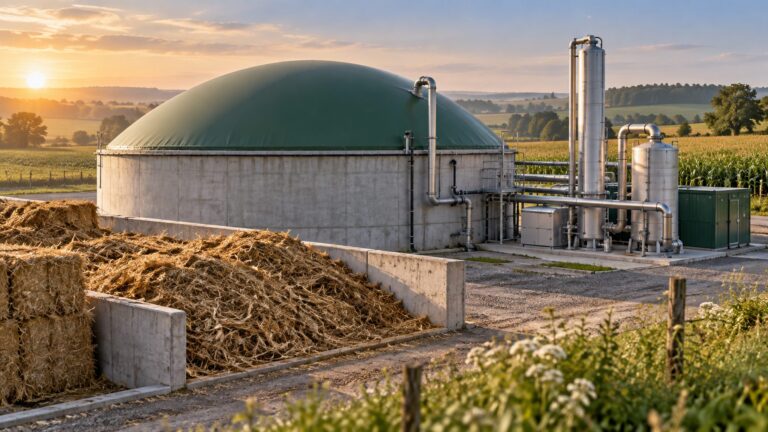
- Eligible feedstocks include cattle dung, agricultural residue, press mud, municipal organic waste and other biodegradable material.
- CBG can be sold as a transport fuel, injected into natural-gas pipelines or blended in the CNG transport and domestic PNG segments, subject to technical and quality norms.
- The scheme should not be confused with the original GOBARdhan initiative launched in 2018 under Swachh Bharat Mission (Grameen), although both form part of the wider waste-to-wealth policy ecosystem.
- India imports a large share of its crude oil and natural gas requirements. Locally produced biomethane can substitute a part of fossil gas demand while using domestic waste streams.
- Agricultural residue and cattle dung have a collection cost as well as an environmental cost when unmanaged. A reliable CBG value chain can convert them into fuel and digestate-based manure.
- The policy is also a test of the circular economy: environmental gains depend on segregation, methane control, viable logistics and productive use of every output, not only on announcing plant capacity.
UPSC Relevance
Prelims Relevance
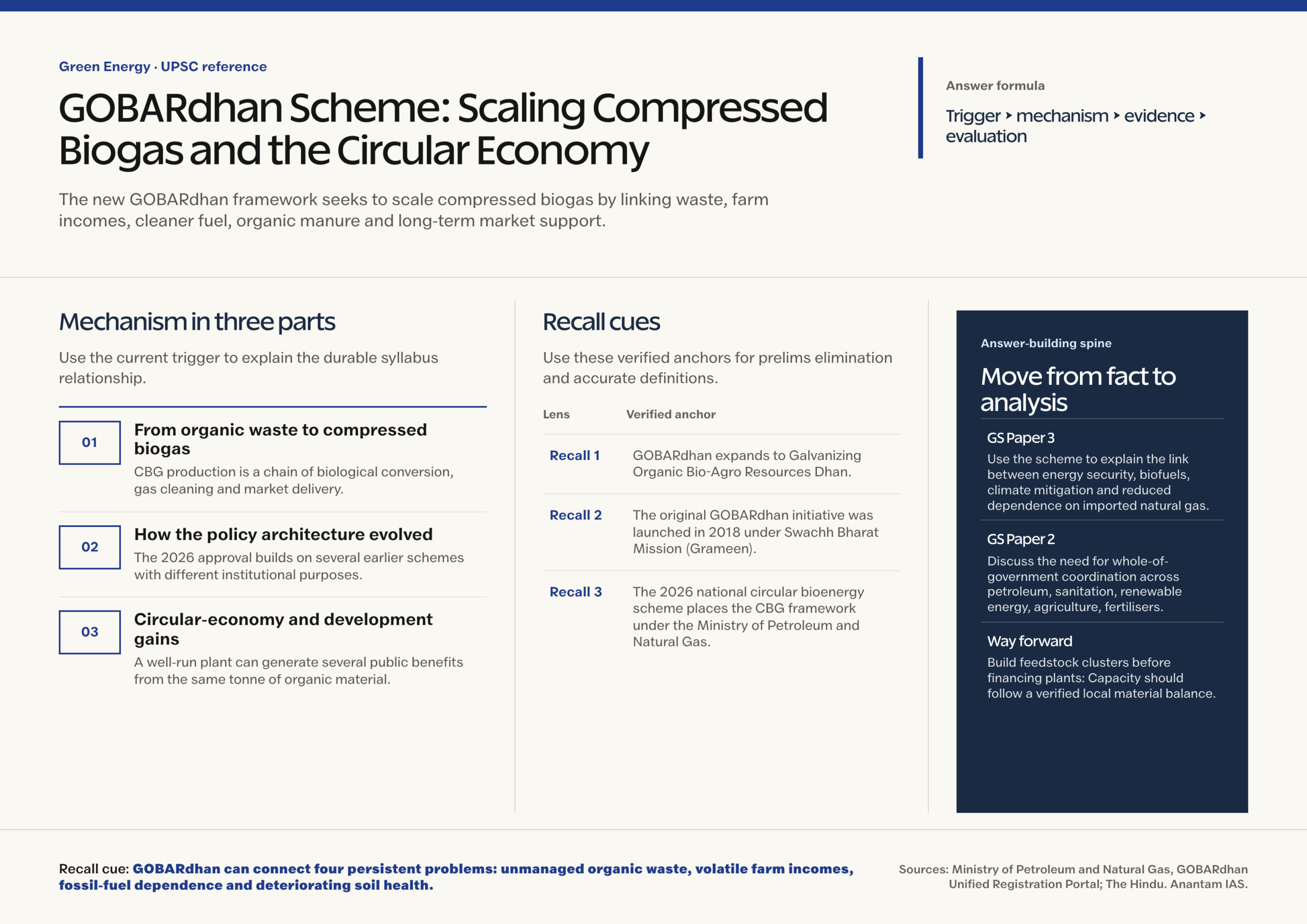
- GOBARdhan expands to Galvanizing Organic Bio-Agro Resources Dhan.
- The original GOBARdhan initiative was launched in 2018 under Swachh Bharat Mission (Grameen); the Department of Drinking Water and Sanitation coordinates that umbrella initiative.
- The 2026 national circular bioenergy scheme places the CBG framework under the Ministry of Petroleum and Natural Gas.
- SATAT, launched on 1 October 2018, stands for Sustainable Alternative Towards Affordable Transportation and created an offtake-oriented ecosystem for CBG.
- Biogas is produced by the anaerobic digestion of biodegradable material. It is upgraded by removing carbon dioxide, hydrogen sulphide and moisture before compression as CBG.
- CBG and fossil CNG are both methane-rich gaseous fuels, but CBG comes from renewable biological feedstock.
Mains Relevance
GS Paper 3
- Use the scheme to explain the link between energy security, biofuels, climate mitigation and reduced dependence on imported natural gas.
- Assess CBG as an instrument for managing crop residue, cattle dung, wet municipal waste and agro-industrial by-products.
GS Paper 2
- Discuss the need for whole-of-government coordination across petroleum, sanitation, renewable energy, agriculture, fertilisers, urban affairs and state pollution-control authorities.
- Evaluate implementation through measurable outcomes such as commissioned capacity, verified gas output, methane leakage, manure sales and timely offtake rather than registrations alone.
Essay
- Waste becomes wealth only when institutions connect technology to reliable markets.
Background and Context
From organic waste to compressed biogas
CBG production is a chain of biological conversion, gas cleaning and market delivery.
- Source-segregated cattle dung, crop residue, press mud, food waste or sewage-derived organic matter enters a sealed digester. Microorganisms break it down in the absence of oxygen through anaerobic digestion.
- Raw biogas contains combustible methane along with carbon dioxide, moisture and trace contaminants. Upgrading removes impurities; compression produces CBG suitable for regulated fuel use.
- The residual digestate is not automatically a saleable fertiliser. It needs quality control, processing, nutrient testing, storage and a credible market as FOM, LFOM or another permitted organic input.
- The climate case depends on preventing fugitive methane emissions. Poorly sealed digesters, leaking equipment or unmanaged digestate can erode the claimed benefit because methane is a potent greenhouse gas.
How the policy architecture evolved
The 2026 approval builds on several earlier schemes with different institutional purposes.
- The 2018 GOBARdhan initiative began as an integral component of solid-waste management under SBM(G), focused on village cleanliness and conversion of biodegradable waste into biogas and bio-slurry.
- SATAT, also launched in 2018 by the petroleum ministry, encouraged entrepreneurs to produce CBG and supply it to oil and gas marketing companies under long-term procurement arrangements.
- The Ministry of New and Renewable Energy’s National Bioenergy Programme has provided central financial assistance for waste-to-energy and Bio-CNG projects, while urban waste projects may receive support under SBM-U 2.0.
- The Department of Fertilisers supports the sale of manure from CBG plants; agriculture programmes support biomass-aggregation machinery; and the petroleum ecosystem addresses offtake and pipeline injection.
- The new framework’s significance lies in integration and policy continuity. It must align capital support, credit, price signals, feedstock logistics, pipeline access and by-product markets.
Circular-economy and development gains
A well-run plant can generate several public benefits from the same tonne of organic material.
- Diverting biodegradable waste from dumps, drains and open heaps can improve sanitation, reduce odour and lower local water and air pollution.
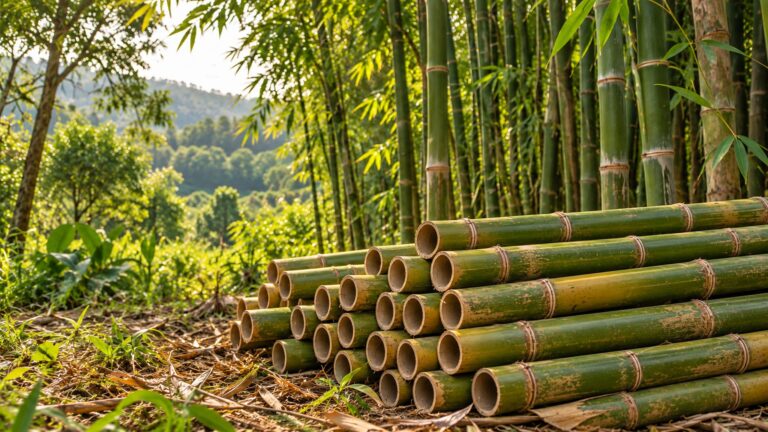
- Using paddy straw and other residues as feedstock can create an alternative to open burning, provided collection payments and transport distances remain economically viable.
- Farmers, cattle owners, self-help groups and cooperatives can earn from feedstock aggregation and local services, while plants create technical and operating jobs.
- Domestic CBG can displace a portion of fossil CNG or imported LNG in transport and city-gas networks. The effect on import dependence will depend on actual annual output and offtake, not announced capacity.
- Properly processed digestate can return organic matter and nutrients to soil, linking the energy system with soil-health and fertiliser-efficiency objectives.
Why CBG projects struggle to scale
The central risk is a mismatch between plant finance and the everyday economics of feedstock and sales.
- Biomass is dispersed, seasonal and bulky. A plant may face high collection, baling, storage and transport costs even when a region has abundant theoretical feedstock.
- Municipal plants require consistent source segregation. Mixed waste raises contamination, maintenance costs and rejection of both gas-system inputs and digestate.
- CBG projects need land, environmental consents, gas-quality testing, compression equipment, safety approvals and dependable pipeline or cascade transport connectivity.
- Delayed commissioning and uncertain offtake can stress debt repayment. Small developers also face technology-selection and working-capital risks.
- The manure side is often treated as a secondary revenue line, although unsold digestate creates storage and environmental liabilities. Farmer trust depends on verified nutrient quality and agronomic guidance.
Way Forward
Build feedstock clusters before financing plants
- Prepare district-level maps of seasonal biomass, cattle dung, wet waste, competing uses, transport radius and storage needs.
- Use transparent multi-year contracts with farmer organisations, dairies, sugar mills and urban local bodies, including quality and contamination standards.
- Support cooperatives, self-help groups and rural entrepreneurs as aggregation partners so value does not bypass the waste suppliers.
Conclusion
- GOBARdhan can connect four persistent problems: unmanaged organic waste, volatile farm incomes, fossil-fuel dependence and deteriorating soil health.
- The real test will be operational discipline.
UPSC Practice Questions
Prelims MCQ 1
With reference to India’s compressed-biogas ecosystem, consider the following statements:
- GOBARdhan was first launched in 2018 under Swachh Bharat Mission (Grameen).
- SATAT is an initiative of the Ministry of Petroleum and Natural Gas.
- Compressed biogas can be blended in the CNG transport and domestic PNG segments of city-gas distribution.
How many of the above statements are correct?
(a) Only one (b) Only two (c) All three (d) None
Answer: (c) All three
Explanation:
All three statements are correct. GOBARdhan began under SBM(G) in 2018; MoPNG launched SATAT in October 2018; and the government has adopted phase-wise CBG blending for the CNG transport and domestic PNG segments.
Prelims MCQ 2
Which one of the following best describes compressed biogas (CBG)?
(a) Hydrogen produced by electrolysis using biomass electricity (b) Methane-rich gas obtained by upgrading and compressing biogas from organic feedstock (c) Liquefied petroleum gas blended with ethanol (d) Synthetic gas produced only through coal gasification
Answer: (b) Methane-rich gas obtained by upgrading and compressing biogas from organic feedstock
Explanation:
Anaerobic digestion produces raw biogas. Removing carbon dioxide, moisture and other contaminants raises its methane concentration; the upgraded gas is then compressed for use as CBG.
UPSC Mains Questions
- The success of compressed biogas depends as much on feedstock, offtake and manure markets as on plant technology. Discuss in the context of the GOBARdhan scheme. (250 words)
- Examine how GOBARdhan can advance India’s circular economy, rural incomes and energy security. What environmental and governance safeguards are required? (250 words)
Sources: Ministry of Petroleum and Natural Gas, GOBARdhan Unified Registration Portal and The Hindu.
Frequently Asked Questions
What is GOBARdhan?
GOBARdhan means Galvanizing Organic Bio-Agro Resources Dhan. The original 2018 initiative under SBM(G) promotes conversion of cattle dung and other biodegradable waste into biogas, CBG and bio-slurry. The 2026 national circular bioenergy scheme adds an integrated, petroleum-led framework for scaling.
What did the Union Cabinet approve in August 2026?
The Cabinet approved GOBARdhan as a national circular bioenergy scheme with a reported ten-year outlay of ₹23,731 crore for FY2026-27 to FY2035-36. The new framework is led by the Ministry of Petroleum and Natural Gas and is intended to support.
How is compressed biogas different from ordinary biogas?
Raw biogas contains methane, carbon dioxide, moisture and trace contaminants. To make CBG, the gas is purified to raise methane content and then compressed. This produces a regulated fuel that can substitute or blend with fossil CNG, while ordinary biogas.
How does GOBARdhan support a circular economy?
It redirects cattle dung, crop residue, press mud and wet organic waste into useful outputs. The gas becomes transport or city-gas fuel, while properly processed digestate can become organic manure. The loop is complete only when waste is segregated, methane.
What are the main implementation challenges for CBG plants?
Major constraints include seasonal and dispersed feedstock, contamination in municipal wet waste, high transport and storage costs, project finance, delayed clearances, gas-quality compliance, pipeline connectivity and uncertain manure demand. A registered plant is not the same as a commissioned and.
Tell Google you want more of this.
Add Anantam IAS as a preferred sourceOne tap, and this site shows up more often in your own Top Stories, AI Overviews and AI Mode. Remove it any time.