Why in News?
The Lok Sabha passed the Micro, Small and Medium Enterprises Development (Amendment) Bill, 2026 on August 7, 2026, after the Rajya Sabha passed it on August 3.
- As of August 9, the Bill has been passed by both Houses, but its provisions should not be treated as operative merely because Parliament has passed it; commencement follows the legal process and a Central Government.
- A proposed new Section 15A requires every Central Public Sector Enterprise to route settlement of invoices for goods or services procured from micro, small and medium enterprises through an RBI-authorised Trade Receivables Discounting System platform.
- The Bill sets a 90-day limit for mediation from the date fixed for first appearance, a 30-day limit for referring an unsuccessful mediation to arbitration, and a 90-day limit for making an award after completion of.
- A mediated settlement or arbitral award may be recovered as arrears of land revenue; the amount is also declared a valid and legally enforceable debt liable to recognition under the Insolvency and Bankruptcy Code, 2016.
- Where a challenge to an award or settlement has remained pending for more than six months, the court must order payment to the supplier of at least 50% of the awarded amount from the mandatory deposit.
- Delayed receivables are a working-capital shock: wages, raw materials, utilities and loan instalments fall due even when the buyer has not paid an accepted invoice.
- The existing MSMED Act creates payment discipline for micro and small enterprise suppliers, but delays in dispute disposal and award enforcement can weaken the value of the statutory remedy.
- TReDS can convert an accepted invoice into early liquidity through competitive financing, but its impact still depends on timely invoice acceptance, buyer participation, reliable data and affordable discount rates.
UPSC Relevance
Prelims Relevance
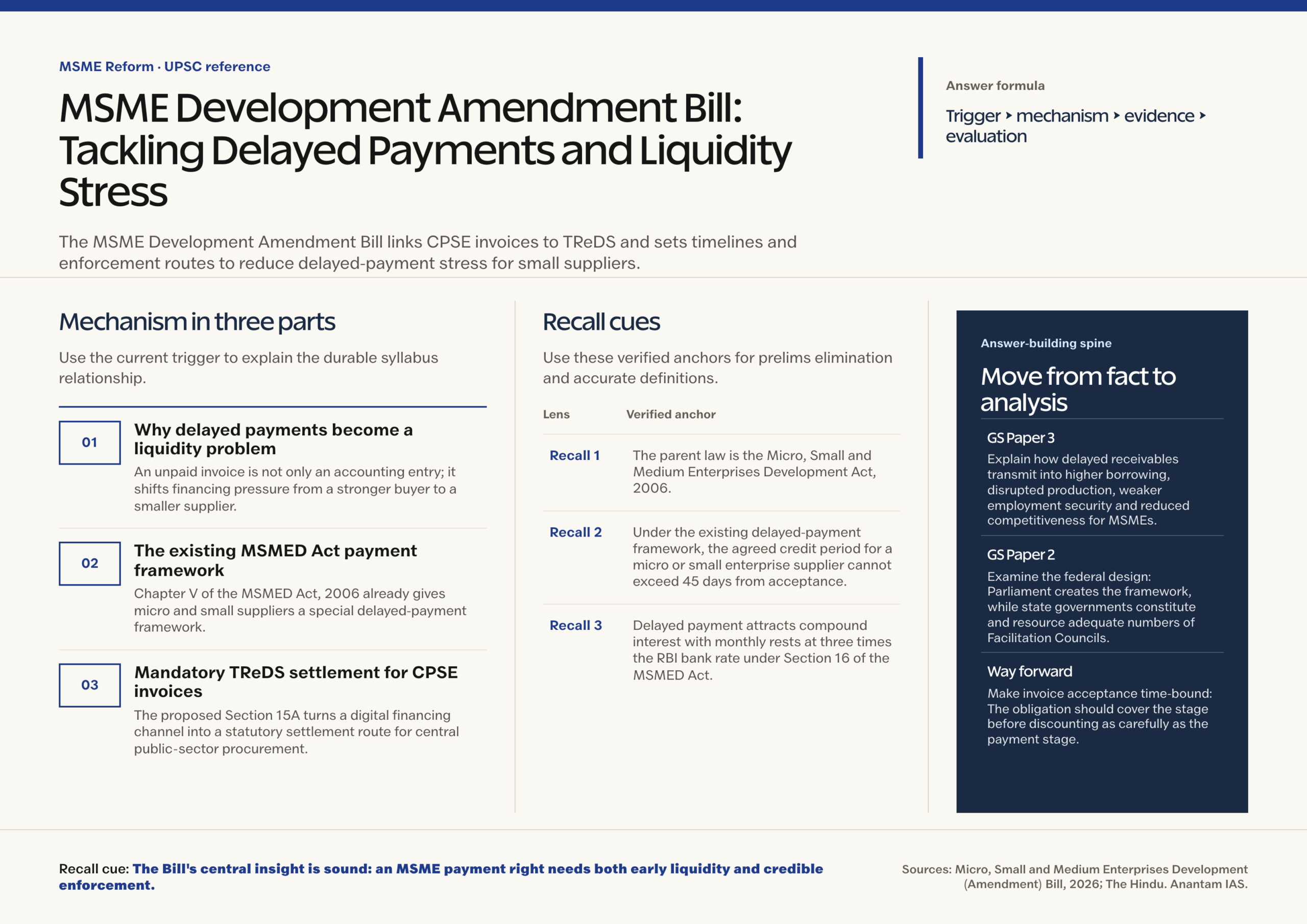
- The parent law is the Micro, Small and Medium Enterprises Development Act, 2006.
- Under the existing delayed-payment framework, the agreed credit period for a micro or small enterprise supplier cannot exceed 45 days from acceptance or deemed acceptance.
- Delayed payment attracts compound interest with monthly rests at three times the RBI bank rate under Section 16 of the MSMED Act.
- A Micro and Small Enterprises Facilitation Council handles references concerning amounts due to eligible micro and small suppliers.
- TReDS is an RBI-regulated electronic platform for financing or discounting MSME trade receivables due from buyers.
- The Bill’s mandatory TReDS provision applies to procurement by every Central Public Sector Enterprise; the Centre and states may notify additional bodies or entities.
Mains Relevance
GS Paper 3
- Explain how delayed receivables transmit into higher borrowing, disrupted production, weaker employment security and reduced competitiveness for MSMEs.
- Assess TReDS as a market-based working-capital mechanism and distinguish invoice financing from final adjudication of a disputed claim.
GS Paper 2
- Examine the federal design: Parliament creates the framework, while state governments constitute and resource adequate numbers of Facilitation Councils.
- Discuss administrative adjudication, appellate review, online dispute resolution and access to justice for geographically dispersed small suppliers.
Essay
- A legal right has limited economic value when enforcement arrives after the enterprise has lost its working capital.
Background and Context
Why delayed payments become a liquidity problem
An unpaid invoice is not only an accounting entry; it shifts financing pressure from a stronger buyer to a smaller supplier.
- The supplier has usually already paid for labour, inputs, transport, electricity and taxes. A delayed receivable creates a cash-flow mismatch even when the enterprise remains profitable on paper.
- The firm may respond by drawing costly short-term credit, postponing wages or investment, reducing inventories, or declining new orders. These choices can turn a buyer’s delay into lower production and employment.
- Micro and small firms often possess weaker bargaining power and may hesitate to pursue a large customer for fear of losing future business. A statutory remedy must account for this power asymmetry.
- Liquidity stress can also discourage formalisation. Registration and tax compliance become less attractive if a formal invoice is enforceable only after a long and expensive dispute.
The existing MSMED Act payment framework
Chapter V of the MSMED Act, 2006 already gives micro and small suppliers a special delayed-payment framework.
- Section 15 requires payment by the agreed date; where the agreement allows credit, the period cannot exceed 45 days from the day of acceptance or deemed acceptance of goods or services.
- Section 16 makes a defaulting buyer liable for compound interest with monthly rests at three times the RBI bank rate. This is designed to make delayed payment more expensive than normal commercial credit.
- A supplier may refer the dispute to the relevant Micro and Small Enterprises Facilitation Council. The framework combines conciliation or mediation with arbitration when settlement does not succeed.
- The special delayed-payment protections are framed around a micro or small supplier. This should not be confused with the Bill’s broader TReDS language covering procurement from micro, small and medium enterprises.
- The statutory interest rule does not by itself put cash into the supplier’s account. Case backlogs, challenges to awards, uneven Council capacity and enforcement delays can postpone effective relief.
Mandatory TReDS settlement for CPSE invoices
The proposed Section 15A turns a digital financing channel into a statutory settlement route for central public-sector procurement from MSMEs.
- Every CPSE must route settlement of covered invoices through an RBI-authorised TReDS platform in the prescribed form and manner.
- The Central Government may notify another authority, body or entity for the same obligation. A state government may notify state public-sector enterprises and other state-level bodies or entities.
- On TReDS, an accepted receivable can be discounted by banks or other permitted financiers. The MSME receives funds before maturity, while the financier receives payment from the buyer on the due date.
- The reform can create a traceable invoice trail, increase financing competition and reduce dependence on collateral-based working-capital loans. It can also produce better compliance data for public procurement.
- TReDS is not a cure for every dispute. If a buyer delays acceptance, contests delivery, withholds documentation or fails to honour the obligation, platform coverage must be backed by grievance resolution and enforcement.
Time-bound mediation, arbitration and online access
The Bill addresses delay within the dispute-resolution chain by fixing separate clocks for its key stages.
- The Council or its mediation service provider must complete mediation within 90 days from the date fixed for first appearance.
- If mediation terminates without settlement, the reference to arbitration must be made within 30 days from termination.
- The Council or alternative dispute-resolution institution must make the arbitral award within 90 days from completion of pleadings.
- Jurisdiction follows the supplier’s official registered address, while the buyer may be located anywhere in India. This can reduce the travel and forum burden on a small supplier.
- The Central Government may establish an online mechanism for mediation and arbitration using audio-video communication, electronic pleadings, evidence and related processes.
Way Forward
Make invoice acceptance time-bound
- Prescribe a short, transparent period for accepting or recording a reasoned dispute against an invoice, with deemed escalation when the buyer remains silent.
- Integrate CPSE procurement and accounting systems with TReDS so invoice data moves automatically and suppliers do not upload the same evidence repeatedly.
- Set caseload-based norms for the number of Councils, legal and financial expertise, e-filing support, hearing infrastructure and trained case managers.
- Publish state-wise data on first appearance, mediation completion, arbitral awards, challenges, amounts released and final recovery, while protecting commercially sensitive details.
Conclusion
- The Bill’s central insight is sound: an MSME payment right needs both early liquidity and credible enforcement.
- The real test will be operational.
UPSC Practice Questions
Prelims MCQ 1
With reference to the Micro, Small and Medium Enterprises Development (Amendment) Bill, 2026, consider the following statements:
- It requires every Central Public Sector Enterprise to route settlement of invoices for MSME procurement through an RBI-authorised TReDS platform.
- It requires mediation to be completed within 90 days from the date fixed for first appearance.
- It abolishes the requirement of a deposit when a buyer seeks to set aside an arbitral award.
How many of the above statements are correct?
(a) Only one (b) Only two (c) All three (d) None
Answer: (b) Only two
Explanation:
Statements 1 and 2 are correct. Statement 3 is incorrect because the Bill retains and extends the rule that a non-supplier applicant must deposit 75% of the relevant award or mediated settlement amount before a court entertains the challenge.
Prelims MCQ 2
Which one of the following best describes the primary function of the Trade Receivables Discounting System (TReDS)?
(a) It classifies enterprises into micro, small and medium categories (b) It provides an electronic platform for financing or discounting MSME trade receivables (c) It adjudicates all contractual disputes between private buyers and suppliers (d) It grants unsecured budgetary subsidies directly to every registered MSME
Answer: (b) It provides an electronic platform for financing or discounting MSME trade receivables
Explanation:
TReDS is an RBI-regulated electronic platform that enables financing or discounting of MSME receivables against buyer invoices. It does not classify enterprises, act as a universal adjudicatory body or automatically distribute subsidies.
UPSC Mains Questions
- Delayed payments are not merely a contractual problem; they are a transmission channel for liquidity stress across the MSME economy. Discuss in the context of the MSME Development (Amendment) Bill, 2026.
- Evaluate the proposed combination of mandatory TReDS settlement, time-bound alternative dispute resolution and stronger award enforcement. What implementation gaps could still weaken payment discipline?
Sources: Micro, Small and Medium Enterprises Development (Amendment) Bill, 2026 and The Hindu.
Frequently Asked Questions
What is the MSME Development (Amendment) Bill, 2026?
It is a Bill passed by both Houses of Parliament to amend the MSMED Act, 2006. Its major changes concern MSME classification and registration, mandatory TReDS settlement for CPSE procurement, deadlines for mediation and arbitration, enforcement of settlements and awards.
Does the Bill reduce the existing 45-day payment limit?
The Bill’s central delayed-payment reforms do not replace the existing Section 15 ceiling under which an agreed credit period for an eligible micro or small supplier cannot exceed 45 days from acceptance or deemed acceptance. It adds TReDS routing and.
How does TReDS help an MSME supplier?
After a buyer accepts an invoice, financiers can competitively discount the receivable on an RBI-authorised TReDS platform. The MSME gets funds before the invoice matures, improving working capital. The mechanism works best when buyers accept invoices promptly and financiers compete.
What timelines does the Bill set for delayed-payment disputes?
Mediation must finish within 90 days from the date fixed for first appearance. If it fails, referral to arbitration must occur within 30 days from termination of mediation. The arbitral award must then be made within 90 days from completion.
How does the Bill strengthen enforcement of an MSME award?
A mediated settlement or arbitral award may be recovered as arrears of land revenue and recognised as a legally enforceable debt under the IBC framework. A non-supplier challenging it must deposit 75%, and a prolonged challenge triggers release of at.
Tell Google you want more of this.
Add Anantam IAS as a preferred sourceOne tap, and this site shows up more often in your own Top Stories, AI Overviews and AI Mode. Remove it any time.