India-Russia Relation
Context:
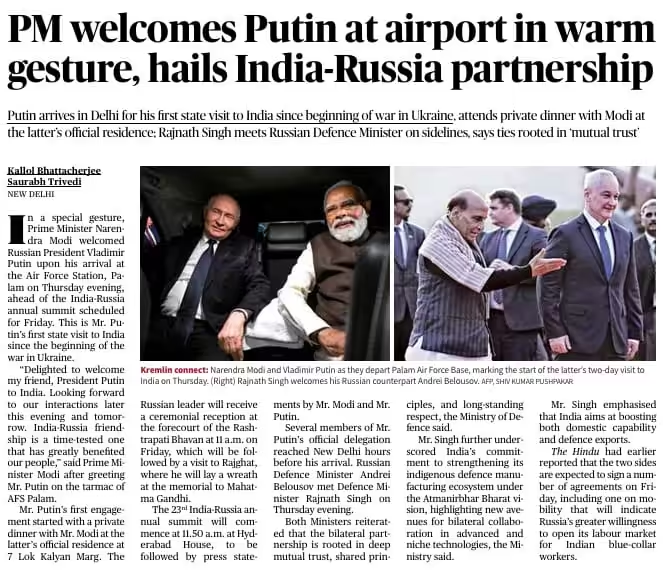
Russian President Vladimir Putin arrived in New Delhi for his first India visit since the Ukraine war began.
UPSC Relevance:
International Relation
UPSC PYQ:
Q. What is the significance of Indo-US defence deals over Indo-Russian defence deals? Discuss with reference to stability in the Indo-Pacific region. (2020)
About India-Russia Relation:
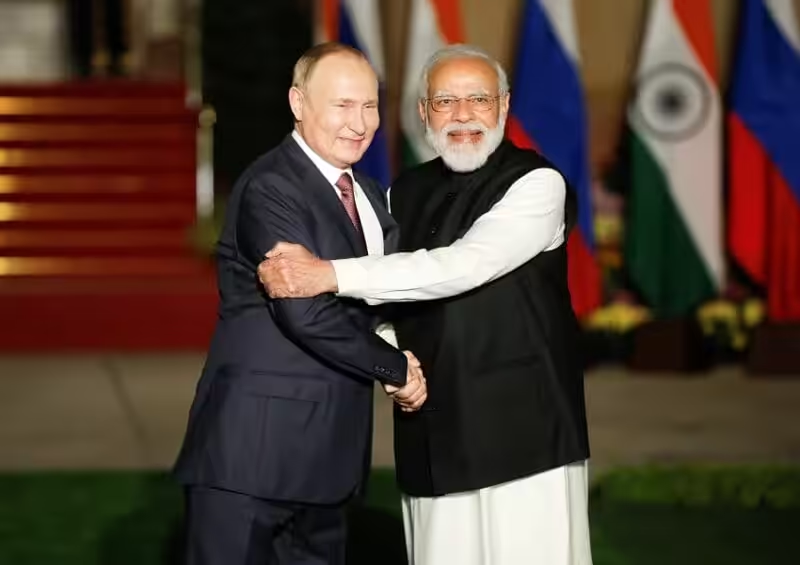
India quotes Russia as an “all-weather friend,” a “true friend in good and bad times” (sukh-dukh ka saathi), and a “trusted and special strategic partner”
India-Russia Bilateral Brief:
- Russia has been a longstanding and time-tested partner for India. Development of India-Russia relations has been a key pillar of India’s foreign policy. Since the signing of the “Declaration on the India-Russia Strategic Partnership” in October 2000, India-Russia ties have acquired a qualitatively new character with enhanced levels of cooperation in almost all areas, including political, security, defense, trade and economy, science & technology, culture, and people-to-people ties.
- During the visit of the Russian President to India in December 2010, the Strategic Partnership was elevated to the level of “Special and Privileged Strategic Partnership.”
Political relations:
- The Annual Summit between the Prime Minister of India and the President of the Russian Federation is the highest institutionalized dialogue mechanism in the strategic partnership between India and Russia.
- The last Summit was held on July 8-9, 2024 in Moscow. Following the Summit, a Joint Statement titled “India-Russia: Enduring and Expanding Partnership” was released.
- Both countries remain in regular contact at Ministerial level. EAM and FM Lavrov met recently on 17 November 2025 during EAM’s visit to Moscow for SCO Council of Heads of Government (CHG) meeting.
Trade and Economic Cooperation:
Bilateral trade between India and Russia reached a record high of USD 68.7 billion in FY 2024-25.
- The primary mechanism at the government level for enhancing trade and economic cooperation is the India-Russia Intergovernmental Commission for Trade, Economic, Scientific & Cultural Cooperation (IRIGC-TEC), co-chaired by EAM from the Indian side and First DPM Mr. Denis Manturov from the Russian side.
- For timely achievement of the revised bilateral trade target of USD 100 billion by 2030.
- Intensifying the trade and economic relations has been identified as a priority area by both the leaders who had set the targets of increasing bilateral investment to USD 50 billion (by 2025) and bilateral trade to USD 100 billion (by 2030).
- It comprises India’s exports worth USD 4.9 billion and imports from Russia amounting to USD 63.8 billion.
Major items of export:
- India include pharmaceuticals, organic and inorganic chemicals, iron & steel and marine products, while major items of import from Russia include oil and petroleum products, vegetable oil (particularly sunflower oil), fertilizers, coking coal, precious stones and metals.
The major bilateral investments by Russia in India are in the oil and gas, petrochemicals, banking, railways and steel sectors, while Indian investments in Russia are mainly in oil and gas and pharmaceuticals sectors.
Defence cooperation:
- The longstanding and wide-ranging military technical cooperation between India and Russia has evolved from a buyer-seller framework to one involving joint research, development and production of advanced defence technologies and systems.
- Several defence platforms are also assembled/produced in India such as T-90 tanks and Su-30 MKI aircraft.
- The 14th edition of India-Russia joint training exercise INDRA-2025 was held in Bikaner, Rajasthan from 6-15 October, 2025.
- Defence ties have evolved from a buyer-seller model to joint research, development, and production of advanced defence technologies. E.g., BrahMos Cruise Missiles
- Conducts military exercise INDRA and Avia Indra.
Energy Security:
- Russia is the largest crude oil supplier to India. It supplies oil at discounted prices which has helped in curbing inflation.
- Some of India’s largest state-owned and private companies have invested in the Russian Far East (RFE), including ONGC’s investments in oil and gas project.
- Promotes nuclear energy development. E.g., Kudankulam Nuclear Power Plant, Tamil Nadu.
Connectivity:
- Russia can enhance India’s connectivity with Central Asia and the wider Eurasia through projects like the International North-South Transport Corridor (INSTC), Northern Sea Route and Chennai-Vladivostok Eastern Maritime Corridor.
Nuclear & Space Cooperation:
- Russia is an important partner for India in the area of peaceful use of nuclear energy. India’s only nuclear power plant established with another country is in Kudankulam in Tamil Nadu which established in collaboration with Russia. India-Russia cooperation in the field of peaceful uses of outer space dates back to four decades. Both countries continue to engage in several niche areas of space cooperation including India’s manned spaceflight program (Gaganyaan).
Cultural Cooperation:
India and Russia have deep and historic cultural linkages. Various writers, philosophers, thinkers and artists have exercised mutual influence on each other’s art, culture and societies. The Jawaharlal Nehru Cultural Centre (JNCC), Moscow maintains close cooperation with leading Russian institutions. A number of Russian universities and institutions, teach Indian languages. Indian cinema was especially popular in the Soviet period with screenings in most major cities and urban centers. Yoga is also immensely popular across Russia.
Source:- https://indianembassy-moscow.gov.in/bilateral-relations-india-russia.php
Challenges:
Trade Imbalance
- The bilateral trade balance is heavily tilted in favour of Russia.
- In FY 2024–25, India’s imports from Russia stood at USD 63.84 billion, whereas exports were only USD 4.88 billion, creating a significant trade asymmetry.
- The surge in crude oil and fertiliser imports from Russia has been the primary driver of this imbalance.
Rupee Surplus and Settlement Constraints
- The widening trade deficit has led to the accumulation of large rupee surpluses in Special Rupee Vostro Accounts (SRVAs) maintained by Russian banks in India.
- The Russian Foreign Minister has acknowledged this as a financial challenge, highlighting that Russia faces difficulty in utilising these rupee holdings for international transactions, especially due to restrictions within the Western-dominated financial system.
- Limited convertibility of the rupee and constrained investment avenues in India further complicate the issue.
Declining Defence Imports from Russia
- India’s dependence on Russian defence equipment has gradually declined due to strategic diversification.
- India now sources arms from France, Israel, and the United States, alongside a strong thrust on indigenisation under the Atmanirbhar Bharat initiative.
- This shift has reduced Russia’s earlier dominance in India’s defence procurement ecosystem.
Diverging Geopolitical and Strategic Priorities
(a) India–US Strategic Convergence
- India has significantly strengthened its strategic and security partnership with the United States, particularly through groupings such as the Quadrilateral Security Dialogue (Quad).
- This growing engagement reflects India’s Indo-Pacific orientation, which occasionally creates discomfort for Russia.
(b) Deepening Russia–China Strategic Alignment
- In 2022, Russia and China announced a “no-limits” strategic partnership, signalling enhanced political, economic, and military cooperation.
- This raises concerns for India, particularly in the context of China’s assertive posture along the Line of Actual Control (LAC).
(c) Russia–Pakistan Rapprochement
- Russia has expanded its engagement with Pakistan, including joint military exercises, counter-terrorism cooperation, and naval drills.
- Though limited, this engagement marks a shift from Russia’s earlier Pakistan policy and is viewed cautiously by India.
Impact of US Sanctions and CAATSA
- CAATSA mandates sanctions against countries engaging in significant transactions with Russia, Iran, and North Korea, thereby constraining India’s defence engagement with Russia.
- Since the S-400 air defence system deal, India has avoided concluding major new defence contracts with Russia to prevent potential sanctions under the US Countering America’s Adversaries Through Sanctions Act (CAATSA), 2017.
Way Forward:
Mutual Strategic Trust
- Both countries must proactively reassure each other of their strategic commitment, especially amid India’s growing engagement with the United States and Russia’s deepening partnership with China.
- Establishing regular high-level political and security dialogues can help address misperceptions and strategic anxieties.
Strengthening Track-II and People-to-People Diplomacy
- There is a need to institutionalise Track-II diplomacy involving think tanks, academics, youth, and strategic communities.
- Enhancing academic exchanges, joint research programmes, and media presence, including the stationing of Indian journalists in Russia, will deepen societal understanding.
Diversification and Rebalancing of Trade
- Bilateral trade must move beyond hydrocarbons and fertilisers to include:
- Information Technology
- Pharmaceuticals
- Textiles
- Agriculture and food processing
- Such diversification will help correct trade imbalances and expand India’s export footprint in the Russian market.
Deepening Defence Co-Production and Joint R&D
- Building on successful flagship projects such as the BrahMos missile system and the AK-203 rifle manufacturing, future cooperation should focus on:
- Next-generation defence technologies
- Unmanned systems
- Cyber and space defence
- This aligns with India’s Atmanirbhar Bharat in defence manufacturing.
Expediting the Free Trade Agreement with the Eurasian Economic Union (EAEU)
- Early conclusion of the India–EAEU Free Trade Agreement will open new markets across Central Eurasia.
- As the largest and most influential member of the EAEU, Russia can play a pivotal role in accelerating this process.
Expanding Cooperation in Civil Nuclear Energy
- Russia can significantly contribute to India’s nuclear energy transition through:
- Assistance in developing Small Modular Reactors (SMRs)
- Expansion of existing cooperation such as the Kudankulam Nuclear Power Project
- This supports India’s clean energy and net-zero commitments.
Cooperation in Emerging and Non-Traditional Domains
- These sectors represent the new frontiers of strategic power and economic growth.
- Future partnership should extend to high-technology and non-traditional security areas such as:
- Artificial Intelligence (AI)
- Cyber security
- Space technology
- Critical and emerging technologies
The bilateral relationship has remained strong and stable over the past 78 years. The India-Russia partnership has been among the steadiest in the contemporary era with a shared commitment to a multipolar world as well to expand the engagement beyond the traditional military, nuclear and space cooperation. In the past three years, the bilateral trade has expanded significantly. There are discussions on ways to increase exports from India as well developing new models of cooperation. Both countries are also looking to strengthen inter-regional cooperation, especially with the Russian Far East and promote connectivity initiatives like the International North-South Transport Corridor, the Chennai-Vladivostok Eastern Maritime Corridor and the Northern Sea Route. There is a synergy between Russia’s pivot to the East, its resources and technology and India’s own flagship initiatives such as Atmanirbhar Bharat and Make in India.