West Asia War: Iran-US Escalation Spreads to Kuwait
Why in News?
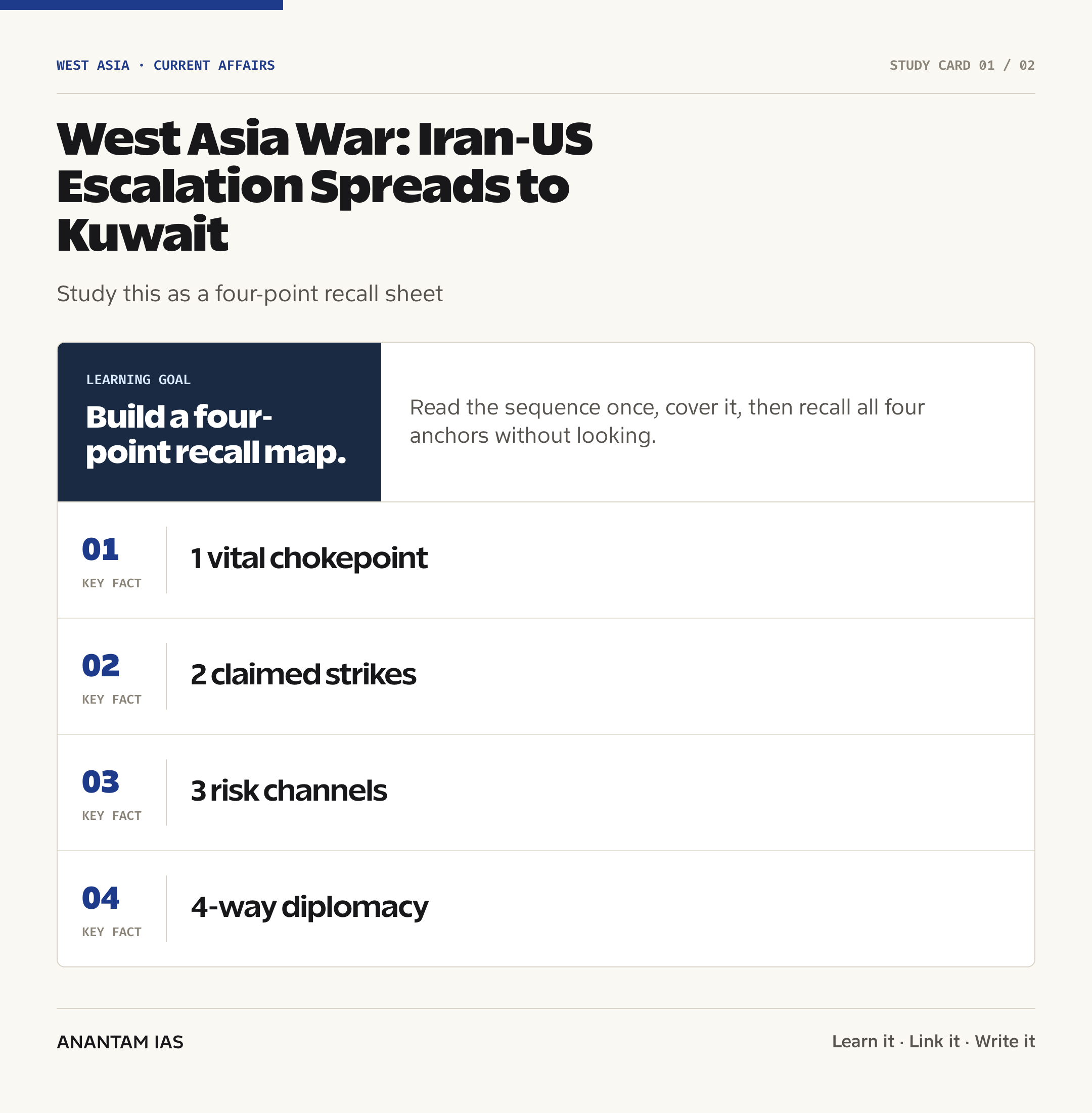
The Islamic Revolutionary Guard Corps claimed on July 20 that Iranian forces had struck U.S. military targets in Kuwait, including an early-warning radar and facilities at Ali Al Salem Air Base. The claim, carried by Iranian state media and reported by The Hindu, had not been independently verified in the cited update.
The development came alongside fresh reported U.S. air strikes on Iran, severe disruption to traffic through the Strait of Hormuz, and a revised Indian advisory asking nationals to postpone travel to Iran. Together, these developments show the conflict moving from bilateral retaliation towards a wider Gulf security and maritime crisis.
- Iran’s Guards said a drone strike destroyed a U.S. early-warning radar in Kuwait and separately claimed damage to a warehouse and an MQ-9 hangar at Ali Al Salem Air Base.
- The Hindu reported that the United States launched another round of strikes on Iran as an earlier interim arrangement unravelled.
- The Guards also said two oil tankers had exploded and become immobilised after trying to use what Iran called an unsafe southern route through the Strait of Hormuz.
- The Embassy of India in Tehran advised Indians to postpone travel, consider leaving through available commercial flights, and avoid areas of heightened military activity, especially Iran’s southern coast.
- The new theatre matters to India because Kuwait hosts a large Indian community and the Gulf is central to India’s energy supplies, trade routes and consular responsibilities.
The development matters in the context of:
- The crisis tests whether attacks on overseas military facilities remain limited or trigger collective regional escalation involving more Gulf states.
- Disruption around Hormuz can transmit a military shock into oil prices, LNG availability, freight rates and marine insurance even without a formally declared closure.
- India must protect citizens while maintaining working relations with Iran, the Gulf states, Israel and the United States, making strategic autonomy an operational requirement.
UPSC Relevance
Prelims Relevance
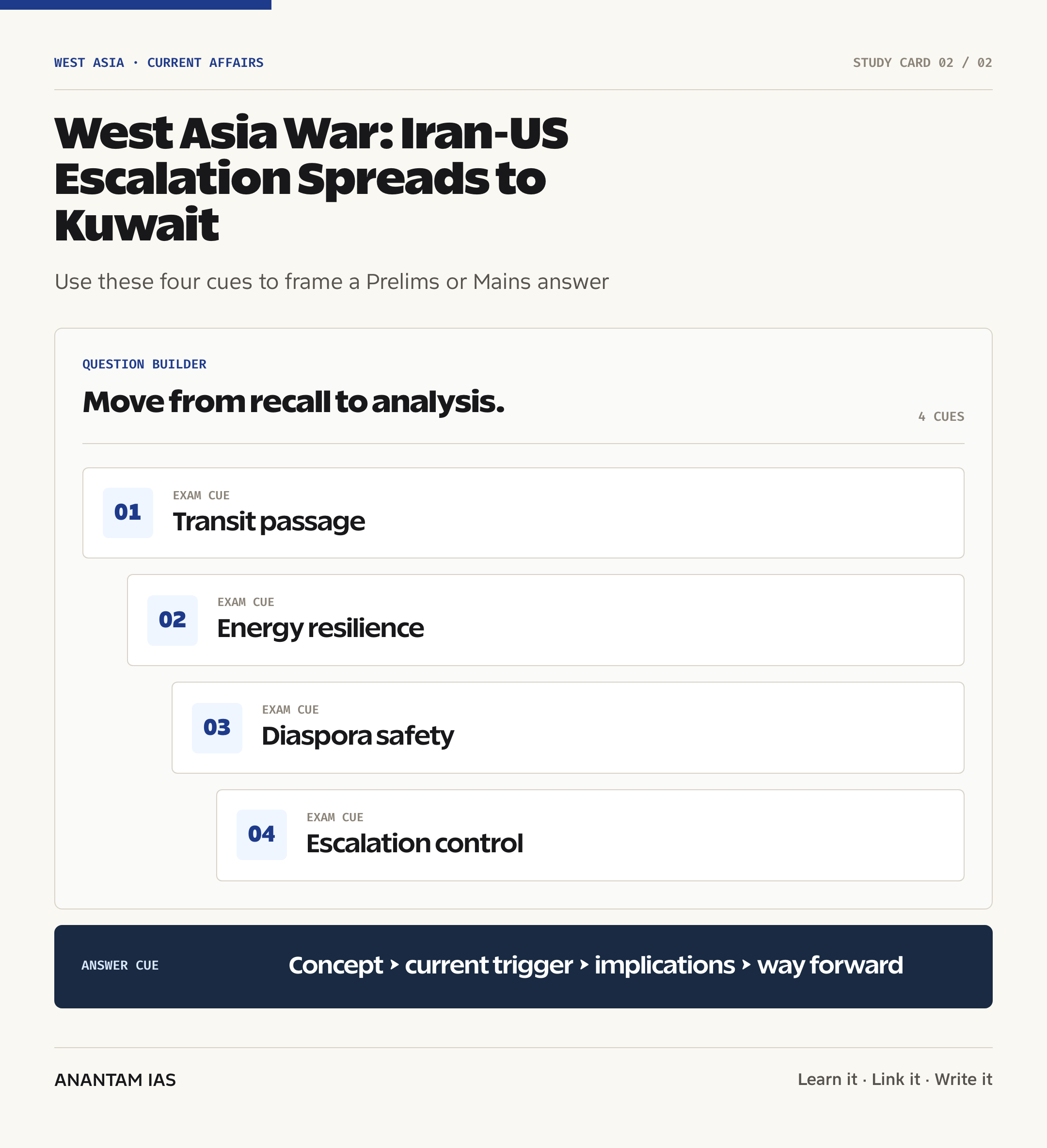
- The Strait of Hormuz connects the Persian Gulf with the Gulf of Oman and, beyond it, the Arabian Sea.
- The strait lies between Iran to the north and the Musandam peninsula of Oman to the south.
- Under UNCLOS Part III, straits used for international navigation are generally governed by the regime of transit passage.
- Kuwait lies at the northwestern end of the Persian Gulf and shares land borders with Iraq and Saudi Arabia.
- The IRGC is a distinct branch of Iran’s armed forces created after the 1979 Islamic Revolution; its naval arm operates alongside Iran’s regular navy.
- Ali Al Salem Air Base is a Kuwaiti military installation used by U.S. forces in the Central Command area.
- Chabahar Port is on Iran’s Gulf of Oman coast, outside the Strait of Hormuz, and supports India’s access towards Afghanistan and Central Asia.
- A travel advisory is a consular risk-management measure; it is not the same as severing diplomatic relations or imposing a legal travel ban.
Mains Relevance
GS Paper 2
- India’s multi-alignment in West Asia and the limits of issue-based partnerships during an expanding war.
- The diplomatic balance between citizen protection, de-escalation, international law and strategic interests.
- The role of embassies, registration systems and evacuation planning in diaspora diplomacy.
GS Paper 3
- Vulnerability of India’s energy security to a maritime chokepoint and war-risk pricing.
- Protection of merchant shipping, ports, crews and supply chains under a maritime-security framework.
- Need for strategic petroleum reserves, diversified contracts and demand management as parts of economic resilience.
Essay
- Geography can turn a local conflict into a global economic shock.
- Strategic autonomy is tested most when partners stand on opposing sides.
- Security includes the safe movement of citizens, energy and commerce, not only territorial defence.
Background and Context
What Has Changed in the Conflict?
The Kuwait claim signals a potential widening from strikes inside Iran to attacks on U.S. military infrastructure hosted by another sovereign Gulf state.
- The latest battlefield detail comes from an IRGC statement; an exam answer should separate a party’s claim from an independently verified outcome.
- A strike on facilities in Kuwait creates three simultaneous relationships: Iran-US hostilities, Iran-Kuwait sovereignty concerns, and Kuwait-US defence cooperation.
- Reported U.S. strikes inside Iran and Iranian attacks or attempted attacks around neighbouring states create an escalation ladder in which each side frames force as retaliation or self-defence.
- The risk is no longer confined to missiles and aircraft. It extends to ports, air bases, radar, energy infrastructure, shipping and civilian travel.
- The central policy question is whether regional states can preserve defensive cooperation with Washington while also keeping diplomatic channels with Tehran open.
Why the Strait of Hormuz Matters
Hormuz is a narrow international waterway whose strategic value comes from the concentration of Gulf energy exports and commercial traffic.
- The strait links the Persian Gulf to the Gulf of Oman. Tankers and gas carriers serving major Gulf exporters must normally pass through this route.
- A formal closure isn’t required to disrupt trade. Drone threats, mines, tanker incidents, navigation warnings and uncertain routing can raise war-risk insurance and freight costs or cause ships to wait.
- The legal baseline is transit passage under the law of the sea: ships and aircraft may continuously and expeditiously transit straits used for international navigation, subject to safety and other lawful rules.
- The duty of states bordering such a strait includes not hampering transit passage and publicising known dangers. Claims of military necessity remain constrained by international law.
- For deeper continuity, compare this episode with the earlier Strait of Hormuz standoff and India’s energy stakes.
Kuwait's Strategic Position
Kuwait is a small Gulf monarchy, a major hydrocarbon producer and a longstanding host of U.S. forces.
- Ali Al Salem Air Base supports U.S. and coalition air operations, logistics and regional mobility, making it militarily significant beyond Kuwait’s size.
- The U.S. security presence is intended to deter threats and reassure partners, but it can also expose host states to retaliation when a conflict directly involves Washington.
- For Gulf states, the policy dilemma is to strengthen missile and drone defence without allowing their territory to become a platform for uncontrolled offensive escalation.
- For India, Kuwait is both an energy partner and home to a substantial Indian community; consular readiness must cover residents, workers, students, air links and emergency documentation.
International Law and Escalation Control
The legality of each use of force depends on facts, attribution and necessity, not merely on the label of retaliation.
- Article 2(4) of the UN Charter prohibits the threat or use of force against another state’s territorial integrity or political independence.
- Article 51 preserves the inherent right of individual or collective self-defence after an armed attack, but necessity and proportionality remain central tests.
- Kuwait’s consent can authorise a foreign military presence, but it doesn’t erase Kuwaiti sovereignty or automatically legalise attacks by a third state.
- Once an armed conflict exists, international humanitarian law requires distinction between military objectives and civilians, proportionality in attack, and precautions to reduce civilian harm.
- Attacks affecting desalination, electricity, ports or commercial vessels can create cascading humanitarian effects, so civilian dependence on infrastructure must form part of the proportionality assessment.
India's Energy and Economic Exposure
India’s exposure arises from import dependence, Gulf shipping routes and the economy-wide effect of costlier energy.
- A prolonged Hormuz disruption can increase the landed cost of crude oil, LNG, LPG, fertiliser feedstock and petrochemicals, even when physical cargoes still move.
- Higher fuel and freight costs can feed into inflation, the current-account balance, the rupee, transport costs and fiscal pressure from consumer-price management.
- Supply security needs more than buying from additional producers. It requires diversified ports and routes, flexible contracts, refinery compatibility, inventories and transparent release rules for strategic petroleum reserves.
- The crisis reinforces the case for domestic alternatives such as compressed biogas; see the note on biogas and India’s energy security.
- Chabahar, located outside Hormuz on the Gulf of Oman, has strategic value for connectivity, but conflict inside Iran can still affect insurance, finance and inland movement. The background is covered in India’s Chabahar investment.
India's Diplomatic and Consular Challenge
India must protect people and commerce without being pulled into the strategic choices of any one combatant.
- The revised Embassy of India advisory asks prospective travellers to postpone journeys, Indians in Iran to consider available flights, and those remaining to exercise the highest caution.
- Registration with the mission helps officials estimate locations and needs, communicate alerts, prioritise vulnerable groups and plan evacuation or assisted departure if commercial options shrink.
- India’s diplomatic language should consistently support de-escalation, civilian protection, freedom of navigation and respect for sovereignty while keeping communication open with all sides.
- India’s maritime response can include information-sharing, naval presence and merchant-vessel advisories without entering the conflict. The INS Trikand piracy response shows the broader logic of protecting sea lines of communication.
Way Forward
Create a Consular Protection Ladder
- Maintain verified registration, multilingual alerts and round-the-clock contact points through the Embassy in Tehran and missions across the Gulf.
- Pre-identify commercial departure options, assembly procedures, medical cases and coordination channels, while treating evacuation as a last resort after safer voluntary departure.
- Issue location-specific guidance that distinguishes Iran’s southern coast, border zones, airports and relatively lower-risk areas instead of relying only on a country-wide warning.
Build Energy Shock Absorbers
- Review crude, gas and LPG inventories under multiple disruption scenarios and publish clear principles for any strategic reserve release.
- Use flexible procurement, supplier diversification and demand-side conservation to prevent panic buying or expensive emergency contracting.
- Coordinate with refiners, shipping companies and insurers so government decisions reflect both physical availability and delivered cost.
Secure Shipping Without Escalating
- Improve maritime-domain awareness through naval, coast guard and commercial reporting, with rapid authentication of incidents and navigation warnings.
- Support freedom of navigation and safe transit while avoiding unilateral steps that could be read as participation in offensive operations.
- Back an internationally communicated mechanism for deconfliction, tanker routing and rescue response under established law-of-the-sea principles.
Invest in an Indian Diplomatic Off-Ramp
- Use India’s access across opposing camps to press for a verifiable pause, protection of civilian infrastructure and renewed indirect dialogue.
- Coordinate with Oman and other credible mediators that can carry messages between Tehran, Washington and Gulf capitals.
- Keep humanitarian, consular and maritime talks insulated from wider political bargaining so practical risk reduction can continue even when formal negotiations stall.
Conclusion
The claimed attacks in Kuwait matter because they connect three theatres that can no longer be analysed separately: military escalation, Hormuz shipping and the security of Gulf host states.
For India, the correct response is neither alarmism nor distance. It is a coordinated policy of citizen protection, energy resilience, maritime awareness and active de-escalation, backed by the capacity to adjust quickly as verified facts emerge.
UPSC Practice Questions
Prelims MCQ 1
With reference to the Strait of Hormuz, consider the following statements:
- It connects the Persian Gulf with the Gulf of Oman.
- It lies between Iran and Oman’s Musandam peninsula.
- UNCLOS provides for transit passage through straits used for international navigation.
How many of the above statements are correct?
(a) Only one (b) Only two (c) All three (d) None
Answer: (c) All three
Explanation:
All three statements are correct. Hormuz is the maritime outlet of the Persian Gulf, its shores are formed by Iran and Oman, and UNCLOS Part III sets out the transit-passage regime for international straits.
Prelims MCQ 2
Why does Chabahar Port retain particular strategic relevance for India during a Strait of Hormuz crisis?
(a) It is located inside Kuwait’s territorial waters (b) It lies on Iran’s Gulf of Oman coast outside the Strait and supports access towards Afghanistan and Central Asia (c) It is India’s only strategic petroleum reserve (d) It is the headquarters of the Gulf Cooperation Council
Answer: (b) It lies on Iran's Gulf of Oman coast outside the Strait and supports access towards Afghanistan and Central Asia
Explanation:
Chabahar’s location outside the Strait reduces one geographical constraint and supports India’s continental connectivity. It isn’t immune to conflict-related insurance, finance or inland-logistics risks.
UPSC Mains Questions
- The widening Iran-US conflict shows how overseas military bases can convert bilateral hostilities into a regional security crisis. Examine the sovereignty, alliance-management and escalation-control issues raised by the reported strikes on U.S. facilities in Kuwait and India’s interests in a stable Gulf order.
- A disruption at the Strait of Hormuz is simultaneously an energy, maritime, inflation and diaspora challenge for India. Analyse the transmission channels and propose a coordinated strategy that balances resilience with de-escalatory diplomacy without making consumers bear avoidable short-term costs.
- Strategic autonomy in West Asia requires operational capacity, not equidistance in public statements. Discuss with reference to citizen protection, Chabahar connectivity, Gulf partnerships and India’s relations with Iran and the United States during a prolonged regional conflict and shipping disruption.
Sources: Ministry of External Affairs and Embassy of India, Tehran and The Hindu.
Frequently Asked Questions
What happened in Kuwait?
Iran’s Revolutionary Guards claimed that Iranian forces struck U.S. military targets in Kuwait, including an early-warning radar and facilities at Ali Al Salem Air Base. The cited live report attributed the account to an IRGC statement carried by Iranian state media. The specific damage claims should be treated as claims unless independently confirmed.
Why is Ali Al Salem Air Base important?
Ali Al Salem is a Kuwaiti air base used by U.S. forces for regional air operations, logistics and mobility. Its military role makes it strategically significant in the U.S. Central Command area. A reported attack there also raises questions of Kuwaiti sovereignty and the exposure of host states during direct Iran-US confrontation.
Why does the Strait of Hormuz matter to India?
Hormuz carries Gulf energy and commercial shipping into the Gulf of Oman and Arabian Sea. Disruption can raise crude oil, LNG, LPG, freight and insurance costs for India. The shock can then affect inflation, the current account, the rupee, transport expenses and the cost of fertiliser and petrochemical inputs.
What did India advise its citizens?
The Embassy of India in Tehran advised prospective travellers to postpone travel until security improves. Indians already in Iran were asked to consider leaving through available commercial flights. Those staying were told to exercise the highest caution, avoid areas of intense military activity and register with the mission if they hadn’t done so.
What is transit passage?
Transit passage is the freedom of navigation and overflight through straits used for international navigation, exercised continuously and expeditiously under UNCLOS Part III. It is broader than innocent passage because it also covers aircraft and normal-mode transit. Ships and aircraft must still comply with applicable safety and pollution rules.
What should India prioritise now?
India should prioritise verified consular registration, safe commercial departure options, energy inventories, shipping intelligence and coordination with Gulf partners. Diplomatically, it should press for civilian protection, freedom of navigation and a verifiable pause in attacks while retaining communication with Iran, the United States and regional mediators.