Why in News?
A recent explainer in The Hindu revisits whether compressed biogas can meaningfully strengthen India’s energy security, as tensions in West Asia keep global energy markets on edge. India imports nearly 85% of its crude oil, much of it from West Asia, and around 90% of its LPG imports transit the Strait of Hormuz, making the region a standing risk to supply. Any disruption there feeds directly into fuel prices, the import bill and the current-account balance, which is why domestic, waste-based fuels keep returning to the policy conversation.
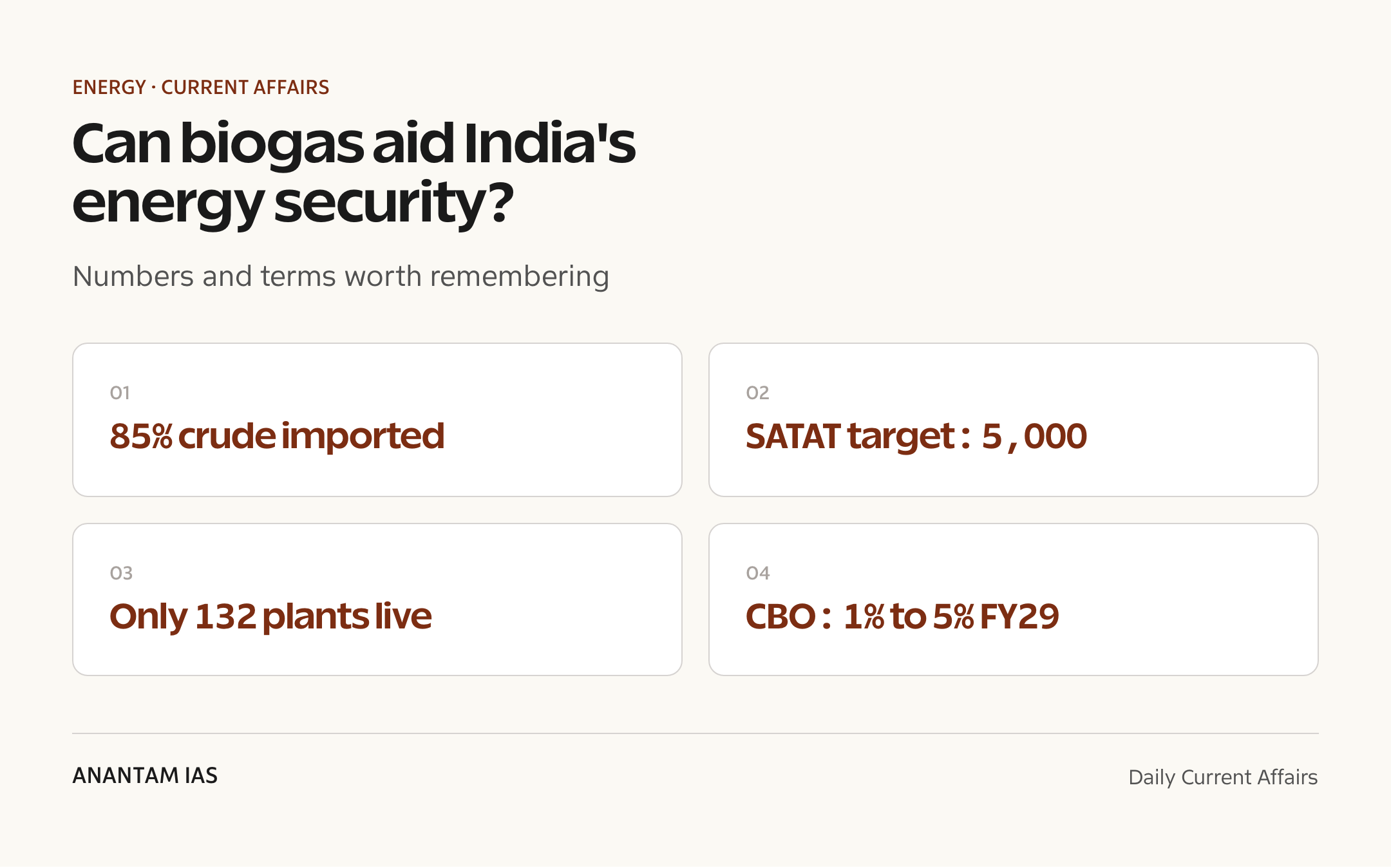
The flagship SATAT scheme, launched in 2018, aimed for 5,000 Compressed Biogas (CBG) plants by 2023, but only 132 were completed as of June 3, 2026. The persistent gap between target and delivery has drawn fresh scrutiny of the finance, feedstock and off-take problems that hold the sector back.
The debate has sharpened because a mandatory CBG Blending Obligation (CBO) is now rolling out from FY26, starting at 1% and rising to 5% by FY29. Coupled with warnings in the Economic Survey 2026 about a maize-cultivation surge that echoes Germany’s biogas ‘corn mania’, the story has become a live GS3 debate on renewables, waste-to-energy, import substitution and the food-versus-fuel trade-off.
- West Asia instability threatens crude and LPG supply routes India depends on
- SATAT (2018) targeted 5,000 CBG plants by 2023; only 132 are operational (June 2026)
- Mandatory CBG Blending Obligation (CBO) begins FY26 at 1%, rising to 5% by FY29
- Economic Survey 2026 flags a maize-cultivation surge that could echo Germany’s biogas ‘corn mania’
The development matters in the context of:
- Biogas is methane plus CO2 from anaerobic digestion of organic waste; purified and compressed it becomes CBG, chemically identical to CNG
- CBG sits within the National Bioenergy Programme and India’s broader clean-fuel push alongside ethanol and green hydrogen
UPSC Relevance
Prelims Relevance
- SATAT = Sustainable Alternative Towards Affordable Transportation; launched 2018 by the Ministry of Petroleum and Natural Gas
- Compressed Biogas (CBG) is chemically identical to CNG (methane-rich, renewable, near carbon-neutral)
- GOBARdhan = Galvanising Organic Bio-Agro Resources Dhan (waste-to-wealth programme)
- National Bioenergy Programme is implemented by the MNRE (biogas, biomass, waste-to-energy sub-schemes)
- India imports about 85% of its crude oil and roughly 90% of LPG imports pass through the Strait of Hormuz
- Biogas is produced by anaerobic digestion (breakdown of organic matter without oxygen)
- CBG Blending Obligation starts FY26 at 1% and rises to 5% by FY29 (approved by the National Biofuels Coordination Committee, 2023)
- Ethanol blending in petrol rose from 1.5% (2014) to 20% (December 2025), five years ahead of the 2030 target
Mains Relevance
GS Paper 3
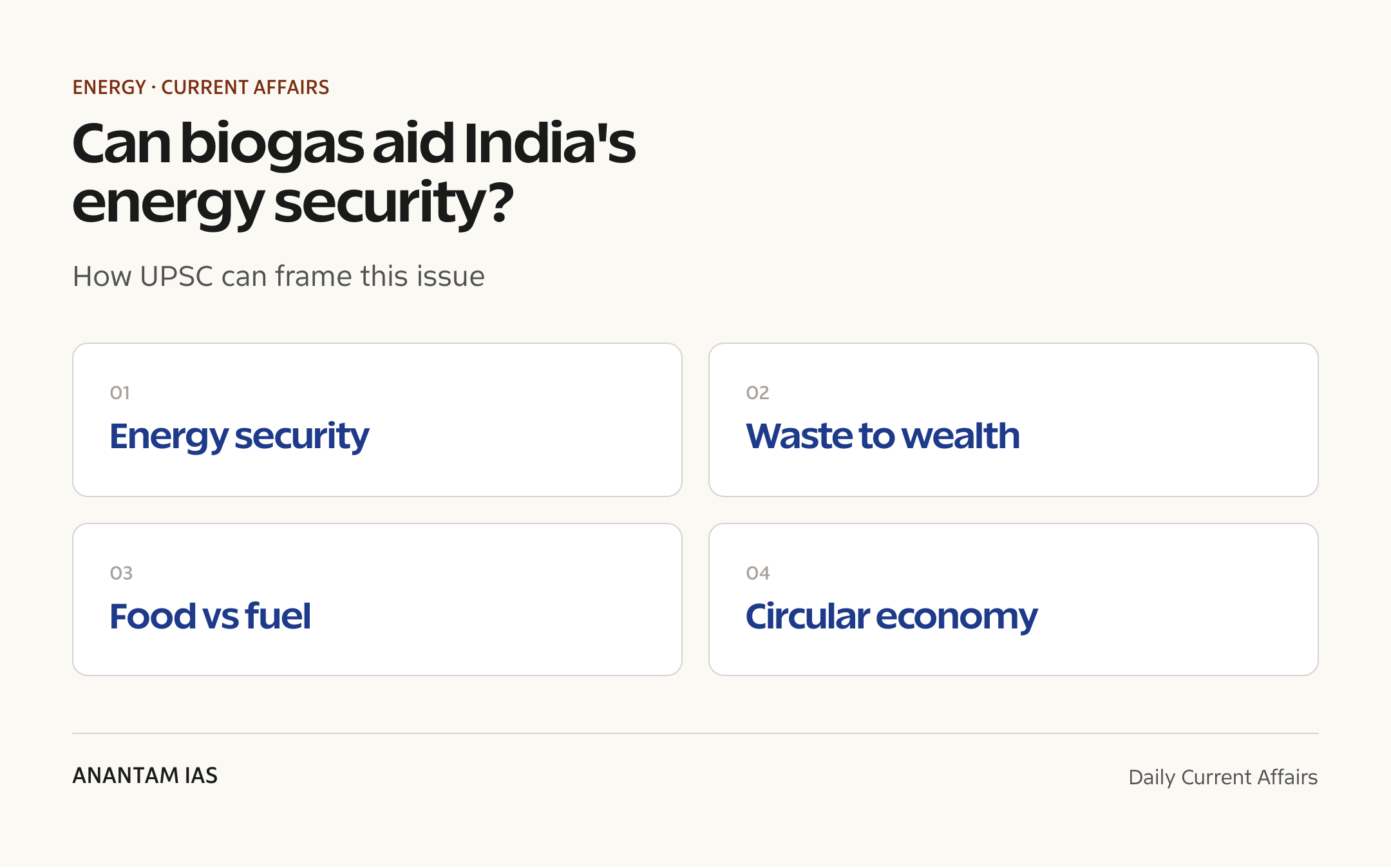
- Energy security and import substitution: can CBG and biofuels cut India’s crude and LPG import dependence?
- Waste-to-energy and the circular economy: converting agricultural residue and municipal waste into fuel and rural income
- Assess why SATAT has under-delivered (finance, infrastructure, off-take) and what policy corrections a blending mandate needs
- Food-versus-fuel trade-offs: feedstock choice, crop diversion and food security lessons from ethanol pricing
Essay
- Growth that does not cost the earth: fuel from waste and the circular economy
- When policy incentives distort the plate: food security in the age of biofuels
Background and Context
Why energy security frames the biogas debate
India’s exposure to imported fuel is the strategic backdrop to every clean-fuel push.
- India imports nearly 85% of its crude oil, much of it from West Asia, leaving the economy vulnerable to price and supply shocks
- About 90% of India’s LPG imports transit the Strait of Hormuz, a single chokepoint that regional conflict can disrupt
- Domestic, waste-based fuels like CBG promise import substitution while cutting the trade and current-account pressure that oil imports create
- The push also serves climate goals, since CBG is renewable and treated as near carbon-neutral when made from waste
What Compressed Biogas actually is
The chemistry explains why CBG can slot into existing gas infrastructure.
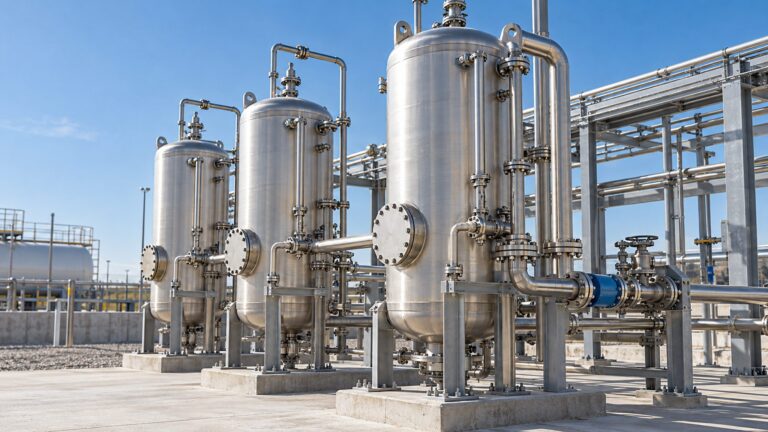
- Biogas is a mix of methane, carbon dioxide and trace gases produced by anaerobic digestion of organic matter (crop residue, cattle dung, food and municipal waste)
- Purifying and compressing biogas yields Compressed Biogas (CBG), which is chemically identical to CNG
- CBG can power vehicles, generate electricity, provide heating or serve as a cooking fuel, and can be injected into City Gas Distribution (CGD) piped networks
- Because it is made from waste, CBG doubles as a waste-management and circular-economy tool, not only an energy source
- Feedstock is diverse and largely low-value: press mud from sugar mills, paddy straw and other crop residue, cattle dung, food waste and the organic fraction of municipal solid waste (MSW)
- Digestion also yields Fermented Organic Manure (FOM) as a co-product, which can substitute chemical fertiliser and improve soil health, adding a second revenue stream for plant operators
- Using crop residue like paddy straw for CBG offers an alternative to stubble burning, linking the fuel to the North India air-pollution problem
SATAT and GOBARdhan: the policy scaffolding
India has layered several schemes to seed a CBG ecosystem.
- SATAT (Sustainable Alternative Towards Affordable Transportation), launched in 2018, targeted 5,000 CBG plants by 2023
- As of June 3, 2026, only 132 plants were completed, a fraction of the target
- GOBARdhan (Galvanising Organic Bio-Agro Resources Dhan) is a ‘waste to wealth’ programme offering grants of up to Rs 50 lakh per district for community biogas plants
- The Centre earmarked Rs 564 crore for biomass collection machinery and Rs 994 crore to build pipelines linking biogas plants to the gas grid
- Under SATAT, oil marketing companies act as the anchor buyers, offering off-take assurance so that producers have a guaranteed market for their CBG
- GOBARdhan operates a unified registration portal that registers biogas and CBG plants across the country, meant to ease monitoring, credit and investment tracking
- CBG also sits within the National Bioenergy Programme run by the Ministry of New and Renewable Energy (MNRE), which supports biogas, biomass and waste-to-energy plants through central financial assistance
Why scale-up has stalled
The gap between targets and completed plants points to structural bottlenecks.
- Weak infrastructure for feedstock collection and gas evacuation raises project risk
- Poor private investment and difficulty accessing formal credit starve projects of capital
- High upfront technology costs lengthen payback periods and deter developers, creating a viability-gap that grant support alone has not closed
- Uncertain and dispersed feedstock supply, plus the cost of aggregating crop residue and dung, makes plant economics fragile
- Gaps in City Gas Distribution pipeline connectivity mean many plants cannot easily inject or sell their gas, weakening off-take despite the SATAT assurance
- MNRE reported only 36 medium-size biogas plants installed under its Biogas Programme in the three years to August 2025, underscoring the slow pace
The blending mandate: learning from ethanol
A demand-side mandate is meant to guarantee off-take and pull in investment.
- In 2023 the National Biofuels Coordination Committee approved a mandatory CBG Blending Obligation (CBO)
- Gas distributors must blend CBG into supply from FY26, starting at 1% and rising to 5% by FY29 along a phased ramp
- The blending applies to CNG for transport and Piped Natural Gas for domestic use, as flagged by the Finance Minister in the 2024 Budget
- A demand-side mandate matters because it converts CBG from a subsidy-dependent product into one with assured, growing demand, which is what draws private capital
- The template is ethanol: petrol blending jumped from 1.5% (2014) to 20% by December 2025, five years ahead of the 2030 target, showing that a firm mandate plus assured procurement can move fast
The food-versus-fuel warning
Global and domestic evidence shows feedstock policy can distort farming.
- Germany’s Renewable Energy Sources Act (2000) sparked a biogas boom but also a ‘corn mania’, as maize displaced food crops until the government capped maize use
- The Economic Survey 2026 notes India’s maize cultivation has risen sharply, potentially hurting crop diversity and food security
- Administered ethanol prices favour maize-based ethanol (price CAGR of about 11.7% between FY22 and FY25), nudging farmers toward maize over pulses and oilseeds
- Denmark offers a cleaner model: targeting only biomethane in its gas system by 2030, it discourages food crops and relies on livestock manure and agricultural waste
Way Forward
Fix the finance and viability gap
- Provide upfront capital support, viability-gap funding and easier formal credit to de-risk CBG projects
- Offer accelerated depreciation and tax holidays to attract private developers
Build enabling infrastructure
- Complete grid-connectivity pipelines so plants have assured evacuation and off-take
- Strengthen feedstock aggregation and biomass collection logistics in rural clusters
Design feedstock policy to protect food security
- Prioritise waste and manure feedstock over food crops, following the Denmark approach
- Realign ethanol and CBG pricing so incentives do not divert land from pulses, oilseeds and millets
Use the mandate to build a market
- Enforce the CBG Blending Obligation transparently to guarantee demand and crowd in investment
- Replicate the ethanol programme’s monitoring and target discipline for CBG
Conclusion
Compressed biogas checks several boxes at once: it substitutes imported fuel, turns farm and municipal waste into value, and supports rural incomes while lowering emissions. With crude import dependence near 85% and LPG supply routes exposed, the strategic case for scaling CBG is strong.
The obstacle has never been the idea but the execution. SATAT’s 132 plants against a 5,000 target show that ambition without finance, infrastructure and off-take stalls. If the new blending mandate is enforced with the same discipline that took ethanol to 20%, and if feedstock policy avoids a food-versus-fuel trap, biogas can become a real, if partial, pillar of India’s energy security rather than a perpetual pilot.
UPSC Practice Questions
Prelims MCQ 1
With reference to Compressed Biogas (CBG) in India, consider the following statements:
- CBG is chemically identical to CNG and can be injected into the piped natural gas grid.
- The SATAT initiative was launched in 2018 with a target of 5,000 CBG plants by 2023.
- The CBG Blending Obligation makes it mandatory for gas distributors to blend CBG in their supply from FY26.
How many of the above statements are correct?
(a) Only one (b) Only two (c) All three (d) None
Answer: (c) All three
Explanation:
CBG is chemically identical to CNG and grid-injectable. SATAT (2018) set a 5,000-plant-by-2023 target. The CBG Blending Obligation, approved by the National Biofuels Coordination Committee in 2023, mandates blending from FY26, starting at 1% and rising to 5% by FY29. All three statements are correct.
Prelims MCQ 2
The GOBARdhan scheme, associated with biogas promotion, is best described as:
(a) A programme to convert organic and agricultural waste into biogas and organic manure under a ‘waste to wealth’ approach (b) A scheme to import liquefied natural gas through the Strait of Hormuz (c) A green hydrogen production mission under the Ministry of Power (d) A crude-oil strategic reserve programme
Answer: (a) A programme to convert organic and agricultural waste into biogas and organic manure under a 'waste to wealth' approach
Explanation:
GOBARdhan (Galvanising Organic Bio-Agro Resources Dhan) is a ‘waste to wealth’ programme that promotes converting cattle dung, agricultural residue and organic waste into biogas/CBG and organic manure, offering grants of up to Rs 50 lakh per district for community plants.
UPSC Mains Questions
- India imports nearly 85% of its crude oil, yet its Compressed Biogas programme has badly underperformed its targets. Examine the potential of CBG for India’s energy security and the structural reasons its scale-up has lagged. (GS3, 250 words)
- Biofuel promotion can strengthen energy security but risks distorting agriculture and food security. Discuss with reference to India’s ethanol and Compressed Biogas policies and the lessons from international experience. (GS3, 250 words)
Source: The Hindu.
Frequently Asked Questions
What is Compressed Biogas (CBG)?
CBG is biogas (mainly methane and CO2 from anaerobic digestion of organic waste) that has been purified and compressed. It is chemically identical to CNG, is renewable and near carbon-neutral, and can fuel vehicles, generate power or be injected into the piped gas grid.
What is the SATAT scheme and how has it performed?
SATAT (Sustainable Alternative Towards Affordable Transportation), launched in 2018, aimed to set up 5,000 CBG plants by 2023. Progress has been slow: only 132 plants were completed as of June 3, 2026, far short of the target.
How does CBG help India’s energy security?
India imports about 85% of its crude oil and roughly 90% of its LPG through the Strait of Hormuz. CBG is a domestic, waste-based fuel that can substitute some imported fuel, reduce the trade deficit and lower emissions while supporting rural incomes.
What is the CBG Blending Obligation?
Approved by the National Biofuels Coordination Committee in 2023, it mandates gas distributors to blend CBG into their supply from FY26. Blending starts at 1% and rises to 5% by FY29, applying to CNG for transport and Piped Natural Gas for domestic use.
What is the food-versus-fuel concern with biofuels?
Incentivising crop-based feedstock can pull land away from food crops. Germany’s biogas push triggered a ‘corn mania’, and the Economic Survey 2026 flags a maize surge in India as ethanol pricing favours maize over pulses and oilseeds, which could raise import dependence for food.
How is GOBARdhan different from SATAT?
SATAT focuses on procuring CBG for transport fuel through oil marketing companies. GOBARdhan is a broader ‘waste to wealth’ programme that promotes community and rural biogas plants, offering grants of up to Rs 50 lakh per district and converting organic waste into biogas and manure.
Tell Google you want more of this.
Add Anantam IAS as a preferred sourceOne tap, and this site shows up more often in your own Top Stories, AI Overviews and AI Mode. Remove it any time.