

Why in News?
The US military launched fresh strikes on Iran overnight into Monday, 13 July 2026, saying they were meant to degrade Tehran’s ability to attack commercial ships transiting the Strait of Hormuz. The Hindu reported this was the third round of American airstrikes in a week, set off by an Iranian strike on a container ship in the waterway.
Iran retaliated with missile and drone attacks on Gulf Arab states hosting US forces — Qatar, Kuwait, Jordan, the UAE and Oman — with Washington and Tehran midway through a 60-day interim deal meant to end the war. UN Secretary-General António Guterres warned of “catastrophic consequences” if full-scale hostilities resume.
- Three rounds of US airstrikes in a week hit missile and air-defence systems and Revolutionary Guard fast boats near Qeshm Island, Bandar Abbas and Hajiabad.
- Iranian retaliation reached across the Gulf: Qatar intercepted incoming missiles, a Kuwait Oil Company offshore platform was damaged, and three missiles struck Jordan.
- Oman summoned Iran’s ambassador — its first such protest since the war began — calling Iran’s actions “irresponsible”.
- Tehran insists it alone must control the strait and has floated charging vessels for transit — a direct challenge to freedom of navigation.
- Talks under the 60-day interim deal are near collapse at their halfway mark, with the strait’s status the biggest sticking point.
The development matters in the context of:
- Roughly a fifth of the world’s traded oil and LNG passes through this one channel — and there’s no sea alternative.
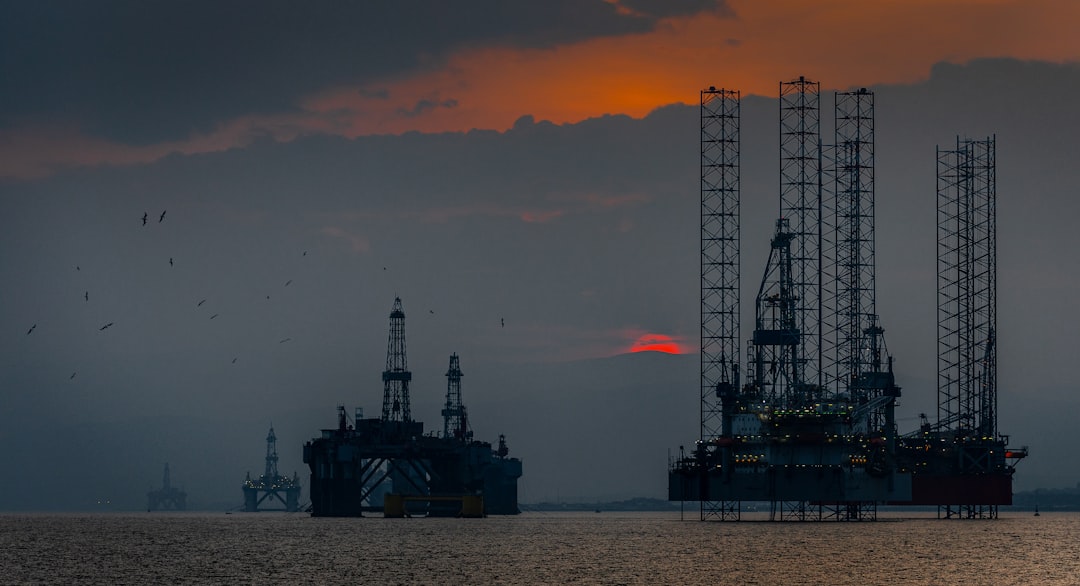
- For India, which imports about 88% of its crude oil, Hormuz is the single biggest physical chokepoint in the energy supply chain.
- The standoff stress-tests India’s West Asia balancing act: Gulf energy and diaspora ties, a stake in Iran’s Chabahar port, a growing US partnership.
UPSC Relevance
Prelims Relevance
- Strait of Hormuz: connects the Persian Gulf with the Gulf of Oman and the Arabian Sea; Iran to its north, Oman’s Musandam exclave to its south.
- Narrowest width about 21 nautical miles (39 km); shipping lanes only about 3 km wide each way under an IMO traffic separation scheme.
- Carries roughly 20 million barrels per day — about one-fifth of global oil consumption — and about a fifth of global LNG trade (US EIA estimates).
- Lies entirely within the territorial waters of Iran and Oman; passage is governed by the transit passage regime under Part III of UNCLOS.
- Partial bypasses: Saudi Arabia’s East–West (Petroline) pipeline (~5 million b/d) and the UAE’s Habshan–Fujairah pipeline. Qatar’s LNG has no bypass.
- ISPRL reserves: Visakhapatnam (1.33 MMT), Mangaluru (1.5 MMT), Padur (2.5 MMT); Phase II at Chandikhol (Odisha) and Padur.
- Operation Sankalp (2019): the Indian Navy’s escort operation in the Gulf of Oman after tanker attacks.
- Bandar Abbas hosts Iran’s main naval base; Qeshm is Iran’s largest island, just inside the channel.
Mains Relevance
GS Paper 3
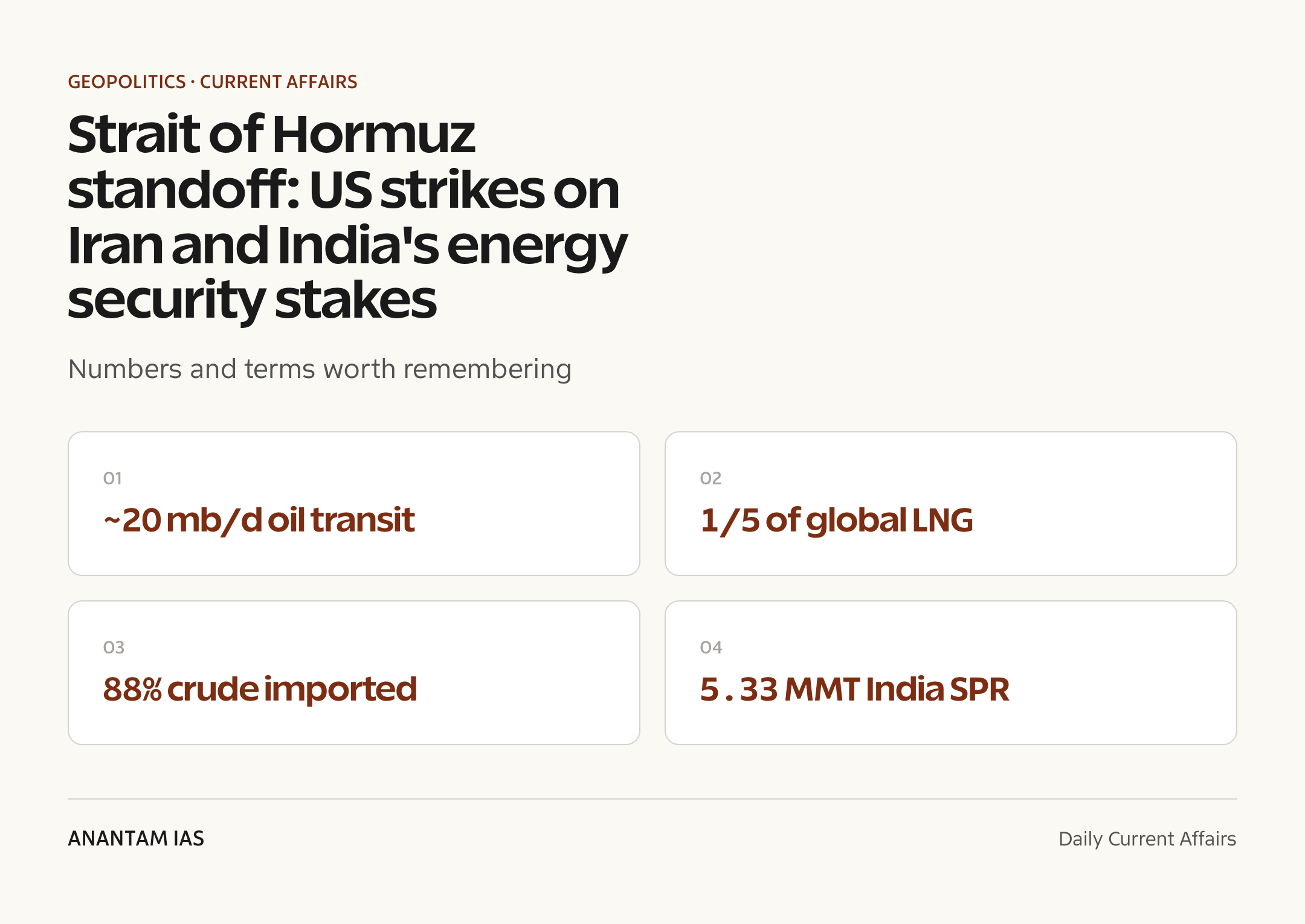
- Energy security as national security: import dependence, chokepoint concentration risk, strategic reserves and supplier diversification.
- Macroeconomic transmission of an oil shock — current account deficit, rupee, imported inflation, fertilizer and fuel subsidy burden.
GS Paper 2
- India’s West Asia policy under stress: balancing the US, the Gulf Arab states, Israel and Iran simultaneously.
- The ~9 million Indian diaspora in the Gulf and remittances as foreign-policy determinants; evacuation preparedness.
Essay
- Energy is the new geography: chokepoints, not borders, shape the destiny of importing nations.
- Strategic autonomy is tested in crises, not in peacetime.
Background and Context
The strait: geography of the world's most watched waterway
One narrow channel between Iran and Oman carries more traded energy than any other stretch of water on earth.
- The Strait of Hormuz is the only sea outlet from the Persian Gulf: exports from Kuwait, Qatar, Bahrain and southern Iraq — and most Saudi and UAE cargoes — must pass through it.
- About 21 nautical miles (39 km) wide at its narrowest, with usable shipping lanes of roughly 3 km each way under an IMO traffic separation scheme.
- US Energy Information Administration estimates: about 20 million barrels per day — near a fifth of global oil consumption — plus about a fifth of the world’s LNG, almost all from Qatar.
- It has never been fully closed, not even during the Tanker War (1984–88), when the US Navy escorted reflagged Kuwaiti tankers.
- Full geography in our explainers on the Strait of Hormuz and important straits of the world.
How the July 2026 escalation unfolded
A strike on one container ship has spiralled into a region-wide exchange of fire in under a week.
- After an Iranian strike on a container ship, the US hit back on Sunday and again overnight into Monday, 13 July — its third round of airstrikes in a week, The Hindu reported.
- A US official said the strikes targeted missile and air-defence systems and Revolutionary Guard boats; Iranian agencies reported a navy officer killed.
- Iran’s counter-strikes spanned the Gulf: interceptions over Qatar, damage to a Kuwait Oil Company platform, missiles in Jordan, explosions in the UAE, drones over Oman.
- Ships had begun routing off Oman’s coast to avoid Iranian waters; Tehran insists it alone should control the strait and could charge vessels for passage.
- The strait’s status is now the sticking point on which the 60-day interim deal — and the path out of the war — may collapse.
The legal battle beneath the military one
Under the shooting war runs an older dispute: who, if anyone, controls passage through the strait?
- The channel lies inside the territorial waters of Iran and Oman, so shipping depends on the transit passage regime of UNCLOS Part III: continuous, expeditious passage that bordering states cannot suspend.
- Iran signed but never ratified UNCLOS. It argues transit passage doesn’t bind it in favour of non-parties (the US hasn’t ratified either) and recognises only the suspendable innocent passage.
- Tehran’s demand to levy transit fees would overturn the principle that international straits stay open to all — a precedent reaching from Malacca to Bab-el-Mandeb.
- Oman — co-littoral state and traditional US–Iran mediator — summoning Iran’s ambassador shows how far the escalation has strained even Tehran’s most patient interlocutor.
India's exposure: counting the barrels
India is the world’s third-largest oil importer, and a large share of what it buys sails through this one channel.
- India imports about 88% of its crude and roughly 50% of its natural gas (PPAC); estimates during the June 2025 flare-up put about 2 million barrels a day — near 40% of crude imports — through Hormuz.
- Cargoes from Iraq, Saudi Arabia, the UAE and Kuwait all transit the strait; so does about half of India’s LNG. Petronet’s 7.5 MMTPA contract with QatarEnergy, running till 2048, has no alternative route.
- The cushion: Russia, India’s largest crude supplier since 2022–23, plus US and West African barrels arrive by routes that avoid Hormuz. But refinery configurations and pricing still tie Indian refiners to Gulf grades.
- India stopped importing Iranian crude in 2019 under US sanctions — background in our note on India–Iran relations.
What a disruption would do to the economy
Even a partial squeeze on the strait transmits into Indian inflation, the rupee and the fisc within weeks.
- Markets price the risk before any blockade: during the June 2025 Israel–Iran flare-up, Brent briefly rose past $80 a barrel on Hormuz fears.
- Widely used estimates: every US$10/barrel rise in crude widens India’s current account deficit by roughly 0.4% of GDP and adds about 0.3 percentage points to headline inflation.
- War-risk insurance and freight rates spike even when ships keep moving; costlier LNG and naphtha raise the fertilizer subsidy bill and squeeze petrochemicals, power and city gas.
- Beyond energy: close to 9 million Indians work in the Gulf, and India received about $129 billion in remittances in 2024 (World Bank) — a war endangers both.
India's buffers and playbook
India has built partial insurance against exactly this scenario — enough for a short crisis, not a long one.
- Strategic Petroleum Reserves (ISPRL) hold 5.33 MMT of crude — about 9.5 days of demand; with refiners’ stocks, total cover is around 74 days, against the IEA’s 90-day norm.
- Phase II caverns at Chandikhol (4 MMT) and Padur (2.5 MMT) are sanctioned but unbuilt — the crisis strengthens the case to accelerate them.
- The Indian Navy has run Operation Sankalp escorts in the Gulf of Oman since 2019; the IFC-IOR (Gurugram) tracks regional shipping, and India has naval-logistics access to Oman’s Duqm port.
- Evacuation muscle memory exists: Operation Sindhu (Iran–Israel war, 2025), Operation Kaveri (Sudan, 2023), Operation Ajay (Israel, 2023) and the 1990 Kuwait airlift.
The balancing act: Iran, the Gulf and Washington
Every escalation in the strait forces India to hold together relationships that are shooting at each other.
- India’s stake in Iran survives sanctions: the 10-year Chabahar agreement (2024) gives India Ports Global the Shahid Beheshti terminal — the gateway to Central Asia and the INSTC, all hostage to a wider war.
- On the other flank sit the India–UAE CEPA, I2U2 and IMEC, announced at the 2023 G20 in Delhi — a corridor whose viability assumes a stable West Asia.
- Washington expects alignment, Tehran expects neutrality, and the Gulf capitals under Iranian fire host India’s workers and supply its oil. India’s answer: issue-based alignment — de-escalation calls without naming sides.
- The doctrinal frame — strategic autonomy through multi-alignment — is examined in our note on India’s West Asia policy.
Way Forward
Diversify barrels and routes
- Deepen term contracts with non-Hormuz suppliers — Russia, the US, West Africa, Latin America — and widen refinery crude slates.
- Fast-track SPR Phase II and commercial stockpiling to lift total cover toward the 90-day IEA norm.
Harden the maritime shield
- Scale up Operation Sankalp escorts and mine-countermeasure readiness; deepen coordination with Gulf navies.
- Use IFC-IOR and Duqm access for persistent domain awareness — drones and small-boat swarms, not fleets, are the threat in the strait.
Cut structural oil dependence
- Press demand-side levers: the E20 ethanol milestone, electric mobility, the 500 GW non-fossil target and the National Green Hydrogen Mission all shrink the barrel-shaped hole in the balance of payments.
Diplomacy for de-escalation
- Back Oman- and UN-mediated channels; as the world’s third-largest oil buyer, India has standing to insist the strait stays open to all.
- Keep consular and evacuation plans for the Gulf diaspora current — the lesson of every West Asia crisis since 1990.
Conclusion
The Strait of Hormuz is where geography refuses to be negotiated with. A channel a few kilometres wide carries a fifth of the world’s oil, and India — importing nearly nine of every ten barrels it refines — feels every tremor in it as inflation, a weaker rupee and a bigger subsidy bill.
The July 2026 standoff shows India’s buffers are real but shallow: reserves counted in days, escorts in ships, and a diplomacy that must keep the US, the Gulf and Iran within talking distance. The durable levers — diversified suppliers, deeper reserves, less oil in the economy — need pulling before the crisis, not during it.
For the exam, Hormuz is the cleanest case study there is: a maritime chokepoint, a contested legal regime, an energy stress test and a balancing act, all in one strip of water.
UPSC Practice Questions
Prelims MCQ 1
With reference to the Strait of Hormuz, consider the following statements:
- It connects the Persian Gulf with the Gulf of Oman.
- Its designated shipping lanes pass through the territorial waters of Iran and Oman.
- Qatar’s LNG exports can reach world markets through an existing pipeline that bypasses the strait.
How many of the above statements are correct?
(a) Only one (b) Only two (c) All three (d) None
Answer: (b) Only two
Explanation:
Statements 1 and 2 are correct. Statement 3 is wrong — Qatar’s LNG has no bypass; only Saudi Arabia and the UAE have partial crude-oil bypass pipelines.
Prelims MCQ 2
Under the UN Convention on the Law of the Sea (UNCLOS), the ‘transit passage’ regime applicable to straits used for international navigation provides that:
(a) Coastal states may suspend passage temporarily on security grounds (b) Ships and aircraft enjoy continuous and expeditious passage that bordering states cannot suspend (c) Only merchant vessels, not warships, may pass without prior authorisation (d) Passage requires prior notification to all littoral states
Answer: (b) Ships and aircraft enjoy continuous and expeditious passage that bordering states cannot suspend
Explanation:
Transit passage under UNCLOS Part III covers ships and aircraft and cannot be suspended — unlike innocent passage. Iran signed but never ratified UNCLOS and contests transit passage for non-parties.
UPSC Mains Questions
- The Strait of Hormuz remains the single biggest physical vulnerability in India’s energy security. Examine the risks a prolonged disruption of the strait would pose to the Indian economy, and evaluate the adequacy of the buffers India has built against such a shock. (250 words)
- India’s West Asia policy is a balancing act between partners in conflict with one another. In the context of the US–Iran confrontation over the Strait of Hormuz, discuss how India can protect its energy, diaspora and connectivity interests while preserving strategic autonomy. (250 words)
Source: The Hindu.
Frequently Asked Questions
Why is the Strait of Hormuz in the news?
The US launched its third round of airstrikes on Iran in a week, saying it was protecting commercial ships transiting the strait after Iran struck a container ship. Iran retaliated against Gulf states hosting US forces, and talks under a 60-day interim deal to end the war are close to collapse.
How much oil passes through the Strait of Hormuz?
US Energy Information Administration estimates put transit at roughly 20 million barrels per day — about one-fifth of global petroleum liquids consumption — plus around a fifth of the world’s LNG trade, almost all from Qatar. It is the world’s most important energy chokepoint.
How dependent is India on the strait?
India imports about 88% of its crude oil, and roughly 40% of those imports — around 2 million barrels a day, from Iraq, Saudi Arabia, the UAE and Kuwait — transit Hormuz. About half of India’s LNG, including all Qatari cargoes under the long-term Petronet contract, also comes through it.
Can ships avoid the strait entirely?
Only partially. Saudi Arabia’s East–West (Petroline) pipeline can move about 5 million barrels a day to the Red Sea, and the UAE’s Habshan–Fujairah line carries crude past the strait. Qatar’s LNG has no bypass at all, so a closure would halt those exports completely.
What is India’s strategic petroleum reserve?
ISPRL stores 5.33 million tonnes of crude in rock caverns at Visakhapatnam, Mangaluru and Padur — roughly 9.5 days of national demand. With refiners’ commercial stocks, total cover is about 74 days, below the IEA’s 90-day norm. Phase II caverns at Chandikhol and Padur are sanctioned but unbuilt.
Has the strait ever been fully closed?
No. Even during the Tanker War of 1984–88, when Iran and Iraq attacked hundreds of merchant vessels and the US Navy escorted reflagged Kuwaiti tankers, traffic never stopped completely. Closing the strait would also choke Iran’s own oil exports — one reason threats have historically outnumbered attempts.
Tell Google you want more of this.
Add Anantam IAS as a preferred sourceOne tap, and this site shows up more often in your own Top Stories, AI Overviews and AI Mode. Remove it any time.






