Why in News?
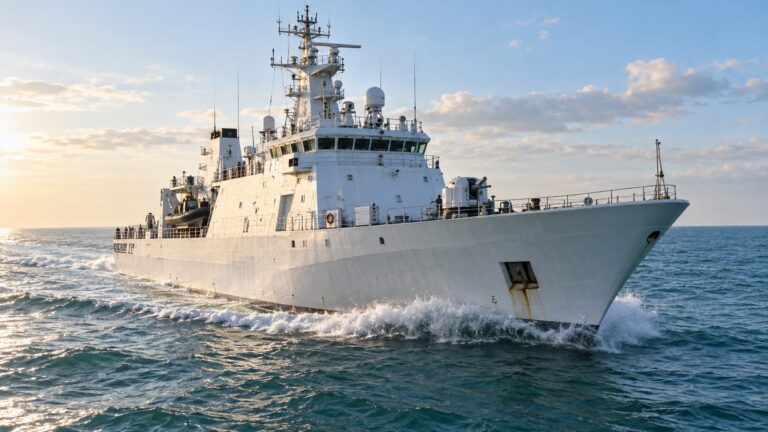
INS Trikand, a mission-deployed stealth frigate of the Indian Navy operating in the Gulf of Aden, responded to a piracy attempt on MV Golden Arsenal, a St. Vincent and the Grenadines-flagged bulk carrier, on 1 July 2026. PIB confirmed that the merchant vessel, transiting from Aden in Yemen, reported the attack roughly 300 nautical miles east-northeast of Djibouti.
The vessel’s 21 crew members, including one Indian national, took shelter in the ship’s citadel — a fortified safe room designed to protect sailors during a pirate boarding — and were reported safe. A boarding team from INS Trikand sanitised the vessel on 2 July, and a P-8I maritime patrol aircraft provided aerial surveillance. MV Golden Arsenal has since resumed her voyage.
- Piracy attempt on MV Golden Arsenal occurred on 1 July 2026, about 300 nautical miles east-northeast of Djibouti.
- The incident was reported in coordination with the Information Fusion Centre – Indian Ocean Region (IFC-IOR), leading to INS Trikand’s tasking.
- The ship carried 21 crew members, including one Indian national; the bridge superstructure was damaged but no injuries were reported.
- On 2 July 2026, an Indian Navy boarding team searched and sanitised the vessel; no suspicious personnel were found onboard.
- A P-8I long-range maritime patrol aircraft undertook aerial reconnaissance to support the response.
The development matters in the context of:
- The response showcases India’s mission-based deployments — warships stationed round-the-clock at Indian Ocean chokepoints as first responders.
- It reinforces India’s role as the net security provider in the Indian Ocean Region, protecting seafarers irrespective of nationality.
- The Gulf of Aden–Red Sea corridor has faced renewed shipping threats since late 2023, making naval presence a core element of economic security.
UPSC Relevance
Prelims Relevance
- INS Trikand (F51) — a Talwar-class (Project 1135.6) stealth frigate, commissioned in 2013; armed with BrahMos cruise missiles.
- MV Golden Arsenal — St. Vincent and the Grenadines-flagged bulk carrier attacked ~300 nm east-northeast of Djibouti.
- Citadel — a fortified compartment where merchant crews shelter during pirate attacks.
- IFC-IOR — Information Fusion Centre for the Indian Ocean Region, set up at Gurugram in December 2018.
- Maritime Anti-Piracy Act, 2022 — India’s first dedicated anti-piracy law; applies on the high seas beyond India’s Exclusive Economic Zone (EEZ).
- Operation Sankalp — Indian Navy’s Gulf-region maritime security operation, launched in June 2019.
- P-8I Poseidon — long-range maritime patrol and anti-submarine warfare aircraft of the Indian Navy.
- Bab-el-Mandeb — the chokepoint linking the Gulf of Aden with the Red Sea and the Suez route.
- SAGAR (2015) and MAHASAGAR (2025) — India’s maritime doctrines for security and growth in the Indian Ocean and beyond.
Mains Relevance
GS Paper 3
- Security of sea lanes of communication (SLOCs) as an extension of internal and economic security; role of mission-based deployments and maritime domain awareness.
- Legal-institutional response to piracy: the Maritime Anti-Piracy Act, 2022, IFC-IOR, and Navy-DG Shipping coordination.
- Linkages between organised crime at sea (piracy, smuggling) and instability in the Horn of Africa.
GS Paper 2
- India as a net security provider and first responder in the Indian Ocean Region — soft-power and diplomatic dividends of protecting foreign-flagged shipping.
- India’s maritime multilateralism: SAGAR to MAHASAGAR, cooperation with littoral states and international navies in the Gulf of Aden.
Essay
- The sea unites what the land divides — oceans as arteries of prosperity and arenas of insecurity.
- A nation’s power is measured not by what it conquers but by what it protects.
Background and Context
What Happened: The Incident at Sea
PIB’s account of the operation shows a textbook anti-piracy response — detection, interception, boarding, and sanitisation.
- On 1 July 2026, MV Golden Arsenal, transiting from Aden, Yemen, reported an attempted pirate attack about 300 nautical miles east-northeast of Djibouti.
- The report flowed through the IFC-IOR, after which INS Trikand, already mission-deployed in the Gulf of Aden, was directed to intercept.
- The vessel’s bridge superstructure and adjoining compartments were damaged; all 21 crew, including one Indian national, sheltered safely in the citadel.
- On 2 July, a boarding team from INS Trikand embarked the ship and found no suspicious personnel onboard after a thorough search.
- A P-8I maritime patrol aircraft flew surveillance sorties, enhancing maritime domain awareness over the area.
- With the threat neutralised, MV Golden Arsenal resumed her voyage — the Navy stressed its commitment to seafarers irrespective of nationality.
INS Trikand and the Talwar-Class Frigates
The platform behind the operation is a frontline guided-missile frigate that regularly features in prelims questions.
- INS Trikand (F51) is a Talwar-class stealth frigate (Russian Project 1135.6, a Krivak III derivative), commissioned into the Indian Navy in 2013.
- It was built at the Yantar Shipyard, Kaliningrad (Russia), as the third ship of the follow-on batch (INS Teg, INS Tarkash, INS Trikand).
- The class carries the BrahMos supersonic cruise missile, surface-to-air missiles, torpedoes and a multi-role helicopter, with radar-signature-reducing stealth features.
- Follow-on ships INS Tushil (2024) and INS Tamal (2025) extended the lineage; INS Tamal is expected to be India’s last imported warship as shipbuilding shifts to Indian yards.
- Frigates like Trikand are the workhorses of mission-based deployments — versatile enough for escort, boarding and surveillance duties in distant waters.
India's Anti-Piracy Record: Escorts to Operation Sankalp
The Gulf of Aden response rests on a decade and a half of institutionalised anti-piracy experience.
- The Indian Navy has maintained continuous anti-piracy escort patrols in the Gulf of Aden since October 2008, escorting thousands of merchant ships of all flags.
- Operation Sankalp, launched in June 2019 after tanker attacks in the Gulf of Oman, keeps Indian warships on station near the Strait of Hormuz.
- After the Red Sea crisis erupted in late 2023 — drone and missile attacks plus resurgent Somali piracy — the Navy surged multiple task groups across the Arabian Sea and Gulf of Aden.
- Landmark actions include the March 2024 recapture of MV Ruen by INS Kolkata, with 35 pirates brought to Mumbai for trial, and the January 2024 MV Lila Norfolk rescue after a citadel drill similar to Golden Arsenal’s.
- Mission-based deployments, adopted in 2017, station ships permanently at key chokepoints, cutting response time from days to hours — the reason Trikand could intercept swiftly.
Maritime Anti-Piracy Act, 2022: The Legal Backbone
Interdiction at sea is only half the job; prosecution needs a dedicated domestic law, which India acquired in 2022.
- The Maritime Anti-Piracy Act, 2022 is India’s first standalone law on piracy, giving effect to the piracy provisions of the UN Convention on the Law of the Sea (UNCLOS), 1982.
- It applies to offences committed on the high seas beyond India’s EEZ — that is, beyond 200 nautical miles — closing a jurisdictional gap that earlier forced prosecutors to stretch the Indian Penal Code.
- Piracy is punishable with imprisonment up to life; where the act of piracy causes or attempts to cause death, the punishment can extend to death or life imprisonment.
- The Act permits arrest and prosecution of pirates apprehended by the Indian Navy and Coast Guard anywhere on the high seas, with trials before designated Sessions Courts.
- The MV Ruen pirates became the first major batch prosecuted under the new law, signalling that India can complete the full arrest-to-trial chain.
IFC-IOR and Maritime Domain Awareness
The Golden Arsenal tasking began with an information-sharing hub, not a warship — a reminder that data is the first line of maritime defence.
- The Information Fusion Centre – Indian Ocean Region (IFC-IOR) was established in December 2018 at Gurugram, co-located with the Navy’s Information Management and Analysis Centre (IMAC).
- It tracks white shipping (commercial vessel traffic) across the Indian Ocean using data-sharing agreements and hosts International Liaison Officers from partner countries.
- In this incident, the piracy report was coordinated through IFC-IOR, which enabled the Navy to direct the nearest mission-deployed asset — a working demonstration of maritime domain awareness (MDA).
- MDA is reinforced by the P-8I fleet, coastal radar chains and satellite surveillance, knitting sensors and ships into one operational picture.
Why the Gulf of Aden Matters: Chokepoints and Trade
Geography explains why a piracy attempt 300 nautical miles from Djibouti is a concern for New Delhi.
- The Gulf of Aden connects the Arabian Sea to the Red Sea through the Bab-el-Mandeb strait, feeding the Suez Canal route that carries roughly 12 per cent of global trade.
- It is bounded by Yemen to the north and Somalia and Djibouti on the Horn of Africa — where state fragility and poverty incubate piracy networks.
- A large share of India’s crude oil imports and Europe-bound exports transits this corridor; disruption raises freight, insurance and energy costs.
- Thousands of Indian seafarers crew the world’s merchant fleet at any time, giving India a direct human stake in these waters.
- Multiple navies operate here — including the multinational Combined Task Force 151 — but India deploys independently, preserving strategic autonomy while sharing information.
Net Security Provider: From SAGAR to MAHASAGAR
Protecting a foreign-flagged ship with one Indian aboard is strategy, not charity — it operationalises India’s maritime doctrine.
- SAGAR (Security and Growth for All in the Region), articulated in 2015 at Mauritius, framed India as a partner for capacity-building and security across the Indian Ocean.
- In March 2025, this was elevated to MAHASAGAR (Mutual and Holistic Advancement for Security and Growth Across Regions), widening the canvas to the broader Global South.
- The net security provider concept means India supplies more security than it consumes — escorts for ships of all flags, disaster relief, hydrography and training for littoral navies.
- Each successful rescue builds India’s credibility amid expanding Chinese naval presence in the Indian Ocean, including its base at Djibouti.
- For revision, pair this note with the daily digests on current affairs and the compiled monthly current affairs PDFs.
Way Forward
Deepen maritime domain awareness
- Expand IFC-IOR partnerships, white-shipping agreements and liaison-officer postings so threats are flagged early.
- Invest in satellite tracking, unmanned vessels and long-range drones for persistent surveillance over piracy-prone waters.
Sustain presence and platforms
- Maintain mission-based deployments at chokepoints while accelerating indigenous frigate and destroyer construction.
- Institutionalise escort corridors and convoy schedules with the shipping industry during high-threat periods.
Attack the roots, not just the skiffs
- Support capacity-building in Horn of Africa littorals — coast guards, courts, coastal livelihoods — since piracy revives wherever governance recedes.
- Prosecute apprehended pirates consistently under the Maritime Anti-Piracy Act, 2022 to build deterrence beyond tactical interdiction.
Conclusion
The INS Trikand operation is a compact case study in how India’s maritime security architecture works: an information hub (IFC-IOR) detects, a mission-deployed frigate intercepts, air power (P-8I) surveils, and the Maritime Anti-Piracy Act, 2022 stands ready to prosecute — each layer the product of a decade of deliberate investment.
For the examination, anchor this news to the durable concepts — mission-based deployments, net security provider, SAGAR/MAHASAGAR, Gulf of Aden chokepoints — rather than the incident’s particulars. The particulars change every few months; the architecture endures.
UPSC Practice Questions
Prelims MCQ 1
With reference to the Indian Navy’s recent anti-piracy operation involving MV Golden Arsenal, consider the following statements:
- INS Trikand, which responded to the incident, is a Talwar-class stealth frigate.
- The piracy incident was reported in coordination with the Information Fusion Centre – Indian Ocean Region (IFC-IOR).
- MV Golden Arsenal is an Indian-flagged oil tanker.
How many of the above statements are correct?
(a) Only one (b) Only two (c) All three (d) None
Answer: (b) Only two
Explanation:
Statements 1 and 2 are correct: INS Trikand is a Talwar-class (Project 1135.6) frigate, and the attack report was coordinated through IFC-IOR, Gurugram. Statement 3 is incorrect — MV Golden Arsenal is a St. Vincent and the Grenadines-flagged bulk carrier, not an Indian-flagged tanker.
Prelims MCQ 2
The Maritime Anti-Piracy Act, 2022 applies to acts of piracy committed in which of the following maritime zones?
(a) Only within India’s territorial waters (b) Only within India’s Exclusive Economic Zone (c) On the high seas beyond India’s Exclusive Economic Zone (d) Only within 24 nautical miles of the Indian coast
Answer: (c) On the high seas beyond India's Exclusive Economic Zone
Explanation:
The Act gives effect to UNCLOS piracy provisions and applies to the high seas beyond India’s EEZ (beyond 200 nautical miles), enabling Indian courts to try pirates apprehended by the Navy or Coast Guard in international waters.
UPSC Mains Questions
- India describes itself as the ‘net security provider’ in the Indian Ocean Region. With reference to the Indian Navy’s anti-piracy operations in the Gulf of Aden, examine how this role advances India’s strategic and economic interests. (250 words)
- Maritime domain awareness, forward deployment and domestic legislation form the three pillars of India’s response to piracy. Analyse each pillar, citing IFC-IOR, mission-based deployments and the Maritime Anti-Piracy Act, 2022. (250 words)
Source: PIB, Indian Navy.
Frequently Asked Questions
What happened to MV Golden Arsenal?
MV Golden Arsenal, a St. Vincent and the Grenadines-flagged bulk carrier, reported an attempted pirate attack on 1 July 2026 about 300 nautical miles east-northeast of Djibouti. Its 21 crew, including one Indian national, sheltered safely in the citadel. INS Trikand intercepted, boarded and sanitised the vessel, which then resumed her voyage.
What class of warship is INS Trikand?
INS Trikand (F51) is a Talwar-class stealth frigate of the Indian Navy, built under Russia’s Project 1135.6 at the Yantar Shipyard, Kaliningrad, and commissioned in 2013. The class carries BrahMos supersonic cruise missiles, air-defence missiles, torpedoes and a multi-role helicopter, with stealth shaping to reduce radar signature.
What is a ship’s citadel?
A citadel is a fortified safe room inside a merchant ship, stocked with communications, water and supplies, where the crew locks itself in during a pirate boarding. It denies attackers hostages, buys time for naval forces to respond, and is a core recommendation of the shipping industry’s Best Management Practices.
What is the IFC-IOR?
The Information Fusion Centre – Indian Ocean Region, established at Gurugram in December 2018, is the Indian Navy’s hub for tracking commercial shipping and maritime threats across the Indian Ocean. It hosts International Liaison Officers from partner countries and coordinated the reporting that led to INS Trikand’s tasking in this incident.
What does the Maritime Anti-Piracy Act, 2022 do?
It is India’s first dedicated anti-piracy law, implementing UNCLOS provisions. It applies to piracy on the high seas beyond India’s EEZ, prescribes punishment up to life imprisonment — and death or life imprisonment where piracy causes death — and lets designated Sessions Courts try pirates apprehended by the Navy or Coast Guard.
Why does India patrol the Gulf of Aden?
The Gulf of Aden feeds the Bab-el-Mandeb strait and the Suez route, which carries a large share of India’s trade and energy imports. Indian escort patrols have run there since 2008 to protect merchant shipping and seafarers of all nationalities, reinforcing India’s role as the region’s net security provider.
Tell Google you want more of this.
Add Anantam IAS as a preferred sourceOne tap, and this site shows up more often in your own Top Stories, AI Overviews and AI Mode. Remove it any time.